Surface Plasmon Waves on noble metals at Optical
Wavelengths
Niladri Pratap Maity1 and Reshmi Maity2
1
Department of Electronics & Communication Engineering, Mizoram University (A Central University),
Aizawl - 796004, Mizoram, India.
2
Department of Electronics & Communication Engineering, Mizoram University (A Central University),
Aizawl - 796004, Mizoram, India.
Abstract
In this paper the variation of the propagation constant, the attenuation coefficient, penetration depth inside the metal and the dielectric has been evaluated. The propagation characteristics of Surface Plasmon Waves (SPWs) which exists on noble metals like gold (Au), silver (Ag) and aluminium (Al) due to the formation of Surface Plasmon Polaritons (SPPs), have been evaluated theoretically and simulated. It has been found that highly conducting metals Au and Ag provide a strong confinement to the SPWs than Al at optical frequencies. The comparative study reveals that metal having higher conductivity can support a more confined SPW, having a lower penetration depth than metals of lower conductivity at terahertz frequencies when its dielectric constant assumes a negative value.
Keywords: Attenuation coefficient, Penetration depth, Propagation constant, SPP, SPW
1.
Introduction
Recently, there has been a growing interest of SPPs which are a surface bounded electromagnetic waves coupled to electron density oscillations, guided along metal and dielectric interfaces [1]. SPPs results in the formation of electromagnetic waves which are completely confined to the interface with the fields decaying exponentially in the two media, known as Surface Electromagnetic Waves (SEW). In the current years several structures of SPPs have been widely studied [2]-[5]. When the metal is an ideal one it is known as Fano wave while when it is a real one, having some attenuation the SEW is better known as the SPW [6]. In the field of nano-photonics and biosensors metallic nanostructures, SPWs find wide applications as Resonance Sensing [7], Raman Spectroscopy [8], Enhanced Fluorescence and Absorption [9], Nonlinear Optics [10], Nanolithography [11]. They even find applications for on-chip switching and sensing with confinement below the diffraction limit for metal– dielectric–metal waveguides [12]. Au, Ag and Al are noble metals which show a negative dielectric constant at optical
frequency in the terahertz range. The propagation constant, the attenuation coefficient and penetration depth of the SPWs and these properties are extensively studied for the three metals and a comparison is made between them. Among the different metals studied Au is found to be the most superior metal as it has the least attenuation constant.
2. Single interface analyzation of SEW
A planar interface of a dielectric and metal with relative dielectric constants 1= n12 (x > 0) and 2 = n22 (x < 0) supporting confined propagation. The two media is assumed to be semi-infinite. The coordinate axes have been chosen so that the x axis is normal to the interface with x = 0 corresponding to the interface. The z axis is in the direction of propagation, and y axis lies in the interface plane (see Fig. 1). The electric field and the magnetic field equations are derived with the help of the coupled mode theory as follow [13]-[17].
Fig.1 Confined optical propagation at single interface.
media (q = 1, 2) in the y direction along the plane of interface. We have,
(1)
Where,
n1 and n2 are the refractive indices of the two medium,
Aq and Bq are the field amplitudes,
ω is the radial frequency in radians/sec,
β is the longitudinal propagation constant in per μm,
,
,
.
The fields have to decay exponentially hence the wave numbers in the two media kq has to be imaginary, kq = -j|kq| so, equation (1) becomes,
= (2)
The continuity of the tangential field components and Eqy at x = 0 gives
(3)
which cannot be satisfied since k1, k 2 > 0. Therefore, a single interface structure between that of a metal and dielectric cannot support TE confined wave propagation.
Similarly, for TM waves we have two magnetic field components Hqy for the two different media (q = 1, 2) in the y direction along the plane of interface.
(4)
Then the boundary conditions at x = 0 gives
(5)
which can be satisfied only if 1 , 2 have opposite signs since k1, k2 > 0.
Metals exhibit negative dielectric constants in the visible and infrared wavelength regions having frequencies in the terahertz region producing structures supporting such kind of confined propagation with their amplitude decaying exponentially with increasing distance from the boundary into the different media. We start with an ideal situation which is physically not realizable of the metal having a negative real and later take into consideration of the realistic situation where is of complex value. Such confined propagation supports the Fano waves. For the analysis following, we can assume a structure of with 1 > 0 and 2 = - |2 |.
From Maxwell’s equations the Fano field components for each region from equations (2) and (4), omitting exp
[j(wt-z)] are:
Region 1(x > 0)
(6)
(7)
(8)
Region 2 (x < 0)
(9)
(10)
(11)
The value of can now be found analytically,
(12)
(13)
(14)
SPWs represent realistic situations with non-ideal metals having a complex relative dielectric constant given by 2 =
2R - j2I with 2R = (- |2R |) and 2I > 0. Because 2 is now complex, hence the expression for will be complex of the form = R - jI with R, I > 0. The real part R is called propagation constant and the imaginary I is attenuation coefficient having their numerical value in the range of per µm.
(15)
(16)
with
Because of the new complex , the new | k1| and | k2| are also complex of the form |k1| = |k1R| - j |k1I| and |k2| = |k2R| -j |k2I| with |k1R|, |k1I|, |k2R|, |k2I| being the corresponding real and imaginary parts of |k1| and |k2| respectively. Again the penetration depths of the fields inside the two media are now evaluated through the real parts of |k1| and |k2| respectively.
The presence of the attenuation coefficient, represents a lossy wave that can propagate for a finite distance L along the z direction until its field intensity exp (-2I z) becomes e-1. Hence,
(17)
It is clearly shown from equation (16) that for long wavelengths since the losses of the metal is reduced, hence
I become smaller and the propagation distance having the value in the range of μm. However, there is a price to be paid for that and this is that the penetration depth inside the dielectric increases hence the field spreads more, resulting to a less intense field.
3. Results and Discussion
3.1 The Propagation Constant and the
Attenuation Coefficient
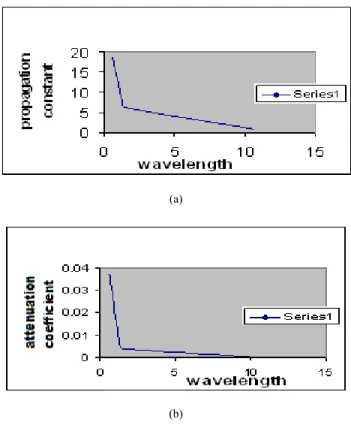
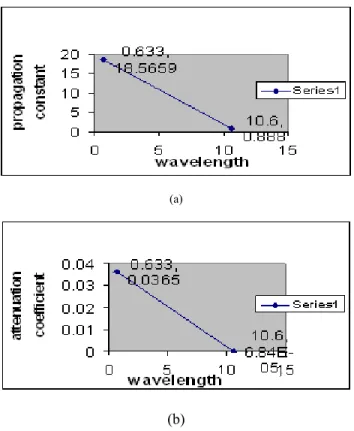
With the help of MATLAB programming the propagation constant and the attenuation coefficient is found out from equation (15) and (16) for the metal Au, Ag, Al at the different wavelengths. The graphical plots for the variation of the propagation constant and the attenuation coefficient with the wavelength are shown in Fig. 2, 3 and 4 for Au, Ag and Al respectively.
From the figures we find that the propagation constant and the attenuation coefficient of Au are of higher magnitudes at higher frequencies and decreases rapidly as the frequency is decreased. Hence we have confinement of the SPWs at higher frequencies which are found out to be of the range of terahertz frequencies. Moreover the propagation constant is of lower magnitude and the attenuation coefficient is of much higher value of Al than of Ag at the same frequency of operation, hence Ag will support a more confined propagation of than of Al. The attenuation coefficient increases because of a higher value of the imaginary part of the dielectric constant of Al at the terahertz frequencies than of Ag. Therefore Au which has the highest conductivity can support SPWs more than Ag and Al.
(a)
(b)
(a)
(b)
Fig. 3 Propagation Constant (a) and Attenuation Coefficient (b) of Ag.
(a)
(b)
Fig. 4 Propagation Constant (a) and Attenuation Coefficient (b) of Al.
3.2 Evaluation of the Penetration Depth
The value of penetration depth in equation (15) and (16) is evaluated for the different metals at various wavelengths and the graphical representation of the variation with wavelength is shown in the Fig. 5, 6 and 7 for Au, Ag and Al respectively.
From the figures it is found that the penetration depth inside the dielectric is nearly ten times more than the penetration depth inside the metal at the same frequency for Au. Since the penetration depth inside the metal is of very low magnitude hence most of the energy is confined to the surface which is essential for the propagation of the SPWs. For a three layer hetero-structure of gold– semiconductor–gold it is found that the optical gain of the core material can be made very high. The penetration depth increases with the decrease of frequency and it is maximum for Al and the least being for Ag. Increase in the penetration depth results in weak confinement of the surface plasmon waves at the surface.
(a)
(b)
(a)
(b)
Fig. 6 Penetration depth inside the dielectric (a) and metal (b) of Ag
(a)
(b)
Fig. 7 Penetration depth inside the dielectric (a) and metal (b) of Al
3.3 Evaluation of the Propagation Distance
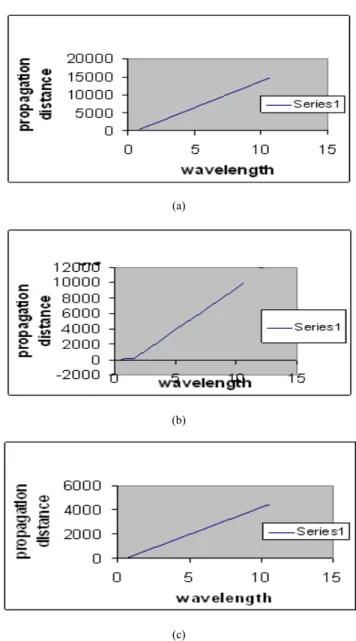
The value of the propagation distance is evaluated form equation (17) for the different metals at various wavelengths and is shown in the Fig. 8 for the metal Au, Ag and Al respectively.
(a)
(b)
(c)
Fig. 8 Propagation distance for Au (a), Ag (b) and Al (c)
The propagation distance for Au is 15000 µm, 10000 for Ag and only 5000 for Al at nearly the same frequency of operation. Hence much of the power of the SPW dissipates in the metal before it can travel a long distance.
4. Conclusions
inside the dielectric, the penetration depth inside the metal and the variation of the spot size with wavelength. Three metals, Au, Ag and Al have been considered. It is found that surface plasmon waves are highly localized since they can be excited at a single interface. This high localization of electric field is possible only at those frequencies when the dielectric constant of the metal becomes negative and it is found to be at optical frequencies. Among the different metals studied Au is found to be the most superior metal as it has the least attenuation constant. Hence as the conductivity of the metal increases the localization of the surface Plasmon waves increases. This high localization results in strong field intensity, the most important feature of surface plasmon waves.
References
[1] M. Ambati, D. Genov, R. Oulton and X. Zhang, “Active Plasmonics: Surface plasmon Interaction with Optical Emitters”, IEEE Journal of Selected Topics in Quantum Electronics, Vol. 14, No. 6, 2008, pp. 1395-1403.
[2] S. Tripathy, A. kumar, E. Marin and J-P. Meunier, “Highly sensitive Miniaturized Refractive Index Sensor Based on Au-Ag Surface Gratings on a Planner Optical Waveguide”, Journal of Lightwave Technology, Vol. 28, No. 17, 2010, pp. 2469-2475.
[3] G. Nemova and R. Kashyap, “Modelling of plasmon-polariton refractive-index hollow core sensors assisted by a fiber bragg grating”, Journal of Lightwave Technology, Vol. 24, No. 10, 2006, pp. 3789–3796.
[4] G. Nemova and R. Kashyap, “Theoretical model of a planar integrated refractive index sensor based on surface plasmon-polariton excitation”, Optical Communication, Vol. 275, 2007, pp. 76-82.
[5] S. Tripathy, A. kumar, E. Marin and J-P. Meunier, “Refractive index sensing characteristics of dual resonance long period gratings in bare and metal coated D-shaped fibers”, Applied Optics, Vol. 48, 2009, pp. G53-G58. [6] J. J. Burke and G. I. Stegeman, “Surface-polariton like
waves guided by thin, lossy metal films”, Physical Review B, Vol. 33, 1986, pp. 5186-5201.
[7] J. Homole, “Surface plasmon resonance sensors for detection of chemical and biological species”, Chemical Review, Vol. 108, No. 2, 2008, pp. 462-493.
[8] R. Gordon, “Surface Plasmon Nanophotonics: A Tutorial”, IEEE Nanotechnol Magazine, Vol. 12, 2008, pp. 12-18. [9] D. M. Schaadt, B. Feng and E. Yu, “Enhanced
Semiconductor optical absorption via surface plasmon excitation in metal nanoparticles”, Applied Physics Letter, Vol.86, No. 6, 2005, Art. no. 063106.
[10] J. A. H. van Nieuwstadt, M. Sandtke, R. H. Harmsen, F. B. Segerink, J. C. Prangsma, S. Enoch, and L. Kuipers, “Strong modification of the nonlinear optical response of metallic subwavelength hole arrays”, Phys. Review Letter, Vol. 97, No. 14, 2006, Art. no. 146102.
[11] N. Fang, H. Lee, C. Sun and X. Zhang, “Sub diffraction limited optical imaging with a silver super lens”, Science, Vol. 308, No. 5721, 2005, pp. 534-537.
[12] Stefan A. Maier, Gain-assisted propagation of electromagnetic energy in subwavelength surface plasmon polariton gap waveguides, Elsevier, vol. 258, No. 2, 2006. [13] M. J. adams, An Introduction to Optical Waveguides, John
Wiley & Sons, 1981.
[14] Yariv, Optical Electronics in Modern Communications, Oxford University Press, 1997.
[15] E. Anemogiannis and E. Glytsis, “Multilayer Waveguides: Efficient Numerical Analysis of General Structures”, Journal of Lightwave Technology, Vol. 10. No. 10, 1992, pp. 344-351.
[16] E. K. Sharma, M. P. Singh and P. C. Kendall, “Exact Multilayer Waveguide Design Including Absorbing on Metal Layers”, Electronics Letters, Vol. 27, No. 5, 1991, pp. 408-410.
[17] M. R. Ramadas, E. Garmire, A. Ghatak, K. Thyagarajan and M. R. Shenoy, “Analysis of absorbing and leaky planar waveguides: a novel method”, Optics Letters, Vol. 14, 1989, pp.376-378.
Niladri Pratap Maity received the M. Sc. Degree in Electronics from Sambalpur University and M. Tech. degree in Electronics Design & Technology from Tezpur University (A Central University, Govt. of India), India. He joined the Mizoram University (A Central University) as an Assistant Professor and Head of the Department of Electronics & Communication Engineering in 2007. He has good industrial experience in the field of VLSI design & Microelectronics. He is currently working with high-k dielectric materials, microelectronics and Electronics Materials. He is the author of more than 20 international journal/conference papers with one best paper award. He is the Life Member of Semiconductor Society of India (SSI), Indian Society of Technical Education (ISTE), Photonics Society of India (PSI) and Material Research Society of India (MRSI). He has got the Visiting Scientist Fellow Award from Department of Science & Technology (DST), Ministry of Science & Technology (MIT), Govt. of India in 2010. He has two ongoing major projects from Ministry of Human Resource & Development (MHRD) and MIT, Govt. of India.