Anterior Restorations in Bleached Teeth: Difficulty Establishing the Color after Bleaching CASE REPORT
Anterior Restorations in Bleached Teeth:
Difficulty Establishing the Color after Bleaching
Carolina Santezi, Mateus Rodrigues Tonetto, Cristina Dupim Presoto, Fernanda Ferreira Jassé Osmir Batista de Oliveira Júnior, Marcelo Ferrarezi de Andrade, Renato de Toledo Leonardo 10.5005/jp-journals-10024-1219
ABSTRACT
It is becoming more common for patients to look for cosmetic procedures in dental offices. The search for lost or desired esthetics by patients is increasingly frequent and the professional must be able to meet this demand. To do this, dentists not only need to return the tooth back to its normal functioning state but also promote esthetic excellence. In this context, the association of cosmetic procedures, such as teeth whitening and restorative procedures, such as direct adhesive restorations is very common. The composite resins employed nowadays allow the reproduction of various optical properties of natural teeth. With these composite resins, it is possible to reproduce features such as translucency, opacity and specific features of the dental element, to bring back the esthetic harmony of the smile. This article reports a clinical case demonstrating the placement, in a stratified manner, of composite resins in bleached teeth, as well as the reproduction of optical and natural aspects of the teeth. In order to achieve esthetic and functional success of the restored procedure, it is important to be familiar with the new techniques and new materials in the market and above all, we must know when and where to use them.
Keywords: Bleached teeth, Dental esthetics, Composite resin.
How to cite this article: Santezi C, Tonetto MR, Presoto CD, Jassé FF, de Oliveira OB Junior, de Andrade MF, de Toledo Leonardo R. Anterior Restorations in Bleached Teeth: Difficulty Establishing the Color after Bleaching. J Contemp Dent Pract 2012;13(5):735-739.
Source of support: Nil
Conflict of interest: None declared
INTRODUCTION
It has become increasingly common in the clinical practice to come across patients who are in search of cosmetic procedures, since the presence of an esthetically pleasing smile directly affects the individual’s social life. Therefore, it is extremely important that the professional is able to meet the demand of function and esthetics as desired by the patient.1,2
The emergence of adhesive materials to tooth structure allows the dentist with the opportunity to enjoy more conservative and esthetic dentistry. With the new technological advances in dental materials, it is now possible to reproduce the lost dentin and enamel as well as individual characteristics almost indiscernibly. The current composite resins offer different shades (color name), chroma (color intensity) and value (degree of brightness), allowing mimicked optical characteristics of natural teeth, such as fluorescence, opalescence and translucence, which is extremely relevant when it comes to restorations in anterior teeth.2-6
In bleached teeth, even those who wait for 15 days to achieve a stabilized color, the color choice becomes a difficult task, since the teeth are replaced with a higher value of lightness. Because of this a lot of professionals tend to make mistakes, with restorative procedures resulting in either gray (low value) or too white (high value).7,8
Nowadays, due to the strong demand for esthetic treatment, including tooth whitening, bleaching composite resins has become essential. There are multiple trademarks that have composite resins with specific colors for teeth that have undergone this esthetic procedure. Colors like B1, B0.5, and composite resins with high value have become common for professionals working in the field of esthetics. It is important to accentuate, however, that to mimic the real appearance of teeth, one must understand all factors associated with natural composite resin restorations. Thus, the professional must know how and where to use these materials and always obey the natural stratification.3-5
736
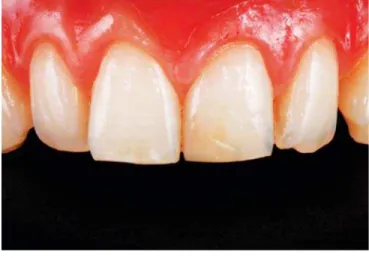
Patient 22-year-old, male, came to the clinic of Restorative Dentistry, Araraquara Dental School (UNESP) reporting dissatisfaction with the yellowing of the Class IV restoration involving the mesial surface of element 21 which became more evident after performing tooth whitening (Fig. 1). No changes in pulp and periodontal tissues were noted after a detailed clinical and radiographic examination.
First a prophylaxis was performed with pumice and water for later verification and matching the color according to the technique of stratification in layers, where colors of composite resins were selected for enamel and dentin (Fig. 1). For the dentin layer located in the middle and the making of mamelons the dentin shade A2 Z350 Filtek Supreme XT (3M–ESPE) was chosen. A body composite resin (A2 Body Z350 Filtek Supreme XT–3M ESPE), which has an intermediate opacity between those of enamel and dentin, was also used to mask the line of union enamel/ composite resin. For the enamel, the A1 and B1 colors were selected, both Z350 Filtek Supreme XT (3M–ESPE), where the first was used for reproduction of the palatine enamel or ‘palatine shell’ and the incisal third of the buccal. The second was used for production-specific characteristics of the patient’s teeth such as white spots in the proximal and incisal.
In order to assist in the construction of the palatine wall, a palatine guide was made of condensation silicone obtained from the diagnostic waxing (Fig. 2), and its adaptation was found in the upper jaw.
Absolute isolation was carried out on the upper front teeth and the previous substandard restoration was removed using a diamond cutting 1149 (KG Sorensen). A short bevel was performed (2135FF–KG Sorensen) in order to mask the bond line dental substrate/composite resin.
The phosphoric acid 37% (Villevie) was applied to the dentin and enamel for a duration of 15 to 30 seconds respectively. The surface was thoroughly washed with water for 30 seconds to remove the acid. The excess water was removed from the dentin with the aid of sterile paper points and then the enamel was dried with light blasts of air. A microbrush dampened with a 2% chlorhexidine solution was then applied to the dentin for 60 seconds. It has been shown that this procedure inhibits the metalloproteinases9 enzymes that can be activated during phosphoric acid etching10 and are able to degrade the hybrid layer over time.11-13 Thus, it is expected to increase the longevity of the composite resin restoration.
The next step was hybridizing the dental structure using a three-step total-etch adhesive system (Adper Scothbond Multi-purpose, 3M ESPE). The making of the palatal enamel was initiated with the aid of a condensation silicone guide.
XT (3M–ESPE) was placed in the palatine guide, which was held in position and photoactivated for 40 seconds (Fig. 3).
The dentin resin layer was inserted, in the color A2 D-Z350 Filtek Supreme XT (3M-ESPE). This mass of resin was then used to manufacture the dentinal mamelons. After this the body portion of the resin (A2 Body Z350-Filtek
Fig. 1: Initial photo
Fig. 2: Silicone wall
Anterior Restorations in Bleached Teeth: Difficulty Establishing the Color after Bleaching
Supreme XT-3M ESPE) was placed on the resin dentin and extended up to half of the bevel to mask the bond line dental substrate/restoration (Fig. 4).
Composite resins for characterization were also inserted, such as translucent composite resin (Z350 Filtek Supreme XT–3M ESPE) in the region between the dentinal mamelons. Small portions of resin B1 E Z350 Filtek Supreme XT (3M–ESPE) were placed in the incisal and proximal. The photoactivation was started and then the enamel shade was placed and photoactivated once (Figs 5 and 6).
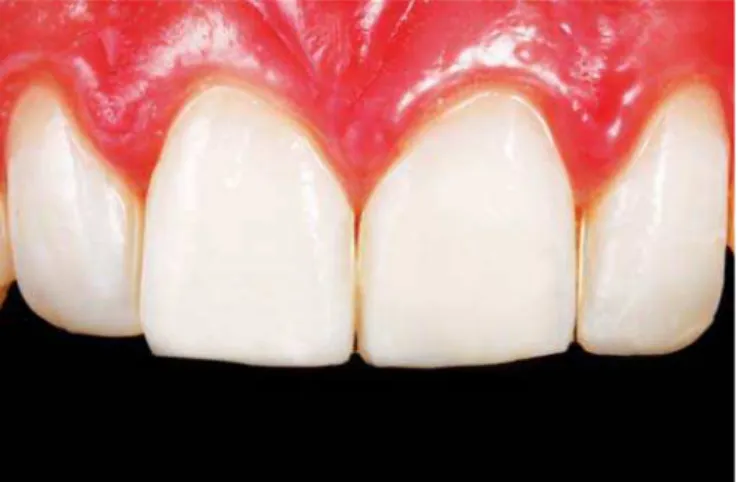
Finishing burs F and FF series (2135FF in the buccal region and 3118FF on the palatine face- KG Sorensen) were then used. After 1 week, the polishing was done with sanding disks Soflex Pop-On (3M-ESPE) to provide greater brightness and smoothness of the restoration and to leave it with a more natural appearance and prevent the adhesion of plaque (Figs 7 and 8).
DISCUSSION
Selecting the appropriate composite resin that simulates the physical and optical properties of enamel and dentin can
determine the success of an esthetic and functional restoration. The relationship between color and color contrast are optical characteristics and are important when choosing an appropriate restorative material.
The natural layering technique is undoubtedly the best way to optimize the use of these composite resins.14,15 This allows sequential construction of the palatal/lingual enamel, the body of dentin and the buccal enamel. It is also possible
Fig. 4: Insertion of dentin resin, body, incisal effect, opaque resin and characterization of white
Fig. 5: Profile after built and polymerization of buccal enamel
Fig. 6: Final aspect after esthetic restoration
Fig. 7: Profile after 1 week, before polishing
738
dental anatomy.
Bleached teeth have a higher luminosity, in other words, its value becomes greater, since it reflects more light than it absorbs. It is important to understand that composite resins (dentin resins, body resins and even resins used to mask stained teeth) have higher luminosity than more translucent composite resins. Such information is extremely important when it comes to restorative/esthetic treatment in whitened teeth.17
Nowadays, there are a range of compounds developed especially for use in bleaching. For example, L, XL, XXL (4-Seasons, Ivoclar Vivadent), SL, SSL (Durafil, Heraeus Kulzer), W, XL, WO, WE (Esthet-X, Dentsply- Caulk), XWE, XWB, XWD, WD, WB, WE (Filtek Supreme, 3M ESPE).
It is important to note that these resins are quite opaque and therefore a translucent layer is needed for covering this portion of the tooth in order to establish the natural restoration. The thickness of this resin’s layer on the bleached teeth will directly influence more or less plainness to the restoration. It is extremely important for this layer to be thin.
Due to the development of specific bleaching composites, within the same brand, these composites are expected to have higher luminosity and be more opaque than conventional resins. Surprisingly, few composites developed for bleached teeth have the same brightness as conventional resins.18
Tooth bleaching can result in a variety of tones often more luminous and or yellowish than the VITA Classical, which is the most widely used worldwide. Lest there be any confusion, personalized color scales should be used when choosing colors for bleached teeth restorations.7,8
FINAL CONSIDERATION
With the addition of technical improvements, the pursuit of knowledge, and the availability of resins it is in the dentists hands to ensure patient satisfaction and restore harmony to their smile.
REFERENCES
1. Baratieri LN. Estética: Restaurações adesivas diretas em dentes anteriores fraturados. São Paulo: Santos 1995.
2. Carrilho EVP, Paula A, Tomaz J. Terapêuticas estéticas integradas no âmbito da dentistaria operatória. Rev Port Estomatol Cir Maxilofac 2007 Jan-Mar;48(1):23-34.
3. Dietschi D. Free-hand composite resin restorations: A key to anterior aesthetics. Pract Periodontics Aesthet Dent 1995 Sep; 7(7):15-25.
4. Dietschi D. Free-hand bonding in the esthetic treatment of anterior teeth: Creating the illusion. J Esthet Restor Dent 1997 Jul; 9(4):156-64.
6. Tonetto MR, de Oliveira OB Jr, Campos EA, Saad JRC, Dantas AAR, Rastelli ANS, Porto Neto ST, Andrade MF. Fluorescence level of composites assessed by computer processing of digital images: Scan white. World J Dent 2012;3:141-44.
7. Kabbach W, Zezell DM, Bandéca MC, Andrade MF. The effect of power bleaching actived by several light sources on enamel microhardness. Laser Phys 2010 Jul;20(7):1654-58.
8. Silva Costa SX, Becker AB, de Souza Rastelli AN, de Castro Monteiro Loffredo L, de Andrade MF, Bagnato VS. Effect of four bleaching regimens on color changes and microhardness of dental nanofilled composite. Int J Dent 2009;31:38-45. 9. Gendron R, Grenier D, Sorsa T, Mayrand D. Inhibition of the
activities of matrix metalloproteinases 2, 8 and 9 by chlorhexidine. Clin Diagn Lab Immunol 1999 May;6(3):437-39. 10. Pashley DH, Tay FR, Yiu C, Hashimoto M, Breschi L, Carvalho RM, Ito S. Collagen degradation by host-derived enzymes during aging. J Dent Res 2004 Mar;83(3):216-21. 11. Carrilho MR, Tay FR, Donnelly AM, Agle KA, Tjaederhane L,
Mazzoni A, Breschi L, Foulger S, Pashley DH. Host-derived loss of dentin matrix stiffness associated with solubilization of collagen. J Biomed Mater Res B Appl Biomater 2009 Jul;90B(1): 373-80.
12. Birkedal-Hansen H. Matrix metalloproteinases. Adv Dent Res 1995 Nov;9(3 Suppl):16.
13. Ricci HA, Sanabe ME, de Souza Costa CA, Pashley DH, Hebling J. Chlorhexidine increases the longevity of in vivo resin-dentin bonds. Eur J Oral Sci 2010 Aug;118(4):411-16. 14. Mondelli J. Remodelação cosmética. In: Estética e cosmética
em clínica integrada restauradora. São Paulo: Quintessence 2003. 15. Walker R, Burgess J. Comparing resin-based composites.
Compend Contin Educ Dent 2004 Jun;25(6):424-28.
16. Hirata R, Ampressan RL, Liu J. Reconstrução de dentes anteriores com resinas compostas: uma seqüência de escolha e aplicação de resinas. JBC J Bras Clin Estet Odontol 2001 Jan-Feb;5(25):15-25.
17. da Costa J, Vargas M, Swift EJ Jr, Anderson E, Ritter S. Color and contrast ratio of resin composites for whitened teeth. J Dent 2009; 37 (Suppl 1):e27-33.
18. Kamishima N, Ikeda T, Sano H. Color and translucency of resin composites for layering techniques. Dent Mater J 2005 Sep; 24(3):428-32.
ABOUT THE AUTHORS
Carolina Santezi (Corresponding Author)
Master’s Student, Department of Restorative Dentistry UNESP, Araraquara (FOAr), São Paulo, Brazil, Humaitá St, 1680 CEP: 14801-903, Phone: 55 16 3307-1853/55 16 8114-3400 e-mail: [email protected]
Mateus Rodrigues Tonetto
Master’s Student, Department of Restorative Dentistry, UNESP Araraquara (FOAr), São Paulo, Brazil
Cristina Dupim Presoto
Anterior Restorations in Bleached Teeth: Difficulty Establishing the Color after Bleaching
Fernanda Ferreira Jassé
Doctoral Student, Department of Restorative Dentistry, UNESP Araraquara (FOAr), São Paulo, Brazil
Osmir Batista de Oliveira Júnior
Professor, Department of Restorative Dentistry, UNESP, Araraquara (FOAr), São Paulo, Brazil
Marcelo Ferrarezi de Andrade
Professor, Department of Restorative Dentistry, UNESP, Araraquara (FOAr), São Paulo, Brazil
Renato de Toledo Leonardo