FUNDAÇÃO GETULIO VARGAS
ESCOLA BRASILEIRA DE ADMINISTRAÇÃO PÚBLICA E DE EMPRESAS CENTRO DE FORMAÇÃO ACADÊMICA E PESQUISA
MASTER THESIS
MASTER IN INTERNATIONAL BUSINESS MANAGEMENT - MIM BY
Isabella Moreira Pereira de Vasconcellos
TITLE
FACTORS INFLUENCING SUPERMARKET STORE LOYALTY
1
CONTENTS
PAGE
SUMMARY/RESUMO...2
1. INTRODUCTION 1.1Theme...5
1.2Relevance of the Subject... 10
1.3Research Problem………..11
2 LITERATURE REVIEW 2.1 Program Perceived Value...17
2.2 Program Loyalty……...21
2.3 Store Perceived Value...26
2.4 Store Loyalty...33
3 RESEARCH DESIGN AND METHODOLY……….37
4. RESEARCH FINDINGS AND DISCUSSION ……….40
5. FINAL REMARKS 5.1 CONCLUSION...45
5.2 MANAGERIAL IMPLICATIONS………. 47
5.3 RESEARCH LIMITATION……….47
5.4 FURTHER RESEARCHES………..48
6. REFERENCES...50
7. ANNEX 7.1 QUESTIONNAIRE...56
2
SUMMARY
3
RESUMO
4
AGRADECIMENTOS
Agradeço ao meu marido Sérgio, meus filhos Felipe e Rafael pela paciência em
me ver estudando e consequentemente usando parte do nosso precioso tempo de
convívio.
Obrigada a Alda Rosana D. de Almeida que muito me auxiliou nessa
dissertação.
Agradeço também ao meu orientador Delane Botelho pelas valiosas críticas e
5
CHAPTER 1
INTRODUCTION
This thesis is organized as follows: Chapter 1 provides the research theme highlighting the relevance of the subject and introducing the research problem. Chapter 2 discusses literature review, Chapter 3 shows research design and method, Chapter 4 documents research findings and discussion, Chapter 5 presents final remarks, including main conclusions, theoretical and managerial implications, limitations, and suggestions for future research.
1.1 Theme
Customer Relationship Management (CRM) has become for many firms a solution to keep in touch with their customers in a profitable way.
CRM that can be also denominated a Loyalty Program can be defined as a marketing tool that combines different elements such as: program members and their demographic and purchase information, program currency to be traded for rewards and program loyalty to increase sales and profit. These set helps market-driven firms to deliver superior value to their customers, materialized by monetary or non-monetary benefits. Loyalty programs have become an important component of firms’ relationship management strategies, their marketing strategy and consumers have reacted positively to that. Liu &Yang (2009) state that
…”In the last years a proliferation of loyalty programs has occurred and that reflects a change in market environment with more intense competition, more demanding and knowledgeable consumers, and a development toward relationship marketing and customer relationship management in marketing thinking and practice. “
6 Many theories of Customer Relationship Management defend the idea that this marketing investment develops customer trust, commitment and gratitude and, in turn it leads to customer purchase intention, sales growth, and share of wallet (Palmatier et all, 2009). In fact, the perceptions of relative advantage are a crucial driver of program value. Customers have to invest a stream of efforts like time and money to earn future rewards. These efforts are typically extended over time while rewards are reached after a certain amount of effort or a particular requirement level has been attended.
A well designed Loyalty Program would affect the consumer’s choice in such a way that, on a given choice occasion, two competing companies, one offering extra points in the loyalty program and the other offering price reduction, the consumer would pick up the first one, adding more points to a future reward trade off ( Peine,2007).
There is a consideration to be done on Peine’s study: Liu &Yang (2009) have found out in their study that “ loyalty program has a positive impact only when the offering firm’s market share is relatively high, consistent with our notion that firms need complementary resources to derive competitive advantage from their loyalty programs.” That may be due to the fact that small market-share means smaller assortment in a supermarket, less locations available or less routes offered by airlines. In those cases, customers would have fewer chances to buy and consequently, be less loyal to the firm. On the other side, they concluded from the study that market saturation do not significantly reduce the effectiveness of loyalty programs.
Once the consumer perceives unfairness in the program it may bring negative consequences for a seller, like customers defecting to rivals. Firm cannot forget that consumers have their self-interest and want to maximize their own benefits. Thus, companies have a vital interest in creating marketing offers, that compared to other competitors are considered superior.
Leenheer and Bijmolt (2008) found that delayed rewards in a loyalty program have a significant impact on customer loyalty.
7 world Loyalty Programs. Although media may alter consumer’s preferences, the amount of Loyalty Program points awarded per purchase give him a measure of program attractiveness. Shi et al. (2006) have argued that consumers decide to participate in Loyalty Programs as a goal-directed activity. Consumers recognize their participation as a chance to obtain a desired outcome.
There are other remaining components of a Loyalty Program which are also capable of giving rise to perceptions of advantage relative to consumers.Klaus Peine (2007) has listed four factors that influence Loyalty Program evaluation:
• Brand attitude can drive consumer behavior (Keller 1993). The consumer develops in his mind brand beliefs and the judgment of those beliefs leading to a favorable or unfavorable attitude toward the brand.
• Satisfaction which is the discrepancy between expectations and perceived rewards of loyalty program. (fulfillment of needs and desires) (Tse and Wilton 1988).
• Loyalty intentions which is a precursor to customer’s commitment to re-purchase in a site, despite marketing efforts (Oliver 1999). Of course this behavior can be a
consequence of customer’s perceived value of the program.
• Positive word-of-mouth is one of the consequences from a company’s efforts to develop good relations with consumers. It represents customer satisfaction with the program and marketing offers (Brown et al. 2005).
8 complains. CRM is expected to contribute to existing or new relationships and facilitate the customization of the offerings to profitable customers to increase their loyalty, and it is also expected to reduce the transaction costs by adapting the interaction to the kind of answer expected by the client. That comes from the fact that firms can create value for its buyers that will exceed the firms’ cost of creating it (Desarbo e all, 2001). The managerial value of CRM can be described as customer relationship building programs based on Information Technology
To build a relationship program as a value and as a quality driver, customers’ expectations are considered as the referential to design appropriate interaction flows with customers. The interaction process is part of an internal and external supply chain of the firm that must be integrated and coordinated among all organizational, technological and human components of the CRM system for the effective relationship quality management and it
requires a cross-functional integration of processes, people, operations, and marketing capabilities (Dimitriadis and Stevens, 2008).
The customers’ psychological effect is taken into account. It may be seen as a status to be part of a certain group awarded for buying and patronage an outlet. Once the loyalty program supplies exclusive rights and benefits, which often provoke respect, consideration, or envy from others, it is a strong motivator to remain loyal to that program.
The Relationship Program enhances value to customers making them to become loyal to the store/brand, to purchase more and to advocate the firm to others. Hierarchical loyalty programs award elevated customer status (e.g., “elite membership”) to consumers who meet a predefined spending level (Tillmann et al, 2009). At the same time, the expected sequential effect of CRM (Minami and Dawson, 2008) is to bring financial benefits for the firm, through the increase of marketing productivity. Loyal customers can provide profitability either increasing sales volume consequence of customer retention or through the cost reduction across the whole management system.
9 integration of marketing ideas and newly available data, technologies and organizational forms. The private brand loyalty card came from this merge and is nowadays used as an important tool to make the link between firms and its customers.(Boulding et al, 2005).
The private brand card can have three versions:
(1) It can be a simple card that is used only to identify the customer at the sales moment and can help the company to feed a data base with consumer behavior and also offer those customers some benefits as special discounts or gifts.
(2) It can be a credit card which credit is totally managed by the retail company and cards can only be used in that specific store chain.
(3) It can be a co-branded card, using the retail brand and some credit card flag as Visa, MasterCard, Amex or any other. In this case, cards can be used in any place.
My primary interest in this research is to estimate the effect of the variables Program Perceived Value, Program Card Loyalty and Store Perceived Value on Store Loyalty. It is important to differentiate these three independent variables. Studies have showed that many firms have conquered the loyalty of their customers without a Loyalty program. That was due to the quality of service of their employees in the stores, the ambience, the assortment and other things that can be of high value to consumers. That leads to a strong relationship between Store Perceived Value and Store Loyalty.
On the other hand, the Program Perceived Value does not guarantee a Program Card Loyalty. Consumers may see a high value in a certain Program, but may end using another program due to other analysis. An example for that would be the loyalty program of two airlines: One of them may offer more advantages to the consumer, but he keeps using the other airline due to other characteristics like service on board, route options or even a better perception of brand image.
Consumers may also perceive value in a certain loyalty program, but is loyal to another store because it has a more convenient location. Demographic characteristics like age, marital status, gender and income level may affect consumers’ decision process.
10
1.2 Relevance
The modern loyalty era of loyalty programs began with frequent flyer incentives in 1981 when, on May 1, 1981 American Airlines launched the first full-scale loyalty marketing program of the modern era with the A Advantage frequent flyer program (Kotler,2005).This revolutionary program was the first to reward "frequent fliers" with reward miles that could be accumulated and later redeemed for free travel. Colloquy research based on a
fourth-quarter 2006 analysis of a dozen business sectors in United States showed that loyalty rewards program membership has reached US$ 1.3 billion. From 2000 to 2006, total loyalty program enrollments in the United States increased 35.5% to 1.5 billion (Ferguson and Hlavinka 2007). The study also revealed that the average US household belongs to 12 loyalty programs (Ferguson and Hlavinka, 2007).
In Brazil, according to ABECS (Associação Brasileira de Empresas de Cartão de Crédito e Services), in the last five years, as part of Loyalty Programs, a great number of private brand cards have been issued in the Brazilian retail industry. A total of 466 million plastic cards circulated in the Brazilian market in 2008, and out of this total, 156 million are private label cards issued by fashion boutiques, drugstores, supermarket and bookstore chains (Figueiras, 2008). The forecast for 2010 is a total of 628 thousands cards. Of this total, 225 thousands will be store private brand cards. The study says that 70% of the big retail companies already have their private label card. In the middle size segment, this percentage is 30%.
Considering only a few but huge cases, we can exemplify the partnerships created between Itaú Bank and Lojas Marisa in 2008 (Department store), Itaú Bank and Pão de Açucar in 2005 (Supermarket Chain) and Itaú Bank and Lojas Americanas in 2006 (Variety Store Chain).
Itaú Bank has invested R$ 120 million on the co-branded card project with Lojas Marisa. That allows Itaú Bank to manage the purchase amount of 140 million Marisa customers who generated sales of R$ 1,8 billion in 2007 in its 207 stores. The contract will last 10 years.
11 Other Banks are also emphasizing this business. HSBC has signed contract with Ricardo Eletro, Citylar and Epa Supermarket to issue and manage their private cards. Bradesco Bank has the same deal with Casas Bahia, Hering Stores and Leader Magazine.
Customer profitability must be considered assessing customer lifetime value, or the time he remains as a customer generating revenue and profit to the firm. The right selection of customers based on purchasing profile can provide higher profitability to the firm. All the CRM programs of those companies represent a cost line on their financial statement and the purpose of that cost is to shift the marketing paradigm from transactional marketing to relationship orientated marketing. But relationship building between companies and consumers has difficulties and limitations. Besides that, loyalty programs do not necessarily guarantee relationship and the database marketing may end in a collection of data and not necessarily useful information. Maybe emotional dimension of the consumer should be considered in the relationship building, especially in the analysis of Store Perceived Value and Program Perceived Value. A positive attitude does not guarantee consequent purchasing behavior and, frequency and recency of purchase does not build relationship. Considering that the switching cost for the customer may be low, it is important to consider that affective feelings may generate favorable attitudes and lead to commercial behavioral consequences in the long run. Distant and discrete business to consumer relationship should be avoided and social exchange should be promoted as the differentiation of a frequent-buyer program. A loyal relationship with customer can be considered an intangible asset but it can only be achieved through the customization of store offerings (and that can mean service and not necessarily product offering), improvement of consumption reliability and effective and constant management of relationship.
1.3 Research Problem
12 differentiated services and products. This combined effort aims to increase the perception of value customers can have of the stores and Loyalty Program and consequently, become loyal to the store. The objective of a Relationship Program is to influence customers’ attitude, increasing their perception of value.
13
CHAPTER 2
LITERATURE REVIEW
CRM has been defined in a number of ways, but it certainly has a twofold main definition:
• It is a collection and analysis of customer data for internal use and
• It is a builder of relationships with customers, for external role. Examining the impact of CRM strategy usage, it can have alternative roles:
• For those innovative companies CRM would be used to build strong differentiating customer relationships, communicating continuously with customers on an individual basis.
• Cost leaders, with a lesser focus on innovation, might use it as part of a more defensive customer retention strategy (Valos and Bednall, 2007).
Many loyalty programs have been developed by retail stores with the objective to retain customers in order to increase profitability of stable customers in the long-term. It became a key component of CRM, as an important tool to develop relationships and stimulate buying behavior of products and services.
Ruiz-Molina and Gil-Saura (2008) state that loyal customers increase the volume of sales of the company based on cross-selling. The investment on communication is lowered by word-of-mouth advertising. Customer loyalty also increases price inelasticity and advertisement of competitors become less effective.
14 To set up and maintain these programs it is necessary a considerable amount of money. The question is: Is it worth?
If the customer does not receive the promised reward or if the indicated benefit proves worthless to him, customer frustration may arise and that may not lead to customer loyalty and consequently consumption. (Stauss et al,2005),
In Loyalty Program is considered the concept of value to the customer and how he perceives value. According to Anderson and Narus (1998), a customer value model is based on the relationship between cost and benefit. Included in the cost is the price customer pays for the product but it is not all of its cost. In fact, the raising or lowering of the price, not necessarily changes the value for the customer, rather it changes the customer’s incentive to buy the product. Value has in its concept the perception of functionality, performance, the meaning of status, security and other feelings the product or service may bring to the customer.
Anderson (1998) says that market can offer a “naked” solution relating it to the basic product that can be sold by the lowest price. Market can also “wrap” this basic product, adding value to it, creating differentiation and gaining customers.
15 One of the deep changes occurred in society is related to family structure. According to Huddleston, Whipple and VanAuken (2004) “the typical family structure of one-parent-at-home and one-parent-at-work exists in only 7 per cent of US families, while dual-income families account for almost 50 per cent of US households. Thirty-one per cent of families are single-parent households.”
These changes in consumer’s life have also occurred in other countries like in Brazil where 31% of the householders are women according to IBGE statistics. Classes C and D with an income lower than one thousand dollars represent almost 80% of the population and it is the group with the largest population growth rates. As people have less time and money to spend on food purchase, as well as the amount of time they are willing to spend on food preparation and consumption, they look for convenient sites and for the best worth alternatives of shopping. Besides time, people may have become more concerned about heath food, ecological issues and the store social responsibility.
Each one has a different expectation and, because of that, will perceive value in different ways. That variance in expectation can be related to age, gender and previous experience. In Huddleston, Whipple and VanAuken (2004) research they observed that older people had already accumulated knowledge on a specific brand and their loyalty is higher. On the other side, younger people are at a stage in their lives that make them search for new consumer knowledge. The authors also consider that the valuation of a brand can also be related to the expected satisfaction of competing brands. To guarantee loyalty, firms have to focus on different attributes, the more relevant, to each customer.
16 (Meyer-Waarden, 2008) with respect to loyalty card possession causes disparities in individual purchase behavior. The development of an effective relationship with customers it may be necessary to identify and manage different customers’ clusters with different relationship stages.
A program perceived value must mean to the customer a barrier for churn* due to the switching cost. That would mean to him or her that in choosing another retailer, customer would lose value.
A good example of that is Pão de Açucar supermarket loyalty program. It offers an emotional annoyance. The reward is associated with a disproportionately high purchase volume.
In every R$ 3 thousand purchase volume the customer gets a R$ 20,00 bonus to be used in the store. That means a discount of 0,6%, or less than 1%. If that is supposed to be an
economical incentive, it can be easily achieved in some other supermarket which practices a discount policy on everyday purchase, aiming the same segment of customers.
To sustain customer relationship it is necessary two essential characteristics: trust and commitment. Once the supplier understands customer’s desire and is able to deliver superior value, it will make profit on its investment. The objective of the supermarket is to promote customers’ satisfaction, in order to generate future profit potential (Hauser,1994), since satisfied customers will buy more, more often, and will communicate their satisfaction to other potential customers.
As the perceived value can vary in time, it is relevant to consider Mazursky and Geva (1989) findings that, satisfaction and buying intention are highly correlated when measured in the same survey at time. A gap in time can also disrupt the correlation between intention and behavior. In this case the usual behavior of buying in a certain supermarket can be changed due to a temporary promotion announced by a competitor. In fact, customer satisfaction can be considered a multi-period issue (Hauser,1994) because a firm effort to promote customer satisfaction in today’s period can affect purchasing behavior in the future.
17
2.1 Program Perceived Value
According to Omar et al (2007), “Perceived value is a trade-off between the benefits
customers receive in relation to total cost which include the price paid plus other costs
associated with the purchase”. The other costs associated refer to the effort to purchase considering time spent, distance to get to the supermarket, convenience, security and other factors.
Customer satisfaction leads to perceived service quality and consequently service value. Perceived service quality is defined as the customer's assessment of the overall excellence or superiority of the service (ZeithamI 1988).
Bolton and Drew (1991) say that customers' assessments of service value are positively
related to their evaluations of service quality. The perceptions of performance exerts a direct influence on customer satisfaction and customers’ expectation will depend on customer tastes, customer characteristics, personal needs and word-of-mouth past experiences. The gap between expectations and perceptions leads to satisfaction or dissatisfaction.
The customers’ satisfaction can be related to a specific transaction or to a global evaluation of a service quality. The higher the level of satisfaction, the higher the chance to generate purchase intentions and behavior.
The objective of a Relationship Program is to influence customers’ attitude, increasing their perception of value. Many customer associated to loyalty programs aren't boosting marketing share as intended because most retailers adopt a one-size-fits-all approach. In fact, product discounts do not change the long-term buying behavior in shoppers who value things like personalized service, convenience or shopping pleasure more.Reward from a loyalty program may generate a feeling of obligatory response from the customer in the form of more business
18 value and store loyalty (H1) was found to be insignificant and not supported. The study was conducted from the economic and rational view, not considering multidimensional elements.
As the perception of value may change because of a longer experience with the brand or store, the economic value may not always be an important element for cardholders. They may evaluate value from the point of view of quality of service or store convenience, for example. On the other hand, Lin and Wang(2006) and Harris and Goode(2004), found a positive relationship between the variables.
Considering the services, rebates or some other kind of incentives to customers as a reward to their loyalty, the model is designed to measure the relationship between the Program Perceived Value by the customers and their Store Loyalty. The higher the level of satisfaction, the higher the chance to generate purchase intentions and behavior. This perceived cost-benefit relationship of the program becomes an important variable to the Store Loyalty.
H1: The program perceived value affects positively the Store Loyalty
Apparently, the research results indicate that program perceived value (H1) and program card loyalty are not significantly related to store loyalty. It found out that program loyalty is valuable to produce positive outcomes to cardholders such as satisfaction towards the program which indirectly link to store fidelity. There was not a straight relationship between these two variables and store loyalty.
The relationship between Program Perceived Value and Program Card Loyalty was tested and found strong by Omar at all (2007).
19 direct relationship between value perception and brand loyalty and immediate rewards are easy to be duplicated by competitors.
The results indicate that customer involvement may change the effects of the loyalty program on customer loyalty. This means that delayed rewards such as a mileage program can be justified in the high-involvement condition as long as they are linked with value-enhancing rewards. In the low-involvement condition, customers are looking for immediate rewards because that may be their incentive to patronage a store.
The relationship between program value perception and program loyalty was statistically significant for low-involvement as well as for the high-involvement condition.
In Research developed by Huddleston, Whipple and VanAukenl (2004) one of the characteristics indicated by shoppers to define the Perceived Value of their favorite stores was the existence of loyalty cards as a saving tool.
20 The perception of program value may be related to high levels of employee engagement because it plays an important role in contributing to an outstanding service performance and increased customer satisfaction and loyalty. When employees are highly engaged, it is expected that they will perform well with customers, therefore leading to favorable customers’evaluation. Customers may develop both emotional and rational bonds with a brand store and therefore their outlet choice is based on feelings of confidence, integrity and pride in a brand (Bowden, 2009).
According to Baird (2007) loyalty programs are at a crossroads. Although loyalty programs can be a very effective way of capturing customer data, some retailers are cutting back or eliminating their loyalty programs to save money. On the other side, other retailers enjoy highly loyal customers with no loyalty programs at all. So what makes a loyalty program effective in terms of putting the customer at the center of their businesses?
The attitude is the expression of a favorable or unfavorable perceived value. Customer’s perception is affected by the information and experiences the program delivers. Those can be economical benefits like discounts, mileage, or any other offer perceived as a benefit by customers.
Based on Loyalty Program data, it is possible to identify higher value customers at the front end of the sales process (Baird,2008), in order to give them a special and differentiated service to keep they loyal to the store. In many cases, most of the surveys only capture and
21 Many important clues cannot be obtained from purchase registers. Other channels may be necessary as the web site and call center. The frequency of communication may be taken by the customers as a sign of proximity and perceived value of the program.
But one rule has to be attended in order to make the customer perceive value in loyalty program: Retailers have to know who their customers are, develop and deliver the best offers to target customers. It makes no sense to have the right offer if they can’t get it into the right customer’s hands.
An effective Loyalty Program has to be structured in order to motivate customers to view purchases as a sequence of related decisions rather than as independent transactions (Omar and al, 2007). Due to that, awards offered to customers must be related to their loyalty to the
store, frequency of buying, total amount and must be related to the specific characteristics of those customers. The Perceived Value of the Program plays an important hole in the
determination of store loyalty and it must lead to building relationship among customer and store. Customers are expected to consider that purchasing in the same store brings them better benefits compared to other competitors1 points of sale.
2.2 Program Loyalty
Liu and Yang (2009) define loyalty programs
“as long-term-oriented programs that allow consumers to accumulate some form of program currency, which can be redeemed later for free rewards. The long-term are not promotional programs that offer only one-shot, immediate benefits, such as instant-win scratch cards and grocery stores’ discount card programs that create sudden changes in sales without producing sustained customer loyalty or revenue potential for a firm. . The loyalty programs are designed to create a future orientation and increase switching costs over the long run.”
22 In times of severe competition, a loyalty program, that is a marketing program, sometimes called a reward program, is usually introduced to build customer loyalty through the planned reward scheme based on profitable customers’ purchase history. It is seen as a way of product differentiation.
Loyalty programs have become key marketing activities for many companies (Meyer-Waarden, 2008). Loyalty programs have become an important component of firms’ relationship management strategies and many firms have installed loyalty programs as a core component of their marketing strategy. The program loyalty can be considered a consequence of a motivated customer who sees it as a win-win program and he is willing and motivated to make efforts to obtain a given reward against associated expenses. Because of that, he becomes loyal to the store. As it is costing to maintain a loyalty program, it is important to measure if it can be considered effective as a tool to develop Store Loyalty.
H2: The Program Loyalty affects positively the Store Loyalty
Concerning the rewards delivered for loyalty, the timing of reward can be classified into two categories: immediate rewards given for every visit and delayed rewards, given after a certain number of visits. The program frequently treats rewards as short-term promotional giveaways which do not lead to the development of loyalty. Delayed gratification is able to build exit barriers which might be a conflict of interest between the customer and the program sponsor.
The point-saving feature provides points that depend linearly on the amount customers spend. Customers also can earn points by buying certain promoted products or brands once they pass through the checkout counter and identify themselves as a loyalty program member. Depending on the Program, members must spend a considerable amount to reach the minimum redemption threshold to exchange points for gifts or they can receive immediate discount on each purchase.
23 program members and non-members demonstrate significantly different purchase behavior. Cardholders have significantly higher purchase intensities in terms of total and average shopping baskets, share of category purchases, purchase frequencies and inter-purchase times than do non-members. A loyalty program also enables a firm to differentiate itself from competitors and deliver superior value to its customers. Using the essential customer information captured from the loyalty program it is possible to develop a market-sensing capability and make offers suitable to each segment.
Yi and Jeon (2003) investigated how reward schemes of a loyalty program influence perceived value of the program and how value perception of the loyalty program affects customer loyalty. They observed that involvement moderates the effects of loyalty programs on customer loyalty. In high-involvement situations, direct rewards are preferable to indirect rewards. In low-involvement situations, immediate rewards are more effective in building a program’s value than delayed rewards. In any of those cases, loyalty program should not be treated like price promotion, but as a long-term perspective in shaping customer behavior. They found out that the path from Program Loyalty to Brand (Store) Loyalty (H2) was statistically significant for high involvement and for low-involvement.
To maximize customer retention rates many firms use relationship marketing instruments, loyalty programs and frequency reward programs. Loyalty card program can be defined as an integrated system of marketing actions that aims to make customers more loyal by developing personalized relationships with them. It has been found that the perception of program value by loyal customers take into account the processes employed in administering the reward program because they value interactions such as contact with the customer service center more than reward itself.
24 information recorded by loyalty cards and using the techniques of direct marketing and communication tools.
Besides encouraging cross and/or up-selling possibilities, loyalty programs also tend to develop psychological, sociological and relational drivers on customers’ attitude, enhancing customers’ trust, affective commitment and attachment to the organization. They tend to identify themselves more strongly with the company. Loyalty programs can induce feelings of group fit as preferred or special customer and pride for paying less due to the membership. It has been analyzed by Liu and Yang (2009) that as many program loyalty cards has been issued in market, competitive forces, market saturation and the relative size of the offering firm affect the performance of a loyalty program. Within the industry of loyalty programs competition has increased and today, industries like airline, financial services, retail, hotel, and credit card industry are competing among themselves, using their loyalty card program as a competitive tool. Collecting and analyzing customers’ data would allow companies to identify the attributes customers consider most important and target them with appropriate rewards offers, increasing the likelihood of retaining their patronage and capturing a greater share of consumer dollars overall.
Loyalty programs may have two possible effects on purchase behavior:
(1)Differentiation loyalty which means that loyalty decreases the degree of sensitivity customers have towards competing offers and make them buy bigger quantity or choose better quality products and/or more expensive brands.
(2)Purchase Loyalty which favors repeat purchase behavior and customer retention. Program members have to receive a reward, possibly as a result of store patronage and once re-patronage persists they have to be rewarded again. The purchaser must first perform the behavior, then receive the reward, and then repeat the behavior.
25 competitive in the market battle to win business. Another fact that can change loyalty programs results is the way retailers manage the program. If they adopt a one-size-fits-all approach instead of more individualized rewards, based on what they value, it will probably not give the expected return. Loyalty program require costly long-term investments, and the effectiveness of the program can avoid costly and useless actions. It is important to create a long-term loyalty program, creating long-term obligations for the customers in order to value for the firm.The loyalty programs must reward consumers’ current behavior at some point in the future and customers must be able to foreseen those benefits, otherwise they won’t value the program. The reward must come from accumulated required “points” related to the increase of their purchases. The customer must receive a reward at the end of period, and it needs to be proportional to his or her purchase level during that period.
Companies have been widely adopting Loyalty Programs. Kivetz and Simonson (2003) have said
“that consumers often evaluate Loyalty Programs on the basis of their individual effort to obtain the reward relative to the relevant reference effort ... When consumers believe they have an effort advantage over typical others … higher program requirements magnify this perception of advantage and can therefore increase the overall perceived value of the program.”
26 It is also important to consider that a successful CRM Program requires constant
communication with all participants, in order to develop a positive image of the store and influence customer’s attitudes and loyalty to the program.
Liu and Yang (2009) have identified three groups of joint forces that determine the eventual outcome of a loyalty program:
1-Program-Related Factors;
Program Design: Participation Requirements (Convenience and cost of participation),
Point issuance/ratio and effort requirement, Cash value, Variety of options, Brand–reward congruence and Reward form (cash versus free product).
Program Management: Utilization of consumer information and Organizational support. 2- Consumer-Related Factors;
Purchase Segmentation, Usage/patronage level and Perceived effort advantage
Consumer Traits: Demographics, Shopping orientation, Future orientation, Variety seeking and Price sensitivity.
3-Competition-Related Factors
Competition: Market position (e.g., market share), Product substitutability (within category), Category expandability (outside category) and Market fragmentation, Loyalty Programs saturation, differentiation and order of entry.
2.3 Store Perceived Value
“Perceived value is defined as the result of the comparison between perceived benefits and sacrifices by the customer” (Ruiz-Molina and Gil-Saura,2008). That perception can change according to the type of product and the characteristics of the purchase process. Different consumer behavior patterns can be expected. Some are more price-sensitive; others are more quality or convenience attracted. In fact, store perceived value has multidimensionality and many explanatory factors can measure and explain it.
27 value and customer attitude, which is an important determinant of customer loyalty (H3). Ruiz-Molina and Gil-Saura (2008) study conclude that store perceived value has a strong influence on both customer attitude and consequently store loyalty. The study considered four value components: Quality, Emotional, Price and Social in Grocery stores. Quality and Emotional component were the most relevant components for customers’ analysis of Store Perceived Value. The components Price and Social had lower correlation with customer attitude and store loyalty in the grocery store industry. It is possible to infer the importance to retailers to emphasize on physical and human resources to create a pleasant store atmosphere where the customer feels good and enjoys shopping in this establishment, contributing in this way to repeat patronage.
Retailers have invested in their private labels to develop consumer store loyalty, obtain higher retail margins and to negotiate leverage with national brand manufacturers. Store brands may help retailers to increase store traffic and customer loyalty by offering exclusive lines under labels not found in competing stores. Those results depend on how private label is positioned. If it is a saving tool to customers, they may be loyal to private label products in general, not to the private label of a particular retailer. Differentiation in private label is the main issue to conquer store loyalty (Ailawadi et all,2008).
Huddleston, Whipple and VanAukenl (2004) developed a research to ask shoppers to define the characteristics of the favorite stores and they found out the following ones:
1. Promotions.
2. Loyalty cards as a saving tool. 3. Low prices.
4. Convenience (Familiarity with the lay-out, One-stop shopping, Time poverty, Self-scan, Open 24 hours, Speed and Small size store).
5. Location (Proximity and en route)
6. Product (Store brand, Variety, Produce, Meat, Bulk purchases) 7. Atmosphere ( Aisle width, Cleanliness, Layout)
28 Promotion, convenience, location, product selection, environment and service were pointed as the predominant themes.
The customer’s perception of value is directly affected by the retail stores’ service provision and the execution of the service processes by their employees. The service provided by employees is argued to play an important role in consumers’ evaluations of service performance. Another important component in consumer’s perception of value is the congruence between store brand image and consumer’s own self- image.
The relationships between store service and perceived value are stronger for the high congruent self–store image customers. The compatibility between the store’s image (evidenced by the store’s service) and the consumer’s image has, in itself, been instrumental in providing perceived value (O’Cass and Debra,2008).
An important point to be considered is that some characteristics may have a negative impact on buying behavior if they do not exist (like cleanliness) because they are taken by the consumers as basic conditions to buy in a certain supermarket. But the value-added characteristics are the ones that push the customers to the store. Those are the ones that differentiate one store from the other. In Huddleston, Whipple and VanAukenl research, price was not determinant on the store perceived value.
Zentes et al (2007) state that retailer’s stores brand can be considered to be their ‘products’. It identifies the goods and services of a retailer and differentiates them from those of competitors. A brand has its own characteristics or traits and they can be translated into a personality like human personality.
29 can derivate partly from its functional qualities and partly from its psychological attributes like in luxury items.
Brakus et al (2009) had related the brand experience to store loyalty. The shopping and service experience includes not only utilitarian attributes but also hedonic dimensions, such as feelings and fun and can be affected by marketing communication. Brand connection can lead to involvement related to values, interests and needs. Their research describes the descriptions of sensations by consumers in stores like Wal-Mart, Home Depot and Starbucks. In those cases, consumer related the Store Perceived Value to the Brand Experience (sensory, affective, intellectual and behavioral) that has a behavioral impact and it affects consumer satisfaction and loyalty directly and indirectly through brand personality (ruggedness, sophistication, competence, excitement and sincerity). Brakus et al (2009) concluded that brand experience seems to be a strong predictor of buying behavior and store loyalty.
Depending on the perception of customer, the store perceived value can be strictly related to the physical aspects of the store like its ambience, assortment, layout, atmosphere, but, since other ways of shopping like shopping on internet or by phone, have been created in the last years, the store perceived value may also derivate from the evaluation of multi interface channels between customers and firms. In any of those touch points with customers, it is important to consider that satisfaction is the difference between perceptions and expectation. Depending on the characteristics of customers, they can expect different levels of time savings, financial returns, customization and social satisfaction.
Most have been said about the relationship between service quality and customer satisfaction. Their combination would lead to competitive advantages and customer loyalty. Iacobucci and Ostrom (1995) studied the possibility of distinction between service quality and satisfaction and identified some other variables that would be more strictly related to each one:
30
• Timeliness, Service Recovery and Physical Environment = more related to Customer Satisfaction.
Once again, the perception of quality may depend on customer demographic profile.
There are behavior differences between newly acquired customers versus repeat purchase, loyal customers. New customers display a number of unique characteristics that separate them from more experienced repeat purchase customers. They represent two segments of customers, who search for different attributes in consumption in order to meet their needs in terms of utility.
Concerning the assortment as an element which would affect store perceived value, Chernev and Hamilton (2009) address this issue by investigating how consumer choice among retailers, offering various-sized assortments, is influenced by the attractiveness of the options constituting these assortments. The data has showed that consumer preference for retailers who offer larger assortment, tends to decrease as the attractiveness of the options in their assortments decreases and can even lead to a reversal of preferences in favor of retailers offering smaller assortments. That is an important issue to retailers because this decision involves optimizing the benefits and costs of the assortment size for both buyers and sellers and also how assortment size influences buyers’ perceived value of a retailer. Recent research has shown that the benefits of greater variety are often offset by an increase in consumers’ cognitive costs associated with choosing from a larger assortment.
31 According to Payne and Frow (2004), there are other channels being used by companies to interact with their customers through multiple ways and they are certainly sources of interface and evaluation of store perceived value. Those multi-channels can include:
(1) sales force, including field account management, service, and personal representation; (2) outlets, including retail branches, stores;
(3) telephony, including traditional telephone, facsimile and call center contact;
(4) direct marketing, including direct mail, radio, and traditional television (but excluding e-commerce);
(5) e-commerce, including e-mail, the internet, and interactive digital television; and
(6) m-commerce, including mobile telephony, short message service and text messaging, wireless application protocol, and 3G mobile services.
Part of relationship management includes integration and coordination of these alternative distribution channels which work as customer touch points. The synergy among these channels and build mechanisms as common systems platforms and training programs, to avoid and resolve possible conflicts among these channels. For the customer, no matter which communication he uses, it is still the same company.
The experience of buying leads the customer through a process of learning by which experience leads to a change in knowledge, attitude and behavior. That process of learning arises from a consumer’s development of favorable or unfavorable attitudes toward a company and its products (Wu and Chen, 2000). In the situation where customer make the product choice by himself with no help of any employee, both service and merchandise quality exert significant influence on sales volume and customer satisfaction. Customers may change their buying behavior through learning and learning can affect the purchase behavior and the repurchase process creating store loyalty. Usually, the last purchase occasion will significantly affect whether a customer will make another purchase or not. The consumption experience and advertising exposure on consumer may also affect his behavior.
32 the possibility of finding or not substitutes. Considering that supermarket assortment is basically the same among competitors that attend the same target market, finding a substitute product is very easy for customers. Of course supermarkets can develop high-value products to differentiate themselves from competitors but they are more restricted than fashion retail industry. Innovativeness and perceived product newness can affect consumer’s perception of store value if they cause positive reactions and attractiveness, of the customers. That can lead to sales growth.
One of the tools to create store value is to work with differentiated private labels. Their quality level can be similar to leading producer brands and often have no price discount versus leading brands. In Brazil, supermarket Zona Sul has adopted that strategy creating a private label for its own meat. The supermarket has positioned that brand as a high quality and premium price brand. It works as a differentiation, giving the supermarket an image of the best meat in the town.
There are heterogeneous segments characterized by different trade-offs between price and perceived quality. Among the customers there is a segment of consumers which is sensitive to quality store brands and there is the price-sensitive segment that can be an instrument for retailers to generate store differentiation, store loyalty, and store profitability (Corstjens, 2000). The increase in private labels market share was caused not by the advertisement. In fact, retailers have the most important element in sales success: the point of sale. While the producers spend millions of dollars on advertisement, retailers use this investment that attracts people to the store, and sell their own private labels, usually with lower cost and higher margins. It is important to highlight that, to make a store brand successful, it is necessary to combine fair price and high quality.
33
H3: The Store Perceived Value affects positively the Store Loyalty.
2.4 Store Loyalty
Store Loyalty is usually measured by the firm-level sales, which, for many retailers, is the key driver in the establishment of loyalty programs (Baird 2007). But there is another group of retailers who believe that the return visit and consequently purchase frequency are top-line elements of customer loyalty. Researchers define Loyalty as repeated purchases of particular products or services during a certain period of time.
There is a set of variables used in market to measure Store Loyalty success: Higher customer purchase frequency, customer profitability, lower inter-purchase times, higher average transaction / basket size as a result of cross-selling (Meyer-Waarden,2006). Loyalty program impact on profit margin since the reward goal induces purchase acceleration.
Stores differ in loyalty program performance and that asymmetric performances across firms can be explained by different factors such as a program characteristics, market competition, industry on analysis and many other.
As it was previously mentioned, the quality store brands can increase store perceived value and it consequently increases store loyalty (Corstjens,2000), because, once the customer is used to those private brands it makes it more costly for consumers to switch stores.
34 Many American corporations include customer satisfaction or quality in their employee motivation systems. In fact, it works as a round process where, once customers are satisfied, employees themselves will also be satisfied and will work more effectively. Because of that, the satisfied customer will buy more, the firm will become more profitable, employees will remain employed and, perhaps, earn higher wages. That makes satisfied customers an asset of the firm. Some companies have already related employee compensation to customer
satisfaction or quality measures. (Hauser, 1994).
Total Quality, because of its focus on benchmarking customer and consumer satisfaction, is basically an insurance policy for sustaining competitive advantage over the long term. - Edwin Artzt, Chairman and CEO of Procter & Gamble (The Artzt quote is from Bemowski ,1992).
It is widely held that a firm customer-oriented is more likely to deliver exceptional service quality and create satisfied customers. The great difficult however is to disseminate this customer-oriented concept among employees throughout the firm. It is especially important in service firms where employees are at the frontline, responsible for the direct contact with the final customers. Some mechanisms are able to increase commitment of employees involved in that relationship with customers and Hartline (2000) denominates them “corridors of influence". This “corridors” are related to formalization, empowerment, behavior-based employee evaluation, and work group socialization. It is common sense that incenting employees on customer satisfaction is profitable.
Customers often base their impressions of the firm largely on the service received from customer contact employees. Employees at the frontline are the key tool to guarantee the customer a high quality Store Perceived Value. Of course there are other facts that contribute to customer’s perception as the firm’s structures and processes. All of them have to be well integrated in a customer-oriented firm (Hartline, 2000).
Huddleston, Whipple and VanAukenl (2004) research, some of the definitions of store loyalty given by many participants said:
35 3. Associated dollars spent or frequency of visits to a store.
Professors Lars Meyer-Waarden of the University of Toulouse III-Paul Sabatier in Toulouse, France, and Christophe Benavent of the University of Paris X-Nanterre identified five different purchase motivations in surveying shoppers in France from 2005 to 2007:
1. An economic motivation: the main goal is to save money;
2. A hedonistic motivation: the aim is to feel pleasure;
3. A routine-loyal/risk-avoiding motivation: the goal is to reduce the risk of being disappointed by a purchase by remaining loyal to a favorite brand or store;
4. A relational motivation: buyers seek to establish a relationship with a store or its staff and be recognized as a privileged client;
5. A functional motivation: the aim is to decrease the time and effort devoted to making purchases.
The weight of each of those characteristics may vary according to customers' ages, incomes, sex and other factors to draw general conclusions about what drives purchases. Or those younger customers who generally tend to be economical, discounts may be the best way to keep them loyal. For older clients with higher incomes who tend to be relational and routine-loyal consumers a touching relationship can be more effective. Women tend to be hedonistic while executive men, are generally more functional. As the motivations can vary, it is important to segment customers to offer different benefits and achieve store loyalty.
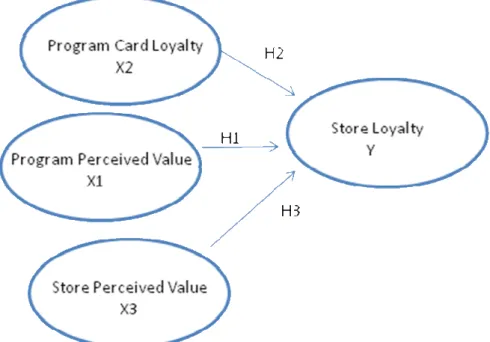
36 These four variables described above (Program Perceived Value, Program Loyalty, Store Perceived Value and Store Loyalty) were considered in the model framework.
Figure 1 shows the research framework among the constructs in a path diagram format.
37
CHAPTER 3
RESEARCH DESIGN AND METHODOLY
The purpose of this study is to identify the variables and at what level they influence Store Loyalty. The primary interest in this research is to estimate the reciprocal and potentially linear relationship betweenProgram Perceived Value (X1), Program Loyalty (X2) and Store Perceived Value (X3) on Store Loyalty (Y).
It was also done the factor analysis among the questions of each dependent variable to verify if they were reliable to represent the variable. The analysis tested the hypothesis that those three independent variables (X1, X2, and X3) are related to the independent variable which is the Store Loyalty (Y) as demonstrated in figure 1.
Linear Regression was used to test if the variables are correlated and how strong they are correlated. The mathematic equation described the estimated relationship among the variables.
The survey was carried out mainly in Rio de Janeiro, São Paulo and Ceará states in Brazil, all of them in the capital city, where there is a great offer of different supermarket stores. Most of the questionnaires (92%) were answered by residents in Rio de Janeiro.
The majority of the questionnaires were answered on Survey Gizmo site and some of them were sent by e-mail. All of them were self-administered.
38 The population used in this study was defined as consumers (over 18 years old), former or current students of undergraduate or graduate course and relatives and friends who are members of at least on supermarket retail store loyalty program.
The survey used a set of 24 questions but 14 were directly tied to the four constructs of study. The interval scale was anchored using a Likert Scale based on five response categories with the following end points: (1) which means “strongly disagree” and (5) for “strongly agree”. Before conducting the study, the author pre-tested the survey instrument twice by administering it to 5 people each time to verify the suitability of the terminology used as well as the clarity of the instructions and scales.
In order to test each hypothesis, a linear regression model was used. The construct validity was tested. In factor analysis was found a high correlation among the questions representing variable X1 (Program Perceived Value) and independent variable Y (Store Loyalty). This high correlation was not found among the questions representing variables X2 (Program Card Loyalty) and X3 (Store Perceived Value). To test the theoretical assertion that those three variables affect positively the Store Loyalty, it was used a regression modeling method based on 110 collected questionnaires. The reason is that sequential effects of constructs (path) had to be tested.
The level of significance considered in the model was 5%. All variables in this study were measured by multi item scales, and operationalized based on previous research, such as: The questions included in the questionnaire regarding Program Perceived Value (X1)
have been extracted and adapted from the scale proposed by Yi and Jeon (2003). Three questions were used from their questionnaires.
Program Card Loyalty (X2) was measured using Yi and Jeon (2003) and Zeitham and Berry (1996) scales and three questions were applied.
39 This scale is one of the rare attempts to offer an operative proposal of measurement of perceived value at the point of sale. It identifies three basic dimensions of value, that is, emotional value (affective feelings generated by a product), social value (the utility derived from the product’s ability to enhance the consumer’s social self-concept) and functional value, composed of the sub-dimensions of price (utility derived from the product due to the reduction of its perceived short-term and longer-term costs) and quality (referred to as product performance).
Store Loyalty (Y) was based on Yi and Jeon (2003) and Maria Eugenia Ruiz-Molina and Gil Saura (2008) scales.
CHART 1 – Source of Questions
Variables Question Indicators Author
PROGRAM PERCEIVED VALUE “The proposed rewards are what I have wanted.” YI and JEON (X1) 5
As recompensas do Programa de Fidelidade do supermercado que freqüento são aquelas que eu desejo.
“I have a strong preference for the proposed loyalty program.” YI and JEON 6 Eu tenho uma grande preferência por esse Programa de Fidelidade.
“I would inform or recommend the proposed loyalty program on other friends.” YI and JEON 8 Eu recomendaria a outras pessoas a participação nesse Programa de Fidelidade.
PROGRAM CARD LOYALTY I like the proposed loyalty program more so than any other (fried chicken or beauty shop)’s loyalty program.” YI and JEON (X2) 7
Eu prefiro esse Programa de Fidelidade a vários outros Programas de Fidelidade de supermercados que conheço.
Say positive things about the Loyalty Program to the other people
12 Eu diria coisas positivas sobre esse Programa a outras pessoas.
Pay a higher price than other retail stores charge for the benefits you currently receive from
9
Eu percorro uma distância maior para ir a esse supermercado pelo benefício que o Programa de Fidelidade me oferece.
STORE PERCEI VED VALUE En esta TIENDA los productos son buenos por el precio que valen MARIA EUGENIA RUIZ-MOLINA
(X3) 10 Neste supermercado que tenho o Cartão Fidelidade, os produtos são bons. 11 Neste supermercado que tenho o Cartão Fidelidade, considero os preços bons.
“I would recommend X shop to other friends.” YI and JEON 13 Eu recomendaria esse supermercado a outras pessoas.
Recomendaría esta TIENDA a otros MARIA EUGENIA RUIZ-MOLINA
16 Eu gosto de ir a esse supermercado
M e gusta usar esta TIENDA MARIA EUGENIA RUIZ-MOLINA
15 Considero esse supermercado o melhor para fazer compras.
Para mi esta TIENDA es la mejor TIENDA para comprar estos productos MARIA EUGENIA RUIZ-MOLINA
STORE LOYALTY 17 Quando penso em fazer compras de supermercado, este supermercado é a minha primeira opção. YI a nd JEON e Ma ri a Eugeni a Rui z-Mol i na (Y)
“I have a strong preference for X shop.” YI and JEON
“I like X shop more so than any other shop.” YI and JEON Cuando necesito hacer una compra de estos productos esta TIENDA es mi primera elección MARIA EUGENIA RUIZ-MOLINA 14 Eu me considero um cliente leal desse supermercado de onde tenho o cartão fidelidade.
M e considero un cliente leal de esta TIENDA MARIA EUGENIA RUIZ-MOLINA
18
Enquanto este supermercado continuar oferecendo os mesmos serviços que oferece hoje, duvido que eu mude para outro supermercado.
M ientras continúe el servicio actual, dudo que cambie de TIENDA MARIA EUGENIA RUIZ-MOLINA
40
CHAPTER 4
RESEARCH FINDINGS AND DISCUSSION
The ratio of man to women was 1,4 what suggests that women make up a larger percentage of purchases compared to men.
Approximately 70% of the sample is between 36 and 55 years old. And 63% has completed their undergraduate course. More than half of the sample (56%) is divorced and 72% has a monthly payment above R$ R$ 4.500,00.
Chart 2 - Main characteristics of the sample:
More than 2 years 79%
No 78%
3 to 4 times 32%
More than 4 times 41%
STATE
Rio de Janeiro 92%
GENDER
female 58%
MARITAL STATUS
Single 34%
Divorced 56%
YOUR AGE
26 a 35 anos 15%
36 a 45 anos 20%
46 a 55 anos 44%
EDUCATION DEGREE
graduated 63%
MOUTHLY PAYMENT
between R$ 2.251,00 /R$ 4.500,00 24% between R$ 4.501,00 /R$ 9.000,00 28%
above R$ 9.001,00 44%
HOW MANY TIMES A MONTH DO YOU GO TO THE SUPERMARKET?
FOR HOW LONG HAVE BEEN A MEMBER OF A SUPEMARKET
PRIVATE LABEL CARD? HAVE LOYALTY CARD OF OTHER
SUPERMARKETS?
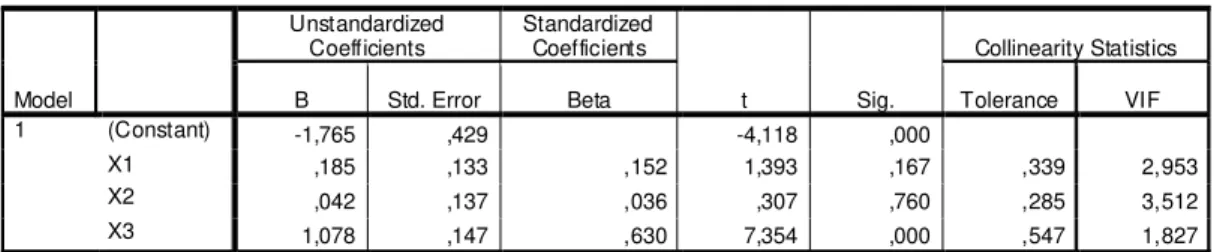
41 The level of significance considered in the model was 5%. At this level of significance X2 (Program Card Loyalty) was considered not significant to explain the independent variable Y (Store Loyalty) because it presented a p-value of 0,760. So, a new regression was made with variables Program Perceived Value (X1) and Store Perceived Value (X3), both considered significant for the model.
Table 1 - Coefficients
Coefficients(a)
Model
Unstandardized Coefficients
Standardized Coefficients
t Sig.
Collinearity Statistics B Std. Error Beta Tolerance VIF 1 (Constant) -1,765 ,429 -4,118 ,000
X1 ,185 ,133 ,152 1,393 ,167 ,339 2,953 X2 ,042 ,137 ,036 ,307 ,760 ,285 3,512 X3 1,078 ,147 ,630 7,354 ,000 ,547 1,827 a Dependent Variable: Y
Source: SPSS
The multicollinearity among the variables was tested and not found (VIF < 5).
42 Table 2 – Correlation among X1, X2, X3 and Y
Source: SPSS
The new p-value for the coefficients of X1 and X3 were respectively 0,027 and 0,000. Both lower than 5%. So, variables Program Perceived Value (X1) and Store Perceived Value (X3) were kept in the model. The model was found to be
Y = -1,801 + 0,213 X1 + 1,097 X3.
43 Table 3 - Coefficients
Coefficients(a)
Model
Unstandardized
Coefficients t Sig. Collinearity Statistics
B Std. Error Tolerance VIF
1 (Constant) -1,801 ,411 -4,386 ,000
X1 ,213 ,095 2,248 ,027 ,657 1,522
X3 1,097 ,133 8,231 ,000 ,657 1,522
a Dependent Variable: Y
Source: SPSS
The collinearity between the variables was not found (VIF ≤ 5).
ANOVA Test was made and it proved to have a linear relationship between, at least one, of the two remaining variables together and Y (Store Loyalty) (p-value < 1%).
The adjusted coefficient of determination was found to be 0,565, showing a relationship not so strong between the Program Perceived Value (X1) and Store perceived Value (X3) to Store Loyalty. What the model shows is that, only 56,5% of Y(Store Loyalty) can be explained by X1(Program Perceived Value) and X3(Store Perceived Value).
Influent Value (Cook's Distance) or any outlier (Standard Residual) were not found:
Table 4 – Residual Statistics
Residuals Statistics(a)
Minimum Maximum Mean Std. Deviation N Residual -2,23083 2,04203 ,00000 ,87673 110 Std. Residual -2,521 2,308 ,000 ,991 110 Stud. Residua l -2,572 2,340 ,002 1,005 110 Cook's Distance ,000 ,162 ,010 ,020 110 a Dependent Variable: Y
Source: SPSS
44 This kind of finding can lead to the speculation that the customers do not see value in the present Loyalty Programs offered by the supermarkets. That would mean that in the analyses of cost benefit, customers do not think it is worth to patronage a certain supermarket due to its loyalty program. In fact, the research suggests that the store perceived value, that is related to other characteristics, is a more relevant variable considered by customers on their buying decision making process.
Chart 3 – Hypothesis
45
CHAPTER 5
FINAL REMARKS
5.1 Conclusions
The research has showed that the Loyalty Programs in supermarkets are not working as an effective loyalty tool. Firms are spending money on it that may not be justified. The perception of store value is much more considered by customers when they decide to patronage the supermarket. That identification of value may be related to the ambience, product assortment or even the quality of service that is offered inside of the store or on any of the touch points with the customer (web, telephone, chats).
Further research would be necessary to identify the most relevant features a Loyalty Program must have in order to develop customer loyalty to the store.
Firms have tried to differentiate themselves from competitors, offering a loyalty program. But this program will only be effective if the firm is able to use it to generate business opportunities and develop tools to address the customer in a personal way, based on segmentation.
Demographic data and purchase profile shall be used to develop promotions and attractive bargains. The consequences would be an increase in average basket value and a higher customer frequency to the store.
The Program Card Loyalty proved to have no correlation with the Store Perceived Value, what makes sense in the real world. Many stores do not have a program card and are able to develop customer loyalty