A Work Project, presented as part of the requirements for the Award of a Master Degree in Management from the NOVA – School of Business and Economics.
Online Grocery shopping in Portugal: How store-based
businesses can adapt to win
Ana Rita Andrade Rosa, 2489
A Project carried out under the supervision of Professor José Crespo de Carvalho
Acknowledgements
I would like to thank my family for the support throughout my path as a student and for the patience on those days when I was not a ray of sunshine. Also, I cannot thank my friends enough for pushing me and reminding me to focus, while at the same time helping me clear my mind when I needed to.
I would like to thank my advisor José Crespo de Carvalho, not only for the availability shown in his busiest times, but also for the learnings he passed to me as a professor of the Global Supply Chain Management course, which I attended during my Masters’ studies at Nova.
Abstract
This paper examines the current state of online grocery shopping in Portugal, in order to help existing store-based grocers provide the best online offer that they can. Review on existing studies and an analysis of customer preferences in Portugal helped understand that Price and Convenience are the key factors to win in the online grocery channel. Given the early stage of adoption of this service, this means that retailers have improvement opportunities through which they can adapt their offers and increase sales, especially in what concerns order fulfilment.
Key Words: Online Shopping, FMCG, Grocery, E-commerce
1.Abstract
The abstract should be a miniature report in 100 words.
It should be brief and informative: 1! Why you did what you did (purpose) 2! How you did it (method)
3! What you found (main results) 4! What it means (key conclusions)
5! Self-contained, i.e. no referencing to the main text
Index
1. Introduction ... 5
2. Literature review ... 6
2.1. E-commerce and the need to go digital ... 6
2.2. Studies on FMCG and grocery e-commerce ... 7
2.3. The Last Mile issue ... 8
2.3.1. DC-based picking ... 9
2.3.2. In-store picking ... 9
2.4. Delivering a valuable online offer ... 10
3. Methodology ... 11
3.1. Overview of the Portuguese FMCG retail market in Portugal ... 12
3.1.1. Continente Online ... 13
3.1.2. @Jumbo ... 14
3.1.3. Intermarché ... 14
3.1.4. El Corte Inglés (SuperCor) ... 15
3.2. The Five C’s for each online player ... 16
3.3. Survey ... 18
3.3.1. Sample Characterization ... 18
3.3.2. Grocery Shopping Pattern ... 18
3.3.3. Perceptions of online grocery shopping ... 19
3.3.4. Online Grocery Shopping Experience ... 20
3.3.5. Pearson’s Correlation Coefficient analysis ... 21
3.4. Limitations ... 21
3.5. Main Findings ... 22
3.6. Recommendations ... 23
4. Conclusion ... 25
5. Bibliography ... 26
1.
!
Introduction
The emergence of e-commerce has posed a challenge to fast moving consumer goods (FMCG) companies worldwide. The European trend shows double digit growth for online shopping (acepi, 2015), hand in hand with internet and smartphone penetration. This represents equal potential value for the online grocery shopping segment, which is still a category that consumers seem more reluctant to buy solely at a virtual store. Those who have not yet come up with valuable online offers face the risk of following and losing market share to others that are able to find and attract the existing and potential markets. As an example, we have seen Amazon recently surpass Walmart as the leading retailer in market value, now that its Fresh foods segment is also a fierce competitor (Bloomberg, 2015).
Existing grocery store chains can still have a head start in the online channel in Portugal, as the adoption is low and no pure online player has captured a relevant share of the market. For them, it is about adapting and becoming hybrid. To date, no grocery store-based business has yet found the recipe to get big wins from e-commerce in Portugal, which might mean they have not found the right way to approach the channel.
The little depth and study existing for the case of Portugal is understandable, as it represents a small market with low penetration and low profits. The country is behind most other European nations when it comes to online grocery shopping. Even for global retailers that are winning in other markets, it can be difficult to replicate the online models in their entirety, given the variety of factors that change from country to country, such as geography, or buying culture of the people.
This work intends to shed light on the factors that are not allowing store-based grocers to fully win in the online grocery world in Portugal. In order to so, there is the objective of answering the following research questions:
2.! What are the key factors that encourage and discourage online grocery shopping? 3.! Should grocers focus on one fulfillments model or offer both home delivery and
pick-up?
Lastly, recommendations on how store-based businesses can improve their online models and conclusions will be derived from an analysis of customer preferences and online offers developed to date, complemented by existing research on the topic.
2.
!
Literature review
2.1. E-commerce and the need to go digital
Online grocers function within the online retail sector, as a form of e-commerce. From the many perspectives one can look at e-commerce, the business perspective suggests this is the possibility of “buying and selling products and information on the internet and other online services” (Kalakota et al, 1997). Some grocers have started their business solely through the internet, such as Good After, while others added e-commerce to their existing physical stores, the latter being the object of study. Specifically, online grocers fit in the merchant model, meaning the typical store-selling model is transferred to the online platform (Bidgoli, 2002).
2.2. Studies on FMCG and grocery e-commerce
Even though consumers are becoming more digital, the timing and characteristics for the success of online grocery shopping can vary across countries and cultures. There are studies that provide a global overview and compare several regions and countries. Nielsen’s (2015) recent research on grocery and e-commerce shows that Europe seems to be comparable to North America or Latin America in terms of current use and future willingness to buy groceries online, but it still lags behind all the remaining regions. Furthermore, the European average of internet penetration result was 76%, and Portugal still falls below that value, with 65%.
Because of the constraint of delivery times and the urgency in receiving some items, physical stores remain as the first option for consumers. It that seems e-commerce will not surpass traditional commerce so soon, with 61% of the people who answered Nielsen’s (2015) survey stating that going to the store was a positive experience. Instead, a balanced mixed model should be implemented, with first-movers taking a serious head start if they are successful. It is mentioned that companies should specialize and focus on the viable products in order to have successful sales, as well as to limit the delivery options, considering logistic costs and the market they are approaching (Nielsen, 2015).
customers are middle or upper class, spending more than average, and valuing brands in a stronger way in this platform. They are also more likely to switch less between products, as 55% buy the same shopping list, which can be saved in their online account. Furthermore, the online channel seems to favor categories of products that are non-perishable and are usually bought in bulk, such as diapers.
“The future of online grocery in Europe” (McKinsey & Company, 2013) mentioned the cannibalization that can happen from shifting from the offline to the online channel, as well as the lower margins. Even so, the online channel can be favorable for grocers, as they gain market share. The corresponding survey, which considers respondents from Spain, France and the United Kingdom, concludes that around 64% of customers switch retailers when they move to the online channel. When considering the Portuguese market, the introductory stage of online grocery shopping could be an explanatory factor, as not all players have gone online.
Finally, McKinsey’s report (2013) points out that a click-and-collect model is favorable for grocers in terms of profits, as consumers gladly incur in the Last Mile costs – they drive in order to pick up the order at a given location. However, preferences among European consumers suggest both delivery and pick-up options should be offered, to capture a relevant slice of the market.
2.3.The Last Mile issue
For the case of e-commerce, the Last Mile represents the costliest, despite being the shortest, last step of order fulfilment. The two most common fulfilment methods that businesses can choose are in-store picking and picking from a Distribution Center.
2.3.1. DC-based picking
In more advanced, higher-volume markets like France or the UK, there can be fulfillments centers specifically tailored towards online orders, as well as also dark stores, which combine the picking facilities without the buzz and complexity of an actual store with clients. The benefits of a DC picking method are reduced labor costs, lower picking errors, less out of stock (OOS) due to higher safety stock, while creating a shorter supply chain for perishable products, translating into a higher quality and more accurate order for the final customer. On the one hand, this means it is easier to manage and to respond to demand through centralization – a better perspective for long-term expansion, as volume increases. On the other hand, it requires larger initial fixed costs from companies, as they have to invest the capital to adapt their DCs for individual orders: more complexity means the DCs need more flexible picking structures, due to increased usage of cross-docking. (Klose et al, 2002). At the same time, businesses face the risk of extra transportation lead time to reach end customers’ homes, as distant increases. In Portugal, the majority of bricks and mortar have not taken this step of adapting their structural operational processes, perhaps so as not to risk damaging the successful offline businesses, as the online still represents a small share of sales.
2.3.2. In-store picking
fulfillment point, but they also feel closer to the customized process, which favors the after-sales service. From the company perspective, this also means lower transportation costs; simultaneously, it facilitates the reverse logistics process, for the case of order returns. However, this might be a double-edged sword, since in-store picking can increase errors and lower overall quality, as opposed to what was mentioned for the case of a DC-based method (Boyer et al, 2004).
At its early stage, the online platform tends to be characterized by rapid and unpredictable sales growth, which may cause existing businesses to eventually suffer with unsteady demand. “Despite the better forecast perspectives that arise from data interchange and future growth stabilization of online sales, the trend to reduce stores’ stock levels still gives less ability to cope with variability of orders, compared to a DC. Both on and offline customers may more often not find all the products they had in their list, and the overall experience might suffer. The out-of-stock problem is even more aggravated by the promotional context, which is particularly intense in the Portuguese market.
2.4. Delivering a valuable online offer
For the purpose of this work, the third C, community, will not be approached. This factor is thought to be more relevant when customers are not familiar with the products they are buying, which is mainly not the case for online grocery shopping. Besides, there are not yet considerable economies of scale in Portugal to generate valuable community-related content. The remaining Five C’s can help evaluate the current online offers of store-based businesses in the Portuguese market, given consumer preferences and its stage of adoption.
3.
!
Methodology
The methodology that is used seeks the validation of the proposed hypothesis, so as to understand how bricks and mortar in Portugal can more successfully obtain gains from e-commerce. For that matter, indirect and direct sources of information were considered. The indirect consists on research on the topic. The first direct source is quantitative, which was obtained through an online survey, and the second direct source is a qualitative one, consisting of an evaluation of the existing online offers to a small group of people.
All the learnings gathered from these two main sources of information are then applied so as to obtain the main findings, which then are used as a basis for recommendations. Overall, the main findings will add to the existing research and can help bricks and mortar in Portugal improve their current and future online models.
For this work, it was assumed that there is a standard value proposition, according to consumer market characteristics in Portugal, that online grocery shopping must offer. The strategic choices in accordance with their positioning are what differentiate them from others, and this is what matters the most when we have many players in the market. At this early stage of development of the Portuguese grocery shopping segment, it is only by successfully satisfying the basic market requirements that these businesses can bring added value to customers with such services.
market and its players, it was decided that the focus should be on finding the characteristics that can provide the best online offer in terms of online content and order fulfillment.
3.1. Overview of the Portuguese FMCG retail market in Portugal
Portugal’s grocery retail market is mainly dominated by the physical stores. Pure online players - GoodAfter, Atuadespensa or specialized stores like Myprotein – are succeeding in their segments, but they only represent a fragment of the market. Thus, right now, working more as a push for bigger players to become aware of the importance to get involved in e-commerce.
In 2014, only 8% of the Portuguese people where buying FMCG online. (Observador, 2014). Nevertheless, a recent Growth Reporter study showed that in the third quarter of 2016, FMCG in Portugal sales grew 3,2% in value and 2,7% in volume, highly above the European average, and it was also visible in an increase of 0,5% in prices (Nielsen, 2016). However, groceries are still the category that people buy the least in Portugal (Statista, 2015). (Appendix 1)
Nielsen’s 2015 Global Consumer confidence study has shown that Portugal is recovering and overcoming the effects of the crisis, reaching the highest confidence level -59- since 2006, despite still being below the European average level of 77. (Nielsen, 2015)
According to Nielsen, 46% of the people used the internet to obtain information about FMCG products in 2015 compared to 44% that said to have gotten to know new product through TV advertising. (Nielsen, 2015)
Regarding grocery retail, there is as high concentration of market share in a few players, the top ones being Jerónimo Martins and Sonae (Kantar, 2013), as shown in Appendix 2. Looking from a format perspective, the Portuguese show a growing preference for the traditional shopping experience, with small supermarkets representing 34,9% of the total sales, followed by bigger supermarkets with 31% and hypermarkets at 25,8% (Meios&Publicidade, 2015).
The following summaries will provide a characterization of the most relevant players that have already stepped into the online channel. The descriptions will allow for the evaluation and comparison of all value offers according to the Five C’s.
3.1.1. Continente Online
Modelo Continente appeared in 1985 as the first hypermarket chain in Portugal, and is part of the Sonae mc group. The group has invested in different grocery formats, from Continente hypermarket stores, to smaller Meu Super stores, a recent format aiming to compete with traditional and proximity commerce. Between all the different supermarket and hypermarket formats, there are more than 200 Continente stores throughout Portugal.
Continente Online was launched in 2001, and was the first player to implement a successful model, which lasts today, and has already developed an app for this service. In 2015, Continente Online held around 70% of the online food channel (Hipersuper, 2015).
As a personalized suggestion, Continente Online offers a selection of seasonal baskets of fresh products at fixed prices, carefully selected by producers.
The Home Delivery pricing goes from 4,90€ up to 7,90€, in an attempt to reduce demand for peak hours. There is no delivery on weekends or on the same day. The Click&Go option is available for free from a minimum of 10€ order value. The customer has a possible complement to home delivery, called EntregaZer∅. This product includes exclusive promotional information and offers for the clients that buy it. A single payment of 26,90€ means no additional delivery costs for the four months after, for minimum orders of 25€.
3.1.2. @Jumbo
Part of the French Auchan Group, it opened its first Pão de Açúcar supermarket in Portugal in 1970. Together with Jumbo hypermarkets, the group has a total of 33 stores up to date. It opened its online channel, @Jumbo, in 2007.
The website is the online available product to date. Only at the checkout does it indicate product suggestions and nowhere else on the site. @Jumbo shows the same feature as Continente Online regarding the choice for product substitution, a setting that can be changed by accessing the account preferences.
@Jumbo offers three different options: Home Delivery, Drive Through at some stores’ parking lots (3€), and order pick up at the store for 1€, the latter two fitting in the click-and-collect concept. Home delivery fees range from 5,90€ to 9,90€ and there can be same day delivery at the higher rate. The website is now offering free delivery on the first order.
3.1.3. Intermarché
Once the user enters the website, he or she can select one of the available stores. During the navigation, similar item suggestions are proposed. While other players’ websites have the option of adding products to the chart by weight or units, Intermarché only allows for the weight option. The substitution option in case of product unavailability can be personalized for each item at the checkout. Intermarché goes further in terms of interaction and engagement: it publishes several recipes, suggesting the basket ingredients the person will need to cook those meals.
The proposed Drive option is free of charge for purchases of at least 30€. Home delivery has a fixed rate of 6€ and for the first online order, the fee is not charged. Only a few stores offer the home delivery feature, none of which are in the Lisbon area. The website, as it is, might “trick” the customer, as he or she might only find out at checkout that there is no possible shipping for the chosen address.
3.1.4. El Corte Inglés (SuperCor)
El Corte Inglés is a Spanish group that began its expansion into Portugal with a successful shopping mall concept in 2001. It currently owns nine SuperCor stores spread throughout the country’s biggest cities. The group’s strategy is reflected in stores that provide a differentiated selection of more exclusive, and mostly higher-priced, products. The online supermarket was introduced in 2004.
The website shows bugs regarding subcategory organization. Adding product quantities to the cart can be done freely by low weight intervals or also by number of items. Regarding product substitution, it can be done at checkout according to brand or size.
From the grocery shopping website, customers can be directed to the apetece (aptc) site, where they can find recipes equally shared in the company’s magazine, or even articles with curiosities about ingredients - similarly to Tesco’s platform in the UK.
The existing home delivery service currently offers a discount of 10€ on the first order, which must be more than 50€. Moreover, orders totaling more than 140€ or 100€ with the client card get free delivery within the available areas. For the remaining options, the delivery is a fixed fee of 6,90€. The Click&Car is the alternative option, which allows customers to pick up their groceries (for a minimum of 10€) at one of the seven stores for free. El Corte Inglés Online surprises its customers with one free item if the person buys more than 50€ in groceries. The online platform now features another option called Click&Now, with promise of delivering maximum of 15 items (there are some restrictions such as size), in less than an hour, for a fixed fee of 6,90€. Only available in Lisbon, Gaia and Porto, this distribution is done using motorbikes, without the need for refrigeration.
3.2. The Five C’s for each online player
choice, which essentially refers to the range of products offered, that will depend on the stores and their stock; 5) cost reduction, being the means by which the offer can generate savings for the customer, and takes into account all fees and costs that are transferred to the end customer.
A small sample of six people was selected and asked to interact with the different existent platforms – four websites and two apps. They explored the contents and simulated a purchase, in order to score the four players according to the Five C’s that were explained to them. Their individual scores can be seen in Appendix 3.
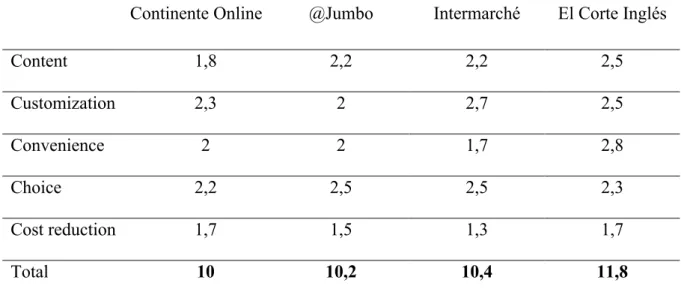
The resulting table provides an average of all individual scores for each one of the five C’s for each player, as well as the total. The four online offers were scored from a scale of zero to three, zero being the lowest, with room for improvement, and three being the highest, with excellent performance.
Continente Online @Jumbo Intermarché El Corte Inglés
Content 1,8 2,2 2,2 2,5
Customization 2,3 2 2,7 2,5
Convenience 2 2 1,7 2,8
Choice 2,2 2,5 2,5 2,3
Cost reduction 1,7 1,5 1,3 1,7
Total 10 10,2 10,4 11,8
Table 1: The Five C’s score of each online grocer
With the different offers on the table, the survey provides quantitative data regarding customer preferences.
3.3. Survey
Using Google forms, a survey was created and shared through e-mail and Facebook. The full script of the survey can be found in Appendix 13. Answers were accepted from the 16th to the 28th of September. 218 people responded to the questionnaire, but the answers of those who reported that they are not responsible for buying their groceries were excluded from the study. Those were considered irrelevant to this analysis, together with with outliers. Subsequently, the answers of 193 respondents were used for this purpose. The data was exported, treated, and analyzed using MS Excel and SPSS.
3.3.1. Sample Characterization
The 193 respondents’ age is comprehended between 17 and 80. Around 53% are 22 or less years old, 22,8% being 22 years old. Less than 5% of the sample is more than 60 years old. 144 women (74,6%) answered the survey. A total of 61% of the people who responded live in Lisbon. Around 64% are students and close to 30% are full-time workers. One should also note that the survey did not inquire unemployed people. A sample summary can be found in the Appendix 4.
3.3.2. Grocery Shopping Pattern
Firstly, respondents were asked about their offline habits, in order to evaluate the sample’s market representativeness.
(Appendix 6). These percentages give an accurate depiction of the volume and value share of these two big players, as presented in the market overview.
When asked about the overall shopping experience at their preferred store, 32,6% mentioned they find it boring, 29,5% referred to it as tiring, while another 22,8% consider it relaxing. The most valued in-store features are value proximity (63,7%), lower prices (58%), promotions (43%) and product freshness (40,9%).
3.3.3. Perceptions of online grocery shopping
The 185 respondents who said they had heard about online grocery shopping were then asked which features they felt were more disadvantageous in online grocery shopping, as opposed to going to a physical store (Appendix 7). This question intended to assess actual experience with the service but also shared ideas/misconceptions from those who had not tried the service. As such, the answers can be divided in two groups: the users (33%), and the non-users (66%).
An interesting result was that only less than 7% of the non-users selected that not having contact with the products was a main disadvantage of online grocery shopping. After all, the preference for traditional store formats and proximity does not discourage as many buyers from ordering online as one would expect, specifically due to cultural reasons.
Moreover, around one quarter of the non-users seem to dislike the payment method, compared to 16,4% of the users. 26,2% of the latter also believe that online orders result in receiving items of lower quality.
the delivery fee as being too high, 47,5% find that the delivery times are not always sure, and 24,6% consider that the products have less promotions online, compared to the physical stores’ offer.
From the total of 61 users, Continente Online was the most tried platform (75,4%), followed by @Jumbo (29,5%) and El Corte Inglés (9,8%). Further questions were asked about their experience.
3.3.4. Online Grocery Shopping Experience
Acknowledging that recommendations can be a good indicator of customer satisfaction, respondents were asked if they would recommend online grocery shopping, on a scale of one to six, with one being “would not recommend” and six “would certainly recommend”. A total of 32,8% gave a score of four, showing they were slightly positive about the idea, with a respective cumulative percent was of 70,5%(Appendix 8). Likewise, during the previous 6 months, 41% of the respondents did not buy any groceries online. (Appendix 9) These results suggest that, as the choice for online grocery shopping did not generate much repetition; it might have been more a trial situation. As such, overall satisfaction with the service is still not high enough to incentivize more than punctual purchases. It is possible to conclude that the majority of the respondents are still reluctant and not convinced by services they have tried.
3.3.5. Pearson’s Correlation Coefficient analysis
A Pearson’s table was extracted using SPSS, and correlations for 10% and 5% confidence levels were considered. Appendix 12 shows the summarized data regarding the relevant relationships.
A moderate negative correlation was found between respondents having tried Jumbo Online and Continente Online, at the same time there is a 0,4 positive correlation between visiting Jumbo and having tried Jumbo Online. This can indicate that, at least at an initial stage of online grocery shopping, customers tend to go for the store they already shop at.
The data also showed a positive correlation coefficient of around 0,3 between the number of times users have ordered groceries in the past six months and the perceived risk of incorrect or incomplete orders. As provided in the previous section, a great percentage of users were not repetitive buyers. And knowing there is higher risk for disloyalty in the online channel (McKinsey & Company, 2013), it is important that grocers match customers’ expectations right from the start and come up with strategies for customer retention. Particularly, in the case of Continente Online, there is also a positive correlation of around 0,4 between buying at this store and the perception of issues with product availability - out of stock items.
Lastly, there is a positive coefficient of correlation of 0,4 between consumers who spend higher monthly values on groceries and those who prefer the picking up their online order at the store.
The section on limitations will clarify the context for the interpretation of the previous results.
3.4. Limitations
Concerning the quantitative analysis – the survey – it is limited by the fact that it was mostly shared through social media and emails to friends. As it showed, a younger audience and people living mostly in Lisbon, constituted a great percentage of the total respondents. It was also verified a prevalence of female respondents. A larger number of respondents could have diminished these issues and allowed for a more normalized distribution sample.
As for the qualitative analysis, the obtained scores are at risk of being subjective to individual interpretation, coming from a very small sample. More than that, the scores were attributed by people all aged 26 or less, who, similarly to what was mentioned for the quantitative analysis, are already more representative of an age group that is more comfortable buying online.
The following topic will reveal the main findings, obtained from the qualitative and quantitative analyses, in order to answer the proposed research questions.
3.5. Main Findings
Are online customers more valuable than offline ones?
Value of customers can be assessed considering frequency of purchases, loyalty, and value of the total purchase. Even though previous studies have found online baskets are more valuable than offline ones, the obtained survey results did not show any relationship between online grocery shopping and typical spending in in-store groceries. Moreover, it was observed that the majority of people who had tried the online platforms were not frequently purchasing. One explanation could be the early stage of adherence to this service, meaning people are still experimenting, and improvements on the platforms are needed. Furthermore, it is imperative for one to consider the limitations posed by the sample group collected, a majority of which are students who spend a lower amount of money on groceries.
What are the key factors that encourage and discourage online grocery shopping?
very discouraging factor for online grocery shopping, people in Portugal seem to have overcome that issue. Convenience-related factors were found to be the most encouraging ones and high delivery fees are the most discouraging factor. It is also important to note that, for people who have ordered online, some of their main fears and negative experiences are associated with order fulfilment issues. As it was seen that not many people would recommend this service, it is essential that grocers start off with positive impressions that can generate repetition and increase loyalty.
Should grocers focus on one fulfillments model or offer both home delivery and pick-up?
According to the survey, a great majority of the people prefer the home-delivery method. However, a click-and-collect model is more profitable, and the survey also showed a positive relationship between preference for picking up groceries and higher monthly spending on groceries. For these reasons, it is believed both models should be offered, but the click-and-collect model could be stimulated. As for the home-delivery method, given its relevance, it should be efficient and up to customers’ expectations.
With all the obtained learning, some recommendations can be given to assist store-based businesses in adding more value to their customers.
3.6. Recommendations
Price
The premise that the delivery fees offered by some clicks and mortar is high can be explained by the lack of economies of scale, and the tendency should be to reduce them over time. Nevertheless, the survey results showed how price-sensitive customers in Portugal can be. The basic notion must be that all players’ price points should not be too different from each other, or a customer might easily shift to a better deal.
Tesco’s proposal is targeted towards different customer groups, as can be seen in Appendix 13. Having options according to order frequency can give customers more choice, and longer subscription stimulate purchases and loyalty. Other online offers, such as delivery fee reductions, or “happy hours” can help customers perceive home-delivery as a better deal for the convenience factor they are looking for.
Further assessment of consumers’ willingness to pay should be done to understand which price points for each deals would be preferable.
Convenience - Order Fulfilment
The notion that online orders will result in receiving lower quality should be mitigated. To alleviate this problem, fresh products could be marked with an online quality stamp, similarly to what El Corte Inglés shows on its website.
Despite the lack of information regarding the type of method used by each grocer, the different websites’ contents point out to a majority of them utilizing as in-store order picking method. In stores that have big affluence, having employees picking products from the shelves can disturb other customers, and eventually becomes unsustainable when online orders increase to a certain level. In this sense, one should consider setting up dark stores near densely populated areas as a feasible solution.
For sparsely-populated areas, with a justifiable online sales volume, DC-picking seems more favorable. Despite the potential room for growth, some peripheral areas at reach could still more likely be served at a lower cost from the already existing facilities.
Concerning the consumers’ uncertainty in the punctuality of their orders, it would be advisable to provide live tracking online. In this manner, the client would be able to follow the order’s status and know an accurate prediction, not only of arrival time, but of the total period required for its fulfillment.
In the meantime, it is also recommended that grocers find ways to incentivize the click-and-collect model, the most profitable, yet the least attractive, of the online channel, as indicated by the findings. One suggestion would be having a pop-up window at the website checkout with personalized offers – coupon discounts or free items – if the person would select this pick up method.
One should take into account the existence of the aforementioned constraints when considering these recommendations and subsequent conclusions.
4.
!
Conclusion
As a result of the work developed, it was confirmed that Portugal is still in an early stage of adoption of online grocery shopping. However, the market is growing at a rapid pace, which signifies great opportunities for businesses and also the need for investment. New entries will already be followers, and this is a critical moment for store-based businesses to make sure they are on the run to win in the online world. The results of the questionnaire backed up research, showing the small reach of e-commerce for this segment.
seem to be ready to go online. As a result, it was indeed important to see how the online offers could be improved to engage consumption.
The general overview of the market resulted in brief recommendations that match consumers’ expectations. As previously mentioned, this was under the assumption that there is a common standard for a value proposition that each grocer should deliver. With that in mind, and also due to the lack of information about each market player, the suggestions are not targeted towards any specific grocer. Instead, they can serve as a reflection for improvement of chosen strategic fields and also for future bricks and mortar that may enter the online channel. For the future, given the access to data provided by clients’ loyalty cards, it would be of interest to online grocers to explore their specific clients’ preferences and consumption patterns. Retailers have access to a larger sample, assuring more reliable results. As such, they could better understand, for their own case, the weight their customers attribute to each factor, so as to focus on winning on the differentiating ones.
5.
!
Bibliography
acepi. (2015, July). Comércio Eletrónico continua a crescer a dois dígitos na Europa.
Retrieved from acepi: http://www.acepi.pt/artigoDetalhe.php?idArtigo=91682 Bidgoli, H. (2002). Electronic Commerce: Principles and Practice.
Bloomberg. (2015). Amazon Passes Wal-Mart as Biggest Retailer by Market Value.
Retrieved from Bloomberg: https://www.bloomberg.com/news/articles/2015-07-23/amazon-surpasses-wal-mart-as-biggest-retailer-by-market-value
Chaffey, D. (2009). E-business and e-commerce management strategy, implementation and
practice.
Distribuição Hoje. (2015). Entrevista: El Corte Inglés vai investir 2 milhões no
http://www.distribuicaohoje.com/entrevista-el-corte-ingles-vai-investir-2-milhoes-no-desenvolvimento-de-e-commerce-em-portugal/
Hipersuper. (2015). Continente detém 70% das vendas alimentares no canal online.
Retrieved from Hipersuper: http://www.hipersuper.pt/2015/05/08/continente-detem-70-das-vendas-alimentares-no-canal-online/
Hipersuper. (2015). Marcas de fabricante representam 65% das vendas no primeiro semestre
do ano. Retrieved from Hipersuper: http://www.hipersuper.pt/2015/07/09/marcas-da-distribuicao-representam-65-das-vendas-no-primeiro-semestre-do-ano/
Jornal de Negócios. (2003). Pingo Doce suspende Online e OnTV a partir de 1 de Julho.
Retrieved from Jornal de Negócios:
http://www.jornaldenegocios.pt/empresas/tecnologias/detalhe/pingo_doce_suspende_ online_e_ontv_a_partir_de_1_de_julho
Kalakota, R., & B. Whinston, A. (1997). Electronic Commerce: A Manager's Guide.
Kantar. (2013). Kantar retail market visit series: portuguese grocery retail. Retrieved from
Kantar Retail IQ:
https://www.kriq.com/ContentIndex/ArticleDetails.aspx?key=BlgDyrQrbCLgY2XCg aCpwg==&id=571979
Kantar Worldpanel. (2015). Accelerating the growth of ecommerce in fmcg.
Kantar Worldpanel. (2016). THE FUTURE OF E-COMMERCE IN FMCG.
Boyer, K. K., Frohlich, M. T., & Tomas, G. (2004). Extending the Supply Chain: How
Cutting-edge Companies Bridge the Critical Last Mile Into Customers' Homes. Klose, A., Van Wass, L. N., & Speranza, M. G. (2002). Quantitative Approaches to
Distribution Logistics and Supply Chain Management.
McKinsey & Company. (2013). The future of online grocery in Europe.
Meios&Publicidade. (2015). Em que ponto está o grande consumo em portugal? Retrieved
from Meios&Publicidade: http://www.meiosepublicidade.pt/2015/10/em-que-ponto-esta-o-grande-consumo-em-portugal/
Nielsen. (2015). A Confiança dos consumidores portugueses atingue o nível máximo desde
2006. Retrieved from Nielsen: http://www.nielsen.com/pt/pt/press-room/2015/a-confianca-dos-consumidores-portugueses-a-tingue-o-nivel-maximo.html
Nielsen. (2015). Quatro em cada dez portugueses incluíram um produto novo no carrinho, na
sua última ida às compras. Retrieved from Nielsen:
http://www.nielsen.com/pt/pt/press-room/2015/Quatro-em-cada-dez-portugueses-incluiram-um-produto-novo.html
Nielsen. (2015). THe future of grocery: e-commerce, digital technology and changing
shopping preferences around the world.
Nielsen. (2016). POrtugal com sinais evidentes de recuperação nas vendas dos bens de grande
consumo. Retrieved from Nielsen:
http://www.nielsen.com/pt/pt/press-room/2016/portugal-com-sinais-evidentes-de-recuperacao-nas-vendas-dos-bens.html Observador. (2014). Apenas 8% dos portugueses fazem compras de supermercado online.
Retrieved from Observador: http://observador.pt/2014/06/17/apenas-8-dos-portugueses-fazem-compras-de-supermercado-online/
Statista. (2015). Portugal: most popular online shopping categories 2015. Retrieved from
Statista: https://www.statista.com/statistics/348921/popular-online-purchases-categories-portugal/
Waynext. (2015). Ecommerce – guia completo – o que é e como funciona? Retrieved from