Research Open Access
Screening of Less known Two Food Plants for Comparison of Nutrient
Contents: Iranian and Indian Vegetables
Ali Aberoumand
Department of Fisheries, Behbahan Khatemolanbia Technology University, Behbahan, Khuzestan Province, Iran
Corresponding author: Ali Aberoumand, PhD, Department of Fisheries, Behbahan Khatemolanbia Technology University, Behbahan, Khuzestan Province, Iran
Submission date: September 14, 2011; Acceptance date: Octoberr 16, 2011; Publication date: October 22, 2011
Abstract
Background: Greater consumption of fruits and vegetables is associated with reduced risk of cardiovascular disease, stroke, and cancers. The most important nutrients present in plants are carbohydrates, such as the starch and free sugars, oils, proteins, minerals, ascorbic acid, and the antioxidant phenols.Plants are an essential component of the universe. Human beings have used those as medicine from the very beginning of time.
Methods: The proximate composition and mineral constituents of Asparagus officinalis stem and Momordica dioica fruit were evaluated in order to scientific standard methods of Association for Official and Analytical Chemists (AOAC).
Results: The stem contained ashes: 10.70% crude protein: 32.69%, crude lipid: 3.44%, crude fiber: 18.50%, and carbohydrates: 34.67%. Stem also have high energy value (384.27kcal/100g) dry weight. Mineral ranges (mg/100g dry weight, DW) were: K (10.94), Na (1.84), Ca (0.67), Fe (0.19), and Zn (2.60). The fruits contained ashes: 9.1%, crude protein: 5.44%, crude lipid: 3.25%, crude fiber: 22.9%, and carbohydrates: 59.31%. The fruits also have high energy value (288.25kcal/100g) dry weight. Mineral ranges (mg/100g dry weight, DW) were: K (4.63), Na (1.62), Ca (7.37), Fe (5.04), and Zn (3.83).
Keywords: Asparagus officinalis stem; Momordica dioica; Micronutrients; Proximate and Mineral composition.
BACKGROUND:
In developing nations, numerous types of edible wild plants are exploited as sources of food hence provide an adequate level of nutrition to the inhabitants. Recent studies on agro pastoral societies in Africa indicate that these, plant resources play a significant role in nutrition; food security and income generation [5].
Furthermore, FAO report, at least one billion people are thought to use wild foods in their diet [6]. In Ghana alone, the leaves of over 300 species of wild plants and fruits are consumed. In Swaziland, wild plants provide a greater share of the diet than domesticated cultivars. In India, Malaysia and Thailand, about 150 wild plants species have been identified as sources of emergency food [8]. Similarly, in South Africa about 1400 edible plant species are used, In Sahel region of Africa, over 200 wild foods were identified to be used by the rural communities [17]. In most of these reports, it was emphasized that nutritionally, these unconventional plants foods could be comparable to or even sometimes superior to the introduced cultivars [7]. It is, therefore, worthwhile to note that the incorporation of edible wild and semi-cultivated plant resources could be beneficial to nutritionally marginal populations or to certain vulnerable groups within populations, especially in developing countries where poverty and climatic changes are causing havoc to the rural populace. In this context, analyses were carried out to evaluate the nutritional content of Asparagus officinalis stem and Momordica dioica fruit with hope that it would be incorporated into the food basket of the country [8-11].The aim of analysis of nutrients in the plant foods is preliminary assessment of nutritional value of the plant-based diet.
MATERIALS AND METHODS: Plant material
Asparagus officinalis stem and Momordica dioica fruits used as experimental material were collected from farm and Agricultural lands (garden) in around Behbahan, South Iran, in October 2007. Extent of production/availability of the plants was in areas of Maharashtra state in India and southern Iran, Behbahan. The collected plant material was placed in a polyethylene bag to prevent loss of moisture during transportation to the laboratory.
Preparation of the plant materials for chemical analyses
Asparagus officinalis stem and Momordica dioica fruits were washed with distilled water and dried at room temperature to remove residual moisture, then placed in paper envelope and oven-dried at 55ºC for 24 hours 2,3. The dried stem were ground into powder using pestle and mortar, and sieved through 20-mesh sieve. The root tubers powder was used for the nutrients analyzes.
The methods recommended by the Association of Official Analytical Chemists were used to determine ash (#942.05), crude lipid (#920.39), crude fibre (#962.09) and nitrogen content (#984.13)[4].
Determination of crude lipid and crude fibre Content
Two grams of dried root tubers or fruits were weighed in a porous thimble of a Soxhlet apparatus, with its mouthed cotton wool plugged. The thimble was placed in an extraction chamber which was suspended above a pre-weighed receiving flask containing petroleum ether (b.p. 40-60ºC). The flask was heated on a heating mantle for eight hours to extract the crude lipid. After the extraction, the thimble was removed from the Soxhlet apparatus and the solvent distilled off. The flask containing the crude lipid was heated in the oven at 100ºC for 30 minutes to evaporate the solvent, then cooled in a dessicator, and reweighed. The difference in weight was expressed as percentage crude lipid content.
Crude fiber was estimated by acid-base digestion with 1.25% H2SO4 (prepared by
diluting 7.2 ml of 94% conc. acid of specific gravity 1.835g ml-1 per 1000 ml distilled water) and 1.25% NaOH (12.5 g per 1000 ml distilled water) solutions. The residue after crude lipid extraction was put into a 600 ml beaker and 200 ml of boiling 1.25% H2SO4 added. The contents
were boiled for 30 minutes, cooled, filtered through a filter paper and the residue washed three times with 50 ml aliquots of boiling water. The washed residue was returned to the original beaker and further digested by boiling in 200 ml of 1.25% NaOH for 30 minutes. The digest was filtered to obtain the residue. This was washed three times with 50 ml aliquots of boiling water and finally with 25 ml ethanol.
The washed residue was dried in an oven at 130ºC to constant weight and cooled in a dessicator. The residue was scraped into a pre–weighed porcelain crucible, weighed, ashed at 550ºC for two hours, cooled in a dessicator and reweighed. Crude fibre content was expressed as percentage loss in weight on ignition, [4, 14].
Determination of nitrogen content and estimation of crude protein
Macro–Kjeldahl method was used to determine the nitrogen content of the stem 2g of dried plants were digested in a 100 ml Kjeldahl digestion flask by boiling with 10 ml of concentrated tetraoxosulphate (VI) acid and a Kjeldahl digestion tablet (a catalyst) until the mixture was clear. The digest was filtered into a 100 ml volumetric flask and the solution made up to 100 ml with distilled water. Ammonia in the digest was steam distilled from 10 ml of the digest to which had been added 20 ml of 45% sodium hydroxide solution. The ammonia liberated was collected in 50 ml of 20% boric acid solution containing a mixed indicator. Ammonia was estimated by titrating with standard 0.01 mol L-1 HCl solution. Blank determination was carried out in a similar manner. Crude protein was estimated by multiplying the value obtained for percentage nitrogen content by a factor of 6.25 [4].
Estimation of carbohydrates and energy values
value (in kJ) was estimated by multiplying the percentages of crude protein, crude lipid and carbohydrate by the factors 16.7, 37.7 and 16.7 respectively [4].
Mineral analysis
The mineral elements Na, K, Ca, Fe, and Zn were determined on 0.3g plant powder by the methods of Funtua. using Energy Dispersive X-ray Fluorescence (EDXRF) transmission emission spectrometer carrying an annular 25 mCi 109Cd isotopic excitation source that emits Ag-K X-ray (22.1 keV) and a Mo X-ray tube (50KV, 5mA) with thick foil of pure Mo used as target material for absorption correction. The system had a Canberra Si (Li) detector with a resolution of 170eV at 5.9keV line and was coupled to a computer controlled ADCCard (Trump 8K).
Measurements were carried out in duplicate. Na was analyzed after wet digestion of one gramme of the stem powder with nitric/perchloric/sulphuric acid (9:2:1 v/v/v) mixture. Sodium was analyzed with a Corning 400 flame photometer [4].
RESULTS AND DISCUSSION: Proximate analysis
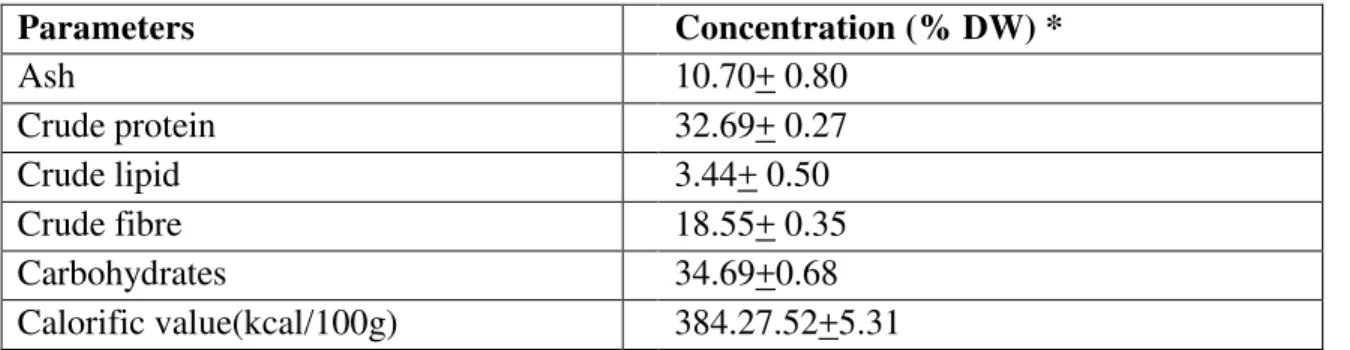
The results of proximate composition of Asparagus officinalis stem and Momordica dioica fruits are shown in Tables 1 and 2.
Table 1. Proximate composition of Asparagus officinalis stem
Parameters Concentration (% DW) *
Ash 10.70+ 0.80
Crude protein 32.69+ 0.27
Crude lipid 3.44+ 0.50
Crude fibre 18.55+ 0.35
Carbohydrates 34.69+0.68
Calorific value(kcal/100g) 384.27.52+5.31
* The data are mean values+ deviation (SD) of three replicates. * Values expressed as % dried weight.
of protein. The crude lipid contents of both plant foods were less than the range (8.3 – 27.0% DW) reported for some vegetables consumed in Nigeria and Republic of Nigeria [13,14].
Table 2. Proximate composition of Momordica dioica fruit
Parameters Contents
Ash 6.7±5.17
Crude protein 19.38+ 0.27 Crude lipid 4.7+ 0.50
Crude fibre 21.3+ 0.35
Carbohydrates 47.92+0.68
Calorific value(kcal/100g) 311.5+5.31
* The data are mean values+ deviation (SD) of three replicates. * Values expressed as % dried weight.
The estimated carbohydrate contents in Asparagus officinalis stem and in Momordica dioica fruits were stand to be higher than that for Senna obtusfolia leaves (20%) and Amaranthus incurvatus leaves (23.7%). On the other hand, Asparagus officinalis stem and M. dioica fruits contain comparable amount of carbohydrate for Momordica balsamina (39.05 ± 2.01%). The crude fibre content in both plant foods were more than the reported values (8.50 – 20.90%) for some Nigeria vegetables, [12]. One discussed drawback to the use of vegetables in human nutrition is their high non soluble fibre content, which may cause intestinal irritation and a decrease of nutrient bioavailability. The fibre RDA values for children, adults, pregnant and breast-feeding mothers are 19 –25%, 21 – 38%, 28% and 29% respectively. The reason for the variation in nutrient content compared to available data by AOAC was due to species variation.
Mineral content
Table 3 and 4 show the results of the mineral concentrations of Asparagus officinalis stem and Momordica dioica fruits. Nutritional significance of elements is compared with the standard recommended dietary allowance. When compared with standard values as showed in Table 3 and 4, Asparagus officinalis stem and M. dioica fruits less than adequate level of K, Fe, Zn, Ca, and Na, but the plant stem could be good sources of K.
Table 3. Mineral composition of Asparagus officinalis stem
Recommended Dietary Allowances(mg/day)
Mineral Available Quantity in mg/100g DW*
Children 7-10 Years
Potassium 10.94+0.02 800 800 800 1200
Calcium 0.67+0.15 1600 2000 2000 2000
Sodium 1.84+0.08 400 500 400 500
Iran 0.19+0.01 10 10 15 13
Zinc 2.60+0.07 10 15 12 19
* The data are mean values+ deviation(SD) of three replicates.
Table 4. Mineral composition of Momordica dioica fruit
Recommended Dietary Allowances (mg/day)
Minerals Available
quantity in mg/100gD*
Children 7-10years
Adult Male
Adult female
Pregnant and lactating Mothers
Calcium 0.46+0.02 800 800 800 1200
Potassium 8.25+0.15 1600 2000 2000 2000
Sodium 1.51+0.08 400 500 400 500
Iron 0.14+0.01 10 10 15 13
Zinc 1.34+0.07 10 15 12 19
* The data are mean values+ deviation (SD) of three replicates.
CONCLUDING REMARKS:
The results of the nutrient content analysis shows that Asparagus officinalis stem could be a good supplement for some nutrients such as protein, lipid, potassium and Zinc, fibre and carbohydrates while Momordica dioica fruit was good source of lipid, crude fiber, carbohydrates, Fe and Zinc.
the exclusive criteria for judging the nutritional significance of plant parts for human consumption as food. Thus, it becomes necessary to consider order aspects such as presence of any antinutritional / toxicological factors and biological evaluation of nutrient content, [1].
Abbreviations: AOAC: Association of Official Analytical Chemists, FAO: Food and Agricultural Organization, RDA: recommended dietary allowances; DW: dried weight.
Acknowledgements: The authors are grateful to Head Department of Food Science Technology of Ramin Agricultural University of Iran for providing necessary laboratory facilities and for encouragement.
REFERENCES:
1. Aberoumand A, Deokule SS, Comparison of Phenolic compounds of some edible plants of Iran and India, Pakistan J of Nutr. 2008. 7 (4): 582-585.
2. Abuye C, Urga K, Knapp H, Selmar D, Omwega A, Imungi J, Winterhalter P. A compositional study of moringa stenopetala leaves. East African Med J 2003.80(5): 247-52.
3. Aletor V, Adeogun O. Chemical analysis of the fruit of Vitex doniana (Verbenaceae). Food Chem 1995. 53: 375-379.
4. AOAC Official methods of analysis, 14th edition, Association of Official Analytical Chemists, Washington DC. Arlington, Virginia, USA. 1990.
5. Asibey-Berko E, Tayie F. The antibacterial properties of some plants found in Hawaii, Ghana J Sci 1999. 39: 91-92.
6. Burlingame B. Comparison of total lipids, fatty acids, sugars and nonvolatile organic
acids in nuts from Castanea species. J of Food Comp and Anal 2000.13: 99-100. 7. Edmonds J, Chweya J. 1995 Black nightshades, Solanum nigrum L. and related species.
Promoting the conservation and use of underutilized and neglected crops. Taylor & Francis, London.
8. Faruq U, Sani A, Hassan L. Composition and distribution of deadly nightshade. Niger Journal of Basic Appl Sci 2002. 11: 157-164.
9. Hazell T.1985; Minerals in foods: dietary sources, chemical forms, interactions, bioavailability. World Rev Nutr Diet. 46:1-123.
10.Funtua I, Trace J. Quantitative variability in Pisum seed globulins: its assessment and significance. Plant Foods for Human Nutr 1999, 17: 293-297.
11.Ifon E, Bassir O. Determination of carbohydrates in foods. II—unavailable carbohydrates. Food Chem 1980, 5: 231-235.
12.Isong EU, Idiong UI. 1997; Comparative studies on the nutritional and toxic composition of three varieties of Lesianthera africana. Source Department of Biochemistry, University of Uyo, Nigeria. Plant Foods Hum Nutr. 51(1):79-84.
14.Nesamvuni C, Steyn N, Potgieter M. nutrients analysis of selected western African foods, South African J Sci 2001. 97: 51-54.
15.Pearson D. Nutrient and chemical composition of 13 wild plant foods of Niger. Ghana J. Sci 1999. 39:.91- 92.
16.Plessi M, Bertelli D, Phonzani A, Simonetti M, Neri A, Damiani P. Role of indigenous leafy vegetables in combating hunger and malnutrition, J of Food Comp and Anal 1999. 12: 91-96.