Face Tracking in Video by Using Kalman Filter
Saranya M*, Padmavathi S**
*(Department of Computer Science, Amrita University, Coimbatore-641 112) ** (Department of Information Technology, Amrita University, Coimbatore-641 112)
ABSTRACT
Face Tracking has been one of the most studied topics in computer vision literature. Facial feature extraction has some problems which must be researched. Small variations of face size and orientation can affect the result of face tracking. Since the input image is captured from a surveillance camera, certain conditions have to be considered - like different levels of brightness, shadows and clearness - which are challenges for detection and tracking purpose.
Most facial feature extraction methods are sensitive to various non-ideal such as variation in illumination, noise, orientation, time-consumption and color space used. So there is a need for a good feature extraction method that will enhance the quality and performance of face recognition system.
First, segmentation of foreground and background object is the one by using histogram equalization. By this method we are able to segment face based on skin color. After segmenting, Kalman filter is used to track the faces under several conditions. This feature is helpful for the development of a real-time visual tracking control system.
Keywords
—Face detection, Facial Feature Extraction, Kalman Filter, Histogram Equalization, Face Tracking.I.
INTRODUCTION
The traditional attendance management system where the attendance is marked by the teachers have many issues associated with the chances of proxy attendance, wastage of class hours, etc. So to avoid these drawbacks and to increase the quality of the educational system, automatic attendance marking systems is developed.
The face is a curved three-dimensional surface, in videos there may be changes in human face due to illumination, pose, hairstyle, facial hair, makeup and age. All faces have basically the same shape, yet the face of each person is different .
The existing automatic attendance management system use passwords, key, ID cards and barcodes to identify the students. These techniques have major drawbacks like they do not check who is entering or holding the information. They only check whether the correct information is presented to the system. So such system can be easily missed because any student can remember the password or she/he can carry the student of other ID cards . To overcome this problem we propose to create a system to track the students by face detection.
The organization of the paper is as follows: Section I gives the introduction of the paper. The overview of the method is given in section II. Literature Survey is given in the section III. The method is explained in this section IV. The algorithms used in the method are explained in section V. The experimental results are given in the section VI. Concludes the paper.
II.
LITERATURE SURVEY
Here the details about the referred paper, author, advantage and disadvantage etc. are given below
2. 1. Pose-Robust Recognition of Low-Resolution
Face Images Author: Soma Biswas, Member,
IEEE, Gaurav Aggarwal, Member, IEEE, Patrick
J. Flynn, Fellow, IEEE and Kevin W. Bowyer,
Fellow, IEEE
The SIFT+PCA , SIFT+LDA, tensor analysis-based approaches are used. A tensor analysis-analysis-based approach.To estimate approximate poses and rough locations of the facial landmarks. Advantages of the this method are increasing the computational cost. Proposed MDS based approach with both training and testing phases non frontal images under varying illumination conditions. Disadvantages: Locating the facial landmarks in low resolution, non frontal images under varying illumination condition.
2.2.Video -based Face Recognition
Author: Huafeng Wang, Yunhong Wang, And
Yuan Co
The SVM, color based method, HMM method is used to track the human faces. It used for Multiple frames can provide better face recognition performance. Surveillance videos are generally of low resolution containing faces mostly in non frontal pose. But the difficulty is identifying the local information Facial expression and emotions is also used, Equal weight and aligned face.
2.3. Detecting Faces in images
Author: Ming-Hsuan Yang, Member, IEEE, David J. Kriegman, Senior Member, IEEE, and Narendra Ahuja, Fellow, IEEE
Face detection in single images is based on knowledge based method, feature invariant method, template matching, Appearance based method. It is easily identified that partially occluded face can be located. Perfect for a test set of 30 Inages with 60 faces.
2.4. Face Detection and Tracking in a Video by Propagating Detection Probabilities
Author: Ragini Choudhury Verma, Cordelia
Schmid, and Krystian Mikolajczyk
Here using head tracking ,facial feature tracking, color, shape and region based methods are used. The advantages is We eliminate the lower frequencies, thus eliminating light a Skin color information. The Disadvantage is Difficulty for Our approaches are changing zoom, significant lighting changes, and occlusion.
2.5. Face Tracking in Video Sequences Using Particle Filter based on the Skin Color Model and Facial Contour
Author: Yinghua Lu, Yuanhui Wang, Xianliang
Tong, Zebai Zhao1, Hongru Jia, Jun Kong
The face tracking method using particle filter based on skin color model and facial contour. The advantage of this method is the tracking algorithm is based on particle filter using skin color and facial contour as cues. The particle filter is used for tracking the big rotation and partial occlusion, Compared with other face tracking methods, which only use the skin color as the cue, our approach works more robustly.
2.6.Face Detection In Low Resolution color image
Author: Jun Zheng, Geovany A. Ramirez, and Olac Fuentes
The system consist of two method boosting and bootstrapping algorithm. In this low-resolution image, the people appear very small and we may be
interested in detecting the subject’s face for
recognition or analysis. If there is any problem is there in car detection, road detecting means we can use Float- Boost and Real AdaBoost to further improve the performance of our system in low-resolution object detection.
III.
METHOD
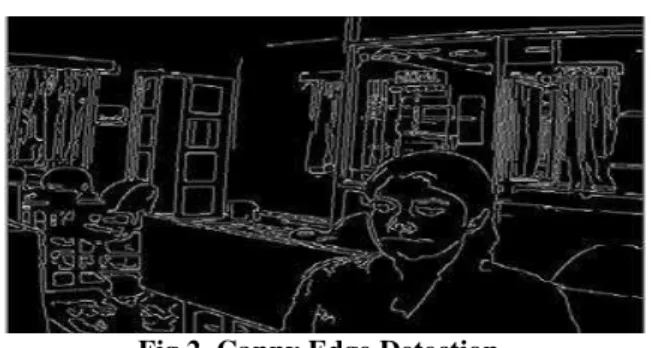
Based on our study of the existing systems we have proposed a new method for face detection and tracking. Our method is implemented in four steps which include preprocessing, feature extraction, face detection and finally face tracking. On pre-processing stage we propose to use canny edge detection for
estimation using Kalman filter. In the feature extraction stage we propose to use color feature extraction to detect human face. In the face detection stage we plan to use a hole filling and histogram equalization. In future we plan to do the face detection from the above output. A summary of the proposed method may be as follows:
The system design of the propose system follows:
Fig.1: System Architecture Diagram
IV.
THE ALGORITHMS USED
4.1.Edge DetectionThe canny edge containing Sobel, Prewitt and Roberts. The object finds the edges in the image by using the Gradient magnitude of the image. Canny algorithm, the object finds edges by looking for the local maxima of the gradient of the input image. The gradient filter is used for Gaussian filter. This algorithm is more robust to noise and more likely to detect true weak edges. At each output unit the bias and the weights are updated. Similarly for hidden units also updation of bias and weights is done.
4.2.Motion Estimation Using Kalman Filter The Kalman filter function predicts the position of a moving object based on its past values. It uses a Kalman filter estimate, a recursive adaptive filter that estimates the state of a dynamic system from a series of noisy measurements. Kalman filtering has a broad range of application in areas such as signal and image processing, control design, and computational finance. The Kalman filter is used for to reduce the dimensionality Error. The Kalman filter is used for motion estimation. A Kalman filter is used to estimate the dynamic changes of a state vector of which only a function can be observed. When the function is nonlinear, we must use an extended Kalman filter. The Kalman filter is used for to reduce the dimensionality Error
4.3.Facial feature extraction
In this stage we use histogram equalization and skin color segmentation for facial feature extraction.
The human faces have different skin color, hence to identify a student the skin color segmentation method is an important step.
A face detection algorithm based on skin color is discussed. For detecting face there are various algorithms, including skin color based algorithms. Color is an important feature of human faces. Using skin color as a feature for tracking a face has several advantages. Color processing is much faster than processing other facial features. Under certain lighting conditions, color is orientation invariant. Tracking human faces using color as a feature has several problems like the color representation of a face obtained by the camera is influenced by many factors (ambient light, object movement, etc.), different cameras produce significantly different color values even for the same person under the same lighting conditions also the skin color differs from person to person. Here the serious issue with skin-color based algorithm is that, no-one faces with color similar to face is detected as false.
4.3.2Histogram Equalization
The Histogram Equalization used to enhance the contrast of images by transforming the values in an intensity image Skin segmentation commonly performs morphological operations on each binary image. If there is a binary image, where pixel values equal to 1 indicate skin color locations is present, suppose in another case the pixel value is equal to zero means if there is no skin color present in the image. During skin color segmentation, the hue value gets changed.
Let G(X) be a grayscale image with n number of pixels and L gray level(usually 256). Lets Ni be the number of pixels having a gray level I (I<L). The probability of occurrence of pixel with gray level am given by p (xi).
n
x
x
p
i
i (1)P (xi) is normalized to [0,1].Next the cumulative distribution function for p(x)is calculated which is given by
p
x
p
x
p
cdf
ji
j
i
))
(
)
(
(
0
(2)We define a function y to produce a new image with a flat histogram where y is given by:
))
(
(
)
(
k
cdf
p
k
T
y
(3) Where k is in the range [0, L].V.
EXPERIMENTAL RESULTS
5.1.Canny Edge DetectionEdge detection is done by using canny edge detection.
Fig.2. Canny Edge Detection
5.2.Motion Estimation
Motion estimation is performed using Kalman filter. The value is after tracking the face in the video is 0.4000.
Fig.3.Motion Estimation
5.3 Skin Color Segmentation
Skin color segmentation is done by using the Histogram Equalization and hole filling algorithm. Face detection is the most important step towards face tracking. In real time video the human face is tracked by a skin color based face detection or face tracking algorithm. It will identify and locate the faces accurately even with different backgrounds and illumination condition.
Fig .4. Input Image
Fig.6. Hole Filling
Fig.7. Face Detection
5.4.Result analysis
In a video, edges have been detected by using the canny edge detection method. After that motion estimation is done by using the Kalman filter. Finally, histogram equalization is to used detect faces in the video by using skin color segmentation. The advantages of the our method is using histogram equalization we are able to segment face based on skin color. The disadvantage of our method is that if background color is similar to the face color, then the background also gets detected.
VI.
CONCLUSION
The various existing methods such as PCA, Appearance based model. But we're using the propose technique for skin color segmentation and Histogram equalization, should be a failure because the screen color and having the same skin color. So, to avoid this problem to improve the GLF method under low resolution, illumination conditions, where we able to detect the face more in more accurately. In future work, GLF (Gradient and logarithm field) method is used for the lower resolution face tracker under illumination invariant, pose variation, and partial occlusion.
REFERENCES
[1] Soma Biswas and Alexandros Eleftheriadis, "Pose-Robust Recognition of Low-Resolution Face Images " ,IEEE Trans. Pattern Anal. Mach. Intell.
[2] Huafeng Wang, Yunhong Wang, And Yuan Cao," Video- based Face Recognition", IEEE Trans. World Academy of Science, Engineering and Technology , vol. 36,no.3,pp 1530-1539, May 2009.
[3] Ming- Hsuan Yang, David J. Kriegman and
in Images: A Survey‖, IEEE Trans. Pattern Anal. Mach. Intell., vol 24, no. 1, pp. 0162-8828, January 2002.
[4] Ragini Choudhury Verma, Cordelia Schmid, and Krystian Mikolajczyk, ―Face Detection and Tracking in a Video by Propagating Detection Probabilities,‖ IEEE Trans. Pattern Anal. Mach. Intell., Vol. 25, no. 10, pp. 0162-8828, October 2003.
[5] Yinghua Lu, Yuanhui Wang1, Xianliang Tong, Zebai Zhao1, Hongru Jia, Jun Kong,
―Face Tracking in Video Sequences Using Particle Filter based on the Skin Color Model and Facial Contour‖, IEEE Tranas. Second International Symposium on Intelligent Information Technology Application,VOL. 29. No. 8, pp. 978-0-7695-3497-8. August 2007.
[6] Wilman W. Zoo, Pong C. Yuen, Rama Chellappa,"Low Low-Resolution Face Tracker Robust to Illumination Variations", IEEE Trans. Image Processing, Vol. 22, no. 5, May 2013. [7] M. Zhou, L. Liang, J. Sun, and Y. Wang,
―AAM based face tracking with temporal matching and face segmentation,‖ in Proc.f. Comput. Vis. Pattern Recognit., 2010, pp. 701–708.
[8] B. Li and R. Chellappa, ―Face verification through tracking facial features,‖ J. Opt. Soc. Amer. A, vol. 18, no. 12, pp. 2969– 2981, 2001.
[9] Yogesh Rathi, ―Tracking Deforming Objects Using Particle Filtering for Geometric Active Contours‖, IEEE Transactions on Pattern Analysis and Machine Intelligence. VOL. 29. NO. 8. August 2007.
[10] Yan Tong, Qiang Ji, Yang Wang and
Zhiwei Zhu, ― Robust facial feature tracking under varying face pose and facial expression‖, Pattern Recognition VOL. 40, 2007.
[11] P. Hennings-Yeomans, S. Baker, and B.
Kumar, ―Simultaneous super resolution and feature extraction for recognition of low-resolution faces,‖in Proceedings of IEEE Conference on Computer Vision and Pattern Recognition, 2008, pp. 1–8.
[12] R.S. Ferries, T.E. De Campos, and R.M.
Cesar Junior, ―Detection and Tracking of Facial Features in Video Sequences,” Lecture Notes in Artificial Intelligence, pp. 197-206, 2000.
[13] K. Mikolajczyk, R. Choudhury, and C.
[14] K. Schwerdt and J. Crowley, ―Robust Face Tracking Using Color,‖ Proc. Int’l Conf. Automatic Face and Gesture Recognition, pp. 90-95, 2000.
[15] Y. Raja, S.J. McKenna, and S. Gong,
―Tracking and Segmenting People in Varying Lighting Conditions Using Color,‖ Proc. International Conference on Automatic Face and Gesture Recognition, pp. 228-233, 1998.
[16] J. Yang and A. Waibel, ―Tracking Human Faces in Real Time,‖Technical Report CMU-CS-95-210, School of Computer Science, Carnegie Mellon Univ., Pittsburgh, Pa., 1995.
[17] S.JMckenna, S. Gong," Tracking Faces," Proc. International Conference on Face and Gesture Recognition,pp.271-276,1996. [18] C. Garia, G.Tziritas, ―Face detection using
quantized skin color regions merging and wavelet packet analysis,‖ IEEE Trans, on MultimediaVol.1,no.3.pp.264-276,1999. [19] Yan Tong, Qiang Ji ,YangWang and Zhiwei
Zhu, ―Robust facial feature tracking under varying face pose and facial expression‖, Pattern Recognition VOL. 40, 2007.
[20] Yogesh Rathi, ―Tracking Deforming Objects Using Particle Filtering for Geometric Active Contours‖, IEEE Transactions on Pattern Analysis and Machine
Intelligence.VOL. 29. NO. 8. August 2007.
About the Authors
M. Saranya PG Scholar pursing herundergraduate degree from Anna University Coimbatore in the department of Computer Science in 2011 and pursuing her post graduate in Amrita University, Coimbatore, TamilNadu, India. Her specialized interest includes computer vision and image processing.