Vol-7, Special Issue4-May, 2016, pp178-184 http://www.bipublication.com
Research Article
Assessment of Seed Priming on Germination Improvement of
Lathyrus sativus
under Allelopathic Components of
Juglans regia
Mojtaba Akhavan Armaki
Department of Agriculture
Payame Noor University (PNU), Karaj, Iran
Email: [email protected]
ABSTRACT
The objective of this study was to evaluate the effectiveness of seed priming in improving seed germination and seedling vigor ofLathyrus sativusunder laboratory conditions. Growth stimulators included: gibberellic acid (125,250 and 500 ppm) and salicylic acid (100,200 and 300 mg/lit). Extract of Juglans regia as allelopathic compounds consist of 0, 25, 50, 75 and 100 percentages. This experiment was carried out as factorial experiment based on a randomized completely design with four replications. The results showed that Juglans regiaextract had inhibitive effect on germination and early seedling growth of Lathyrus sativus. Early seedling growth of Lathyrus sativusincreased by pretreatment of seeds in growth stimulators so that the highest effect was observed in 250 ppm level of gibberellic acid. The growth stimulators don’t have any effect on germination speed. Interaction effects of allelopathic and pretreatment with chemical stimulators were significance on germination percentage, root, shoot and plant length and seed vigour index.
Keywords: Germination, Allelopathy, Juglans regia, Lathyrus sativus
INTRODUCTION
Germination is one of the most important stages on life cycle of plant since it controls establishment of plants and determines final function of them. Poor establishment of plant is a main reason of decreasing its function in arid and semiarid environment [1-10]. In this arias, soil environment often are not suitable for high germination and growth of plants. Biotic and abiotic factors such as lack or extras of water and high elements can decrease the germination speed and percentage or inhibit them completely [2].
Improvement of germination can increase
establishment of plant spatially in stress condition [11]. Allelopathy, as a stress, is defined as direct and indirect effects of allelochemical compounds resulted from organism which may have inhibitive or stimulative effects on the same or different
organism. Allelopathic components restrict
growth of plant through interaction in important physiological process such as change in cell wall structure, infiltration and function of membrane, prevention of cell division and activity of some enzymes. These components also can cause effect on equilibrium of plant hormones, absorption of nutrient elements, displacement of stomata, photosynthesis, respiration, protein synthesis and pigment and change in DNA and RNA structures [8]. This phenomenon has direct effect on plants in agricultural ecosystems or indirect effects in biological or non biological process through the same or the other plants [14]. Priming is used to improve germination, reduce germination time
and embryo emergency, and improve
also applies in increasing of seed vigority and reducing of losses from late plantation. Many researchers have reported that priming can increase germination percentage and emergence of weakened or damaged seeds [12].
Different physiological and biochemical effects from salicylic acid on plant systems have been observed that include ion absorption, membrane permeability, mitochondrial respiration, and effect on stomata, growth rate and photosynthesis rate
[21]. Furthermore, salicylic acid causes
production of phenolic matter which acts as blockage in cell wall and then decreases losses of water and also inhibits spread of diseases. Phenols acts as antioxidant in plant and causes to trap free radicals by antioxidant process [5]. It is determined that salicylic acid decreased ion
leakage and accumulation of toxic ions
significantly in plants [17-25] and caused decrease the effect of environmental stress via increase of hormones such as auxins and cytokinins [22]. Saberi et al. (2011) reported that pretreatment the
seeds of Agropyron elongatum and Bromus
inermis by growth stimulators (gibberellic acid,
potassium nitrate and salicylic acid) decreased the
allelopathic effect of Thymus kotschyanus. It has
been pointed to salicylic acid as intermediate for reacting to abiotic stress [4-18]. Pre-treatment with chemical substance had been known as a simple technique, low cost and risk to improve germination and seedling. The objective of this study was to evaluate the effectiveness of seed priming in improving seed germination and
seedling vigour ofLathyrus sativus, in response to
allelopathic effects of Juglans regiaunder
laboratory conditions. Juglans regiais one of the
most important plants used to prevent soil erosion and to recover the plant cover in studied area. This plant also used in farmland as windbreak and medical plant. In studied area which consists of 6000 hec, many plants (range species, cultivatable and medical plant) were cultivated based on different goals. This research was conducted to
increase the resistance of Lathyrus sativusin
facing inhibitory effect of Juglans regiaby using
growth stimulators (include: gibberellic acid and salicylic acid as pre-treatment).
MATERIAL AND METHODS
This research was conducted to determine the effect of growth stimulators used to reduction of allelopathic effect of Juglans regiaon germination
and primary growth of Lathyrus sativus. To meet
this aim, at first, aerial and underground parts of Juglans regiawere collected from Chah Nime, Zabol, Iran. After air drying at room temperature, 5 g of powder was picked and mixed in 100 mL water, placed on a shaker for 24 h then centrifuged at 3000g for 15 min. The obtained mixture was
filtered using Whatman 1 filter paper.
Concentrations of 25, 50, 75 and 100% were prepared using centrifuged solution. Seeds of
Lathyrus sativus(collected from Chah Nime’s
farm and rangeland) were disinfected by using 5% solution of sodium hypochlorite before starting of test and were washed by using distilled water several times. Then seeds were pretreated using salicylic acid 100, 200 and 300 mg for 10 hours and using gibberellic acid 125, 250 and 500 ppm
for 24 hours at 25ċ temperature and distilled water
were used as control treatment simultaneously. All seeds were washed with distilled water after soaking period and then were placed into petri dishes with dimensions of 9cm on a filter paper (Watman 1) after being dried in order to test
different stress conditions with various
concentration of allelopathic extract related Juglans regia. Petri dishes were steriled for 48
hours in the oven at 20ċ before placing seeds.
Germination test was performed using factorial test (5×7) in completely randomized design with 4 replications (25 seeds per Petri dishes) in different concentration of extract related to Juglans regia(0,
5, 25, 50 and 75 percentage) and 25 ċ in the
and Mccarty, 1999) and germination speed were measured based on equations at follow:
(1) Germination percentage
100
N G GP
GP: germination percentage, G: number of germinated seeds, N: number of seeds
(2) germination speed
n
i i i
D S GR
1
Si : number of germinated seed at each counting,
Di: number of day until n counting, n: numbers
of counting
(3) plant length = root length + shoot length
(4) vigour index
100
%Gr MSH
Vi
Vi : vigour index, MSH: mean of plant length
(root length + shoot length) per mm, Gr: Germination percentage
The obtained data was analyzed using analysis of variance (ANOVA). Means were compared at the 5% level of significance using Duncan’s multiple range tests with statistical software MSTAT-C version 2.00.
RESULTS
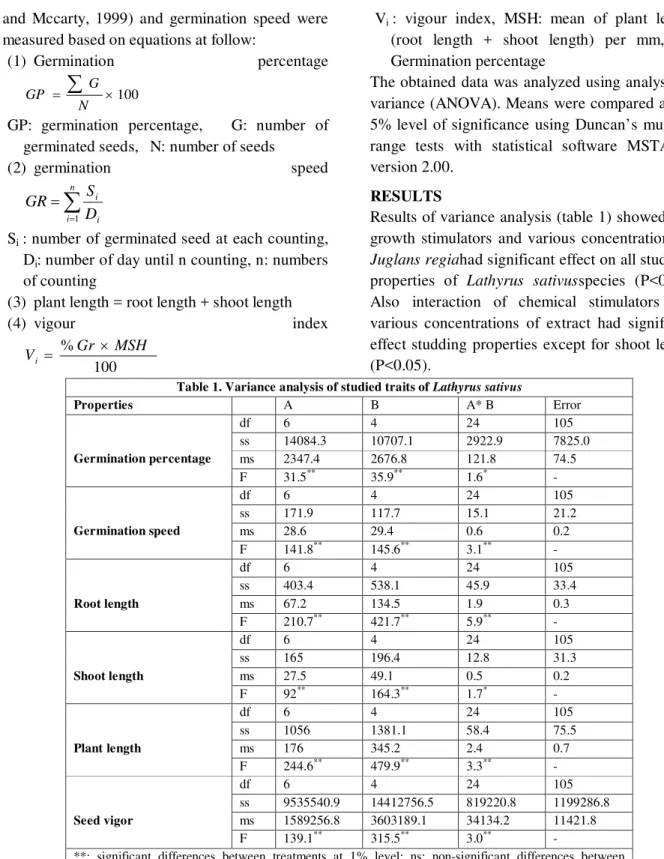
Results of variance analysis (table 1) showed that growth stimulators and various concentrations of
Juglans regiahad significant effect on all studding
properties of Lathyrus sativusspecies (P<0.01).
Also interaction of chemical stimulators and various concentrations of extract had significant effect studding properties except for shoot length (P<0.05).
Table 1. Variance analysis of studied traits of Lathyrus sativus
Properties A B A* B Error
Germination percentage
df 6 4 24 105
ss 14084.3 10707.1 2922.9 7825.0 ms 2347.4 2676.8 121.8 74.5 F 31.5** 35.9** 1.6* -
Germination speed
df 6 4 24 105
ss 171.9 117.7 15.1 21.2 ms 28.6 29.4 0.6 0.2 F 141.8** 145.6** 3.1** -
Root length
df 6 4 24 105
ss 403.4 538.1 45.9 33.4 ms 67.2 134.5 1.9 0.3 F 210.7** 421.7** 5.9** -
Shoot length
df 6 4 24 105
ss 165 196.4 12.8 31.3 ms 27.5 49.1 0.5 0.2 F 92** 164.3** 1.7* -
Plant length
df 6 4 24 105
ss 1056 1381.1 58.4 75.5 ms 176 345.2 2.4 0.7 F 244.6** 479.9** 3.3** -
Seed vigor
df 6 4 24 105
ss 9535540.9 14412756.5 819220.8 1199286.8 ms 1589256.8 3603189.1 34134.2 11421.8 F 139.1** 315.5** 3.0** -
**: significant differences between treatments at 1% level; ns: non-significant differences between treatments; A = pretreatment; B = allelopathic extract.
Germination percentage and speed
The results of this research showed that
germination percentage of Lathyrus
sativusdecrease by increasing various
concentrations of allelopathic extract of Juglans
control treatment and various concentrations of extract. All the growth stimulators could increase
germination percentage of Lathyrus sativusseeds
comparing to control treatment (fig. 1) so that maximum of germination percentage was related to various concentrations of gibberelic acid. Interaction effects of growth stimulators and
various concentrations of Juglans regiaon
germination percentage of Lathyrus sativusseeds
were significance (P<0.01) (Fig. 1). Results showed that germination speed of seeds that were exposure of various concentrations of extracts had significant differences with the control treatment. Using of the growth stimulators doesn’t have any effect on germination speed so that they decreased germination speeds compare to control treatment (fig. 2). a b cd d ef g a a b cd e a b c a b cd e fg h a bc d a b cd e cd e cd
e bcd
e g h b cd e a b cd b cd e d ef g d e
fg defg
i cd e f b cd e d e fg fg h d e fg d e fg j d ef g cd e ef g h h ef g h 0 10 20 30 40 50 60 70 80 90 100
100mg/l 200mg/l 300mg/l 125ppm 250ppm 500ppm
SA GA3 Control
g er m in a ti o n (% ) 0 25% 50% 75% 100%
Fig. 1. Interaction comparison of growth stimulators and various concentrations on germination of Lathyrus sativus
a e fg h b b ef g h fg h i b b m n c d e c d e e fg h h ij k c d e b c n o e fg e fg h k l jk l jk l b c d o p g h ij fg h i lm n o lm d e f p jk l ij k l lm n o m n 0 1 2 3 4 5 6 7 8
100mg/l 200mg/l 300mg/l 125ppm 250ppm 500ppm
SA GA3 Control
g e rm in a ti o n s p ee d (s ee d /d a y ) 0 25% 50% 75% 100%
Fig. 2. Interaction comparisons of growth stimulators and various concentrations on germination speed of Lathyrus sativus
Root, shoot and plant length
Interaction effect of growth stimulators and various concentrations of extract of Juglans regiawere
significance on root length. All stimulators improved root length in stress condition with extract of Juglans
d e h ij k a ef b d e c h ij ij k l b f d e f fg k lm n o p d g h fg k lm n h p q q r ef h ij k ij k l n o p h ij k q r r h i jk lm m n o o p lm n o 0 2 4 6 8 10 12 14
100mg/l 200mg/l 300mg/l 125ppm 250ppm 500ppm
SA GA3 Control
R o o t L en g th (c m ) 0 25% 50% 75% 100%
Fig. 3. Interaction comparison of growth stimulators and various concentrations on root length of Lathyrus sativus.
Results also indicated that Interaction effects of growth stimulators and various concentrations of extract of Juglans regiawere significance on shoot length. The highest shoot length of Lathyrus sativuswas related to
use of gibberllic acid treatment in stress and non stress conditions. Various concentrations of Juglans
regiareduced shoot length of the species. Growth stimulators caused an increase in shoot length in stress condition which differences were significance (Fig. 4).
b cd fg h i a b c a c d e a ef ij k lm a e fg b c e fg h b c d fg h i lm b fg h i d e h ij k e f ij k lm n d e g h ij h ij k ij k l h ij k jk lm n ef g m ij k lm jk lm k lm 0 1 2 3 4 5 6 7 8
100mg/l 200mg/l 300mg/l 125ppm 250ppm 500ppm
SA GA3 Control
S h o o t le n g th (c m ) 0 25% 50% 75% 100%
Fig. 4. Interaction comparison of growth stimulators and various concentrations on shoot length of Lathyrus sativus.
Mean comparison of data showed that interaction effect of growth stimulators and various concentrations of Juglans regiawere significant on plant length so that plant length reduced by increasing concentration of Juglans regia. In reverse all concentrations of growth stimulators caused an increase in plant length of Lathyrus sativusin stress condition except for 500 ppm gibberellic acid. The highest its plant length was related to use of gibberellic acid at 250 ppm in stress and non stress conditions (fig. 5).
cd ij a d e b c d e b h j jk l b fg cd fg e f jk m n c h i fg jk l g h m n o ef ij g lm ij n p h i k lm lm m n lm 0 5 10 15 20 25
100mg/l 200mg/l 300mg/l 125ppm 250ppm 500ppm
SA GA3 Control
P la n t le n g th (c m ) 0 25% 50% 75% 100%
Fig. 5. Interaction comparison of growth stimulators and various concentrations on plant length of Lathyrus sativus.
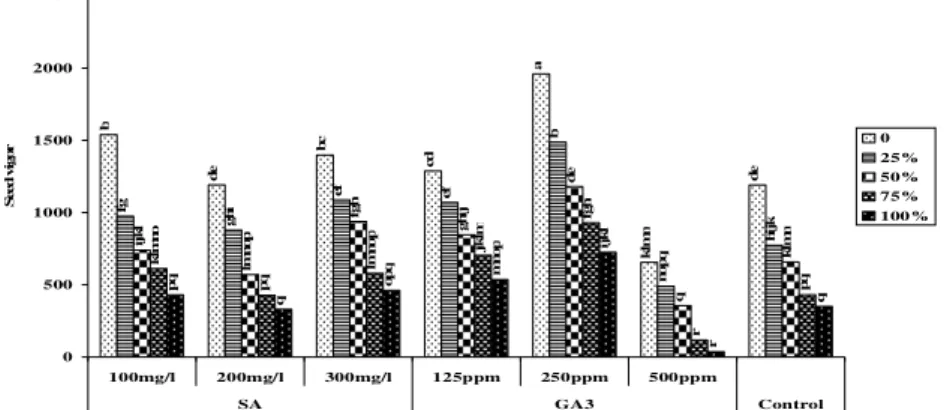
Mean comparison showed that interaction effect of growth stimulators and various concentrations Juglans regiawere significance on vigourindex. Results showed that vigourindex reduced by increasing the
concentration of Juglans regiaand it was significance by comparison to the control treatment. In reverse
growth stimulators increased vigority of seeds as the highest increase was related to gibberellic acid at 250 ppm (fig. 6).
b
d
e
b
c
cd
a
k
lm
n
d
e
fg
g
h
i
ef ef
b
n
o
p
q
h
ij
k
ij
k
l
lm
n
o
p
fg
h
g
h
ij
d
e
q
k
lm
n
k
lm
n
o
p
q
lm
n
o
p
jk
lm
fg
h
r
p
q
p
q
q
o
p
q mn
o
p ijk
l
r
q
0 500 1000 1500 2000 2500
100mg/l 200mg/l 300mg/l 125ppm 250ppm 500ppm
SA GA3 Control
S
ee
d
v
ig
o
r 0
25% 50% 75% 100%
Fig. 6. Interaction comparison of growth stimulators and various concentrations on seed vigor of Lathyrus sativus.
DISCUSSION AND CONCLUSION
The objective of this research was to test effects of pretreatment (salicylic and gibberellic acid) on
germination properties of Lathyrus sativusunder
stress condition. Results of this research showed that growth stimulators used in this study plays key role in reduction of stress induced by
allelopahic compounds of Juglans regia. These
results are coincide with the results of Saberi et al. (2011) who stated growth stimulators such as gibberellic and salicylic acid could be used as stimulator for improving germination under allelopathic condition. Obtained results from Kang
and Saltveit (2002) and Tasgin et al (2003) also
verify this hypothesis that salicylic acid is a suitable stimulator for seed germination. Salicylic acid increases the germination by neutering of free radicals or active oxygen (Hus and Sung, 1997), increasing of antioxidant such as ascorbate [3], decreasing of ion transfers and accumulation of toxic ions [17] and increasing of some plant hormones such as auxins and cytokinins [22]. In addition to effect of salicylic acid in increasing plant growth in stress condition, this research confirms importance of these phenolic compounds on improvement of initial growth stage when
seeds expose to stress condition with Juglans
regia. Germination and early seedling growth decreased by increasing extract concentration. This may be because of inhibitive effects of allelochemical on gibberellic acid. Pretreatment with gibberellic acid increased germination and
early seedling growth of Lathyrus
sativussignificantly under stress and non stress condition. This hormone has an important role in germination of seeds [19]. Gibberellic acid increases enzymatic synthesis such as hydrolytic enzymes. Synthesized enzymes transfer to endosperm and cause digestion of reserve food and provide supply of energy for germination and growth. Delay or stimulate in digestion of reserve food may cause lack of productions of respiration and consequently caused lack of ATP in seeds exposed to allelochemicals. Disorder in respiration results limits in metabolic energy and causes decrease in germination and early seedling growth [7].
Over all, results indicated that pretreatment of seeds by gibberellic and salicylic acid cause
improvement in germination properties of
Lathyrus sativusunder stress and non-stress condition. It is suggested that 250 ppm of gibberellic acid was used as pretreatment to
Lathyrus sativus. Hence germination percentage
and establishment of Lathyrus sativusmust be
increased by pretreatment with gibberellic acid before planting in field.
REFERENCES
1. Afzal I., (2005). Ph.D. Thesis, Agricultural
University of Faisalabad, Pakistan, 266 p.
2. Ashraf M., M.R. Foolad, (2005). Advances in
Agronomy, 88:223- 265.
3. Baalbaki R.Z., R.A. Zurayk, M.M. Blelk, S.N.
Tahouk, (1999). Seed Sciences and
Technology, 27:291-302.
4. Bor M., F. Ozdemir, I. Turkan, (2003). Plant
Science, 164:77-84.
5. Burguieres E., P. McCu, Y.I. Kwon, K. Shetty,
(2007). Bioresource Technology, 98:1393-1404.
6. Camberato J., B. Mccarty, (1999). South
CarolinaTurfgrass Foundation News, 6: 68.
7. Cirac C., A.K. Ayan, K. Kevseroglu, (2004).
Pak. J. Biol. Sci., 7: 182-186.
8. Glass A.D.M., (1974). J. Exp. Bot.,
25:1104-1113.
9. Ghobadi M, M Shafiei-Abnavi, S
Jalali-Honarmand, ME Ghobadi, GR Mohammadi, (2012). Annals of Biological Research, 3 (7):3156-3160
10.Harris D., A.K. Pathan, P. Gothkar, A. Joshi,
W. Chivasa, P. Nyamudeza, (2001). Agric. Syst, 69: 151-164.
11.He Y.L., Y.L. Liu, Q. Chen, A.H. Bian,
(2002). Journal of Plant Physiology, Molecular and Biology, 28: 89-95.
12.Horii A, P. McCue, K. Shetty, (2007).
Bioresource Technology, 98: 623–632.
13.Hus J.L., J.M. Sung, (1997). Physiologa
Plantarum, , vol. 100: 967-974.
14.Inderjit W.J., (2001). Agronomy Journal, vol.
93: 79-84.
15.Kang H.M., M.E. (2002). Saltveit, Plantarum,
115: 571-576.
16.Kaya M.D., G. Okçu, M. Atak Y. Çıkılı, Ö.
Kolsarıcı, Europ. (2006). J. Agronomy, 24:
291–295.
17.Krantev A., R. Yordanova, T. Janda, G. Szalai,
L. Popova, (2008). J. Plant Physiol., 165: 920-931.
18.Naser-alavi S.M., G.h. Safari, M. Govahi,
(2008). The First National Iranian Seed Science and Technology, Iran.
19.Ritchie S., S. Gilroy, (1998). New Phytologist,
140: 363–383.
20.Saberi M., A.R. Shahriari, F. Tarnian, M.
Jafari, H. Safari, (2011). Frontiers of Agriculture in China, 5: 310-321.
21.Senaratna T., (2003). Plant Growth Regulation,
vol. 30: 157-161.
22.Sharikova F., A. Sakhabutdinova, M.
Bezrukova, R. Fatkhutdinova, D.
Fatkhudinova, (2003). Plant Sci., vol. 164: 317-322.
23.Tasgin E., O. Atic, B. Nalbantoglu, (2003).
Plant Growth Regul, 41:231-236.
24.Zahedi SM, M Azizi, H Gheysari, (2012).
Annals of Biological Research, 3 (8):4192-4194
25.Zhou Zh.Sh., K. Guo, A. Abdou Elbaz, Zh.M.
Yang, (2009). Environmental and