63
[Notes from the Field]
A Note on the Distribution and Geographical Variation of the Gray-sided
Vole (
Clethrionomys rufocanus
Sund., 1846-1847) in Mongolia
Davaa Lkhagvasuren
1, Ravchig Samiya
1and Bazartseren Boldgiv
21 Department of Zoology, Faculty of Biology, National University of Mongolia, Ulaanbaatar 210646, Mongolia, E-mail: [email protected], [email protected]
2 Department of Ecology, Faculty of Biology, National University of Mongolia, Ulaanbaatar 210646, Mongolia, E-mail: [email protected]
Abstract
In this paper, we present a new distribution record for the Gray-sided vole found in an isolated birch forest in southern Mongolia, at Ih Bogd mountain. This represents a very remote and isolated population of this species from its main range of forested areas. Morphological characters were used to determine the morphological variation of Gray-sided vole in the investigated southern population in comparison with two other populations: one from Honin nuga (Hentii mountain range) and the other from Hangai mountains. We revealed fi ve distinct morphotypes based on the fur coloration patterns. Two morphotypes were found in the isolated Ih Bogd population, while there were two morphotypes for the Hentii and one for the Hangai population. Moreover, based on the nine standard skull measurements, we found a marginally signifi cant difference among the three populations, indicating that there are detectable differences. However, the discriminant function analysis was moderate in classifying the three populations. This small variation may be explained by our limited sample sizes (6-15 individuals per population) and possibly by the fact that the southern population of this species may have been isolated only for a short time.
Key words: Gray-sided vole, distribution, geographical variation, Mongolia
Introduction
Mongolia ranges 2368 km from east to west and 1260 km from south to north, covering almost 1.6 million square kilometers. Although Mongolia comprises many different types of ecosystem, in general it contains the northern part of the Central Asian Gobi desert and the southern part of the Siberian taiga, with the steppe zone in between. Southern Mongolia is mostly Gobi desert, except for a few mountain ranges. Forested areas are found in Hövsgöl, Hentii and Hangai mountains, as well as in the northern parts of the Mongol Altai mountain range (Sokolov et al., 1985).
A total of 136 species of mammals belonging to 70 genera, 22 families and 8 orders have been recorded for Mongolia. From these, the order Rodentia is the most diverse group, accounting for 65 species in 8 families (Dulamtseren, 1989). A commonly distributed species of the genus Clethrionomys in the forest region are the Gray-sided vole, Clethrionomys rufocanus and the Northern red-backed vole, Clethrionomys rutilus.
They occur exclusively in forested areas, and the Gray-sided vole occurs more abundantly than the other. With its large distribution range, the Gray-sided vole exhibits a considerable geographic variation (Kaneko et al., 1998).
Members of a joint expedition in 2001 by the Philipps-University of Marburg, Germany and the National University of Mongolia investigated the mammal communities in the Ih Bogd mountain, which is located in Bogd soum of Bayanhongor Aimag. As a result, the Gray-sided vole was found in the remnant forest island (N44058.510’; E100019.600’) of the Ih Bogd mountain, which is a part of the Gobi Altai mountain range. This presents a new record for the distribution of the Gray-sided vole in southern Mongolia. We aimed to determine whether there is detectable geographic variation in the isolated population of the Gray-sided vole found in Ih Bogd, that is deeply penetrated into the Gobi zone, using materials our own and previous research work. Specifi cally, we attempt (a) to synthesize existing data on the distribution of the Gray-sided vole in Mongolia and (b) to describe
Lkhagvasuren et al. Distribution and geographical variation of the gray-sided vole 64
the morphology of the Gray-sided voles inhabiting the relict birch forest in the Gobi Altai mountain range to determine if there is geographic variation for this isolated population.
Materials and Methods
We examined a total of 137 specimens (83 skins, 61 teeth, and 33 skulls): 101 (45 skins, 41 teeth, and 15 skulls) specimens of C. rufocanus collected from Honin nuga of the Hentii mountain range (N49005.220’; E107017.440’) collected by R. Samiya and co-workers; 32 (17 skins, 9 teeth, and 6 skulls) specimens from Tuvshruuleh soum of Arhangai Aimag (Hangai mountain range) collected by S. Dulamtseren and co-workers; and 44 (21 skins, 11 teeth, and 12 skulls) specimens from Ih Bogd of the Gobi Altai mountain range (N44058.510’ E100019.600’).
Sherman live-traps were used for capturing small mammals. Although, this trapping method was originally used to estimate population and community structures of small mammals via the capture-mark-recapture technique, we collected some individuals of the Gray-sided vole during the trapping effort for detailed analysis. Although we looked at tooth variation as it is considered an important tool for classifi cation effort (Gromov & Polyakov, 1977; Kaneko, 1991), we do not report the results in this note.
Color variation of the fur is a criterion to distinguish species and genera of animals, especially small mammals. As the fur color changes depending on climate and habitat, it is generally used to assess geographical variation among populations. We attempted to determine the variation in the ventral color, width of the dorsal band, dorsal color, lateral color and color transition on dorso-lateral side among the Hangai, Hentii (Honin nuga) and Gobi Altai (Ih Bogd) populations. Skull measurements were made on nine variables: greatest (overall) length, condylobasal length, zygomatic breadth, least interorbital breadth, nasal length, maxillary tooth row, diastema length, mastoid breadth, and palatal length following the standard guidelines (DeBlase & Martin, 1981). In order to minimize the researcher bias, only one observer made the skull measurements. Multivariate ANOVA and discriminant function analysis (Manly, 1994; Quinn & Keough, 2002) were done using the statistical package SYSTAT 11 (Systat Software,
Inc., Point Richmond, California, www.systat. com).
Results
Distribution of the Gray-sided vole
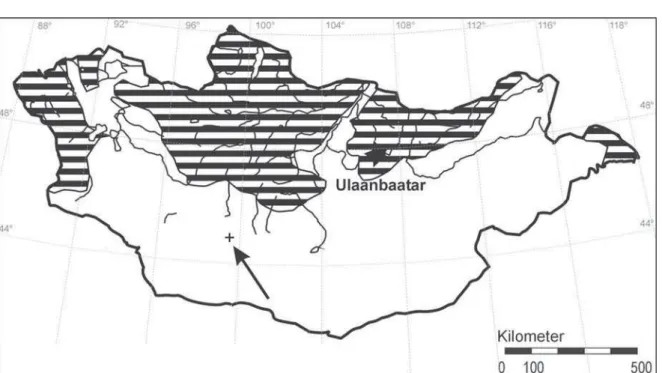
The Gray-sided vole is exclusively a forest species, thus its distribution overlaps with that of forested area. The fi rst distribution map of the Gray-sided vole in Mongolia was published by Dulamtseren (1970). Later, Sokolov and Orlov (1980) presented a revised form of this map (Figure 1). These are the only distribution maps developed for this species.
In Mongolia, the species occurs in Ih Hyangan in the east, Hangai, north-facing slopes of Han Höhii and Hasagt Hairhan (Mongol Altai mountain range), Tarvagatai (northern part of the Hangai mountain range), Bulnai, Horidol Saridag in the Hövsgöl Aimag and the Hentii mountain range (Dulamtseren & Tsendjav, 1989). Our fi nding from this research led to a new record of the distribution of this species in the Ih Bogd mountain of the Gobi Altai mountain range, making it the southernmost record of the Gray-sided vole in the country (Figure 1). This in itself is quite an interesting report as Ih Bogd mountain is isolated from other forested areas.
Geographical variation of fur color
Five fur color morphotypes could be distinguished in the Gray-sided voles collected from Hangai (Tuvshruuleh soum, Arhangai Aimag), Hentii (Honin nuga), and Gobi Altai (Ih Bogd). These morphotypes are shown in Figure 2. Two morphotypes of the Ih Bogd population differed in the ventral color variation, but showed the same lateral color (white, dark gray). The Hangai morphotype differs from the Hentii population by showing a more slender dorsal color stripe (Figure 3).
Figure 1. Distribution map of the Gray-sided vole (Clethrionomys rufocanus Sund.,) after Sokolov & Orlov (1980). The + marks the new record in the Ih Bogd mountain range.
Variation in skull measurements
We examined our ability to discriminate between the three populations of the Gray-sided vole (Hangai, Honin nuga and Ih Bogd) on which we measured nine skull variables. The result of MANOVA indicated marginally signifi cant differences among the three populations (Table 1) for the fi rst discriminant function.
We solved the classifi cation function for each population (Table 2).
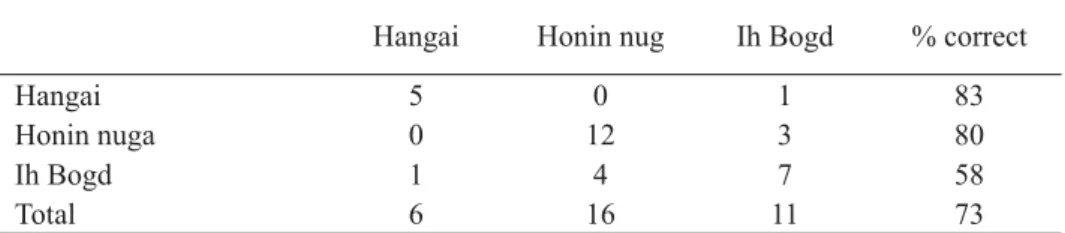
The classifi cation matrix shows that we could more correctly classify some populations than others (Table 3). We were most successful at discriminating the Hangai population of the Gray-sided vole and least the Ih Bogd population. The plot of the scores for the fi rst two discriminant functions shows that there is a considerable overlap between the three populations for both functions (Figure 4). Although the Hangai population of the Gray-sided vole was more distinct from the other two, the Ih Bogd population was the tightest (Figure 4).
Discussion
According to Denisman et al. (1989), fossil trees (Betula, Larix, Pinus, and Abies) with an age of 4000-4500 BP were found in the debris layer in the Burhan Buudai mountain (southwest of Ih Bogd) and Bayan Sair (southeast of Ih Bogd). Today only about 50 hectares of birch trees are remaining in the Ih Bogd mountain (Cermak, 2002). From this,
it can be hypothesized that the former forests have been reduced in size following climatic changes that left the birch trees as remnants isolated from its main range. We found that the Gray-sided vole, which is a species of the forest-steppe zone, is still found in this birch forest today. This record can be interpreted as an indication of a former continuous forest distribution including the now isolated birch forest in the Ih Bogd mountain. A similar conclusion can be reached by studying soil microarthropods of the Gobi Gurvan Saihan mountains, which are also a part of the Gobi Altai mountain range, in southern Mongolia (Bolortuya & Bayartogtokh, 2005), as soil microarthropod communities from the forest patches included species found in the main forested areas in Mongolia. In the meantime, it should also be highlighted that the species has good dispersal ability, indicated by their colonization of planted forest in the semi-arid region of Inner Mongolia (Xiaodong & Heping, 2000).
Lkhagvasuren et al. Distribution and geographical variation of the gray-sided vole 66
Table 1. Results of MANOVA for the difference between the Gray-sided vole populations from Hangai, Honin nuga and Ih Bogd based on the nine skull variables.
Test Value Approximate
F
Numerator df
Denominator
df Prob>F
Wilks’ Lambda 0.317136 1.8962 18 44 0.0427
Pillai’s Trace 0.797183 1.6937 18 46 0.076
Hotelling-Lawley Trace 1.792749 2.0915 18 42 0.0248
Roy’s Maximum Root 1.561969 3.9917 9 23 0.0035
Table 2. Classifi cation function solved for each population.
Hangai Honin nuga Ih Bogd
Constant -1199.42 -1100.27 -1126.94
Greatest skull length 34.514 33.541 34.533
Condylobasal length -32.165 -31.046 -31.993
Zygomatic breadth 49.308 43.369 45.19
Least interorbital breadth 184.51 176.429 179.997
Nasal length -41.321 -40.644 -41.559
Maxillary tooth row 32.936 32.982 33.601
Diastema length 28.106 31.026 31.736
Mastoid breadth 52.318 49.489 48.661
Palatal length 45.692 49.183 48.022
Table 3. Classifi cation matrix of the three populations of the Gray-sided vole based on nine skull variables.
Hangai Honin nug Ih Bogd % correct
Hangai 5 0 1 83
Honin nuga 0 12 3 80
Ih Bogd 1 4 7 58
Total 6 16 11 73
The result of MANOVA on the nine skull variable was marginally signifi cant, indicating that there is a detectable variation among the three populations we studied (Table 1), even though the sample sizes were relatively small (6-15 individuals). However, the discriminant function analysis was moderately successful in discriminating the three populations with an overall success rate of classifi cation 73%, as there is a considerable overlap among populations (Figure 4). Therefore, we suggest that more rigorous research is necessary to determine the geographic variation not only in fur coloration and skull variables, but also in tooth morphology. It would also be interesting to include individuals from more populations in the analysis to determine the relatedness of the Gray-sided vole populations. Only from such an analysis is it possible to determine whether the Ih Bogd population is truly a remnant population left following large scale climatic change that has caused fragmentation of forested habitats.
Results of this type of research will provide us with an opportunity to study an isolated small mammal population.
Acknowledgments
We would like to express deepest gratitude to Jan Cermak and Lars Opgenoorth, Faculty of Geography, Philipps University of Marburg, Germany for the assistance in the fi eld study. We also thank Dr. Georg Miehe, Faculty of Geography, Philipps University of Marburg, Germany for fi nancial support and organization of the fi eld work.
References
-3 -2 -1 0 1 2 3 4 Discriminant function 1
-3 -2 -1 0 1 2 3 4
Discriminant func
tion 2
Ih Bogd Honin nuga Hangai LOCATIONS:
Figure 4. Plot of discriminant function scores for the three populations of the Gray-sided vole for the fi rst two functions from discriminant function analysis on the nine skull measurements.
Gobi Altai Hangai Hentii Gobi Altai Hangai Hentii
Figure 2. Ventral color variation in the morphotypes of the Gray-sided vole. 1 and 3 are morphotypes from the Gobi Altai (3 is from the Ih Bogd), 2 and 4 are morpho-types from the Hentii, and 5 is a morphotype from the Hangai mountain range.
Figure 3. Dorsal color variation in the morphotypes of the Gray-sided voles from the Gobi Altai, Hangai and Hentii.
Bolortuya, Ts. & Bayartogtokh, B. 2005. Ecology of soil microarthropods in Govi Gurvan Saykhan mountains, southern Mongolia. Erforschung der Biologischer Ressourcen der Mongolei 9: 53-58. Cermak, J. 2002. Isolated Birch Forest in
Southern Mongolia and Nomads: A Case Study for Biodiversity Conservation. MA Thesis. University of London.
DeBlase, A.F. & Martin, R.E. 1981. A Manual of Mammalogy with Keys to Families of the
World. 2nd ed. Wm. C. Brown Co. Dubuque.
Dinesman, L.G., Kiseleva, N.K. & Knyazev, A.B. 1989. The History of Steppe Ecosystems
in Mongolian People’s Republic. Nauka, Moscow. (in Russian)
Dulamtseren, S. 1970. Identifi cation key to the Mammals of the Mongolian People’s Republic. Mongolian Academy of Sciences Press, Ulaanbaatar. (in Mongolian)
Dulamtseren S. & Tsendjav, D. 1989. Mammals of Mongolia. In Shagdarsuren O., (eds). Fauna of Mongolian People’s Republic: Mammals. Mongolian State Publishing House, Ulaanbaatar. (in Mongolian)
Lkhagvasuren et al. Distribution and geographical variation of the gray-sided vole 68
Nauka, Leningrad. (in Russian)
Kaneko, Y. 1991. Identifi cation and morphological characteristics of Clethrionomys rufocanus, Eothenomys shanseius, E. inez and E. eva from the USSR, Mongolia, and northern and central China. Journal of the Mammalogical Society of Japan 16: 71-95.
Kaneko, Y., Nakata, K., Saitoh, T., Stenseth, N.C. & , Bjørnstad, O.N. 1998. The biology of the vole Clethrionomys rufocanus: a review. Researches on Population Ecology 40: 21-37. Manly, B.F.J. 1994. Multivariate Statistical
Methods. 2nd ed. Chapman & Hall. New York.
Quinn, G.P. & Keough, M.J. 2002. Experimental Design and Data Analysis for Biologists. Cambridge University Press, Cambridge Sokolov, V.E. & Orlov, V.N. 1980. Identifi cation
Key to the Mammals of the Mongolian People’s Republic. Nauka, Moscow. (In Russian) Sokolov, V.E., Shvetzov, J.G. & Litvinov, N.I.
1985. Small Mammals of the Forests of the Mongolian People’s Republic. Nauka, Moscow. (In Russian)
Xiaodong, W.U. & Heping, F.U. 2000. Study on rodent community structure and pest harm type in semi-arid region of Inner Mongolia. Acta Theriologica Sinica 20: 21-29.
Õóðààíãóé
Э
.
,
.
ё (
Х Х ,
Х
) ,
.
.
ё , Х
ё , Х .
. (discriminant function
( 73%
).
( 6-15 )
.