www.biogeosciences.net/14/215/2017/ doi:10.5194/bg-14-215-2017
© Author(s) 2017. CC Attribution 3.0 License.
Biogeochemical constraints on the origin of methane in an alluvial
aquifer: evidence for the upward migration of methane from
underlying coal measures
Charlotte P. Iverach1,2, Sabrina Beckmann3, Dioni I. Cendón1,2, Mike Manefield3, and Bryce F. J. Kelly1 1Connected Waters Initiative Research Centre, UNSW Australia, UNSW Sydney, NSW, 2052, Australia
2Australian Nuclear Science and Technology Organisation, New Illawarra Rd, Lucas Heights, NSW, 2234, Australia 3School of Biotechnology and Biomolecular Sciences, UNSW Australia, UNSW Sydney, NSW, 2052, Australia
Correspondence to:Charlotte P. Iverach ([email protected])
Received: 26 August 2016 – Published in Biogeosciences Discuss.: 5 September 2016 Revised: 12 December 2016 – Accepted: 24 December 2016 – Published: 17 January 2017
Abstract. Geochemical and microbiological indicators of methane (CH4) production, oxidation and migration pro-cesses in groundwater are important to understand when at-tributing sources of gas. The processes controlling the natural occurrence of CH4in groundwater must be understood, es-pecially when considering the potential impacts of the global expansion of coal seam gas (CSG) production on ground-water quality and quantity. We use geochemical and micro-biological data, along with measurements of CH4 isotopic composition (δ13C-CH4), to determine the processes acting upon CH4in a freshwater alluvial aquifer that directly over-lies coal measures targeted for CSG production in Australia. Measurements of CH4indicate that there is biogenic CH4in the aquifer; however, microbial data indicate that there are no methanogenic archaea in the groundwater. In addition, geochemical data, particularly the isotopes of dissolved in-organic carbon (DIC) and dissolved in-organic carbon (DOC), as well as the concentration of SO2−4 , indicate limited poten-tial for methanogenesis in situ. Microbial community analy-sis also shows that aerobic oxidation of CH4occurs in the al-luvial aquifer. The combination of microbiological and geo-chemical indicators suggests that the most likely source of CH4, where it was present in the freshwater aquifer, is the up-ward migration of CH4from the underlying coal measures.
1 Introduction
Interest in methane (CH4)production and degradation pro-cesses in groundwater is driven by the global expansion of unconventional-gas production. There is concern regarding the potential impacts of gas and fluid movement, as well as depressurisation, on groundwater quality and quantity in ad-jacent aquifers used to support other industries (Atkins et al., 2015; Heilweil et al., 2015; Iverach et al., 2015; Moritz et al., 2015; Owen et al., 2016; Zhang and Soeder, 2016).
unconventional-gas studies that investigate connectivity is-sues of freshwater aquifers.
Methane is subject to many production and degradation processes in groundwater (Whiticar, 1999). The carbon iso-topic composition of CH4(δ13C-CH4)gives insight into the source (Quay et al., 1999), but oxidation processes may en-rich or deplete this signature (Yoshinaga et al., 2014). There-fore, it is very difficult to determine the potential source of CH4 and processes occurring using CH4 concentration and isotopic data alone.
Previous studies have used geochemical indicators, such as the concentration of sulfate [SO2−4 ], nitrate [NO−3] and nitrite [NO−2], and the carbon isotopic composition of dissolved inorganic carbon (δ13C-DIC) and dissolved organic carbon (δ13C-DOC) to attribute the source of CH4 in groundwater (Valentine and Reeburgh, 2000; Kotelnikova, 2002; Antler, 2014; Green-Saxena et al., 2014; Antler et al., 2015; Hu et al., 2015; Segarra et al., 2015; Sela-Adler et al., 2015; Cur-rell et al., 2016). Other studies have shown that the presence of active methanogenesis can be determined using isotopes of hydrogen in the CH4(δ2H-CH4)and the surrounding for-mation water (δ2H-H2O) (Schoell, 1980; Whiticar and Faber, 1986; Whiticar, 1999; Currell et al., 2016). Additionally, re-cent studies have used clumped isotopes of CH4 and their temperature interpretations to ascribe a thermogenic versus biogenic source in groundwater (Stolper et al., 2014). How-ever, non-equilibrium (kinetic) processes may be responsible for an overestimation of CH4formation temperatures (Wang et al., 2015). Microbiological indicators (in addition to geo-chemical data) may resolve some of the uncertainties asso-ciated with the determination of CH4origin, as they directly discriminate between microbiological communities involved in either production or degradation processes. There are no studies using combined geochemical and microbiological in-dicators to assess CH4production and degradation processes in a freshwater aquifer. We aim to fill this gap in the litera-ture.
Throughout the world the occurrence of freshwater aquifers adjacent to unconventional-gas production is com-mon (Osborn et al., 2011; Moore, 2012; Roy and Ryan, 2013; Vidic et al., 2013; Vengosh et al., 2014; Moritz et al., 2015). We have previously shown that there may be local natural connectivity between the WCM and the CRAA (Iverach et al., 2015). Here we show that a combination of geochemi-cal data ([CH4], [SO2−4 ], [NO−3], [NO−2],δ13C-CH4,δ13 C-DIC, δ13C-DOC andδ2H-H2O), as well as characterisation of microbiological communities present, can inform the dis-cussion surrounding the occurrence of CH4and its potential for upward migration in the groundwater of the CRAA. 1.1 Geochemical indicators of methanogenic processes
Methanogenesis via acetate fermentation (Eq. 1) and carbon-ate reduction (Eq. 2) can be restricted in groundwcarbon-ater with abundant dissolved SO2−4 (>19 mg L−1) (Whiticar, 1999)
because sulfate-reducing bacteria (SRB) often outcompete methanogenic archaea for reducing equivalents (Lovley and Klug, 1985; Struchtemever et al., 2005).
CH3COOH→CH4+CO2 (R1)
CO2+8H++8e−→CH4+2H2O (R2)
Therefore, the presence or absence of [CH4] and [SO2−4 ] are good preliminary indicators of the potential for in situ methanogenesis.
In addition, the δ13C-CH4 of the underlying WCM in and around the study area has been characterised. Draper and Boreham (2006) characterised the isotopic signature of the WCM to be between−57.3 and−54.2 ‰. Hamilton et al. (2014) and Baublys et al. (2015) expanded this range to be from −58.5 to −45.3 and −57 to −44.5 ‰, respec-tively. Recently, Owen et al. (2016) have established a “shal-low” WCM directly underlying the alluvium and a deeper “gas reservoir”. The isotopic signatures of these range from −80 to−65 and−58 to−49 ‰, respectively. These values are summarised in Table 1, along with available ranges of
δ13CDICfor the study area. Thus, the isotopic signature can be used to identify the potential source of the CH4; however, localised formation and oxidation processes that may occur either in the aquifer or during transport can confound the in-terpretation of mixing versus oxidation processes.
The isotopic compositions of DIC and DOC are also use-ful indicators of CH4processes, as they can be used to deter-mine the occurrence of methanogenesis (Kotelnikova, 2002; Wimmer et al., 2013). Kotelnikova (2002) found that 13C depletion ofδ13C-DOC in combination with a13C enrich-ment ofδ13C-DIC was characteristic of methanogenesis in groundwater, consistent with the reduction of12CO2by au-totrophic methanogens. Conversely,δ13C-DIC data are use-ful because DIC produced during CH4oxidation was found to have a characteristically 13C-depleted signature (as de-pleted as−50 ‰) (Yoshinaga et al., 2014; Hu et al., 2015; Segarra et al., 2015).
1.2 Methane oxidation in freshwater
Table 1.Observed ranges ofδ13CCH4andδ13CDICfor the WCM in previous studies.
Location of samples δ13CCH4range δ 13C
CH4median δ 13C
DIC Source
WCM Surat Basin −57.3 to−54.2 ‰ nd nd Draper and Boreham (2006) WCM – upper and lower measures −58.5 to−45.3 ‰ −51.8 ‰ nd Hamilton et al. (2014) WCM – upper and lower measures −57.0 to−44.5 ‰ −52.1 ‰ 14.2 ‰ (median) Baublys et al. (2015) WCM gas reservoir −58.0 to−49.0 ‰ −51.6 ‰ 9.0 to 23.0 ‰ Owen et al. (2016) WCM shallow −80.0 to−65.0 ‰ −75.0 ‰ −15.9 to−3.5 ‰ Owen et al. (2016)
monooxygenase (sMMO) (McDonald et al., 1995; Murrell et al., 2000). Recently, new groups of aerobic and anaero-bic MOB distantly related to known methanotrophic groups have been discovered (Raghoebarsing et al., 2006; Stoecker et al., 2006; Op den Camp et al., 2009). Geochemically, the expression of thepmoAandmmoXis triggered by the amount of available Cu ions. In addition, aerobic CH4oxidation has been previously coupled to denitrification in groundwater (Zhu et al., 2016).
Besides methanotrophic bacteria, anaerobic CH4-oxidising archaea (ANME) also play a significant role in the oxidation of CH4in both freshwater and saline water sources (Knittel and Boetius, 2009). These anaerobic methanotrophs are associated with the methanogenic Euryarchaeota within the clusters ANME-1, ANME-2 and ANME-3 and are closely related to the ordersMethanosarcinalesand Metha-nomicrobiales (Knittel et al., 2003, 2005). Geochemical indicators can provide evidence for the occurrence of AOM (anaerobic oxidation of methane), such as the prevalence of certain electron acceptors (SO2−4 , NO−3, NO−2 and Fe2+) (Valentine and Reeburgh, 2000; Ettwig et al., 2010; Sivan et al., 2011; Antler, 2014; Green-Saxena et al., 2014) and denitrification processes occurring in the groundwater (Ettwig et al., 2008; á Norði and Thamdrup, 2014; Timmers et al., 2015).
2 Study area
The CRAA is the primary aquifer in the Condamine Catch-ment (Fig. 1). It is used for irrigated agriculture, stock and domestic water supplies. There has been increased interest in the presence of CH4in the aquifer due to expanding CSG production to the north-west of the study area (Fig. 1). CSG production began in 2006 (Arrow Energy, 2015) and has been expanding in the decade since then. This has raised concerns regarding the quality (especially with respect to CH4 concen-trations) and quantity of the groundwater in the CRAA.
Hydrogeological setting
The CRAA sits within the Surat Basin, which sits within the Great Artesian Basin (GAB) in south-east Qld, Australia (Radke et al., 2000; Ransley and Smerdon, 2012) (Fig. 2).
Aquifers in the GAB vary between semi-confined and con-fined (Kelly and Merrick, 2007; Dafny and Silburn, 2014).
The environment of deposition for the Surat Basin was flu-violacustrine in the late Triassic–Jurassic and shallow marine and coastal in the Cretaceous (Hamilton et al., 2012). The middle-Jurassic WCM are a group of low-rank coal seams in the Surat Basin targeted for CSG production (Hamilton et al., 2012). The WCM are thicker (150 to 350 m) along the western margin of the CRAA and thin to around 50 m in the east, where the unit outcrops (KCB, 2011); however, only around 10 % of this is coal. The unit consists of very fine-to medium-grained sandsfine-tone, siltsfine-tone, mudsfine-tone and coal, with minor calcareous sandstone, impure limestone and iron-stone (KCB, 2011). The coal consists of numerous discontin-uous thin lenses separated by sediments of low permeability (Hillier, 2010). The unit dips gently to the west (around 4◦), which is consistent with the general trend of the Surat Basin in this region.
The WCM overlie the Eurombah Formation (consisting of conglomerate sandstone with minor siltstones and mudstone beds) and underlie the Kumbarilla Beds (mainly sandstone, with lesser mudstone, siltstones and conglomerates) (KCB, 2011).
The unconfined CRAA fills a paleovalley that was carved through the GAB (including the WCM). The valley-filling sediments are composed of gravels and fine- to course-grained channel sands interbedded with floodplain clays and, on the margins, colluvial deposits, which were deposited from the mid-Miocene to the present (Huxley, 1982; Kelly and Merrick, 2007; Dafny and Silburn, 2014). The valley-filling sediments have a maximum thickness of 134 m near Dalby (Dafny and Silburn, 2014). Along the eastern margin of the valley, the CRAA is bounded by the Main Range Vol-canics. Estimations of the sources and quantity of recharge to the CRAA vary widely; however, streambed recharge is generally considered to be the major source of freshwater to the aquifer (Dafny and Silburn, 2014).
Figure 1.Site map showing the extent of the study area and sample locations within the Condamine Catchment, south-east Queensland, Australia. Map created in QGIS; data and imagery: Statem Toner, Open Street Map and contributors, CC-BY-SA (QGIS 2.8.2 Wien, 2015). Modified with Corel Painter 2015 (Corel Corporation, 2015).
Figure 2.Geological cross section along A–A′in Fig. 1 (adapted from Dafny and Silburn, 2014). KB – Kumbarilla Beds; MRV – Main Range Volcanics.
immediately underlies the CRAA (Dafny and Silburn, 2014). This suggests that there is some level of connectivity between the CRAA and the WCM. Huxley (1982) and Hillier (2010) both suggest that the general decline in water quality down-stream is due to net flow of the more saline WCM water into the CRAA. Connectivity between the formations is not well understood; however, studies have been conducted to better understand the movement of both water and gas between the two aquifers. Duvert et al. (2015) and Owen and Cox (2015) both used hydrogeochemical analyses to show that there was limited movement of water between the two formations. By contrast, Iverach et al. (2015) used the isotopic signature of CH4 in the groundwater to show that there was localised movement of gas between the coal measures and the over-lying aquifer.
More recently, a report prepared by the Office of Ground-water Impact Assessment, Department of Natural Resources and Mines, found that a low-permeability transition layer
ex-ists between the CRAA and the zones of the WCM that could contain commercially viable CSG. The report concluded that, overall, the level of hydraulic connectivity between the CRAA and the WCM is low (OGIA, 2016). This research provides additional insight to inform the debate about the degree of connectivity for both water and gas between the WCM and the CRAA. The microbiological insights also in-form the global research on biological CH4production and degradation in alluvial aquifers, in particular for zones distal to the river corridor.
3 Methods
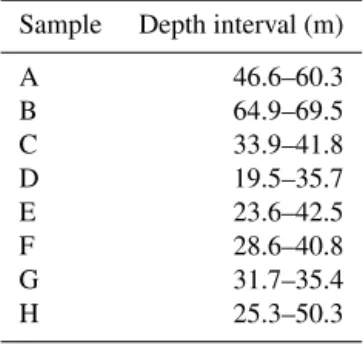
From 22 to 31 January 2014 we collected groundwater sam-ples for geochemical analysis from eight private irrigation boreholes in the Condamine Catchment (locations shown in Fig. 1). Iverach et al. (2015) outlines the complete methods for sample collection for [CH4] and δ13C-CH4 and subse-quent analysis. The eight samples collected from the uncon-fined CRAA are representative of the aquifer, given their var-ied depths and locations (Table 2).
Table 2.Slotted depth intervals for the 8 samples.
Sample Depth interval (m)
A 46.6–60.3
B 64.9–69.5
C 33.9–41.8
D 19.5–35.7
E 23.6–42.5
F 28.6–40.8
G 31.7–35.4
H 25.3–50.3
collected after passing the water through a 0.45 µm, high-volume groundwater filter, which was connected to the pump outlet. Samples for the analysis of anions and water stable-isotopes were stored in 125 mL high-density polyethylene (HDPE) bottles and 30 mL HDPE bottles, respectively. Both had no further treatment. The water forδ13C-DIC andδ13 C-DOC was further filtered through a 0.22 µm filter and stored in 12 mL Exetainer vials and 60 mL HDPE bottles, respec-tively. Samples to be analysed for DIC were refrigerated at 4◦C and analysed within 1 month. Samples to be analysed for DOC were frozen within 12 h of collection.
Groundwater samples for the microbiological analyses were collected between 8 and 11 December 2014 from the same eight private irrigation boreholes used for the geo-chemical analyses. Groundwater samples for microbiologi-cal analysis were collected in 2 L Duran Schott bottles and sealed (gas-tight). We used aspects of the geochemical data collected in the January campaign to interpret the microbial results from the December campaign.
3.1 Geochemical analyses
The major ion chemistry in the groundwater samples was analysed at the Australian Nuclear Science and Technology Organisation (ANSTO) using inductively coupled plasma atomic emission spectroscopy for cations and ion chromatog-raphy for anions. The samples forδ2H-H2O andδ18O-H2O were analysed at ANSTO and are reported as per mill de-viations from the international standard V-SMOW (Vienna Standard Mean Ocean Water). δ18O samples were run us-ing an established equilibration, continuous-flow IRMS (iso-topic ratio mass spectrometry) method andδ2H samples were run using an online combustion, dual-inlet IRMS method (Cendón et al., 2015).
The isotopes of carbon in DIC were analysed at ANSTO using an established method on a Delta V Advantage mass spectrometer, and a GasBench II peripheral. The results are reported as a per mill deviation from IAEA secondary stan-dards that have been certified relative to V-PDB (Vienna Pee Dee Belemnite) for carbon (Cendón et al., 2015). The iso-topes of carbon in DOC were analysed at the UC-Davis (Uni-versity of California, Davis) Stable Isotope Facility; results
are reported as per mill and are corrected based on laboratory standards calibrated against NIST Standard Reference Mate-rials with an analytical precision of±0.6 ‰. Samples were run using a total organic carbon (TOC) analyser connected to a PDZ Europa 20–20 IRMS using a GD-100 Gas Trap in-terface (Meredith et al., 2016). The [SO2−4 ] were too low in six of the eight samples forδ34S andδ18O analysis. The re-maining two samples were analysed for their sulfur and oxy-gen isotope compositions at the University of Calgary Iso-tope Science Laboratory. Sulfur isoIso-tope ratios were analysed using continuous-flow elemental analysis isotope ratio mass spectrometry (CF-EA-IRMS) with an elemental analyser in-terfaced to a VG PRISM II mass spectrometer (Cendón et al., 2015). The results are reported against V-CDT (Vienna Canyon Diablo Troilite). The oxygen isotope ratio was deter-mined using a high temperature reactor coupled to an isotope ratio mass spectrometer in continuous-flow mode (Cendón et al., 2015).
3.2 DNA extraction and Illumina sequencing
DNA was extracted from the biomass collected from filter-ing 2 L of groundwater usfilter-ing a 0.2 µm filter (Merck Milli-pore). Briefly, DNA was isolated using a phenol-chloroform extraction method as described by Lueders et al. (2004). The DNA was then precipitated using polyethylene glycol 6000 (Sigma Aldrich), and the DNA pellet was washed us-ing 70 % (v/v) ethanol and resuspended in 50 µL nuclease free water (Qiagen). DNA concentration and purity were de-termined by standard agarose gel electrophoresis and fluo-rometrically using RiboGreen (Qubit Assay Kit, Invitrogen) according to the manufacturer’s instructions. The extracted DNA was used as a target for Illumina sequencing. Am-plicon libraries were generated by following Illumina’s 16S Metagenomic Sequencing Library Preparation Protocol, us-ing 12.5 ng of template DNA per reaction. The number of cycles for the initial PCR was reduced to 21 to avoid bi-ases from over-amplification. The following universal primer pair was used for the initial amplification, consisting of an Illumina-specific overhang sequence and a locus-specific se-quence:
926F_Illum(5′-TCGTCGGCAGCGTCAGATGTGTATA AGAGACAG[AAACTYAAAKGAATTGRCCG]-3′),
1392R_Illum(5′-GTCTCGTGGGCTCGGAGATGTGTA TAAGAGACAG[ACGGGCGGTGTGTRC]-3′).
specifica-tions. Illumina sequences were checked for quality (FastQC, BaseSpace) and analysed using the BaseSpace cloud com-puting platform (Illumina, 2016) and mothur (Schloss, 2009) with modified protocols (Schloss et al., 2009; Kozich et al., 2013). Taxonomy was assigned according to the SILVA Database (SILVA, 2016). To ensure even sampling depth for subsequent analyses, OTU (operational taxonomic unit) abundance data were rarefied to the lowest number of se-quences for a sample (8300 sese-quences per sample).
3.3 Quantification of bacterial and archaeal 16S rRNA and functional genes
Quantitative real-time PCR was used to determine abun-dances of bacterial and archaeal 16S rRNA gene targets and functional gene targets (mcrA, pmoA, mmoXanddsrA), using the MJ Mini™96 Well Thermal Cycler (Bio-Rad, Hercules, CA). Each qPCR (quantitative real-time PCR) 25 µL reaction mixture contained 12.5 µL of premix solu-tion from an iQ SYBRGreen qPCR Kit (Bio-Rad), 8 µL PCR-grade water, 1.5 µL of each primer (final concentra-tion 0.2–0.5 µM) and 2 µL of template DNA (10 ng). Bac-terial and archaeal 16S rRNA genes were amplified using the primer pairs 519F/907R (Lane, 1991; Muyzer et al., 1995) and SDArch0025F/SDArch0344R (Vetriani et al., 1999).
mcrAanddsrAsequence fragments were amplified using the primer pairs ME1F/ME3R (Hales et al., 1996) and 1F/500R (Wagner et al., 1998; Dhillon et al., 2003). qPCR was per-formed as described previously by Wilms et al. (2007).pmoA
qPCR was performed using the pmoA primer pair A189F (Holmes et al., 1999) and mb661R (Kolb et al., 2003) with a final total primer concentration of 0.8 µM. The qPCR pro-gramme for the amplification was as follows: 95◦C for 3 min followed by 40 cycles of 95◦C for 30 s, 64◦C for 45 s and 68◦C for 45 s. ThemmoXgene fragment was quantified us-ing the primer pairs mmoX-ms-945f and mmoXB-1401b at a final total concentration of 0.8 µM. The qPCR conditions for themmoXwere as follows: 94◦C for 3 min followed by 45 cycles of 94◦C for 1 min, 50◦C for 1 min and 72◦C for 1 min. Bacterial and archaeal targets were measured in at least three different dilutions of DNA extracts (1 : 10, 1 : 100, 1 : 1000) and in triplicate. To maintain inter-assay reliabil-ity, standards ranging from 108to 102copies µL−1were in-cluded on each assay plate to account for slight variations between runs. A no-template control (NTC) of molecular-biology-grade H2O was also included on each plate to de-tect PCR contamination. PCR products were checked by gel electrophoresis using 2 % (w/v) agarose with TBE buffer (90 mM Tris, 90 mM boric acid, 2 mM Na2-EDTA; pH 8.0). The specificity of the reactions was confirmed by melting curve analysis and agarose gel electrophoresis to identify non-specific PCR products. Amplification efficiencies for all reactions ranged from 96.3 to 110.5 % with anr2 value of
>0.99 for standard curve regression. DNA calibration stan-dards for qPCR were prepared as follows. ThemcrA, dsrA,
pmoAandmmoX genes were amplified from pure cultures of Methanosarcina barkeri(DSM 800), Desulfovibrio vul-garis(DSM 644),Methylosinus sporium(DSM 17706) and
Methylocella silvestris (DSM 15510; DSMZ, Brunswick, Germany). The PCR amplicons were purified using the DNA Clean and Concentrator™-5 kit (Zymo Research, Irvine, CA) and eluted into 20 µL DNA elution buffer. DNA concen-trations were quantified with 2 µL DNA aliquots using the Qubit® dsDNA BR Assay Kit (Invitrogen, Life Technolo-gies, Carlsbad, CA). Purified target gene PCR products were cloned into plasmids following the manufacturer’s instruc-tions for the pGEM® – T Easy Vector System (Promega, Madison, WI).
4 Results and discussion
4.1 Previousδ13C-CH4investigation
A previous study by Iverach et al. (2015) analysed theδ13 C-CH4in the groundwater from an off-gassing port on the eight private irrigation boreholes studied here (samples A–H) (Ta-ble S3 in the Supplement). These measurements were un-derstood to have been mixing with regional background at-mospheric CH4(1.774 ppm;−47 ‰); therefore, mixing plots were used to infer the isotopic source signature of the CH4 off-gassing from the groundwater. Iverach et al. (2015) found that samples E, G and H plotted on a regression line that had an isotopic source signature of−69.1 ‰ (90 % CI,−73.2 to −65.0 ‰), indicative of a biological source. However, sam-ples A, B, C, D and F plotted on a regression line that had an isotopic source signature of−55.9 ‰ (90 % CI,−58.3 to −53.4 ‰), suggesting either oxidation was occurring at the source or there was upward migration of CH4from the un-derlying WCM.
4.2 Limited geochemical and microbiological potential for methanogenesis in the groundwater
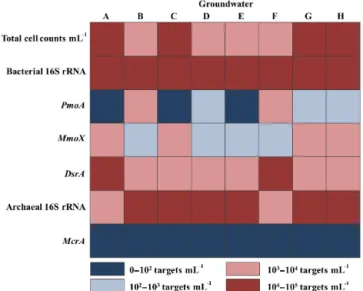
To further elucidate the source of the CH4 reported in the groundwater (Iverach et al., 2015), Illumina sequenc-ing and quantitative real-time PCR were used to target bac-terial and archaeal 16S rRNA genes, as well as specific functional genes (mcrA,pmoA,mmoXanddsrA) associated with CH4 metabolism. Microbial abundances estimated by SYBRGreen I counts were between 103and 105cells mL−1 throughout all groundwater samples (Fig. 3). This was con-gruent with the qPCR data observed for bacterial and ar-chaeal cell concentrations.
Figure 3.Total cell concentration and copy number abundances of bacterial and archaeal 16SrRNA genes and functional key genes for aerobic CH4oxidation (pmoAandmmoX), CH4production (mcrA)
and sulfate reduction (dsrA) in the groundwater carried out by quan-titative PCR. Low abundances are highlighted in dark blue. High abundances are highlighted in dark red. The calculated standard deviations for replicate quantifications of one sample were consis-tently between 10–20 %.
phylum Thaumarchaeota dominated the archaeal communi-ties with a relative abundance of 81–99 %, while Crenar-chaeota made up 1–3 %. Further sequences were related to other (if<1 % relative abundance) and unclassified Bacteria and Archaea. No members of the Euryarchaeota, compris-ing the methanogenic archaea, were observed. The archaeal
mcrA gene, which encodes the methyl coenzyme M reduc-tase, was not detected in any of the groundwater samples (detection limit <10 cells mL−1; Fig. 3). This was consis-tent with the Illumina sequencing results and suggests that the CH4observed off-gassing from the groundwater was not being produced in situ within the CRAA.
The microbial community in the groundwater was as-sumed to reflect that of the geological formations because when we sample the groundwater, we are also sampling fine particles with biomass attached. Additionally, Maamar et al. (2015) found that the microbial community composi-tion of groundwater was controlled by groundwater residence times and flow paths, independent of the geology. Further, the intense purging of the production wells in the Condamine al-luvium ensure that we are sampling groundwater that is rep-resentative of the sampled formations.
Our isotopic geochemical data also showed no evidence for the occurrence of methanogenesis in the groundwater. As previously stated, a 13C enrichment in δ13C-DIC cou-pled with a 13C depletion in the δ13C-DOC is characteris-tic of methanogenesis (Kotelnikova, 2002). Our groundwater data showed no correlation between δ13C-DOC and δ13
C-DIC (Fig. 5a), and the most13C-enrichedδ13C-DIC was also the second highest enrichedδ13C-DOC value. Additionally, on a stable water isotope plot (Fig. 5b; Table S1 in the Sup-plement), it is evident that there is no noticeableδ2H enrich-ment that can be ascribed to methanogenesis in any of the groundwater samples (Cendón et al., 2015).
These geochemical analyses, along with the lack of clas-sified methanogens, suggest that biogenic CH4 production is not one of the major processes responsible for the pres-ence of CH4 in the CRAA. Therefore, the CH4 reported in all samples in Iverach et al. (2015) must be derived from an-other source. We propose that the upward migration of CH4 from the WCM must be considered as the potential source. The isotopic signature of CH4 from the deeper coal mea-sures has been characterised between−58.5 and−45.3 ‰, indicating thermogenic CH4with a secondary biogenic com-ponent (Papendick et al., 2011; Hamilton et al., 2012, 2014). Five of the eight samples analysed in this study have an iso-topic source signature within this range, as reported in Iver-ach et al. (2015). This implies that upward migration from the deeper WCM is the source of the CH4 detected in the groundwater.
However, the remaining three samples (samples E, G and H) have a typically biogenic isotopic source signature (−69.1 ‰). Owen et al. (2016) recently characterised the iso-topic signature of both the WCM gas reservoir and the shal-low WCM layer between the gas reservoir and the overly-ing alluvium (Table 1). The isotopic signature for the shal-low WCM samples was between−80 and−65 ‰. The three samples here, which exhibit a source signature of−69.1 ‰, could potentially be sourcing CH4from the shallow WCM. This would result in a biological source signature of the CH4 in the overlying aquifer despite the absence of methanogenic archaea.
4.3 Sulfate reducers and aerobic methanotrophs potentially outcompete methanogens
Figure 4.Bacterial, archaeal and methanotrophic community profiles and relative abundances detected by Illumina sequencing.
closely related to acetate-oxidising, sulfate/sulfur-reducing bacteria (Desulfovibrionales, Syntrophobacterales, Desul-furomonadales; Fig. 4). Additionally,Methylocellaspp. are capable of using methanogenic substrates, such as acetate and methylamines, for their metabolism and therefore are not limited to growing on one-carbon compounds such as CH4 (Dedysh et al., 2005). This could have major implica-tions for the lack of methanogenic activity in the groundwa-ter. In addition, the presence of SO2−4 along with conditions favouring SRB is further evidence that in situ methanogen-esis is unlikely to be responsible for the presence of CH4in the shallow aquifer.
4.4 Microbial methane oxidation in the groundwater catalyses upward-migrating methane
from the WCM
The functional gene for aerobic CH4 oxidation (pmoA) was detected at relatively high concentrations (7.9×10²– 9.3×10³ targets mL−1) compared to the overall bacterial 16S rRNA concentration (2.5×10⁴–5.1×10⁴targets mL−1)
(Fig. 3). All groundwater samples were characterised with regard to the community structure of MOB. The samples harboured a low-diversity methanotrophic community as-sociated with the order Rhizobiales (Alphaproteobacteria); however, MOB accounted for up to 7 % of the overall mi-crobial community (Fig. 4). All groundwater samples were dominated by two MOB, belonging to the type-II methan-otrophs (Fig. 4). Five samples had bothMethylocella palus-tris(familyBeijerinckiaceae) andMethylosinus acidophilus
Figure 5. (a) A plot of δ13C-DOC vs. δ13C-DIC. There is no correlation between these geochemical data, indicating that there is no methanogenic end member in our samples. Samples E, G and H are omitted because they were below the detection limit forδ13C-DOC (Table S1 in the Supplement). Arrow 1 delineates the expected trend for methanogenesis, and arrow 2 is the expected trend for the dissolution of marine carbonates (Currell et al., 2016). Arrows 3–6 highlight expected ranges forδ13C-DIC that are off the scale of the graph (Currell et al., 2016).(b)A plot ofδ18O-H2O vs.δ2H-H2O showing that there is no2H enrichment in any of the groundwater samples. The GMWL
(global meteoric water line; Craig, 1961) and LMWL (local meteoric water line; Hughes and Crawford, 2012) are also displayed.
2000).Methylocella andMethylosinusspp. possess a solu-ble CH4 monooxygenase (mmoX) (McDonald et al., 1995; Murrell et al., 2000), which is consistent with the high abun-dance of the mmoX gene targeted in all groundwater sam-ples (Fig. 3). Interestingly, no pmoAgene, a biomarker for all MOBs, has previously been detected in known Methylosi-nusspp. (Dedysh et al., 2005). This is supported by our data, which show the sole predominance ofmmoXgenes in three of the eight groundwater samples that are exclusively domi-nated byMethylosinussp. (samples A, C and E) (Figs. 2 and 3).
In addition to low concentrations of CH4reported in Iver-ach et al. (2015), the dissolved O2(DO) in our groundwater samples had a large range, from low to close to saturation (0.91 to 8.6 mg L−1). The reported concentration of DO for the groundwater was measured at the ground surface and is therefore not an accurate measure of the in situ value. How-ever, it could contribute to the absence of methanogenic ar-chaea, as well as the abundance of aerobic bacteria. In addi-tion, the reduction of sulfate under oxic conditions has been observed (Kieldsen et al., 2004; Fike et al., 2008), which would explain the abundance of sulfate-reducing Deltapro-teobacteria in most samples, despite the high concentration of DO in the groundwater.
Methylocella spp. are not associated with the previously known type-II cluster of methanotrophs but are closely re-lated to a non-methanotroph (Dedysh et al., 2005), suggest-ing different affinities to CH4and O2compared to previously known type-II methanotrophs (Amaral and Knowles, 1995). There is no correlation between the methanotrophic commu-nity in each sample and the CH4data reported in Iverach et al. (2015) nor is there any correlation between the
composi-tion of methanotrophs and DO in the groundwater (Table S2 in the Supplement).
The sample with the most diverse bacterial community (Sample F, Fig. 4) had the most 13C-enriched individual
δ13C-CH4 relative to regional background (Iverach et al., 2015) (Table S3 in the Supplement). A relatively high abun-dance (11 %) of relatives belonging to the Chloroflexi phy-lum was observed exclusively in this groundwater sample.
4.5 Absence of anaerobic methane oxidation
The lack of detection of themcrA gene not only indicates the absence of methanogens but also suggests the absence of anaerobic methanotrophs (Hallam et al., 2003). Details on the functional genomic link between methanogenic and methanotrophic archaea are discussed comprehensively in Hallam et al. (2003). Additionally, no sequences belong-ing to ANME-SRB clades were detected in the groundwa-ter samples, indicating the absence of ANME activity. How-ever, members of the phylum Thaumarchaeota dominated the archaeal community in the groundwater (Fig. 4). Thau-marchaeota contains several clusters of environmental se-quences representing microorganisms with an unknown en-ergy metabolism (Pester et al., 2011). Members of the Thau-marchaeota encode monooxygenase-like enzymes able to utilise CH4, suggestive of a role in CH4 oxidation (Pester et al., 2011).
measure the stable isotopes in the SO2−4 . This is useful be-cause the isotopes yield a unique signature when SO2−4 re-duction is coupled to CH4oxidation in anaerobic conditions (Antler et al., 2015). However, because there are only two data points (Table S2 in the Supplement), determining a cor-relation betweenδ34S-SO4andδ18O-SO4is statistically in-valid. The highest relative abundance of methanotrophs was found in samples D and H (Fig. 4); however, these methan-otrophs are not anaerobic oxidisers and therefore the correla-tion may not imply causacorrela-tion.
The concentration of NO−3 and NO−2 in the groundwater was also very low relative to groundwaters with the potential for AOM via denitrification (á Norði and Thamdrup, 2014). Our samples had [NO−3] ranging from 1.2 to 2.3 mg L−1and [NO−2] below 0.05 mg L−1 (Table S2 in the Supplement). Therefore, AOM coupled to denitrification is unlikely to be occurring in the groundwater of the CRAA (á Norði and Thamdrup, 2014).
Theδ13C-DIC data indicate limited13C depletion as a re-sult of DIC formation during AOM. Segarra et al. (2015) showed that maximum 13C depletion of DIC in the zone of maximum AOM activity (0–3 cm) was highly dependent upon the isotopic composition of the DIC before biologi-cal consumption. However, the difference between maximum 13C depletion of DIC and13C enrichment often exceeded 10 ‰. As our samples are taken from deep in the aquifer (30 m or more below the ground surface), and the difference between our most13C-depleted DIC value and the most13 C-enriched was only 4 ‰ (Sample H; Table S1 in the Supple-ment), it is unlikely that AOM is occurring in the groundwa-ter. Additionally, a previous study of the GAB geochemistry showed thatδ13C-DIC values in this region are in the range of −15 to−6 ‰ (Herczeg et al., 1991). All of our samples fall within this regional range, and we see no obvious 13C depletion of DIC in the groundwater that can be ascribed to AOM.
Therefore, any oxidation occurring in the groundwater would have been facilitated by the two members of type-II methanotrophs that we identified in the microbial commu-nity analysis. Both of the species identified are classified as aerobic CH4oxidisers, agreeing with our geochemical data that no anaerobic oxidation was occurring. Despite abun-dant SO2−4 in two sample locations, the absence of anaero-bic methanotrophic archaea amongst other geochemical ev-idence (denitrification processes) suggests that it is unlikely that AOM is occurring within the aquifer.
The above geochemical and microbiological data place constraints on the active process, gas origin and pathways of migration. Figure 6 presents a conceptual schematic of the processes occurring between the WCM and the CRAA.
Figure 6.A conceptual schematic of the processes occurring be-tween the WCM and the CRAA.
5 Conclusion
We used geochemical and microbiological indicators to ex-plain the occurrence of CH4in the groundwater of an allu-vial aquifer. Microbial community analysis and geochemical data were consistent with a lack of methanogenic archaea and methanogenic activity in the aquifer. What is the origi-nal source of the CH4if not biologically produced in situ? One hypothesis to explain the presence of CH4despite there being no evidence of methanogenesis is that there is localised upward migration of CH4from the WCM into the CRAA via natural faults and fractures (Iverach et al., 2015).
Our geochemical data and microbiological community analysis both indicate that AOM is not a major oxidation pro-cess occurring in the CRAA. However, the microbiological data suggest the presence of aerobic CH4oxidisers. Due to the absence of methanogenesis, the oxidation of CH4 (facili-tated by the aerobic methanotrophs present in the groundwa-ter) would require a secondary source of CH4. This, coupled with the isotopic signature of the CH4and the concentration of SO2−4 in the groundwater, suggests that the upwards mi-gration of CH4from the underlying WCM is the likely source (Fig. 6).
Methane occurs naturally in groundwater, is produced via numerous biological pathways and can migrate through nat-ural geological fractures. Therefore, determination of the source of CH4 using [CH4] andδ13C-CH4data alone does not discern all the processes occurring. Our microbiological community analysis showed that there were no methanogens present to produce the CH4measured in Iverach et al. (2015), and our geochemical analyses supported the absence of methanogenesis in the alluvial aquifer. Similarly, the geo-chemical and microbiological data revealed that oxidation may not have as large an effect on CH4due to the low abun-dance of aerobic oxidisers and the absence of anaerobic ar-chaea.
faults and fractures, transport along poorly installed well cas-ings, or direct leakage of gas between the WCM and CRAA where the units are in direct contact. A consideration of both geochemical and microbiological analyses is particularly im-portant in this study area because of the immediate proxim-ity of the underlying WCM and the proximproxim-ity of the study area to CSG production. This research uses biogeochemical constraints on the origin of CH4 in a freshwater aquifer to demonstrate the upward migration of CH4from an underly-ing coal seam.
6 Data availability
We have provided our data set in the Supplement. All of our findings in this article can be reproduced by the data that we provided, either in the text itself or the Supplement.
In addition, data from Iverach et al. (2015) have been used.
The Supplement related to this article is available online at doi:10.5194/bg-14-215-2017-supplement.
Author contributions. Experimental conceptualisation and design were carried out by Dioni I. Cendón and Bryce F. J. Kelly. Field-work was conducted by Charlotte P. Iverach, Sabrina Beckmann, Dioni I. Cendón and Bryce F. J. Kelly. Geochemical analyses were conducted by Dioni I. Cendón. Microbiological analyses were con-ducted by Sabrina Beckmann, Charlotte P. Iverach and Mike Mane-field. The paper was written by Charlotte P. Iverach and Sab-rina Beckmann with input from all authors.
Competing interests. The authors declare that they have no conflict of interest.
Acknowledgement. This research was funded by the Cotton Research and Development Corporation and the National Centre for Groundwater Research and Training (funded by the Australian Research Council and the National Water Commission). The authors thank Stuart Hankin for assistance and expertise in the field and Lisa Williams for reviewing and editing the final paper. In addition, many thanks to the two reviewers, who provided constructive feedback and raised the overall quality of the paper.
Edited by: C. P. Slomp
Reviewed by: M. Currell and one anonymous referee
References
Amaral, J. A. and Knowles, R.: Growth of methanotrophs in methane and oxygen counter gradients, FEMS Microbiol. Lett., 126, 215–220, 1995.
á Norði, K. and Thamdrup, B.: Nitrate-dependent anaerobic methane oxidation in a freshwater sediment, Geochim. Cos-mochim. Ac., 132, 141–150, 2014.
Antler, G.: Sulfur and oxygen isotope tracing of sulfate driven anaerobic methane oxidation in estuarine sediments, Estuar. Coast. Shelf S. 142, 4–11, 2014.
Antler, G., Turchyn, A. V., Herut, B., and Sivan, O.: A unique isotopic fingerprint of sulfate-driven anaerobic oxidation of methane, Geology, 43, 619–622, 2015.
Arrow Energy: Our Operations, available at: http://www. arrowenergy.com.au/our-company/our-projects (last access: 18 May 2016), 2015.
Atkins, M. L., Santos, I. R., and Maher, D. T.: Groundwater methane in a potential coal seam gas extraction region, J. Hy-drol. Reg. Stud., 4, 452–471, 2015.
Barker, J. F. and Fritz, P.: The occurrence and origin of methane in some groundwater flow systems, Can. J. Earth Sci., 18, 1802– 1816, 1981.
Baublys, K. A., Hamilton, S. K., Golding, S. D., Vink, S., and Esterle, J.: Microbial controls on the origin and evovlution of coal seam gases and production waters of the Walloon Sub-group; Surat Basin, Australia, Int. J. Coal Geol., 147–148, 85– 104, 2015.
Bowman, J.: The Methanotrophs: the families Methylococcaceae and Methylocystaceae, in: The Prokaryotes, an evolving Elec-tronic Resource for the Microbiological Community, edited by: Dworkin, M., Falkow, S., Rosenberg, E., Schleifer, K.-H., and Stackebrandt, E., Heidelberg: Springer Science Online, avail-able at: http://www.prokaryotes.com (last access: 19 July 2016), 2000.
Cendón, D. I., Hughes, C. E., Harrison, J. J., Hankin, S. I., Jo-hansen, M. P., Payne, T. E., Wong, H., Rowling, B., Vine, M., Wilsher, K., Guinea, A., and Thiruvoth, S.: Identification of sources and processes in a low-level radioactive waste site ad-jacent to landfills: groundwater hydrogeochemistry and isotopes, Aust. J. Earth Sci., 62, 123–141, 2015.
Corel Corporation: Corel Painter Education, Version 14.1.0.1105, Ottawa, Canada, 2015.
Craig, H.: Isotopic variations in meteoric waters, Science, 133, 1702–1703, 1961.
Currell, M., Banfield, D., Cartwright, I., and Cendón, D. I.: Geo-chemical indicators of the origins and evolution of methane in groundwater: Gippsland Basin, Australia, Environ. Sci. Pollut. R., doi:10.1007/s11356-016-7290-0, online first, 2016.
Dafny, E. and Silburn, D. M.: The hydrogeology of the Condamine River Alluvial Aquifer, Australia: a critical assessment, Hydro-geol. J., 22, 705–727, 2014.
Dedysh, S. N., Knief, C., and Dunfield, P. F.: Methylocella species are facultatively methanotrophic, J. Bacteriol., 187, 4665–4670, 2005.
Dhillon, A., Teske, A., Dillon, J., Stahl, D. A., and Sogin, M. L.: Molecular characterization of sulfate-reducing bacteria in the Guaymas basin, Appl. Environ. Microb., 69, 2765–2772, 2003. Draper, J. J. and Boreham, C. J.: Geological controls on exploitable
coal seam gas distribution in Queensland, APPEA J., 46, 343– 366, 2006.
Dunfield, P. F., Khmelenina, V. N., Suzina, N. E., Trotsenko, Y. A., and Dedysh, S. N.: Methylocella silvestris sp. nov., a novel methanotrophic bacterium isolated from an acidic forest cam-bisol, Int. J. Syst. Evol. Micr., 53, 1231–1239, 2003.
Duvert, C., Raiber, M., Owen, D. D. R., Cendón, D. I., Batiot-Guilhe, C., and Cox, M. E.: Hydrochemical processes in a shal-low coal seam gas aquifer and its overlying stream-alluvial sys-tem: implications for recharge and inter-aquifer connectivity, Appl. Geochem., 61, 146–159, 2015.
Ettwig, K. F., Shima, S., van de Pas-Schoonen, K. T., Kahnt, J., Medema, M. H., Op den Camp, H. J. M., Jetten, M. S. M., and Storus, M.: Denitrifying bacteria anaerobically oxidize methane in the absence of Archaea, Environ. Microbiol., 10, 3164–3173, 2008.
Ettwig, K. F., Butler, M. K., Le Paslier, D., Pelletier, E., Mangenot, S., Kuypers, M. M. M., Schreiber, F., Dutilh, B. E., Zedelius, J., de Beer, D., Gloerich, J., Wessels, H. J. C. T., van Alen, T., Luesken, F., Wu, M. L., van de Pas-Schoonen, K. Y., Op den Camp, H. J. M., Janssen-Megens, E. M., Francoijs, K.-J., Stun-nenberg, H., Weissenbach, J., Jetten, M. S. M., and Strous, M.: Nitrite-driven anaerobic methane oxidation by oxygenic bacteria, Nature, 464, 543–548, 2010.
Fike, D. A., Gammon, C. L., Ziebis, W., and Orphan, V. J.: Micron-scale mapping of sulfur cycling across the oxycline of a cyanobacterial mat: a paired nanoSIMS and CARD-FISH ap-proach, ISME J., 2, 749–759, 2008.
Fontenot, B. E., Hunt, L. R., Hildenbrand, Z. L., Carlton Jr., D. D., Oka, H., Walton, J. L., Hopkins, D., Osorio, A., Bjorndal, B., Hu, Q. H., and Schug, K. A.: An evaluation of water quality in private drinking water wells near natural gas extraction sites in the Barnett Shale Formation, Environ. Sci. Technol., 47, 10032– 10040, 2013.
Green-Saxena, A., Dekas, A. E., Daleska, N. F., and Orphan, V. J.: Nitrate-based niche differentiation by distinct sulfate-reducing bacteria involved in the anaerobic oxidation of methane, ISME J., 8, 150–163, 2014.
Hakemian, A. S. and Rosenzweig, A. C.: The biogeochemistry of methane oxidation, Annu. Rev. Biochem., 76, 223–241, 2007. Hales, B. A., Edwards, C., Ritchie, D. A., Hall, G., Pickup, R. W.,
and Saunders, J. R.: Isolation and identification of methanogen-specific DNA from blanket bog peat by PCR amplification and sequence analysis, Appl. Environ. Microbiol., 62, 668–675, 1996.
Hallam, S. J., Girguis, P. R., Preston, C. M., Richardson, P. M., and DeLong, E. F.: Identification of methyl coenzyme M reductase A (mcrA) genes associated with methane-oxidising archaea, Appl. Environ. Microbiol., 69, 5483–5491, 2003.
Hamilton, S. K., Esterle, J. S., and Golding, S. D.: Geological inter-pretation of gas content trends, Walloon Subgroup, eastern Surat
Basin, Queensland, Australia, Int. J. Coal. Geol., 101, 21–35, 2012.
Hamilton, S. K., Golding, S. D., Baublys, K. A., and Esterle, J. S.: Stable isotopic and molecular composition of desorbed coal seam gas from the Walloon Subgroup, eastern Surat Basin, Australia, Int. J. Coal Geol., 122, 21–36, 2014.
Hanson, R. S. and Hanson, T. E.: Methanotrophic bacteria, Micro-biol. Rev., 60, 439–471, 1996.
Heilweil, V. M., Grieve, P. L., Hynek, S. A., Brantley, S. L., Solomon, D. K., and Risser, D. W.: Stream measurements lo-cate thermogenic methane fluxes in groundwater discharge in an area of shale-gas development, Environ. Sci. Technol., 49, 4057– 4065, 2015.
Herczeg, A. L., Torgersen, T., Chivas, A. R., and Habermehl, M. A.: Geochemistry of ground waters from the Great Artesian Basin, Aust. J. Hydrol., 126, 225–245, 1991.
Hillier, J. R.: Groundwater connections between the Walloon Coal Measures and the Alluvium of the Condamine River, Central Downs Irrigators Limited, Bribie Island, Queensland, Australia, 2010.
Holmes, A. J., Roslev, P., McDonald, I. R., Iversen, N., Henriksen, K., and Murrell, J. C.: Characterisation of methanotrophic bac-terial populations in soils showing atmospheric methane uptake, Appl. Environ. Microbiol., 65, 3312–3318, 1999.
Hu, Y., Feng, D., Liang, Q., Xia, Z., Linying, C., and Chen, D.: Im-pact of anaerobic oxidation of methane on the geochemical cy-cle of redox-sensitive elements at cold-seep sites of the northern South China Sea, Deep-Sea Res. Pt. II, 122, 84–94, 2015. Hughes, C. E. and Crawford, J.: A new precipitation weighted
method for determining the meteoric water line for hydrologi-cal applications demonstrated using Australian and global GNIP data, J. Hydrol., 464–465, 344–351, 2012.
Huxley, W. J.: Condamine River valley groundwater investiga-tion: the hydrogeology, hydrology and hydrochemistry of the Condamine River valley alluvium, Queensland Water Resources Commission, Brisbane, Australia, 1982.
Illumina: Basespace Sequence Hub, available at: http://basespace. illumina.com, last access: 3 May 2016.
Iverach, C. P., Cendón, D. I., Hankin, S. I., Lowry, D., Fisher, R. E., France, J. L., Baker, A., and Kelly, B. F. J.: Assessing con-nectivity between an overlying aquifer and a coals seam gas re-source using methane isotopes, dissolved organic carbon and tri-tium, Sci. Rep., 5, 1–11, doi:10.1038/srep15996, 2015. KCB (Klohn Crippen Berger): Conceptualisation of the Walloon
Coal Measures beneath the Condamine Alluvium – Final Report, Dept. of Environment and Resource Management, Toowoomba, Queensland, Australia, 2011.
Kelly, B. F. J. and Merrick, N.: Groundwater Knowledge and Gaps in the Condamine Alliance Area for the Cotton Catchment Com-munities CRC, UTS – National Centre for Groundwater Man-agement Report, NCGM, 2007.
Kieldsen, K. U., Joulian, C., and Ingvorsen, K.: Oxygen tolerance of sulfate-reducing bacteria in activated sludge, Environ. Sci. Tech-nol., 38, 2038–2043, 2004.
Knittel, K. and Boetius, A.: Anaerobic oxidation of methane: progress with an unknown process, Annu. Rev. Microbiol., 63, 311–334, 2009.
and diversity of sulfate reducers and other bacteria in sediments above gas hydrate (Cascadia margin, Oregon), Geomicrobiol. J., 20, 269–294, 2003.
Knittel, K., Loesekann, T., Boetius, A., Kort, R., and Amann, R.: Di-versity and distribution of methanotrophic archaea at cold seeps, Appl. Environ. Microbiol., 71, 467–479, 2005.
Kolb, S., Knief, C., Stubner, S., and Conrad, R.: Quantitative detec-tion of methanotrophs in soil by novel pmoA-targeted real-time PCR assays, Appl. Environ. Microbiol., 69, 2423–2429, 2003. Kotelnikova, S.: Microbial production and oxidation of methane in
deep subsurface, Earth-Sci. Rev., 58, 367–395, 2002.
Kozich, J. J., Westcott, S. L., Baxter, N. T., Highlander, S. K., and Schloss, P. D.: Development of a dual-index sequencing strategy and curation pipeline for analysing amplicon sequence data on the MiSeq Illumina sequencing platform, Appl. Environ. Micro-biol., 79, 5112–5120, 2013.
Lane, D. J.: 16S/23S sequencing, in: Nucelic Acid Techniques in Bacterial Systematics, edited by: Stackebrandt, E. and Goodfel-low, M., Wiley, Chichester, 205–248, 1991.
Lovley, D. R. and Klug, M. J.: Model for the distribution of sulfate reduction and methanogenesis in freshwater sediments, Geochim. Cosmochim. Ac., 50, 11–18, 1985.
Lueders, T., Manefield, M., and Friedrich, M. W.: Enhanced sensi-tivity of DNA-and rRNA-based stable isotope probing by frac-tionation and quantitative analysis of isopycnic centrifugation gradients, Environ. Microbiol., 6, 73–78, 2004.
Maamar, S. B., Aquilina, L., Quaiser, A., Pauwels, H., Michon-Coudouel, S., Vergnaud-Ayraud, V., Labasque, T., Roques, C., Abbott, B. W., and Dufresne, A.: Groundwater Isola-tion Governs Chemistry and Microbial Community Struc-ture along Hydrologic Flowpaths, Fron. Microbiol., 6, 1457, doi:10.3389/fmicb.2015.01457, 2015.
McDonald, I. R., Bodrossy, L., Chen, Y., and Murrell, J. C.: Molec-ular ecology techniques for the study of aerobic methanotrophs, Appl. Environ. Microbiol., 74, 1305–1315, 2008.
McDonald, L. R., Kenna, E. M., and Murrell, J. C.: Detection of methanotrophic bacteria in environmental samples with the PCR, Appl. Environ. Microbiol., 61, 116–121, 1995.
Meredith, K. T., Han, L. F., Hollins, S. E., Cendón, D. I., Jacobsen, G. E., and Baker, A.: Evolution of chemical and isotopic compo-sition of inorganic carbon in a complex semi-arid zone environ-ment: Consequences for groundwater dating using radiocarbon, Geochim. Cosmochim. Ac., 188, 352–367, 2016.
Moore, T. A.: Coalbed methane: a review, Int. J. Coal Geol., 101, 36–81, 2012.
Moritz, A., Hélie, J. F., Pinti, D. L., Larocque, M., Barnetche, D., Retailleau, S., Lefebvre, R., and Gélinas, Y.: Methane base-line concentrations and sources in shallow aquifers from the shale gas-prone region of the St. Lawrence Lowlands (Quebec, Canada), Environ. Sci. Technol., 49, 4765–4771, 2015. Murrell, J. C., Gilbert, B., and McDonald, I. R.: Molecular
biol-ogy and regulation of methane monooxygenase, Arch. Micro-biol., 173, 325–332, 2000.
Muyzer, G., Teske, A., Wirsen, C. O., and Jannasch, H. W.: Phylo-genetic relationships of Thiomicrospira species and their identifi-cation in deep-sea hydrothermal vent samples by denaturing gel electrophoresis if 16S rDNA, Arch. Microbiol., 164, 165–172, 1995.
Papendick, S. L., Downs, K. R., Vo, K. D., Hamilton, S. K., Daw-son, G. K. W., Golding, S. D., and Gilcrease, P. C.: Biogenic methane potential for Surat Basin, Queensland coal seams, Int. J. Coal Geol., 88, 123–134, 2011.
Pester, M., Schleper, C., and Wagner, M.: The Thaumarchaeota: an emerging view of their phylogeny and ecophysiology, Current Opinion in Microbiology, 14, 300–306, 2011.
OGIA: Department of Natural Resources and Mines, Queensland Government, Underground Water Impact Report for the Surat Cumulative Management Area, State of Queensland, 2016. Op den Camp, H. J. M., Islam, T., Stott, M. B., Harhangi, H. R.,
Hynes, A., Scouten, S., Jetten, M. S. M., Birkeland, N.-K., Pol, A., and Dunfield, P. F.: Environmental, genomic and taxonomic perspectives on methanotrophic Verrucomicrobia, Environ. Mi-crobiol., Rep. 1, 293–306, 2009.
Osborn, S. G., Vengosh, A., Warner, N. R., and Jackson, R. B.: Methane contamination of drinking water accompanying gas-well drilling and hydraulic fracturing, P. Natl. Acad. Sci. USA, 108, 8172–8176, 2011.
Owen, D. D. R. and Cox, M. E.: Hydrochemical evolution within a large alluvial groundwater resource overlying a shallow coal seam gas reservoir, Sci. Total Environ., 523, 233–252, 2015. Owen, D. D. R., Shouakar-Stash, O., Morgensern, U., and Aravena,
R.: Thermodynamic and hydrochemical controls on CH4 in a coal seam gas and overlying alluvial aquifer: new insights into CH4origins, Sci. Rep., 6, 1–20, 2016.
QGIS 2.8.2 Wien: Statem Toner and Open Street Map licensed un-der Creative Commons Attribution – ShareAlike 3.0 license (CC-BY-SA), 2015.
Quay, P., Stutsman, J., Wilbur, D., Snover, A., Dlugokencky, E., and Brown, T.: The isotopic composition of atmospheric methane, Global Biogeochem. Cy., 13, 445–461, 1999.
QWC (Queensland Water Commission): Underground water im-pact report: Surat cumulative management area, QWC, Brisbane, Australia, 2012.
Radke, B. M., Ferguson, J., Cresswell, R. G., Ransley, T. R., and Habermehl, M. A.: Hydrochemistry and implied hydrodynamics of the Cadna-owie-Hooray Aquifer Great Artesian Basin, Bureau of Rural Sciences, Canberra, 2000.
Raghoebarsing, A. A., Pol, A., van de Pas-Schoonen, K. T., Smol-ders, A. J. P., Ettwig, K. F., Rijpstra, W. I. C., Schouten, S., Sinninghe Damasté, J. S., Op den Camp, H. J. M., Jetten, M. S. M., and Strous, M.: A microbial consortium couples anaero-bic methane oxidation to denitrification, Nature, 440, 918–921, 2006.
Ransley, T. R. and Smerdon, B. D. (Eds.): Hydrostratigraphy, hy-drogeology and system conceptualisation of the Great Artesian Basin, A technical report to the Australian Government from the CSIRO Great Artesian Basin Water Resource Assessment, CSIRO Water for a Healthy Country Flagship, Australia, 2012. Roy, J. W. and Ryan, M. C.: Effects of unconventional gas
develop-ment on groundwater: a call for total dissolved gas pressure field measurements, Groundwater, 51, 480–482, 2013.
Schloss, P. D.: mothur, available at: http://www.mothur.org/ (last ac-cess: 3 May 2016), 2009.
platform-independent, community-supported software for de-scribing and comparing microbial communities, Appl. Environ. Microbiol., 75, 7537–7541, 2009.
Schoell, M.: The hydrogen and carbon isotopic composition of methane from natural gases of various origins, Geochim. Cos-mochim. Ac., 44, 649–661, 1980.
Segarra, K. E. A., Schubotz, F., Samarkin, V., Yoshinaga, M. Y., Hinrichs, K.-U., and Joye, S. B.: High rates of anaerobic methane oxidation in freshwater wetlands reduce potential atmospheric methane emissions, Nat. Commun., 6, 1–8, 2015.
Sela-Adler, M., Herut, B., Bar-Or, I., Antler, G., Eliani-Russak, E., Levy, E., Makovsky, Y., and Sivan, O.: Geochemical evidence for the biogenic methane production and consumption in the shal-low sediments of the SE Mediterranean shelf (Israel), Cont. Shelf Res., 101, 117–124, 2015.
SILVA: High Quality Ribosomal RNA Databases, available at: http: //www.arb-silva.de, last access: 10 May 2016.
Sivan, O., Adler, M., Pearson, A., Gelman, F., Bar-Or, I., John, S. G., and Eckhert, W.: Geochemical evidence for iron-mediated anaerobic oxidation of methane, Limnol. Oceanogr., 56, 1536– 1544, 2011.
Stoecker, K., Bendinger, B., Schöning, B., Nielsen, P. H., Nielsen, J. L., Baranyi, C., Toenshoff, E. R., Daims, H., and Wagner, M.: Cohn’s Crenothrix is a filamentous methane oxidizer with an un-usual methane monooxygenase, P. Natl. Acad. Sci. USA, 103, 2363–2367, 2006.
Stolper, D. A., Sessions, A. L., Ferreira, A. A., Santos Neto, E. V., Schimmelmann, S. S., Valentine, D. L., and Eiler, J. M.: Combined13C-D and D-D clumping in methane: Methods and preliminary results, Geochim. Cosmochim. Ac., 126, 169–191, 2014.
Struchtemever, C. G., Elshahed, M. S., Duncan, K. E., and McIner-ney, M. J.: Evidence for aceticlastic methanogenesis in the pres-ence of sulfate in a gas condensate-contaminated aquifer, Appl. Environ. Microbiol., 71, 5348–5353, 2005.
Timmers, P. H. A., Suarez-Zuluaga, D. A., van Rossem, M., Dien-der, M., Stams, A. J. M., and Plugge, C. M.: Anaerobic oxidation of methane associated with sulfate reduction in a natural fresh-water gas source, ISME J., 10, 1400–1412, 2015.
Valentine, D. L. and Reeburgh, W. S.: New perspectives on anaero-bic methane oxidation, Environ. Microbiol., 2, 477–484, 2000. Vengosh, A., Jackson, R. B., Warner, N., Darrah, T. H., and
Kon-dash, A.: A Critical Review of the Risks to Water Resources from Unconventional Shale Gas Development and Hydraulic Fractur-ing in the United States, Environ. Sci. Technol., 48, 8334–8348, 2014.
Vetriani, C., Jannash, H. W., MacGregor, B. J., Stahl, D. A., and Reysenbach, A. L.: Population structure and phylogenetic char-acterisation of marine benthic archaea in deeo-sea sediments, Appl. Environ. Microbiol., 65, 4375–4384, 1999.
Vidic, R. D., Brantley, S. L., Vandenbossche, J. M., Yox-theimer, D., and Abad, J. D.: Impact of Shale Gas Devel-opment on Regional Water Quality, Science, 340, 1235009, doi:10.1126/science.1235009, 2013.
Wagner, M., Roger, A. J., Flax, J. L., Brusseau, G. A., and Stahl, D. A.: Phylogeny of dissimilatory sulfite reductases supports an early origin of sulfate respiration, J. Bacteriol., 180, 2975–2982, 1998.
Wang, D. T., Gruen, D. S., Lollar, B. S., Hinrichs, K.-U., Stewart, L. C., Holden, J. F., Hristov, A. N., Pohlman, J. W., Morrill, P. L., Könneke, M., Delwiche, K. B., Reeves, E. P., Sutcliffe, C. N., Ritter, D. J., Seewald, J. S., McIntosh, J. C., Hemond, H. F., Jubo, M. D., Cardace, D., Hoehler, T. M., and Ono, S.: Nonequi-librium clumped isotope signals in microbial methane, Science, 348, 428–431, 2015.
Ward, C. R. and Kelly, B. F. J.: Background Paper on New South Wales Geology, University of New South Wales, Sydney, Aus-tralia, 2007.
Whiticar, M. J.: Carbon and hydrogen isotope systematics of bacte-rial formation and oxidation of methane, Chem. Geol., 161, 291– 314, 1999.
Whiticar, M. J. and Faber, E.: Methane oxidation in sediment and water column environments – isotope evidence, Org. Geochem., 10, 759–768, 1986.
Wilkins, D., van Sebille, E., Rintoul, S. R., Lauro, F. M., and Cav-icchioli, R.: Advection shapes Southern Ocean microbial assem-blages independent of distance and environmental effects, Nat. Commun., 4, 1–7, 2013.
Wilms, R., Sass, H., Koepke, B., Cypionka, H., and Engelen, B.: Methane and sulfate profiles within the subsurface of a tidal flat are reflected by the distribution of sulfate-reducing bacteria and methanogenic archaea, FEMS Microbiol. Ecol., 59, 611–621, 2007.
Wimmer, B., Hrad, M., Huber-Humer, M., Watzinger, A., Wyhlidal, S., and Reichenauer, T. G.: Stable isotope signatures for char-acterising the biological stability of landfilled municipal solid waste, Waste Manage., 33, 2083–2090, 2013.
Yoshinaga, M. Y., Holler, T., Goldhammer, T., Wegener, G., Pohlman, J. W., Brunner, B., Kuypers, M. M. M., Hinrichs, K. U., and Elvert, M.: Carbon isotope equilibration during sulphate-limited anaerobic oxidation of methane, Nat. Geosci., 7, 190– 194, 2014.
Zhang, L. and Soeder, D. J.: Modeling of methane migration in shal-low aquifers from shale gas well drilling, Groundwater, 54, 345– 353, 2016.