www.biogeosciences.net/10/5367/2013/ doi:10.5194/bg-10-5367-2013
© Author(s) 2013. CC Attribution 3.0 License.
Biogeosciences
Geoscientiic
Geoscientiic
Geoscientiic
Geoscientiic
Indications of nitrogen-limited methane uptake in tropical forest
soils
E. Veldkamp1, B. Koehler2, and M. D. Corre1
1Soil Science of Tropical and Subtropical Ecosystems, Buesgen Institute, Georg-August-Universit¨at G¨ottingen, Buesgenweg 2, 37077 G¨ottingen, Germany
2Department of Limnology, Evolutionary Biology Centre, Uppsala University, Norbyv¨agen 18 D, 75236 Uppsala, Sweden
Correspondence to:E. Veldkamp ([email protected])
Received: 14 March 2013 – Published in Biogeosciences Discuss.: 28 March 2013 Revised: 19 June 2013 – Accepted: 21 June 2013 – Published: 9 August 2013
Abstract.It is estimated that tropical forest soils contribute 6.2 Tg yr−1(28 %) to global methane (CH4) uptake, which is large enough to alter CH4accumulation in the atmosphere if significant changes would occur to this sink. Elevated depo-sition of inorganic nitrogen (N) to temperate forest ecosys-tems has been shown to reduce CH4uptake in forest soils, but almost no information exists from tropical forest soils even though projections show that N deposition will increase substantially in tropical regions. Here we report the results from two long-term, ecosystem-scale experiments in which we assessed the impact of chronic N addition on soil CH4 fluxes from two old-growth forests in Panama: (1) a low-land, moist (2.7 m yr−1 rainfall) forest on clayey Cambisol and Nitisol soils with controls and N-addition plots for 9– 12 yr, and (2) a montane, wet (5.5 m yr−1rainfall) forest on a sandy loam Andosol soil with controls and N-addition plots for 1–4 yr. We measured soil CH4fluxes for 4 yr (2006–2009) in four replicate plots (40 m×40 m each) per treatment using vented static chambers (four chambers per plot). CH4fluxes from the lowland control plots and the montane control plots did not differ from their respective N-addition plots. In the lowland forest, chronic N addition did not lead to inhibi-tion of CH4 uptake; instead, a negative correlation of CH4 fluxes with nitrate (NO−3) concentrations in the mineral soil suggests that increased NO−3 levels in N-addition plots had stimulated CH4 consumption and/or reduced CH4 produc-tion. In the montane forest, chronic N addition also showed negative correlation of CH4fluxes with ammonium concen-trations in the organic layer, which suggests that CH4 con-sumption was N limited. We propose the following reasons why such N-stimulated CH4consumption did not lead to
sta-tistically significant CH4uptake: (1) for the lowland forest, this was caused by limitation of CH4diffusion from the at-mosphere into the clayey soils, particularly during the wet season, as indicated by the strong positive correlations be-tween CH4fluxes and water-filled pore space (WFPS); (2) for the montane forest, this was caused by the high WFPS in the mineral soil throughout the year, which may not only limit CH4 diffusion from the atmosphere into the soil but also favour CH4production; and (3) both forest soils showed large spatial and temporal variations of CH4fluxes. We con-clude that in these extremely different tropical forest ecosys-tems there were indications of N limitation on CH4uptake. Based on these findings, it is unlikely that elevated N depo-sition on tropical forest soils will lead to a rapid reduction of CH4uptake.
1 Introduction
aggregates (Keller and Reiners, 1994). In well-aerated soils, CH4 is oxidized by methanotrophic microorganisms and CH4oxidation normally exceeds production, which results in a net CH4uptake. The largest biogenic sink of atmospheric CH4 is through uptake by upland soils, which contributes about 5 % to the total removal of CH4from the atmosphere (Reeburgh, 2003).
Tropical ecosystems play an important role in the pro-duction and uptake of atmospheric CH4 (Keller and Mat-son, 1994). In tropical forest areas, known wetland sources of CH4 production do not suffice to explain the observed high CH4concentrations over Neotropical forests (Franken-berg et al., 2008), and some “canopy” wetlands may con-tribute significantly to the CH4production (Martinson et al., 2010). Most tropical forests grow on well-drained upland soils that are too dry to emit CH4but act instead as an im-portant sink for atmospheric CH4(Kiese et al., 2003). In a review where measurements were stratified according to cli-matic zone, ecosystem and soil texture, the total global CH4 uptake was estimated at 22.4 Tg yr−1, of which 9.2 Tg yr−1 (41 %) occurred in tropical ecosystems (Dutaur and Verchot, 2007). The contribution of tropical forest soils to global CH4 uptake was estimated at 6.2 Tg yr−1(28 %), which is large enough to alter the CH4 accumulation in the atmosphere if significant changes would occur to this sink.
CH4 fluxes at the soil surface are the result of methano-genesis and CH4oxidation, which can occur simultaneously in aerated soils (Yavitt et al., 1995). The microorganisms in-volved in CH4 oxidation are methanotrophic bacteria and ammonium-oxidizing bacteria. Most methanotrophic bacte-ria use CH4 as their only source of carbon and energy and all use methane monooxygenase in the first step of CH4 ox-idation (Hanson and Hanson, 1996). Methanotrophic bacte-ria are separated into Type I and II according to their bio-chemical pathways of oxidizing CH4. Type I methanotrophs are generally non-N-fixing organisms, while Type II methan-otrophs can fix atmospheric N2but can also assimilate min-eral N (Hanson and Hanson, 1996). Depending on the CH4 concentration that they live on, two groups of methanotrophs can be distinguished: one group contains “low affinity” methanotrophs which are adapted for growth at high CH4 concentrations (e.g. in rice fields), and the other group con-tains “high affinity” methanotrophs which are able to make use of the atmospheric CH4concentrations (around 1.8 ppm). Ammonium-oxidizing bacteria can also oxidize CH4through the enzyme ammonia monooxygenase, which can react with CH4instead of NH+4 (B´edard and Knowles, 1989).
The increased use of nitrogen (N) fertilizers, fossil fuel, and cultivation of N-fixing crops have more than doubled the amount of “reactive” nitrogen (Nr) cycling worldwide (Vitousek et al., 1997). In the past decades, this has led to enhanced Nr input in forest ecosystems, especially in eco-nomically developed regions of the temperate zone. Projec-tions are that the input of Nr will increase substantially in tropical regions such as Southeast Asia and South and
Cen-tral America due to increasing agricultural and industrial use of N (Galloway et al., 2008). A recent study suggested that elevated anthropogenic Nr deposition is probably already widespread in tropical forests (Hietz et al., 2011).
Elevated depositions of mineral N (ammonium (NH+4) and nitrate (NO−3)) and N fertilization to forest ecosystems have been shown to affect CH4fluxes from forest soils (Steudler et al., 1989; Brumme and Borken, 1999). Several mecha-nisms have been proposed to explain how mineral N affects CH4fluxes in upland soils. Most commonly, the inhibition of CH4oxidation in the soil by increased NH+4 levels is men-tioned, not only in temperate soils (Steudler et al., 1989; Crill et al., 1994) but also in tropical soils (Veldkamp et al., 2001). The enzyme methane monooxygenase, which initiates the oxidation pathway of CH4, is also able to oxidize NH+4. When NH+4 competes with CH4for reactive sites of methane monooxygenase, this can cause inhibition of CH4oxidation (B´edard and Knowles, 1989).
An osmotic effect may also contribute to the inhibition of CH4oxidation (Nesbit and Breitenbeck, 1992; Veldkamp et al., 2001). There is a discrepancy in published literature about the duration over which NH+4 can inhibit CH4 oxida-tion. An inhibition effect of NH4for 13 yr has been reported (Mosier et al., 1996), whereas in another study inhibition lasted only about four weeks (Veldkamp et al., 2001). On the other hand, increased NO−3 levels can inhibit CH4production because NO−3 is preferred as an electron acceptor over bicar-bonate (Conrad, 1989), and some intermediates if NO−3 is denitrified (NO−2, NO, N2O) can be toxic for methanogenic microorganisms (Kl¨uber and Conrad, 1998).
Methanotrophic microorganisms also need a N source and thus could be N limited (Bender and Conrad, 1995; Bode-lier et al., 2000). However, BodeBode-lier and Laanbroek (2004) showed through a literature review that many indications for N limitation of soil CH4consumption have been ignored in earlier studies. Apart from the effects N limitation has on the growth and activity of CH4-oxidizing bacteria, they also pro-posed that switching from fixation of molecular N to assim-ilation of mineral N can cause almost instantaneous changes in CH4-oxidizing activity.
To date, only one N-manipulation study has been pub-lished on N effects on soil CH4 fluxes from (sub)tropical forests, and this was conducted in China (Zhang et al., 2008; Zhang et al., 2011). In this study, CH4uptake decreased with increasing N application rate, whereas in the disturbed and rehabilitated forest no N-addition effect was observed. The authors concluded that the response of soil CH4 uptake to N addition in tropical forests varied depending on the soil N status; the lack of effect from the disturbed and rehabili-tated forest was explained by intense competition for N by the vegetation (Zhang et al., 2008).
Nitisol soils, and a montane, wet forest on a sandy loam An-dosol soil covered with an organic layer. We hypothesized that (1) in the lowland forest, with large soil N-cycling rates (Corre et al., 2010) and tree stem diameter growth (≥10 cm diameter trees), as well as fine litterfall that is not N lim-ited (Wright et al., 2011), long-term N addition will inhibit CH4 uptake; (2) in the montane forest, with comparatively small soil N-cycling rates (Corre et al., 2010) and tree stem diameter growth (10–50 cm diameter trees), as well as fine litterfall that is N limited (Adamek et al., 2009), long-term N addition will stimulate CH4uptake. We tested these hy-potheses by comparing soil CH4fluxes over a period of four years (2006–2009) in the lowland forest between control and N-addition plots during 9 to 12 yr of N additions and in the montane forest between control and N-addition plots during 1 to 4 yr of N additions. Our objectives were to (1) assess changes in soil CH4fluxes as a result of long-term N addi-tion, and (2) relate these changes to soil-extractable NO−3, NH+4 and soil water-filled pore space, which are factors that potentially control soil CH4fluxes. This is the first study to report how CH4fluxes change under chronic N addition in diverse, old-growth Neotropical forests.
2 Materials and methods
2.1 Approach
We applied N fertilizer to create N-enriched conditions, which ultimately will simulate future increased atmospheric N deposition. N deposition normally enters the ecosystem at the canopy level at low N concentrations with each rain shower whereas we applied N fertilizer to the soil at high N concentration in four doses per year (see below). One of the artefacts of N fertilization is the occurrence of pronounced peaks of soil mineral N concentrations, which can affect short-term CH4fluxes within the first weeks following N ap-plication (Veldkamp et al., 2001). We therefore did a separate statistical analysis for CH4fluxes that include all measure-ments conducted from 1 day to 3 months after an N applica-tion and for CH4fluxes that were measured≥6 weeks after the last N application (hereafter referred as long-term CH4 fluxes). The long-term CH4fluxes are unlikely to be affected by the artificially high mineral N concentrations directly fol-lowing N application. Furthermore, the type of N fertilizer (in our case urea) will be less important for the long-term CH4fluxes because within six weeks following urea applica-tion in our study sites, urea-N was hydrolyzed and processed in the internal soil N cycle (Koehler et al., 2009).
2.2 Site description and experimental design
The lowland forest (25 to 61 m elevation) consists of an old-growth (>200 yr), semi-deciduous forest and is located on the Gigante Peninsula (9◦06′N, 79◦50′W), which is part of the Barro Colorado Nature Monument, Republic
of Panama. On the nearby Barro Colorado Island, annual rainfall averages 2715±139 mm (1999–2010) with a dry season from January to April. Ambient N deposition from rainfall was 9 kg N ha−1yr−1, measured bi-weekly in 2006– 2007 at the shore of Gigante Peninsula near the study site (Corre et al., 2010). The mean annual air temperature is 27.2±0.1◦C. Stem diameter growth of trees with ≥10 cm diameter at breast height (dbh), fine litter production, and fine-root biomass within 0–10 cm depth were not affected by 11 yr of N addition (Wright et al., 2011). The soils are Endog-leyic Cambisol in the lower parts of the landscape and Acric Nitisol in the upper parts of the landscape, both with heavy clay texture. Bulk density was 0.62 g cm−3 in the top 5 cm depth of mineral soil (Koehler et al., 2009). After 8 yr of N addition, we measured significant decreases in soil pH (con-trol = 5.1±0.1, N addition = 4.8±0.1) and base saturation (control = 67±8%, N addition = 41±7%), while exchange-able aluminium (Al) increased (control = 213±39 g Al m−2, 8 yr N addition = 297±44 g Al m−2) in the top 50 cm of min-eral soil.
The montane forest (1200–1300 m elevation) consists of an old-growth lower montane forest and is located in the Fortuna Forest Reserve in the Cordillera Central (8◦45′N, 82◦15′W), Chiriqu´ı Province, Republic of Panama. Mean annual rainfall is 5461±250 mm (1997–2010) with no dry season. Ambient N deposition from rainfall was 5 kg N ha−1yr−1, measured biweekly in 2006–2007 at a forest clearing near the study site (Corre et al., 2010). The annual mean air temperature is 20.3±0.2◦C. Stem diameter growth of trees with 10–50 cm dbh and fine litter production increased during the first two years of N addition compared with the control plots (Adamek et al., 2009), whereas fine-root biomass and production (from organic layer down to 20 cm depth of the mineral soil) were not affected by N addition (Adamek et al., 2011). The soil is Aluandic Andosol with sandy loam texture and has an organic layer thickness of 10±1 cm. Bulk density of the organic layer was 0.07 g cm−3 and the underlying mineral soil had a bulk density of 0.47 g cm−3 in first 5 cm depth (Koehler et al., 2009). After 3 yr of N addition no significant changes in pH (control = 4.7±0.1, N addition = 4.6±0.2), base saturation (control = 8±3 %, N addition = 11±4 %), and exchangeable Al (control = 252±16 g Al m−2, N addition = 280±24 g Al m−2) were observed in the top 50 cm of mineral soil.
done. The N-addition plots received 125 kg urea-N ha−1yr−1 split in four applications (i.e. during the rainy season (May– December) for the lowland forest, and every quarter of the year for the montane forest). Measurements were conducted in the central 20 m×20 m area of the plot to prevent possible edge effects (e.g. roots from trees outside the plots growing into the N-fertilized plots).
2.3 CH4flux measurements
Soil CH4 fluxes were measured using vented static cham-bers. Four permanent chamber bases (area 0.04 m2, height 0.25 m, total volume with cover 11 L) were installed on each plot in a stratified random design along two perpendicular 20 m long transects that crossed in the plot’s centre. Dur-ing the first two years (2006–2007), samplDur-ing frequency was from once a month to four times a month when we inten-sively measured following an N application. During the third and fourth year (2008–2009), sampling was conducted at least once a month. Four gas samples (100 mL each) were removed at 2, 12, 22 and 32 min after chamber closure and stored in pre-evacuated glass containers with a teflon-coated stopcock. Gas samples were analyzed in the field station in Panama using a gas chromatograph (Shimadzu GC-14B, Columbia, MD, USA) equipped with a flame ionization de-tector and an autosampler (Loftfield et al., 1997). CH4 con-centrations were determined by comparison of integrated peak areas of samples with those of three to four standard gases (depending on concentrations: 250, 1499, 1996, 9900 and 20 010 ppb CH4; Deuste Steininger GmbH, M¨uhlhausen, Germany). Gas fluxes were calculated from the concentration change in the chamber versus time and were adjusted for air temperature and atmospheric pressure measured at the time of sampling. To account for the decreasing diffusion gradient over time caused by the chamber feedback, we fitted both a linear and a quadratic regression model if CH4 concentra-tions increased or decreased asymptotically (Wagner et al., 1997). We chose the statistically more adequate model based on the Akaike information criterion. The quadratic model was used in 14 % of the flux calculations in the montane forest and in 20 % of the gas flux calculations in the low-land forest. If CH4concentrations leveled out over time and the quadratic model was statistically inferior, we excluded the last data point and calculated the flux based on a linear model. These data screening and calculation procedures en-sure that we minimized underestimations which may occur if a linear model was uncritically applied to static chamber flux data (Livingston et al., 2006). Positive fluxes indicate CH4 emission from the soil; negative fluxes indicate CH4uptake by the soil. Zero fluxes were included. The annual CH4fluxes were approximated by applying the trapezoid rule (linear in-terpolation of time intervals between measured flux rates), assuming constant flux rates per day.
2.4 Soil mineral N and moisture
From earlier experience in tropical forests, we learned that short storage of disturbed soil samples can considerably al-ter mineral N concentrations (Arnold et al., 2008). We there-fore conducted mineral N extractions in the field. Parallel to gas sampling, four samples of mineral soil (0–0.05 m depth) were collected within the central 10 m×10 m of each plot. For the montane site, we sampled the organic layer and 0– 5 cm depth mineral soil separately. While in the field, sam-ples were pooled for each plot, leaves and roots were man-ually removed, and a subsample (50–60 g fresh weight) was added to a prepared extraction bottle containing 150 mL of 0.5 mol L−1K2SO4. Shaking (1 h) and filtering continued upon arrival at the field station, which was at most 6 h after field extraction. Soil extracts were stored in a freezer and kept frozen during air transport to the University of G¨ottingen (Germany), where NH+4 and NO−3 contents were analyzed using continuous flow injection colorimetry (Cenco/Skalar Instruments, Breda, Netherlands). NH+4 was determined us-ing the Berthelot reaction method (Skalar Method 155-000) and NO−3 was measured using the copper-cadmium reduc-tion method (NH4Cl buffer but without ethylenediamine tetraacetic acid; Skalar Method 461-000). The rest of the field-moist sample was stored in plastic bags for gravimet-ric moisture determination, conducted in the field station on the same sampling day. We dried 40–100 g of fresh-weight soil for 24 h at 105◦C. We expressed moisture content as WFPS using measured bulk density and particle densities of 2.65 g cm−3for mineral soil (Linn and Doran, 1984) and 1.4 g cm−3for organic layer (Breuer et al., 2002).
2.5 Statistical analyses
of WFPS, soil temperature, NH+4 and NO−3 concentrations on soil CH4 fluxes. A few CH4fluxes from the N-addition plots of the montane forest were exceptionally high (21 out of 196 plot means with emissions>60 µg CH4-C m−2h−1), and correlation analyses were conducted both including (us-ing logarithmic transformation) and exclud(us-ing these high emissions. We also used Pearson correlation to test the influ-ences of annual rainfall, soil clay and sand contents, organic layer thickness, and annual N deposition on annual soil CH4-C fluxes of tropical forests published so far. Mean values in the text are given with±1 standard error. Analyses were con-ducted using R 2.15.2 (R Development Core Team, 2011).
3 Results
3.1 Soil water content, temperature and mineral N
In the lowland forest, the pronounced dry season from Jan-uary to April caused a strong seasonality in WFPS, which ranged from approximately 55–70 % during rainy season to 35–45 % during dry season (Fig. 1a). Mean annual soil tem-perature was 25.5◦C and the seasonal variation was 2.5◦C (Fig. 1c). Neither WFPS nor soil temperature differed be-tween the control and N-addition plots (P =0.37 to 0.95). In the montane forest, where the dry season is absent, the WFPS in the mineral soil was high (70–80 %) throughout the year. The organic layer with its low bulk density had a much lower WFPS (20–35 %; Fig. 1b). Mean annual soil temperature was 18.1◦C and the seasonal variation was 3.8◦C (Fig. 1d). Also, WFPS and soil temperature were similar between the control and N-addition plots (P =0.31 to 0.47).
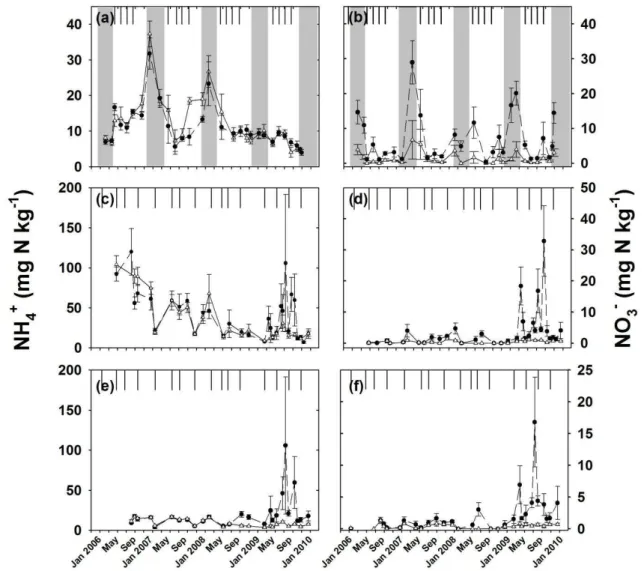
In the lowland forest, NH+4 concentrations did not dif-fer between the control and N-addition plots (P =0.82) (Fig. 2a), but NO−3 concentrations increased with N addi-tion (P <0.01) (Fig. 2b). In the montane forest, mineral N was dominated by NH+4 in both organic layer and min-eral soil. N addition increased NH+4 concentrations in the mineral soil (P <0.01) but did not show an effect on NH+4 concentrations in the organic layer (P =0.31) (Fig. 2c and e). NO−3concentrations increased in both mineral soil (P=
0.01) and organic layer (P =0.03) with very large increases in the fourth year of N addition (Fig. 2d and f).
3.2 CH4fluxes from control forest soils
CH4 fluxes from the lowland forest control plots (−21.47±1.57 µg CH4-C m−2h−1) did not differ (P =0.82) from the fluxes of the montane forest con-trol plots (−3.99±3.40 µg CH4-C m−2h−1; Fig. 3, Table 1). This seemingly larger CH4 uptake rates in this moist (2.7 m yr−1 rainfall) lowland forest soil than the wet (5.5 m yr−1 rainfall) montane forest soil was not statisti-cally significant because of the large spatial and temporal variations (Fig. 3). Before elaborating on how soil factors
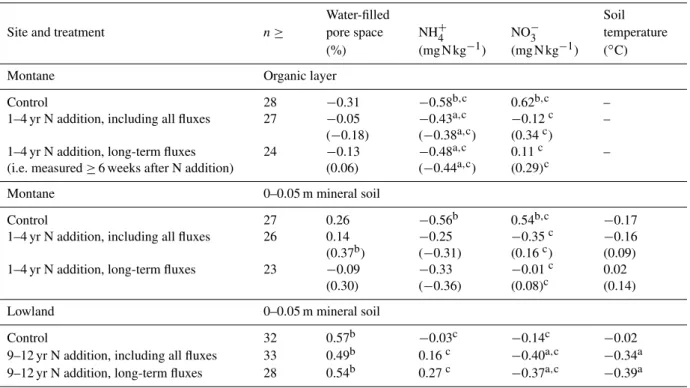
influence CH4fluxes, we want to point out the implications of correlations: a positive correlation between CH4 fluxes and a soil variable indicates a decrease in CH4uptake rates with an increase in the soil parameter values, whereas a negative correlation indicates an increase in CH4 uptake rates with an increase in the soil parameter values. In the lowland forest, CH4 fluxes were positively correlated with WFPS (Table 2). In the montane forest, CH4 fluxes were negatively correlated with NH+4 concentrations and positively correlated with NO−3 concentrations of the organic layer and mineral soil (Table 2). These opposing correlations of CH4 fluxes with NH+4 and NO−3 were because the tem-poral patterns of NH+4 and NO−3 showed the opposite trend (Fig. 2c–f). The correlation between CH4 fluxes and total soil mineral N (NH+4 + NO−3) concentrations (organic layer
R= −0.51, P =0.01, n=28; mineral soil R= −0.56,
P =0.00, n=27) followed that of NH+4, because NH+4 comprised the largest part of mineral N.
3.3 Effects of N addition on soil CH4fluxes
In the lowland forest, neither all CH4 fluxes (−24.22±1.64 µg C m−2h−1) nor the long-term CH4 fluxes (−26.14±2.00 µg C m−2h−1) from the N-addition plots differed (P =0.55 to 0.57) from the CH4fluxes of the control plots (Fig. 3a and c; Table 1). The reason was the oc-casional CH4emissions from three of the four replicate plots of the control and N-addition treatment regardless of seasons (46 emission fluxes out of 373 plot-mean fluxes or 12 % of the observations, ranging from 0.4 to 210 µg C m−2h−1), resulting in the large spatial and temporal variations (i.e. large SE bars; Fig. 3a and c). For all CH4fluxes, we detected a positive correlation with WFPS and negative correlations with soil temperatures and NO−3 concentrations (Table 2). The same soil factors showed similar trends of correlations with the long-term CH4fluxes (Table 2).
Table 1.Annual soil CH4-C fluxes (kg C ha−1yr−1, mean±SE,n=4) from the control and N-addition plots, separated into all and long-term fluxes, with the latter including only the fluxes measured at least six weeks after a N application. For the montane forest, values in parentheses are estimates that excluded one pair of plots (control and N addition) which dominated CH4emissions (49 emission fluxes out of 351 plot-mean fluxes).
Site Treatment 2006 2007 2008 2009
Montane Control −1.69±0.36 −1.18±0.41 −0.53±0.50 1.91±2.49 (−1.83±0.48) (−1.15±0.58) (−0.93±0.42) (−0.56±0.57) 1–4 yr N addition, all fluxes −1.86±0.57∗ 7.64±9.40 4.42±5.86 8.99±10.41
(−2.37±0.35) (−1.75±0.30) (−1.42±0.59) (−1.42±0.38) 1–4 yr N addition, long-term fluxes −2.19±0.76∗ 8.34±9.97 5.36±6.82 8.56±9.89
(−2.91±0.37) (−1.63±0.30) (−1.44±0.63) (−1.33±0.43)
Lowland Control −1.93±0.24 −1.82±0.51 −2.38±0.54 −1.60±0.45 9–12 yr N addition, all fluxes −2.33±0.85 −2.22±0.60 −1.94±0.98 −2.20±0.50 9–12 yr N addition, long-term fluxes −2.09±0.92 −2.42±0.68 −2.15±0.51 −2.16±0.51
∗The two pre-treatment measurements from January and February 2006 were not included in the calculation.
Fig. 1.Mean (±SE,n=4) soil water-filled pore space (WFPS) and temperature at 0–0.05 m mineral soil in the control (△) and N-addition (•) plots of the lowland forest (aandc) with 9–12 yr of treatment and of the montane forest (bandd) with 1–4 yr of treatment. For WFPS in the montane forest, the upper and lower values are for the 0–0.05 m mineral soil and organic layer, respectively. Grey shadings in(a)and(c) mark the dry seasons. The first two years were previously reported by Koehler et al. (2009).
>60 µg CH4-C m−2h−1). Thus, we looked critically at how these few high CH4emissions influence the relationships be-tween CH4fluxes and soil factors. We first analyzed the cor-relations between CH4fluxes and soil factors that include all emission fluxes and that exclude the exceptionally high CH4
Fig. 2.Mean (±SE,n=4) soil-extractable ammonium (NH+4, left panels) and nitrate (NO−3, right panels) at 0–0.05 m mineral soil in the control (△) and N-addition (•) plots of the lowland forest (aandb) and montane forest (canddfor organic layer,eandffor 0–0.05 m mineral soil). The black vertical lines indicate dates of N addition during 9–12 yr of treatment in the lowland forest and 1–4 yr of treatment in the montane forest. Grey shadings in(a)and(b)mark the dry seasons. The first two years were previously reported by Koehler et al. (2009).
remained negatively correlated with NH+4 concentrations of the organic layer (Table 2). Considering only the long-term CH4 fluxes, we observed also a negative correlation with NH+4 concentrations of the organic layer both including and excluding the large emissions (Table 2).
4 Discussion
4.1 CH4fluxes from control forests in comparison with
published values
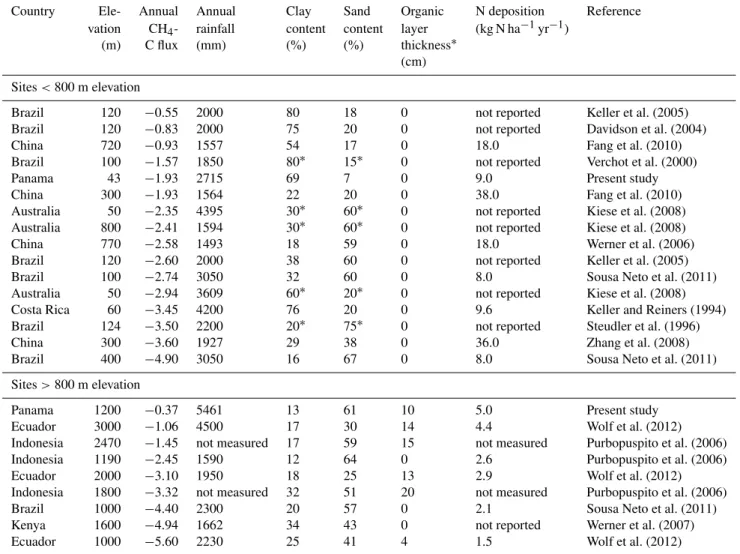
The mean annual CH4uptake rate in the control plots of the lowland forest was within the range of published values from (sub)tropical forests below 800 m elevation (Table 3). The few published CH4 uptake rates that were lower than our lowland forest soil were mainly from Amazon forest soils
with low sand or high clay contents, while those with larger CH4uptake rates were mostly at sites with low clay content (Steudler et al., 1996; Sousa Neto et al., 2011). Indeed, from studies compiled (Table 3), the only significant correlation between annual CH4 fluxes and site factors for the tropical forests below 800 m elevation was a positive correlation be-tween annual soil CH4 fluxes and clay contents (R= 0.58,
Table 2.Pearson correlation coefficients between soil CH4-C fluxes (µg C m−2h−1) and soil variables, using the mean values of each treatment on each sampling day, measured from 2006 to 2009. For the montane forest N-addition plots, coefficients in parentheses are from analyses that include the few events of large CH4emissions (please see Sect. 2.5).
Water-filled Soil
Site and treatment n≥ pore space NH+4 NO−3 temperature
(%) (mg N kg−1) (mg N kg−1) (◦C)
Montane Organic layer
Control 28 −0.31 −0.58b,c 0.62b,c –
1–4 yr N addition, including all fluxes 27 −0.05 (−0.18)
−0.43a,c (−0.38a,c)
−0.12c (0.34c)
–
1–4 yr N addition, long-term fluxes (i.e. measured≥6 weeks after N addition)
24 −0.13
(0.06)
−0.48a,c (−0.44a,c)
0.11c (0.29)c
–
Montane 0–0.05 m mineral soil
Control 27 0.26 −0.56b 0.54b,c −0.17
1–4 yr N addition, including all fluxes 26 0.14 (0.37b)
−0.25 (−0.31)
−0.35c (0.16c)
−0.16 (0.09) 1–4 yr N addition, long-term fluxes 23 −0.09
(0.30)
−0.33 (−0.36)
−0.01c (0.08)c
0.02 (0.14)
Lowland 0–0.05 m mineral soil
Control 32 0.57b −0.03c −0.14c −0.02
9–12 yr N addition, including all fluxes 33 0.49b 0.16c −0.40a,c −0.34a 9–12 yr N addition, long-term fluxes 28 0.54b 0.27c −0.37a,c −0.39a
a,b:P≤0.05andP≤0.01, respectively.
cData were logarithmically transformed before analysis (please see Sect. 2.5).
diffusion, as was illustrated by the correlation of CH4fluxes with WFPS (Table 2); during the wet season when WFPS was high, CH4uptake was low because CH4diffusion from the atmosphere to this site’s clayey soils was probably slowed down by the high soil water contents.
The mean annual CH4 uptake rate in the control plots of the montane forest was the lowest published so far for tropi-cal forests above 800 m elevation (Table 3). This was caused by the frequent CH4emissions from our wet, montane forest soil (Fig. 3b and d). From tropical forests above 800 m ele-vation (Table 3), we detected a positive correlation between annual CH4fluxes and rainfall (R= 0.78,P =0.04,n=7), which is in line with the gas diffusion control on soil CH4 uptake as discussed above. Rainfall influences gas diffusion through its effects on soil moisture content. However, in con-trast to the forests below 800 m elevation, we detected a neg-ative correlation with clay contents (R=−0.68, P =0.04,
n=9). This can probably be explained by the occurrence of thick organic layers (Table 3) at the surface of some of these soils, which may interfere with gas exchange between soil and atmosphere. From an earlier study we conducted in montane forests of Ecuador, we found that, contrary to com-mon belief, the deeper part of such organic layers can con-tribute to the CH4-oxidation capacity of soils (Wolf et al., 2012). The thickness, bulk density and CH4-oxidation capac-ity of these organic layers may influence CH4uptake stronger
than the soil texture of the underlying mineral soil. We also detected a positive correlation between annual CH4 fluxes and annual N deposition rates (R=0.96,P <0.00,n=6) of tropical forests above 800 m elevation. This may suggest that CH4uptake is lower at sites with higher N deposition. However, this correlation is based on six sites that had N deposition rates of only≤5.0 kg N ha−1yr−1. At such low rates of N deposition, we think that inhibition of CH4 oxida-tion by NH+4 is unlikely. Instead, we think that such correla-tion is only circumstantial because in these six sites annual N deposition was positively correlated with annual rainfall (R= 0.89,P =0.02,n=6), signifying that low CH4uptake was reported for sites with high rainfall and high N deposi-tion. Thus, we think it is more likely that soil water content (which controls gas diffusion) as influenced by rainfall was the reason behind the observed correlation between annual CH4fluxes and annual N deposition rates.
Fig. 3.Mean (±SE,n=4) soil CH4-C fluxes from the control (△) and N-addition (•) plots of the lowland forest (aandc) and montane forest (bandd). The black vertical lines indicate dates of N addition during 9 to 12 yr of treatment in the lowland forest and 1 to 4 yr of treatment in the montane forest; the grey horizontal lines mark the zero flux. The upper panels include all fluxes whereas the lower panels show only the long-term fluxes, which were measured at least six weeks after a N addition. Grey shadings in(a)and(c)mark the dry seasons.
we think that this is very unlikely since the NO−3 concentra-tions were one to two orders of magnitude smaller than the NH+4 concentrations (compare Fig. 2c and d and 2e and f, and note the different scales on they axis). Furthermore, mea-surements of gross and net nitrification rates showed very low nitrification activity (Koehler et al., 2009; Corre et al., 2010). Although Bodelier and Laanbroek (2004) suggest that N limitation of methanotrophic bacteria is less likely at (sub-)atmospheric CH4concentrations in the soil, we had ancil-lary measurements of the soil-air CH4concentrations in our montane forest soil that showed CH4concentrations in this forest soil were occasionally high. These measurements were conducted monthly from October 2008 to January 2010 in three control plots and three N-addition plots for various lay-ers: 0.10 m above the soil surface, at the interface of the or-ganic layer and mineral soil, at 0.05, 0.20, 0.40, 0.75 and 1.25 m depths in the mineral soil; we employed the same gas sampling methods described in our earlier study (Koehler et al., 2012). We found that 34 % of 421 observations had CH4 concentrations in the mineral soil higher than the concentra-tion at 0.10 m above the soil surface of 2.0±0.1 ppm CH4-C, particularly during periods of high rainfall and thus high soil water contents. Such high CH4 concentrations in our mon-tane forest soil air may allow for population increases of
methanotrophic bacteria which, in turn, may lead to N limi-tation on their activity (Bodelier and Laanbroek, 2004).
4.2 Response of soil CH4fluxes to N addition in the
lowland and montane forests
Table 3.Compilation of CH4-C fluxes (kg CH4-C ha−1yr−1) from soils of old-growth (sub)tropical forests, sorted from smallest to largest uptake rates within each elevation category.
Country Ele- Annual Annual Clay Sand Organic N deposition Reference vation CH4- rainfall content content layer (kg N ha−1yr−1)
(m) C flux (mm) (%) (%) thickness∗
(cm)
Sites<800 m elevation
Brazil 120 −0.55 2000 80 18 0 not reported Keller et al. (2005)
Brazil 120 −0.83 2000 75 20 0 not reported Davidson et al. (2004)
China 720 −0.93 1557 54 17 0 18.0 Fang et al. (2010)
Brazil 100 −1.57 1850 80∗ 15∗ 0 not reported Verchot et al. (2000)
Panama 43 −1.93 2715 69 7 0 9.0 Present study
China 300 −1.93 1564 22 20 0 38.0 Fang et al. (2010)
Australia 50 −2.35 4395 30∗ 60∗ 0 not reported Kiese et al. (2008)
Australia 800 −2.41 1594 30∗ 60∗ 0 not reported Kiese et al. (2008)
China 770 −2.58 1493 18 59 0 18.0 Werner et al. (2006)
Brazil 120 −2.60 2000 38 60 0 not reported Keller et al. (2005)
Brazil 100 −2.74 3050 32 60 0 8.0 Sousa Neto et al. (2011)
Australia 50 −2.94 3609 60∗ 20∗ 0 not reported Kiese et al. (2008)
Costa Rica 60 −3.45 4200 76 20 0 9.6 Keller and Reiners (1994)
Brazil 124 −3.50 2200 20∗ 75∗ 0 not reported Steudler et al. (1996)
China 300 −3.60 1927 29 38 0 36.0 Zhang et al. (2008)
Brazil 400 −4.90 3050 16 67 0 8.0 Sousa Neto et al. (2011)
Sites>800 m elevation
Panama 1200 −0.37 5461 13 61 10 5.0 Present study
Ecuador 3000 −1.06 4500 17 30 14 4.4 Wolf et al. (2012)
Indonesia 2470 −1.45 not measured 17 59 15 not measured Purbopuspito et al. (2006)
Indonesia 1190 −2.45 1590 12 64 0 2.6 Purbopuspito et al. (2006)
Ecuador 2000 −3.10 1950 18 25 13 2.9 Wolf et al. (2012)
Indonesia 1800 −3.32 not measured 32 51 20 not measured Purbopuspito et al. (2006)
Brazil 1000 −4.40 2300 20 57 0 2.1 Sousa Neto et al. (2011)
Kenya 1600 −4.94 1662 34 43 0 not reported Werner et al. (2007)
Ecuador 1000 −5.60 2230 25 41 4 1.5 Wolf et al. (2012)
∗Percentages of clay and sand were estimated from the reported soil texture class. If no organic layer was mentioned, we assumed that it was absent (i.e. thickness of 0 cm).
that inhibition by high NO−3 levels in N addition plots on CH4 production was unlikely (Koehler et al., 2012). Instead, there were other supporting indications that methanotrophic activ-ity was N limited aside from the negative correlation of soil CH4 fluxes with NO−3 concentrations: soil-air CH4 concen-trations and contents (or the total amount of CH4in a soil-air volume) down to 0.4 m depth were 30 % lower in N-addition than in control plots, and the minimum CH4 concentration of 552±42 ppb was reached at shallower depth (already at 0.40 m) in N-addition than in control plots (only at 1.25 m depth) (Koehler et al., 2012). It should be noted that these patterns were not influenced by WFPS because there were no differences in WFPS between control and N-addition plots at all depths. The reason why we did not detect significant dif-ferences in soil CH4 fluxes despite stimulated CH4 uptake by chronic N addition is first due to the large spatial and temporal variations of CH4 fluxes (Fig. 3a and c). Similar large variability was reported for tropical lowland forest soils
and was attributed to production of CH4 by termites or in microsites of anaerobic conditions, and to temporal patterns of rainfall and soil moisture contents (Verchot et al., 2000; Davidson et al., 2004; Koehler et al., 2012). Second, CH4 consumption was also largely limited by gas diffusion as shown by the positive correlation of CH4fluxes with WFPS (Table 2). Even if N addition stimulated methanotrophic ac-tivity, the supply of CH4as substrate from the atmosphere to the soil through diffusion did not change, and thus chronic N addition did not necessarily result in a larger CH4uptake rate. Stimulation of methanotrophic activity may be explained by a shift in N nutrition of type II methanotrophic bacteria from energy-demanding N2fixation to assimilation of soil mineral N (Bodelier and Laanbroek, 2004; Koehler et al., 2012), of which the NO−3 concentrations had increased under chronic N addition (Fig. 2b).
N addition as shown by the negative correlations between CH4 fluxes and NH+4 concentrations of the organic layer. However, this N-stimulated methanotrophic activity was masked by the frequent CH4 emissions. The frequent CH4 emissions in this wet montane forest soil indicated the reg-ulation of WFPS of the mineral soil on CH4 fluxes, as was shown by their positive correlation when all CH4fluxes are included in the statistical analysis (Table 2). WFPS did not only regulate CH4fluxes through the diffusive limitation of CH4as substrate for methanotrophs but also through the oc-currence of anaerobic conditions for CH4 production. In-deed, the WFPS of this montane forest was high through-out the year (Fig. 1b), and our ancillary measurements of WFPS at various depths in the mineral soil of these plots, conducted monthly during October 2008 to January 2010, showed WFPS between 96±1 % and 88±1 % from 0.20 m down to 1.25 m depth. Such high WFPS may have favoured CH4 production and thus the frequent CH4emissions from all eight plots. This was probably the principal reason why we were not able to detect potential differences in CH4 up-take rates between control and N-addition plots despite an in-dication of N limitation on CH4consumption. Exclusion of one pair of control and N-addition plots that strongly domi-nated the CH4emissions during our four-year measurements did not change the statistical trend even though the mean CH4 uptake rates in the N-addition plots were seemingly larger than the control plots in all years (Table 1).
4.3 Consequences of chronic N deposition on soil CH4
fluxes from tropical forests
Nine to twelve years of N addition to a lowland forest and one to four years of N addition to a montane forest did not affect soil CH4 fluxes, although we found indications that CH4 consumption may have been N limited at both sites. We proposed the following reasons why such N-stimulated CH4consumption did not lead to statistically larger CH4 up-take: (1) for the moist, lowland forest soil, this was caused by limitation of CH4diffusion from the atmosphere into the clayey soils, particularly during the wet season when WFPS was high; (2) for the wet, montane forest soil, this was due to the high WFPS in the mineral soil throughout the year, which may not only limit CH4diffusion from the atmosphere into the soil but also favours CH4production; and (3) both for-est soils showed large spatial and temporal variations of CH4 fluxes. The lowland forest soil showed occasional but low CH4emissions whereas the montane forest soil showed more frequent CH4emissions with a few exceptionally large emis-sions (Fig. 3). Accordingly, such high CH4 concentrations in the soil provide large amounts of substrate for methan-otrophy and favour N limitation on methanotrophic bacteria (Bodelier and Laanbroek, 2004).
Our results contrast with the only published study about N-addition effects on soil CH4fluxes from (sub)tropical forests, which was conducted in China, where increasing N addition rates resulted in decreasing CH4uptake rates. These results were attributed to several possible causes: high N status, low pH values and Al toxicity (Zhang et al., 2008; Zhang et al., 2011). Although our lowland forest soil also had a high N status (Corre et al., 2010) and our montane forest soil also had low pH and high exchangeable Al (see Sect. 2.2), the differences in site conditions between our sites and this for-est in China are that the Chinese site had suffered decades of high N deposition (Table 3) leading to soil pH values be-low 4.0, exchangeable Al of >400 mg Al kg−1 even in the control plots, and never emitted CH4during the first year of measurements. Sub-atmospheric soil CH4concentrations are possibly prevalent in this Chinese site, and in such conditions methanotrophic activity is less likely to be N limited (Bode-lier and Laanbroek, 2004).
If our explanation for the contrasting effects of N addi-tions between our study sites and that of Zhang et al. (2008) holds up throughout the tropics, it is unlikely that elevated N deposition on tropical forests will lead to a rapid reduction in CH4 uptake. We expect that in tropical montane forests, which typically have low N availability, N deposition may stimulate CH4oxidation at sites where occasional CH4 emis-sions occur or will cause no change in CH4uptake at sites where no CH4emissions occur. In tropical lowland forests, which often have a high N availability, N deposition only ap-pears to inhibit CH4 uptake if soil pH values have become so low that considerable Al toxicity occurs. In other situa-tions, it seems more likely that N deposition will not affect CH4fluxes or may even stimulate CH4 uptake. Whether N additions to tropical forests with N-limited methanotrophic activity can indeed stimulate soil CH4uptake remains to be seen. The most likely time when CH4uptake may be stimu-lated by N additions is during dry periods/seasons when CH4 supply from the atmosphere is not or less limited by gas dif-fusion. The most likely place where CH4uptake may be stim-ulated by N addition is in forests with a strong seasonal rain-fall where occasional CH4emissions occur during the rainy season and strong uptake occurs during the dry season.
Acknowledgements. We thank S. Joseph Wright, one of the PIs
for their thorough and helpful reviews. M. D. Corre acknowledges funding from the Robert Bosch Foundation (Germany) for her independent research group NITROF, and from the Deutsche Forschungsgemeinschaft (Co 749/1-1). B. Koehler acknowledges further funding by the Swedish Research Council for Environment, Agricultural Sciences and Spatial Planning and from Erwin Zehe at the Karlsruhe Institute of Technology, Germany.
This Open Access Publication is funded by the University of G¨ottingen.
Edited by: Z. Jia
References
Adamek, M., Corre, M. D., and Hoelscher, D.: Early effect of ele-vated nitrogen input on above-ground net primary production of a lower montane rain forest, Panama, J. Trop. Ecol., 25, 637–647, doi:10.1017/S0266467409990253, 2009.
Adamek, M., Corre, M. D., and Hoelscher, D.: Responses of fine roots to experimental nitrogen addition in a tropical lower montane rain forest, Panama, J. Trop. Ecol., 27, 73–81, doi:10.1017/S0266467410000507, 2011.
Arnold, J., Corre, M. D., and Veldkamp, E.: Cold storage and labo-ratory incubation of intact soil cores do not reflect in-situ nitro-gen cycling rates of tropical forest soils, Soil Biol. Biochem., 40, 2480–2483, doi:10.1016/j.soilbio.2008.06.001, 2008.
B´edard, C. and Knowles, R.: Physiology, biochemistry, and specific inhibitors of CH4, NH+4, and CO oxidation by methanotrophs and nitrifiers, Microbiol. Rev., 53, 68–84, 1989.
Bender, M. and Conrad, R.: Effect of CH4concentrations and soil conditions on the induction of CH4oxidation activity, Soil Biol. Biochem., 27, 1517–1527, doi:10.1016/0038-0717(95)00104-M, 1995.
Bodelier, P. L., Roslev, P., Henckel, T., and Frenzel, P.: Stimula-tion by ammonium-based fertilizers of methane oxidaStimula-tion in soil around rice roots, Nature, 403, 421–424, doi:10.1038/35000193, 2000.
Bodelier, P. L. E. and Laanbroek, H. J.: Nitrogen as a regulatory fac-tor of methane oxidation in soils and sediments, FEMS Microb. Ecol., 47, 265–277, doi:10.1016/s0168-6496(03)00304-0, 2004. Breuer, L., Kiese, R., and Butterbach-Bahl, K.: Temperature and moisture effects on nitrification rates in tropical rain-forest soils, Soil Sci. Soc. Am. J., 66, 834–844, 2002.
Brumme, R. and Borken, W.: Site variation in methane oxida-tion as affected by atmospheric deposioxida-tion and type of temper-ate forest ecosystem, Global Biogeochem. Cy., 13, 493–501, doi:10.1029/1998GB900017, 1999.
Conrad, R.: Control of methane production in terrestrial ecosys-tems, in: Exchange of trace gases between terrestrial ecosystems and the atmosphere, edited by: Andreae, M. O. and Schimel, D. S., Wiley, Chichester, UK, 39–58, 1989.
Corre, M. D., Veldkamp, E., Arnold, J., and Wright, S. J.: Impact of elevated N input on soil N cycling and losses in old-growth low-land and montane forests in Panama, Ecology, 91, 1715–1729, doi:10.1890/09-0274.1, 2010.
Crawley, M. J.: The R book, John Wiley & Sons Ltd, Chichester, UK, 2009.
Crill, P. M., Martikainen, P. J., Nykanen, H., and Silvola, J.: Tem-perature and N fertilization effects on methane oxidation in a drained peatland soil, Soil Biol. Biochem., 26, 1331–1339, doi:10.1016/0038-0717(94)90214-3, 1994.
Davidson, E. A., Ishida, F. Y., and Nepstad, D. C.: Effects of an experimental drought on soil emissions of carbon dioxide, methane, nitrous oxide, and nitric oxide in a moist tropical forest, Glob. Change Biol., 10, 718–730, doi:10.1111/j.1365-2486.2004.00762.x, 2004.
Denman, K. L., Brasseur, G., Chidthaisong, A., Ciais, P., Cox, P. M., Dickinson, R. E., Hauglustaine, D., Heinze, C., Holland, E., Jacob, D., Lohmann, U., Ramachandran, S., Dias, P. L. d. S., Wofsy, S. C., and Zhang, X.: Couplings Between Changes in the Climate System and Biogeochemistry, in: Climate Change 2007: The Physical Science Basis. Contribution of Working Group I to the Fourth Assessment Report of the Intergovernmental Panel on Climate Change, edited by: Solomon, S., Qin, D., Manning, M., Chen, Z., Marquis, M., Averyt, K. B., Tignor, M., and Miller, H. L., Cambridge University Press, Cambridge, United Kingdom and New York, NY, USA, 2007.
Dutaur, L. and Verchot, L. V.: A global inventory of the soil CH4 sink, Global Biogeochem. Cy., 21, GB4013, doi:10.1029/2006gb002734, 2007.
Fang, H. J., Yu, G. R., Cheng, S. L., Zhu, T. H., Wang, Y. S., Yan, J. H., Wang, M., Cao, M., and Zhou, M.: Effects of multiple en-vironmental factors on CO2emission and CH4uptake from old-growth forest soils, Biogeosciences, 7, 395–407, doi:10.5194/bg-7-395-2010, 2010.
Frankenberg, C., Bergamaschi, P., Butz, A., Houweling, S., Meirink, J. F., Notholt, J., Petersen, A. K., Schrijver, H., Warneke, T., and Aben, I.: Tropical methane emissions: A re-vised view from SCIAMACHY onboard ENVISAT, Geophys. Res. Lett., 35, L15811, doi:10.1029/2008gl034300, 2008. Galloway, J. N., Townsend, A. R., Erisman, J. W., Bekunda, M.,
Cai, Z., Freney, J. R., Martinelli, L. A., Seitzinger, S. P., and Sutton, M. A.: Transformation of the nitrogen cycle: recent trends, questions, and potential solutions, Science, 320, 889–892, doi:10.1126/science.1136674, 2008.
Hanson, R. S. and Hanson, T. E.: Methanotrophic bacteria, Micro-biol. Rev., 60, 439–471, 1996.
Hietz, P., Turner, B. L., Wanek, W., Richter, A., Nock, C. A., and Wright, S. J.: Long-term change in the nitrogen cycle of tropical forests, Science, 334, 664–666, doi:10.1126/science.1211979, 2011.
Hillel, D.: Environmental soil physics, Academic Press, San Diego, California, USA, 771 pp., 1998.
Keller, M. and Matson, P. A.: Biosphere-Atmosphere exchange of trace gases in the tropics: evaluating the effects of land use changes, in: Global Atmospheric-Biospheric Chemistry, edited by: Prinn, R. G., Plenum Press, New York, 103–117, 1994. Keller, M. and Reiners, W. A.: Soil-atmosphere exchange of nitrous
oxide, nitric oxide and methane under secondary succession of pasture to forest in the Atlantic lowlands of Costa Rica, Global Biogeochem. Cy., 8, 399–409, doi:10.1029/94GB01660, 1994. Keller, M., Varner, R., Dias, J. D., Silva, H., Crill, P., and de
Kiese, R., Hewett, B., Graham, A., and Butterbach-Bahl, K.: Sea-sonal variability of N2O and CH4 uptake by tropical rainfor-est soils of Queensland, Australia, Global Biogeochem. Cy., 17, 1043, doi:10.1029/2002GB002014, 2003.
Kiese, R., Wochele, S., and Butterbach-Bahl, K.: Site specific and regional estimates of methane uptake by tropical rainfor-est soils in north eastern Australia, Plant Soil, 309, 211–226, doi:10.1007/s11104-008-9545-0, 2008.
Kl¨uber, H. D. and Conrad, R.: Effects of nitrate, nitrite, NO and N2O on methanogenesis and other redox processes in anoxic rice field soil, FEMS Microb. Ecol., 25, 301–318, doi:10.1111/j.1574-6941.1998.tb00482.x, 1998.
Koehler, B., Corre, M. D., Veldkamp, E., Wullaert, H., and Wright, S. J.: Immediate and long-term nitrogen oxide emis-sions from tropical forest soils exposed to elevated nitrogen in-put, Glob. Change Biol., 15, 2049–2066, doi:10.1111/j.1365-2486.2008.01826.x, 2009.
Koehler, B., Corre, M. D., Steger, K., Well, R., Zehe, E., Sueta, J. P., and Veldkamp, E.: An in-depth look into a tropical low-land forest soil: nitrogen-addition effects on the contents of N2O, CO2and CH4and N2O isotopic signatures down to 2-m depth, Biogeochemistry, 111, 695–713, doi:10.1007/s10533-012-9711-6, 2012.
Linn, D. and Doran, J.: Effect of water-filled pore space on carbon dioxide and nitrous oxide production in tilled and nontilled soils, Soil Sci. Soc. Am. J., 48, 1267–1272, 1984.
Livingston, G. P., Hutchinson, G. L., and Spartalian, K.: Trace gas emission in chambers, Soil Sci. Soc. Am. J., 70, 1459–1469, doi:10.2136/sssaj2005.0322, 2006.
Loftfield, N., Flessa, H., Augustin, J., and Beese, F.: Automated gas chromatographic system for rapid analysis of the atmospheric trace gases methane, carbon dioxide, and nitrous oxide, J. En-viron. Qual., 26, 560–564, 1997.
Martinson, G. O., Werner, F. A., Scherber, C., Conrad, R., Corre, M. D., Flessa, H., Wolf, K., Klose, M., Gradstein, S. R., and Veld-kamp, E.: Methane emissions from tank bromeliads in neotrop-ical forests, Nat. Geosci., 3, 766–769, doi:10.1038/Ngeo980, 2010.
Mosier, A. R., Parton, W. J., Valentine, D. W., Ojima, D. S., Schimel, D. S., and Delgado, J. A.: CH4 and N2O fluxes in the Colorado shortgrass steppe: 1. Impact of landscape and nitrogen addition, Global Biogeochem. Cy., 10, 387–399, doi:10.1029/96GB01454, 1996.
Nesbit, S. P. and Breitenbeck, G. A.: A laboratory study of factors influencing methane uptake by soils, Agr. Ecosyst. Environ., 41, 39–54, doi:10.1016/0167-8809(92)90178-E, 1992.
Purbopuspito, J., Veldkamp, E., Brumme, R., and Murdiyarso, D.: Trace gas fluxes and nitrogen cycling along an eleva-tion sequence of tropical montane forests in Central Su-lawesi, Indonesia, Global Biogeochem. Cy., 20, GB3010, doi:10.1029/2005GB002516, 2006.
R Development Core Team: R: A language and environment for statistical computing, R Foundation for Statistical Computing, Vienna, Austria, 2011.
Reeburgh, W.: Global methane biogeochemistry, in: Treatise on geochemistry, edited by: Keeling, R. F., Holland, H., and Turekian, K., Elsevier, Oxford, UK, 65–89, 2003.
Sousa Neto, E., Carmo, J. B., Keller, M., Martins, S. C., Alves, L. F., Vieira, S. A., Piccolo, M. C., Camargo, P., Couto, H. T. Z., Joly,
C. A., and Martinelli, L. A.: Soil-atmosphere exchange of nitrous oxide, methane and carbon dioxide in a gradient of elevation in the coastal Brazilian Atlantic forest, Biogeosciences, 8, 733–742, doi:10.5194/bg-8-733-2011, 2011.
Steudler, P. A., Bowden, R. D., Melillo, J. M., and Aber, J. D.: In-fluence of nitrogen fertilization on methane uptake in temperate forest soils, Nature, 341, 314–316, doi:10.1038/341314a0, 1989. Steudler, P. A., Melillo, J. M., Feigl, B. J., Neill, C., Piccolo, M. C., and Cerri, C. C.: Consequences of forest-to-pasture conversion on CH4fluxes in the Brazilian Amazon Basin, J. Geophys. Res.-Atmos., 101, 18547–18554, doi:10.1029/96JD01551, 1996. Veldkamp, E., Weitz, A. M., and Keller, M.: Management effects
on methane fluxes in humid tropical pasture soils, Soil Biol. Biochem., 33, 1493–1499, doi:10.1016/S0038-0717(01)00060-8, 2001.
Verchot, L. V., Davidson, E. A., Cattanio, J. H., and Ackerman, I. L.: Land-use change and biogeochemical controls of methane fluxes in soils of eastern Amazonia, Ecosystems, 3, 41–56, doi:10.1007/s100210000009, 2000.
Vitousek, P. M., Aber, J. D., Howarth, R. W., Likens, G. E., Matson, P. A., Schindler, D. W., Schlesinger, W. H., and Tilman, D. G.: Human alteration of the global nitrogen cycle – sources and con-sequences [review], Ecol. Appl., 7, 737–750, doi:10.1890/1051-0761(1997)007[0737:HAOTGN]2.0.CO;2, 1997.
Wagner, S. W., Reicosky, D. C., and Alessi, R. S.: Regression mod-els for calculating gas fluxes measured with a closed chamber, Agronom. J., 89, 279–284, 1997.
Werner, C., Zheng, X., Tang, J., Xie, B., Liu, C., Kiese, R., and Butterbach-Bahl, K.: N2O, CH4and CO2emissions from sea-sonal tropical rainforests and a rubber plantation in Southwest China, Plant Soil, 289, 335–353, doi:10.1007/s11104-006-9143-y, 2006.
Werner, C., Kiese, R., and Butterbach-Bahl, K.: Soil-atmosphere exchange of N2O, CH4, and CO2and controlling environmental factors for tropical rain forest sites in western Kenya, J. Geophys. Res., 112, D03308, doi:10.1029/2006jd007388, 2007.
Wolf, K., Flessa, H., and Veldkamp, E.: Atmospheric methane uptake by tropical montane forest soils and the contri-bution of organic layers, Biogeochemistry, 111, 469–483, doi:10.1007/s10533-011-9681-0, 2012.
Wright, S. J., Yavitt, J. B., Wurzburger, N., Turner, B. L., Tanner, E. V. J., Sayer, E. J., Santiago, L. S., Kaspari, M., Hedin, L. O., Harms, K. E., Garcia, M. N., and Corre, M. D.: Potassium, phos-phorus or nitrogen limit root allocation, tree growth and litter production in a lowland tropical forest, Ecology, 92, 1616–1625, doi:10.1890/10-1558.1, 2011.
Yavitt, J. B., Fahey, T. J., and Simmons, J. A.: Methane and Carbon Dioxide Dynamics in a Northern Hard-wood Ecosystem, Soil Sci. Soc. Am. J., 59, 796–804, doi:10.2136/sssaj1995.03615995005900030023x, 1995. Zhang, T., Zhu, W., Mo, J., Liu, L., and Dong, S.: Increased
phos-phorus availability mitigates the inhibition of nitrogen deposi-tion on CH4 uptake in an old-growth tropical forest, southern China, Biogeosciences, 8, 2805–2813, doi:10.5194/bg-8-2805-2011, 2011.