Jebmh.com
Original Article
J. Evid. Based Med. Healthc., pISSN- 2349-2562, eISSN- 2349-2570/ Vol. 3/Issue 38/May 12, 2016 Page 1881
HYPERTENSION IN PREGNANCY: A STUDY IN A TEACHING HOSPITAL
Shiva Subramanyam1, Abdul Razaak2, Ilyas Ahmed3, Krishna RPSC4, Prabhakar Rao5
1Associate Professor, Department of General Medicine, KIMS, Narketpally, Telangana. 2Associate Professor, Department of General Medicine, FIMS, Kadapa.
3Assistant Professor, Department of General Medicine, FIMS, Kadapa.
4Associate Professor, Department of General Medicine, KIMS, Narketpally, Telangana. 5Professor & HOD, Department of SRMC, Nandyal.
ABSTRACT
BACKGROUND
In pregnant women, hypertension is one of the common causes of mortality and morbidity in Indian women.
METHODS
We conducted a study on four hundred and sixteen pregnant women consisting of 202 primigravidae, 148 gravidae 2 and 66 multigravidae. We screened these pregnant women for hypertension between January 2015 to July 2015 at Kamineni Institute of Medical Sciences and Fathima Institute of Medical Sciences(FIMS), which are tertiary care hospitals catering most of the rural areas of Hyderabad & Kadapa Districts.
RESULT
Hypertension was noted in 34 (8.2%) of pregnant women. Majority of pregnant women in the study population were primigravidae (48.56%). Nearly 80% of hypertensive pregnant women were primigravidae. 88.24% developed hypertension in III trimester. Complication like preeclampsia was seen in 23.52%.
CONCLUSION
We conclude that pregnancy-induced hypertension is the common variety of hypertension in pregnant women. It is commonly seen in primigravidae who are exposed to the trophoblastic tissue for the first time.
KEYWORDS
Hypertension, Pregnancy, Complications.
HOW TO CITE THIS ARTICLE: Subramanyam S, Razaak A, Ahmed I, et al. Hypertension in pregnancy: A study in a teaching
hospital. J. Evid. Based Med. Healthc. 2016; 3(38), 1881-1884. DOI: 10.18410/jebmh/2016/418
INTRODUCTION: Hypertension in pregnancy is a most
common medical complication. It ranges from a mild-to-severe and major cause of maternal & perinatal morbidity and mortality.1 Hypertension during pregnancy
(Pregnancy-induced Hypertension (PIH), Preeclampsia, Eclampsia) is difficult to treat. Eclampsia and preeclampsia contribute to death of one woman every 3 minutes worldwide. Hypertensive disorders in pregnancy are the third leading cause of maternal mortality after other causes like haemorrhage & sepsis. Preeclampsia is a pregnancy specific syndrome. It occurs in 5% of all pregnancies, 10% of first pregnancies and 20-25% of women with chronic hypertension. There are only isolated documentations of hypertension in pregnancy in India.2,3 Hypertension is
present in 6-8% of young women of childbearing age but the prevalence increases with advancing age and in women with diabetes mellitus, primary renal disease or collagen vascular disease reaching up to 20% in such population.2
The question of whether hypertension in pregnancy and specifically pre-eclampsia are a marker for cardiovascular disease later in life has implications for health promotion in women, similar to the link between gestational diabetes and the later development of a clinical diabetic state. To evaluate such a risk, long follow-up will be necessary.
Working group of National High Blood Pressure Education Program 2000 classification of hypertensive disease is as follows.
a) Gestational Hypertension (formerly added PIH or transient hypertension of pregnancy).
b) Preeclampsia & Eclampsia syndrome.
c) Seizures, intracerebral haemorrhage, pulmonary preeclampsia syndrome superimposed on chronic hypertension.
d) Chronic hypertension.
Maternal diastolic blood pressure of more than 110 mmHg is associated with an increased risk for abruptio placentae, intrauterine foetal growth retardation, premature delivery and intrauterine foetal death.4 Severe maternal
complications include eclamptic oedema, acute renal failure, proteinuria greater than 4.5 g/dL, liver dysfunction, disseminated intravascular coagulation and consumptive coagulopathy.4 Perinatal mortality and morbidity are also
Financial or Other, Competing Interest: None. Submission 18-04-2016, Peer Review 08-05-2016, Acceptance 11-05-2016, Published 12-05-2016. Corresponding Author:
Dr. Prabhakar Rao,
Professor & HOD, Department of General Medicine, SRMC, Nandyal.
Jebmh.com
Original Article
J. Evid. Based Med. Healthc., pISSN- 2349-2562, eISSN- 2349-2570/ Vol. 3/Issue 38/May 12, 2016 Page 1882
high due to chronic placental insufficiency and growth restriction of foetus.
AIMS AND OBJECTIVES:
1. To find out prevalence of hypertension in pregnant women attending antenatal outpatient department of the hospitals.
2. To estimate the prevalence of hypertension in pregnancy.
MATERIAL AND METHODS: The present prospective
study was carried out jointly in the Department of Gynaecology & Obstetrics & Department of General Medicine between January 2015 to July 2015. About 416 pregnant women attending the antenatal outpatient department were screened for hypertension. Blood pressures were measured in the supine, left lateral and sitting positions in both the upper limbs. Systolic blood presence of more than 140 mmHg and diastolic blood pressure of more than 90 mmHg are taken as cut off values for labelling a pregnant woman as hypertensive. Disappearance of Korotkoff sound phase V was taken as cut-off for diastolic blood pressure measurement. Age, parity, gestational age at which blood pressures are recorded, previous obstetric history of pregnancy-induced hypertension and its complications, family history of hypertension & diabetes mellitus, presence of pedal oedema or anasarca, excess weight gain are noted. Relevant laboratory investigations like complete urine examination, random blood sugar, liver function tests, renal function tests were done and values are noted.
Results obtained were tabulated and analysed.
Inclusion Criteria:
1. All pregnant women attending antenatal OPD. 2. Age 20-35 yrs.
3. Not having any previous history of hypertension.
Exclusion Criteria:
1. Pregnant women >35 yrs. 2. Any past history of hypertension.
3. Pregnant women having other systemic disease.
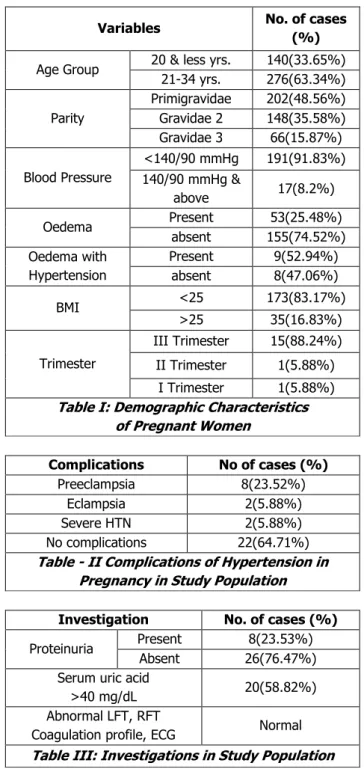
RESULTS: Out of 416 pregnant women, 33.65% were less
than 20 yrs., 66.34% were between 21-34 yrs. Primigravidae (48.56%) were more than gravidae 2(35.58%) and multigravidae (15.87%), 34(8.2%) were hypertensive (Table - I). Oedema was present in 25.48% of pregnant women & 52.94% of hypertensive women had oedema. Most of high blood pressures were noted in III trimester (88.24%). 83.17% of pregnant women had normal BMI. Table II shows preeclampsia is a common complication (23.52%). Proteinuria was absent in 76.47%, raised serum uric acid was seen in 58.82% & other investigations were normal (Table III).
Variables No. of cases
(%)
Age Group 20 & less yrs. 140(33.65%)
21-34 yrs. 276(63.34%)
Parity
Primigravidae 202(48.56%)
Gravidae 2 148(35.58%)
Gravidae 3 66(15.87%)
Blood Pressure
<140/90 mmHg 191(91.83%) 140/90 mmHg &
above 17(8.2%)
Oedema Present 53(25.48%)
absent 155(74.52%)
Oedema with Hypertension
Present 9(52.94%)
absent 8(47.06%)
BMI <25 173(83.17%)
>25 35(16.83%)
Trimester
III Trimester 15(88.24%)
II Trimester 1(5.88%)
I Trimester 1(5.88%)
Table I: Demographic Characteristics of Pregnant Women
Complications No of cases (%)
Preeclampsia 8(23.52%)
Eclampsia 2(5.88%)
Severe HTN 2(5.88%)
No complications 22(64.71%)
Table - II Complications of Hypertension in Pregnancy in Study Population
Investigation No. of cases (%)
Proteinuria Present 8(23.53%)
Absent 26(76.47%)
Serum uric acid
>40 mg/dL 20(58.82%)
Abnormal LFT, RFT
Coagulation profile, ECG Normal
Table III: Investigations in Study Population
DISCUSSION: Hypertension in pregnancy has long been
suspected of heralding an increased risk of high blood pressure in later life.5,6 In the population studied, blood
pressure of 140/90 mmHg & above was seen in 34 pregnant women. This accounts to an incidence of 8.2%. Hypertensive disorders complicating pregnancies have been reported in 6-8% and may go up to 20%.7 Proteinuria is
seen in only 23.53% and majority of hypertensive women had no proteinuria. This shows that gestational hypertension or pregnancy-induced hypertension is the type of hypertension commonly seen in pregnancy. Pregnancy-induced hypertension and chronic hypertension was responsible for hypertension in 96% and 4% of cases respectively in an Indian study,8 chronic hypertension is not
Jebmh.com
Original Article
J. Evid. Based Med. Healthc., pISSN- 2349-2562, eISSN- 2349-2570/ Vol. 3/Issue 38/May 12, 2016 Page 1883
pathologic oedema is the first sign of PIH. Excess weight gain (gaining more than ½ kg per week of gestation) is the first symptom of pregnancy-induced hypertension. Preeclampsia is seen in 10-15% of primigravidae with hypertension and 5.7-7.3% in multigravidae.9 Preeclampsia
is hence peculiar to pregnancy. Elevated serum uric acid levels more than 4 mg/dL indicate foetal compromise and indicate need to deliver the foetus as early as possible. Serum uric acid level of more than 5.5 mg/dL is consistent with preeclampsia and above 6 indicates serious disease when liver dysfunction and mild elevation of serum transaminases occurs.10
LFT, RFT Blood coagulation profile, ECG were normal in the study population. Ophthalmoscopy showed normal fundus. Retinal vasospasm is a manifestation of severe maternal disease. The study populations with high blood pressures were picked up early and hence they did not have complications. Incidence of preeclampsia is increased with twins & previous history of eclampsia.11 Pregnancy-induced
hypertension is usually thought to resolve without serious sequelae, but a link to cardiovascular disease in later life was suggested from an early follow-up study of preeclamptic and eclamptic women and from an increased incidence of previous preeclampsia observed in women who had suffered myocardial infarction.12 Gerdur A13 et al study showed death
rates from ischaemic heart disease are higher in women who had hypertension in pregnancy when compared with the general population, and that this risk might be linked to increasing severity of the disease in pregnancy.14 Four
subsequent studies have since independently indicated a significantly increased risk of myocardial ischaemia and related cardiovascular disease later in life in women who had hypertensive disorder in pregnancy.15-18 Pregnancy-induced
hypertension may not only be an expression of underlying genotypic and phenotypic hypertensive tendency19,20 but has
its own adverse and longterm effect on the endothelium and the cardiovascular system.21,22,23 Women with preeclampsia
or eclampsia should, therefore, receive follow-up and health care advice with regard to lifestyle, nutrition and weight control.
CONCLUSION: Pregnancy-induced hypertension is
predominant in Indian pregnant women. In our study, this is confirmed. But study population is small, it requires large population studies to confirm the same. Chronic hypertension is less commonly seen. Blood pressure should be measured in sitting position with cuff at level of heart. Majority of deaths are preventable if pregnancy-induced hypertension is detected and treated early.
ACKNOWLEDGEMENT: We thank Management of
Kamineni institute of Medical Sciences, and Fathima Institute of Medical Sciences for allowing us to conduct this study, and pregnant women who have given consent.
REFERENCES:
1. Prakash J, Pandey LK, Singh AK. Hypertension in pregnancy. Hospital based study. JAPI 2006;54:273-278.
2. Report of NHBPEP Working group on high blood pressure in pregnancy. Am J Obst & Gynaec 2000;183(1):S1-S22.
3. American College of Obstetrics & Gynecology. Hypertension in pregnancy. ACOG technical bulletin No 219, Washington DC 1996.
4. Sandhya A Kamath. Hypertension in pregnancy. JAPI 2006;54:269-270.
5. Long PA, Oats JN. Preeclampsia in twin pregnancy, severity & pathogenesis. Aust N Z J Obst & Gynaec 1987:27(1):1-5
6. Long PA, Abell DA, Brischer NA. Parity & preeclampsia. Aust N Z J Obst & Gyneac 1979;19:203-206.
7. Yadav S, Saxena V, Yadav P, et al. Hypertensive disorders of pregnancy & maternal fetal outcome – case controlled study. JIMA 1997;95(10):548-551. 8. Pallea MS. Hypertension in pregnancy. Journal of Am
Soc Nephrol 1998;9(2):314-321.
9. Helewa ME, Burrows RF, Smith J. Report of the Canadian hypertension society consensus conference: 1. definitions, evaluation and classification of hypertensive disorders in pregnancy. 1997;157(6):715-725.
10. Chesley LC, Annitto JE, Cosgrove RA. The remote prognosis of eclamptic women. sixth periodic report. Am J Obstet Gynecol 1975;124;446-459.
11. Mann JL, Doll R, Thorogood M, et al. Risk factors for myocardial infarction in young women. Br J Prey Soc Med 1976;30(2):94-100.
12. Hannaford P, Ferry S, Hirsch S. Cardiovascular sequelae of toxaemia of pregnancy. Heart 1997;77(2):154-158.
13. Jonsdottir LS, Arngrimsson R, Geirsson RT, et al. Death rates from ischemic heart disease in women with a history of hypertension in pregnancy. Acta Obstet Gynecol Scand 1995;74(10):772-776. 14. Smith CS, Pell JP, Walsh D. Pregnancy complications
and maternal risk of ischaemic heart disease: a retrospective cohort study of 129,290 birth. Lancet 2001;357(9273):2002-2006.
15. Irgens HU, Reisaeter L, Irgens LM, et al. Long term mortality of mothers and fathers after pre-eclampsia:
population based cohort study. BMJ
2001;323(7323):1213-1216.
16. Wilson BJ, Watson MS, Prescott GJ, et al. Hypertensive diseases of pregnancy and risk of hypertension and stroke in later life: results from a cohort study. BMJ 2003;326(7394):845-851.
17. Roberts JM. Endothelial dysfunction in preeclampsia. Semin Reprod Endocrinol 1998;16(1):5-15.
Jebmh.com
Original Article
J. Evid. Based Med. Healthc., pISSN- 2349-2562, eISSN- 2349-2570/ Vol. 3/Issue 38/May 12, 2016 Page 1884
19. Ness RB, Roberts JM. Heterogenous causes constituting the single syndrome of preeclampsia a hypothesis and its implications. Am J Obst & Gynec 1996;175(5):1365-1370.
20. Levine RJ, Maynard SE, Qian C, et al. Circulating angiogenic factors and the risk of preeclampsia. N Engl J Med 2004;350(7):672–683.
21. Svensson A, Andersch B, Hansson L. A clinical follow-up study of 260 women with hypertension in pregnancy. Clin Exp Hypertens B 1983;2(1):95-102.
22. Sibai BM, El-Nazer A, Gonzalez-Ruiz A. Severe preeclampsia-eclampsia in young primigravidae women: subsequent pregnancy out come and remote prognosis. Am J Obst & Gynec 1986;155(5):1011-1016.