AACL BIOFLUX
Aquaculture, Aquarium, Conservation & Legislation
International Journal of the Bioflux Society
Physiological response of the intertidal copepod
Tigriopus japonicus
experimentally exposed to
cadmium
Emadeldeen H. Mohammed, Guizhong Wang, Zhihuan Xu, Ziming Liu, and
Lisheng Wu
College of Oceanography and Environmental Science, State Key Laboratory of Marine Environmental Science, Xiamen University, People’s Republic of China.
Corresponding author: G. Wang, [email protected]
Abstract. The intertidal harpacticoid copepod Tigriopus japonicus is a benthic copepod and has been commonly used in ecotoxicology and environmental genomics studies as a marine model species. In this study, Laboratory experiments were conducted to investigate the effects of cadmium (Cd) on survival, development, growth and reproductive performance of T. japonicus. Our results indicated that Cd was significantly affected adult survival and development, but not those of nauplii. Despite the reduction in adult female total body length, Cd was not significantly affected copepod growth. Concerning T. japonicus
reproduction response, Cd was significantly reduced the number of nauplii produced at 10 μg L-1. Thus,
survival, development and reproduction in T. japonicus as a model test species could be effective physiological markers to monitor marine metal pollution and to assess population response.
Keywords: metals, cadmium, copepods, Tigriopus japonicus, ecotoxicology studies.
Introduction. Heavy metals are common environmental pollutants and their toxicity is a problem of increasing significance for ecological, evolutionary, nutritional and environmental reasons. They are considered hazardous to aquatic life because of their extreme persistence, high toxicity, tendency to bioaccumulate, and because they are available through many and diverse anthropogenic sources (Fairbrother et al 2007; Nicula et al 2010; Rahman et al 2010). Thus, environmental monitoring is essential to restore and resolve metal pollution. Major emissions of Cd to aquatic environment are atmospheric fallout and effluents from smelting, metal mining, refining industries, sewage, and runoff from agricultural fertilizers (WHO 1992; CCME 1999; Jarup 2003). In the marine environment, river runoff is another major pathway of Cd (CCME 1999). Although Cd occurs in very low concentrations in open ocean waters, however, its concentrations in coastal and estuarine waters are higher (Chiffoleau et al 2001).
chemical pollutants, however, metals and organic pollutants have shown reproducible biological responses when tested using Tigriopus spp. in ecological risk assessment associated with water pollution (Lee et al 2007, 2008; Raisuddin et al 2007; Kwok et al 2008, 2009).
In order to develop the copepod T. japonicus as a model species, information on its sensitivity to different chemical pollutants is, therefore, highly desirable. Moreover, laboratory studies addressing acute and chronic effects of heavy metals on physiological response of copepods, particularly life-cycle and reproductive tests, are considered important to understand how copepod populations cope with metal pollution and to conclude a holistic risk assessment of metal pollution. However, recent studies indicated that Cd pollution in Xiamen waters and Jiulongjiang estuary, where T. japonicus was collected, is the most hazardous with respect to other metals. Hence, Jian-qing et al (2007) reported dissolved and particulate Cd concentrations in Jiulongjiang estuary of 0.34 and 0.0064 μg L-1, respectively. They also estimated the average flux of dissolved and particulate Cd from Jiulong river to Jiulongjiang estuary of about 1.47 and 0.027 kg d-1, respectively. Weili et al (2009) found that Cd content in the surface sediments of Jiulongjiang river estuary is beyond marine quality standard in some stations. Thus, the present study primarily aimed to: (1) determine the 48h-LC50 value of Cd to the copepod T. japonicus (2) assess the sublethal toxicity of Cd in a full life-cycle toxicity test on survival, development, and growth of T. japonicus. (3) assess the sublethal toxicity of Cd on offspring production of T. japonicus.
Materials and Methods. The copepod T. japonicus was obtained from continuous stock culture in our laboratory and maintained under static-renewal conditions in 0.45µm millipore filtered seawater with 7 to 7.9 mg L-1 dissolved oxygen, 7.90 to 8.25 pH, 18 to 22° C and 24 to 26 ppt salinity. The original stock culture of T. japonicus was obtained from rocky intertidal zone pools in Xiamen Bay, China. Copepods were fed a mixed algal diet of Isochrysis galbana and Platymonas subcordiformis. The algae were cultured in filtered seawater contain f/2 enriched media at 20° C.
Cadmium was provided as a chloride salt (CdCl2 · 2.5H2O) from Sinopharm Chemical Reagent Co., Ltd, China (≥ 99.0% pure). The stock solutions were prepared (at concentrations high enough to prevent weighing errors (= 1000 mg L-1) in double distilled water. Selected test Cd concentrations were prepared by dilution of the stock solution in 0.45 μm filtered seawater. Reference seawater used in the experiments was obtained 20 km offshore in Xiamen Bay. All Cd concentrations reported in this study were nominal concentrations.
Acute toxicity tests. Semi-static 48-h acute toxicity tests were performed using standard methods outlined by Verriopoulos & Dimas (1988) and ASTM (2004) with certain modifications. Experimental conditions were the same as copepod maintenance, except for temperature and salinity, which were 20° C and 25 ppt salinity, respectively. Only active adult copepods (females) were subjected to the acute tests. Copepods were exposed to different Cd concentrations in a semi-static exposure system bioassays, during which the test solutions were replaced every 24 h. Six toxicant Cd concentrations as nominal concentrations and control were used. Each treatment was run in triplicate, with 10 active individuals for each replicate. Acute tests of T. japonicus were done in six well culture plates, each with 10 mL of solution and five female copepods. Culture plates were provided from Corning Incorporated, USA. Animals were monitored and dead animals removed at 24 and 48 h. The criteria for mortality are total lack of movement and lack of response after repeat touches with a probe during two minutes. Because of the shorter time, copepods were not fed during the test period.
conditions were the same as acute toxicity test. Cd test concentrations used were 0, 1, 10, 100 μg L-1. Experiments were carried out as renewal bioassay, with daily renewal of half of the exposure solution. After the daily renewal of half of the test solutions, copepods were fed with Isochrysis galbana at a density of 5 × 10⁵ cells mL-1 during whole life-cycle exposure. Survival and development were monitored everyday until animals reached females with egg sac. Observations of copepods were performed under a stereomicroscope (Motic, series SMZ140). Nauplii survival rate calculated as percentage of surviving nauplii which reached copepodid stage on day 8. Adult survival rate calculated as percentage of surviving copepod (male and female) on day 21. Mean developmental time defined as the time (days) required for development of 50% of individuals into a specific stage (Vidal 1980) and was estimated from the graphical representation (regression analysis) of cumulative percentage of the specific stage against time. Nauplii developmental time (the duration of nauplii stage) was expressed as the time taken for 50% of nauplii (<24h old) to reach the first copepodid stage. Time to first reproduction (the duration to reach adult female stage with egg sac) was expressed as the time taken for 50% of nauplii (<24h old) to reach the adult female stage with egg sac. Individuals that became males were considered in the calculations of adult survival rate, but not in adult growth and developmental time. At the end of the tests females were preserved in 5% formalin to measure their growth as total body length. Total body length measurements of 15 individuals per treatment were obtained on a microscope (Olympus BX51, Japan) slide using Image-pro Express software version 6.0.0.319, Media Cybernetics Inc.
Reproductive toxicity test. Reproductive tests were conducted using a modified ASTM protocol (ASTM 2004). Experimental conditions and Cd concentrations used were the same as life-cycle toxicity tests. Copepods were fed daily with 5 × 10⁵ cells/mL of the algae Isochrysis galbana. For each test concentration, 20 females of T. japonicus, bearing an egg sac, were individually transferred to a new six well culture plates (Corning, USA), each with 10 mL of solution. These females were cultured for 10 days. The fecundity (offspring production) was assessed as the number of nauplii per female. Every day females were transferred to a new culture plate with fresh solutions and the resulting nauplii were counted under a stereomicroscope (Motic, series SMZ140).
Two statistical programs (Microsoft excel 2003 package; SPSS 17, Chicago, IL, USA) were used to analyze the data.LC50 value was computed using probit analysis (Finney 1971). The data were expressed as mean ± standard deviation (S.D.). Percentages for survival rate were arcsine-transformed prior to statistical analysis. Statistical analysis for survival rate, developmental time, body length, and offspring production comparisons was carried out using one-way ANOVA and the Fisher least significant difference test to evaluate whether the means were significantly different among cadmium treatments. The level of significance was accepted as p< 0.05.
Results
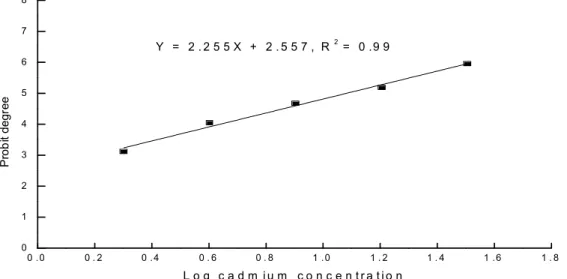
Acute toxicity tests. There was no control mortality during the experimental period. The probit analysis of acute toxicity data showed that 48h-LC50 value of Cd for T.
japonicus was 12.1 mg L-1 (Fig. 1).
Fig. 1. 48h-LC50 value of Cd for T. japonicus on probit scale was calculated as the return logarithmic value of x, when y = 5.
Fig. 2. Effects of cadmim on nauplii and adult survival of T. japonicus. Data are described as mean ± standard deviation. Different letters indicate a significant difference among
different Cd concentrations at p< 0.05.
Fig. 3. Effects of cadmium on nauplii and adult developmental time of T. japonicus. Data are described as mean ± standard deviation. Different letters indicate a significant
difference among different Cd concentrations at p< 0.05.
0 .0 0 . 2 0 .4 0 . 6 0 . 8 1 .0 1 . 2 1 . 4 1 .6 1 . 8 0 1 2 3 4 5 6 7 8 P ro bi t d eg re e
L o g c a d m i u m c o n c e n t r a t i o n Y = 2 . 2 5 5 X + 2 . 5 5 7 , R2
= 0 .9 9
0 µ g/L 1 µ g /L 10 µ g /L 1 0 0 µ g/L
0 10 20 30 40 50 60 70 80 90 1 00 S ur vi va l %
C a d m iu m c o n c e n tra tio n n a u p lii
a d u lt a
A
a a a
B
B A B
0 µ g /L 1 µ g/L 1 0 µ g /L 1 00 µ g /L 0 2 4 6 8 1 0 1 2 1 4 1 6 1 8 2 0 2 2 2 4 2 6 2 8 3 0 D ev el op m en ta l t im e (d ay s)
C a d m iu m co n ce n tra tio n n a u p lii
a d u lt fe m a le
a A
a a a
Figure 4 shows the effect of Cd on the growth of T. japonicus adult female, measured as total body length (µm). There was no statistically significant difference between control treatment and all Cd treated groups 1, 10 and 100 μg L-1 Cd (Fig. 4, p< 0.05). However, female total body length decreased when exposure to Cd treated groups.
Fig. 4. Effects of cadmium on adult female body length of T. japonicus. Data are described as mean ± standard deviation. Different letters indicate a significant difference
among different Cd concentrations at p< 0.05.
Reproductive toxicity test.During the reproductive toxicity tests of T. japonicus, there was no mortality in all treatments. In summary, a 10 day exposure of T. japonicus to Cd resulted in a significant reduction of its reproductive output. Offspring production (i.e. number of nauplii produced) of T. japonicus decreased with increasing Cd concentrations and was significantly (p< 0.05) reduced by 24.25% at 10 μg L-1 Cd (Fig. 5).
Fig. 5. Effect of Cd on offspring production of T. japonicus. Data are described as mean ± standard deviation. Different letters indicate a significant difference among different Cd
concentrations at p< 0.05.
0 µ g /L 1 µ g/L 1 0 µ g /L 1 00 µ g /L
0 1 0 0 2 0 0 3 0 0 4 0 0 5 0 0 6 0 0 7 0 0 8 0 0 9 0 0 10 0 0 1 10 0 12 0 0
To
ta
l b
od
y
le
ng
th
(
m
)
C a d m iu m co n ce n tra tio n
a a a
a
0µ g/l 1 µ g /l 1 0µ g/l 1 0 0 µ g /l
0 2 4 6 8 1 0 1 2 1 4 1 6 1 8 2 0 2 2 2 4 2 6 2 8 3 0 3 2 3 4 3 6 3 8 4 0
N
um
be
r o
f o
ffs
pr
in
g
pe
r f
em
al
e
C a d m iu m co n ce n tra tio n a
a
b
Discussion. Previous studies have clearly demonstrated the potential deleterious effects of metal pollutants on copepod biology (Raisuddin et al 2007; Kwok et al 2008, 2009). Generally, the results of this study indicated that Cd was negatively affected the survival, development, growth, and reproduction of harpacticoid copepod T. japonicus.
48h-LC50 value of Cd for T. japonicus was 12.1 mg L-1 (Fig. 1). A study by Lee et al (2007) reported a 96-h LC50 value of 25.2 mg L-1 Cd for the same species. The difference may be due to different experimental conditions, especially salinity. The experimental salinity of this study is 25 ppt while theirs is 32 ppt. However, there was a significant decrease in LC50 values as salinity decrease and was most likely related to increase in cadmium free ion (Hall Jr et al 1995). Previously we found a 48-h LC50 value
of 17.7 mg L-1 Ni for T. japonicus (Mohammed et al 2010). Thus, Cd was more acutely
toxic to T. japonicus than Ni. Verriopoulos & Dimas (1988) reported a 48-h LC50 value of 0.9 mg L-1 Cdfor the copepod Tisbe holothuriae. Thus, T. holothuriae was more sensitive
to Cd than T. japonicus (12.1 mg L-1). Forget et al (1998) found a 96-h LC50 value of
47.9 μg L-1 Cd for the copepod Tigriopus brevicornis. Exact comparisons are difficult because of difference in LC50 time interval.
Exposure to Cd was not significantly affected nauplii survival rate at Cd concentration tested, but in contrast it was significantly (p< 0.05) affected adult survival rate at 10 μg L-1 Cd (Fig. 2, p< 0.05). Conversely, Lee et al (2008) found that exposure to 0.1, 1, 10, 100 μg L-1 of Cu, As3+ and As5+ using T. japonicus in two generation life-cycle toxicity test were not significantly affected the adult survival (to reach maturity). The difference may be due to different experimental conditions, especially salinity. The experimental salinity of this study is 25 ppt while theirs is 32 ppt. Considering other copepod species, Medina et al (2008) observed that Cu was significantly affected the juvenile survival of the copepod Tigriopus angulatus.
Like all copepods, T. japonicus undergoes anamorphic development with 12 distinctive post-embryonic developmental stages, six naupliar stages, five copepodid stages, and an adult stage. Its distinct developmental stages permit detailed ecotoxicological studies on the effects of toxicants on their development (Raisuddin et al 2007). In this study the effect of Cd on T. japonicus development was evaluated. Although nauplii developmental time increased with the increasing Cd concentrations, it was not significantly affected when nauplii exposed to all Cd concentrations tested (Fig.
3, p< 0.05). However, Cd was significantly affected time to first reproduction at the
highest Cd concentration tested, 100 μg L-1 (Fig. 3, p< 0.05). Thus, time to first reproduction of T. japonicus was more sensitive to Cd than nauplii developmental time. In agreement with our results, previous studies showed that metals were negatively affected copepod developmental time. For instance, Toudal & Riisgard (1987) observed that developmental time of copepodite and adult stages of the copepod Acartia tonsa was highly influence by Cd. Correspondingly, it was reported that Cu caused a prolongation of maturation time of the marine copepods Tisbe holothuriae (Moraïtou-Apostolopoulou et al 1983) and T. anagulatus (Medina et al 2008). Regarding T. japonicus, it was reported that time to develop into copepodid stage 1 (Kwok et al 2008, 2009) and time to first reproduction (Kwok et al 2008) slowed down significantly at 10 μg L-1 Cu in a full life-cyle test. Also, Lee et al (2008) found that exposure of T. japonicus to Cu, As3+ and As5+ were significantly increased the duration of nauplii phase at 1, 0.1, 0.1 μg L-1, respectively, but not the generation time for adult.
Most copepods of the genus Tigriopus spp. are small in size, adult generally about 1.0 mm in length (Raisuddin et al 2007). Here we measured total body length of T. japonicus adult female in response to Cd. Despite the reduction in its total body length when exposure to Cd, copepod growth measured as total length was not significantly affected at all Cd concentrations tested, (Fig. 4 p< 0.05). Previously, Toudal & Riisgard (1987) found that the cephalothoracic length of adult copepod was significantly reduced at 40 μg L-1 Cd in life-cycle toxicity test with A. tonsa. Thus, the growth of A. tonsa was more sensitive to Cd than T. japonicus.
exposed to metals. For instance, Medina et al (2008) found that nauplii production of T. angulatus was significantly different from the control at Cu exposures to 103 and 180 μg L-1. Regarding T. japonicus, it was reported that Cu and Ni were significantly reduced its
offspring production at 10 μg L-1 (Kwok et al 2009; Mohammed et al 2010). Conversely,
Lee et al (2008) found that Cu, As3+, and As5+, had no significant effects on offspring production of T. japonicus after 10 days exposure at the concentrations tested (0.1, 1, 10, and 100 μg L-1). With the exception of salinity, they used natural seawater and the same experimental condition. Taken together, T. japonicus was more sensitive to Cd than Cu, As3+ and As5+.
Conclusion. The present study showed that Cd was negatively affected the survival, development, growth and reproduction of harpacticoid copepod T. japonicus. Specifically, Cd was significantly affected adult survival and development at 10 and 100 μg L-1, respectively. Moreover Cd was significantly reduced its offspring production at 10 μg L-1. Consequently, Cd can have detrimental effects on copepod population dynamics. As a next step to understand the mechanistic basis, it is necessary to evaluate the potential impacts Cd on the biochemical and molecular components of different copepod stages in long-term toxicity test. Furthermore, the synergistic effects of Cd and other environmental factors, such as temperature, salinity, and pH should be investigated.
Acknowledgments. This work was funded by National Natural Science Foundation of China (No. 40876060). We thank the colleagues of our lab for assistance in the laboratory.
References
Andersen H. R., Halling-Sørensen B., Kusk K. O., 1999 A parameter for detecting estrogenic exposure in the copepod Acartia tonsa. Ecotoxicology and Environmental Safety 44:56–61.
Andersen H. R., Wollenberger L., Halling-Sørensen B., Kusk K. O., 2001 Development of copepod nauplii to copepodites – a parameter for chronic toxicity including
endocrine disruption. Environmental Toxicology and Chemistry 20:2821–2829.
ASTM, 2004 Standard guide for conducting renewal microplate-based life-cycle toxicity tests with a marine meiobenthic copepod. American Society for Testing and Materials, Philadelphia, PA, ASTM Standard No. E2317-04, pp. 1–16.
Breitholtz M., Wollenberger L., 2003 Effects of three PBDEs on development, reproduction and population growth rate of the harpacticoid copepod Nitocra spinipes. Aquatic Toxicology 64:85–96.
CCME, Canadian Council of Ministers of the Environment, 1999 Canadian Water Quality Guidelines for the Protection of Aquatic Life: Cadmium. In Canadian environmental quality guidelines. Winnipeg.
Chiffoleau J.-F., Auger D., Chartier E., Michel P., Truquet I., Ficht A., Gonzalez J.-L., Romaña L.-A., 2001 Spatiotemporal changes in cadmium contamination in the Seine estuary (France). Estuaries 24:1029–1040.
Fairbrother A., Wenstel R., Sappington K., Wood W., 2007 Framework for metals risk
assessment. Ecotoxicology and Environmental Safety 68:145–227.
Finney J., 1971 Probit analysis. 2nd ed. Cambridge, UK. Cambridge University Press. Forget J., Pavillon J. F., Menasria M. R., Bocquene G., 1998 Mortality and LC50 values for
several stages of the marine copepod Tigriopus brevicornis (Muller) exposed to the metals arsenic and cadmium and the pesticides atrazine, carbofuran, dichlorvos,
and malathion. Ecotoxicology and Environmental Safety 40:239–244.
Hall L. W., Jr., Ziegenfuss M. C., Anderson R. D., Lewis B. L., 1995 The effect of salinity on the acute toxicity of total and free cadmium to a Chesapeake Bay copepod and fish. Marine Pollution Bulletin 30(6):376–384.
Jarup L., 2003 Hazards of heavy metal contamination. British Medical Bulletin 68:167–
182.
study on the geochemical behaviour of Cu, Pb, Cd in the Jiulong estuary, Xiamen]. Journal of Xiamen University (Natural Science) 46:54-61. [In Chinese]
Kusk K. O., Wollenberger L., 2007 Towards an internationally harmonized test method for reproductive and developmental effects of endocrine disrupters in marine copepods. Ecotoxicology 16:183–195.
Kwok K. W. H., Grist E. P. M., Leung K. M. Y., 2009 Acclimation effect and fitness cost of copper resistance in the marine copepod Tigriopus japonicus. Ecotoxicology and
Environmental Safety 72:358–364.
Kwok K. W. H., Leung K. M. Y., Bao V. W. W., Lee J.-S., 2008 Copper toxicity in the marine copepod Tigropus japonicus: Low variability and high reproducibility of repeated acute and life-cycle tests. Marine Pollution Bulletin 57:632–636.
Lee K.-W., Raisuddin S., Hwang D. S., Park H. G., Lee J.-S., 2007 Acute toxicities of
trace metals and common xenobiotics to the marine copepod Tigriopus japonicus:
evaluation of its use as a benchmark species for routine ecotoxicity tests in Western Pacific Coastal Regions. Environmental Toxicology 22:532–538.
Lee K.-W., Raisuddin S., Hwang D. S., Park H. G., Dahms H. U., Ahn I. Y., Lee J.-S.,
2008 Two-generation toxicity study on the copepod model species Tigriopus
japonicus. Chemosphere 72:1359–1365.
Medina M. H., Morandi B., Correa J. A., 2008 Copper effects in the copepod Tigriopus angulatus Lang, 1933: natural broad tolerance allows maintenance of food webs in
copper-enriched coastal areas. Marine and Freshwater Research 59:1061–1066.
Mohammed E. H., Wang G., Jiang J., 2010 The effects of nickel on the reproductive ability of three different marine copepods. Ecotoxicology 19:911–916.
Moraïtou-Apostolopoulou M., Kiortsis M., Verriopoulos V., Platanistioti S., 1983 Effects of
copper sulphate on Tisbe holothuriae Humes (Copepoda) and development of
tolerance to copper. Hydrobiologia 99:145–150.
Nicula M., Bănăţean-Dunea I., Gergen I., Hărmănescu M., Simiz E., Pătruică S., Polen T., Marcu A., Lunca M., Szucs S., 2010 Effect of natural zeolite on reducing tissue bioaccumulation and cadmium antagonism related to some mineral micro- and macronutrients in Prussian carp (Carassius gibelio). AACL Bioflux 3(3):171-179. OECD, 2006 Detail review paper on aquatic arthropods in life cycle toxicity tests with an
emphasis on developmental, reproductive and endocrine disruptive effects. OECD series on testing and assessment number 55, ENV/JM/MONO(2006)22, Environment Directorate, Organisation of Economic Corporation and Development, Paris, p. 125. Rahman M. M., Rahman M. M., Chongling Y., Islam K. S., 2010 Changes in growth and
antioxidant enzymes activities during cadmium stress in the mangrove plant
Kandelia candel(L.) Druce. AES Bioflux 2(1):15-24.
Raisuddin S., Kwok K. W. H., Leung K. M. Y., Schlenk D., Lee J.-S., 2007 The copepod Tigriopus: A promising marine model organism for ecotoxicology and environmental genomics. Aquatic Toxicology 83:161–173.
Templeton R. C., Ferguson P. L., Washburn K. M., Scrivens W. A., Chandler G. T., 2006 Life-cycle effects of single-walled carbon nanotubes (SWNTs) on an estuarine
meiobenthic copepod. Environmental Science and Technology 40:7387–7393.
Toudal K., Riisgard H. U., 1987 Acute and sublethal effects of cadmium on ingestion, egg production and life-cycle development in the copepod Acartia tonsa. Marine Ecology
37:141–146.
Verriopoulos G., Dimas S., 1988 Combined toxicity of copper, cadmium, zinc, lead,
nickel, and chrome to the copepod Tisbe holothuriae. Bull Environ Contam Toxicol
41:378–384.
Vidal J., 1980 Physioecology of zooplankton. II. Effects of phytoplankton concentration, temperature, and body size on the development and molting rates of Calanus
pacificus and Pseudocalanus sp. Marine Biology 56:135–146.
Weili W., Anchao G., Huatai L., Aiguo G., 2009 [Distribution and potential ecological risk evaluation of heavy metals in the surface sediments from the Juilongjiang river estuary]. Advances in Marine Science 27:502-508. [In Chinese]
Received: 22 December 2010. Accepted: 22 January 2011. Published online: 24 January 2011. Authors:
Emadeldeen Hassan Mohammed, Department of Marine Biology, College of Oceanography and Environmental Science, Xiamen University, Xiamen, Postal Code 361005, Siming Area, Da Xue Street, People’sRepublic of China, Tel: +86-592-2188471, e–mail: [email protected]
Guizhong Wang, Professor of marine biology, Department of Marine Biology, College of Oceanography and Environmental Science, Xiamen University, Xiamen, Postal Code 361005, Siming Area, Da Xue Street, People’s Republic of China, Tel: +86-0592-2188471, Fax: +86 0592-2186397, e-mail: [email protected]
Zhihuan Xu, Department of Marine Biology, College of Oceanography and Environmental Science, Xiamen University, Xiamen, Postal Code 361005, Siming Area, Da Xue Street, People’sRepublic of China,
Tel: +86-592-2188471, e-mail: [email protected]
Ziming Liu, Department of Marine Biology, College of Oceanography and Environmental Science, Xiamen University, Xiamen, Postal Code 361005, Siming Area, Da Xue Street, People’sRepublic of China, Tel: +86-592-2188471, e-mail: [email protected]
Lisheng Wu, Department of Marine Biology, College of Oceanography and Environmental Science, Xiamen University, Xiamen, Postal Code 361005, Siming Area, Da Xue Street, People’sRepublic of China, Tel: +86-592-2188471, e-mail: [email protected]
How to cite this article:
Mohammed E. H., Wang G., Xu Z., Liu Z., Wu L., 2011 Physiological response of the intertidal copepod