The Effect of Road Traffic Noise on Reaction Time
Iraj Alimohammadi 1, *Mojtaba Zokaei 1, Stephan Sandrock 2
1 Occupational Health Engineering Department, Iran University of Medical Sciences, Tehran, Iran 2 Institute for Applied Ergonomics and Industrial Engineering, Düsseldorf, Germany
ARTICLE INFO ABSTRACT
Article history: Received: Mar 05 2015 Accepted: Jul 25 2015 e-published: Oct 25 2015
Background: Traffic noise is one of the main important sources in urban noise pollution, which causes various physiological and psychological effects that can cause disturbs in performance, sleep disturb-ances, hearing loss and impact on job performance. This study was conducted to verify the impact of road traffic noise on reaction time in terms of extraversion and sex.
Methods: Traffic noise was measured and recorded in 10 arterial streets in Tehran, andthen the rec-orded noise was emitted towards participants in an acoustic room. The participants were 80 (40 cases and 40 controls) students. Personality type was determined by Eysenck Personality Inventory (EPI) questioner. Reaction time before and after exposure to traffic noise was measured.
Results: Reaction time before exposure to traffic noise did not differ (P=0.437) significantly between introverts and extraverts. However, it was increased significantly in both groups after exposure to traf-fic noise (P<0.01). Introvert’s reaction time was more increased than that of extraverts.
Conclusion: Traffic noise augmented reaction time of both males and females. This study also re-vealed that exposure to traffic noise leads to increase in reaction time.
Keywords: Traffic Noise, Reaction Time, Extraversion, Student
*Corresponding Author: Mojtaba Zokaei Iran University of Medical Sciences
Tel:+98 9183376627; e-mail:
Introduction
Developing and developed countries are en-countered to high road traffic noise level in urban environment. Road traffic noise level in many big cities is usually higher than those set by national noise standards and policy to protect public health and welfare in residential areas.1 Approximately
30% of the population in the European Union still is exposed to an average day-night traffic noise exceeding 55dB (A). Social cost of road traf-fic noise in European countries has been estimat-ed 38 billion dollars annually.2
Traffic noise is considered as one of the im-portant sources of noise pollution that adversely effects on human health and social welfare.3,4
Traffic noise causes various effects on physical and mental, daily activities and sleep disturbances, hearing loss, annoyance and may affect job perfor-mance.5 Noise can adversely affect work and
men-tal performance parameters such as memory,
at-tention, concentration and reaction time.6 Expo-sure to noise lead to a performance decrement, although some such findings are controversial.7
If road traffic noise effects on mental perfor-mance, has it any role in increment of reaction time of drivers as an important factor influencing on road traffic accidents? Human error is a signifi-cant cause in 57 percentage traffic accidents.7
More than 50 million people are injured and 1.2 million people are died in traffic accidents all over the world yearly.8 Human costs of road traffic
ac-cidents in the United States of America have been estimated $ 230 billion in 2000.9 Reaction time –
one of a performance parameter of driver10 is a
very important factor in driving because it will distinguish difference between safe driving and accident.11Some traffic accidents happen due to
slow reaction of drivers, this is why drivers re-sponded slowly to visual stimuli.12 There is a
sig-Citation: Alimohammadi I, Zokaei M, Sandrock S. The Effect of Road Traffic Noise on Reaction Time. Health Promot Perspect 2015; 5(3):
nificant correlation between accidents and reac-tion time pattern. Time to respond varies greatly in different tasks and even in a special task varies greatly under different conditions. In fact, reaction time is a complicated behavior and is affected by a large number of variables.13 Components of reac-tion time include mental processing time and movement time. Mental processing time is elapsed time between stimulus perception and decision making for an appropriate response to the stimu-lus.13 It can be said, mental processing time takes
500 to 800 milliseconds.14 Movement time is
elapsed time for execution the selected response that the respondent do muscle movement.13 Noise
can cause undesirable effects like reducing the driver's concentration that cause traffic accident consequence.15Durić and Filipović found people who cause traffic accidents hadlonger reaction times.7 David et al. studied the effect of cellular
telephone conversation and music listening on response time in braking and found telephone conversation cause to increase reaction time.16
Elmenhorst studied effects of recorded traffic noise on reaction time and found that the mean of reaction time in morning psychomotor conscious-ness task slowed significantly by 3.6 ms after ex-posure to recorded traffic noise.17
Noise characteristics, the type of tasks, and personality trait of exposed person- which are in-terrelated network of three group factors- proba-bly decrease mental performance level in a noisy environment.18 Individual differences between
participants who participated in different studies could partly change the results in noise research on mental performance.19 According to
Broad-bent’s arousal theory, among individual factors, the personality trait of intro/extroversion has been denoted as relevant for the effects of noise on mental performance.20The fact that introverts
show higher basic level of arousability is well known and highly regarded.21 It seems that sex could influence the reaction time. Men are faster than women are across all age levels.22
Concerning the importance of the probably ef-fect of reaction time on road traffic accidents re-garding to different personality types and sex, this research was conducted. The main purpose of this
study was to answer the question whether reaction time is increased when exposure to traffic noise.
Materials and Methods
In this experimental study, participants were ex-posed to road traffic noise with level of 72.9 dBA recorded and measured at ninety points in a central parts (that have often heavy traffic) of Tehran, Iran in 2012. Noise was measured according to the CRTN method.23 The equivalent noise level was measured (each measurement took 5 min) at any point 4 times during a day, 2 times in the morning rush hours (8-10 am) and 2 times in the evening rush hours (6-8 pm). Points of noise measurements were selected in distance of 2 meters from the edge of streets, at a height of 1.5 meter from the ground using B&K 2238 Sound level Meter.23 Field
calibra-tion of sound level meter had been conducted with a B&K 4231 acoustic calibrator at reference pres-sure level of 94dB at 1 kHz before starting to measurement. Noise was measured at A– frequen-cy weighting and fast time weighting. During the traffic noise measurement, the traffic noise was recorded by a high quality voice recorder using voice recorder Sony ICD MX20.
In order to study the effects of traffic noise on reaction time in different personality types (intro-vert and extro(intro-vert), this study was conducted on 80 students [40 cases (20 introverts, 20 extraverts), 40 controls (20 introverts, 20 extraverts)] from the School of Public Health of Iran University of Medical Sciences. In the present study Control group was used for omitting any disorder factors (such as fatigue, mood of participants) which could influence the results of the study. Partici-pant recruitment procedure was as follows: At first, an announcement was made on the news boards of the School of Public Health and the volunteer students were required to appear at the test hall. In this manner, 265 volunteers were re-cruited. Then intro/extraversion as personality trait factors was measured by Eysenck’s Personal-ity Inventory (EPI) (57 items).24Forty extraverts
explanation of the experiment’s purpose was of-fered to the participants; possible risks due to the experiment were explained.
Ethical Issues
Participants after accepting to cooperation in the study, for each of them about the process of study, duration of traffic noise exposure, comple-mentary questionnaire was explained and the con-fidentiality of results was assured. Participants were clear learning about the study. Then all par-ticipants were required to sign a consent form. The research protocol of the study was approved by the Iran University of Medical Sciences Ethical Committee.
Recorded traffic noise of the street was emitted in an acoustic room for participants and they were asked to perform Reaction Time (RT) test before and after exposure to traffic noise. Before starting, the test participants were taught to learn how to perform the tests. Reaction time was measured by RT test from Vienna Test System.25 Test form S5
was used in this study. This test form assess reac-tion time (split into reacreac-tion and motor time) in response to simple and complex visual or acoustic signals. Reliabilities (Cronbach's alpha) in the norm sample vary between r=0.83 and r=0.98 for reaction time and between r=0.84 and r=0.95 for motor time.25In this test from a sequence of
yel-low and red lights, a tone and combinations of these stimuli is presented. The mechanical re-sponse movement consists either of two visual stimuli (yellow and red lights) or a visual and an acoustic stimulus (yellow light and tone at 2000 Hz). The respondents are instructed to respond less than 2 seconds otherwise the alternative sig-nals are appeared. Incorrect reactions are there-fore possible. A minimum of 12 practice stimuli are presented. In the test phase 48 stimuli were presented; of which 16 required a reaction. In this study, the time from the presentation stimuli on the monitor to taking index finger from golden button was considered as movement time. In
ad-dition, the time from taking index finger on gold-en button to putting on black button was defined as movement time.
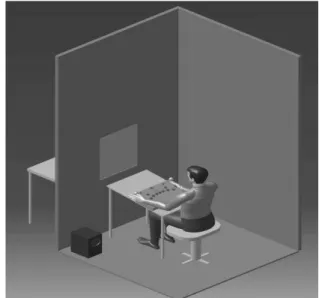
At first stage the participants (case and control groups) were asked to do the above mentioned RT test in the acoustic room in quiet condition (with background noise of 32.9 dBA) equipped with universal panel of Vienna test system (Figure 1). In order to reduce recalling effect, RT test un-der noisy condition was performed after one month (stage 2). In this stage case group partici-pants were exposed to traffic noise levels with 72.9 dBA -that was equal to the average of sound pressure level in the main streets of Tehran- for duration of two hours and then they did the RT test. In this stage, control group participants had been sat in acoustic room for two hours without noise and then they did RT test. To control the participant noise exposure pattern a noise analysis measurement was also performed during the test (Table 1).
The collected data were analyzed using the SPSS software (Chicago, IL, USA).
Fig. 1: Schematics of participant in acoustic room perform-ing RT test
Table 1: Traffic noise spectrum emitted in the acoustic room
Frequency(Hz) 31.5 63 125 250 500 1000 2000 4000 8000
Results
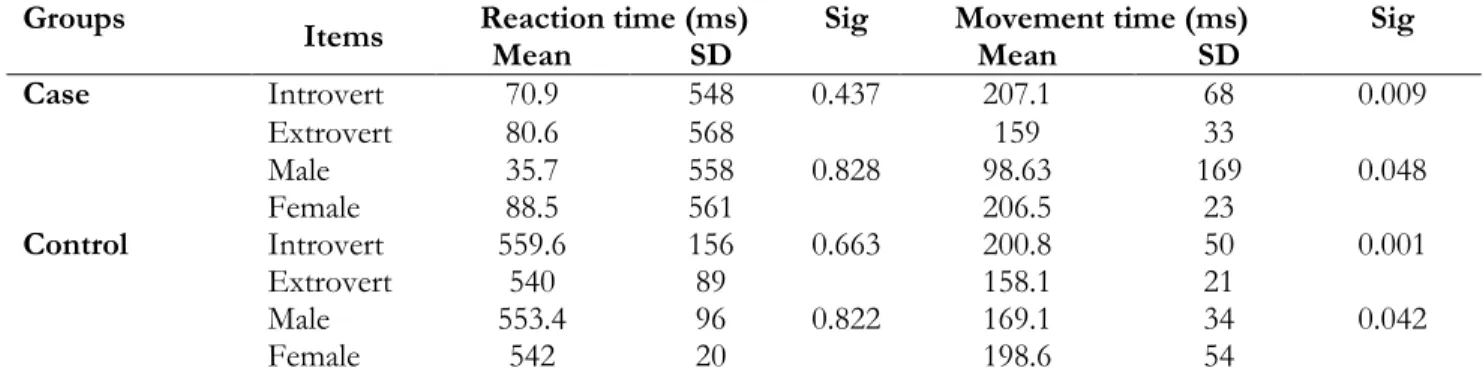
The number of males and females of partici-pants were 51(25 case, 26 control) and 29 (15 case, 14 control) respectively. The results of statistical analysis of reaction and movement time before exposure to traffic noise are shown in Table 2.
The results revealed that reaction time before exposure to traffic noise does not (P=0.437) sig-nificant difference between introverts and extra-verts, and between males and females (P=0.828) in case and control groups. Furthermore this
study was shown significant difference in move-ment time between introverts and extraverts (P=0.009), and between males and females (P=0.048) on the other side. Reaction time after exposure to traffic noise did not have (P=0.554) significant difference between introverts and ex-traverts, and between males and females (P=0.706) in case and control groups. Further-more, there was significant difference in move-ment time between introverts and extraverts (P=0.003), and between males and females (P=0.028) on the other side (Table 3).
Table 2: Reaction time (RT) and movement time (MT) of all participants in quiet condition
Groups
Items Reaction time (ms) Sig Movement time (ms) Sig
Mean SD Mean SD
Case Introvert 70.9 548 0.437 207.1 68 0.009
Extrovert 80.6 568 159 33
Male 35.7 558 0.828 98.63 169 0.048
Female 88.5 561 206.5 23
Control Introvert 559.6 156 0.663 200.8 50 0.001
Extrovert 540 89 158.1 21
Male 553.4 96 0.822 169.1 34 0.042
Female 542 20 198.6 54
Exposure to road traffic noise significantly in-creased reaction time in introverts, extroverts, and males and females, (P=0.001), (P=0.000), (P=0.001), (P=0.001) respectively for case group. While movement time difference between before
and after exposure to traffic noise was not signifi-cant among introverts, extroverts, and males, fe-males, (P=0.831), (P=0.212), (P=0.137), (P=0.774) respectively for both case and control groups.
Table 3: Reaction time (RT) and movement time (MT) of participants in stage 2
Groups Items Reaction time (ms) P value Movement time (ms) P value
Mean SD Mean SD
Case Introvert 617 81 0.554 206.3 68 0.003
Extrovert 607 91 150.2 34
Male 605 71 0.706 161.4 67 0.028
Female 616 87 205.9 41
Control Introvert 590 104 0.172 203.7 53 0.002
Extrovert 542 116 159.5 24
Male 556 108 0.408 170.5 36 0.039
Female 588 145 202.3 57
The results of statistical analysis for reaction time and movement time before and after expo-sure to traffic noise for cases are shown in Table 4.
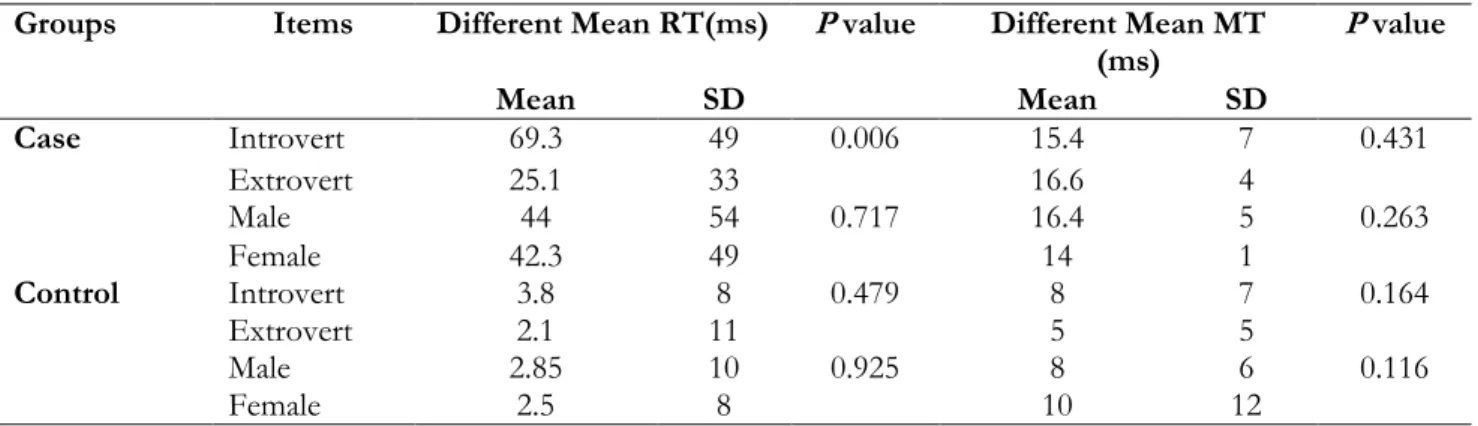
de-termination, if the level of increment of reaction time due to noise was equal in introverts and ex-troverts and in males and females more statistical analysis was performed (Table 5). Table 5 shows that the average reaction time differences before and after exposure to traffic noise was significant (P=0.006) in introverts and extroverts. In other words, noise cause to more increment of reaction time in introverts than extroverts’. But the average reaction time differences had no significant differ-ence (P= 0.717) for males and females. The aver-age movement time differences before and after exposure to traffic noise had no significant differ-ence (P=0.43) in introverts and extroverts and in males and females (P=0.236).
Table 4: reaction time (RT) and movement time (MT) between stage 1 and stage 2
Groups Items RT MT)
Case
Introvert 0.0001 0.831 Extrovert 0.0001 0.212 Male 0.001 0.137 Female 0.001 0.774
Control
Introvert 0.275 0.211 Extrovert 0.433 0.516 Male 0.169 0.504 Female 0.312 0.106
Table 5: The average reaction time and the average movement time differences before and after exposure to traffic noise
Groups Items Different Mean RT(ms) P value Different Mean MT
(ms)
P value
Mean SD Mean SD
Case Introvert 69.3 49 0.006 15.4 7 0.431
Extrovert 25.1 33 16.6 4
Male 44 54 0.717 16.4 5 0.263
Female 42.3 49 14 1
Control Introvert 3.8 8 0.479 8 7 0.164
Extrovert 2.1 11 5 5
Male 2.85 10 0.925 8 6 0.116
Female 2.5 8 10 12
Discussion
This study showed that exposure to road traffic noise tended to degrade performance through in-crement of reaction time. A human’s information processing center has limited capacity.26
Accord-ingly, noise as a stressor leads to in corresponding decrements in performance. Longer reaction time for both introverts and extroverts in noisy envi-ronment in compare to quiet condition was shown in this experiment. The results revealed that reaction time before exposure to traffic noise did not have significant difference for introverts and extroverts (Table 3) but after exposure to noise, mean reaction time was increased for the both groups (Table 4). On the other hand,
incre-ment level of reaction time in introverts was high-er than extrovhigh-erts’ afthigh-er exposure to noise (Table 5). There was no significant difference in reaction time between introverts and extroverts27that was
in contrast to our results. Longer reaction time of introverts after exposure to noise may be ex-plained by arousal theory. Arousability, which rep-resents activity level of Central Nervous System (CNS), fluctuates between sleep and alertness28
and adjusts human response to stimulus.29
arousal theory31 stressors (such as noise) affects performance through draw operator’s attention away from primary task or increase operator’s lev-el of arousal. Introverts arousal levlev-el are higher than extroverts’. Eysenck believes introverts have more potential for arousal and their concentration can be more affected than extroverts.20This study
showed that introverts’ reaction time increases more than extroverts’ because introverts are more arousal. Tolerance preference noise levels differ in introverts and extroverts.32 Extroverts need to
stimulate and seek it actively because of low levels of arousal and brain excitation, unlike introverts who avoid arousal because of their high level of brain arousal; hence introverts react more to sen-sory stimulation than extroverts.20
In the present study, road traffic noise at 72.9 dBA level was emitted to subjects and reduction of performance was seen. Although there are wide variation in the findings of investigation, most re-search on dB level indicate that impairment in performance can be observed after exposure to between 90 and 100 dB of noise.6
In this study, movement time as a perceptual motor performance indicator no differ between introverts and extraverts before and after exposing to noise. If we suppose that motor performance involves primarily muscular activity, it could be concluded that there was no difference between coordination of sensory process and motor activ-ity of introverts and extroverts. In controversy to our study, Monteith found that there was no sig-nificant difference between reaction time on in-troverts and exin-troverts; whereas extraverts gener-ate quicker movement times than introverts.33
Ex-troverts have faster motor responses with more frequency than introverts.34
In the present study, no significant difference was found between reaction time of males and females while the movement time was signifi-cantly different within them (Tables 2 and 3). Our finding is in harmony with those of David’s who found that reaction time showed no significant difference for males and females. Meanwhile, males have faster movement time than females.16 Males have faster reaction times than that of fe-males. This contradictory result happened because
reaction time and movement time were measured as one variable.35The study also showed that the average differences movement time between be-fore and after exposure to traffic noise had no significant difference for introverts and extroverts. One of the limitations of this study was the un-willingness of the participants for exposure to traffic noise. Other limitations were small changes in some frequencies traffic noise distribution in the acoustic room. Using sound pressure levels of traffic noise, different age range to determine the reaction time of exposure to traffic noise, traffic noise levels of sound pressure levels at different frequencies can be examined in future studies.
Conclusion
The finding of our experimental study sup-ported the hypothesis that degradation of perfor-mance in introverts when are exposed to traffic noise is more than extroverts’. Movement time in females was longer than males’. It could be ex-pected that road accidents are happened for intro-verts and females than extraintro-verts and males. The-se findings could be uThe-sed in reduction of road ac-cidents for example through as setting a new crite-rion for driving certificate. More studies in the role of introversion and sex in reaction time are suggested.
Acknowledgements
This research study was supported by Iran Uni-versity of Medical Science. We thank deputy Edu-cation and Research University.
Conflict of Interest
The authors declare that they have no conflict of interest.
Reference
1. Ali SA. Investigation of the dose–response relation-ship for road traffic noise in Assiut, Egypt. Applied
Acoustics 2004; 65:1113-1120. doi: 10.1016/
2. Den Boer LC, Schroten A. Traffic noise reduction in Europe. CE Delft Solutions for enviromen, economy and technology. Netherland: Delft; 2007.Publication code: 07.4451.27
3. AydinY, Kaltenbach M. Noise perception, heart rate and blood pressure in relation to aircraft noise in the vicinity of the Frankfurt airport. Clin Res Car-diol 2007;96:347–358.doi: 10.1007/s00392-007-0507-y
4. Fyhri A, Klaeboe R. Road traffic noise, sensitivity, annoyance and self-reported health- a structural equation model exercise. Environ Int 2009;35:91– 97.doi: 10.1016/j.envint.2008.08.006.
5. Pirrera S, De Valck E, CluydtsR. Field study on the impact of nocturnal road traffic noise on sleep: The importance of in- and outdoor noise assessment, the bedroom location and nighttime noise disturb-ances. Sci Total Environ 2014;500-501:84-90. doi: 10.1016/j.scitotenv.2014.08.061
6. Eysenck MW, Derakshan N, Santos R, Calvo MG. Anxiety and cognitive performance: attentional control theory. Emotion 2007;7:336-353.doi: 10.1037/1528-3542.7.2.336 .
7. Duric P, Filipovic D. Reaction time of drivers who caused road traffic accidents. Med Pregl 2009;62:114-119.doi: 10.2298/MPNS0904114D
8. Margie P, Richard S, David S. World report on road traffic injury prevention. Geneva: Word Health Or-gnization (WHO); 2011.
9. Waters HR, Hyder AA, Phillips TL. Economic evaluation of interventions to reduce road traffic in-juries--a review of the literature with applications to low and middle-income countries. Asia Pac J Public
Health 2004;16:23-31. doi: 10.1177/
101053950401600105
10. Saeki T, Fujii T, Yamaguchi S, and Harima S. Ef-fects of acoustical noise on annoyance, perfor-mance and fatigue during mental memory task.
Ap-plied Acoustics 2004; 65:913-921.doi: 10.1016/
j.apacoust.2003.12.005
11. Andrieu C, Pierre GS. Comparing effects of eco-driving training and simple advices on eco-driving be-havior. Procedia - Social and Behavioral Sciences.
2012;54:211-220. doi :10.1016/ j.sbspro. 2012.09.740
12. da Silva FP, Santos JA, Meireles A. Road accident: driver behaviour, learning and driving task. Procedia -
Social and Behavioral Sciences 2014;162:300-309. doi:
10.1016/j.sbspro.2014.12.211
13. Mohebbi R, Gray R, Tan HZ. Driver reaction time to tactile and auditory rear-end collision warnings
while talking on a cell phone. Hum Factors
2009;51:102-110. doi:10.1177/0018720809333517 14. Zajdel R, Nowak D. Simple and complex reaction
time measurement: a preliminary evaluation of new approach and diagnostic tool. Comput Biol Med
2007;37:1724–1730.
doi:10.1016/j.compbiomed.2007.04.008
15. Hughes GM, Rudin-Brown CM, Young KL. A simulator study of the effects of singing on driving performance. Accid Anal Prev 2013;50:787-792.doi: 10.1016/j.aap.2012.07.001.
16. Bellinger DB, Budde BM, Machida M, Gary BR, Berg WP. The effect of cellular telephone conver-sation and music listening on response time in brak-ing. Transport Research, Part F 2009;12:441– 451.doi:10.1016/j.trf.2009.08.007
17. Kim M, Chang SI, Seong JC, Holt JB, Park TH, K JH, et al. Road traffic noise : annoyance, sleep dis-turbance, and public health implications. Am J Prev Med 2012;43:353-360. doi: 10.1016/ j.amepre. 2012.06.014
18. Jakovljevic B, Paunovic K, Belojevic G. Road-traffic noise and factors influencing noise annoy-ance in an urban population. Environ Int
2009;35:552–556. doi: 10.1016/ j.envint. 2008.10.001
19. Belojevic G, Jakovljevic B, Slepcevic V. Noise and mental performance: personality attributes and noise sensitivity. Noise Health 2003;6:77-89.
20. Brown B, Rutherford P, Crawford P. The role of noise in clinical environments with particular refer-ence to mental health care: A narrative review. Int J
Nurs Stud 2015;52:1514–1524. doi:
10.1016/j.ijnurstu.2015.04.020
21. Sygna K, Aasvang GM, Aamodt G, Aftedal B, Krong NH. Road traffic noise, sleep and mental health. Environ Res 2014;131:17-24. doi: 10.1016/j.envres.2014.02.010
22. Bayless DW, Darling JS, Stout WJ, Daniel JM. Sex differences in attentional processes in adult rats as measured by performance on the 5-choice serial re-action time task. Behav Brain Res 2012;235:48-54.
doi: 10.1016/j.bbr.2012.07.028
23. Crown. Calculation of Road Traffic Noise. London:
Her majesty’s stationary office; 1988.
24. Aluja A, Garcia O, Garcia LF. A psychometric analysis of the revised Eysenck Personality Ques-tionnaire short scale. PersIndiv Differ 2003;35:449-460.doi:10.1016/S0191-8869(02)00206-4
http://www.schuhfried.com/fileadmin/con-tent/2_Kataloge_en/Vienna_Test_System_2011_e n_Catalog_SCHUHFRIED.pdf
26. Layer JK, Karwowski W, Furr A. The effect of cognitive demands and perceived quality of work life on human performance in manufacturing envi-ronments. Int J Indus Ergon 2009;39:413-421.doi:
10.1016/j.ergon.2008.10.015
27. Stahl J, Rammsayer T. Differences in the transmis-sion of sensory input into motor output between introverts and extraverts: Behavioral and psycho physiological analyses. Brain Cogn 2004;56:293– 303.doi: 10.1016/j.bandc.2004.07.004
28. Qian S, Li M, Li G, Liu KJ, Li B, Jiang Q, et al. En-vironmental heat stress enhances mental fatigue during sustained attention task performing: Evi-dence from an ASL perfusion study. Behav Brain Res
2015;280:6-15. doi: 10.1016/j.bbr.2014.11.036 29. Hubbard J, Ruppert E, Gropp CM, Burgin P.
Non-circadian direct effects of light on sleep and alert-ness: Lessons from transgenic mouse models. Sleep Med Rev 2013; 17:445–452. doi:10.1016/ j.smrv.2012.12.004
30. Teichner WH, Areas E, Reilly R. Noise and human performance: A psychological approach.
Ergonomics 1963; 6:83–97. doi:10.1080/
00140136308930678
31. Correa A, Molina E, Sanabria D. Effects of chro-notype and time of day on the vigilance decre-ment during simulated driving. Accid Anal Prev
2014;68: 113–118. doi:
10.1016/j.aap.2014.02.020
32. Alimohammadi I, Zokaei M, Farshad A, Falahati M, Mosavi B. The effects of road traffic noise on the students' errors in movement time antici-pation; the role of introversion. Iran Occupational
Health 2012; 9:53-59.
33. Stauffer CC, Indermühle R, Troche SJ, Rammsayer TH. Extraversion and short-term memory for chromatic stimuli: an event-related potential analysis. Int J Psychophysiol 2012; 86:66– 73. doi:10.1016/j.ijpsycho.2012.07.184
34. Muncer SJ. The general factor of personality: evaluating the evidence from meta-analysis, con-firmatory factor analysis and evolutionary theory.
PersIndiv Differ 2011; 55:775–778.doi: 10.1016/
j.paid.2011.06.029
35. Der G, Deary IJ. Age and sex differences in reac-tion time in adulthood: results from the United Kingdom Health and Lifestyle Survey.
Psy-cholAging 2006; 21:62–