DOI: 10.1590/0004-282X20130214
ARTICLE
Intra- and interobserver agreement in the
diagnosis of malocclusion in sleep-disordered
breathing
Concordância intra e inter observadores no diagnóstico da má oclusão dentária nos
distúrbios respiratórios do sono
Fernando Rodrigues Carvalho1, Débora Aparecida Lentini-Oliveira 2, Graziele Maria Missiano Carvalho3, Julio
Motta Singer 4, Lucila Bizari Fernandes Prado5, Gilmar Fernandes Prado6, Luciane Bizari Coin Carvalho7
Malocclusion is associated with many problems, rang-ing from respiratory conditions to impaired masticatory per-formance1-5 and aesthetic concerns, all of which have a
ma-jor impact on quality of life6-8.As sleep-disordered breathing
(SDB) is related to malocclusion9,10, dentists should be able to
recognize the signs of occlusal changes that may be associat-ed with the development9,11, onset, and persistence of SBD9,10,12.
he trained dental practitioner can contribute to the diagno -sis and treatment plan for SDB9,13 and to early identiication of
risk factors, contributing to the prevention of problems that
1D.D.S., PhD, Specialist in orthodontics, Departamento de Medicina, Universidade Federal de São Paulo; Sao Paulo SP, Brazil; 2D.D.S., PhD, Specialist in pediatric dentistry, Departamento de Medicina, Universidade Federal de São Paulo; Sao Paulo SP, Brazil; 3D.D.S., Specialist in Implantology;
4Departamento de Estatística, Instituto de Matemática e Estatística, Universidade de São Paulo; Sao Paulo SP, Brazil; 5MD, PhD, Neuro-Sono, Departamento de Neurologia, Universidade Federal de São Paulo; Sao Paulo SP, Brazil; 6MD, PhD, Neuro-Sono, Departamento de Neurologia, Universidade Federal de São Paulo; Sao Paulo SP, Brazil; 7PhD, Neuro-Sono, Departamento de Neurologia, Universidade Federal de São Paulo. Sao Paulo SP, Brazil;
Correspondence: Luciane BC Carvalho. Rua Claudio Rossi, 394; 01547-000 São Paulo SP, Brasil. E-mail: [email protected]
Support: Fundação de Amparo à Pesquisa do Estado de São Paulo (no. 2010/02633-2).
Conflict of interest: There is no conflict of interest to declare.
Received 13 May 2013; Received in final form 19 September 2013; Accepted 26 September 2013.
ABSTRACT
Sleep-disordered breathing (SDB) is often related to malocclusion, and dentists should be able to recognize occlusal changes that may be associated with the development, onset, or persistence of SDB. Although clinical examination is routinely used by specialists in ortho-dontics and functional jaw orthopedics, differences in diagnosis are very common. Method: Two observers, both dentists specializing in functional jaw orthopedics, examined 56 children aged 7 to 9 years. Intra- and interobserver agreement in identification of functional ortho-pedic and orthodontic conditions were assessed. Results: Intraobserver agreement was strong for all variables. Interobserver agreement was also strong, except for the variable overbite, which showed good agreement. Conclusion: Diagnostic criteria provide an opportunity for dentists to recognize dental malocclusions that may be associated with sleep-disordered breathing.
Keywords: malocclusion, obstructive sleep apnea, child.
RESUMO
Os distúrbios respiratórios do sono podem estar relacionados com problemas de má oclusão. O cirurgião dentista deve estar apto a reco-nhecer as alterações oclusais que possam estar associados com o desenvolvimento, instalação ou manutenção dos distúrbios respirató-rios do sono. Apesar do exame clínico ser rotineiramente utilizado pelos especialistas em ortodontia e ortopedia funcional dos maxilares, a divergência no diagnóstico é muito frequente. Método: Dois observadores, cirurgiões dentistas, ortopedistas funcionais dos maxilares, exa-minaram 56 crianças entre 7 e 9 anos de idade para verificar a concordância intra e inter observador na identificação de problemas orto-dônticos e ortopédicos funcionais. Resultados: A concordância intraobservador foi forte em todas as variáveis pesquisadas. A concordân-cia interobservador também foi forte exceto na variável sobremordida que foi apresentou boa concordânconcordân-cia. Conclusão: O estabelecimento de critérios diagnósticos explícitos dá oportunidade ao cirurgião dentista de reconhecimento das más oclusões dentárias potencialmente associadas aos distúrbios respiratórios do sono.
begin in childhood and can persist into adulthood14. SDB is
associated with permanent physical, psychological, and neu-rological damage15. Early recognition and treatment can
re-duce its high economic burden and improve quality of life14.
Malocclusion is evaluated along the sagittal, vertical, and
transverse planes, and classiied as compared with normal occlusion on the basis of clinical examination. he dentist
can then establish an orthodontic diagnosis and plan treat-ment with appliances to correct any deviations.
Although clinical examination is routinely used by spe-cialists in orthodontics and functional jaw orthopedics, dif-ferences in diagnosis are very common16; therefore, the dei
-nition of clear diagnostic criteria is paramount. Within this context, and in view of the importance of reproducibility and applicability in the diagnosis of SBD, a highly prevalent dis-ease, we conducted this study to evaluate intra- and interob-server agreement in malocclusion diagnosis.
METHOD
Two observers, both dentists specializing in functional jaw orthopedics and having extensive experience in the
clas-siication of malocclusion, examined 56 children (aged 7 to 9
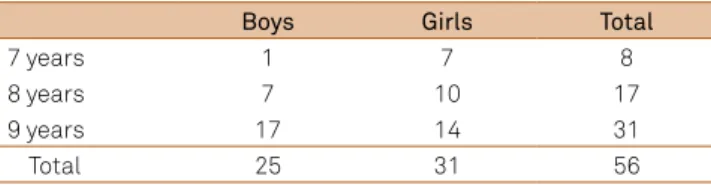
years) recruited from public elementary schools in the mu-nicipality of Osasco, state of São Paulo, Brazil (Table 1).
We included children aged 7 to 9 years whose parents
had signed a consent form for participation in the study. We excluded children who were receiving or had previously re-ceived orthodontic or functional jaw orthopedics treatment, those with a history of cleft lip and/or palate, and those with
neurological syndromes. Children whose irst permanent
molars had not yet erupted were excluded from evaluation
of Angle’s classiication. his study was approved by the
Universidade Federal São Paulo/Hospital São Paulo Research Ethics Committee under protocol no.1181/09.
Procedure
he irst observer examined children twice with an inter
-val of 7 days between observations. he second observer ex
-amined the children once, on the same day that the irst ex -aminer observed the children for the second time.
Assessment of occlusion was divided into sagittal, verti-cal, and transverse analysis.
Sagittal assessment: performed according to Angle’s
classiication19, which is based on the anteroposterior
rela-tionship of the mandible and maxilla and anteroposterior
re-lationships between the irst permanent molars. It is divided
into three classes:
1. Class I: is characterized by a normal relationship be-tween the mandible and the maxilla and the correct rela-tionship between the mesiodistal permanent molars, i.e., the
mesiobuccal cusp of the permanent maxillary irst molar oc -cludes in the vestibular groove of the permanent mandibular
irst molar.
2. Class II: is characterized by distal displacement of
the mandibular irst molars in relation to their maxillary
counterparts, such that the mesiobuccal cusp of the
max-illary irst molar occludes with the distal aspect of the sec
-ond premolar. he entire lower arch is positioned distally to
the upper arch; hence, the maxillary incisors are mesial to their mandibular counterparts.
3. Class III: is characterized by mesial displacement of
the permanent irst molars; the entire lower arch is situated
mesially in relation to the upper arch.
Overjet is the extent to which the maxillary incisors pro-trude beyond the mandibular incisors on the horizontal plane.
It was considered normal if the vestibular surface of the man -dibular incisors contacted the palatal surface of maxillary in-cisors or if the distance between these surfaces was <2 mm.
Vertical assessment: was based on measurement of
overbite, i.e. the extent of overlap of the maxillary teeth over
the mandibular teeth in the vertical plane. It was consid
-ered normal when this overlap ranged from 0 to +4 mm. If
the maxillary incisors overlapped the mandibular incisors by more than 4 mm, or if the teeth touched the palate, this was considered excessive overbite. Conversely, open bite was di-agnosed when there was no contact between the maxillary and mandibular incisors, i.e., negative overbite.
Transverse assessment: we checked for crossbite, which is deined as an abnormal labiolingual relationship or bucco -lingual relationship between the maxillary and mandibular teeth. Bite reversal occurs where the mandibular teeth
over-lap with the maxillary teeth. It is the result of a large discrep -ancy between the maxilla and the mandible. Dental crowd-ing was characterized by lack of space in the dental arch, causing displacement and misalignment of teeth.
he observers then completed a form with the following data: Angle classiication (Class I, II or III), overjet (present
or absent), overbite (present or absent), anterior open bite (present or absent), crossbite (present or absent), and crowd-ing (present or absent).
Statistical analysis
Cohen’s kappa coeicient was used to assess intra- and
interobserver agreement for the diagnosis of orthodontic and functional orthopedic conditions of the jaws. Cohen
Table 1. Characteristics of the sample.
Boys Girls Total
7 years 1 7 8
8 years 7 10 17
9 years 17 14 31
kappa17 is an index used on a nominal scale to assess the
ex-tent to which observations deviate from the expected due to chance, thus providing an indicator of the reliability of this
information. Interpretation of this coeicient was based on the cutof values listed in Table 218.
RESULTS
Only 53 of the 56 children included underwent assessment
of Angle classiication, because three children had no erupted
permanent irst molars. For the other malocclusions, all 56 children were examined. he number of participants for each
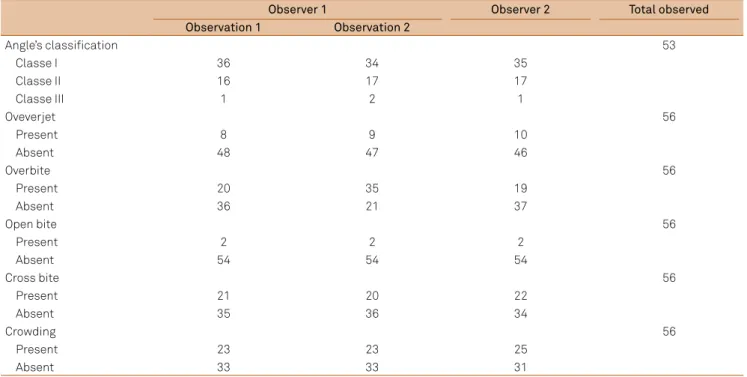
type of occlusion according to the two observations of observ-er 1 and the one obsobserv-ervation of obsobserv-ervobserv-er 2 is shown in Table 3.
Intraobserver agreement was strong (>0.8) for all parame -ters analyzed (type of occlusion according to the Angle
classi-ication, overjet, overbite, open bite, crowding, and crossbite, Table 4). Interobserver agreement was good for overbite and
strong for all other parameters (Table 5).
DISCUSSION
The main finding of this study was the high intraob-server and interobintraob-server agreement for the diagnosis of malocclusions, which may be attributed to the explic-itly defined diagnostic criteria currently adopted and to the familiarity of the observers with the classification of malocclusion.
Table 3. Number of participants according to the occlusion*.
Observer 1 Observer 2 Total observed
Observation 1 Observation 2
Angle’s classification 53
Classe I 36 34 35
Classe II 16 17 17
Classe III 1 2 1
Oveverjet 56
Present 8 9 10
Absent 48 47 46
Overbite 56
Present 20 35 19
Absent 36 21 37
Open bite 56
Present 2 2 2
Absent 54 54 54
Cross bite 56
Present 21 20 22
Absent 35 36 34
Crowding 56
Present 23 23 25
Absent 33 33 31
*The two observations of observer 1 and the one observation of observer 2.
Table 2. Interpretation of the level of agreement18
Kappa coefficient (K) Level of agreement
< 0.20 None
0.21–0.40 Weak
0.41–0.60 Moderate
0.61–0.80 Good
0.81–1.0 Strong
Table 4. Concordance intraobserver for all malocclusions evaluated.
Intraobserver kappa coefficient 95% confidence interval p-value Interpretation of kappa coefficient
Angle classification 0.838 0.592–1.000 p<0.001 strong
Overjet 0.931 0.669–1.000 p<0.001 strong
Overbite 0.808 0.546–1.000 p<0.001 strong
Open bite 1.0 p<0.001 strong
Cross bite 0.885 0.623–1.000 p<0.001 strong
In this study the two observers were specialized dentists
that have extensive experience in this area, but as the exami-nation of malocclusions is also part of the academic dental curriculum, dentists who are not experts should also be able to diagnose these issues reliably, although we emphasize that
it is essential to deine the diagnostic criteria clearly in ad -vance of examination.
Diagnosis is very important, because it is the main
deter-minant of treatment decisions. In orthodontics and function -al jaw orthopedics, clinic-al examination of occlus-al status is
an essential practice. he classiication of patients according
to malocclusion facilitates communication among profes-sionals and choice of treatment protocols.
In this study, two observers assessed the main char -acteristics of malocclusions known to be associated with SDB1,10,20,21. We found that the degree of agreement between
the observers for diagnosis of these malocclusions was high (Figure 1). Conversely, Luke et al. reported poor agreement among 39 professionals for diagnosis and treatment planning
in a sample of six patients. heir poor performance was at
-tributed to the need for better-deined diagnostic criteria16.
Future studies are needed to check which malocclu-sions are more closely associated with SDB, because al-though all the above-mentioned malocclusions are report-ed to be associactreport-ed with SDB, it is possible that there is
Table 5. Interobserver agreement for all malocclusions evaluated.
Intraobserver kappa coefficient 95% confidence interval p-value Interpretation of kappa coefficient
Angle classification 0.84 0.595–1.000 p<0.001 strong
Overjet 0.868 0.608–1.000 p<0.001 strong
Overbite 0.767 0.506–1.000 p<0.001 good
Open bite 1.0 strong
Cross bite 0.848 0.587–1.000 p<0.001 strong
Crowding 0.854 0.593–1.000 p<0.001 strong
a diference in the degree of association between SDB and
each type of malocclusion.
It should be noted that although sample selection was
not concerned with the distribution by gender and age of the
participants, this would not have inluenced achieving the
main objective of this study: to verify the intra- and interob-server agreement.
In conclusion, both intra- and interobserver agreement
were fully satisfactory for all of the evaluated parameters. We
attribute this high level of agreement to the clear deinition
of the diagnostic criteria and to the familiarity of dental
prac-titioners with the Angle classiication. Clearly established di -agnostic criteria can give dentists the opportunity to recog-nize dental malocclusions potentially associated with SDB.
intra obs inter obs
1
0.5
0 type occlusion
overjet overbite openbite crossbite crowding
Figure. Comparison between intra- and inter observer agreement for all malocclusions evaluated.
References
1. Guilleminault C, Pelayo R, Leger C, Clerk A, Bocian RC. Recognition of sleep-disordered breathing in children. Pediatrics 1996;98:871-872.
2. Marklund M, Franklin KA, Sahlin C, Lundgren R. The effect of a mandibular advancement device on apneas and sleep in patients with obstructive sleep apnea. Chest 1998;113:707-713.
3. Shintani T, Asakura K, Kataura A. The effect of adenotonsillectomy in children with OSA. Int J of Pediatr Otorhinolaryngol 1998;44:51-58.
4. Guilleminault C, Lee JH, Chan A. Pediatric obstructive sleep apnea syndrome. Arch Pediatr Adolesc Med 2005;159:775-785.
5. Pirilä-Parkkinen K, Pirttiniemi P, Nieminen P, Tolonen U, Pelttari U, Löppönen H. dental arch morphology in children with sleep disodered breathing. Eur J Orthod 2009;31:160-167.
6. O’Brien C, Benson PE, Marshman Z. Evaluation of a quality of life measure for children with malocclusion. J Orthod 2007;34:185-193.
7. Kalha AS. Evidence that of orthodontics improves long term
8. Arrow P, Brennan D, Spencer AJ. Quality of life and psychosocial outcomes after fixed orthodontic treatment: a 17-year observational cohort study. Community Dent Oral Epidemiol 2011;39:505-514.
9. Guilleminault C, Quo SD. Sleep-disordered breathing. A view at the beginning of the new Millennium. Dent Clin North Am 2001;45:643-656.
10. Caprioglio A, Zucconi M, Calori G, Troiani V. Habitual snoring, OSA and craniofacial modification. Orthodontic clinical and diagnostic aspects in a case control study. Minerva Stomatol 1999;48:125-137.
11. Mohsenin N, Mostofi MT, Mohsenin V. The role of oral appliances in treating obstructive sleep apnea. J Am Dent Assoc 2003;134:442-449.
12. Barsh LI. Responsibilities of the dental profession in recognizing and treating sleep breathing disorders. Compend Contin Educ Dent 1996;17:490-494.
13. Paskow H, Paskow S. Dentistry’s role in treating sleep apnea and snoring. N J Med 1991;88:815-817.
15. Brouillette RT, Fernbach SK, Hunt CE. Obstructive sleep apnea in infants and children. J Pediatr 1982;100:31-40.
16. Luke LS, Atchison KA, White SC. Consistency of patient classification in orthodontic diagnosis and treatment planning. Angle Orthod 1998;68: 513-520.
17. Cohen J. Acoefficient of agreement for nominal scales. Educ Psychol Measur 1960;20:37-46.
18. Altman DG. Practical statistics for medical research. London: Chapman & Hall. 1991;611.
19. Moyers RE. Classificação e terminologia da má oclusão. In: Moyers RE (Ed). Ortodontia traduzido por Décio Rodrigues Martins. Rio de Janeiro:Guanabara Koogan. 1987:265-282
20. Defabjanis P. Impact of nasal airway obstruction on dentofacial development and sleep disturbances in children: preliminary notes. J Clin Pediatr Dent 2003;27:95-100.