613 Synaptonemal complex in Dasypus novemcinctus
Genetics and Molecular Biology, 23, 3, 613-616 (2000)
INTRODUCTION
The Dasypodidae family has nine genera, and the ge-nus Dasypus, six species. The species of this family have a highly conserved phenotype, making its taxonomy problem-atic (Jorge et al., 1985). Widely distributed, the nine-banded armadillo, D. novemcinctus, is found in northeastern Ar-gentina, all of eastern South America, Central America, Mexico, and in the southeastern part of the United States (Storrs et al., 1974). The importance of D. novemcinctus as a model for basic research on reproduction and genetics has long been recognized (Storrs et al., 1974).
The D. novemcinctus karyotype was described by Beath et al. (1962), with 2n = 64 chromosomes, consist-ing of two large metacentric pairs, four large acrocentric pairs, 14 sized acrocentric pairs, six medium-sized metacentric pairs and five small acrocentric pairs. The X chromosome is a large metacentric and the Y chro-mosome is the smallest acrocentric. Benirschke et al. (1969) and Jorge et al. (1985) found several chromosomal polymorphisms in this species in North America.
One of the most important characteristics of the first meiotic prophase is the presence of the synaptonemal complex (SC), a protein structure formed at the begin-ning of prophase I between the sister chromatids of each bivalent. In the SC, kinetochores are seen as a prominent differentiation of the lateral elements (LEs), while the te-lomeres, attached to the nuclear envelope, are seen as dark regions in the SC extremities (Moses, 1977). New cyto-logical techniques developed to analyze the SC have al-lowed detailed studies of chromosome synapsis at meio-sis, including the identification of zygotene and pachytene
substages (Solari, 1980; Dollin et al., 1989; Greenbaum et al., 1990; Villagomez, 1993). Moreover, SC studies have greatly contributed to karyotypic studies of several species, mainly mammals (Gillies, 1989).
We examined SC in Dasypus novemcinctus sperma-tocytes, in different zygotene and pachytene substages, to determine the structure and behavior of the autosomes, sex chromosomes, and nucleoli.
MATERIAL AND METHODS
Spermatogenic cells were collected from three male nine-banded armadillos, Dasypus novemcinctus, about one year old, collected in Botucatu, SP, Brazil. The SC was ana-lyzed by the surface spread technique (Santos, 1993). Sper-matocytes were lysed with 0.01% Triton X100, fixed in 4% paraformaldehyde and stained with 50% silver nitrate (Howell and Black, 1980). SC were transferred to 75-mesh electron microscope grids, examined with a Phillips EM301 electron microscope, at 80 kV, and photographed on Kodak-Eastman film. Photographs of 41 cells were taken.
RESULTS AND DISCUSSION
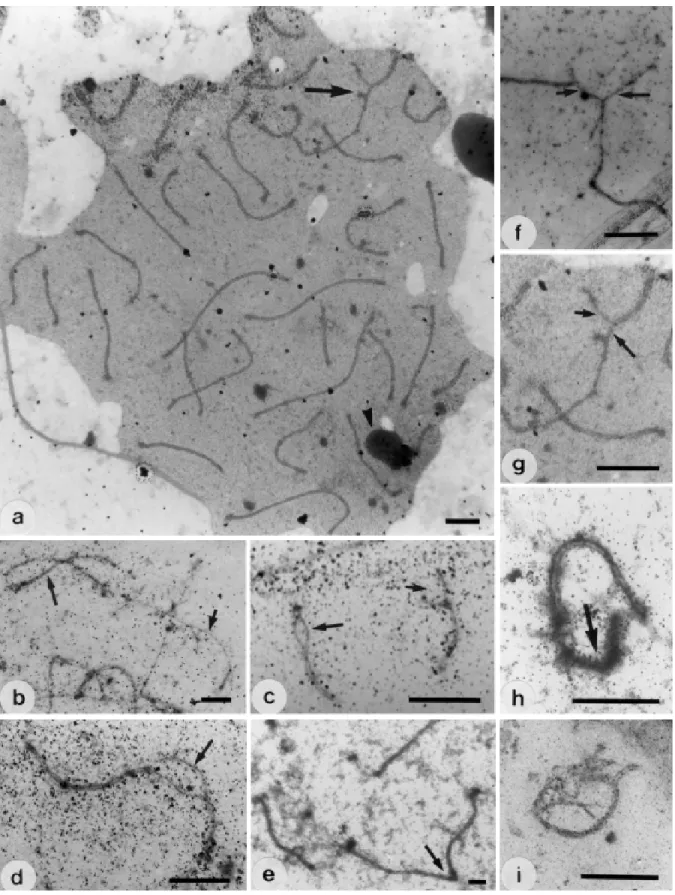
Complete cells of D. novemcinctus in zygotene and pachytene stages contained 32 bivalents, 31 autosomes and one XY sex pair (Figure 1a). Previous cytogenetic studies of this species also indicated 2n = 64 chromosomes in-cluding the XY sex chromosomes (Beath et al., 1962; Jorge et al., 1985). In the extremities of the LEs, darkly stained telomeric plaques were observed, as has been found for other organisms (Solari, 1989).
Analysis of the synaptonemal complex of the nine-banded armadillo,
Dasypus novemcinctus
Márcia Denise da Paixão Scavone1, Claudio Oliveira1, Eduardo Bagagli2 and Fausto Foresti1
Abstract
The synaptonemal complex (SC) of three specimens of the nine-banded armadillo (Dasypus novemcinctus) was analyzed. Thirty-two bivalents (2n = 64) were observed, 31 of them being autosomes and one an XY sexual bivalent. Chromosome synapsis processes and nucleolus structure changes were analyzed in zygotene and pachytene cells, allowing a detailed description of the beginning of meiotic prophase in this species. There was complete synapsis of X and Y chromosomes. Some abnormalities in SC were observed in cells during zygotene and at the beginning of pachytene, but not in cells in the middle and late pachytene, suggesting the occurrence of synaptic adjustments in their SC.
Departamentos de 1Morfologia and 2Microbiologia/Imunologia, Instituto de Biociências, UNESP, 18618-000 Botucatu, SP, Brasil.
Send correspondence to C.O. Fax: +55-14-6802-6264. E-mail: [email protected]
614 Scavone et al.
Figure 1 - Synaptonemal complex of Dasypus novemcinctus. a, Electron micrograph of a early pachytene cell with 31 autosomal bivalents and the XY sexual
615 Synaptonemal complex in Dasypus novemcinctus
D. novemcinctus spermatocytes were classified into two substages of zygotene and three substages of pachytene by examination of autosome and sex chromosome LEs ac-cording to criteria proposed by Greenbaum et al. (1990). Early and late zygotene processes were identified accord-ing to the autosomal synapsis complexity. The early, middle and late substages of pachytene were identified by the de-gree of LE shortening, sexual vesicle condensation and nucleolus dispersion.
Synapsis is asynchronous in D. novemcinctus. Totally paired bivalents were observed simultaneously with other bivalents at the beginning of the pairing process (Figure 1b). Autosome synapsis begins either at one telomere and con-tinues linearly towards the opposite telomere or begins at both telomeres and progresses towards the centromere (Fig-ure 1c). These observations can be explained by the occur-rence of one- and two-armed chromosomes (Beath et al., 1962). D. novemcinctus autosome behavior resembles that observed in other mammalian species with one- and two-armed chromosomes (Moses, 1977; Gillies, 1989).
In some centromeric regions there was a longer delay in LE synapsis (Figure 1d), possibly due to the presence of heterochromatic segments, which have been observed in chromosomes of several armadillo species (Jorge et al., 1985). Asynapsed areas at early pachytene has been observed in some heterochromatic human chromosome segments (Solari, 1980) and more recently in other mammalian spe-cies (Koykul and Basrur, 1995; Fagundes and Yonenaga-Yassuda, 1996).
Nucleoli were identified in chromosomes 2 and 24. Association of nucleoli with LEs was frequently seen dur-ing zygotene and early pachytene (Figure 1a). This associa-tion disappeared during the middle and late pachytene. The sequence of nucleolus fragmentation was similar to that described for other mammals (Solari, 1989). Secondary association of the nucleolus with the XY bivalent, as seen in humans and mice (Solari, 1989), was not observed.
In late zygotene unpaired sex chromosomes were in close proximity (Figure 1f). Synapsis of these chromo-somes started during early pachytene in the long arm ex-tremity of X chromosome (Figure 1g). This is also observed in cattle (Switonski et al., 1990), mink (Koykul and Basrur, 1995) and mice (Fagundes and Yonenaga-Yassuda, 1996). During middle pachytene, the homologous segment and the pseudoautosomal portion of the sex chromosome were al-most totally synapsed. The remainder of the X chromosome was totally heteropycnotic (Figure 1h). Synapsis of the sex chromosomes was completed during late pachytene, as in-dicated by a marked thickening of the unsynapsed X seg-ment and formation of the sexual vesicle (Figure 1i). Syn-apsis of the sexual chromosomes occurred in a such way that the X and Y chromosomes became entirely paired (Fig-ure 1h). Complete X and Y chromosome synapsis is un-common but has been observed in mammalian species such as mice (Joseph and Chandley, 1984), cats (Gillies and Cowan, 1985) and mink (Koykul and Basrur, 1995).
Several chromosome pairing failures were observed in the zygotene and pachytene cells, e.g., telomere associa-tions (Figure 1e), univalents, pairing delays and inter-lockings. The frequency of these cell anomalies declined from late zygotene to late pachytene. This could be because synaptic adjustment reduces pairing failures, as has been proposed for several mammalian species (Ashley et al., 1981; Moses and Poorman, 1981; Gabriel-Robez et al., 1986; Dollin et al., 1991).
ACKNOWLEDGMENTS
The authors thank Dr. E.A. Gregório for making an electron microscope available and Dr. M.K. Tansey for critical review of the original manuscript. Financial aid for the research was provided by FAPESP and CNPq. Publication supported by FAPESP.
RESUMO
Foi analisado o complexo sinaptonêmico (SC) de três espé-cimens de tatu galinha (Dasypus novemcinctus). Foi observada a ocorrência de 32 bivalentes (2n = 64), 31 dos quais correspon-diam aos autossomos e um ao bivalente sexual XY. Os processos de sinapse cromossômica e transformação na estrutura do nucléolo foram analisados em células em zigóteno e paquíteno, permitindo uma detalhada descrição do início da prófase meiótica dessa espécie. Uma característica importante observada foi o completo emparelhamento dos cromossomos X e Y. Algumas anormalidades do SC foram observadas em células em zigóteno e no início de paquíteno, porém essas anormalidades não foram observadas em células no meio e fim de paquíteno, sugerindo a ocorrência de ajustamentos sinápticos no SC.
REFERENCES
Ashley, T., Moses, M.J. and Solari, A.J. (1981). Fine structure and behaviour
of a pericentric inversion in the sand rat, Psammomys obesus. J. Cell
Sci. 50: 105-119.
Beath, M.M., Benirschke, K. and Brownhill, L.E. (1962). The chromosomes
of the nine-banded armadillo, Dasypus novencinctus. Chromosoma 13: 27-38.
Benirschke, K., Low, R.J. and Ferm, V.H. (1969). Cytogenetic studies of
some armadillos. In: Comparative Mammalian Cytogenetics (Benirschke, K., ed.). Springer-Verlag, New York, pp. 330-345.
Dollin, A.E., Murray, J.D. and Gillies, C.B. (1989). Synaptonemal complex
analysis of hybrid cattle. I. Pachytene substaging and the normal full bloods. Genome 32: 856-864.
Dollin, A.E., Murray, J.D. and Gillies, C.B. (1991). Synaptonemal complex
analysis of hybrid cattle. III. Meiotic pairing mechanisms in F1 Brahman x Hereford hybrids. Genome 34: 228-235.
Fagundes, V. and Yonenaga-Yassuda, Y. (1996). The analysis of
synaptone-mal complex formation in Trichomys apereoides (Rodentia, Echimyidae) with detailed XY pairing. Caryologia 49: 183-192.
Gabriel-Robez, O., Ratomponirina, C., Rumpler, Y., Le Marec, B., Luciani, J.M. and Guichaoua, M.R. (1986). Synapsis and synaptic adjustment in
an infertile human male heterozygous for a pericentric inversion in chro-mosome 1. Hum. Genet. 72: 148-152.
Gillies, C.B. (1989). Fertility and Chromosome Pairing: Recent Studies in
Plants and Animals. CRC Press, Boca Raton.
Gillies, C.B. and Cowan, S.K. (1985). The pachytene synaptonemal complex
complement of the cat. Genetica 67: 99-107.
Greenbaum, I.F., Hale, D.W., Sudman, P.D. and Nevo, E. (1990). The
616 Scavone et al.
pachynema from deer mouse spermatocytes. Chromosoma 93: 203-212.
Howell, W.M. and Black, D.A. (1980). Controlled silver-staining of
nucleo-lus organizer regions with a protective colloidal developer: a 1-step method. Experientia 36: 1014-1015.
Jorge, W., Orsi-Souza, A.T. and Best, R. (1985). The somatic chromosomes
of Xenarthra. In: The Evolution and Ecology of Armadillos, Sloths,
and Vermilinguas (Montgomery, G.G., ed.). Smithsonian Institution
Press, Washington.
Joseph, A.M. and Chandley, A.C. (1984). The morphological sequence of
XY pairing in the Norway rat Rattus norvegicus. Chromosoma 89: 381-386.
Koykul, W. and Basrur, P.K. (1995). The XY pair of the mink (Mustela
vision) during different periods of testicular activity. Hereditas 122:
169-176.
Moses, M.J. (1977). Synaptonemal complex karyotyping in spermatocytes
of the Chinese hamster (Cricetulus griseus). I. Morphology of the au-tosomal complement in spread preparations. Chromosoma 60: 99-125.
Moses, M.J. and Poorman, P.A. (1981). Synaptonemal complex analysis of
mouse chromosomal rearrangements. II. Synaptic adjustment in a tan-dem duplication. Chromosoma 81: 519-535.
Santos, J.L. (1993). Spreading synaptonemal complex from the
grasshop-per Chorthippus jacobsi: pachytene and observations. Hereditas 118: 235-241.
Solari, A.J. (1980). Synaptonemal complex and associated structures in
microspread human spermatocytes. Chromosoma 81: 315-337.
Solari, A.J. (1989). Sex chromosome pairing and fertility in the
heteroga-metic sex of mammals and birds. In: Fertility and Chromosome
Pair-ing: Recent Studies in Plants and Animals (Gillies, C.B., ed.). CRC
Press, Boca Raton, pp. 77-135.
Storrs, E.E., Walsh, G.P., Burchfield, H.P. and Binford, C.H. (1974). Leprosy
in the armadillo: new model for biomedical research. Science 183: 851-852.
Switonski, M., Ansari, H.A., Mathew, A., Jung, H.R. and Stranzinger, G.
(1990). Synaptonemal complex analysis in primary spermatocytes of cattle x zebu hybrids (Bos taurus x Bos indicus). Breed Genet. 107: 229-238.
Villagomez, D.A.F. (1993). Zygotene-pachytene substaging and
synaptone-mal complex karotyping of boar spermatocytes. Hereditas 118: 87-99.