Characterization of the FKBP12-Encoding
Genes in
Aspergillus fumigatus
Katie Falloon1☯‡, Praveen R. Juvvadi2☯‡, Amber D. Richards2, José M. Vargas-Mu ñiz3,
Hilary Renshaw3, William J. Steinbach2,3*
1Duke University School of Medicine, Durham, NC, United States of America,2Department of Pediatrics, Division of Pediatric Infectious Diseases, Duke University Medical Center, Durham, NC, United States of America,3Department of Molecular Genetics and Microbiology, Duke University Medical Center, Durham, NC, United States of America
☯These authors contributed equally to this work. ‡These authors are co-first authors on this work. *[email protected]
Abstract
Invasive aspergillosis, largely caused byAspergillus fumigatus, is responsible for a growing number of deaths among immunosuppressed patients. Immunosuppressants such as FK506 (tacrolimus) that target calcineurin have shown promise for antifungal drug develop-ment. FK506-binding proteins (FKBPs) form a complex with calcineurin in the presence of FK506 (FKBP12-FK506) and inhibit calcineurin activity. Research on FKBPs in fungi is limited, and none of the FKBPs have been previously characterized inA.fumigatus. We identified four orthologous genes of FKBP12, the human FK506 binding partner, inA.
fumigatusand designated themfkbp12-1,fkbp12-2,fkbp12-3, andfkbp12-4. Deletional analysis of the four genes revealed that theΔfkbp12-1strain was resistant to FK506, indi-cating FKBP12-1 as the key mediator of FK506-binding to calcineurin. The endogenously expressed FKBP12-1-EGFP fusion protein localized to the cytoplasm and nuclei under nor-mal growth conditions but also to the hyphal septa following FK506 treatment, revealing its interaction with calcineurin. The FKBP12-1-EGFP fusion protein didn’t localize at the septa in the presence of FK506 in thecnaAdeletion background, confirming its interaction with calcineurin. Testing of all deletion strains in theGalleria mellonellamodel of aspergillosis suggested that these proteins don’t play an important role in virulence. While theΔfkbp12-2
andΔfkbp12-3strains didn’t show any discernable phenotype, theΔfkbp12-4strain displayed slight growth defect under normal growth conditions and inhibition of the caspo-fungin-mediated“paradoxical growth effect”at higher concentrations of the antifungal cas-pofungin. Together, these results indicate that while only FKBP12-1 is the bona fide binding partner of FK506, leading to the inhibition of calcineurin inA.fumigatus, FKBP12-4 may play a role in basal growth and the caspofungin-mediated paradoxical growth response. Exploitation of differences betweenA.fumigatusFKBP12-1 and human FKBP12 will be crit-ical for the generation of fungal-specific FK506 analogs to inhibit fungal calcineurin and treat invasive fungal disease.
OPEN ACCESS
Citation:Falloon K, Juvvadi PR, Richards AD, Vargas-Muñiz JM, Renshaw H, Steinbach WJ (2015) Characterization of the FKBP12-Encoding Genes in Aspergillus fumigatus. PLoS ONE 10(9): e0137869. doi:10.1371/journal.pone.0137869
Editor:Gustavo Henrique Goldman, Universidade de Sao Paulo, BRAZIL
Received:June 12, 2015
Accepted:August 22, 2015
Published:September 14, 2015
Copyright:© 2015 Falloon et al. This is an open access article distributed under the terms of the Creative Commons Attribution License, which permits unrestricted use, distribution, and reproduction in any medium, provided the original author and source are credited.
Data Availability Statement:All relevant data are within the paper and its Supporting Information files.
Funding:PRJ and WJS are supported by the National Institutes of Health 1R01AI112595 (http:// www.nih.gov/). JVM is supported by the National Science Foundation Graduate Research Fellowship Program DGF 1106401 (http://www.nsf.gov/funding/ pgm_summ.jsp?pims_id=6201). The funders had no role in study design, data collection and analysis, decision to publish, or preparation of the manuscript.
Introduction
Medical advancement, especially in the fields of transplantation and oncology, has led to a growing population of immunosuppressed patients. Unfortunately, as this population has expanded, the incidence of infections in these patients has also increased and invasive fungal infections are a leading cause of infection-related mortality in the immunosuppressed [1–5].
Chief among these infections is invasive aspergillosis, largely caused byAspergillus fumigatus, which kills 40–60% of those it infects [2,3,6–8]. Given the relative ineffectiveness of current
antifungal treatment options, an improved understanding of invasive aspergillosis, coupled with novel therapeutic agents, is needed [9].
Paradoxically, the immunosuppressants that accommodate organ transplantation, yet ren-der patients susceptible to opportunistic infections, also possess the ability to halt invasive aspergillosis [9–11]. Epidemiologically, patients on agents that inhibit the Ca2+/calmodulin
(CaM) dependent protein phosphatase calcineurin, such as cyclosporine A and FK506 (tacroli-mus), have been shown to be less likely to suffer invasive fungal infections than those receiving other forms of immunosuppression [12,13]. Additionally,in vitrotesting shows cyclosporine A and FK506 both interfere with fungal growth and virulence [14].
Calcineurin inhibitors function by first forming complexes with immunophilins, highly conserved peptidyl-prolyl cis-trans isomerases that serve as chaperones in protein folding in organisms from fungi to humans [15–20]. The immunophilins can be further classified into
cyclophilins, which bind to cyclosporine A, and FK506-binding proteins (FKBPs), which bind to FK506 or rapamycin [21–25]. Immunosupressant-immunophilin complexes then bind to
calcineurin between its catalytic (CnaA) and regulatory (CnaB) subunits to exert their inhibi-tory effects [15,16,26,27]. In humans, this binding prevents activation of the immune system [21,28,29]. InA.fumigatus, binding prevents a number of functions important for fungal pathogenesis, including regulation of stress response, cation homeostasis, cell wall integrity, and virulence [30–35]. Given this unique mechanism of antifungal activity, as well as the
syner-gism of calcineurin inhibitors with standard antifungals and antifungal activity against drug resistant strains, the calcineurin pathway is an optimal target for drug development [9,11,14,
36,37]. With appropriate chemical modifications, it is possible that a calcineurin inhibitor could be designed for fungal-specific targeting, leaving human calcineurin, and by extension the human immune system, untouched [9]. Therefore, it is important to gain a better under-standing of one of the key binding partners of calcineurin, FKBP.
Work on FKBPs in mammals has been extensive, and mammalian FKBPs have been shown to interact with TGF-βas well as with calcium release channels (ryanodine receptors and inosi-tol 1,4,5 triphosphate receptors) via calcineurin and mTOR [38–44]. On the contrary,
explora-tion of FKBPs in fungi has been limited. Work in the model organismsSaccharomyces cerevisiaeandNeurospora crassashows no essential role for the FKBPs [45,46], and orthologs of FKBP12 in both fungi mediated resistance to FK506 and rapamycin [45–48]. Studies in the
plant pathogensBotrytis cinereaandFusarium fujikuroialso demonstrated a role for fungal orthologs of FKBPs in FK506 and rapamycin resistance [49–51]. In human pathogenic fungi,
deletions of the FKBP12 orthologfrr1inCryptococcus neoformansand disruptions in the FKBP12 orthologfkbAinMucor circinelloideshave also led to FK506 and rapamycin resistance [52–55]. However, no studies have focused on FKBPs in one of the most common invasive
fun-gal pathogens,A.fumigatus.
difference between it and human FKBP12 could prove important in the generation of fungal-specific FK506 analogs.
Materials and Methods
Strains, media, and growth conditions
TheA.fumigatus akuBKU80pyrG-uracil/uridine auxotroph strain was used as the recipient strain in the construction of theΔfkbp12-1,Δfkbp12-2,Δfkbp12-3, andΔfkbp12-4deletion strains [56,57]. It was also used in the construction of thefkbp12-1-egfpexpression strain in thepyrG-background. Thefkbp12-1-egfp pyrG-strain was then used as the recipient strain in the generation of thefkbp12-1-egfpΔcnaAstrain. TheA.fumigatus akuBKU80strain was used as the recipient strain in construction of thefkbp12-1-egfpstrain, as well as the wild-type control for all experiments [57]. TheA.fumigatusΔfkbp12-1strain was used as the recipient strain in the generation of theΔfkbp12-1Δfkbp12-2double deletion strain. AllA.fumigatuscultures were grown on glucose minimal media (GMM) at 37°C as previously described, unless other-wise specified [58].Escherichia coliDH5αcompetent cells (New England Biolabs, Ipswich, MA) were used for cloning and grown on LB media supplemented with appropriate antibiotics at 37°C.
Construction of FKBP12 single and double deletion strains
With a focus on the role ofA.fumigatusFKBPs in mediating antifungal resistance or pathogen-esis, we constructed deletion strains of all FKBP12-encoding genes (Δfkbp12-1,Δfkbp12-2,
Δfkbp12-3, andΔfkbp12-4). Primers used for the construction of the various deletion cassettes are listed in theS1 Table. TheΔfkbp12-1strain was constructed via replacement of the 637 bp
fkbp12-1gene (fkbp1/Afu6g12170,www.aspergillusgenome.org) with the 3.0 kbA.parasiticus pyrGgene to serve as a selectable marker to complement the uracil/uridine auxotrophy of
akuBKU80[31]. Approximately 1 kb of flanking upstream sequence offkbp12-1was PCR ampli-fied fromA.fumigatusstrain AF293 genomic DNA and cloned into the pCDF-Duet-1 vector (Novagen EMD Millipore, Billerica, MA), using the BamHI and EcoRI sites. Fusion PCR was used to generate the ~4.0 kb sequence containing theA.parasiticus pyrGgene and ~1 kb of flanking downstream sequence offkbp12-1, which was also cloned in the pCDF-Duet-1 vector using the EcoRI and SacI sites. The resulting replacement construct plasmid was used as a tem-plate to create the ~4.7 kb PCR amplicon for use in transformation into theakuBKU80pyrG
-strain.
TheΔfkbp12-2strain was constructed via replacement of the 709 bpfkbp12-2gene (fkbp2/ Afu4g04020,www.aspergillusgenome.org) with the 3.0 kbA.parasiticus pyrGgene. Approxi-mately 1 kb of flanking upstream and downstream sequences were PCR amplified from AF293 genomic DNA and cloned into the pJW24 plasmid, using the SalI and EcoRI sites for the upstream sequence and the BamHI and NotI sites for the downstream sequence. The resulting replacement construct plasmid was then linearized via NotI digestion to yield the final con-struct for transformation into theakuBKU80pyrG-strain.
TheΔfkbp12-4strain was constructed via replacement of the 1653 bpfkbp12-4gene (fkbp4/ Afu6g08580,www.aspergillusgenome.org) with the 3.0 kbA.parasiticus pyrGgene. Approxi-mately 1 kb of flanking upstream and downstream sequences were PCR amplified from AF293 genomic DNA and cloned into the pJW24 plasmid, using the SalI and EcoRI sites for the upstream sequence and the NotI and SacI sites for the downstream sequence. The resulting replacement construct plasmid was then linearized via digestion with SalI and SacI to yield the construct for use in transformation into theakuBKU80pyrG-strain.
For strainsΔfkbp12-1throughΔfkbp12-4, transformants were selected for growth in the absence of uracil/uridine supplementation.
TheΔfkbp12-1Δfkbp12-2double deletion strain was constructed via replacement of the 709 base pairfkbp12-2gene (fkbp2/Afu4g04020,www.aspergillusgenome.org) with the 4.4 kb hygromycin B resistance (hph)cassette. Approximately 1 kb of flanking upstream and down-stream sequences were PCR-amplified from AF293 genomic DNA and cloned into the pUCGH plasmid, using the HindIII and SbfI sites for the upstream sequence and the EcoRV and NotI sites for the downstream sequence. The resulting replacement construct plasmid was then linearized via digestion with NotI, yielding the construct for use in transformation into theΔfkbp12-1strain. Transformants were selected for resistance to hygromycin B. Primers uti-lized to construct this strain are listed in theS1 Table.
To construct thefkbp12-1-egfpstrain, 384 bp of the 637 bpfbkp12-1gene (fkbp1/
Afu6g12170,www.aspergillusgenome.org) and ~1 kb of thefkbp12-1terminator sequence were PCR amplified from AF293 genomic DNA and cloned into the pUCGH plasmid at the N-ter-minus ofegfp, using the KpnI and BamHI sites for the gene and the SbfI and HindIII sites for the terminator sequence. The plasmid was then sequenced to confirm accuracy of the partial sequence of thefkbp12-1cloned and finally linearized via single restriction enzyme digestion with KpnI. The construct was transformed into theA.fumigatus akuBKU80strain. Transfor-mants were selected for resistance to hygromycin B. All primers utilized to construct the GFP strain are listed in theS4 Table.
To construct thefkbp12-1-egfpΔcnaAstrain, first 384 bp of the 637 bpfbkp12-1gene (fkbp1/ Afu6g12170,www.aspergillusgenome.org) and ~1 kb of thefkbp12-1terminator sequence were PCR amplified from AF293 genomic DNA and cloned into the pUCGH plasmid at the N-ter-minus ofegfp, using the KpnI and BamHI sites for the gene and the SbfI and HindIII sites for the terminator sequence. The plasmid was then sequenced to confirm accuracy of the partial sequence of thefkbp12-1cloned and finally linearized via single restriction enzyme digestion with KpnI. The construct was transformed into theA.fumigatus akuBKU80pyrG-strain. Next, the 3.0 kbA.parasiticus pyrGgene was used to replace the 1.9 kbcnaAgene (calA/Afu5g09360,
www.aspergillusgenome.org) as previously described [31] and the resulting replacement con-struct was transformed into theakuBKU80pyrG-fkbp12-1-egfpstrain.
Radial Growth
Radial growth on solid media was quantified as previously described for all deletion strains and the FKBP12-1-EGFP strain [31]. All assays were performed in triplicate. To further validate the slight growth defect observed with theΔfkbp12-4strain, the assays were performed in tripli-cate in two independent experiments. Statistical comparison was performed using Graph Pad Prism (San Diego, CA).
Antifungal and immunosuppressant susceptibility testing
FK506, cyclosporine A, and caspofungin were obtained as commercial products. Rapamycin was obtained from the National Cancer Institute. An inoculum of 10μL of 1x10⁶conidia/mL
(104conidia) was spotted onto GMM plates supplemented with either FK506 (100 ng/mL) or cyclosporine A (10μg/mL). Testing for caspofungin sensitivity was performed with GMM
plates supplemented with either 1μg/mL or 4μg/mL of caspofungin and growth was observed
after 5 days [34]. Susceptibility to caspofungin was also analyzed in 96 well plates using RPMI 1640 liquid media (RPMI; Roswell Park Memorial Institute) supplemented with either 1μg/
mL or 4μg/mL of caspofungin. Hyphal growth was visualized microscopically after incubation
at 37°C for 24 and 48 hours. Spotting on GMM supplemented with both FK506 (100 ng/mL) and caspofungin (1μg/mL) was performed to assess the combined effect on antifungal
resis-tance. Susceptibility to FK506 was also analyzed in 96 well plates using RPMI 1640 media and 100 ng/mL of FK506 [59]. Hyphal growth was visualized microscopically after incubation at 37°C for 24 and 48 hours. Given the high MIC of the drug, resistance to rapamycin was ana-lyzed in 96 well plates using RPMI media and 100μg/mL of rapamycin [14]. Hyphal growth
was visualized microscopically after incubation at 37°C for 24 hours. All drug testing was per-formed in triplicate.
Virulence Testing
Twenty larvae of the waxmothGalleria mellonellawere injected with 5μl of 1 x 10⁸spores/ml
(total inoculum of 2 x 10⁵spores) of the wild-type or the respective FKBP12 deletion strains. Infected larvae were incubated at 37°C with survival scored daily for 5 days [60]. Data from this trial was plotted on a Kaplan-Meier curve with log rank pair-wise comparison and statisti-cal analysis was performed using Graph Pad Prism (San Diego, CA).
Light and Fluorescence Microscopy
Conidia of thefkbp12-1-egfpstrain were cultured for 18–20 hours at 37°C in petri dishes
con-taining coverslips immersed in 10 mL of GMM liquid media [32]. To assess localization follow-ing exposure to FK506, conidia of thefkbp12-1-egfpstrain were cultured for 18–20 hours at
37°C in 60x15 mm petri dishes containing coverslips immersed in 10 mL GMM liquid media supplemented with 100 ng/mL of FK506. Following incubation, spores were adherent to the coverslip and could be visualized via microscopy. To confirm that the septal localization observed was due to interaction with calcineurin, both experiments were repeated with the
fkbp12-1-egfpΔcnaAstrain. Fluorescence microscopy was performed using an Axioskop 2 plus microscope (Zeiss) equipped with AxioVision 4.6 imaging software with Nomarski optics (Dif-ferential Interference Contrast) and fluorescence. For nuclear staining, thefkbp12-1-egfpand wild type strains were cultured in GMM liquid medium on coverslips for 18–20 hours and
37°C. After washing with 50 mM PIPES (pH 7.0) for 20 minutes, the fixed sample was stained with propidium iodide solution (12.5μg/ml) in 50 mM PIPES (pH 7.0) for 5 minutes, washed
again with 50 mM PIPES (pH 7.0) for 20 minutes and observed under the fluorescence microscope.
Results
Identification and phylogenic analysis of putative
A
.
fumigatus
FKBP12
orthologs
In order to characterize the role of FKBP12 orthologs inA.fumigatus, BLAST analysis was used to identify the four putative orthologs of humanfkbp12(www.aspergillusgenome.org). Four FKBPs (fkbp12-1,fkbp12-2,fkbp12-3andfkbp12-4)were identified. Comparison with human FKBP12 revealed that FKBP12-1 had the greatest sequence similarity (55% identity, 74% similarity,http://www.ebi.ac.uk/Tools/psa/emboss_needle), followed by FKBP12-2 (47% identity, 68% similarity,http://www.ebi.ac.uk/Tools/psa/emboss_needle), FKBP12-3 (35% identity, 50% similarity,http://www.ebi.ac.uk/Tools/psa/emboss_needle) and finally FKBP12-4 (10% identity, 14% similarity,http://www.ebi.ac.uk/Tools/psa/emboss_needle). Multiple sequence alignment of the proteins (S1 Fig) and phylogenetic analysis (Fig 1A) showed that the FKBP12 proteins from human and other fungal species were closely related. While FKBP12-1, FKBP12-2 and FKBP12-3 were grouped together, FKBP12-4 may belong to a separate clade and diverged from the other members. Based on the sequence similarity between FKBP12-1 and FKBP12-2, it is possible that FKBP12-2 may have been formed due to gene duplication. Comparison of amino acids at the 14 residues previously identified as key for binding to FK506 [61] revealed that FKBP12-1 differed from human FKBP12 at three of the 14 sites, FKBP12-2 at three of the 14 sites, FKBP12-3 at four of the 14 sites, and FKBP12-4 at two of the 14 sites (Fig 1B). The three substitutions inA.fumigatusFKBP12-1 involved the replacement of an acidic amino acid with a basic one (arginine for glutamate, position 55), the replacement of one small nonpolar amino acid with another (glycine for alanine, position 82), and the replacement of a basic amino acid with a nonpolar and bulky one (phenylalanine for histidine, position 88). As is illustrated inFig 1B, FKBP12 orthologs from other species are mutated only at two residues.
The modifications in FKBP12-2, which shares the next most sequence similarity to human FKBP12, include replacement of the neutral phenylalanine with the nonpolar leucine (position 47), replacement of the acidic glutamate with the acidic aspartate (position 55) and replace-ment of histidine with phenylalanine (position 88). FKBP12-3 differs by four amino acids at similar locations, including replacement of phenylalanine with leucine (position 47), glutamate with arginine (position 55), alanine with glycine (position 82) and histidine with the nonpolar isoleucine (position 88). FKBP12-4, which shares the least sequence similarity to human FKBP12, differs from human FKBP12 at only two of the 14 residues (replacement of arginine with lysine at position 43 and replacement of histidine with leucine at position 88).
Deletion analysis of the FKBP12 genes in
A
.
fumigatus
Based on thein silicoanalysis, single deletion strains for all fourA.fumigatusFKBP12 ortho-logs were generated (Fig 2A–2D). In addition, due to the higher homology observed between
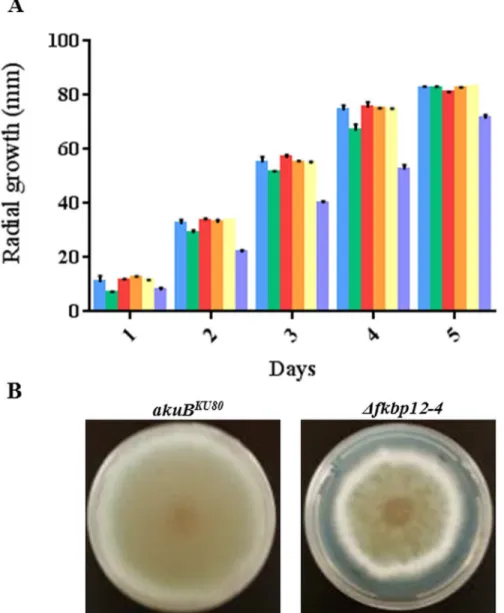
Table 1. Radial growth assays of all the FKBP12 deletion strains revealed them to be non-essen-tial inA.fumigatus(Fig 3A). Among the respective deletion strains only theΔfkbp12-4strain demonstrated slightly impaired growth under basal conditions compared to the wild-type strain (p = 0.016) (Fig 3A and 3B). Apart from the reduced growth rate, however, there were no other visible growth abnormalities in the strain (Fig 3B). TheΔfkbp12-1strain had a statisti-cally significant difference in growth compared to the wild-type strain (p = 0.0405), but by day 5 had reached a similar full growth. All other deletion strains demonstrated radial growth
Fig 1. Phylogenetic analysis of FKBP12 proteins and multiple sequence alignment comparing residues important for FK506-FKBP12 binding. (A) Phylogram showing orthologous FKBP12 proteins from Human (HsFKBP12),S.cerevisiae(ScFKBP12),C.neoformans(CnFKBP12),M.circinelloides
(McFKBP12) andA.fumigatus(AfFKBP12-1, AfFKBP12-2, AfFKBP12-3 and AfFKBP12-4). Phylogenic analysis was performed using the respective amino acid sequences aligned with MUSCLE (v3.8.31) implemented in the PhyML program (v3.1/3.0 aLRT). Graphical representation of the phylogenetic tree was performed with TreeDyn (v198.3).A.fumigatusFKBP12 proteins are designated as AfFKBP12-1, AfFKBP12-2, AfFKBP12-3 and AfFKBP12-4, respectively. (B)14 residues are known to be important for binding FKBP12 to FK506. Residues distinct from human FKBP12 are highlighted in a different color for each
A.fumigatusFKBP12 and for each species-specific FKBP12 homolog.
Fig 2. Construction of the FKBP12 deletion strains. (A) Construction ofΔfkbp12-1strain. In the Δfkbp12-1strain, wild-typeA.fumigatus fkbp12-1(637 bp) was replaced by the 3.0 kbA.parasiticus pyrG
gene. Three of the five strains validated by PCR were then selected for Southern analyses. SalI-digested genomic DNA was probed with the 646 bp probe of the downstream flanking sequence to confirm
homologous recombination. Two of the three tested strains demonstrated the expected ~3.3 kb length, which is contrasted with the WT length of ~1.1 kb. Gel used for Southern analysis was 1% agarose.(B)
Construction ofΔfkbp12-2strain.In theΔfkbp12-2strain, wild-typeA.fumigatus fkbp12-2(709 bp) was replaced with the 3.0 kbA.parasiticus pyrGgene. The strain validated by PCR was then used for Southern analyses. BamHI-digested genomic DNA was probed with the 733 bp probe of the downstream flanking sequence to confirm homologous recombination. The strain demonstrated the expected ~1.1 kb length in contrast with the ~2 kb length in the wild-type strain. Gel used for Southern analysis was 1.5% agarose.(C) Construction ofΔfkbp12-3strain.In theΔfkbp12-3strain, wild-typeA.fumigatus fkbp12-3(485 bp) was replaced by the 3.0 kbA.parasiticus pyrGgene. Four of the strains validated by PCR were then selected for Southern analyses. SacI-digested genomic DNA was probed with the 446 bp probe of the downstream flanking sequence to confirm homologous recombination. All four tested strains demonstrated the expected ~3.9 kb length as opposed to the wild-type length of ~1.4 kb. Gel used for Southern analysis was 1% agarose.(D) Construction ofΔfkbp12-4strain.In theΔfkbp12-4mutant, wild-typeA.fumigatus fkbp12-4
(1653 bp) was replaced by the 3.0 kbA.parasiticus pyrGgene. Four of the strains validated by PCR were then selected for Southern analyses. BamHI-digested genomic DNA was probed with the 677 bp probe of the downstream flanking sequence to confirm homologous recombination. All four tested strains demonstrated the expected ~4.5 kb length as opposed to the wild-type length of ~2.0 kb. Gel used for Southern analysis was 1% agarose.(E) Construction ofΔfkbp12-1Δfkbp12-2strain. In theΔfkbp12-1Δfkbp12-2strain, wild-typeA.fumigatus fkbp12-2(709 bp) is replaced by the 4.4 kb hygromycin B resistance cassette in the Δfkbp12-1strain. Four of the strains validated by PCR were then selected for Southern analyses. BamHI-digested genomic DNA was probed with the 550 bp probe of the downstream flanking sequence to confirm homologous recombination. All four tested strains demonstrated the expected ~5.2 kb as opposed to the wild-type length of ~1.9 kb.
doi:10.1371/journal.pone.0137869.g002
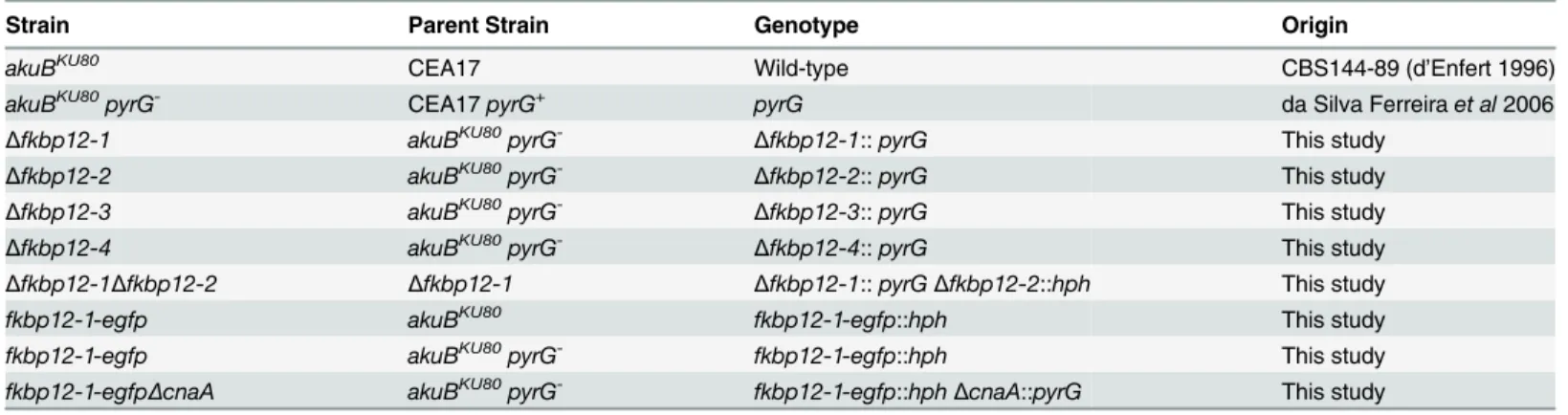
Table 1. Strains used in the Present Study.
Strain Parent Strain Genotype Origin
akuBKU80 CEA17 Wild-type CBS144-89 (d’Enfert 1996)
akuBKU80pyrG- CEA17pyrG+ pyrG da Silva Ferreiraet al2006
Δfkbp12-1 akuBKU80pyrG- Δfkbp12-1::pyrG This study
Δfkbp12-2 akuBKU80pyrG- Δfkbp12-2::pyrG This study
Δfkbp12-3 akuBKU80pyrG- Δfkbp12-3::pyrG This study Δfkbp12-4 akuBKU80pyrG- Δfkbp12-4::pyrG This study Δfkbp12-1Δfkbp12-2 Δfkbp12-1 Δfkbp12-1::pyrGΔfkbp12-2::hph This study
fkbp12-1-egfp akuBKU80 fkbp12-1-egfp::hph This study
fkbp12-1-egfp akuBKU80pyrG- fkbp12-1-egfp::hph This study
fkbp12-1-egfpΔcnaA akuBKU80pyrG- fkbp12-1-egfp::hphΔcnaA::pyrG This study
patterns consistent with that seen with the wild-type strain (Fig 3A). InΔfkbp12-1Δfkbp12-2,
Δfkbp12-2, andΔfkbp12-3, statistically significant differences in growth were not observed (p = 0.4318, p = 0.2601, p = 0.3138). Thus, of the four FKBP12s, only FKBP12-4 is required for proper growth under basal conditions.
FKBP12-1 is the key protein that binds to FK506 and inhibits calcineurin
Next, in order to determine which of these putative FKBP12 proteins is involved in the binding of FK506 and inhibition of calcineurin function inA.fumigatus, the respective deletion strains were cultured in the absence or presence of FK506 (100 ng/mL) (Fig 4A and 4B). As shown in
Fig 4B, with the exception of theΔfkbp12-1strain and theΔfkbp12-1Δfkbp12-2double deletion strain, all deletion strains showed sensitivity to FK506.Δfkbp12-2 andΔfkbp12-3 showed
Fig 3. FKBP12-4 is required for complete hyphal growth. (A)Growth ofA.fumigatus(104conidia) on GMM at 37°C for 5 days, with colony diameter measured every 24 hours, revealed no statistically significant difference in growth amongΔfkbp12-1,Δfkbp12-2,Δfkbp12-1Δfkbp12-2,Δfkbp12-3and wild-type strains.Δfkbp12-4demonstrated reduced growth rate across all 5 days (p = 0.0161).(B)After the 5 day growth period,Δfkbp12-4demonstrated reduced growth compared to wild-type strain but no other obvious phenotypic abnormalities were noted.
susceptibility to FK506 comparable to that of the wild-type strain (Fig 4B). These results con-firmed that the FK506 resistance observed in theΔfkbp12-1Δfkbp12-2double deletion strain
Fig 4.Δfkbp12-1is resistant to FK506 but its response to other antifungal agents is unchanged. (A)A.fumigatusconidia (104conidia) incubated on GMM at 37°C for 5 days.(B)A.fumigatusconidia (104conidia) incubated on GMM + 100 ng/mL FK506 at 37°C for 5 days.
(C)A.fumigatusconidia (104 conidia) incubated on GMM + 10μg/mL cyclosporine A (CsA) at 37°C for 5 days.(D)A.fumigatusconidia (104conidia) incubated on GMM + 1μg/mL caspofungin (CSP) at 37°C for 5 days(E)A.fumigatusconidia (104conidia) incubated on GMM + 1μg/mL caspofungin at 37°C for 5 days(F)A.fumigatus conidia (104conidia) incubated on GMM + 100 ng/mL FK506 + 1μg/mL caspofungin at 37°C for 5 days.
was due to the deletion offkbp12-1.Δfkbp12-4 showed minimal tolerance to FK506, with slightly less sensitivity to the drug than was seen in the wild type strain (Fig 4B). Testing with another immunosuppressant, cyclosporine A, demonstrated susceptibility indistinguishable from the wild-type strain (Fig 4C), indicating that FKBP12-1 specifically binds to FK506 and inhibits calcineurin function. This is expected given the different mechanism of action of cyclo-sporine A, which binds to cyclophilin A and causes the inhibition of calcineurin. TheΔ
fkbp12-1 strain also demonstrated resistance to rapamycin (fkbp12-100μg/mL) (data not shown).
Because theΔfkbp12-4strain showed reduced growth in comparison to the wild-type strain, we also examined the effect of caspofungin, an anti-cell wall antifungal agent, on all the FKBP12 deletion strains. At 1μg/mL caspofungin,Δfkbp12-1,Δfkbp12-2,Δfkbp12-3, and
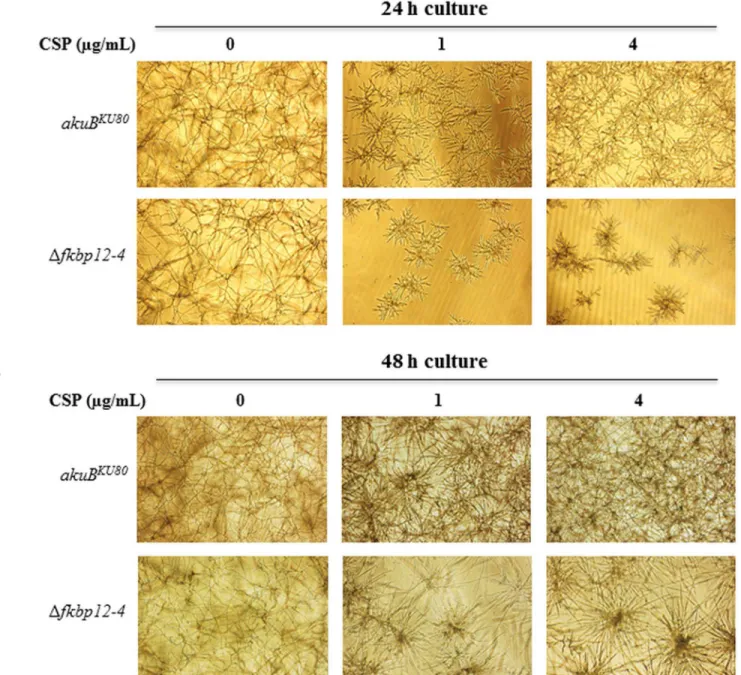
Δfkbp12-1Δfkbp12-2strains demonstrated similar susceptibility to caspofungin, whileΔ fkbp12-4demonstrated increased susceptibility (Fig 4D). As is normally observed in the wild-type strain, paradoxical growth effect was noted at higher caspofungin concentrations in all deletion strains except for theΔfkbp12-4strain (Fig 4E) [62–64]. In the presence of the combination
of FK506 and caspofungin, theΔfkbp12-1andΔfkbp12-1Δfkbp12-2strains demonstrated slightly increased growth compared to other deletion strains as well as the wild-type strain. The growth ofΔfkbp12-1andΔfkbp12-1Δfkbp12-2strains in the presence of both drugs (FK506+ caspofungin) was indistinguishable from their growth in response to caspofungin alone (Fig 4F). To more clearly visualize the inhibition of paradoxical growth at higher caspofungin con-centrations in theΔfkbp12-4strain, theΔfkbp12-4strain was cultured in RPMI liquid media supplemented with caspofungin at 1μg/mL and 4μg/mL (Fig 5A and 5B). In contrast to the
akuBKU80strain theΔfkbp12-4did not demonstrate paradoxical growth recovery. This lack of paradoxical growth inΔfkbp12-4may be due to the fact that theΔfkbp12-4showed reduced growth rate in comparison to the wild-type strain and the other FKBP12 deletion strains.
To visualize hyphal growth in response to FK506, the single deletion strains were also cul-tured in liquid media supplemented with FK506 (Fig 6). TheΔfkbp12-1displayed full hyphal growth in the presence of FK506 after 24 hours, whileΔfkbp12-4seemed slightly tolerant in comparison to the other deletion strains (Fig 6A). At 48 hours the respective strains demon-strated improved growth, although the inhibitory effect of FK506 was still evident in all except for theΔfkbp12-1strain (Fig 6B). TheΔfkbp12-1Δfkbp12-2strain was also resistant to FK506 (data not shown).
FKBP12-1 localizes to the cytoplasm and nuclei but also shifts to the
hyphal septa following exposure to FK506
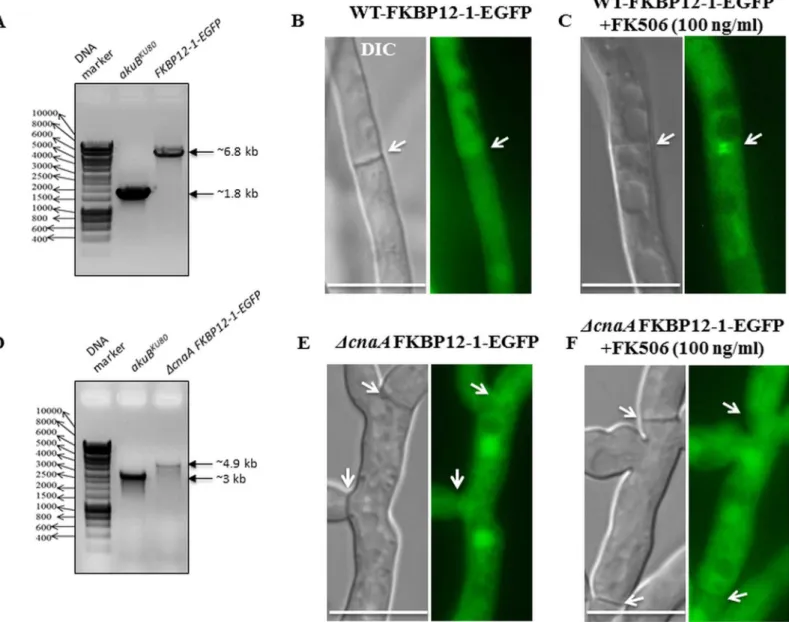
expression strain and deleted the catalytic subunit of calcineurin encoding genecnaAin this background (Fig 8A–8C and 8D). Akin to what was seen earlier with the wild type
FKBP12-1-EGFP, the localization patterns of FKBP12-1 in a calcineurin null strain (fkbp12-1-egfpΔ c-naA) revealed nuclear and cytoplasmic localization under basal conditions (Fig 8E). However, upon exposure to FK506 FKBP12-1-EGFP failed to localize to the septa, confirming that FKBP12-1 localizes at the hyphal septum through binding to calcineurin upon exposure to FK506 (Fig 8F).
Fig 5.Δfkbp12-4is more susceptible to caspofungin and lacks paradoxical growth at higher concentrations of caspofungin. (A)A.fumigatus akuBKU80and theΔfkbp12-4conidia (104/mL) were cultured in RPMI for 24 hours either in the absence or presence of 1μg/ml and 4μg/ml caspofungin (CSP).(B)A.fumigatus akuBKU80and theΔfkbp12-4conidia (104/mL) cultured in RPMI for 48 hours either in the absence and presence of 1μg/ml and 4μg/ ml caspofungin (CSP).
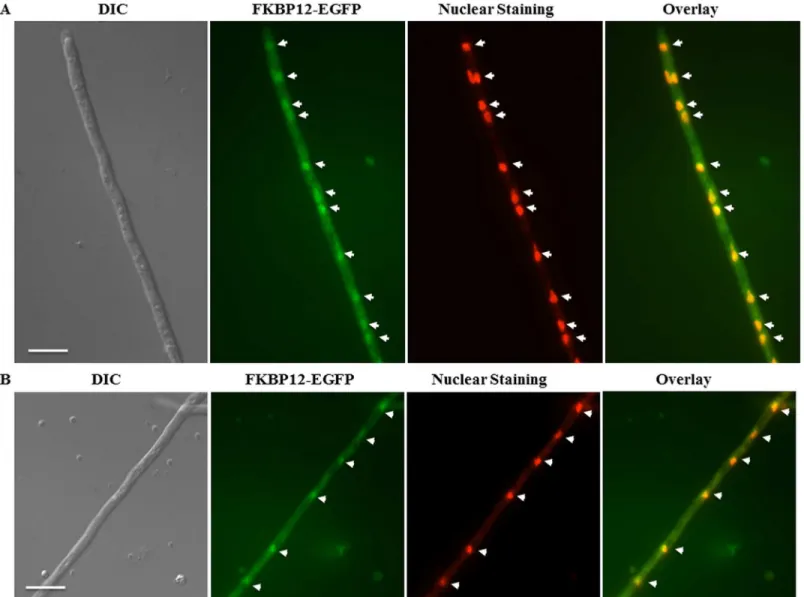
Nuclear localization of FKBP12-1 was confirmed by propidium iodide staining of nuclei (Fig 9). Although we could not identify any nuclear localization signal consensus sequence in FKBP12-1, we speculate that FKBP12-1 might translocate into the nucleus by binding to other protein/s.
FKBP12-1 proteins do not play a key role in virulence
Earlier reports on the human pathogenic bacterium,Legionella pneumophila, and the human parasitic protozoan,Trypanosoma cruzi, have revealed the association of the FKBP12 proteins with virulence [65,66]. While in the plant pathogenic fungusBotrytis cinereadisruption of the only ortholog ofFKBP12,BcPIC5, caused a reduction in pathogenicity [50], in another plant pathogenFusarium graminearumthe interaction of FKBP12 with a virulence factor FGL1
Fig 6.Δfkbp12-1demonstrates full hyphal growth in response to FK506;Δfkbp12-4is slightly tolerant to FK506. (A)A.fumigatusconidia (104/mL) incubated in RPMI for 24 hours.(B)A.fumigatusconidia (104/mL) incubated in RPMI with 100 ng/mL FK506 for 24 hours.(C)A.fumigatusconidia (104/mL) incubated in RPMI for 48 hours.(D)A.fumigatusconidia (104/mL) incubated in RPMI with 100 ng/mL FK506 for 48 hours.
encoding a secreted lipase was demonstrated [67]. In order to verify ifA.fumigatusFKBP12s played a role in virulence, we employed a screening systemic aspergillosis infection model using the heterologous invertebrate hostGalleria mellonella. Infection of the larvae with all the FKBP12 deletion strains led to survival comparable to that seen in the wild-type strain (p = 0.64) (Fig 10). No difference in melanization of theGalleria, which serves as an indication of immune response, was noted following infection with the wild type strain or FKBP12 dele-tion strains.
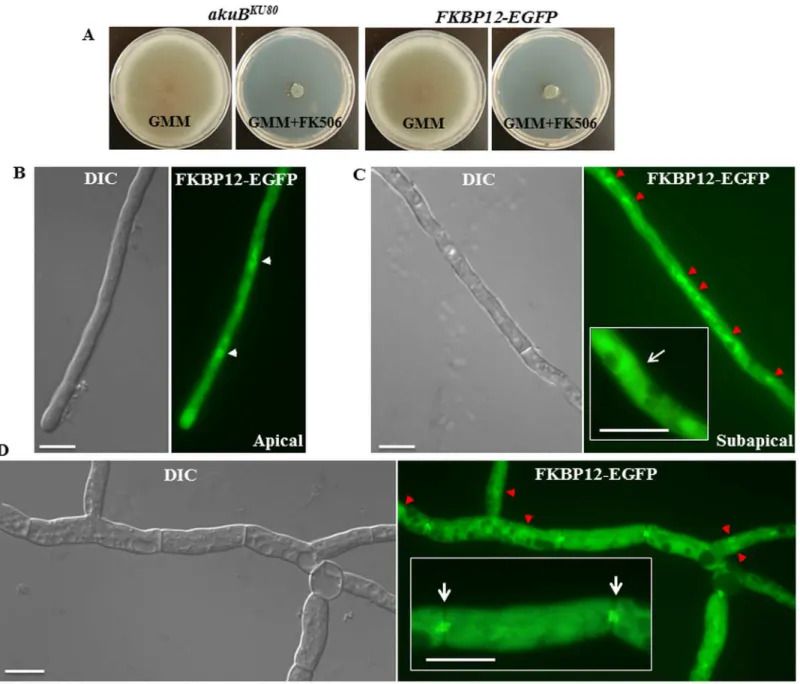
Fig 7. FK506 altered the localization of FKBP12-1 to the hyphal septum. (A)Functionality of the expressed FKBP12-1-EGFP was assessed by comparing the growth of the FKBP12-1-EGFP expression strain with theakuBKU80strain either in the absence or presence of FK506 (0.1μg/mL)(B, C) Under normal growth conditions, FKBP12-1 evenly distributes throughout the cytoplasm and is also found in the nucleus at the hyphal tips (panel B) and sub-apical compartment (panel C and panel D) (marked by a white arrow heads in panel B and by red arrowheads in panel C and panel D). It is not seen at the septum (marked by a white arrow in the Fig 7C inset).(C)In the presence of FK506, FKBP12-1 can be seen localized as a double bar on either side of the septa indicating its binding to calcineurin complex at the hyphal septum (marked by a white arrows in the Fig 7D inset).
Discussion
Previous work has demonstrated the potential of drugs currently used as immunosuppressants, such as FK506, as possible therapeutic agents against invasive fungal infections, includingA.
fumigatus[11–13,68,69]. While in humans the FK506-FKBP12 complex binding to
calci-neurin suppresses the immune system, inA.fumigatusbinding of the FK506-FKBP12 complex to fungal calcineurin leads to impaired growth and virulence [9,28]. Thus, drugs like FK506 could be chemically modified or repurposed for targeted inhibition of fungal-specific calci-neurin in the treatment of invasive fungal infections. While study of FKBP12, one of the key proteins through which FK506 and rapamycin exert their effects, has been extensive in
Fig 8. FKBP12-1 localizes to the hyphal septum through binding to CnaA in the presence of FK506. (A)Confirmation of generation of the FKBP12-1-EGFP expression strain by PCR and fluorescence microscopy.(B)Cytosolic localization of FKBP12-1-EGFP.(C)Septal localization of FKBP12-1-EGFP in the presence of FK506 (indicated by white arrows).(D)Confirmation of generation of thecnaAdeletion in the FKBP12-1-EGFP expression background strain by PCR and fluorescence microscopy.(E)Cytosolic localization of FKBP12-1-EGFP in the calcineurin null strain.(F)Absence of septal localization of FKBP12-1-EGFP in the calcineurin null strain in the presence of FK506 (indicated by white arrows).
humans, work in fungi has been limited [50,51,67]. Deletion of orthologs of FKBP12 have been found to mediate resistance to FK506 in pathogenic fungi, includingC.neoformansand
M.circinelloides[52,53,55,70]. However, studies inA.fumigatus, a leading cause of death sec-ondary to invasive fungal infection as well as the pathogen with the largest financial burden of all invasive fungal infections [70], have not yet been undertaken [61]. In this study, we charac-terized the four putativeA.fumigatusFKBP12 orthologs through deletion analysis coupled with phenotypic and virulence studies, and identified FKBP12-1 as responsible for binding to FK506 and inhibiting calcineurin and FKBP12-4 as involved in basal growth.
Given that FKBP12-1 is the ortholog with the most sequence similarity to human FKBP12, it is not surprising that deletion of FKBP12-1 encoding gene led to FK506 resistance, presum-ably through a lack of binding to FK506. Septal localization pattern of FKBP12-1 only in the presence of FK506 in the wild-type but not in thecnaAdeletion background further supports the hypothesis that loss of binding to FK506 is responsible for the resistance. Localization under basal conditions to the cytoplasm and nucleus is consistent with FKBP localization in
Fig 9. FKBP12-1 is seen in the cytoplasm and in the nuclei under basal conditions. (A, B)Propidium iodide staining confirms FKBP12-1 localization to the nucleus in the apical compartment (Fig 9A; marked by white arrow heads) and the sub-apical compartment (Fig 9B; marked by white arrow heads).
other organisms [61], while the presence of the protein at the septa in the presence of FK506 in the FKBP12-1-EGFP strain but not in the FKBP12-1-EGFPΔcnaAstrain suggests calcineurin-binding and inhibition [33]. However, three of the 14 residues important for binding to FK506 are different from human FKBP12 in theA.fumigatusFKBP12-1 protein. On the other hand, FKBP12-2 and FKBP12-3 are mutated at three and four of the 14 residues, respectively, and deletion of these proteins does not lead to resistance to FK506. Thus, the impact of residue changes in FKBP12-2 and FKBP12-3 on binding to FK506 is unclear–it is possible that binding
to FK506 is retained despite these changes. Alternatively, the FKBP12-2 and FKBP12-3 pro-teins may not be endogenously expressed in the fungus and the susceptibility to FK506 observed may be the result of the actions of FKBP12-1 alone on calcineurin, a hypothesis sup-ported by the resistance to FK506 seen in theΔfkbp12-1Δfkbp12-2deletion strain. Interestingly, FKBP12-4, which shares the least sequence similarity to human FKBP12 but also differs at only two of the 14 residues noted to be involved in FK506 binding, shows minimal tolerance to FK506. This suggests that perhaps its mutations lessen but do not preclude binding to FK506. Alternatively, it is possible that binding to FK506 remains intact but the long N-terminal region of the protein interferes with binding of the FKBP12-FK506 complex to calcineurin. However, the tolerance is difficult to interpret as far as biologic relevance in the face of the observed growth defect inΔfkbp12-4strain.
Taken together, these results suggest that homology to human FKBP12 can be predictive in determining resistance to FK506, but they also suggest that the number of residues mutated at the 14 residues previously found to be critical for binding is less predictive. Indeed, while FKBP12-4 has the fewest number of mutations in residues involved in FK506 binding, only the
Δfkbp12-1strain, that which still retains the the most sequence similarity to human FKBP12, is resistant to FK506. Most significantly, the present data suggest that even with differences from human FKBP12 that include alterations in polarity and size, binding of FKBP12-1 to FK506 can still occur. Therefore, designing a FK506 analog that will fit into the altered binding pocket
Fig 10. Deletion of FKBP12 encoding genes did not alter virulence ofA.fumigatus.Larvae of the wax mothGalleria mellonellawere injected with 5μl of 1 x 10⁸spores/ml (a total inoculum of 2 x 10⁵spores) of the wild type,Δfkbp12-1,Δfkbp12-2,Δfkbp12-3,Δfkbp12-4, andΔfkbp12-1Δfkbp12-2strains. 20 larvae were included in each arm. Infected larvae were incubated at 37°C with survival scored daily for 5 days.
of the fungal FKBP12-1, but not into the binding pocket of the human FKBP12, should be explored.
In addition to determining theA.fumigatusFKBP12 responsible for mediating resistance to FK506, we sought to better understand the role of this important family of proteins in fungal biology and thus characterized all four deletion strains as well as a double deletion strain (Δfkbp12-1Δfkbp12-2). As FKBP12s have previously been found to be dispensable for growth in other fungi and model organisms, except under some stress conditions, it is not surprising that theΔfkbp12-1,Δfkbp12-2,Δfkbp12-3, andΔfkbp12-1Δfkbp12-2 strains all demonstrated radial growth consistent with that seen in the wild-type strain [19,20,45,46]. While the
Δfkbp12-1strain did have a statistically significant difference in growth compared to wild type (p = 0.0405), that theΔfkbp12-1Δfkbp12-2strain did not, and that theΔfkbp12-1strain did reach full growth by the end of the 5 day incubation period, suggest a lack of biologic relevance.
Unexpectedly, we found that the FKBP with the least sequence similarity to human FKBP12, FKBP12-4, plays a role in growth of the pathogen under basal conditions. TheΔfkbp12-4strain displayed universally slow growth throughout the 5 day testing period. The FKBP12-4 protein is significantly larger than the other three FKBP12s (489 amino acids versus 112 to 134 amino acids in FKBP12-1 through FKBP12-3), with an extended N-terminal sequence.
Though more comparable in size to the otherA.fumigatusFKBP12s, human FKBP12.6, an isoform of human FKBP12, has an N-terminal sequence important for binding to the ryano-dine receptor [71]. Perhaps the long N-terminal sequence ofA.fumigatusFKBP12-4 may simi-larly have residues important for binding to a target, which in this case is related to growth regulation or cell wall stability. It is also possible that the growth defect is a result of changes in amino acids in the regions FKBP12-4 shares with the otherA.fumigatusFKBPs. As FKBPs are involved in protein folding, FKBP12-4 may be required for efficient folding of a protein impor-tant to growth inA.fumigatus. Regardless, the probable reason for this growth defect may be related to a defect in cell wall integrity.
The role of FKBPs in the pathogenesis was also studied through the use ofG.mellonella, which has been shown to be a reliable screening model of infection inA.fumigatus[72,73]. There was no statistically significant difference in virulence between the FKBP12 deletion and wild-type strains.
In conclusion, we have identified fourA.fumigatusFKBP12 orthologs, and through deletion analysis confirmed FKBP12-1 binding to FK506 inA.fumigatus. We have also established that FKBP12-4 leads to a growth defect under basal conditions. Future directions for this work include further study of FKBP12-1, specifically via more in depth identification of fungal-spe-cific residues most important for binding to FK506 through targeted mutagenesis.
Supporting Information
S1 Fig. Multiple sequence alignment comparingA.fumigatusFkbp12 proteins to those in other organisms.Multiple sequence alignment was performed comparing orthologous FKBP12 proteins from Human (HsFKBP12),S.cerevisiae(ScFkbp12),C.neoformans
(CnFkbp12), andA.fumigatus(FKBP12-1, FKBP12-2, FKBP12-3 and FKBP12-4) using Clus-talW (http://www.ebi.ac.uk/Tools/msa/clustalw2/).
(TIF)
S1 Table. Primers Used in the Generation of Deletion Strains.
(DOCX)
S2 Table. Primers Used for PCR Verification of Deletion Strains.
S3 Table. Primers Used for Generation of Probes for Southern.
(DOCX)
S4 Table. Primers Used in the Generation of the EGFP Strains.
(DOCX)
S5 Table. Primers Used for Verification of Fkbp12-1-EGFP and Fkbp12-1ΔCnaA Strains.
(DOCX)
Author Contributions
Conceived and designed the experiments: KAF PRJ WJS. Performed the experiments: KAF PRJ ADR JMV HR. Analyzed the data: KAF PRJ ADR JMV HR WJS. Wrote the paper: KAF PRJ WJS.
References
1. Latgé J-P. Aspergillus fumigatus and Aspergillosis. Clinical Microbiology Reviews. 1999; 12(2):310– 50. PMID:PMC88920.
2. Kontoyiannis DP, Marr KA, Park BJ, Alexander BD, Anaissie EJ, Walsh TJ, et al. Prospective surveil-lance for invasive fungal infections in hematopoietic stem cell transplant recipients, 2001–2006: over-view of the Transplant-Associated Infection Surveillance Network (TRANSNET) Database. Clinical infectious diseases: an official publication of the Infectious Diseases Society of America. 2010 Apr 15; 50(8):1091–100. PMID:20218877. Epub 2010/03/12. eng.
3. Crabol Y, Lortholary O. Invasive Mold Infections in Solid Organ Transplant Recipients. Scientifica. 2014; 2014:17.
4. Marr KA, Carter RA, Crippa F, Wald A, Corey L. Epidemiology and outcome of mould infections in hematopoietic stem cell transplant recipients. Clinical infectious diseases: an official publication of the Infectious Diseases Society of America. 2002 Apr 1; 34(7):909–17. PMID:11880955. Epub 2002/03/ 07. eng.
5. Wilson LS, Reyes CM, Stolpman M, Speckman J, Allen K, Beney J. The direct cost and incidence of systemic fungal infections. Value in health: the journal of the International Society for Pharmacoeco-nomics and Outcomes Research. 2002 Jan-Feb; 5(1):26–34. PMID:11873380. Epub 2002/03/05. eng. 6. Steinbach WJ, Marr KA, Anaissie EJ, Azie N, Quan SP, Meier-Kriesche HU, et al. Clinical epidemiology
of 960 patients with invasive aspergillosis from the PATH Alliance registry. The Journal of infection. 2012 Nov; 65(5):453–64. PMID:22898389. Epub 2012/08/18. eng. doi:10.1016/j.jinf.2012.08.003
7. Denning DW. Therapeutic outcome in invasive aspergillosis. Clinical infectious diseases: an official publication of the Infectious Diseases Society of America. 1996 Sep; 23(3):608–15. PMID:8879787. Epub 1996/09/01. eng.
8. Brakhage AA. Systemic fungal infections caused by Aspergillus species: epidemiology, infection pro-cess and virulence determinants. Current drug targets. 2005 Dec; 6(8):875–86. PMID:16375671. Epub 2005/12/27. eng.
9. Steinbach WJ, Reedy JL, Cramer RA Jr, Perfect JR, Heitman J. Harnessing calcineurin as a novel anti-infective agent against invasive fungal infections. Nature reviews Microbiology. 2007 Jun; 5(6):418–30. PMID:17505522. Epub 2007/05/17. eng.
10. Fox DS, Heitman J. Good fungi gone bad: the corruption of calcineurin. BioEssays: news and reviews in molecular, cellular and developmental biology. 2002 Oct; 24(10):894–903. PMID:12325122. Epub 2002/09/27. eng.
11. Blankenship JR, Steinbach WJ, Perfect JR, Heitman J. Teaching old drugs new tricks: reincarnating immunosuppressants as antifungal drugs. Current opinion in investigational drugs (London, England: 2000). 2003 Feb; 4(2):192–9. PMID:12669381. Epub 2003/04/03. eng.
12. Hofflin JM, Potasman I, Baldwin JC, Oyer PE, Stinson EB, Remington JS. Infectious complications in heart transplant recipients receiving cyclosporine and corticosteroids. Annals of internal medicine. 1987 Feb; 106(2):209–16. PMID:3541723. Epub 1987/02/01. eng.
14. Steinbach WJ, Singh N, Miller JL, Benjamin DK, Schell WA, Heitman J, et al. In Vitro Interactions between Antifungals and Immunosuppressants against Aspergillus fumigatus Isolates from Transplant and Nontransplant Patients. Antimicrobial agents and chemotherapy. 2004; 48(12):4922–5. PMID:
PMC529228.
15. Hemenway CS, Heitman J. Calcineurin. Structure, function, and inhibition. Cell Biochem Biophys. 1999; 30(1):115–51. PMID:10099825. Epub 1999/04/01. eng.
16. Rusnak F, Mertz P. Calcineurin: Form and Function2000 2000-01-10 00:00:00. 1483–521 p. 17. Liu J, Farmer JD Jr, Lane WS, Friedman J, Weissman I, Schreiber SL. Calcineurin is a common target
of cyclophilin-cyclosporin A and FKBP-FK506 complexes. Cell. 1991 Aug 23; 66(4):807–15. PMID:
1715244. Epub 1991/09/02. eng.
18. Arevalo-Rodriguez M, Wu X, Hanes SD, Heitman J. Prolyl isomerases in yeast. Frontiers in bioscience: a journal and virtual library. 2004 Sep 1; 9:2420–46. PMID:15353296. Epub 2004/09/09. eng. 19. Galat A. Peptidylprolyl cis/trans isomerases (immunophilins): biological diversity—targets—functions.
Current topics in medicinal chemistry. 2003; 3(12):1315–47. PMID:12871165. Epub 2003/07/23. eng. 20. Pemberton TJ. Identification and comparative analysis of sixteen fungal peptidyl-prolyl cis/trans
isomer-ase repertoires. BMC genomics. 2006; 7:244. PMID:16995943. Pubmed Central PMCID: PMC1618848. Epub 2006/09/26. eng.
21. Ho S, Clipstone N, Timmermann L, Northrop J, Graef I, Fiorentino D, et al. The mechanism of action of cyclosporin A and FK506. Clinical immunology and immunopathology. 1996 Sep; 80(3 Pt 2):S40–5. PMID:8811062. Epub 1996/09/01. eng.
22. Handschumacher RE, Harding MW, Rice J, Drugge RJ, Speicher DW. Cyclophilin: a specific cytosolic binding protein for cyclosporin A. Science (New York, NY). 1984 Nov 2; 226(4674):544–7. PMID:
6238408. Epub 1984/11/02. eng.
23. Jin L, Harrison SC. Crystal structure of human calcineurin complexed with cyclosporin A and human cyclophilin. Proceedings of the National Academy of Sciences of the United States of America. 2002 Oct 15; 99(21):13522–6. PMID:12357034. Pubmed Central PMCID: PMC129706. Epub 2002/10/03. eng.
24. Griffith JP, Kim JL, Kim EE, Sintchak MD, Thomson JA, Fitzgibbon MJ, et al. X-ray structure of calci-neurin inhibited by the immunophilin-immunosuppressant FKBP12-FK506 complex. Cell. 1995 8/11/; 82(3):507–22. PMID:7543369
25. Kissinger CR, Parge HE, Knighton DR, Lewis CT, Pelletier LA, Tempczyk A, et al. Crystal structures of human calcineurin and the human FKBP12-FK506-calcineurin complex. Nature. 1995 Dec 7; 378 (6557):641–4. PMID:8524402. Epub 1995/12/07. eng.
26. Hemenway C, Heitman J. Calcineurin. Cell Biochem Biophys. 1999 1999/02/01; 30(1):115–51. English. PMID:10099825
27. Huai Q, Kim HY, Liu Y, Zhao Y, Mondragon A, Liu JO, et al. Crystal structure of calcineurin-cyclophilin-cyclosporin shows common but distinct recognition of immunophilin-drug complexes. Proceedings of the National Academy of Sciences of the United States of America. 2002 Sep 17; 99(19):12037–42. PMID:12218175. Pubmed Central PMCID: PMC129394. Epub 2002/09/10. eng.
28. Clipstone NA, Crabtree GR. Identification of calcineurin as a key signalling enzyme in T-lymphocyte activation. Nature. 1992 Jun 25; 357(6380):695–7. PMID:1377362. Epub 1992/06/25. eng. 29. Feske S, Okamura H, Hogan PG, Rao A. Ca2+/calcineurin signalling in cells of the immune system.
Biochemical and biophysical research communications. 2003 Nov 28; 311(4):1117–32. PMID:
14623298. Epub 2003/11/19. eng.
30. Juvvadi PR, Lamoth F, Steinbach WJ. Calcineurin-Mediated Regulation of Hyphal Growth, Septation, and Virulence in Aspergillus fumigatus. Mycopathologia. 2014 Aug 15. PMID:25118871. Epub 2014/ 08/15. Eng.
31. Steinbach WJ, Cramer RA Jr, Perfect BZ, Asfaw YG, Sauer TC, Najvar LK, et al. Calcineurin controls growth, morphology, and pathogenicity in Aspergillus fumigatus. Eukaryotic cell. 2006 Jul; 5(7):1091– 103. PMID:16835453. Pubmed Central PMCID: PMC1489296. Epub 2006/07/13. eng.
32. Juvvadi PR, Fortwendel JR, Rogg LE, Burns KA, Randell SH, Steinbach WJ. Localization and activity of the calcineurin catalytic and regulatory subunit complex at the septum is essential for hyphal elonga-tion and proper septaelonga-tion in Aspergillus fumigatus. Molecular microbiology. 2011 Dec; 82(5):1235–59. PMID:22066998. Pubmed Central PMCID: PMC3225650. Epub 2011/11/10. eng. doi: 10.1111/j.1365-2958.2011.07886.x
34. Juvvadi PR, Gehrke C, Fortwendel JR, Lamoth F, Soderblom EJ, Cook EC, et al. Phosphorylation of Calcineurin at a Novel Serine-Proline Rich Region Orchestrates Hyphal Growth and Virulence in Asper-gillus fumigatus. PLoS pathogens. 2013; 9(8):e1003564. PMID:PMC3749960. doi:10.1371/journal. ppat.1003564
35. Kraus PR, Heitman J. Coping with stress: calmodulin and calcineurin in model and pathogenic fungi. Biochemical and biophysical research communications. 2003 Nov 28; 311(4):1151–7. PMID:
14623301. Epub 2003/11/19. eng.
36. Onyewu C, Blankenship JR, Del Poeta M, Heitman J. Ergosterol biosynthesis inhibitors become fungi-cidal when combined with calcineurin inhibitors against Candida albicans, Candida glabrata, and Can-dida krusei. Antimicrobial agents and chemotherapy. 2003 Mar; 47(3):956–64. PMID:12604527. Pubmed Central PMCID: PMC149324. Epub 2003/02/27. eng.
37. Marr KA, Schlamm HT, Herbrecht R, Rottinghaus ST, Bow EJ, Cornely OA, et al. Combination antifun-gal therapy for invasive aspergillosis: a randomized trial. Annals of internal medicine. 2015 Jan 20; 162 (2):81–9. PMID:25599346. Epub 2015/01/20. eng. doi:10.7326/M13-2508
38. MacMillan D. FK506 binding proteins: cellular regulators of intracellular Ca2+ signalling. European jour-nal of pharmacology. 2013 Jan 30; 700(1–3):181–93. PMID:23305836. Epub 2013/01/12. eng. doi:10. 1016/j.ejphar.2012.12.029
39. MacMillan D, McCarron JG. Regulation by FK506 and rapamycin of Ca2+ release from the sarcoplas-mic reticulum in vascular smooth muscle: the role of FK506 binding proteins and mTOR. British journal of pharmacology. 2009 Oct; 158(4):1112–20. PMID:19785652. Pubmed Central PMCID:
PMC2785532. Epub 2009/09/30. eng. doi:10.1111/j.1476-5381.2009.00369.x
40. MacMillan D, Currie S, McCarron JG. FK506-binding protein (FKBP12) regulates ryanodine receptor-evoked Ca2+ release in colonic but not aortic smooth muscle. Cell calcium. 2008 Jun; 43(6):539–49. PMID:17950843. Epub 2007/10/24. eng.
41. MacMillan D, Currie S, Bradley KN, Muir TC, McCarron JG. In smooth muscle, FK506-binding protein modulates IP3 receptor-evoked Ca2+ release by mTOR and calcineurin. Journal of cell science. 2005 Dec 1; 118(Pt 23):5443–51. PMID:16278292. Epub 2005/11/10. eng.
42. Huse M, Chen YG, Massague J, Kuriyan J. Crystal structure of the cytoplasmic domain of the type I TGF beta receptor in complex with FKBP12. Cell. 1999 Feb 5; 96(3):425–36. PMID:10025408. Epub 1999/02/20. eng.
43. Yao D, Dore JJ Jr, Leof EB. FKBP12 is a negative regulator of transforming growth factor-beta receptor internalization. The Journal of biological chemistry. 2000 Apr 28; 275(17):13149–54. PMID:10777621. Epub 2000/04/25. eng.
44. Girgenrath T, Mahalingam M, Svensson B, Nitu FR, Cornea RL, Fessenden JD. N-terminal and central segments of the type 1 ryanodine receptor mediate its interaction with FK506-binding proteins. The Journal of biological chemistry. 2013 May 31; 288(22):16073–84. PMID:23585572. Pubmed Central PMCID: PMC3668763. Epub 2013/04/16. eng. doi:10.1074/jbc.M113.463299
45. Dolinski K, Muir S, Cardenas M, Heitman J. All cyclophilins and FK506 binding proteins are, individually and collectively, dispensable for viability in Saccharomyces cerevisiae. Proceedings of the National Academy of Sciences of the United States of America. 1997 Nov 25; 94(24):13093–8. PMID:9371805. Pubmed Central PMCID: PMC24268. Epub 1997/12/16. eng.
46. Pinto D, Duarte M, Soares S, Tropschug M, Videira A. Identification of all FK506-binding proteins from Neurospora crassa. Fungal genetics and biology: FG & B. 2008 Dec; 45(12):1600–7. PMID:18948221. Epub 2008/10/25. eng.
47. Heitman J, Movva NR, Hall MN. Targets for cell cycle arrest by the immunosuppressant rapamycin in yeast. Science (New York, NY). 1991 Aug 23; 253(5022):905–9. PMID:1715094. Epub 1991/08/23. eng.
48. Hemenway C, Heitman J. Proline isomerases in microorganisms and small eukaryotes. Annals of the New York Academy of Sciences. 1993 Nov 30; 696:38–46. PMID:8109845. Epub 1993/11/30. eng. 49. Teichert S, Wottawa M, Schonig B, Tudzynski B. Role of the Fusarium fujikuroi TOR kinase in nitrogen
regulation and secondary metabolism. Eukaryotic cell. 2006 Oct; 5(10):1807–19. PMID:17031002. Pubmed Central PMCID: PMC1595341. Epub 2006/10/13. eng.
50. Gioti A, Simon A, Le Pecheur P, Giraud C, Pradier JM, Viaud M, et al. Expression profiling of Botrytis cinerea genes identifies three patterns of up-regulation in planta and an FKBP12 protein affecting path-ogenicity. J Mol Biol. 2006 Apr 28; 358(2):372–86. PMID:16497329. Epub 2006/02/25. eng.
51. Meléndez HG, Billon-Grand G, Fèvre M, Mey G. Role of the Botrytis cinerea FKBP12 ortholog in
patho-genic development and in sulfur regulation. Fungal Genetics and Biology. 2009 4//; 46(4):308–20. doi:
10.1016/j.fgb.2008.11.011PMID:19116175
FKBP12-dependent inhibition of TOR. Antimicrobial agents and chemotherapy. 2001 Nov; 45 (11):3162–70. PMID:11600372. Pubmed Central PMCID: PMC90798. Epub 2001/10/16. eng. 53. Cruz MC, Cavallo LM, Gorlach JM, Cox G, Perfect JR, Cardenas ME, et al. Rapamycin antifungal
action is mediated via conserved complexes with FKBP12 and TOR kinase homologs in Cryptococcus neoformans. Molecular and cellular biology. 1999 Jun; 19(6):4101–12. PMID:10330150. Pubmed Cen-tral PMCID: PMC104369. Epub 1999/05/18. eng.
54. Calo S, Shertz-Wall C, Lee SC, Bastidas RJ, Nicolas FE, Granek JA, et al. Antifungal drug resistance evoked via RNAi-dependent epimutations. Nature. 2014 Jul 27. PMID:25079329. Epub 2014/08/01. Eng.
55. Bastidas RJ, Shertz CA, Lee SC, Heitman J, Cardenas ME. Rapamycin exerts antifungal activity in vitro and in vivo against Mucor circinelloides via FKBP12-dependent inhibition of Tor. Eukaryotic cell. 2012 Mar; 11(3):270–81. PMID:22210828. Pubmed Central PMCID: PMC3294450. Epub 2012/01/03. eng. doi:10.1128/EC.05284-11
56. d'Enfert C. Selection of multiple disruption events in Aspergillus fumigatus using the orotidine-5'-decar-boxylase gene, pyrG, as a unique transformation marker. Current genetics. 1996 Jun; 30(1):76–82. PMID:8662213. Epub 1996/06/01. eng.
57. da Silva Ferreira ME, Kress MR, Savoldi M, Goldman MH, Hartl A, Heinekamp T, et al. The akuB (KU80) mutant deficient for nonhomologous end joining is a powerful tool for analyzing pathogenicity in Aspergillus fumigatus. Eukaryotic cell. 2006 Jan; 5(1):207–11. PMID:16400184. Pubmed Central PMCID: PMC1360264. Epub 2006/01/10. eng.
58. Shimizu K, Keller NP. Genetic involvement of a cAMP-dependent protein kinase in a G protein signaling pathway regulating morphological and chemical transitions in Aspergillus nidulans. Genetics. 2001 Feb; 157(2):591–600. PMID:11156981. Pubmed Central PMCID: PMC1461531. Epub 2001/02/07. eng.
59. Fortwendel JR, Juvvadi PR, Pinchai N, Perfect BZ, Alspaugh JA, Perfect JR, et al. Differential effects of inhibiting chitin and 1,3-{beta}-D-glucan synthesis in ras and calcineurin mutants of Aspergillus fumiga-tus. Antimicrobial agents and chemotherapy. 2009 Feb; 53(2):476–82. PMID:19015336. Pubmed Cen-tral PMCID: PMC2630655. Epub 2008/11/19. eng. doi:10.1128/AAC.01154-08
60. Reeves EP, Messina CG, Doyle S, Kavanagh K. Correlation between gliotoxin production and viru-lence of Aspergillus fumigatus in Galleria mellonella. Mycopathologia. 2004 Jul; 158(1):73–9. PMID:
15487324. Epub 2004/10/19. eng.
61. Kay JE. Structure-function relationships in the FK506-binding protein (FKBP) family of peptidylprolyl cis-trans isomerases. The Biochemical journal. 1996 Mar 1; 314 (Pt 2):361–85. PMID:8670043. Pubmed Central PMCID: PMC1217058. Epub 1996/03/01. eng.
62. Stevens DA, Espiritu M, Parmar R. Paradoxical effect of caspofungin: reduced activity against Candida albicans at high drug concentrations. Antimicrobial agents and chemotherapy. 2004 Sep; 48(9):3407– 11. PMID:15328104. Pubmed Central PMCID: PMC514730. Epub 2004/08/26. eng.
63. Wiederhold NP. Attenuation of echinocandin activity at elevated concentrations: a review of the para-doxical effect. Current Opinion in Infectious Diseases. 2007; 20(6):574–8. PMID: 00001432-200712000-00004.
64. Lewis RE, Albert ND, Kontoyiannis DP. Comparison of the dose-dependent activity and paradoxical effect of caspofungin and micafungin in a neutropenic murine model of invasive pulmonary aspergillo-sis. The Journal of antimicrobial chemotherapy. 2008 May; 61(5):1140–4. PMID:18305201. Epub 2008/02/29. eng. doi:10.1093/jac/dkn069
65. Helbig JH, Konig B, Knospe H, Bubert B, Yu C, Luck CP, et al. The PPIase active site of Legionella pneumophila Mip protein is involved in the infection of eukaryotic host cells. Biological chemistry. 2003 Jan; 384(1):125–37. PMID:12674506. Epub 2003/04/04. eng.
66. Pereira PJ, Vega MC, Gonzalez-Rey E, Fernandez-Carazo R, Macedo-Ribeiro S, Gomis-Ruth FX, et al. Trypanosoma cruzi macrophage infectivity potentiator has a rotamase core and a highly exposed alpha-helix. EMBO reports. 2002 Jan; 3(1):88–94. PMID:11751578. Pubmed Central PMCID: PMC1083928. Epub 2001/12/26. eng.
67. Niu XW, Zheng ZY, Feng YG, Guo WZ, Wang XY. The Fusarium Graminearum virulence factor FGL targets an FKBP12 immunophilin of wheat. Gene. 2013 Aug 1; 525(1):77–83. PMID:23648486. Epub 2013/05/08. eng. doi:10.1016/j.gene.2013.04.052
68. Alarcon CM, Heitman J. FKBP12 physically and functionally interacts with aspartokinase in Saccharo-myces cerevisiae. Molecular and cellular biology. 1997 Oct; 17(10):5968–75. PMID:9315655. Pubmed Central PMCID: PMC232445. Epub 1997/10/07. eng.
70. Wenzel R, Del Favero A, Kibbler C, Rogers T, Rotstein C, Mauskopf J, et al. Economic evaluation of voriconazole compared with conventional amphotericin B for the primary treatment of aspergillosis in immunocompromised patients. The Journal of antimicrobial chemotherapy. 2005 Mar; 55(3):352–61. PMID:15728146. Epub 2005/02/25. eng.
71. Lee EH, Rho SH, Kwon SJ, Eom SH, Allen PD, Kim do H. N-terminal region of FKBP12 is essential for binding to the skeletal ryanodine receptor. The Journal of biological chemistry. 2004 Jun 18; 279 (25):26481–8. PMID:15033987. Epub 2004/03/23. eng.
72. Fuchs BB, O'Brien E, Khoury JB, Mylonakis E. Methods for using Galleria mellonella as a model host to study fungal pathogenesis. Virulence. 2010 Nov-Dec; 1(6):475–82. PMID:21178491. Epub 2010/12/ 24. eng.