HESSD
6, 2633–2678, 2009(“Soil-it-is”)
L. W. de Jonge et al.
Title Page
Abstract Introduction
Conclusions References
Tables Figures
◭ ◮
◭ ◮
Back Close
Full Screen / Esc
Printer-friendly Version
Interactive Discussion Hydrol. Earth Syst. Sci. Discuss., 6, 2633–2678, 2009
www.hydrol-earth-syst-sci-discuss.net/6/2633/2009/ © Author(s) 2009. This work is distributed under the Creative Commons Attribution 3.0 License.
Hydrology and Earth System Sciences Discussions
Papers published inHydrology and Earth System Sciences Discussionsare under open-access review for the journalHydrology and Earth System Sciences
Soil Infrastructure, Interfaces and
Translocation Processes in Inner Space
(“Soil-it-is”): towards a road map for the
constraints and crossroads of soil
architecture and biophysical processes
L. W. de Jonge1, P. Moldrup2, and P. Schjønning1
1
Aarhus University, Dept. of Agroecology and Environment, P.O. Box 50, 8830 Tjele, Denmark
2
Aalborg University, Dept. of Biotechnology, Chemistry and Environmental Engineering, Sohngaardsholmsvej 57, 9000 Aalborg, Denmark
Received: 27 February 2009 – Accepted: 8 March 2009 – Published: 25 March 2009
Correspondence to: L. W. de Jonge ([email protected])
HESSD
6, 2633–2678, 2009(“Soil-it-is”)
L. W. de Jonge et al.
Title Page
Abstract Introduction
Conclusions References
Tables Figures
◭ ◮
◭ ◮
Back Close
Full Screen / Esc
Printer-friendly Version
Interactive Discussion
Abstract
Soil functions and their impact on health, economy and the environment are evident at the macro scale but determined at the micro scale, based on interactions between soil micro-architecture and the transport and transformation processes occurring in the pore and particle networks and at their interfaces. Soil structure formation and its re-5
silience to disturbance are highly dynamic features affected by management (energy input), moisture (matric potential), and solids composition and complexation (organic carbon, OC, and clay interactions). In this paper we review and put into perspective preliminary results of the newly started research program “Soil-it-is” on functional soil architecture. To identify and quantify biophysical constraints on soil structure changes 10
and resilience, we claim that new paradigms are needed to better interpret processes and parameters measured at the bulk soil scale and their links to the seemingly chaotic soil inner space behavior at the micro scale (soil self-organization). As a first step, we revisit the soil matrix (solids phase) and pore system (water and air phases), constitut-ing the complementary and interactive networks of soil infrastructure. For a field-pair 15
with contrasting soil management, we suggest new ways of data analysis on measured soil-gas transport parameters at different moisture conditions to evaluate controls of soil matrix and pore network formation. Results imply that some soils form sponge-like pore networks (mostly healthy soils in terms of environmental functions), while other soils form pipe-like structures (poorly functioning soils), with the difference re-20
lated to both complexation of organic matter and degradation of soil structure. The recently presented Dexter threshold (ratio of clay to organic carbon of 10 g g−1) is
found to be a promising constraint for a soil’s ability to maintain or regenerate func-tional structure. Next, we show the Dexter threshold may also apply to hydrological and physical-chemical interface phenomena including soil-water repellency and sorp-25
HESSD
6, 2633–2678, 2009(“Soil-it-is”)
L. W. de Jonge et al.
Title Page
Abstract Introduction
Conclusions References
Tables Figures
◭ ◮
◭ ◮
Back Close
Full Screen / Esc
Printer-friendly Version
Interactive Discussion organic matter) may be equally important constraints together with the complexation
and degradation of organic carbon in deciding functional soil architecture and inter-face processes. Finally, we envision a road map to soil inner space where we search for the main controls of particle and pore network changes and structure build-up and resilience at each crossroad of biophysical parameters, where, for example, complexa-5
tion between organic matter and clay, and moisture-induced changes from hydrophilic to hydrophobic surface conditions can play a role. We hypothesize that each crossroad (e.g. between OC/clay ratio and matric potential) may initiate breakdown or activation of soil self-organization at a given time as affected by gradients in energy and moisture from soil use and climate. The road map may serve as inspiration for renewed and 10
multi-disciplinary focus on functional soil architecture.
1 The Soil-it-is concept
The upper few meters of the soil sustain our life and society, but we only have an empirical knowledge on how soil behaves. As a contribution towards a better under-standing of soil functional behaviour, we recently started an international framework 15
program on functional soil architecture, called “Soil-it-is” (SoilInfrastructure,Interfaces andTranslocation Processes inInnerSpace).
With the Soil-it-is approach we wish to explore how soil architecture and infrastruc-ture (pore and particle networks) control and are controlled by relatively poorly un-derstood soil-physical and hydrological phenomena in all three soil phases (water, air, 20
solids). The phenomena include soil-water repellency and fingered water flow, diffusive and convective gas transport in variably-saturated pore networks, and colloid mobiliza-tion/release and transport of colloids and colloid-bound chemicals.
The Soil-it-is vision is a holistic understanding of architecture and processes in soil inner space that will provide the basis for solutions to protect groundwater resources, 25
HESSD
6, 2633–2678, 2009(“Soil-it-is”)
L. W. de Jonge et al.
Title Page
Abstract Introduction
Conclusions References
Tables Figures
◭ ◮
◭ ◮
Back Close
Full Screen / Esc
Printer-friendly Version
Interactive Discussion is defined as the “heterogeneous, near surface environment in which complex
interac-tions involving rock, soil, water, air, and living organisms regulate the natural habitat and determine the availability of life-sustaining resources” (NRC, 2001).
The soil vadose zone, being part of the CZ, is characterized by an immense ac-tivity of life, with microbes and fungi playing a key role in the organization and sta-5
bility of soil organomineral complexes. These processes together have been labeled self-organization (Young and Crawford, 2004) and may be studied by reductionistic ap-proaches at the level of microbes and isolated mineral particles. We aim at understand-ing and quantifyunderstand-ing functional architecture and pore network dynamics as emergent properties at the aggregate to pedon scale. This is a prerequisite for, e.g., optimizing 10
soil management in cultivated land productivity and soil recovery, prediction and con-trol of soil greenhouse gas emissions and uptake, realistic risk assessment (chemical fluxes from soil to indoor air and to groundwater), and design of in-situ remediation strategies at urban polluted soil sites.
A platform hypothesis in the Soil-it-is project is that there is a lower limit (threshold) 15
for soil organic matter (OM), below which it fails to support the self-organization and secure the functions and services described above. A low level of structurally active OM seems to dramatically increase the risk of clay dispersion. This in turn may increase soil internal vertical erosion. Mobilized clay colloids may be transported in macropores or inter-aggregate pores to the aquatic environments, strained at lower soil horizons, 20
or crusted on the walls of soil inner space pores. To quantitatively evaluate this, gas transport studies provide an indirect but strong tool to describe the “morphology” per se of soil pores across scales, while mechanical disturbance of intact soil and fragments of soil in water in combination with analyses of structural strength across scales can be used to characterize the soil matrix per se.
25
HESSD
6, 2633–2678, 2009(“Soil-it-is”)
L. W. de Jonge et al.
Title Page
Abstract Introduction
Conclusions References
Tables Figures
◭ ◮
◭ ◮
Back Close
Full Screen / Esc
Printer-friendly Version
Interactive Discussion dispersible colloids, soil water repellency, and sorption of dissolved and vapor-phase
gases at different moisture (soil-water matric potential) conditions.
The study is divided into four parts. As a prelude, we argue for the need for a new and multidisciplinary research paradigm to understand and quantify functional soil architec-ture. Secondly, we take a renewed look at soil infrastructure with its complementary 5
particle and pore network dynamics, hereunder suggest new ways of analyzing gas transport parameters measured at different moisture conditions to better reveal dif-ferences in functional network behavior and possible thresholds for self-organization. Thirdly, we consider a number of interface processes (water repellency and sorption of dissolved and vapor-phase chemicals) to see if the possible controls for soil self-10
organization and certain interface phenomena could be similar or related. Finally, we suggest a new concept for looking at functional soil architecture, making the first draft of a scientific road map to soil inner space where the crossroads between key biophysical parameters encounter gradients in applied mechanical energy and soil water intensity and hereby decides the dynamics of breakdown, resilience or build-up of soil micro-15
architecture. To navigate successfully and to find the mutual controls of soil structure formation as well as transport, translocation, and degradation processes will require a research effort comprising soil physics, chemistry, microbiology, and hydropedology with collaboration from several engineering disciplines. This is the ultimate goal of the “Soil-it-is” framework program.
20
2 Self-organization: the need for a new research paradigm
Science, and physics in particular, has developed out of the Newtonian paradigm of mechanics. In this world view, every phenomenon we observe can be reduced to a collection of atoms or particles, whose movement is governed by the deterministic laws of nature. Everything that exists now has already existed in some different ar-25
HESSD
6, 2633–2678, 2009(“Soil-it-is”)
L. W. de Jonge et al.
Title Page
Abstract Introduction
Conclusions References
Tables Figures
◭ ◮
◭ ◮
Back Close
Full Screen / Esc
Printer-friendly Version
Interactive Discussion Twentieth century science has slowly come to the conclusion that such a philosophy
will never allow us to explain or model the complex world that surrounds us. Around the middle of the century, researchers from different backgrounds and disciplines started to study phenomena that seemed to be governed by inherent creativity, by the spon-taneous appearance of novel structures or the autonomous adaptation to a changing 5
environment. The different observations they made, and the concepts, methods and principles they developed, have slowly started to coalesce into a new approach, a sci-ence of self-organization (Heylighen, 2001).
Soil science has traditionally used reductionistic approaches, implying disruption of the subject prior to its investigation. Decades with this approach have improved our 10
understanding of soil mechanisms (Six et al., 2004). Recent studies accentuate the continued need to uncover soil characteristics at the micro scale (e.g., Or et al., 2007; O’Donnell et al., 2007). However, soil is a very complex ecosystem, and the emergent functions and processes taking place in soil inner space cannot be interpreted from studies of isolated aggregates or micro-locations within the soil. Most soil functions and 15
processes cannot be understood without acknowledging soil as a three-dimensional matrix (Letey, 1991; Karlen et al., 1990; Young and Crawford, 2004). Young and Crawford (2004) suggested that the soil-microbe system should be regarded as self-organized, i.e., that the organization will increase with time, without being controlled by environmental factors or an encompassing or otherwise external system. When a self-20
organized system is disturbed, its resistance to change from the equilibrium state as well as its resilience to a return to this equilibrium state is challenged (Holling, 1973). These classical concepts from ecosystem research extend our framework for interpre-tation of soil behaviour and help identify thresholds of soil disturbance that may be critical to a continued soil function (Carter, 2004).
25
HESSD
6, 2633–2678, 2009(“Soil-it-is”)
L. W. de Jonge et al.
Title Page
Abstract Introduction
Conclusions References
Tables Figures
◭ ◮
◭ ◮
Back Close
Full Screen / Esc
Printer-friendly Version
Interactive Discussion et al. (1990) “Optimal Water Content” concept where solute and gas diffusivities are
at a combined optimum for soil aeration and aerobic microbial activity, the H ˚akansson (1990) “Degree of Compactness” concept as linked to soil and crop productivity, the Moldrup et al. (2000) “Water-induced Linear Reduction” concept for separating resis-tances from solids and water on gas-filled pore network tortuosity and connectivity, 5
the Or et al. (2007) “Soil Physical Constraints” concept emphasizing soil-water matric potential, water distribution and water film geometries and thickness as key controls of biological activity, biodiversity and bioactivity, and the Dexter et al. (2008) “Organic Car-bon Threshold” concept separating clay-complexed or non-clay-complexed soil organic carbon (OC) in relation to soil functions and health.
10
Interestingly, as will be shown in this study, the various indices and concepts for func-tional soil structure (here called soil infrastructure) may be consistent with each other, both in terms of how key translocation parameters (e.g. gas transport parameters) can be used to characterize soil infrastructure and how parameter thresholds for soil struc-ture (e.g. “clay saturation” by OC) control translocation and interface processes. To link 15
the hitherto empirical soil infrastructure indices to a more conceptual understanding and quantification of soil architecture requires that many different physical, chemical, microbiological, and hydropedological parameters for both solid, water, and air phases and interfaces are measured on the same intact or minimally disturbed soil systems across moisture and management conditions. Some preliminary examples illustrating 20
the usefulness of this research paradigm for understanding soil self-organization will be given in the next two sections on soil infrastructure and interface processes.
3 Infrastructure: the soil matrix and the pore system
3.1 The soil matrix
The key to soil self-organization is physical/chemical interactions between mineral and 25
HESSD
6, 2633–2678, 2009(“Soil-it-is”)
L. W. de Jonge et al.
Title Page
Abstract Introduction
Conclusions References
Tables Figures
◭ ◮
◭ ◮
Back Close
Full Screen / Esc
Printer-friendly Version
Interactive Discussion clay and Fe- and Al-oxyhydroxides flocculate, influenced by organic bonding agents,
e.g., extracellular polymeric substances excreted from plants, fauna, and microbes. At larger scales fungal hyphae and plant roots cross-link and enmesh the matrix. This traditional soil aggregation concept is described in Tisdall and Oades (1982) and ref-erences therein. Clay mineralogy governs the mechanisms active in aggregation, and 5
most soils need OM to create stable macro-aggregates (Denef and Six, 2005). Recent achievements focus on the role of OM in re-arranging mineral particles into an open structure (Or et al., 2007). Clay minerals are the basic level in the hierarchy of soil structural elements. If the organization of clay particles – i.e. the interaction between clay and OM – is lost, all other hierarchical orders are lost or absent (Dexter, 1988). 10
This may also be viewed as a collapse of soil self-organization. Re-orientation and hardening of dispersed clay minerals may result in a dense and mechanically strong but non-friable soil (Watts and Dexter, 1997; 1998). Evidence exists that OM in soil will reduce or prevent cementation (e.g. Utomo and Dexter, 1981; Kemper et al., 1987; Dexter, 1988). A similar situation exists in “hard-setting” soils of subtropical and tropical 15
areas, where oxyhydroxides need OM to facilitate satisfactory tilth conditions (Mullins et al., 1987).
3.2 The Dexter (2008) threshold for complexed clay
Dexter et al. (2008) recently showed that arable soils often display a ratio,n, between <2 µm mineral particles (clay) and OC close to or higher than 10 (n=clay/OC=10). 20
Their results further indicated that for such soils, some selected soil physical properties correlated to the content of OC. For mechanically undisturbed soils like pasture, they typically found clay/OC ratios lower than 10. Such soils are often described as having passed their “capacity factor” for carbon sequestration (Carter et al., 2003), and Dexter et al. (2008) found that the physical properties for these soils were not determined by 25
HESSD
6, 2633–2678, 2009(“Soil-it-is”)
L. W. de Jonge et al.
Title Page
Abstract Introduction
Conclusions References
Tables Figures
◭ ◮
◭ ◮
Back Close
Full Screen / Esc
Printer-friendly Version
Interactive Discussion as
CC=IF[nOC<clay]THEN[nOC]ELSE[clay] (1)
wheren=10, and the amount of non-complexed clay, NCC, as
NCC=IF[(clay−CC)>0]THEN[clay−CC]ELSE[0] (2)
Dexter et al. (2008) showed that non-complexed clay is more easily dispersed in water 5
than is clay complexed with OC. We have previously studied a range of arable soils (Schjønning et al., 2002a). For six of these soils having satisfactory tilth conditions the clay/OC ratio averaged∼9.7. A similar calculation on data from the long-term fer-tilization experiment at Askov, Denmark, indicates that soil receiving either animal or mineral fertilizer at adequate rates for a century in three replicate experimental fields 10
had a clay/OC ratio of ∼9.5 (Schjønning et al., 1994; Munkholm et al., 2002). Ac-cording to the suggestion of Dexter et al. (2008), the clay of all these soils is virtually saturated with OC (clay/OC∼10). In contrast, soil unfertilized for a century at the Askov experiment had an average clay/OC ratio of 11.7. This is an indication of a pool of non-complexed clay (NCC, Equation 2), and the soil treated in this way in all three replicate 15
fields displayed severe signs of structural degradation (e.g., weak in wet conditions, mechanically strong in dry conditions). One of the soils studied in the Schjønning et al. (2002a) investigation was also depleted in OC due to long-term continuous growing of small-grain cereals without any return of organic residues and manure to the soil. For that soil, the clay/OC ratio was as high as 13.7, and we found significant signs of degra-20
dation of soil structure (Munkholm et al., 2001; Schjønning et al., 2002a). A detailed study of water dispersibility of clay (WDC) by Elmholt et al. (2008) indicates, for soil samples collected across this Low-C soil – and only this soil – a correlation between WDC and OC expressed as the hot-water extractable C fraction. The above supports the theory suggested by Dexter et al. (2008) of a lower threshold of OC for sustaining 25
HESSD
6, 2633–2678, 2009(“Soil-it-is”)
L. W. de Jonge et al.
Title Page
Abstract Introduction
Conclusions References
Tables Figures
◭ ◮
◭ ◮
Back Close
Full Screen / Esc
Printer-friendly Version
Interactive Discussion for the Danish arable soils reviewed above that have no tilth problems, while those
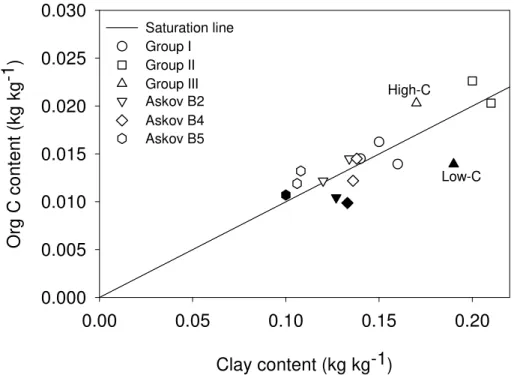
dis-playing poor tilth conditions had higher values. More studies are needed, nevertheless, to investigate the general validity of one specific clay/OC ratio across soil types. The relation between clay and OC for the soils discussed here is shown in Fig. 1. We note that the Dexter CC-NCC concept gives an explanation for the yet unresolved mystery 5
that soils may exhibit satisfactory tilth conditions despite low OC contents as compared to structurally degraded soils with higher OC contents (e.g., the fertilized Askov soils compared to the Low-C of Group III).
3.3 Water-dispersible clay and aggregate stability
Several studies have shown that the water-dispersible clay (WDC) content is smaller 10
when the soil OC content is larger (e.g. Watts and Dexter, 1997; Czyz et al., 2002). Dexter et al. (2008) found a higher correlation between WDC and soil clay content if NCC rather than total clay is used, which is in support of their hypothesis of two functionally different OC fractions. Based on our previous studies of the C-exhausted soil mentioned above (Fig. 1: Low-C soil of Group III), we hypothesize that the self-15
organization of soils with NCC>0 is threatened. Table 1 shows results from the Low-C soil and a neighbouring matching soil managed with forage crops and return of OM to the soil (High-C) (Munkholm et al., 2001; Schjønning et al., 2002a; Elmholt et al., 2008). We note (Table 1) that the soil content of total as well as a labile OC fraction is significantly higher for the High-C soil than the Low-C soil. A calculation based on 20
Dexter et al. (2008) found no NCC for the High-C soil, while the clay of the Low-C soil was not saturated (NCC>0). In accordance with the general expectation, WDC of field-moist soil in a low-energy test was found to be significantly highest for the Low-C soil. However, it is noticeable that a significantly lower amount of WDC was found for the Low-C soil when testing air-dried soil with the same energy input (Table 1). We 25
HESSD
6, 2633–2678, 2009(“Soil-it-is”)
L. W. de Jonge et al.
Title Page
Abstract Introduction
Conclusions References
Tables Figures
◭ ◮
◭ ◮
Back Close
Full Screen / Esc
Printer-friendly Version
Interactive Discussion strength of air-dried aggregates found for that soil; the cemented clay has formed
inter-nal crusts in the aggregates of the Low-C soil, hence producing mechanically stronger clods compared to the High-C soil. It is noteworthy that this is reflected also in a classi-cal Yoder-type wet-sieving test; the Low-C soil displayed significantlyhigher aggregate stability than the High-C soil (Table 1). Other studies have likewise reported a poor 5
correlation between dispersibility of clay and wet aggregate stability (Williams et al., 1966; Molope et al., 1985; Pojasok and Kay, 1990). The effect of organic depletion on the soil matrix and soil pores is visually documented in Fig. 2.
Low levels of soil OM (NCC>0) may create aggregates that are unstable in wet conditions but become hard and strong in dry conditions (Watts and Dexter, 1997; 10
Munkholm et al., 2001, 2002; Schjønning et al., 2002a). However, as discussed above, high stabilities of aggregates in wet conditions can be due to either cemented clay in low-friable clods or to biotic bonding and binding mechanisms in healthy crumbs (Schjønning et al., 2007; Elmholt et al., 2008). This has major impacts on agronomic aspects like tillage but also on clay dispersibility/colloid mobilization and hence colloid-15
facilitated transport of environmental pollutants (de Jonge et al., 2004a, b).
Colloid mobilization, stability, and transport in soil inner space are newly recognized and not-yet understood processes. The physical deposition of colloids on pore net-work walls (straining) may cause clogging of netnet-works and dramatically changed soil architecture and infra-structure, affecting transport of colloid-bound chemicals through 20
the soil vadose zone (de Jonge et al., 2004a; Sen and Khilar, 2006). These processes completely redefine our ideas about soil inner space dynamics. However, colloid trans-port has only recently been considered in models for transtrans-port and fate processes in the critical zone (Bradford and Torkzaban, 2008) due to a glaring lack of process knowledge. Soil physical disturbance, soil solution chemistry, and ambient soil mois-25
HESSD
6, 2633–2678, 2009(“Soil-it-is”)
L. W. de Jonge et al.
Title Page
Abstract Introduction
Conclusions References
Tables Figures
◭ ◮
◭ ◮
Back Close
Full Screen / Esc
Printer-friendly Version
Interactive Discussion essential phenomena for quantifying colloidal transport in natural, undisturbed soils
(Poulsen et al., 2006). Thus, there is considerable scope in studying colloid mobility and transport in the context of soil architecture and the self-organization concept.
3.4 Characterizing the soil pore system
Combined measurements of soil-gas diffusivity and air permeability are powerful 5
means of characterising pore system dynamics in undisturbed soil (e.g., Ball, 1981; Moldrup et al., 2001). The breakdown of clay-OM interaction may induce distinct changes in the soil pore network. In a previous study (Schjønning et al., 2002b), we used a combination of gas diffusion and air permeability measurements to describe the pore system of intact soil cores collected in the same fields with contrasting man-10
agement as addressed in the section on the soil matrix (Table 1). Figure 3 shows measured gas diffusivity for the two soils at four water potentials. The estimates of pore volumes blocked from the surrounding atmosphere (see data in the Figure) were found by assuming 1) a simple power law relationship between gas diffusivity and the air-filled pore space, and 2) a lower threshold ofDp/D0=10−4, reflecting no gas phase
15
diffusion (Weast et al., 1983). We note that the High-C soil returns the highest esti-mate, which may be interpreted as a first indication of a more complex soil structure for that soil.
Moldrup et al. (2000) showed that for sieved, repacked soil in a wide texture range (between 6 and 54% clay) the soil relative gas diffusivity was well predicted by the 20
model:
Dp D0 =
ε2a.5
Φ (3)
where Dp and D0 are the gas diffusion coefficients in soil and air, respectively, εa
is the volume of air-filled pore space, andΦis soil total porosity. This so-called WLR (Marshall) model indicates that for soils with a non-complex soil structure, the reduction 25
HESSD
6, 2633–2678, 2009(“Soil-it-is”)
L. W. de Jonge et al.
Title Page
Abstract Introduction
Conclusions References
Tables Figures
◭ ◮
◭ ◮
Back Close
Full Screen / Esc
Printer-friendly Version
Interactive Discussion content (decreasingεa). We now hypothesize that the soil structure of the Low-C soil
with dispersion-cementation cycles of clay – as discussed in the previous section – has degraded to mimic a sieved soil, i.e. obeying the WLR (Marshall) model for gas diffusion. In this exercise, we introduce the specific gas diffusivity as the ratio between the relative gas diffusivity and the volume of air-filled pore space:
5
Dp (D0εa) =
ε2a.5
Φ
εa = ε1a.5
Φ (4)
Figure 4 (right) shows that for four matric potentials investigated, the specific gas dif-fusivity (Dp/(D0εa)) derived from measured data (black bars) is indeed approximately similar to those estimated from the WLR (Marshall) model for the measured εa val-ues (grey bars). In contrast, the High-C soil interpreted as exhibiting an active self-10
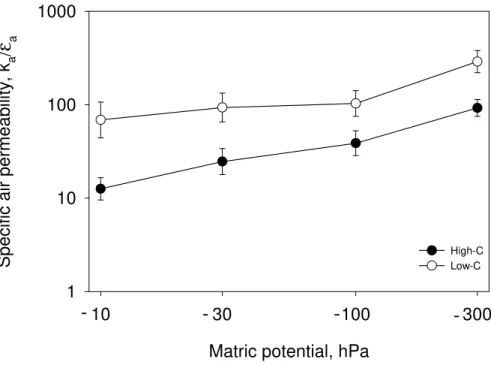
organization (see the previous section) exhibits a specific gas diffusivity much lower than predicted from the WLR (Marshall) model. This reflects a much more tortu-ous/complex pore system than found for the Low-C soil. The same clear trend may be depicted from the independent measurements of convective gas flow in the pore systems. Groenevelt et al. (1984) suggested the specific air permeability as an index 15
analogous to the specific gas diffusivity for expressing the continuity/non-complexity of soil pores. The specific air permeability is nearly an order of magnitude higher for the Low-C than for the High-C soil (Fig. 5). This means that the pore system of the Low-C soil is dominated by continuous (macro)pores enabling a fast convective transport of air through the soil.
20
Following Moldrup et al. (2001), but including the effect of inactive air-filled porosity (Brooks and Corey, 1966) as found in Fig. 3, we further evaluate the air-filled pore-network characteristics from a simple power-law model for relative gas diffusivity,
Dp D0 =
(εa−εap)
ε∗
a−εap
!M
HESSD
6, 2633–2678, 2009(“Soil-it-is”)
L. W. de Jonge et al.
Title Page
Abstract Introduction
Conclusions References
Tables Figures
◭ ◮
◭ ◮
Back Close
Full Screen / Esc
Printer-friendly Version
Interactive Discussion where εap is the inactive air-filled porosity or percolation threshold (Hunt, 2005),
(εa−εap) is the active air-filled porosity, M is a tortuosity-connectivity coefficient
(Mol-drup et al. 2001), and ε∗
a is a chosen reference air-filled porosity. We note that
the often applied assumption of εap=0.1×Φ (Hunt, 2005) approximately applies to the High-C soil (εap=0.051 m3m−3,Φ=0.473 m3m−3), but largely over-estimates εap
5
for the Low-C soil (εap=0.018 m3m−3, Φ=0.420 m3m−3), suggesting much higher
connectivity and continuity of inter-ped pores in the Low-C soil. We chose ε∗
ap at
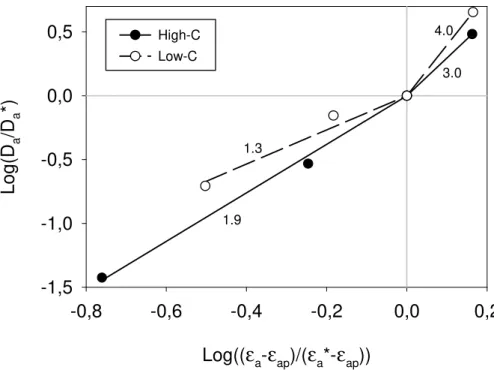
−100 hPa and note pores drained between−10 hPa and−100 hPa inter-ped or macro-pores (Moldrup et al., 2004) and macro-pores additionally drained between −100 hPa and −300 hPa intra-ped or smaller pores. Figure 6 shows the plot of log(Dp/D0) vs.
10
log[(εap−εap)/(ε∗a−εap)] with the air-filled porosity at the reference point soil-water
matric potential represented by the value of 0 on the x-axis (vertical dotted line). The slope to the left of log[(εa−εap)/(ε∗a−εap)]=0 represents the inter-ped
tortuosity-connectivity factor (M1) and the slope to the right of log[(εa−εap)/(ε∗a−εap)]=0 the
intra-ped tortuosity-connectivity factor (M2). The ratio ofM2toM1, 15
m= M2
M1 (6)
represents the change in pore network characteristics (connectivity, continuity and tor-tuosity) between intra- and inter-ped regions. The largem value of∼3 for the Low-C soil (as compared to∼1.5 for the High-C soil) implies a dramatic change in soil archi-tecture between intra- and inter-ped regions, again supporting the hypothesis of a more 20
pipe-like pore-network architecture for the Low-C soil. We therefore suggestm to be a useful soil architecture index.
Recalling the distinctly larger amount of non-complexed clay and hence the higher WDC for the Low-C compared to the High-C soil (Table 1), we note that the higherM2 value of the Low-C soil (Fig. 6) may reflect internal crusting within peds for that soil. 25
HESSD
6, 2633–2678, 2009(“Soil-it-is”)
L. W. de Jonge et al.
Title Page
Abstract Introduction
Conclusions References
Tables Figures
◭ ◮
◭ ◮
Back Close
Full Screen / Esc
Printer-friendly Version
Interactive Discussion 3.5 Soil behavior at critical soil organic matter contents
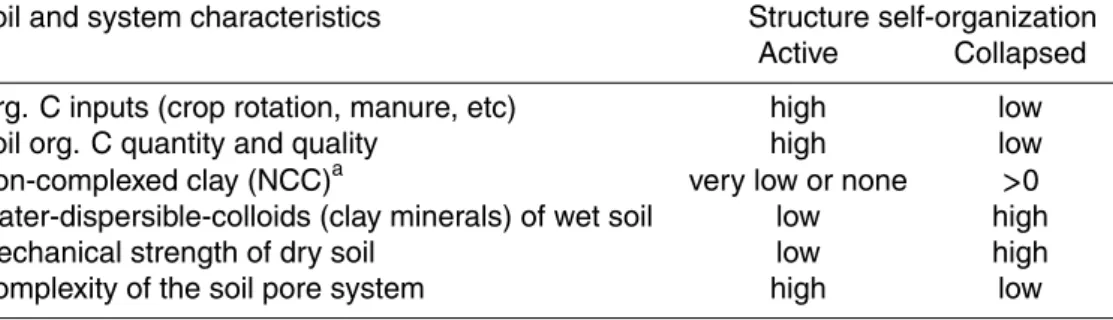
Combining the pore system fingerprints obtained by the analyses performed above, we suggest that the pore system of a C-depleted soil may turn into a downpipe-like appearance in contrast to a well-managed soil exhibiting self-organization where our data indicate a “sponge-like” appearance (Fig. 7). We see a causal relation between 5
the observed pore networks and the behaviour of the soil matrix when mechanically disturbed in wet and dry conditions. In Table 2, we summarize the characteristics of self-organized soils and soils where a low level of OM has inhibited self-organization. Dexter et al. (2008) found a linear relation between NCC and key physical soil proper-ties. Our data indicate that non-linear behaviour (e.g. strongly cemented clods rather 10
than friable aggregates) due to collapse of soil self-organization may be expected at considerable levels of NCC. It may be claimed that crusting and straining of clay par-ticles is still an increase in organization. Thus Swift (1994) emphasized that resilient systems may have the capacity to occupy more than one state of equilibrium. There is, however, no doubt that a range of important soil functions in crop production and 15
environmental protection will be poorer for the soil with a poor interaction between OM and clay particles.
4 Interfaces: processes in the solids-water-air continuum
4.1 Water repellency
Soil functions including water distribution and flow in the soil pore system are governed 20
HESSD
6, 2633–2678, 2009(“Soil-it-is”)
L. W. de Jonge et al.
Title Page
Abstract Introduction
Conclusions References
Tables Figures
◭ ◮
◭ ◮
Back Close
Full Screen / Esc
Printer-friendly Version
Interactive Discussion tecture due to accelerated particle dispersibility in the flow active architecture, which in
turn further influences the flow pathways and vice versa.
The WR is closely related to soil-water content (de Jonge et al., 1999, 2007), OM quantity/quality (Kawamoto et al., 2007; Regalado et al., 2008), microbial activity (Hal-lett and Young, 1999), and soil management (de Jonge et al., 2007). Water repellency 5
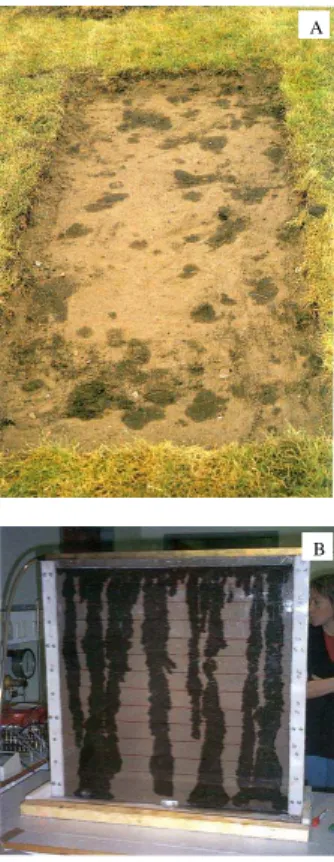
will at the same time control the onset of unstable (preferential or finger-like (Fig. 8)) water flow events in the soil (Nissen et al., 1999), thereby often causing a poor water distribution and accelerated transport of chemicals to the groundwater. Classical soil physics for describing water and chemical transport assumes that soil is non-water-repellent. However, recent evidence suggests that at least low levels of water repel-10
lency are the rule rather than the exception (Hallett and Young, 1999), and that spatial variations in soil OM quality and microbial activity control this so-called sub-critical wa-ter repellency. Consequently, small-scale changes in soil architecture including micro-bial activity and OM quantity and quality are likely major controls of flow heterogeneity and water distribution – where it was hitherto assumed that macropores and cracks in 15
the topsoil were the main cause of preferential water flow and poor water distribution effects observed worldwide (Hallett et al., 2004; Or et al., 2007).
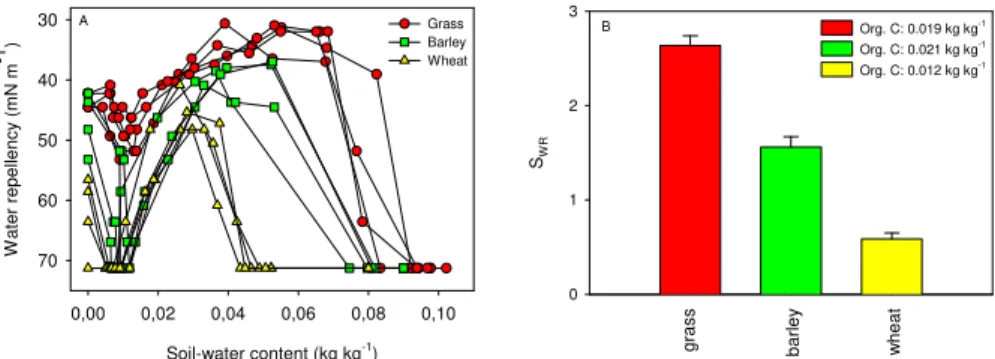
The WR varies non-linearly with soil-water content, w (King, 1981; Wallis et al., 1990; de Jonge et al., 1999, 2007; Kawamoto et al., 2007; Regalado et al., 2008) and all soils finally become wettable above a certain water content. This is illustrated (Fig. 9a) for 20
a coarse-textured Danish soil from Jyndevad (Table 3) grown with three different crops of grass, barley and wheat. The trapezoidal integrated area, SWR (mN m−1kg kg−1)
under the WR-w curves (de Jonge et al., 2007; Regalado et al., 2008), can be used to determine the overall degree of WR for a specific soil (Fig. 9b). The grass crop clearly produces the highest WR followed by barley and wheat. The ways in which these soils 25
HESSD
6, 2633–2678, 2009(“Soil-it-is”)
L. W. de Jonge et al.
Title Page
Abstract Introduction
Conclusions References
Tables Figures
◭ ◮
◭ ◮
Back Close
Full Screen / Esc
Printer-friendly Version
Interactive Discussion soil collected from under a grass or barley crop shows a significantly higher WR for the
grass crop despite the lower OC content of this soil.
Fractionating the Jyndevad soil collected from under grass crop allows us to in-vestigate the effect of particles sizes on the degree of WR. The Jyndevad soil was fractionated into the fractions:<0.063 mm; 0.063–0.125 mm; 0.125–0.250 mm; 0.250– 5
0.500 mm; 0.500–1.000 mm; and 1.000–2.000 mm. The degree of WR,SWR, for the three smallest size-fractions (as well as the water-content at which the fractions be-comes wettable) (Fig. 10a) increases with decreasing size-fractions (modified from de Jonge et al., 1999). Taking another and a closer look (Fig. 10b) by plotting theSWR for all fractions as well as the whole soil as a function of soil OC reveals that the de-10
gree of WR is actually related to the OC content in the fractions rather than the particle sizes themselves. The OC content obviously plays a dominant role for the water repel-lency interface phenomenon. In the literature significant effects of OC on a range of soil physical properties have been reported including compactability, tillage, stability in water, and soil physical quality in general (Dexter et al., 2008 and references therein). 15
Usually the effects of OM are such that an increased OM content results in improved soil physical properties. But as for the effects of increased WR with increasing OC content and the possible resulting irregular water movement the positive role is less clear.
4.2 The Dexter (2008) threshold for complexed organic carbon 20
In line with the complexed clay concept described in Sect. 3, Dexter et al. (2008) intro-duced the term complexed organic carbon (COC). This involves the idea that 1 g of OC is associated or complexed withngrams of clay (n=10). The amount of COC can be calculated by
COC=IF[OC<clay/n]THEN[OC]ELSE[clay/n] (7)
25
Likewise the amount of non-complexed OC (NCOC) can be calculated by
HESSD
6, 2633–2678, 2009(“Soil-it-is”)
L. W. de Jonge et al.
Title Page
Abstract Introduction
Conclusions References
Tables Figures
◭ ◮
◭ ◮
Back Close
Full Screen / Esc
Printer-friendly Version
Interactive Discussion The OC contents of numerous Jyndevad soil samples (de Jonge et al., 2007) having
undergone different treatments are plotted as a function of their clay content (Fig. 11a) along with a number of other soil types, for which the WR-w curve has been determined (de Jonge et al., 1999). All of these soils fall well above the saturation line, which im-plies that they hold smaller or larger amounts of OC in a non-complexed form (NCOC). 5
The degree of WR for these soils, as determined bySWR, plotted against the amount of NCOC yields a linear relationship with a Pearson correlation coefficient ofr=0.77∗∗∗
(note the data points from the Jyndevad grass field, the upper open circles, have been omitted in the correlation analysis due to the influence of eluded OC from the crop). This is only a slight improvement as opposed to correlating against OC (r=0.76∗∗∗,
10
analysis not shown), but the regression line hits the origin when correlating with NCOC (interception not significantly different from zero), which is not the case when using OC (analysis not shown). This points towards the WR phenomenon being switched off when no NCOC is present in the soil.
The above analyses imply that OC quantity and quality, soil texture (specific surface 15
area) and soil structure including aggregation may all in combination with actual soil moisture conditions (content and distribution) play a key role in controlling interface processes such as water repellency. They therefore also play a role in controlling surface and subsurface hydrology as well as the spread of contaminants.
4.3 Sorption (partitioning) processes for organic chemicals 20
Other important interface processes that are intimately linked to soil architecture (ma-trix and pore systems) and soil OM quality and quantity in combination with organo-clay complexing are sorption of organic vapors (Amali et al., 1994; Petersen et al., 1994, 1995) as well as dissolved chemicals (de Jonge et al., 2000, 2008). Taking a closer look at gaseous phase sorption in soils can lead to a renewed understanding of soil 25
HESSD
6, 2633–2678, 2009(“Soil-it-is”)
L. W. de Jonge et al.
Title Page
Abstract Introduction
Conclusions References
Tables Figures
◭ ◮
◭ ◮
Back Close
Full Screen / Esc
Printer-friendly Version
Interactive Discussion pedon or larger scale. The WR-w curves for the Lundgaard and Ødum soils (marked
in Fig. 11) are plotted together with curves relating gaseous phase sorption of the non-polar chemical trichloroethylene with w (Fig. 12). The gaseous phase sorption at zero and very low soil moisture contents takes place directly at the mineral and organic sur-faces. While soil-water contents increase, polar water molecules start competing with 5
the non-polar TCE molecules for sorption sites. From oven-dry conditions to around soil-water contents of approximately four-five molecular layers the VOC adsorption ca-pacity decreases non-linearly and drastically (Petersen et al., 1994, 1995) and Henry’s Law is not valid. For this non-Henrian region the adsorption/dissolution (Eq. 9) is de-scribed by applying a solid/vapor adsorption coefficient,K′
D(cm
3
g−1), defined from:
10
SS +Sw =KD′Cρb (9)
whereSS is the amount of VOC-vapor adsorbed to soil solids (g cm−1), S
w is
VOC-vapor dissolved in water (g cm−1), C is VOC concentration (g VOC cm−3), andρ
bis the
bulk density (g cm−3). In the non-Henrian region between 0 and
∼4 molecular layers of water coverage, the change inK′
D with changing water content can be predicted by
15
Eq. (10):
logK′
D=(A0−β)e−αw +β (10)
whereA0=logK′
D (w=0),βis a fitting parameter, andαas a function ofβis given by:
α=
lnA4−β
A0−β
w4
(11)
where w4 is the water content at four molecular layers of water coverage, and 20
A4=logK′
D (w4). For soil-water contents higher than four molecular layers (Henrian
region), the K′
D slightly increases with increasing water contents due to VOC
HESSD
6, 2633–2678, 2009(“Soil-it-is”)
L. W. de Jonge et al.
Title Page
Abstract Introduction
Conclusions References
Tables Figures
◭ ◮
◭ ◮
Back Close
Full Screen / Esc
Printer-friendly Version
Interactive Discussion applicability of Henry’s Law and that water surface sorption and condensation are
neg-ligible and correspond to the linear parts of theK′
D−w curves (Fig. 12):
K′
D =
KD KH
+ w
KHϕρ
(12)
whereKD is the aqueous/solid partition coefficient (cm3g−1), KH is Henry’s constant,
ϕis the aqueous activity coefficient (=1), andρis the density of water (=1 g cm−3).
5
When moving from the Non-Henry to the Henry region (Fig. 12) – around a molecular water coverage of 4–5, which is also being approximately equal to the wilting point – we seem to reach a crossroad in interface phenomena. The VOC vapour sorption reaches a minimum and around the same point the WR starts increasing. This corroborates with the hypothesis of Or et al. (2007) that partial water coverage of solids surfaces 10
is one of the physical constraints/controls determining numerous interface processes. At the same time the geometry of the bound water (its distribution in films and pore throats) as well as the type of available surfaces (NC, NCC, COC, or NCOC) probably plays an important role regarding interface phenomena (Or et al., 2007; Dexter et al., 2008).
15
Surface area (total as, for example, estimated by EGME measurement or external as, for example, estimated by N2-BET) appears to be a key player in both vapor sorption and likely also WR, with surface areas of course being closely related to both OM and clay (the finer fractions of the soil matrix). For vapor sorption, clay mainly controls the dry region and OM the wet region. For WR, the interactions between OM and clay 20
together with OM quality, control WR-w curve shape and magnitude. The analysis suggests that both the vapor sorption curve (K′
D-w) and the WR curve (WR-w) may be
key interface characteristics towards understanding soil architecture and functions. The carbon saturation effect is examined further (Fig. 13) with regard to sorption of the dissolved polycyclic aromatic hydrocarbons (PAH) pyrene and phenanthrene. 25
HESSD
6, 2633–2678, 2009(“Soil-it-is”)
L. W. de Jonge et al.
Title Page
Abstract Introduction
Conclusions References
Tables Figures
◭ ◮
◭ ◮
Back Close
Full Screen / Esc
Printer-friendly Version
Interactive Discussion correlated to the soil OC (see reviews by Pignatello, 1998 and Huang et al., 2003).
The OC contents of eight European soils (de Jonge et al., 2008; Celis et al., 2006) are plotted as a function of their clay content (Fig. 14). The soils split into two groups with one above and one below the saturation line as defined by Dexter et al. (2008). The sorption coefficients, KD, for pyrene and phenanthrene (de Jonge et al. 2008) 5
are significantly correlated to the NCOC fraction of the soils as calculated by Eq. (8), and an improvement on the correlation to soil OC. The sorption coefficients are not correlated to the COC. Again, part of the OC pool seems to be mainly responsible for interface processes within soil inner space.
5 Interrelations of key parameters in soil structure: towards a road map for soil
10
inner space
5.1 A scientific road map to soil inner space
Soil is the most complex biomaterial on the planet (Young and Crawford, 2004). If we look at soil inner space through a magnifying glass, it seems chaotic. At this scale, the natural intact soil represents an almost unimaginably complex architecture. At first 15
glance, mineral particles, abiotic and biotic organic colloids, “colonies” of particles (ag-gregates) and biomass (films) appear connected in a random fashion. Constricted by this complicated architecture, water and numerous types of colloids, dissolved chemi-cals, air, and gaseous compounds move by tortuous routes. By their own translocation and ensuing biophysical processes, the mobile components are constantly changing 20
soil architecture. The first step towards quantifying these not-yet-understood soil phe-nomena is to envision a scientific roadmap to soil inner space. The map must identify the main bridges and highways for transport and information that are linking key soil constituents and processes and at the same time respecting that any change to a con-stituent or a process will in itself influence soil architecture and infrastructure.
25
HESSD
6, 2633–2678, 2009(“Soil-it-is”)
L. W. de Jonge et al.
Title Page
Abstract Introduction
Conclusions References
Tables Figures
◭ ◮
◭ ◮
Back Close
Full Screen / Esc
Printer-friendly Version
Interactive Discussion liquids, clay particles, and biotic and abiotic OM (Fig. 14). The mobile constituents
travel along tortuous roads and highways formed by complex pore networks, while un-dergoing translocation processes such as diffusion, convection, dispersion, chemical sorption, and physical straining. External system inputs to soil architecture include management induced energy gradients, climate-induced gradients in moisture matric 5
potential and temperature, and plant-root-induced exudates such as extracellular poly-metric substances (EPS) working as biological glues in soil structure formation (Or et al., 2007). The external inputs interacting with the micro-scale biophysical processes cause a variety of not-yet-understood phenomena including creation/breakdown of ag-gregates, blocking of pore networks by deposited colloids, water repellency and onset 10
of finger-like water flow patterns, inter-connections of previously entrapped air-filled pore space, and onset of gas transport and dispersion. All these processes are in-timately linked to the temporal and spatial dynamics of soil inner space architecture, which in turn changes in constant interaction with the biophysical processes.
5.2 Example of a crossroad: Soil-water matric potential and the Dexter clay saturation 15
line
One interesting crossroad is how a change in soil-matric potential (for example quan-tified by pF) will affect soil architecture depending on whether the local soil element is above or below the Dexter clay saturation line. If there is a surplus of NCOC and the water potential decreases below 1000 hPa (pF>3), the analyses in this study would im-20
ply that water repellency, a more heterogeneous distribution of moisture on the micro-scale, and the occurrence of vapour sorption may be promoted. If instead there is a surplus of NCC, release and redistribution of water dispersible colloids (clay) may occur more easily. Any such threshold-induced change in soil infrastructure will both govern and, in turn, be affected by translocations of biotic and abiotic colloidal par-25
un-HESSD
6, 2633–2678, 2009(“Soil-it-is”)
L. W. de Jonge et al.
Title Page
Abstract Introduction
Conclusions References
Tables Figures
◭ ◮
◭ ◮
Back Close
Full Screen / Esc
Printer-friendly Version
Interactive Discussion derstanding irregular water flow and distribution, preferential gas transport linked to
soil architecture, colloid mobilization and chemical-facilitated transport related to soil structure thresholds (healthy sponges versus unhealthy pipes), and moisture and OC thresholds for chemical phase distribution behavior, and finally as the ultimate vision the controls and constraints of self-organization and soil bio(mass)-physical interac-5
tions in time and (inner) space.
6 Conclusions
Conclusions that can be drawn on the preliminary results of the Soil-it-is program in-clude:
– If carefully integrated and interpreted, multi-parameter measurements at scales 10
from aggregates to minimally disturbed bulk soil samples (100 cm3or larger) may provide valuable information of processes at a lower scale, although we acknowl-edge the great heterogeneity in soil architecture and processes at the colloid to cluster scale.
– Novel data analyses of soil-gas transport parameters are presented, including 15
normalization of gas diffusivity data with regard to the WLR model for structure-less porous media, and a Brooks-Corey power-law analysis taking into account a percolation threshold for gas diffusivity and introducing the ratio of intra- to inter-ped tortuosity-connectivity factors,m, as a useful indicator for characterizing pore-network architecture.
20
HESSD
6, 2633–2678, 2009(“Soil-it-is”)
L. W. de Jonge et al.
Title Page
Abstract Introduction
Conclusions References
Tables Figures
◭ ◮
◭ ◮
Back Close
Full Screen / Esc
Printer-friendly Version
Interactive Discussion not complexed by organic carbon (NCC), which is supported by high
dispersibili-ties of field moist soil and high mechanical strengths of dry aggregates.
– The Dexter et al. (2008) clay saturation concept in combination with distribution and intensity of soil water may also in part govern functional soil architecture with regard to hydrological interface processes such as water repellency and fin-5
gered flow. For example, the area under the water repellency curve (water re-pellency versus gravimetric soil-water content) was positively correlated to non-clay-complexed organic carbon (NCOC) for a number of differently textured and managed Danish soils.
– Also for interface processes governing the fate of environmental impact chemicals 10
such as sorption of volatile organic chemicals and PAHs, both NCOC and soil-moisture status were shown to play a key role in the phase partitioning of both volatile vapors and PAHs.
– Based on these preliminary results, we envision a road map to soil inner space where important crossroads for key parameters (e.g. NCOC and soil-water matric 15
potential) govern the build-up and resilience or breakdown of soil infrastructure and the thresholds for the ability of soils to self-organize after structure break-down.
– The road map may hopefully serve as inspiration for a more focused and multi-disciplinary effort combining high-resolution measurement methods from soil sci-20
ences, hydropedology and engineering disciplines in soil inner space.
Acknowledgements. This work was financed by the international project Soil Infrastructure,
HESSD
6, 2633–2678, 2009(“Soil-it-is”)
L. W. de Jonge et al.
Title Page
Abstract Introduction
Conclusions References
Tables Figures
◭ ◮
◭ ◮
Back Close
Full Screen / Esc
Printer-friendly Version
Interactive Discussion
References
Amali, S., Petersen, L. W., Rolston, D. E., and Moldrup, P.: Modeling multicomponent volatile organic and water vapor adsorption on soils, J. Hazard. Mat., 36, 89–108, 1994.
Ball, B. C.: Modelling of soil pores as tubes using gas permeabilities, gas diffusivities and water
release, J. Soil Sci., 32, 465–481, 1981. 5
Bradford, S. A. and Torkzaban, S.: Colloid transport and retention in unsaturated porous media: A review of interface-, collector-, and pore-scale processes and models, Vadose Zone J., 7, 667–681, 2008.
Brooks, R. H. and Corey, A. T.: Properties of porous media affecting fluid flow, J. Irrig. Drain.
Eng. Div. Am. Soc. Civ. Eng. (ASCE), 92, 61–89, 1966. 10
Carter, M. R., Angers, D. A., Gregorich, E. G., and Bolinder, M. A.: Characterizing organic matter retention for surface soils in eastern Canada using density and particle size fractions, Can. J. Soil Sci., 83, 11–23, 2003.
Carter, M. R.: Researching structural complexity in agricultural soils, Soil Till. Res., 79, 1–6, 2004
15
Celis, R., de Jonge, H., de Jonge, L. W., Real, M., Hermosin, M. C., and Cornejo, J.: The role of mineral and organic components in phenanthrene and dibenzofuran sorption by soil, Eur. J. Soil Sci., 57, 308–319, 2006.
Czy˙z, E. A., Dexter, A. R., and Terelak, H.: Content of readily-dispersible clay in the arable layer of some Polish soils.In: Sustainable Land Management–Environmental Protection, edited 20
by: Pagliai, M. and Jones, R., Advan. Geoecol., 35, 115–124, 2002.
de Jonge, L. W., Jacobsen, O. H., and Moldrup, P.: Soil water-repellency: Effects of water
content, temperature, and particle size, Soil Sci. Soc. Am. J., 63, 437–442, 1999.
de Jonge, L. W., de Jonge, H., Moldrup, P., Jacobsen, O. H., and Christensen, B. T.: Sorption of Prochloraz on primary soil organomineral size separates, J. Environ. Qual., 29, 206–213, 25
2000.
de Jonge, L. W., Kjaergaard, C., and Moldrup, P.: Colloids and colloid-facilitated transport of contaminants in soils: An introduction, Vadose Zone J., 3, 321–325, 2004a.
de Jonge, L. W., Moldrup, P., Rubæk, G. H., Schelde, K., and Djurhuus, J.: Particle leaching and particle-facilitated transport of phosphorus at field scale, Vadose Zone J., 3, 462–470, 30
2004b.
HESSD
6, 2633–2678, 2009(“Soil-it-is”)
L. W. de Jonge et al.
Title Page
Abstract Introduction
Conclusions References
Tables Figures
◭ ◮
◭ ◮
Back Close
Full Screen / Esc
Printer-friendly Version
Interactive Discussion repellency in soils: Effect of crop type, soil management, and physical-chemical parameters,
Soil Sci., 172, 577–588, 2007.
de Jonge, L. W., Moldrup, P., de Jonge, H., and Celis, R.: Sorption and leaching of short-term-aged PAHs in eight European Soils: Link to physical-chemical properties and leaching of dissolved organic carbon, Soil Sci., 173, 13–24, 2008.
5
Denef, K. and Six, J.: Clay mineralogy determines the importance of biological versus abiotic processes for macroaggregate formation and stabilization, Eur. J. Soil Sci. 56, 469–479, 2005.
Dexter, A. R.: Advances in characterization of soil structure, Soil Till. Res., 63, 199–238, 1988. Dexter, A. R., Richard, G., Arrouays, D., Czyz, E. A., Jolivet, C., and Duval, O.: Complexed 10
organic matter controls soil physical properties, Geoderma, 144, 620–627, 2008.
Elmholt, S., Schjønning, P., Munkholm, L. J., and Debosz, K.: Soil management effects on
aggregate stability and biological binding, Geoderma, 144, 455–467, 2008.
Groenevelt, P. H., Kay, B. D., and Grant, C. D.: Physical assessment of a soil with respect to rooting potential, Geoderma, 34, 101–114, 1984.
15
H ˚akansson, I.: A method for characterizing the state of compactness of the plough layer, Soil Till. Res., 16, 105–120, 1990.
Hallett, P. D. and Young, I. M.: Changes to water repellency of soil aggregates caused by substrate-induced microbial activity, Eur. J. Soil Sci. 50, 35–40, 1999.
Hallett, P. D., Nunan, N., Douglas, J. T., and Young, I. M.: Milimeter-scale spatial variability 20
in soil-water sorptivity: Scale, surface elevation, and subcritical repellency effects, Soil Sci.
Soc. Am. J., 68, 352–358, 2004.
Heylighen, F.: The Science of self-organization and adaptivity, in: Knowledge Management, Or-ganizational Intelligence and Learning, and Complexity, in: The Encyclopedia of Life Support Systems (EOLSS), edited by: Kiel, L. D., Eolss Publishers, Oxford, 2001.
25
Holling, C. S.: Resilience and stability of ecological systems, Ann. Rev. Ecol. Syst., 4, 1–23, 1973.
Huang, W., Peng, P., Yu, Z., and Fu, J.: Effects of organic matter heterogeneity on sorption and
desorption of organic contaminants by soils and sediments, Appl. Geochem., 18, 955–972, 2003.
30
Hunt, A. G.: Percolation theory for flow in porous media, Springer-Verlag, Berlin, 2005.
HESSD
6, 2633–2678, 2009(“Soil-it-is”)
L. W. de Jonge et al.
Title Page
Abstract Introduction
Conclusions References
Tables Figures
◭ ◮
◭ ◮
Back Close
Full Screen / Esc
Printer-friendly Version
Interactive Discussion 1990.
Kawamoto, K., Moldrup, P., Komatsu, T., de Jonge, L. W., and Oda, M.: Water repellency of aggregate size fractions of a volcanic ash soil, Soil Sci. Soc. Am. J., 71, 1658–1666, 2007. Kemper, W. D., Rosenau, R. C., and Dexter, A. R.: Cohesion development in disrupted soils
as affected by clay and organic matter content and temperature, Soil Sci. Soc. Am. J., 51,
5
860–867, 1987.
King, P. M.: Comparison of methods for measuring severity of water repellence of sandy soils and assessment of some factors that affect its measurement, Aust. J. Soil Res., 19, 275–285,
1981.
Kjaergaard, C., de Jonge, L. W., Moldrup, P., and Schjønning, P.: Water-dispersible colloids: 10
Effects of measurement method, clay content, initial soil matric potential and wetting rate,
Vadose Zone J., 3, 403–412, 2004.
Letey, J.: The study of soil structure: Science or art, Aust. J. Soil Res., 29, 699–707, 1991. Moldrup, P., Olesen, T., Gamst, J., Yamaguchi, T., and Rolston, D. E.: Predicting the gas diff
u-sion coefficient in repacked soil: Water-induced linear reduction model, Soil Sci. Soc. Am. J.,
15
64, 1588–1594, 2000
Moldrup, P., Olesen, T., Komatsu, T., Schjønning, P., and Rolston, D. E.: Tortuosity, diffusivity, and permeability in the soil liquid and gaseous phases, Soil Sci. Soc. Am. J., 65, 613–623, 2001.
Moldrup, P., Olesen, T., Yoshikawa, S., Komatsu, T., and Rolston, D. E.: Three-porosity model 20
for predicting the gas diffusion coefficient in undisturbed soil, Soil Sci. Soc. Am. J., 68, 750–
759, 2004.
Molope, M. B., Page, E. R., and Grieve, I. C.: A comparison of soil aggregate stability tests using soils with contrasting cultivation histories, Commun. Soil Sci. Plant Anal. 16, 315–322, 1985.
25
Mullins, C. E., Young, I. M., Bengough, A. G., and Ley, G. J.: Hard-setting soils, Soil Use Manag., 3, 79–83, 1987.
Munkholm, L. J., Schjønning, P., Debosz, K., Jensen, H. E., and Christensen, B. T.: Aggregate strength and mechanical behaviour of a sandy loam under long-term fertilization treatments, Eur. J. Soil Sci., 53, 129–137, 2002.
30
Munkholm, L. J., Schjønning, P., and Petersen, C. T.: Soil mechanical behaviour of sandy loams in a temperate climate: case-studies on long-term effects of fertilization and crop rotation,
HESSD
6, 2633–2678, 2009(“Soil-it-is”)
L. W. de Jonge et al.
Title Page
Abstract Introduction
Conclusions References
Tables Figures
◭ ◮
◭ ◮
Back Close
Full Screen / Esc
Printer-friendly Version
Interactive Discussion Nissen, H. H., Moldrup, P., de Jonge, L. W., and Jacobsen, O. H.: Time domain reflectometry
coil probe measurements of water content during fingered flow, Soil Sci. Soc. Am. J., 63, 493–500, 1999.
NRC: Basic research opportunities in earth science, National Academy Press, Washington, DC, 2001.
5
O’Donnell, A.G, Young, I. M., Rushton, S. P., Shirley, M. D., and Crawford, J. W.: Visualization, modelling and prediction in soil microbiology, Nat. Rev. Microbiol., 5, 689–699, 2007. Or, D., Smets, B. F., Wraith, J. M., Dechesne, A., and Friedman, S. P.: Physical constraints
affecting bacterial habitats and activity in unsaturated porous media – a review, Adv. Water Res., 30, 1505–1527, 2007.
10
Petersen, L. W., Rolston, D. E., Moldrup, P., and Yamaguchi, T.: Volatile organic vapor diffusion
and adsorption in soils, J. Environ. Qual., 23, 799–805, 1994.
Petersen, L. W., Moldrup, P., El-Farhan, Y. H., Jacobsen, O. H., Yamaguchi, T., and Rol-ston, D. E.: Effects of moisture and soil texture on the adsorption of organic vapors, J.
Environ. Qual., 24, 752–759, 1995. 15
Pignatello, J. J.: Soil organic matter as a nanoporous sorbent of organic pollutants, Adv. Coll. Interf. Sci., 77, 445–467, 1998.
Pojasok, T. and Kay, B. D.: Assessment of a combination of wet sieving and turbidimetry to characterize the structural stability of moist aggregates, Can. J. Soil Sci., 70, 33–42, 1990. Poulsen, T. G., Moldrup, P., de Jonge, L. W., and Komatsu, T.: Colloid and bromide transport 20
in undisturbed soil columns: Application of two-region model, Vadose Zone J., 5, 649–656, 2006.
Regalado, C. M., Ritter, A., de Jonge, L. W., Kawamoto, K., Komatsu, T., and Moldrup, P.: Useful soil-water repellency indices: Linear correlations, Soil Sci., 173, 747–757, 2008.
Schjønning, P., Christensen, B. T., and Carstensen, B.: Physical and chemical properties of 25
a sandy loam receiving animal manure, mineral fertilizer or no fertilizer for 90 years, Eur. J. Soil Sci., 45, 257–268, 1994.
Schjønning, P., Elmholt, S., Munkholm, L. J., and Debosz, K.: Soil quality aspects of humid sandy loams as influenced by different long-term management. Agriculture, Ecosyst.
Envi-ron., 88, 195–214, 2002a. 30
Schjønning, P., Munkholm, L. J., Moldrup, P., and Jacobsen, O. H.: Modelling soil pore charac-teristics from measurements of air exchange: the long-term effects of fertilization and crop
HESSD
6, 2633–2678, 2009(“Soil-it-is”)
L. W. de Jonge et al.
Title Page
Abstract Introduction
Conclusions References
Tables Figures
◭ ◮
◭ ◮
Back Close
Full Screen / Esc
Printer-friendly Version
Interactive Discussion Sen, T. K. and Khilar, K. C.: Review on subsurface colloids and colloid-associated contaminant
transport in saturated porous media, Adv. Coll. Interf. Sci., 119, 71–96, 2006.
Six, J., Bossuyt, H., Degryze, S., and Denef, K.: A history of research on the link between (micro) aggregates, soil biota, and soil organic matter dynamics, Soil Till. Res., 79, 7–31, 2004.
5
Skopp, J., Jawson, M. D., and Doran, J. W.: Steady-state aerobic microbial activity as a function of soil-water content, Soil Sci. Soc. Am. J., 54, 1619–1625, 1990.
Swift, M. J.: Maintaining the biological status of soil: a key to sustainable land management? In: Soil resilience and Sustainable Land Use, edited by: Greenland, D. J. and Szabolcs, I., CAB International, Wallingford, UK, 235–247, 1994.
10
Utomo, W. H., and Dexter, A. R.: Soil friability, J. Soil Sci., 32, 203–213, 1981.
Wallis, M. G., Horne, D. J., and McAuliffe, K. W.: A study of water repellency and its amelioration
in a yellow-brown sand. 2. Use of wetting agents and their interaction with some aspects of irrigation, N. Z. J. Agr. Res. 33, 145–150, 1990.
Watts, C. W. and Dexter, A. R.: The influence of organic matter in reducing the destabilization 15
of soil by simulated tillage, Soil Till. Res., 42, 253–275, 1997.
Watts, C. W., and Dexter, A. R.: Soil friability: theory, measurement and the effects of
manage-ment and organic carbon content, Eur. J. Soil Sci., 49, 73–84, 1998.
Weast, R. C., Astle, M. J., and Beyer, W. H.: CRC Handbook of Chemistry and Physics, 64th edn., CRC Press, Boca Raton, FL, 1983.
20
Williams, B. G., Greenland, D. J., Lindstrom, G. R., and Quirk, J. P.: Techniques for the deter-mination of the stability of soil aggregates, Soil Sci., 101, 157–163, 1966.
HESSD
6, 2633–2678, 2009(“Soil-it-is”)
L. W. de Jonge et al.
Title Page
Abstract Introduction
Conclusions References
Tables Figures
◭ ◮
◭ ◮
Back Close
Full Screen / Esc
Printer-friendly Version
Interactive Discussion Table 1.Selected soil characteristics for two arable soils with management-derived differences
in OM (modified after Munkholm et al., 2001; Schjønning et al., 2002a; Elmholt et al., 2008). Within each row, figures followed by different letters (a, b) are significantly different (P=0.05).
Soil characteristics Management system
High-C-input Low-C-input
Soil org. C, total (mg g−1soil) 19.7b 14.3a
Soil org. C, hot-water extractable (µg g−1soil) 232b 202a
Non-complexed clay (NCC) (mg g−1soil)4 0 51
Water-dispersible-colloids of wet soil (mg g−1clay) 98a 134b
Water-dispersible-colloids of dry aggregates1(mg g−1clay) 20.6b 18.0a
Tensile strength of dry aggregates2(kPa) 215a 267b Wet macro-aggregate stability3(mg g−1soil) 637a 873b
1
Averaged across three aggregate sizes, 0.063–0.25, 0.5–1, 4–8 mm.
2
Averaged across four aggregate sizes, 1–2, 2–4, 4–8 and 8–16 mm.
3>
0.25 mm aggregates after Yoder-type wet-sieving for two minutes.
4
HESSD
6, 2633–2678, 2009(“Soil-it-is”)
L. W. de Jonge et al.
Title Page
Abstract Introduction
Conclusions References
Tables Figures
◭ ◮
◭ ◮
Back Close
Full Screen / Esc
Printer-friendly Version
Interactive Discussion Table 2. Soil and system characteristics for soils with clay minerals interacting with OM in
a self-organized manner and for soils below a critical threshold of OM.
Soil and system characteristics Structure self-organization Active Collapsed
Org. C inputs (crop rotation, manure, etc) high low Soil org. C quantity and quality high low Non-complexed clay (NCC)a very low or none >0 Water-dispersible-colloids (clay minerals) of wet soil low high
Mechanical strength of dry soil low high
Complexity of the soil pore system high low
a