HESSD
7, 5213–5234, 2010Stemflow of desert shrub
X.-P. Wang et al.
Title Page
Abstract Introduction
Conclusions References
Tables Figures
◭ ◮
◭ ◮
Back Close
Full Screen / Esc
Printer-friendly Version Interactive Discussion
Discussion
P
a
per
|
Dis
cussion
P
a
per
|
Discussion
P
a
per
|
Discussio
n
P
a
per
|
Hydrol. Earth Syst. Sci. Discuss., 7, 5213–5234, 2010 www.hydrol-earth-syst-sci-discuss.net/7/5213/2010/ doi:10.5194/hessd-7-5213-2010
© Author(s) 2010. CC Attribution 3.0 License.
Hydrology and Earth System Sciences Discussions
This discussion paper is/has been under review for the journal Hydrology and Earth System Sciences (HESS). Please refer to the corresponding final paper in HESS if available.
Stemflow of desert shrub and its
significance in soil moisture
replenishment
X.-P. Wang1,2, Z.-N. Wang1, R. Berndtsson2, Y.-F. Zhang1, and Y.-X. Pan1 1
Shapotou Desert Research and Experiment Station, Cold and Arid Regions Environmental and Engineering Research Institute, Chinese Academy of Sciences, Lanzhou 730000, China
2
Department of Water Resources Engineering, Lund University, 22100 Lund, Sweden
Received: 27 March 2010 – Accepted: 12 July 2010 – Published: 2 August 2010
Correspondence to: X.-P. Wang ([email protected])
HESSD
7, 5213–5234, 2010Stemflow of desert shrub
X.-P. Wang et al.
Title Page
Abstract Introduction
Conclusions References
Tables Figures
◭ ◮
◭ ◮
Back Close
Full Screen / Esc
Printer-friendly Version Interactive Discussion
Discussion
P
a
per
|
Dis
cussion
P
a
per
|
Discussion
P
a
per
|
Discussio
n
P
a
per
|
Abstract
Stemflow of xerophytic shrubs represents a significant component of water replenish-ment to the soil-root systems influences water utilization of plant roots at the stand scale, especially for water scarce desert ecosystems. In this study, stemflow of
Caragana korshinskii was quantified by aluminum foil collar collection method at re-5
vegetated sand dunes of the Shapotou restored desert ecosystem in Northwestern China. Meanwhile, time domain reflectometry probes were inserted horizontally at 20 different soil profile depths under theC. korshinskii shrub to monitor soil moisture vari-ation at hourly intervals. Results indicated that 2.2 mm precipitvari-ation were necessary for the generation of stemflow forC. korshinskii. Stemflow averaged 8% of the gross pre-10
cipitation, and the average funneling ratio was as high as 90. The soil moisture in the uppermost soil profile was strongly correlated with individual rainfall and the stemflow strengthened this relationship. Therefore, it is favorable for infiltrated water redistribu-tion in the deeper soil profile of the root zone. We conclude that stemflow contributes significantly to a positive soil moisture balance in the root zone and the replenishment 15
of soil moisture at deeper soil layers. This plays an important role in plant survival and the general ecology of arid desert environments.
1 Introduction
Water scarcity is greatest in semiarid and arid regions because of limited supplies and increasing demand due to greater population growth relative to more humid regions 20
(V ¨or ¨osmarty et al., 2000). Thus, precipitation plays an important role in water-scarce arid environments. The patterns of transferring limited rainfall to the soil will regulate the soil water replenishment and utilization of plant roots. Stemflow can concentrate the rainfall intercepted by leaves and branches to the plant stem. Since water resources are limited in arid lands, stemflow can be an important source of soil moisture replen-25
HESSD
7, 5213–5234, 2010Stemflow of desert shrub
X.-P. Wang et al.
Title Page
Abstract Introduction
Conclusions References
Tables Figures
◭ ◮
◭ ◮
Back Close
Full Screen / Esc
Printer-friendly Version Interactive Discussion
Discussion
P
a
per
|
Dis
cussion
P
a
per
|
Discussion
P
a
per
|
Discussio
n
P
a
per
|
that stemflow input to the soil area around three semiarid shrub stems in Northeastern Mexico represented a water input that was five times by other areas below the shrub canopies. Other arid shrubs are also adapted to divert rainfall to the base of their stems as stemflow where it subsequently infiltrates the soil and remains available for plant uptake at deeper soil layers (Pressland, 1976; Nulsen et al., 1986; N ´avar, 1993; 5
Martinez-Meza and Whitford, 1996; Li et al., 2008). Levia and Frost (2003) provided a thorough review of the quantitative and qualitative importance of stemflow in forests as well as in agricultural environments.
Herwitz (1986) suggested that the quantitative importance of stemflow at the point scale can be expressed as a funneling ratio,F:
10
F= SF
BA×P (1)
where SF is the volume (l) of stemflow, BA is the trunk basal area (m2), andP is the depth equivalent of gross incident precipitation (mm). The product BA×P provides the volume of water that would have been caught by a rain gauge having an opening equal to that of the trunk basal area. Thus, F represents the ratio of the amount of 15
precipitation delivered to the base of the shrubs to the rainfall that would have reached the ground if the shrub were not present. Many studies in arid environments indicate that funneling ratio can be >10 and in some cases ≫10 (e.g. N ´avar, 1993; Carlyle-Moses, 2004; Li, et al., 2008). Consequently, the water volume that enters the soil around the stem will be greater than that under the corresponding rainfall due to the 20
high funneling ratio.
Re-vegetation experiments have been established for more than 50 years in the southeastern fringe of the Tengger Desert, using mainly xerophytic shrubs, such as
C. korshinskii, Hedysarum scopariumand Artemisia ordosica. The low water content of desert soils limits the number of shrubs and its stabilization. The effects of both 25
HESSD
7, 5213–5234, 2010Stemflow of desert shrub
X.-P. Wang et al.
Title Page
Abstract Introduction
Conclusions References
Tables Figures
◭ ◮
◭ ◮
Back Close
Full Screen / Esc
Printer-friendly Version Interactive Discussion
Discussion
P
a
per
|
Dis
cussion
P
a
per
|
Discussion
P
a
per
|
Discussio
n
P
a
per
|
of stemflow on infiltration patterns associated with the soil moisture replenishment is almost totally unexplored.
The objectives of the study were to quantify the variation of stemflow ofC. korshin-skii, and to evaluate the stemflow water infiltration process in the re-vegetation stabi-lized semiarid shrub desert in Northwestern China that has changed from a bare to 5
a vegetated soil. In the following chapter observations and methods are outlined. Then results from the stemflow observations are described. We close with a discussion of practical results and possibilities for scaling up of results.
2 Materials and methods
2.1 Study site description 10
The study was conducted at Shapotou Desert Research and Experiment Station (37◦27′N, 104◦57′E, 1339 m a.m.s.l.) on the southeastern fringe of the Tengger Desert, where successful revegetation experiments have been carried out since 1956 using a combination of windbreaks, straw checkerboard barriers, and planted xerophytic shrubs. The natural climatic conditions have been described in detail by Wang et al. 15
(2004). Based on analysis of 50-year time series of meteorological data collected at the Shapotou Desert Research and Experiment Station, operated by the Chinese Academy of Sciences, precipitation is the only source of soil water in this area. Mean annual precipitation is 191 mm and about 80% of this fall between June and Septem-ber, with a coefficient of variation as high as 46%. The annual potential evaporation is 20
about 3000 mm. Mean daily temperature of the coldest month (January) is−6.1◦C and that of the warmest month (July) is 24.7◦C. Mean relative humidity varies from 31% (April) to 54% (August). The first frost occurs in late September and the last frost ends in mid-April. The area has large and dense reticulate dune chains. The main dune crest migrates southeastward at a velocity of 0.3–0.6 myr−1. The dune sand consists 25
HESSD
7, 5213–5234, 2010Stemflow of desert shrub
X.-P. Wang et al.
Title Page
Abstract Introduction
Conclusions References
Tables Figures
◭ ◮
◭ ◮
Back Close
Full Screen / Esc
Printer-friendly Version Interactive Discussion
Discussion
P
a
per
|
Dis
cussion
P
a
per
|
Discussion
P
a
per
|
Discussio
n
P
a
per
|
size between 0.002 and 0.05 mm, and 0.2% of clay with grain size less than 0.002 mm (Wang et al., 2008). The soil is loose and impoverished mobile sand with a consistent moisture content ranging from 3–4% and classified as Typic Psammaquent (Berndts-son et al., 1996). The depth to groundwater is between 50 and 80 m and, therefore, is unable to support the natural vegetation.
5
2.2 Experimental set-up and data collection
Stemflow was measured for eight fully mature plants of 20-year-oldC. korshinskii that was replanted in 1989 as 1-year-old seedlings in the water balance experimental field of Shapotou. The number, length, height, diameter of the branches was measured, and branch-angle was calculated by the branch height from the ground surface to the 10
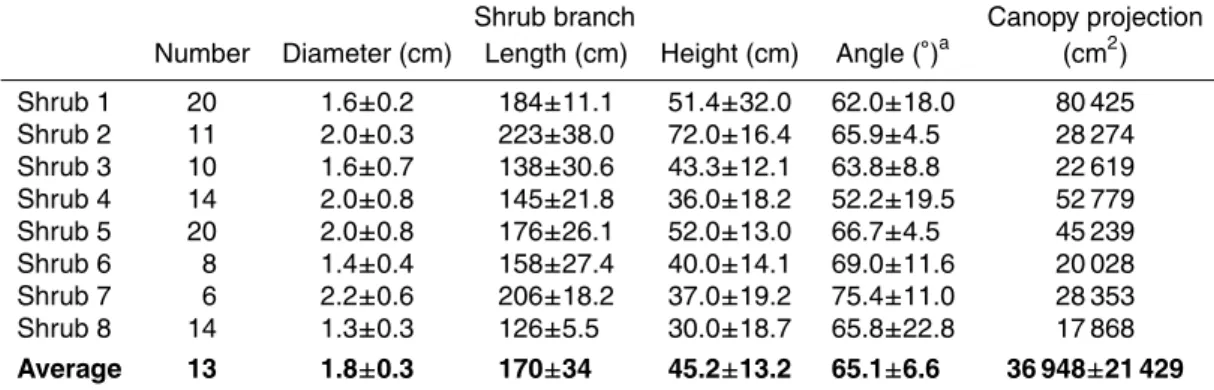
tip of the branch vertically and the distance of the branch away from the stem horizon-tally, the stem basal area in Eq. (1) is the sum of the basal area of each branch. Shrub canopy projective area was calculated by taking the longest and shortest diameters through the centre of the fullest part of the canopy (Table 1). For the stemflow collec-tion, fine sandpapers were used to burnish the selected branch surface about 10 cm 15
above ground. Then stemflow was collected using collars constructed from flexible aluminum foil plates that were fitted around the entire circumference of the branches. Each collar was sealed to the branch using all weather silicon caulking. Stemflow water was delivered from the collar to a collection bottle via a 1.5 cm aperture plastic hose (Fig. 1). Stemflow was measured by graduated cylinder for each branch after 20
each rainfall event and summarized for a single shrub. Stemflow volume of each shrub was divided by its canopy area to calculate the stemflow depth on a stand basis. The stemflow measurements under natural rainfall conditions was carried out according to Dunkerley’s (2008) standard for identifying individual rainfall events in accordance with the condition of dry desert environments in Shapotou, where an individual rainfall event 25
was defined as a rainfall separated by dry intervals of at least 6 h.
HESSD
7, 5213–5234, 2010Stemflow of desert shrub
X.-P. Wang et al.
Title Page
Abstract Introduction
Conclusions References
Tables Figures
◭ ◮
◭ ◮
Back Close
Full Screen / Esc
Printer-friendly Version Interactive Discussion
Discussion
P
a
per
|
Dis
cussion
P
a
per
|
Discussion
P
a
per
|
Discussio
n
P
a
per
|
depths of 5, 10, 15, 20, 25, 30, 35, 40, 45, 50, 60, 70, 80, 90, 100, 120, 140, 160, 180, and 200 cm. The probe has three 20 cm rods spaced 2.5 cm apart. For probe installation, a pit, 20 cm away from the stem, was dug in the soil of sufficient width to be able to insert the probes. The probes were inserted into the soil through the side of the pit that was unaltered and were placed horizontally in the direction of the shrub 5
site. Once the probes had been inserted, the pit was carefully refilled, avoiding pertur-bations as far as possible, and the surface was contoured similar to the surrounding slope. To reduce the influence of terrain, shrubs of C. korshinskii growing at a flat ground were selected. The experiment was set up in February 2008, and soil moisture measurements associated with the stemflow measurements were done between July 10
and October 2008.
The TDR instrument is capable of measuring volumetric soil moisture between 0% and 100%, with an accuracy of≤0.1%. The wetting front location and cumulative infil-tration are detected by measuring changes in soil moisture in the soil profile (Noborio et al., 1996; Wang et al., 2007). Noborio et al. (1996) found that the cumulative infiltration 15
estimated by TDR compared favourably with observed infiltration, and the distance to the wetting front from the soil surface estimated by TDR agreed well with the observed values. All data were collected simultaneously during and directly following rain events sufficient to trace wetting front changes at hourly intervals.
According to the above, volumetric soil water content was measured with TDR 20
probes matching the different depth of the soil profiles. Hence, water balances can be calculated according to the position of TDR probes. Based on the principle of soil water balance, the cumulative infiltration can be described as:
I=10(θe−θi)Zf (2)
∆S=
20
X
d=1
Id (3)
25
HESSD
7, 5213–5234, 2010Stemflow of desert shrub
X.-P. Wang et al.
Title Page
Abstract Introduction
Conclusions References
Tables Figures
◭ ◮
◭ ◮
Back Close
Full Screen / Esc
Printer-friendly Version Interactive Discussion
Discussion
P
a
per
|
Dis
cussion
P
a
per
|
Discussion
P
a
per
|
Discussio
n
P
a
per
|
water content (cm3cm−3),Zf is infiltration depth (mm),∆S the soil moisture increment (mm), andIdis cumulative infiltration at a specific depth section (mm).
A standard automatic rain gauge with a resolution of 0.1 mm (Adolf Thies GMVH & Co. KG, Germany) was installed at an open area 50 m away from the study plot, to obtain the amount and intensity of rainfall.
5
3 Results
3.1 Rainfall characteristics during the experiment period
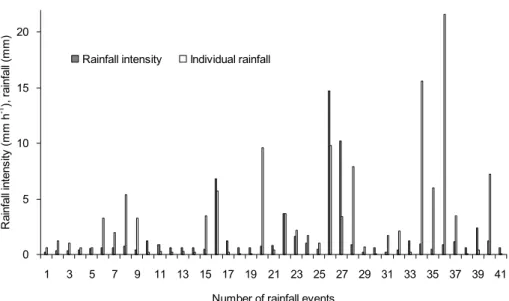
There were totally 41 rainfall events in the year 2008, resulting in an annual rainfall of 127.8 mm with an average event rainfall intensity of 1.5 mmh−1 ranging from 0.2 to 14.7 mmh−1, and an average individual rainfall of 3.1 mm ranging from 0.1 to 21.6 mm 10
(Fig. 2). There was no rainfall in March, May, November and December 2008 and it was a relatively dry year compared to the long-term average rainfall of 191 mm. Stemflow was monitored during a total of 14 rainfall events among the 41 rainfall events num-bered 15, 16, 20, 22, 23, 24, 26, 27, 28, 32, 35, 36, 37, and 40 in Fig. 2, corresponding to the date of 13, 17, 30–31 July, 6, 8, 9, 26, 28, 28–29 August, 8, 22–23, 26–27 15
September, and 3, 21–22 October 2008. The 14 events produced a total of 87.8 mm rainfall, which accounted for 69% of the annual rainfall amount and 34% in events num-bers (Fig. 2), which consisted of the main rain events ranging between 1.7 and 21.6 mm of the year 2008. The maximum rainfall intensity in 10 min (I10) was 33 mmh−1, and the mean rainfall intensity ranged from 0.5 to 14.7 mmh−1(Fig. 2). On the contrary, there 20
were 23 rain events that accounted for 56% in events number contributed to less than 10% of the annual rainfall amount (12.3 mm in total) with no stemflow occurring. Note that the rainfall event numbered 34 occurred on midnight of 21 September at 22:50 LT till 22 September at 16:30 LT. This event had a rain depth of 15.6 mm was excluded from the analysis because the collect bottles overflowed before data collection. There 25
HESSD
7, 5213–5234, 2010Stemflow of desert shrub
X.-P. Wang et al.
Title Page
Abstract Introduction
Conclusions References
Tables Figures
◭ ◮
◭ ◮
Back Close
Full Screen / Esc
Printer-friendly Version Interactive Discussion
Discussion
P
a
per
|
Dis
cussion
P
a
per
|
Discussion
P
a
per
|
Discussio
n
P
a
per
|
for the area. Thus, the observations in the present study are relevant to the estimation of stemflow and ratio to rainfall and likely representative for larger areas of the present.
3.2 Stemflow properties
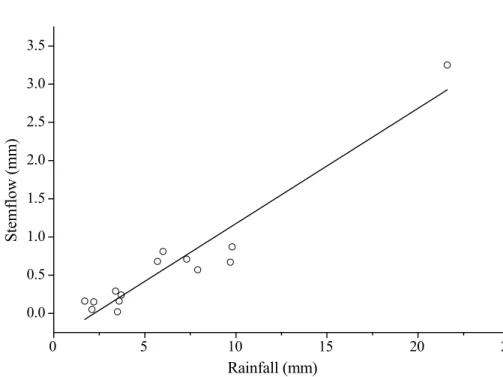
Stemflow increased approximately linearly with cumulative rainfall (Fig. 3). Linear re-gression between individual gross rainfall and individual stemflow was:
5
SFC=0.151PG−0.3346 (R2=0.913,p <0.001) (4) wherePGis the gross rainfall (mm), SFC is the stemflow fromC. korshinskiiplant (mm).
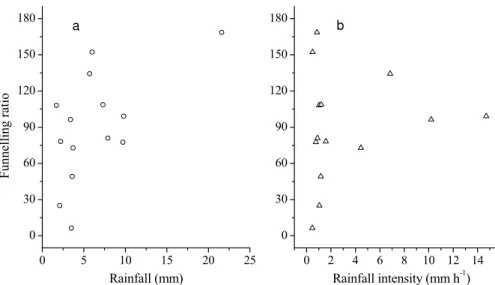
Rainfall threshold for stemflow generation was 2.2 mm according to linear regression forC. korshinskii. Stemflow accounted for 7.9±4.9% (Mean±SD) of rainfall and aver-age funnelling ratio was 89.8 ranging from 6.4 to 168.5 (Fig. 4). Funnelling ratio was 10
close to 60 when rainfall was less than 6 mm and close to 120 when rainfall was larger than 6 mm. There was a great variability in funnelling ratio when rainfall intensity was less than 6 mmh−1. When rainfall intensity was greater than 6 mmh−1, funnelling ratio tended to be stable with increasing rainfall intensity (Fig. 5).
3.3 Advance of wetting front 15
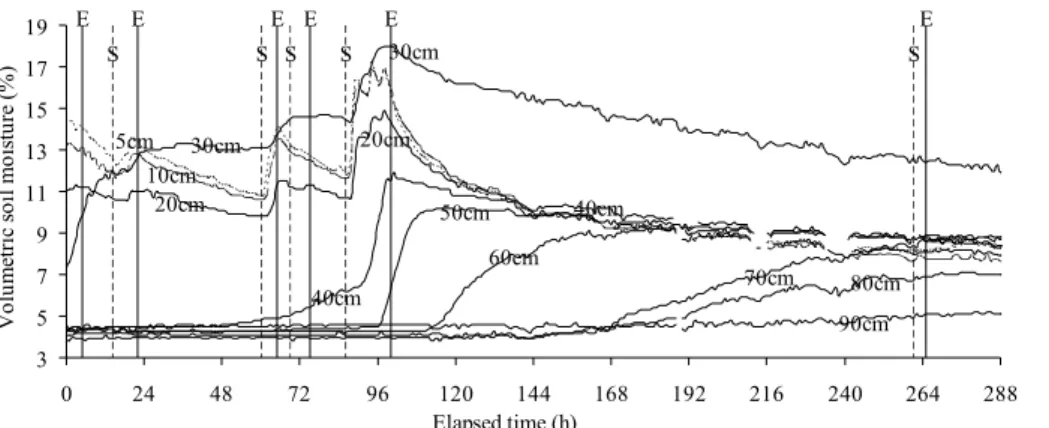
The wetting front was determined by evaluating the difference in soil moisture content for consecutive soil layers. The change in soil moisture with time from 20:00 LT, 28 August, to 20:00 LT, 7 September, and 17:00 LT, 22 September, to 17:00 LT, 7 October, is shown in Figs. 6 and 7. As seen from the figures, infiltrated water reached deeper soil depths after several hours from start of individual rainfall events. At depths greater 20
HESSD
7, 5213–5234, 2010Stemflow of desert shrub
X.-P. Wang et al.
Title Page
Abstract Introduction
Conclusions References
Tables Figures
◭ ◮
◭ ◮
Back Close
Full Screen / Esc
Printer-friendly Version Interactive Discussion
Discussion
P
a
per
|
Dis
cussion
P
a
per
|
Discussion
P
a
per
|
Discussio
n
P
a
per
|
the wetting front could not be noticed at a depth of 40 cm. The increase of soil moisture at the top layer 0–10 cm occurred at exactly the same time as the start of rainfall. The soil moisture in the upper soil profile fluctuated with the variation of rainfall intensity (Figs. 2, 6, and 7). However, there were no noticeable changes in soil moisture at the top soil profile for small-sized rainfall events at 72 and 261 h (Fig. 7). The soil 5
moisture at the top layer of less than 20 cm declined quickly with the cessation of rainfall, though at 30 cm it declined slowly from a relatively large value. A similar trend is seen for soil moisture changes at soil depths larger than 30 cm, soil moisture increased to a maximum after rainfall events, and then declined slowly. Changes in soil moisture after rainfall were generally only noticed at depths of 0–55 cm.
10
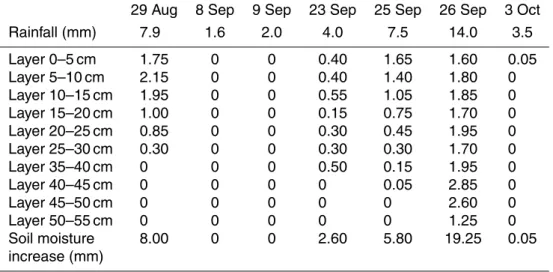
The rainfall amount was compared with the total change of soil moisture at con-secutive depths in the 0–55 cm soil (Table 2). For small-sized rainfall event (about 2.0 mm), no soil moisture change was observed. However, there was a clear increase in soil water when a small-sized rainfall event followed a larger rainfall event (e.g., 23 September). Medium-sized rainfall events (about 4 mm) could effectively infiltrate the 15
soil profile and affected the cumulative infiltration at shallow soil layers. Also, the to-tal soil moisture increase almost equaled to the corresponding rainfall amount. Under relatively large rainfall (about 14 mm), the soil moisture increase was greater than the corresponding rainfall amount.
4 Discussion 20
The experiments were done on eightC. korshinskii shrubs with plenty of branches that varied from 8 to 20 averaging 13 for each shrub (Table 1). The stem traits such as the diameter, length and the stretch angles of the branches together with the canopy pro-jection were identical with typical matureC. korshinskiishrubs in the study area (Wang et al., 2005). The angle of the upward branches to the ground surface that averaged 25
HESSD
7, 5213–5234, 2010Stemflow of desert shrub
X.-P. Wang et al.
Title Page
Abstract Introduction
Conclusions References
Tables Figures
◭ ◮
◭ ◮
Back Close
Full Screen / Esc
Printer-friendly Version Interactive Discussion
Discussion
P
a
per
|
Dis
cussion
P
a
per
|
Discussion
P
a
per
|
Discussio
n
P
a
per
|
applicable methodology for stemflow measurement was used in the present study. ForC. korshinskii, rainfall of at least 2.2 mm was necessary to initiate stemflow ac-cording to linear regression. This threshold is consistent with thresholds reported by previous studies in arid areas (e.g., Martinez-Meza and Whitford, 1996; N ´avar, 1993; Enright, 1987; Li et al., 2008). Stemflow accounted for 7.9% of the gross rainfall and 5
the average funneling ratio was 89.8. For large rainfall events (>10 mm), stemflow con-centrated more water to the root zone. Thus, the efficiency of water infiltration in soil is enhanced and soil moisture increase is larger than the corresponding rainfall.
Funneling ratio varied greatly for different rainfall events, depending upon the rainfall amount and rainfall intensity. Funneling ratios have been found to be greater than 10, 10
and in some cases, far greater than 10 (e.g., N ´avar, 1993; Carlyle-Moses, 2004; Li et al., 2008). Our studies showed that there can be ten or even hundred times the rainwater amount that may reach the root area by stemflow as compared to an open area. The excess water effectively enhances the moisture of the upper soil layer, and then a greater water potential gradient is formed between the upper wet soil layer 15
and the deeper dry soil profile. Consequently, the probability of water infiltrating to the deeper soil becomes higher around shrub stems. Also, stemflow water in desert shrubs may be assumed to be distributed to deep soil layer by preferential flow along root channels (e.g., Martinez-Meza and Whitford, 1996). For relatively large cumulative rainfall of 42.5 mm (from 00:00 LT of 22 September to 21:00 LT of 26 September), the 20
wetting front reached a depth of 90 cm (Fig. 7). Hence, stemflow efficiently helps water to infiltrate to deeper soil layers that can be effectively utilized by the shrub plants.
Stemflow water can effectively refill the soil profile and increase the cumulative infil-tration for medium- and large-sized rainfall. According to previous research, from the point view of soil moisture replenishment in this particular artificially re-vegetated sand 25
HESSD
7, 5213–5234, 2010Stemflow of desert shrub
X.-P. Wang et al.
Title Page
Abstract Introduction
Conclusions References
Tables Figures
◭ ◮
◭ ◮
Back Close
Full Screen / Esc
Printer-friendly Version Interactive Discussion
Discussion
P
a
per
|
Dis
cussion
P
a
per
|
Discussion
P
a
per
|
Discussio
n
P
a
per
|
2008) which replenish the soil moisture at the profile deeper than 5 cm, comparing to the rainfall of 3.5 mm that limited the soil moisture increment within the upper layer of 5 cm (Table 2, on 3 October 2008). Therefore, stemflow doubled the effective rainfall in terms of the soil moisture replenishment in the root zone below 5 cm depth. Stemflow inputs depend not only on rainfall characteristics (such as rainfall amount, intensity, 5
and duration), but also on meteorological conditions, seasonality, and canopy struc-ture. On the other hand, there are interspecific and intraspecific differences among and within shrub species (e.g., Levia and Frost, 2003; Llorens and Domingo, 2007). Infiltration is also influenced by soil surface characteristics (such as microtopography, cracking, surface sealing, and crusting), soil physical properties (such as bulk den-10
sity, organic matter and particle size distribution), and characteristics of the vegetation (such as plant biomass and cover) (e.g., Eldridge et al., 2000). For our study area, the fate of stemflow is probably mainly affected by the properties of the biological soil crust formation that develops around the shrub stems. From our studies we can con-clude that it is important to quantify the stemflow when designing shrub plantations in 15
arid areas. Stemflow contributes efficiently to the water availability for the plant roots. Consequently, stemflow is an important part of the local water balance around shrub species.
5 Conclusions
A better understanding of the stemflow variability and its contribution to soil moisture 20
is essential in the re-vegetation efforts of inhabited arid regions. An antecedent pre-cipitation of 2.2 mm is needed for the initiation of stemflow of the shrub stand. Owing to the high values of funneling ratio (e.g., 90) of the studied species, the shrub plants can concentrate water flux to the stem basal area. A threshold value of correspond-ing rainfall of 4 mm is required for stemflow water to replenish the soil moisture at the 25
HESSD
7, 5213–5234, 2010Stemflow of desert shrub
X.-P. Wang et al.
Title Page
Abstract Introduction
Conclusions References
Tables Figures
◭ ◮
◭ ◮
Back Close
Full Screen / Esc
Printer-friendly Version Interactive Discussion
Discussion
P
a
per
|
Dis
cussion
P
a
per
|
Discussion
P
a
per
|
Discussio
n
P
a
per
|
small and of low intensity, stemflow is of immense importance to sustain the ecosystem close to and around shrubs at the stand scale.
Acknowledgement. The experiment is jointly supported by the CAS Action Plan for West Development Program (KZCX2-XB2-09), the National Natural Science Foundation of China (40871051) and the Western (China) Lightening Foundation of the Talent Training Program of
5
Chinese Academy of Sciences. This publication has been produced during xpw’s scholarship period at Lund University thanks to a Swedish Institute scholarship.
References
Berndtsson, R., Nodomi, K., Yasuda, H., Persson, T., Chen, H., and Jinno, K.: Soil water and temperature patterns in an arid desert dune sand, J. Hydrol., 185, 221–240, 1996.
10
Carlyle-Moses, D. E.: Throughfall, stemflow, and canopy interception loss fluxes in a semi-arid Sierra Madre Oriental matorral community, J. Arid Environ., 58, 181–202, 2004.
Chen, W. R.: Water balance in the revegetated area along the railway in Shapotou area, in: Study on Shifting Sand Control in Shapotou Region of the Tengger Desert (2), edited by: Shapotou Desert Experimental Research Station, Chinese Academy of Sciences, Ningxia
15
People’s Publishing House, Yinchuan, 66–75, 1991.
Dunkerley, D.: Identifying individual rain events from pluviograph records: a review with analysis of data from an Australian dryland site, Hydrol. Process., 22, 5024–5036, 2008.
Eldridge, D. J., Zaady, E., and Shachak, M.: Infiltration through three contrasting biological soil crusts in patterned landscape in the Negev, Israel, Catena, 40, 323–336, 2000.
20
Enright, N. J.: Stemflow as a nutrient source for nikau palm (Rhopalostylis sapida) in a New Zealand forest, Aust. J. Ecol., 12, 17–24, 1987.
Herwitz, S. R.: Infiltration-excess caused by stemflow in a cyclone-prone tropical rainforest, Earth Surf. Proc. Land, 11, 401–412, 1986.
Levia, D. F. and Frost, E. E.: A review and evaluation of stemflow literature in the hydrologic and
25
biogeochemical cycles of froested and agricultural ecosystems, J. Hydrol., 274 (1–4), 1–29, 2003.
Li, X. Y., Liu, L. Y., Gao, S. Y., Ma, Y. J., and Yang, Z. P.: Stemflow in three shrubs and its effect on soil water enhancement in semiarid loess region of China, Agric. Forest Meteorol., 148(10), 1501–1507, 2008.
HESSD
7, 5213–5234, 2010Stemflow of desert shrub
X.-P. Wang et al.
Title Page
Abstract Introduction
Conclusions References
Tables Figures
◭ ◮
◭ ◮
Back Close
Full Screen / Esc
Printer-friendly Version Interactive Discussion
Discussion
P
a
per
|
Dis
cussion
P
a
per
|
Discussion
P
a
per
|
Discussio
n
P
a
per
|
Llorens, P. and Domingo, F.: Rainfall partitioning by vegetation under Mediterranean conditions. A review of studies in Europe, J. Hydrol., 335, 37–54, 2007.
Martinez-Meza, E. and Whitford, W. G.: Stemflow, throughfall and channelization of stemflow by roots in three Chihuahuan desert shrubs, J. Arid Environ., 32, 271–287, 1996.
N ´avar, J.: The causes of stemflow variation in three semiarid growing species of Northeastern
5
Mexico, J. Hydrol., 145, 165–190, 1993.
N ´avar, J. and Bryan, R. B.: Interception loss and rainfall redistribution by three semi-arid grow-ing shrubs in Northeastern Mexico, J. Hydrol., 115, 51–63, 1990.
Noborio, K., McInnes, K. J., and Heilman, J. L.: Measurements of cumulative infiltration and wetting front location by time domain reflectometry, Soil Sci., 161, 480–483, 1996.
10
Nulsen, R. A., Bligh, K. J., Baxter, I. N., Solin, E. J., and Imrie, D. H.: The fate of rainfall in a mallee and heath vegetated catchment in Southern Western Australia, Aust. J. Ecol., 11, 361–371, 1986.
Pressland, A. J.: Soil moisture redistribution as affected by throughfall and stemflow in an arid zone shrub community, Aust. J. Bot., 24, 641–649, 1976.
15
Tromble, J. M.: Water interception by two arid land shrubs, J. Arid Environ., 15, 65–70, 1987. V ¨or ¨osmarty, C. j., Green, P., Salisbury, J., and Lammers, R. B.: Global water resources:
vulner-ability from climate change and population growth, Science, 289, 284–288, 2000.
Wang, X. P., Cui, Y., Pan, Y. X., Li. X. R., Yu, Z., and Young, M. H.: Effects of rainfall character-istics on infiltration and redistribution patterns in revegetation-stabilized desert ecosystems,
20
J. Hydrol., 358, 134–143, 2008.
Wang, X. P., Li, X. R., Zhang, J. G., Zhang, Z. S., and Berndtsson, R.: Measurement of rainfall interception by xerophytic shrubs in re-vegetated sand dunes, Hydrol. Sci. J., 50, 897–910, 2005.
Wang, X. P., Li, X. R., Xiao, H. L., Berndtsson, R., and Pan, Y. X.: Effects of surface
character-25
istics on infiltration patterns in an arid shrub desert, Hydrol. Process., 21, 72–79, 2007. Zhao, X. L.: Problems of revegetation on sand dunes in Shapotou area, in: Study on Shifting
Sand Control in Shapotou Region of the Tengger Desert (2), edited by: Shapotou Desert Experimental Research Station, Chinese Academy of Sciences, Ningxia People’s Publishing House, Yinchuan, 27–57, 1991.
HESSD
7, 5213–5234, 2010Stemflow of desert shrub
X.-P. Wang et al.
Title Page
Abstract Introduction
Conclusions References
Tables Figures
◭ ◮
◭ ◮
Back Close
Full Screen / Esc
Printer-friendly Version Interactive Discussion
Discussion
P
a
per
|
Dis
cussion
P
a
per
|
Discussion
P
a
per
|
Discussio
n
P
a
per
|
Table 1. Desrciptive statistics (mean±standard deviation) of branches and canopy projection
of theC. corshinskii shrubs used in the experiments.
Shrub branch Canopy projection
Number Diameter (cm) Length (cm) Height (cm) Angle (◦)a (cm2)
Shrub 1 20 1.6±0.2 184±11.1 51.4±32.0 62.0±18.0 80 425
Shrub 2 11 2.0±0.3 223±38.0 72.0±16.4 65.9±4.5 28 274
Shrub 3 10 1.6±0.7 138±30.6 43.3±12.1 63.8±8.8 22 619
Shrub 4 14 2.0±0.8 145±21.8 36.0±18.2 52.2±19.5 52 779
Shrub 5 20 2.0±0.8 176±26.1 52.0±13.0 66.7±4.5 45 239
Shrub 6 8 1.4±0.4 158±27.4 40.0±14.1 69.0±11.6 20 028
Shrub 7 6 2.2±0.6 206±18.2 37.0±19.2 75.4±11.0 28 353
Shrub 8 14 1.3±0.3 126±5.5 30.0±18.7 65.8±22.8 17 868
Average 13 1.8±0.3 170±34 45.2±13.2 65.1±6.6 36 948±21 429
a
HESSD
7, 5213–5234, 2010Stemflow of desert shrub
X.-P. Wang et al.
Title Page
Abstract Introduction
Conclusions References
Tables Figures
◭ ◮
◭ ◮
Back Close
Full Screen / Esc
Printer-friendly Version Interactive Discussion
Discussion
P
a
per
|
Dis
cussion
P
a
per
|
Discussion
P
a
per
|
Discussio
n
P
a
per
|
Table 2.Changes in cumulative infiltration (mm) at different soil layers.
29 Aug 8 Sep 9 Sep 23 Sep 25 Sep 26 Sep 3 Oct
Rainfall (mm) 7.9 1.6 2.0 4.0 7.5 14.0 3.5
Layer 0–5 cm 1.75 0 0 0.40 1.65 1.60 0.05
Layer 5–10 cm 2.15 0 0 0.40 1.40 1.80 0
Layer 10–15 cm 1.95 0 0 0.55 1.05 1.85 0
Layer 15–20 cm 1.00 0 0 0.15 0.75 1.70 0
Layer 20–25 cm 0.85 0 0 0.30 0.45 1.95 0
Layer 25–30 cm 0.30 0 0 0.30 0.30 1.70 0
Layer 35–40 cm 0 0 0 0.50 0.15 1.95 0
Layer 40–45 cm 0 0 0 0 0.05 2.85 0
Layer 45–50 cm 0 0 0 0 0 2.60 0
Layer 50–55 cm 0 0 0 0 0 1.25 0
Soil moisture 8.00 0 0 2.60 5.80 19.25 0.05
HESSD
7, 5213–5234, 2010Stemflow of desert shrub
X.-P. Wang et al.
Title Page
Abstract Introduction
Conclusions References
Tables Figures
◭ ◮
◭ ◮
Back Close
Full Screen / Esc
Printer-friendly Version Interactive Discussion
Discussion
P
a
per
|
Dis
cussion
P
a
per
|
Discussion
P
a
per
|
Discussio
n
P
a
per
|
HESSD
7, 5213–5234, 2010Stemflow of desert shrub
X.-P. Wang et al.
Title Page
Abstract Introduction
Conclusions References
Tables Figures
◭ ◮
◭ ◮
Back Close
Full Screen / Esc
Printer-friendly Version Interactive Discussion
Discussion
P
a
per
|
Dis
cussion
P
a
per
|
Discussion
P
a
per
|
Discussio
n
P
a
per
|
0 5 10 15 20
1 3 5 7 9 11 13 15 17 19 21 23 25 27 29 31 33 35 37 39 41 Number of rainfall events
R
ainf
all
int
ens
ity
(m
m
h
-1 ),
rainf
all
(m
m
)
Rainfall intensity Individual rainfall
HESSD
7, 5213–5234, 2010Stemflow of desert shrub
X.-P. Wang et al.
Title Page
Abstract Introduction
Conclusions References
Tables Figures
◭ ◮
◭ ◮
Back Close
Full Screen / Esc
Printer-friendly Version Interactive Discussion
Discussion
P
a
per
|
Dis
cussion
P
a
per
|
Discussion
P
a
per
|
Discussio
n
P
a
per
|
0 5 10 15 20 25
0.0 0.5 1.0 1.5 2.0 2.5 3.0 3.5
Stem
flo
w
(m
m)
Rainfall (mm)
HESSD
7, 5213–5234, 2010Stemflow of desert shrub
X.-P. Wang et al.
Title Page
Abstract Introduction
Conclusions References
Tables Figures
◭ ◮
◭ ◮
Back Close
Full Screen / Esc
Printer-friendly Version Interactive Discussion
Discussion
P
a
per
|
Dis
cussion
P
a
per
|
Discussion
P
a
per
|
Discussio
n
P
a
per
|
25% 75%
50% SD
-SD
25% 75%
50% SD
-SD
0 50 100 150 200 250
Funnelling ratio
Pe
rce
n
ta
ge o
f stem
fl
ow
(
%
)
C. korshinskii C. korshinskii
0 5 10 15 20 25
□
Fig. 4. Box-and-whisker diagrams showing median, 25, 50, 75 percentiles, and standard de-viation for individual funneling ratio and stemflow percentage forC. korshinskii. () represents
HESSD
7, 5213–5234, 2010Stemflow of desert shrub
X.-P. Wang et al.
Title Page
Abstract Introduction
Conclusions References
Tables Figures
◭ ◮
◭ ◮
Back Close
Full Screen / Esc
Printer-friendly Version Interactive Discussion
Discussion
P
a
per
|
Dis
cussion
P
a
per
|
Discussion
P
a
per
|
Discussio
n
P
a
per
|
0 2 4 6 8 10 12 14 16
0 30 60 90 120 150 180
0 5 10 15 20 25
0 30 60 90 120 150 180
Rainfall intensity (mm h-1)
b
F
unnellin
g ratio
Rainfall (mm)
a
HESSD
7, 5213–5234, 2010Stemflow of desert shrub
X.-P. Wang et al.
Title Page
Abstract Introduction
Conclusions References
Tables Figures
◭ ◮
◭ ◮
Back Close
Full Screen / Esc
Printer-friendly Version Interactive Discussion
Discussion
P
a
per
|
Dis
cussion
P
a
per
|
Discussion
P
a
per
|
Discussio
n
P
a
per
|
5cm
5cm 10cm
10cm
10cm 15cm
15cm 20cm
20cm25cm 25cm
30cm
30cm
35cm 40cm
S E
3 6 9 12 15 18
0 24 48 72 96 120 144 168 192 216
Elapsed time (h)
V
o
lu
m
et
ric
s
o
il
m
o
is
tu
re
(
%
)
HESSD
7, 5213–5234, 2010Stemflow of desert shrub
X.-P. Wang et al.
Title Page
Abstract Introduction
Conclusions References
Tables Figures
◭ ◮
◭ ◮
Back Close
Full Screen / Esc
Printer-friendly Version Interactive Discussion
Discussion
P
a
per
|
Dis
cussion
P
a
per
|
Discussion
P
a
per
|
Discussio
n
P
a
per
|
E E E E E
S S S S
5cm 10cm
20cm
20cm 30cm
30cm
40cm
40cm 50cm
60cm
80cm 70cm
90cm E
S
3 5 7 9 11 13 15 17 19
0 24 48 72 96 120 144 168 192 216 240 264 288 Elapsed time (h)
V
o
lu
m
etri
c
so
il
m
o
is
tu
re
(%
)