*Corresponding author: Vishal Pande, Email: [email protected]
©2015 The Authors. This is an Open Access article distributed under the terms of the Creative Commons Attribution (CC BY), which permits Adv Pharm Bull, 2015, 5(4), 537-548
doi: 10.15171/apb.2015.073 http://apb.tbzmed.ac.ir
Advanced
Pharmaceutical
Bulletin
Oleic Acid Coated Gelatin Nanoparticles Impregnated Gel for
Sustained Delivery of Zaltoprofen: Formulation and Textural
Characterization
Savita Pawar1, Vishal Pande2*
1 R.C. Patel College of Pharmaceutical Education and Research, Shirpur, India 425405. 2 Sanjivani College of Pharmaceutical Education and Research, Kopargaon, India 423603.
Introduction
Nanogel may be defined as the nanosized hydrogel systems which are highly crosslinked system in the nature involving polymer system which are either co-polymerized or monomers.1 Nanoparticles are defined as particulate dispersions or solid particles with a size in the range of 1-1000 nm. Nanoparticles are receiving considerable interest to delivery of therapeutic drug.2 Several natural and synthetic polymers have been used for the preparation of micro or nanoparticles.3 The topical drug delivery systems are gaining increasing attention and several drugs have been successfully delivered by this route for both local and systemic action.4 Nanogel is attracting researchers because of its properties like, encapsulation stability, responses to stimuli, passive and active targeting, easy to synthesis and much more.5 In recent years most of NSAIDs have been designed to deliver the drug in the form of topical gels to avoid the gastro intestinal irritation to overcome first pass effect and to enhance the drug concentration at the site of action. As a vehicle they have a better potential to administer drug topically as compared to ointment because they are non-sticky require low energy
during the formulation, they are stable and have an aesthetic value.6
Polymeric nanoparticles release the drugs mostly in subcutaneous layer of skin, by surface modification of GNP with oleic acid as a penetration enhancer helps to improved drug permeation through skin.7 To improve the drug absorption from the skin surface nanoparticulate carriers have proven to be advantageous & effective.7,8 Polymeric nanoparticles have been widely studied as a carrier for the drug and used in various drug delivery systems due to their submicron size, controlled, sustained release properties biocompatibility with tissue and cells.9 Nanoparticles based on negatively charged hydrophilic polymers show a strong increase in bioadhesive properties .Various synthetic like , poly (glycolic acid) , poly (l-lactic acid) , poly (glycerol adipate) etc. & natural like , collagen , alginate , fibrin etc. substance used in controlled release drug delivery systems.10,11
Gelatin is a natural polymer that is derived from collagen. It is commonly used for pharmaceutical & medical application due to its properties like low cost, inexpensive & readily available, low antigenic, due to its structure it can be modified by many ways like; coupling Article info
Article History:
Received: 27 June 2014 Revised: 2 June 2015 Accepted: 30 July 2015 ePublished: 30 November 2015
Keywords:
Zaltoprofen Oleic acid
Gelatin nanoparticles Glutaradehyde CT3 Texture analyzer
Abstract
Purpose: In the present study, we have formulated zaltoprofen loaded, surface decorated, biodegradable gelatin nanogel and evaluated its texture characterization.
Methods: The method used to prepare gelatin nanoparticles (GNP) was ‘two step desolvation’ and its surface decoration was performed with oleic acid (OA). The GNP was optimized by DOE software. Nanogels were evaluated for particle size entrapment efficiency, texture properties, SEM, in-vitro, ex-vivo drug release studies, in-vitro
characterization, stability and in vivo evaluation of nanogel for anti-inflammatory activity was carried out by carrageenan induced rat paw edema method as an anti-inflammatory experimental model.
Results: The formulated GNP with particle size and entrapment efficiency of optimized batch was found to be 247.1 nm and 76.21% respectively. The SEM of GNP shows smooth and spherical shape. In-vitro and Ex-vivo drug release shows that there was 69.47% and 78.59% drug released within 48 hrs. It follows Ritger peppas model, which indicates sustained drug release. The good texture properties of nanogel were observed from texture analysis graphs.In vivo studies of our formulation give significant results compared to the marketed nanogel. Stability data revealed stability of nanogel formulation up to 3 months. Conclusion: The present approach can provide us promising results of the sustained analgesic activity and the stability of drug within the GNP.
Pawar and Pande
of targeting legend, crosslinkers, hydrophilicity of gelatin gives its diffusion mediated drug release, biodegradability.12 Hence gelatin used as a delivery vehicle for the controlled release of bioactive molecule. The use of GNPs as vehicles for topical drug delivery, providing a reservoir system for release into the skin has also been studied. Also, the GNP loaded with drug can be used in topical ophthalmic use.3,13 The current area of interest in the drug encapsulated nanoparticle given by topical route & NP mobility through gel was studied by traditional diffusion cell experiments.13
Rheumatoid arthritis is a chronic autoimmune inflammatory disease, drugs for RA treatment applied topically gives better results as well as reduction in the GI toxicity / irritation produced by oral route. The Hydrophobic drug chosen was zaltoprofen, in order to improve the aqueous solubility of drug, complexes with HP-β-CD were prepared.14 Nanoparticulate suspension of gelatin loaded with zaltoprofen can be coated with oleic acid & converted in to gel by adding poloxamer to enhance viscosity. Optimizations using factorial designs, where all the factors are studied in all possible combinations, are considered to be the most efficient in estimating the influence of individual variables and their interactions using minimum experiments. The application of factorial design in pharmaceutical formulation development has played a key role in understanding the relationship between the independent variables and the responses to them.15
The objective of present study was to develop a nanogel with a strong capacity for controlled delivery of NSAID drug used in RA condition & its (TPA) i.e. texture profile analysis.16 NSAID drugs need to sustained the drug release mainly in case of chronic inflammatory
disorders like Rheumatoid arthritis (RA), which causes serious morbidity and disability for the patients.17 For that purpose we have prepared polymeric nanoparticles loaded with zaltoprofen by two step desolvation method, coating of these nanoparticles was performed with oleic acid and these nanoparticles were incorporated in the gel. The prepared gel retards the drug release from polymeric matrix. Therefore, the goal of present study was first to develop reproducible & homogeneous preparation of zaltoprofen loaded GNPs & application of these particulate carriers for topical drug delivery in the form of gel. Secondly to investigate texture properties of the prepared nanogel & its in-vivo toxicity studies.
Materials and Methods
Material
Zaltoprofen was obtained as a gift sample from Tonira Pharmaceuticals, Ankaleshwar, Pluronic F-127 purchased from Sigma Aldrich, Gelatin type A (Bloom 175) derived from porcine skin purchased from Sigma Aldrich, HP-β-CD purchased from Himedia laboratories Ltd, Mumbai, Glutaradehyde (25% V/V aqueous solution) was purchased from RFCL lab. Pvt. Ltd. Mumbai, All other solvents used were of analytical grade and used as received.
Factorial design parameters and experimental conditions
A 3-level factorial design was implemented to study the effect of two factors on (independent variables), factor level and responses (dependent variables). The levels, factors and responses are given in Table 1. Experimental design of the different batches of GNP is given in Table 2.
Table 1. Factors (independent variables), factor levels and responses (dependent variables) used in 3-level factorial experimental design.
Factors Type of factors Factor level used Response
-1 0 1
X1 Glutaraldehyde (µl) 30 50 70 Y1 Particle size (nm)
X2 Agitation speed (RPM) 500 600 700 Y2 Entrapment Efficiency (%)
Table 2. Experimental design for preparation of different batches and Results for particle size and entrapment efficiency.
Std Run Batch code
Factors Response 1 (Y1) Response 2 (Y2)
Glutaraldehyde amount (µl) Agitation speed (RPM) Particle size (nm) Entrapment efficiency (%)
5 1 GNP 1 50 600 261 74.87
9 2 GNP 2 70 700 303 67.34
3 3 GNP 3 70 500 423 63.74
8 4 GNP 4 50 700 247 76.21
4 5 GNP 5 30 600 553 43.9
1 6 GNP 6 30 500 754.1 37.89
7 7 GNP 7 30 700 514 57.34
2 8 GNP 8 50 500 289 60.17
Oleic acid coated nanogel for sustained delivery of zaltoprofen
Formulation of surface decorated nanogel
To improve aqueous solubility of zaltoprofen, we have prepared a zaltoprofen – Hydroxy propyl beta cyclodextrin (HP-β-CD) complex in 1:2 molar ratio using the kneading method. Gelatin nanoparticles were first prepared by two step desolvation method as described by coester.17,18 With a slight modification in the previous method and by using DOE - Software we have optimized GNP by using different conc. of crosslinking agent and agitation speed. The 250 mg gelatin (type A) was dissolved in double distilled water under cont. heating (40°C). The resulting solution was kept at the room temperature for 10 minutes then immediately added 5ml of ethanol in gelatin solution as a desolvating agent to precipitate high molecular weight (HMW) gelatin. The supernatant was discarded & the HMW gelatin was re-dissolved by adding 5ml double distilled water containing zalto-cyclodextrin complex containing nearly 50 mg of zaltoprofen & stirred at 600 RPM at constant temp. i.e. 40°C. The pH of solution was adjusted to 2.5 for gelatin type A. In situ gelatin nanoparticles were formed during a second desolvation step by dropwise addition of ethanol under constant stirring until permanent turbidity was observed in solution. After 10 min, 30 µl of Glutaradehyde (25% w/v) was added to the reaction vessel to crosslink the nanoparticles & it was further stirred for 6 hrs. at 600 RPM. The resulting solution was centrifuged for 20 min. at 10,000 rpm & the supernatant was removed to determine unloaded drug .The settled particles were washed & re-suspended in highly purified water.
The surface modification was done on zaltoprofen loaded gelatin nanoparticles by adding oleic acid in (mole ratio of gelatin to oleic acid in 1:6) for preparing nanoparticulate suspension & were incubated for 2 hrs. for topical drug delivery. To the above prepared nanogel, the pluronic F-127 was added in the incubated solution of the surface coated nanoparticles at cooling condition (4°C) in conc. of 25% of total solution under cont. stirring for 1 hr for homogenization & kept the solution
overnight in cold condition for dissolution of pluronic. The diagrammatic representation is shown in Figure 1.
Figure 1. Diagrammatic representation of zaltoprofen loaded gelatin nanogel.
Zalto-loaded gelatin nanoparticles charecterization
Particle size
Particle size and polydispersity index was determined using a photon correlation spectrometer (Zetasizer 3000 HAS, Malvern Ltd., UK) based on the laser light scattering phenomenon. Diluted samples were directly placed into the module and measurements were made in triplicate after 2-min stirring. Z-average particle sizes and polydispersity index (PI) were measured.
Entrapment efficiency
Loading of zaltoprofen in gelatin nanoparticles was carried out by calculating the amount of unentrapped drug. To calculate the same, the nanoparticulate suspension was centrifuged at 14,000 rpm for 20 min. and supernatant was collected & analyzed by a UV-Spectrophotometer at 227 nm as a λmax.19 and substracted from the amount of drug added in the formulation. Drug entrapment was calculated by using the formula,
Entrapment efficiency (%) = (actual drug content in nanoparticles / therotical drug content) × 100
Qualitative analysis of crosslinking efficiency
The gelatin nanoparticles that were crosslinked with the glutaraldehyde can be qualitatively estimated by using Potentiometric titration. The potentiometric titration was carried out on the gelatin nanoparticulate dispersion as well as gelatin solution. A 25 ml solution of gelatin was titrated against 0.1 M HCl by using micropipette the pH was monitored with a pH meter. All readings were taken at 25 °C. The procedure was repeated for serial dilutions like 20%, 40%, and 60% of gelatin solution and gelatin nanoparticulate dispersion.20
Differential scanning calorimetry (DSC)
Thermal properties of polymers & particles were measured by DSC. Nitrogen was used as the purge gas .The DSC system was controlled by DSC – Q- 200- TA instruments USA, Built 79 software (version 23.10).
Samples were characterized by DSC at different ranges at a heating rate 10°C per minute.
Fourier transform-infrared spectroscopy (FTIR)
Fourier-transform infrared (FTIR) spectra were obtained using an FTIR spectrometer (Shimadzu 8400S, Japan).The inclusion complex was mixed with KBr. The KBr discs were prepared by compressing the powders at a pressure of 5 tons for 5 min in a hydraulic press. All the spectra acquired scans between 400 to 4000 cm-1. Scanning electron microscopy (SEM)
Pawar and Pande
Texture characterization
Texture Profile Analysis (TPA): Texture profile analysis
(TPA) was performed using a CT3 Texture Analyzer in TPA mode. Sensory properties included measures such as consistency, firmness, cohesiveness, (attractive forces within the formulation) & work of adhesion (attraction between the formulation & substrate). A conical shape sample holder was filled evenly with the nanogel & testing surface which was as flat as possible to avoid early triggering of the test.21,22
The probe (TA3/100) was programmed to descend into the sample at a speed of 0.5 mm/s with a target value of 20 mm and then ascend back at the same speed to its original position the force encountered by the probe to break away from the gel when the point it began to ascend (the point of maximum force) was measured.
Spreadability: The spreadability of the formulations is a
characteristic derived from its more basic property i.e. viscosity. The greater the viscosity the longer will be the time taken for spreading. The spreadability also depends on the polymer in formulation, possessing typical physicochemical properties which create surface tension between slide and product. Spreadability test was performed by using CT3 Texture Analyzer in Compression mode. A cone analytical probe (60°C) was forced down into each sample at a defined rate (0.5 mm/s) and to a defined depth (12 mm). The test was performed and results were observed.23
Viscosity
A Brookfield digital viscometer, cone and plate type of viscometer was used to determine viscosity (cp) of the formulations.24 The viscosity was measured at 5 rpm after 30 seconds, by using the spindle no. 7.
Drug content
The accurately weighed 0.50gm zaltoprofen nanogel was added in100ml volumetric flask which contains100 ml of PBS 6.8. The resultant solution was kept for sonication for 30 mins for complete solubility of the drug, then the resultant solution was filtered. The absorbance of 50 µg/ml solution was checked at 227 nm and compared with pure drug absorbance at the same wavelength and concentration. Thus % assay was calculated this procedure was carried out in triplicate.
pH
The accurately weighed 2.5 gms of gel was dispersed in 25 ml of distilled water. The pH of dispersion was measured by using digital pH meter.
In vitro drug release
The in vitro drug release study of zalto nanogel was
performed to investigate the amount of drug released from a gel. A porous membrane of mol. wt. cut off 12,000- 14,000 Da (HIMEDIA) was used. The membrane was mounted between the donor & receiver compartment of Franz diffusion cells .The surface coated (oleic acid) & uncoated zalto –nanogel were then applied
evenly on the surface of the membrane in the donor compartment. The receiver compartments were filled with PBS (pH 6.8), stirred at 300 rpm, and maintained at 32°C using a circulating water bath. At the predetermined time intervals (1, 2, 4, 6, 8, 12, 24, 36 and 48 h), 0.5 ml samples were collected from the receiver compartment and replace with fresh buffer solution. The samples collected from the receiver compartment were analyzed for the drug content using UV spectrometric method at 227 nm wavelength.25
Ex- vivo study
Rat abdominal skin (0.22µ) was used as diffusion membrane. Membrane was soaked in 6.8 phosphate buffer for 10 minutes before subjecting to diffusion study. The receiver/receptor compartment contains 25ml of phosphate buffer. In the upper donor compartment 0.5 gm of formulation was spread evenly on the membrane. The receptor phase (phosphate buffer) was continuously stirred with help of magnetic stirrer during the experiments. The 3 ml of the sample was withdrawn from the receiver compartment at time intervals 1, 2, 3, 4, 5, 6, 12, 24 up to 48 hours and the same amount of fresh buffer solution was added to maintain the sink condition in the receiver compartment. Care was taken to ensure that no air bubbles were lodged underneath the diffusion membrane during the experiments. The samples were analyzed spectrophotometrically at a wavelength of 227.0 nm. Percentage of zaltoprofen in sample was determined by referring to the previously prepared standard curve.26
Drug release kinetics: To find the kinetics of the drug
release from the test formulation, the following models were used such as, zero order, first order, Higuchi and Ritger-peppas models.27
In vivo study
Oleic acid coated nanogel for sustained delivery of zaltoprofen
a piece of cotton.
The animals were then injected with 0.2 ml of 1% freshly prepared saline carrageenan solution in in plantar region on the right hind paw. The right hind paw thickness was measured with plethesmometer before and 0, 1, 3, 6 and 12 hrs. after the sub-plantar injection. The amount of paw swelling was determined time to time and expressed as percent edema. Percent inhibition calculated against the control group and graphs can be obtained by using Graph pad prism 5 software. Results of these studies were compared using the dunnett test of one way analysis of variance.29,30
Skin irritation study
Male wistar rats (Animal ethical committee) weighing 200-250 g; were used in this study. The animals were housed in propylene cages, with free access to standard laboratory diet and water. Animals were acclimatized for at least seven days before experimentation, the dorsal abdominal skin rats were shaved 24 hrs before study. Then zaltoprofen nanogel was applied onto the dorsal skin to an area of 1″ × 1″ sq. on wistar rats.31
Stability study
In the present work, stability study was carried out for the optimized formulation for condition and time period. Selected formulations (10gm) were filled in lacquered aluminum tubes and were stored at an accelerated temperature (45°C ± 1°C and 75% ± 5% RH). The samples were tested initially and then at 15 days intervals for a total period of 3 months. These samples were evaluated for its appearance, pH and drug content.
Results and Disscusion
Experiments of 3-level factorial design
Experimental design of different batches of zaltoprofen loaded GNP was prepared based on the 32 factorial designs. The independent variables were Glutaraldehyde
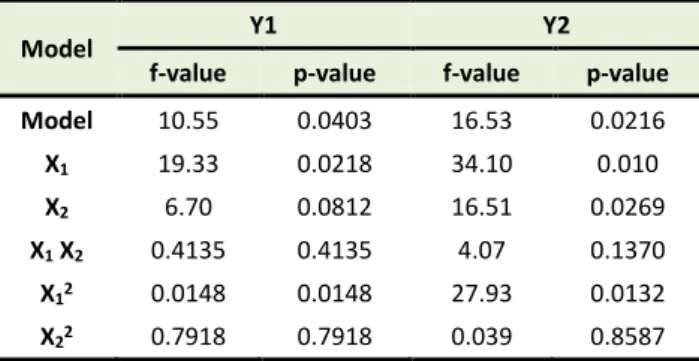
(X1) and Agitation speed (X2). The independent variables and their levels are shown in Table 1. Particle size of the GNP (Y1) and Entrapment efficiency (Y2) were taken as response parameters as the dependent variables given in Table 2.
Mathematical modeling
Mathematical relationship was generated between the factors (independent variables) and responses (dependent variables) using the statistical package Design-Expert. First step in mathematical modeling was fitting the experimental data to an appropriate model. A suitable model was selected by software on the basis of different parameter obtained from regression analysis such as p-value, adjusted R2, predicted R2 and Predicted Residual Sum of Square (PRESS) value (Table 3). ANOVA was applied for estimating the significance of model, at 5% significance level given in Table 4. Focussed on maximizing the value of adjusted R2 and predicted R2. Low PRESS value indicated adequate fitting of model. General quadratic equation for two independent variables is as follow:
Y = β0+ β1X1+ β2X2+ β3X1X2 + β4X12+ β5X22
Where: β0 is the intercept representing the arithmetic averages of all the quantitative outcomes of 9 runs. β1to β5 are all coefficients calculated from the observed experimental values of Y. X1 and X2 are the coded levels of factors. The terms X1, X2 and Xi2 (i є {1, 2}) represent the interaction and quadratic terms, respectively. Coefficients with one factor represent the effect of that particular factor while the coefficients with more than one factor and those with second order terms represent the interaction between those factors and the quadratic nature of the phenomena, respectively. Synergistic effect and antagonistic effect of factor were indicated by a positive sign and negative sign in front of that factor term, respectively.
Table 3. Fit summary of model for the measured responses Y1 (Particle size), Y2 (Entrapment Efficiency)
Source Linear vs Mean Quadratic vs 2FI Linear Quadratic
f-value p-value f-value p-value Adj.R2 Pred.R2 PRESS Adj.R2 Pred.R2 PRESS
Y1 2.635 0.1516 1.23 0.033 0.2890 -0.1516 2.582 0.8565 0.3449 1.469
Y2 4.33 0.068 2.21 0.030 0.4545 0.1840 1078.8 0.9066 0.7081 385.72
Table 4. Analysis of variance (ANOVA) table for measured responses.
Model Y1 Y2
f-value p-value f-value p-value
Model 10.55 0.0403 16.53 0.0216
X1 19.33 0.0218 34.10 0.010
X2 6.70 0.0812 16.51 0.0269
X1 X2 0.4135 0.4135 4.07 0.1370
X12 0.0148 0.0148 27.93 0.0132
X22 0.7918 0.7918 0.039 0.8587
Zaltoprofen loaded gelatin nanoparticles
characterization
Particle size
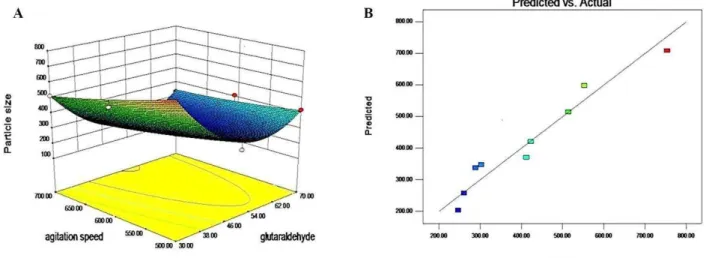
The particle sizes of all 9 batches were ranges from 754.1 - 247 nm. The optimized size of zalto loaded GNP was 247.1nm. Average particle size for optimized batch of zalto- GNP was found 247.1.nm with PDI value is 0.175.
Pawar and Pande
indicating adequate fitting of model (Table 3). Quadratic model was significant with model f-value of 10.55 (p-value <0.0001). The quadratic equation generated by software is as follows:
Y1 = 257.08-113.80X1-67.00X2+30.0X1X2+227.83X12+12.93X22
Equation reveals that the both factors (X1 and X2) affect Particle size characteristics significantly, it also indicated that the effect of the change in Agitation speed seems to be more pronounced in comparison with that of the change in conc. of Glutaradehyde. The combined effect of factors X1 and X2 can further be elucidated with the help of response surface plots Figure 2A, which
demonstrated that Y1 varies in a linear fashion with the effect of both parameter. However, the steeper ascent in the response surface with Agitation speed (X2) – instead of Glutaradehyde conc.(X1) – is clearly discernible from response surface plots, indicating that the effect of Agitation speed is comparatively more pronounced than that of Glutaradehyde conc. From this discussion, one can conclude that the Particle size may be changed by appropriate selection of the levels of X1 and X2. Figure 2B shows a linear relationship between observed response values and predicted values indicating correctness of model.
Figure 2. (A) Response surface plot showing the effect of glutaradehyde conc. and agitation speed on particle size (Y1); (B) Linear plot between observed and predicted value of Y1.
Entrapment efficiency
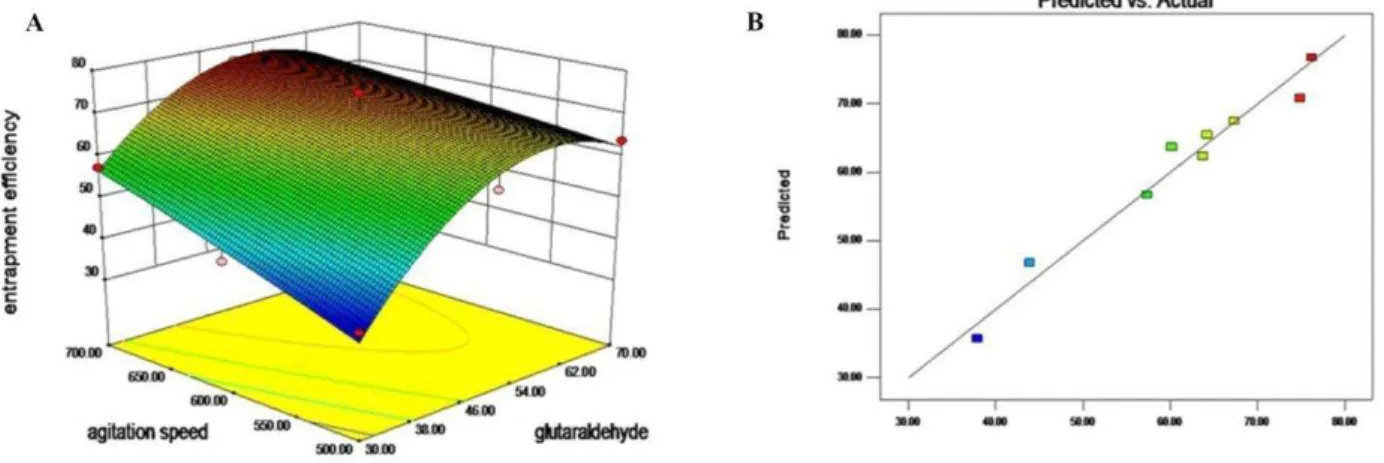
The entrapment efficiency of zaltoprofen for various batches is given in the Table 2 The highest drug loading was 76.21% and the particle size for this batch is 247.1 nm. As the particle size decreases the surface area increases and ultimately there is more space to bind a drug hence entrapment efficiency increases.
From the p-values presented in Table 3, quadratic model was found to be significant for entrapment efficiency. Quadratic model was selected on the basis of maximum value of adj. R2 and low PRESS value indicating adequate fitting of the model (Table 3). Quadratic model was significant with model f-value of 16.53 (p-value < 0.0003). The quadratic equation generated by the software is as follows:
Y2 = 70.78+ 9.36X1 +6.52X2– 3.96X1X2 -14.68X12– 0.55X22
Equation reveals that both factors (X1 and X2) affect entrapment efficiency characteristics of particle size significantly. Equations also indicated that the effect of the change in glutaraldehyde concentration seems to be more pronounced in comparison with that of the change in agitation speed. The combined effect of factors X1 and X2 can further be elucidated with the help of response surface plots Figure 3A, which demonstrated that Y2 varies in a linear fashion with the effect of both factors. However, the steeper ascent in the response surface with glutaraldehyde (X1) – instead of agitation
speed (X2) – is clearly discernible from response surface plots, indicating that the effect of glutaraldehyde is comparatively more pronounced than that of agitation speed. From this discussion, one can conclude that the entrapment efficiency may be changed by appropriate selection of the levels of X1 and X2. Figure 3B shows a linear relationship between observed response values and the predicted values indicating correctness of the model.
Oleic acid coated nanogel for sustained delivery of zaltoprofen
present for protonation than in parent gelatin, resulting in lower IEP. Hence from the resulting potentiometric
graphs indicate that gelatin got crosslinked with the glutaraldehyde.
Figure 3. (A) Response surface plot showing the effect of agitation speed and glutaraldehyde conc. on entrapment efficiency (Y2); (B) Linear plot between observed and predicted value of Y2.
Differential scanning calorimetry (DSC)
DSC is a highly useful means of detecting drug- excipient incompatibility in the formulation. Zaltoprofen alone and in formulation was studied using DSC. For the bulk material of zaltoprofen, the melting process took place with maximum peak at 138.62°C (Figure 4-I). Also DSC of pluronic f 127 polymer (Figure 4-II) shows intense peak at 58°C. DSC thermogram of freeze dried GNP showed an endotherm at 146.46°C (Figure 4-III), the shift of DSC peak is associated with the formation of crosslinked GNP in which the drug is entrapped. Hence from the above data it is confirmed that there was no interaction between drug – polymers and drug were loaded in the gelatin polymers.
Figure 4. (I): DSC of pure zaltoprofen, (II): DSC of pluronic F-127 (III): DSC of GNP
Fourier transform-infrared spectroscopy (FTIR)
The FT-IR spectrum of the Gelatin are characterized by intense bands at 3150–3650 cm-1 due to O–H stretching
vibrations, 2889.27 cm-1 due to stretching vibration of the –CH and CH2 groups, 1737.86 cm-1 due to C=O stretching and peak at 1671 cm-1 further conform the aryl C-C ester group of zaltoprofen. The FT-IR spectrums of the HP-β-CD (Figure 5 C) contains broad peak at 3200- 3500cm-1 region due to O-H stretching, 2875-2925 cm-1 region due to C-H and C-H2 vibrations. Any sign of interaction would be reflected by changes in the characteristic peaks of zalto, depending on the extent of interaction. The FTIR spectra (Figure 5) of the investigated physical mixtures did not show any significant shifts in principal peak with respect to the FTIR spectra of the zalto, only the intensity of the peaks were decreased. In the FTIR spectrum of nanogel, all characteristics stretching bands disappeared along with the reduced intensity of the other band. This might indicate the inclusion of zalto in the hydrophobic cavity of the carrier.
Scanning electron microscopy (SEM)
The shape and surface morphology of optimized Batch GNP 4 was studied by SEM. The SEM micrograph observed formation of spherical nanoparticles with smooth surface and little wide size distribution, (Figure 6). From the figure, we can see that some particles are as small as100 nm. Also, There is clogging of some particles with other particles and it may be due to some charges developed on the surface of polymeric nanoparticles because gelatin is one of the charge sensitive polymer.
Zaltoprofen nanogel characterization
Texture Characterization
Texture Profile Analysis (TPA): TPA is a method to
Pawar and Pande
Figure 5. FT-IR spectrum of; A: Pluronic F-127, B: Zaltoprofen, C:
Mixture of Drug- HP-β-CD with Gelatin, Pluronic F-127, D: Gelatin. Figure 6. Scanning electron microscopy (SEM) of Zalto-GNP.
Figure 7. Figure Texture graph of Nanogel formulation and Spreadability graph of zalto loaded nanogel
The peak / maximum force is taken as a measurement of firmness; higher the value the thicker is the consistency of the sample. The negative region of the graph produced on probe return is an a result of the weight of sample which is lifted primarily on the upper surface of the disc on return i.e. due to the back extrusion and hence gives again an indication of consistency or resistance to flow off the disc. The maximum negative force is taken as an indication of the stickiness / cohesiveness of the sample. The more negative the value the more stuff the sample.
Results were obtained ; deformation at Hardness was 5.12 mm . Adhesiveness, cohesiveness and gumminess was found to be 0.7 mJ, 0.60, 14 gm respectively.
Spreadability: The spreadability of zaltoprofen loaded
Oleic acid coated nanogel for sustained delivery of zaltoprofen
Viscosity
The values of viscosity measurements of zaltoprofen loaded nanogel can be carried out. The Nanogel being made up of Gelatin nanoparticles dispersed in poloxamer gel show moderate viscosities and hence better acceptability the viscosity of optimized nanogel was found to be 734 cp.
Drug content
The drug content of optimized formulations was carried out in triplicate and average drug content was found to be of 90.076%. Hence uniformity of drug content was found satisfactory.
pH
The pH value of optimized formulations was carried out in triplicate and average pH was found to be 6.6. Hence
the formulation was satisfactorily complying with pH values needed for topical application.
In-vitro drug release
The in- vitro drug release from zaltoprofen loaded
nanogel was evaluated by in- vitro diffusion study from Franz diffusion cell, dialysis membrane used as a semi permeable membrane and at pH 6.8 temperature was about 32°C. The nanogel containing gelatin nanoparticles and nanogel containing oleic acid decorated gelatin nanoparticles were used for in-vitro drug release. The Figure 8 shows Cumulative percentage drug release from uncoated nanogel in 48 hrs, which was found to be nanogel 51 and 69 % respectively. Result indicates that, oleic acid coated gelatin nanoparticles containing nanogel shows high permeation and hence high drug release.
Figure 8. In-vitro(A) and Ex-vivo(B) drug release study from surface decorated (Oleic acid) and plane nanogel by using franz diffusion cell.
Ex- vivo study
The Ex-vivo drug release study of the surface decorated
nanogel, where rat abdominal skin was used as diffusion membrane. The diffusion study was performed for 48 hrs, the cumulative percentage drug release shown in
Pawar and Pande
Drug release kinetics: To determine kinetics of drug
release from the test formulation, there are models such as, zero order, first order, Higuchi and Ritger-peppas models. Zero order indicates the system where the drug release rate is independent of time and drug conc. of dissolved substances. This release is particularly important for drug having narrow therapeutic index and release of drug within 24 hrs. in this therapeutic index. First order release system indicates the release of drug totally depends upon its concentration. The Higuchi equation describes that, release of drug is controlled by diffusion. Verification of experimental data using the Ritger-peppas equation and interpretation of the release exponent (n) provides better understanding of the mechanism of controlled release. The release exponent
of coated nanogel was found to be 0.9513 means, n > 0.43 then it shows anomalous transport (Non Fickian) controlled release. Also, release exponent of uncoated nanogel was found to be 0.6604 means, n > 0.43 then it shows anomalous transport (Non Fickian) controlled Release. The selection of model on the basis of goodness of fit test Regression coefficient (R) obtained by fitting experimental release data to distinct model are given in Table 5. For the zalto-GNP both coated with oleic acid and uncoated gelatin nanoparticles, it is observed that the R value is largest, when fitted to the Ritger-peppas equation as opposed to the other equation, which indicates a Ritger- peppas release from prepared nanogel.
Table 5. The Regression equation of coated zaltoprofen nanogel and uncoated zaltoprofen nanogel
Sr. no. Model Coated nanogel (R) Uncoated nanogel (R)
1 Zero order kinetics 0.9053 0.8129
2 First order Kinetics 0.914 0.9153
3 Higuchi equation 0.9416 0.9211
4 Ritger - peppas 0.9532 0.9424
R = Regression Coefficient
Skin irritation study
For the skin irritation test the nanogel applied on dorsal area of skin. Absence of skin irritation gel formulation is acceptable by patient skin irritation test was no erythema, edema or reddening of skin. All gel formulation and marketed gel were found to be free from irritation. Thus observations indicate acceptability of these gels for topical use.
In- vivo study
Carrageenan induced paw edema inflammation test: The
anti-inflammatory effect of developed Nanogel formulation (GN 5) was compared with control group treated with gel base without any active drug and marketed volini gel was used as standard shown in Figure 8. The results of study showed that % rise in paw edema of animals treated with developed nanogel formulation (GN 5) was 23%, 37%, 55% after 1 hr, 3 hr, and 6 hrs respectively shown in (Figure 9). While % rise in the animals treated with standard marketed formulation was 20%, 27%, and 44% respectively. The formulated nanogel showed statistically significant (p < 0.05) decrease in rat paw edema from 1 hr to 6 hrs after carrageenan injection. The anti-inflammatory activity of zaltoprofen drug after 1 hr of carrageenan injection may be due to inhibition of histamine or serotonin. Similarly the activity of drug even up to 6 hrs may be due to inhibition of prostaglandins.
The results of study showed that developed formulation containing zaltoprofen has anti-inflammatory activity which last up to 6 hrs after carrageenan injection. The retention of activity for
longer duration may be due to bioadhesive characteristic of the formulation. The results are also comparable with standard volini gel. Nanogel formulation indicates that it can be used for local as well as for transdermal drug delivery system. An increase in the systemic anti-inflammatory effect of zaltoprofen can leads to inhibition of the inflammation process by blockining B2- type bradykinin receptor.32,33
Accelerated Stability study
The accelerated stability studies were done for the developed formulations, during stability study the formulations were analysed for pH, and drug content. After a 3 month study, it was revealed that there was no change observed in homogeneity. Formulation showed slight changes in pH, but they were in acceptable limits (±0.5). Study of drug content i.e. in the range of 89.06% to 86.23% within 3 months, revealed that there was no definite change observed for the drug degradation.
Conclusion
Oleic acid coated nanogel for sustained delivery of zaltoprofen
Figure 9. Effect of nanogel on carrageenan induced rat paw edema (1 hr, 3 hr, 6 hr) and Effect of nanogel on carrageenan induced rat paw edema.
Acknowledgments
The authors are grateful to the managements of HRPIPER, Shirpur and SCPER Kopargaon, for providing necessary facilities to carry out research work.
Ethical Issues Not applicable.
Conflict of Interests
The authors report no conflict of interests.
References
1. Dorwal D. Nanogels as novel and versatile pharmaceuticals. Int J Pharm Pharm Sci 2012;4(3):67-74.
2. Pinto Reis C, Neufeld RJ, Ribeiro AJ, Veiga F. Nanoencapsulation I. Methods for preparation of drug-loaded polymeric nanoparticles. Nanomedicine 2006;2(1):8-21. doi: 10.1016/j.nano.2005.12.003 3. Vandervoort J, Ludwig A. Preparation and evaluation
of drug-loaded gelatin nanoparticles for topical ophthalmic use. Eur J Pharm Biopharm 2004;57(2):251-61. doi: 10.1016/S0939-6411(03)00187-5
4. Kumar PM, Patel MR, Patel KR, Patel NM. Emulgels: A novel approach to topical drug delivery.
Int J Univ Pharm Bio Sci 2013;2(1):134-48.
5. Chacko RT, Ventura J, Zhuang J, Thayumanavan S. Polymer nanogels: A versatile nanoscopic drug delivery platform. Adv Drug Deliv Rev 2012;64(9):836-51. doi: 10.1016/j.addr.2012.02.002 6. Shah PP, Desai PR, Patel AR, Singh MS. Skin
permeating nanogel for the cutaneous co-delivery of two anti-inflammatory drugs. Biomaterials
2012;33(5):1607-17. doi:
10.1016/j.biomaterials.2011.11.011
7. Tomita T, Ochi T, Sugano K, Uemura S, Makuch RW. Systematic review of NSAID-induced adverse reactions in patients with rheumatoid arthritis in Japan. Mod Rheumatol 2003;13(2):143-52. doi: 10.3109/s10165-002-0214-5
8. Pande V, Patel S, Patil V, Sonawane R. Design Expert Assisted Formulation of Topical Bioadhesive Gel of Sertaconazole Nitrate. Adv Pharm Bull 2014;4(2):121-30. doi: 10.5681/apb.2014.019 9. Shahbazi MA, Hamidi M. The impact of preparation
parameters on typical attributes of chitosan-heparin nanohydrogels: particle size, loading efficiency, and
Pawar and Pande
2013;39(11):1774-82. doi:
10.3109/03639045.2012.736518
10.Young S, Wong M, Tabata Y, Mikos AG. Gelatin as a delivery vehicle for the controlled release of bioactive molecules. J Control Release 2005;109(1-3):256-74. doi: 10.1016/j.jconrel.2005.09.023 11.Wahab A, Favretto ME, Onyeagor ND, Khan GM,
Douroumis D, Casely-Hayford MA, et al. Development of poly(glycerol adipate) nanoparticles loaded with non-steroidal anti-inflammatory drugs. J
Microencapsul 2012;29(5):497-504. doi:
10.3109/02652048.2012.665087
12.Lee EJ, Khan SA, Lim KH. Gelatin nanoparticle preparation by nanoprecipitation. J Biomater Sci
Polym Ed 2011;22(4-6):753-71. doi:
10.1163/092050610X492093
13.Moddaresi M, Brown MB, Zhao Y, Tamburic S, Jones SA. The role of vehicle-nanoparticle interactions in topical drug delivery. Int J Pharm
2010;400(1-2):176-82. doi:
10.1016/j.ijpharm.2010.08.012
14.Bramhane DM, Saindane NS, Vavia PR. Inclusion complexation of weakly acidic NSAID with β -cyclodextrin: selection of arginine, an amino acid, as a novel ternary component. J Incl Phenom Macrocycl
Chem 2011;69(3):453-60. doi:
10.1007/s10847-010-9783-7
15.Gómez-Gaete C, Bustos GL, Godoy RR, Saez CK, Novoa GP, Fernández EM, et al. Successful factorial design for the optimization of methylprednisolone encapsulation in biodegradable nanoparticles. Drug
Dev Ind Pharm 2013;39(2):310-20. doi:
10.3109/03639045.2012.676049
16.Coviello T, Alhaique F, Parisi C, Matricardi P, Bocchinfuso G, Grassi M. A new polysaccharidic gel matrix for drug delivery: preparation and mechanical properties. J Control Release 2005;102(3):643-56. doi: 10.1016/j.jconrel.2004.10.028
17.Coester CJ, Langer K, van Briesen H, Kreuter J. Gelatin nanoparticles by two step desolvation--a new preparation method, surface modifications and cell uptake. J Microencapsul 2000;17(2):187-93. doi: 10.1080/026520400288427
18.Jahanshahi M, Sanatib MH, Babaeia Z. Optimization of parameters for the fabrication of gelatin nanoparticles by the Taguchi robust design method. J
Appl Stat 2008;35(12):1345-53. doi:
10.1080/02664760802382426
19.Nahar M, Mishra D, Dubey V, Jain NK. Development, characterization, and toxicity evaluation of amphotericin B-loaded gelatin nanoparticles. Nanomedicine 2008;4(3):252-61. doi: 10.1016/j.nano.2008.03.007
20.Blei C, Farrugia C, Sinagra E. Potentiometric studies on gelatin nanoparticles dispersion. 2004.
21.das Neves J, Amaral MH, Bahia MF. Performance of an in vitro mucoadhesion testing method for vaginal semisolids: Influence of different testing conditions
and instrumental parameters. Eur J Pharm Biopharm 2008;69(2):622-32. doi: 10.1016/j.ejpb.2007.12.007 22.Dhawan S, Medhi B, Chopra S. Formulation and
Evaluation of Diltiazem Hydrochloride Gels for the Treatment of Anal Fissures. Sci Pharm 2009;77(2):465-82.
23.Foegeding EA, Daubert CR, Drake MA, Essick G, Trulsson M, Vinyard CJ. A comprehensive approach to understanding textural properties of semi- and soft-solid foods. J Texture Stud 2011;42(2):103-29. doi: 10.1111/j.1745-4603.2011.00286.x
24.Phatak Atul A, Chaudhari Praveen D. Development and Evaluation of Nanogel as a Carrier for Transdermal Delivery of Aceclofenac. Asian J Pharm Tech 2012;2(4):125-32.
25.Batheja P, Sheihet L, Kohn J, Singer AJ, Michniak-Kohn B. Topical drug delivery by a polymeric nanosphere gel: Formulation optimization and in vitro and in vivo skin distribution studies. J Control
Release 2011;149(2):159-67. doi:
10.1016/j.jconrel.2010.10.005
26.Pillai O, Panchagnula R. Transdermal delivery of insulin from poloxamer gel: ex vivo and in vivo skin permeation studies in rat using iontophoresis and chemical enhancers. J Control Release 2003;89(1):127-40. doi: 10.1016/S0168-3659(03)00094-4
27.Jiang Y, Luan Y, Qin F, Zhao L, Li Z. Catanionic vesicles from an amphiphilic prodrug molecule: a new concept for drug delivery systems. RSC Adv 2012;2(17):6905-12. doi: 10.1039/c2ra20653f 28.Abu-Elyazid SK, Kassem AA, Samy AM, Gomaa
ME. Evaluation of skin permeation and pharmacological effects on Tenoxicam Nano emulsion in topical formulations. Asian J Pharm
Health Sci 2011;1(3):99-105.
29.Sanna V, Peana AT, Moretti MD. Effect of vehicle on diclofenac sodium permeation from new topical formulations: In vitro and in vivo studies. Curr Drug
Deliv 2009;6(1):93-100.
30.Gupta GD, Gaud RS. Anti-inflammatory activity of Tenoxicam gel on carrageenan induced paw edema in rats. Indian J Pharm Sci 2006;68(3):356-9.
31.Rasool BKA, Abu-Gharbieh E, Fahmy S, Saad H, Khan S. Development and Evaluation of Ibuprofen Transdermal Gel Formulations. Trop J Pharm Res 2010;9(4):355-63. doi: 10.4314/tjpr.v9i4.58928 32.Matsumoto M, Inoue M, Ueda H. NSAID zaltoprofen
possesses novel anti-nociceptive mechanism through blockage of B2-type bradykinin receptor in nerve endings. Neurosci lett 2006;397(3):249-53. doi: 10.1016/j.neulet.2005.12.037
33.Hirate K, Uchida A, Ogawa Y, Arai T, Yoda K. Zaltoprofen, a non-steroidal anti-inflammatory drug, inhibits bradykinin-induced pain responses without blocking bradykinin receptors. Neurosci Res
2006;54(4):288-94. doi: