EFFECTS OF HEAT PROCESSING ON SOYA BEAN FATTY ACIDS CONTENT AND THE LIPOXYGENASE ACTIVITY
Slađana M. Žilić1*, Slađana S. Šobajić2, Snežana D. Mladenović Drinić1, Branka J. Kresović1 and Marko G. Vasić1
1
Maize Research Institute, Zemun Polje, Slobodana Bajića 1,
11085 Belgrade-Zemun, Serbia
2
Faculty of Pharmacy, Institute of Bromatology, Kumodraška 120, 11000 Belgrade, Serbia
Abstract: Effects of increased temperatures on the lipoxygenase activity and changes of soya bean fatty acids were observed in the present study. The kernels of soya bean cultivars Bosa and ZPS 015 were subjected to the treatments of extrusion, autoclaving, micronisation and microwave roasting. Depending on the technological processing procedure, the kernels were exposed to temperatures
ranging from 60 to 150oC for 25 to 30 seconds during extrusion and for 30 minutes
during autoclaving. The temperature that developed in the course of the microwave radiation and autoclaving did not cause statistically significant differences between oil content in heat treated and fresh kernels of soya bean. However, the oil content was higher in soya bean flakes (micronized kernels) and lower in grits than in fresh kernels. The heat treatments resulted in the significant decrease of the linolenic fatty acid content. Depending on the temperature and applied heat treatments, the content
of linoleic and oleic fatty acid oscillated. High temperatures caused changes in
unsaturated fatty acids with 18 carbon atoms resulting in relative increase of the stearic acid content. The lipoxygenase activity decreased in correlation with increased temperatures and the time of heating. The maximum drop of the activity was observed after kernel exposure to the extrusion and micronisation processes at
the temperature of 100oC. However, a significant lipoxygenase activity increase
was recorded in both studied cultivars after one-minute microwave heating, i.e. at
the temperature about 60oC. A further temperature increase led to a gradual
denaturation of the enzyme and therefore to its decreased activity.
Key words: soya bean, oil, fatty acid, lipoxygenase, heat treatments.
Introduction
Among the edible legumes, soya bean, with the oil content of 20%, ranks the second. Beside triglycerides that are dominant components of soya bean oil, this oil contains a low amount of phospholipids (1.5 to 2.5%), non-saponified substances, free fatty acids (0.3 to 0.7%) and metals in traces (2 do 3ppm) (Liu, 1997). According to Hammond and Glatz (1989) and Kitamura et al. (1983), the highest percentage of fatty acids in soya bean oil belongs to linoleic acid (25% to 60%, 53.2% on the average), then to oleic acid (25% to 60%, 23% on the average), palmitic acid (8% to 17%, 11% on the average), linolenic acid (2% to 15%, 7% on the average) and stearic acid (3% to 30%, 4% on the average). Soya bean oil even contains some less presented fatty acids such as arachidic acid (approximately 0.3%), behenic acid (approximately 0.1%), palmitoleic acid (approximately 0.1%) and myristic acid (approximately 0.1). As a great source of essential fatty acids,
especially linoleic (18:2n), that belongs to ω-6 series of fatty acids, and linolenic
(18:3n), that belongs to ω-3 series of fatty acids, soya bean has a beneficial effects
on nutrition and health (Simopoulos, 1991; Friedman and Brandon, 2001; Wathes
et al., 2007). However, a high content of essential polyunsaturated fatty acids
makes soya bean oil less stable. The unsaturated bonds in soya bean oil represent active sites that can react with oxygen even at a low temperature. This reaction,
lipid peroxidation, leads to formation of primary, secondary and tertiary oxidation
products that import undesirable odour and flavour known as rancid. As the reaction progresses, such flavour becomes intense and unpleasant. The resulting product eventually not only becomes unsuitable for consumption but also possesses health potential (Haumann, 1993).
Lipoxygenase (LOX) EC 1.13.11.12 linoleate: oxidoreductase, is an important enzyme in processes of lipid peroxidation. This enzyme catalyses the oxidation of polyunsaturated fatty acids, producing conjugated unsaturated fatty acid hydroperoxides. The enzyme also has an ability to form free radicals, which can then attack other constituents. Lipoxygenases from soya bean are of a particular interest because they have been implicated as the principal cause of undesirable flavours of soya kernels, commonly known as “greeny” or “beany”. Also, LOX catalyses cooxidation of such pigments as carotinoids and chlorophyll.
Materials and Methods
Kernels of a standard chemical composition of commercially used soya bean cultivars, Bosa and ZPS 015, developed at the Maize Research Institute, Zemun Polje, were used in these experiments.
These parameters were analysed also in products obtained after the application
of heat treatments: (a) dry extrusion at 100, 125, 140 and 150oC for 25-30 seconds;
(b) micronisation at 100, 125, 140 and 150oC for 50-60 seconds; (c) kernel roasting
in the microwave oven of 800W and 2450 MHz in the intervals of 1, 2, 3, 4 and
5 minutes; (d) autoclaving at the temperature of 120oC and the pressure of 1.4 bar
for 10, 20 and 30 minutes. In order to compare results obtained in the microwave oven with other results, the sample temperature was checked after kernel roasting
by the “thermos bottle test”: Bosa (1 min. = 57oC, 2 mins = 88oC, 3 mins= 108oC,
4mins = 121oC, 5 mins = 132oC) and ZPS 015 (1 min. = 60oC, 2 mins = 90oC,
3 mins = 108oC, 4 mins = 118oC, 5 mins = 137oC).
The LOX (EC 1.13.11.12) activity was determined in the crude flour homogenate prepared by shaking the sample with five volumes of 0.2 M sodium
phosphate buffer (pH 6.5) at 4oC for 120 mins. The supernatant obtained by
centrifugation at 20,000 g for 15 mins, was used to measure the Lx 1 activity. The assay mixture consisted of 50 mM linoleic acid in 0.2 M borate buffer, pH 9.0, and the aliquot of the sample. The initial rate of the absorbance changes at 234 nm
(ε = 2.5 x 10⁴ M-1cm-1) was recorded. The cuvette contained 2.5 ml of substrate,
10 µl of the extract was added with rapid mixing for 5 secs, and the change in absorbance was recorded for 5 mins. The activity of Lx 1 was expressed in µmol of conjugated diene formed per minute and g d.m. (Axelrod et al., 1981). The total oil content was determined by the diethyl ether-based Soxhlet extraction procedure (Službeni list SFRJ, 1987). Total soya oil fatty acid composition was determined by gas chromatography (GC; VARIAN chromatograph, model 1400; Varian Associates, Walnut Creek, CA), equipped with a flame ionization detector and a 3.0 m × 0.32 cm steel column, packed with LAC-3R-728 (20%; Cambridge Ind. Co., Cambridge, UK) on ChromosorbW/AW(80-100 mesh; Merck, Darmstadt,
Germany). Nitrogen was used as a carrier gas (flow rate, 24 mL min-1) (ISO
5509-1978 (E); ISO 5508-5509-1978 (E). All chemical analyses were performed in four replicates and obtained results were statistically analysed. Statistical significance of differences of means of observed chemical parameters was determined by the LSD test after the analysis of variance for trials set up according to the RCB design was performed.
Results and Discussion
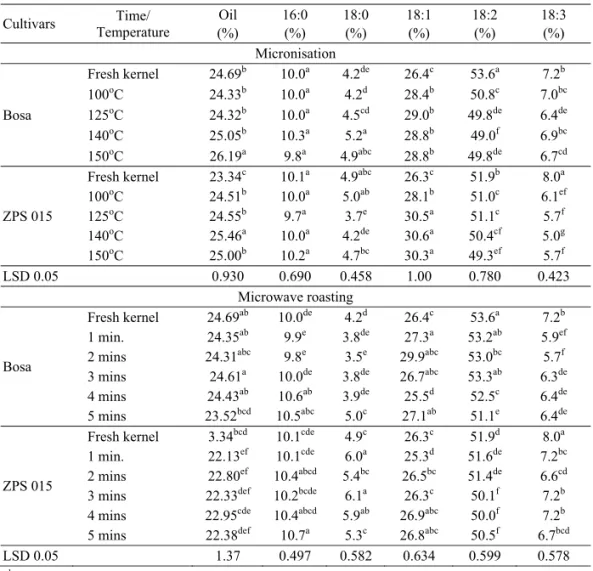
The content of oil and fatty acid composition of the fresh and thermally treated soya bean kernels is presented in Table 1 and 2. The content of oil in fresh
kernels of cultivars Bosa and ZPS 015 was high and amounted to 24.5% and
23.5%, respectively. The oil content was higher in soya bean flakes than in fresh kernels. This content was increased by 8% in flakes of the cultivar ZP 015 after
micronisation at 140oC and by 6% in flakes of the cultivar Bosa after micronisation
at 150oC. Collins and Beaty (1980) state that the temperatures affect the protein
denaturation in soya kernels leading to an easier lipid extraction. The temperature that developed in the course of the microwave radiation and autoclaving did not cause statistically significant differences between oil contents in heat treated and fresh kernels of soya bean (Table 1 and 2). Results presented in Table 1 show that the oil content in soya bean grits obtained by wet and dry extrusion was lower than in the fresh kernel. The drop of the oil content was approximately 15% in grits
obtained by dry extrusion at 150oC. The reason for this could be the specificity of
the extrusion process in which the kernel becomes a special hot mash due to the friction caused by the increased pressure and temperature; hence, the oil extraction already occurs in the extruder cylinder.
Blumenthal and Stier (1991) point out that chemical changes occurring during the oil heating are based on two types of reactions - thermolytic and oxidative. Thermolytic reactions proceed without the oxygen presence, and during these reactions polymerisation, isomerisation, cyclisation and hydrolisis of soya bean oil components occur. Hydrogen peroxides and free peroxide radicals of unsaturated fatty acids are formed in the process of oxidation, causing a decrease of a nutritive value, and unpleasant odour and flavour of soya bean oil.
Linolenic acid (18:3ω-3) is the most unstable fatty acid in soya bean oil due to
the presence of three double bonds (Frankel, 1998). This result is in accordance with our study. The maximal drop of linoleic acid content (8.5%) was observed after the kernel of soya bean Bosa exposure to the micronisation at the temperature
of 140oC. The content of oleic acid was increased by 14% in flakes of the cultivar
ZP 015 after micronisation at 140oC. However, changes of linolenic acid content
affected by heat treatments were higher. In our study it was noted that high temperature during the processes of micronisation and microwave roasting had a far than the temperature caused by a vapour pressure during treatments of autoclaving and extrusion. The content of linolenic acid in the micronised kernel of the soya bean cultivar ZPS 015 dropped by 14 to 38%, while this content in grits made in the processes of dry extrusion dropped by 6 to 12%. The explanation could be that the kernel moisture level provides the protection from losses of unsaturated fatty acids, linoleic and linolenic, during heating, and that is in accordance with the findings of Yoshida and Kajimoto (1988). Based on gained results it can be concluded that linolenic acid degradation already occurred at
Table 1. Content of oil and fatty acids after treatments of autoclaving, dry and wet extrusion.
Cultivars Time/ temperature
Oil (%)
16:0 (%)
18:0 (%)
18:1 (%)
18:2 (%)
18:3 (%) Autoclaving
Bosa
Fresh kernel 24.18b 10.7a 5.2bc 27.5a 51.3a 6.2c 10 mins 23.77b 10.2bc 4.7cd 26.6bc 51.3a 7.3ab 20 mins 24.14b 10.1bc 4.9cd 27.1bc 51.1ab 6.8bc 30 mins 24.75a 10.2bc 4.6d 27.4a 50.5bc 6.3c
ZPS 015
Fresh kernel 23.66bc 10.2b 6.8a 26.8bc 49.9d 7.1a 10 mins 23.22c 10.0bc 5.7b 26.5c 50.1cd 7.7a 20 mins 23.11c 10.4ab 5.6b 26.9abc 50.2cd 7.5ab 30 mins 23.38c 9.8c 5.6b 27.2ab 51.7a 6.9bc LSD 0.05 0.525 0.429 0.539 0.660 0.648 0.729
Dry extrusion
Bosa
Fresh kernel 24.40a 11.4a 4.2abcd 24.1bcd 52.4b 7.6b 100oC 23.73ab 11.1bc 4.5ab 25.2a 52.6ab 6.8c 125oC 22.97c 11.4ab 4.2bcd 25.2abc 53.0ab 6.4d 140oC 22.72c 11.4a 4.7a 23.8d 53.0ab 7.0c
150oC 20.90e 11.4a 4.0bcd 25.2ab 53.1a 6.2d
ZPS 015
Fresh kernel 24.32a 11.2abc 4.4abc 23.6d 52.7ab 8.2a 100oC 21.02d 11.3ab 3.7d 24.0cd 53.0a 7.2c 125oC 21.19d 11.3abc 3.9cd 24.4d 52.9ab 7.5b 140oC 21.45d 11.4a 4.2abcd 23.9d 52.8ab 7.7b 150oC 20.82d 11.1c 3.7d 23.1d 52.6ab 7.4b LSD 0.05 0.703 0.277 0.485 1.147 0.663 0.452
Wet extrusion
Bosa
Fresh kernel 24.69a 10.0a 4.2c 26.4c 53.6a 7.2b 100oC 23.24b 10.1a 4.9b 28.1a 50.8c 6.9cd 125oC 22.56c 10.1a 4.5bc 27.2b 51.1c 6.7d
140oC 22.09cd 10.0a 4.4bc 26.7bc 50.7cd 7.1bc
ZPS 015
Fresh kernel 23.34b 10.1a 4.9b 26.3c 51.9b 8.0a 100oC 23.47b 9.9a 4.2c 26.7bc 52.2b 6.7d 125oC 22.38c 10.2a 5.5a 26.7bc 50.6cd 6.7d 140oC 21.56de 10.3a 5.5a 27.2b 50.2d 6.8cd LSD 0.05 0.607 0.588 0.560 0.736 0.564 0.343
a-b
Means followed by the same letter within the same column are not significantly different (P<0.05); LSD-Least significant difference; C 16:0–palmitic acid, C 18:0–stearic acid, C 18:1–oleic acid, C 18:2–linoleic acid, C 18:3–linolenic acid.
and 2). The linolenic acid increased stability during prolonged heating could be a result of either the increased content of the products of Maillard reaction that are produced under impacts of the temperature and that are known to have antioxidant properties or the position of linolenic acid in the triglyceride molecule. Bolton and Sanders (2002) in their study connected the oxidative stability of prolonged roasted peanut oil with the antioxidative activity of products that were made in the process of the Maillard reaction.
Table 2. Content of oil and fatty acids after treatments of micronisation and microwave roasting.
Cultivars Time/ Temperature
Oil (%)
16:0 (%)
18:0 (%)
18:1 (%)
18:2 (%)
18:3 (%) Micronisation
Bosa
Fresh kernel 24.69b 10.0a 4.2de 26.4c 53.6a 7.2b
100oC 24.33b 10.0a 4.2d 28.4b 50.8c 7.0bc 125oC 24.32b 10.0a 4.5cd 29.0b 49.8de 6.4de 140oC 25.05b 10.3a 5.2a 28.8b 49.0f 6.9bc 150oC 26.19a 9.8a 4.9abc 28.8b 49.8de 6.7cd
ZPS 015
Fresh kernel 23.34c 10.1a 4.9abc 26.3c 51.9b 8.0a 100oC 24.51b 10.0a 5.0ab 28.1b 51.0c 6.1ef 125oC 24.55b 9.7a 3.7e 30.5a 51.1c 5.7f 140oC 25.46a 10.0a 4.2de 30.6a 50.4cf 5.0g
150oC 25.00b 10.2a 4.7bc 30.3a 49.3ef 5.7f LSD 0.05 0.930 0.690 0.458 1.00 0.780 0.423
Microwave roasting
Bosa
Fresh kernel 24.69ab 10.0de 4.2d 26.4c 53.6a 7.2b
1 min. 24.35ab 9.9e 3.8de 27.3a 53.2ab 5.9ef 2 mins 24.31abc 9.8e 3.5e 29.9abc 53.0bc 5.7f 3 mins 24.61a 10.0de 3.8de 26.7abc 53.3ab 6.3de 4 mins 24.43ab 10.6ab 3.9de 25.5d 52.5c 6.4de 5 mins 23.52bcd 10.5abc 5.0c 27.1ab 51.1e 6.4de
ZPS 015
Fresh kernel 3.34bcd 10.1cde 4.9c 26.3c 51.9d 8.0a 1 min. 22.13ef 10.1cde 6.0a 25.3d 51.6de 7.2bc 2 mins 22.80ef 10.4abcd 5.4bc 26.5bc 51.4de 6.6cd
3 mins 22.33def 10.2bcde 6.1a 26.3c 50.1f 7.2b 4 mins 22.95cde 10.4abcd 5.9ab 26.9abc 50.0f 7.2b
5 mins 22.38def 10.7a 5.3c 26.8abc 50.5f 6.7bcd LSD 0.05 1.37 0.497 0.582 0.634 0.599 0.578
a-b Means followed by the same letter within the same column are not significantly different (P<0.05);
The content of linoleic acid (18:6ω-2) oscillated in soya bean products depending on the temperature and the applied treatment. In our study high temperature during autoclaving and dry extrusion did not affect the gradual decrease of linoleic acid content in soya bean products. However, this content was
decreased by 8.5% in flakes of the cultivar ZP 015 after micronisation at 140oC and
by 5% in kernels of the same cultivar Bosa after roasting in microwave oven for five minutes. Oleic acid, with only one double bond in its structure, was more thermostable, which is indicated by the statistically significantly increased content of oleic acid in soya bean products made mainly of the cultivar Bosa. The transition of polyunsaturated fatty acids in the more saturated state can cause the increase of the content of fatty acids with a smaller number of double bonds. According to the obtained results it can be concluded that the increased temperature did not affect the content of saturated palmitic acid (Table 1 and 2). Results of the stearic acid changes under the impacts of increased temperatures cannot be observed separately from the results of the analysis of unsaturated fatty acids. Stearic acid, as a saturated fatty acid, is very stable. However, the changes in unsaturated fatty acids due to thermal oxidation lead to the relative increase of stearic acid in the soya bean products made by the heat treatments. This phenomenon was observed in our study mainly in the kernel of the soya bean cultivar ZPS 015 that was roasted in a microwave oven and also in grits made by the wet extrusion of kernels of the same cultivar (Table 1 and 2).
The destruction of fatty acids was simultaneously observed with changes in lipoxygenase activities. The genotypes Bosa and ZPS 015 had a very similar initial
activity of lipoxygenase 1 (5.63 and 5.34 µmol ml-1 min-1, respectively). According
to the obtained results it can be concluded that activities of lipoxygenase 1 in both soya bean cultivars decreased after the application of all five technological processing procedures (Table 3). The maximal drop of the activity was observed after the kernel exposure to the extrusion and micronisation at the temperature of
100oC. The activity of lipoxygenase in flakes of cultivars Bosa and ZP 015 made
by micronisation at 100oC was 2.74 and 2.80 µmol ml-1 min-1, respectively and the
process of dry extrusion was even more effective when at 100oC the activity of
lipoxygenase in grits of cultivars Bosa and ZP 015 dropped to 0.043 and 0.034
µmol ml-1 min-1, respectively. These results are in accordance with those of Zhu et
al. (1996). These authors reported that the lipoxygenase 1 enzyme activity was decreased to 0 when soya beans were extruded at 107°C. The significant increase of the lipoxygenase activity was recorded in both studied cultivars only after one
minute microwave heating, i.e. at the temperature of about 60oC. This increase is
probably a result of denaturation of antioxidants (Esaka et al., 1987) or some
inhibitors of the lipoxygenase 1 activity, whereby their complex with the enzyme is
disrupted and the active site of the enzyme in the fresh grain is released for the
Table 3. Activity of lipoxygenase (µmol ml-1min-1) after different thermal treatments.
Thermal treatments Time/Temperature Bosa ZPS 015 Fresh kernel 5.630ab 5.341c
Autoclaving
10 mins 0.236h 0.226h
20 mins 0.014i 0.011i
30 mins 0.006i 0.003i
Dry extrusion
100oC 0.042i 0.035i
125oC 0.043i 0.035i
140oC 0.041i 0.034i
150oC 0.019i 0.035i
Wet extrusion
100oC 1.527e 2.615d
125oC 0.113h 0.136h
140oC 0.070hi 0.078hi
Micronisation
100oC 2.742d 2.803d
125oC 0.291h 0.171h
140oC 0.097hi 0.064hi
150oC 0.044i 0.062hi
Microwave roasting
1 min. 5.818a 6.031a
2 mins 0.861f 0.577g
3 mins 0.026i 0.016i
4 mins 0.022i 0.017i
5 mins 0.019i 0.006i
LSD 0.05 0.234
a-b
Means followed by the same letter within the same column are not significantly different (P<0.05); LSD-Least significant difference.
This study was carried out to a better understanding of, and ultimately a better controlling of the processing conditions which affect the nutritional properties of
soyabean,mainlythe fattyacidcontentandtheactivityofenzymelypoxygenase1.
Conclusion
The content of polyunsaturated fatty acids was more stable after the application of high temperature caused by a vapour pressure during treatments of autoclaving and extrusion than after processes of micronisation and microwave roasting. At the same time, the lipoxygenase 1 enzyme activity was decreased to
0.043 and 0.034 µmol ml-1 min-1, respectively when soya beans Bosa and ZP 015
Acknowledgements
This study was supported by the Ministry of Science and Technological Development, the Republic of Serbia, Projects TR-20114.
References
Axelrod, B., Cheesbrough, T.M., Laakso, S. (1981): Lipoxygenase from soybeans. Method in Enzimology 71:441-451.
Blumenthal, M.M., Stier, R.F. (1991): Optimatization of deep-fat frying operations. Trends Food Sci. Technol. 2:144-148.
Bolton, G.E., Sanders, T.H. (2002): Effect of roasting oil composition on the stability of roast high-oleic peanuts. J. Amer. Oil Chem. Soc. 79:129-131.
Collins, J.B., Beaty, B.F. (1980): Heat inactivation of trypsin inhibitor in fresh green soybean and physiological responses of rats fed the beans. J. Food Sci. 45:542-549.
Esaka, M., Suzuki, K., Kubota, K. (1987): Effect of microwave heating on lipoxygenase and trypsin inhibitor activities and water absorption of widgenbeen seeds. J. Food Sci. 52:1738-1739. Frankel, E.N. (1998): Lipid oxidation. The Oily Press Ltd., Glasgow, United Kingdom.
Friedman, M., Brandon, D.L. (2001): Nutritional and health benefits of soy proteins. J. Agric. Food Chem. 49:1069-1086.
Hammond, E.G., Glatz, B.A. (1989): Biotechnology applied of fats and oils. In: King, R., Cheetham, P.S.J (Eds.), Developments in food biotechnology. John Wiley and Sons, Inc., New York, pp. 173-217.
Haumann, B.F. (1993): Health implications of lipid oxidation. INFORM 4:800.
Kitamura, K., Devies, S.C., Kiazuma, N., Nielsen, N.C. (1983): Genetic analysis of null-allele for lipoxygenase-3 in soybean seeds. Crop Sci. 23:924-927.
Liu, K. (1997): Chemistry and nutritional value of soybean components. In: Liu, K. (Ed.), Soyabean chemistry, technology and utilization. Chapman and Hall’s International Resource Center, Dept. BC, New York, pp. 26-36.
Simopoulos, A.P. (1991): Omega-3 fatty acids in health and disease and in growth and development. American Journal of Clinical Nutrition 54:438-463.
Slavin, J.L. Jacobs, D., Marquart, L. (2000): Grain processing and nutrition Crit. Rev. Food Sci. Nutr. 40:309-326.
Službeni list SFRJ (1987):The rule bookof methods ofsampling and of methodsfor performing physical, chemical and microbiological analyses of feeds. Institution for Standardisation of Serbia 15/1987.
Wathes, D.C., Abayasekere, D.R., Aitken, R.J. (2007): Polyunsaturated fatty acids in male and female reproduction. Biology of Reproduction77:190-201.
Yoshida, H., Kajimoto, G. (1988): Effects of microwave treatment on the trypsin inhibitor and molecular species of triglycerides in soybeans. J. Food Sci. 53:1756-1760.
Zhu, S., Riaz, M.N., Lusas, E.W. (1996): Effect of different extrusion temperatures and moisture content on lipoxygenase inactivation and protein solubility in soybeans. J. Agric. Food Chem. 44:3315-3318.
UTICAJ TERMIČKIH TRETMANA PRERADE NA SADRŽAJ MАSNIH KISELINA SOJINOG ZRNA I AKTIVNOST LIPOKSIGENAZE
Slađana M. Žilić1*, Slađana S. Šobajić2, Snežana D. Mladenović Drinić1, Branka J. Kresović1 i Marko G. Vasić1
1
Institut za kukuruz „Zemun Polje“, Slobodana Bajića 1,
11085 Beograd-Zemun, Srbija
2
Farmaceutski fakultet, Institut za bromatologiju, Kumodraška 120, 11000 Beograd, Srbija
R e z i m e
U ovom radu prikazani su rezultati promene aktivnosti lipoksigenaze 1 i sadržaja masnih kiselina u sojinom zrnu pod uticajem povišene temperature. Zrno soje sorte Bosa i ZPS 015 bilo je podvrgnuto tretmanima suve i vlažne ekstruzije,
autoklaviranju, mikronizaciji i prženju u mikrotalasnoj peći. U zavisnosti od
tehnološkog tretmana prerade zrno je bilo izloženo dejstvu povišene temperature
od 60 do 150oC u trajanju od svega 25 do 30 sekundi pri ekstruziji do 30 minuta pri
autoklaviranju. Povišena temperatura tokom mikrotalasnog prženja i autoklaviranja
nije uticala na sadržaj ulja u sojinom zrnu. Međutim, u sojinim flekicama sadržaj
ulja bio je viši, a u grizu niži od sadržaja u sirovom sojinom zrnu. Primenjeni
termički tretmani prerade uticali su na značajno smanjenje sadržaja linolenske
kiseline u ulju sojinog zrna. U zavisnosti od temperature, kao i vrste termičkog
tretmana sadržaj linolne i oleinske kiseline u prerađenom sojinom zrnu je varirao.
Povišena temperatura uslovila je promene nezasićenih masnih kiselina sa 18
ugljenikovih atoma rezultirajući povećanje sadržaja stearinske kiseline. Prema
našim rezultatima aktivnost lipoksiganaze je opadala sa povećanjem temperature i
produženjem tretmana prerade. Maksimalan pad aktivnosti lipoksigenaze utvrđen
je već nakon izlaganja zrna temperaturi od 100oC tokom ekstruzije i mikronizacije.
Međutim, nakom jednog minuta prženja zrna u mikrotalasnoj peći (60oC) aktivnost
lipoksigenaze je bila viša u odnosu na aktivnost u sirovom zrnu. Daljim
produženjem tretmana, a time i povećanjem temperature došlo je do postepene
denaturacije enzima i smanjenja aktivnosti.
Ključne reči: soja, termički tretmani, ulje, masne kiseline, lipokigenaza.
Primljeno: 27. januara 2010. Odobreno: 20. aprila 2010.