Low Birth Weight at Term and Its
Determinants in a Tertiary Hospital of Nepal:
A Case-Control Study
Sudesh Raj Sharma1*, Smith Giri2, Utsav Timalsina1, Sanjiv Sudarshan Bhandari1, Bikash Basyal1, Kusum Wagle3, Laxman Shrestha1
1Maharajgunj Medical Campus, Institute of Medicine, Kathmandu, Nepal,2The University of Tennessee Health Science Center, Memphis, United States of America,3Om Health Campus, Kathmandu, Nepal
Abstract
Birth weight of a child is an important indicator of its vulnerability for childhood illness and chances of survival. A large number of infant deaths can be averted by appropriate manage-ment of low birth weight babies and prevention of factors associated with low birth weight. The prevalence of low birth weight babies in Nepal is estimated to be about 12-32%.Our study aimed at identifying major determinants of low birth weight among term babies in Nepal. A hospital-based retrospective case control study was conducted in maternity ward of Tribhuvan University Teaching Hospital from February to July 2011. A total of 155 LBW babies and 310 controls were included in the study. Mothers admitted to maternity ward dur-ing the study period were interviewed, medical records were assessed and anthropometric measurements were done. Risk factors, broadly classified into proximal and distal factors, were assessed for any association with birth of low-birth weight babies. Regression analysis revealed that a history of premature delivery (adjusted odds ratio; aOR5.24, CI 1.05-26.28), hard physical work during pregnancy (aOR1.48, CI 0.97-2.26), younger age of mother (aOR1.98, CI 1.15-3.41), mothers with haemoglobin level less than 11gm/dl (aOR0.51, CI0.24-1.07) and lack of consumption of nutritious food during pregnancy (aOR1.99, CI 1.28-3.10) were significantly associated with the birth of LBW babies. These factors should be addressed with appropriate measures so as to decrease the prevalence of low birth weight among term babies in Nepal.
Introduction
Birth weight is an important determinant of an infant’s survival and future development [1]. Low birth weight (LBW) is defined as weight less than 2500 grams at birth regardless of gesta-tional age. LBW puts a newborn at increased risk of death and illness [2–6] and limits their growth potential in the adulthood [7–9]. Globally, LBW contributes to 40–60% of newborn mortality [10]. LBW can be caused by preterm birth or by intrauterine growth restriction. The latter group is also referred to as small for gestational age (SGA) babies. In developing countries
OPEN ACCESS
Citation:Sharma SR, Giri S, Timalsina U, Bhandari SS, Basyal B, Wagle K, et al. (2015) Low Birth Weight at Term and Its Determinants in a Tertiary Hospital of Nepal: A Case-Control Study. PLoS ONE 10(4): e0123962. doi:10.1371/journal.pone.0123962
Academic Editor:Olivier Baud, Hôpital Robert Debré, FRANCE
Received:February 22, 2014
Accepted:March 9, 2015
Published:April 8, 2015
Copyright:© 2015 Sharma et al. This is an open access article distributed under the terms of the
Creative Commons Attribution License, which permits unrestricted use, distribution, and reproduction in any medium, provided the original author and source are credited.
Funding:The authors have no support or funding to report.
from Asia, LBW is largely attributed to intrauterine growth retardation as compared to prema-turity in developed and African countries [11,12]. In Nepal, studies have shown that the preva-lence of LBW ranges from 11.9% to 39.6% [13–15]. A multi-hospital based study in Nepal estimated the overall prevalence of LBW to be 27% out of which only 30% were preterm [16].
Prior studies from the Indian subcontinent have identified several socio-economic factors in addition to gestational age and maternal health as risk factors for SGA babies in this region [16–18]. However, studies from Nepal have inadequately addressed the socio-economic factors associated with the birth of LBW babies [19–23]. Many of these studies are based on retrospec-tive chart review that often lack information such as physical work during pregnancy [19,21–
23], nutritious food intake [19,21–23] and nutritional supplementation [22], illness during pregnancy [21,22] and household income [19]. Also, these studies have studied LBW babies in general and not separately analyzed the SGA group, even though previous literature has sug-gested different risk factors for pre-term LBW and SGA babies [24]. To fill the information gap about factors associated with LBW in term babies, we designed the present study in an attempt to identify proximate and distal factors associated with LBW in Nepal.
Methods
A retrospective case-control study design was used. The study was conducted in Tribhuvan University Teaching Hospital (TUTH), one of the largest tertiary hospitals in Kathmandu, Nepal. Cases were identified as newborn babies with birth weight less than 2500 grams whereas controls were newborn babies with a birth weight of more than or equal to 2500 grams. Our study population included singleton newborn babies at term without any congenital diseases. The study was limited to SGA babies at term only. Unlike in developed countries, majority of LBW babies in the developing countries are small for gestational age due to intrauterine growth retardation, which has been associated with a variety of socio-economic and maternal risk fac-tors [11,12,16].
A total of 155 eligible consecutive cases of LBW babies at term were admitted to TUTH be-tween February 2011 and July 2011. Age and sex matching with two controls was done on the same day when a case was found. Whenever there were more than 2 eligible controls for a case, controls were randomly selected. A total of 310 controls were selected. The non-selected con-trols were included for other cases on the same day if it met the inclusion criteria (i.e. age and sex matched). Due to high volume of deliveries, controls for a case were found on the same day. The number of cases and controls was calculated by taking power at 80%, odds ratio of 1.8, two sided significant level at 0.05 and proportion of controls with exposure as 0.25 using Epi Info (Version 3.5.2).
Written consent was taken from the respondents and their guardians prior to the interview. Participants were explained about their right to refuse participation and withdraw from the study.
Explanatory variables
The explanatory variables were divided into proximate and distal factors. The proximate fac-tors included history of chronic medical illness, history of abortion, history of premature deliv-ery, hard physical work during pregnancy, illness during current pregnancy, age of mother, parity, height of mother, haemoglobin level, the practices of taking iron tablets, consuming nu-tritious food (beans, greens or meat) daily, drinking alcohol during pregnancy and antenatal care (ANC) visits during last pregnancy. Chronic medical illness was defined as a pre-existing medical illness of the mother that was documented in the medical record of TUTH with an onset prior to the current pregnancy. Regular physical work during pregnancy was identified as moderate or hard. Hard physical work comprised of three or more of the following listed works: daily household chores, fetching water with large buckets, lifting heavy loads, chopping woods, cutting grass for cattle feeding and washing clothes/utensils for long. These works have been accounted under hard physical activity in a study among rural women in India [25]. On the other hand, illness during current pregnancy was defined as a medical condition that devel-oped during current pregnancy for which medical attention or treatment was sought. This in-cluded pregnancy related medical illnesses and complications based on the International Classification of Diseases (ICD), 10th revision [26]. The age of mother was defined as the cur-rent completed age in years. Age of mothers was categorized into less than 20 years, 20 to 30 years and more than 30 years based on a prior study [27]. Parity was categorized into primipa-rous (mothers with a single living child) and multipaprimipa-rous (mothers with more than one living children). Similarly, mothers were placed into two groups on the basis of their height; less than146 cm and 146 cm or more.
children living together, whereas joint family was defined as all first-degree blood relatives of many generations living under the same roof. An extended family, on the other hand, was de-fined as a family extending beyond the immediate family of parents and their children. The yearly income of the family was hypothetically divided into two levels as more than NRs 240,000 and NRs 240,000 or less. The socio-demographic information was recorded based on face-to-face interview with mothers.
Statistical methods
The data was entered in Epi info (Version 3.5.2)and analyzed in Statistical Package for Social Sciences (Version 17). Bivariate analysis was first conducted with chi-squared test to assess the differences of the various proximal and distal factors between the cases versus the controls (see Table 1andTable 2). All variables with p-value less than 0.1 (90% level of significance) in bi-variate analysis were considered for multibi-variate logistic regression analysis. Backward stepwise logistic regression method was used to enter the predictive factors in logistic regression model. The level of significance for regression analysis was set at 95%. All p values were two sided.
Results
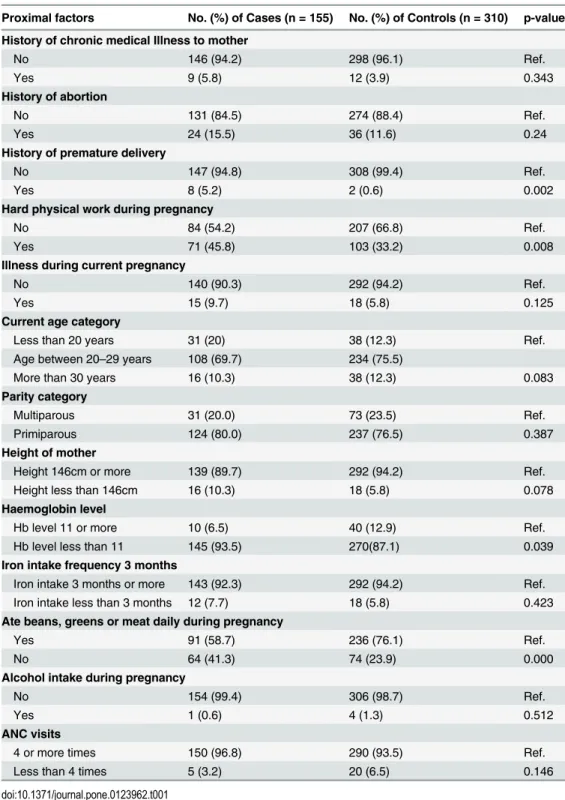
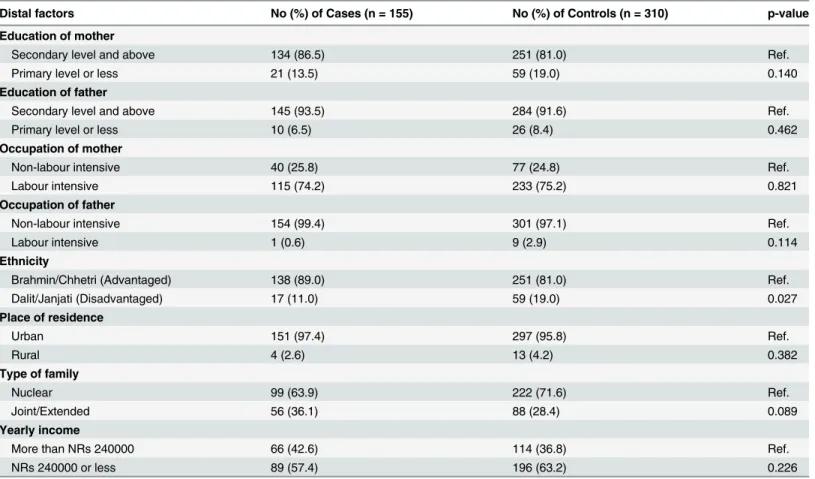
A total of 155 cases and 310 controls were studied. Tables1and2show the distribution of cases and controls as per proximate and distal factors respectively.
Chronic medical illness was present only in a small percentage of the study population. Ma-jority of the mothers had no prior history of abortion or premature delivery. Engaging in hard physical work during pregnancy was fairly common (46% and 33% among cases and controls respectively). Majority of mothers belonged to age 20 to 29 years (69% among cases and 75% among controls), had a height of 146 cm or more (89% among cases and 94% among controls). More than 90% of both groups were taking iron supplements since at least 3 months. Majority of mothers (93% cases and 87% controls) had their haemoglobin level less than 11gm/dl. Alco-hol intake during pregnancy was fairly low (0.6% and 1.3% respectively) and majority of moth-ers had an ANC visit of at least 4 times (96.8% and 93.5% respectively) as inTable 1. Among the distal factors (Table 2), majority of mothers had at least secondary level of education (86% and 81% respectively), belonged to an advantaged ethnicity (89% and 81% respectively) and urban residence (97% and 96% respectively). Similarly 57.4% of the cases and 63.2% of the con-trols had a yearly income of less than NRs 240,000 or less.
Determinants of LBW
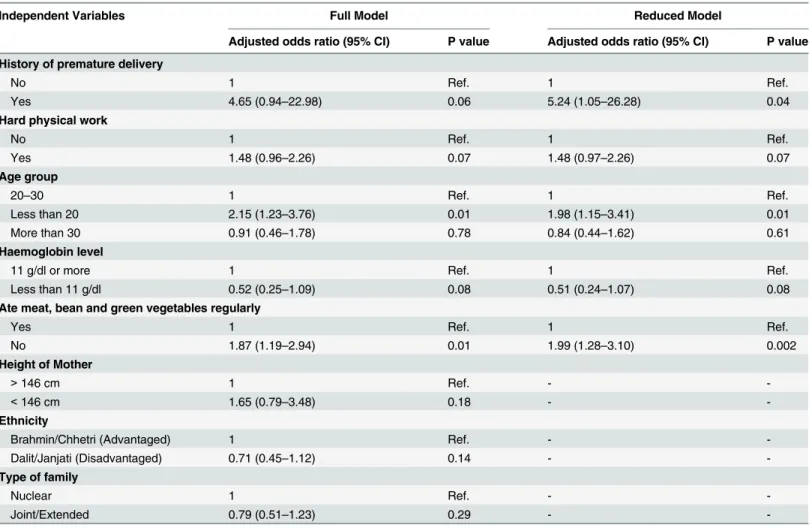
Results of the bivariate (Tables1and2) and the multivariate analysis (Table 3) to study the as-sociation between different risk factors and the occurrence of LBW have been summarized on Tables1–3. In bivariate analysis, history of premature delivery, hard physical work done during pregnancy, current age of mother, height of mother, haemoglobin level, consuming nutritious food during pregnancy, ethnicity and family type were significantly associated with LBW at 90% level of significance (p-value 0.1). These variables were then subjected to the multivariable analysis using backward stepwise logistic regression method (Table 3). History of premature delivery (aOR5.24, CI 1.05–26.28, hard physical work during pregnancy (aOR1.48, CI 0.97–
Discussion
Based on the findings of the present study, history of premature delivery, hard physical work during pregnancy, earlier age at pregnancy, lack of consumption of nutritious food during pregnancy and maternal anemia were the independent risk factors for the birth of SGA babies in Nepal.
Table 1. Description of proximal factors and their association with low birth weight.
Proximal factors No. (%) of Cases (n = 155) No. (%) of Controls (n = 310) p-value
History of chronic medical Illness to mother
No 146 (94.2) 298 (96.1) Ref.
Yes 9 (5.8) 12 (3.9) 0.343
History of abortion
No 131 (84.5) 274 (88.4) Ref.
Yes 24 (15.5) 36 (11.6) 0.24
History of premature delivery
No 147 (94.8) 308 (99.4) Ref.
Yes 8 (5.2) 2 (0.6) 0.002
Hard physical work during pregnancy
No 84 (54.2) 207 (66.8) Ref.
Yes 71 (45.8) 103 (33.2) 0.008
Illness during current pregnancy
No 140 (90.3) 292 (94.2) Ref.
Yes 15 (9.7) 18 (5.8) 0.125
Current age category
Less than 20 years 31 (20) 38 (12.3) Ref.
Age between 20–29 years 108 (69.7) 234 (75.5)
More than 30 years 16 (10.3) 38 (12.3) 0.083
Parity category
Multiparous 31 (20.0) 73 (23.5) Ref.
Primiparous 124 (80.0) 237 (76.5) 0.387
Height of mother
Height 146cm or more 139 (89.7) 292 (94.2) Ref.
Height less than 146cm 16 (10.3) 18 (5.8) 0.078
Haemoglobin level
Hb level 11 or more 10 (6.5) 40 (12.9) Ref.
Hb level less than 11 145 (93.5) 270(87.1) 0.039
Iron intake frequency 3 months
Iron intake 3 months or more 143 (92.3) 292 (94.2) Ref.
Iron intake less than 3 months 12 (7.7) 18 (5.8) 0.423
Ate beans, greens or meat daily during pregnancy
Yes 91 (58.7) 236 (76.1) Ref.
No 64 (41.3) 74 (23.9) 0.000
Alcohol intake during pregnancy
No 154 (99.4) 306 (98.7) Ref.
Yes 1 (0.6) 4 (1.3) 0.512
ANC visits
4 or more times 150 (96.8) 290 (93.5) Ref.
Less than 4 times 5 (3.2) 20 (6.5) 0.146
Our study revealed that a history of premature delivery was significantly associated with LBW in babies. A study by Singh et al in Ahemdabad, India also showed similar findings [31]. A highly significant association of history of premature delivery with LBW in this study indi-cated that mothers with history of premature delivery may need special care during pregnancy in terms of diet and health check-up.
Hard physical work during pregnancy was found to be significantly associated with LBW in this study. A greater proportion of LBW babies were born to mothers who had done hard phys-ical work during pregnancy. A study from Lithuania depicted similar findings that hard manu-al work by mothers attributed to greater percent of LBW cases [32]. Agarwmanu-al et manu-al manu-also showed similar relationship between physical work of mother and LBW [33]. Lifting heavy loads dur-ing pregnancy has been shown to be one of the risk factors for low birth weight [34]. One mechanism suggested involves placental hypoxia leading to low birth weight babies, particular-ly among undernourished women [25]. Frequency and duration of rest taken by pregnant women plays a significant role in determining birth weight [35].
Many studies have shown age of the mother to be significantly associated with the birth of LBW babies [33,36–41]. Previous studies have shown that younger mothers are more likely to have LBW babies [32,42]. The current study showed that young mothers (less than 20 years of age) were nearly two times more likely to deliver LBW babies compared to older mothers. Ef-forts towards preventing early marriage would contribute significantly in reducing the preva-lence of low birth weight.
Table 2. Description of distal factors and their association with low birth weight.
Distal factors No (%) of Cases (n = 155) No (%) of Controls (n = 310) p-value
Education of mother
Secondary level and above 134 (86.5) 251 (81.0) Ref.
Primary level or less 21 (13.5) 59 (19.0) 0.140
Education of father
Secondary level and above 145 (93.5) 284 (91.6) Ref.
Primary level or less 10 (6.5) 26 (8.4) 0.462
Occupation of mother
Non-labour intensive 40 (25.8) 77 (24.8) Ref.
Labour intensive 115 (74.2) 233 (75.2) 0.821
Occupation of father
Non-labour intensive 154 (99.4) 301 (97.1) Ref.
Labour intensive 1 (0.6) 9 (2.9) 0.114
Ethnicity
Brahmin/Chhetri (Advantaged) 138 (89.0) 251 (81.0) Ref.
Dalit/Janjati (Disadvantaged) 17 (11.0) 59 (19.0) 0.027
Place of residence
Urban 151 (97.4) 297 (95.8) Ref.
Rural 4 (2.6) 13 (4.2) 0.382
Type of family
Nuclear 99 (63.9) 222 (71.6) Ref.
Joint/Extended 56 (36.1) 88 (28.4) 0.089
Yearly income
More than NRs 240000 66 (42.6) 114 (36.8) Ref.
NRs 240000 or less 89 (57.4) 196 (63.2) 0.226
The current study well found mother’s level of haemoglobin to be associated with LBW. Lower concentration of maternal haemoglobin is one of the risk factors for LBW among chil-dren [43,44]. Maternal anaemia further limits maternal oxygen uptake, decrease oxygen deliv-ery to fetus [45] and consequently leads to fetal growth restriction [46,47]. Various studies have previously depicted that anemic mothers with haemoglobin level less than 11gm/dl have higher chances of giving birth to LBW babies [48–50].
The study also found that consumption of nutritious diet during pregnancy affects the birth weight, a well-established fact [51–54]. Poor maternal food intake leads to fetal under-nutrition and deficiency of several micronutrients which are necessary for the growth and development of fetus [55,56]. This finding implicates that the prevalence of low birth weight can be reduced by promoting consumption of meat, beans and green vegetables by pregnant mothers and miti-gating food related taboos.
This study however had some notable limitations. The findings might be influenced by pur-posive selection of study area, study design bias and social-desirability bias. Use of hospital rec-ords for background information may have introduced some bias. The study was based on a single tertiary institution limiting its generalizability. In a country with proportion of home de-liveries about 65% [57], a community based study may provide more clear picture on the deter-minants of low birth weight. Also, we did not evaluate other potential risk factors for low birth weight including micronutrient deficiencies among mothers, urinary tract or genital infections, Table 3. Results from the stepwise logistic regression model showing Independent risk factors of low birth weight.
Independent Variables Full Model Reduced Model
Adjusted odds ratio (95% CI) P value Adjusted odds ratio (95% CI) P value
History of premature delivery
No 1 Ref. 1 Ref.
Yes 4.65 (0.94–22.98) 0.06 5.24 (1.05–26.28) 0.04
Hard physical work
No 1 Ref. 1 Ref.
Yes 1.48 (0.96–2.26) 0.07 1.48 (0.97–2.26) 0.07
Age group
20–30 1 Ref. 1 Ref.
Less than 20 2.15 (1.23–3.76) 0.01 1.98 (1.15–3.41) 0.01
More than 30 0.91 (0.46–1.78) 0.78 0.84 (0.44–1.62) 0.61
Haemoglobin level
11 g/dl or more 1 Ref. 1 Ref.
Less than 11 g/dl 0.52 (0.25–1.09) 0.08 0.51 (0.24–1.07) 0.08
Ate meat, bean and green vegetables regularly
Yes 1 Ref. 1 Ref.
No 1.87 (1.19–2.94) 0.01 1.99 (1.28–3.10) 0.002
Height of Mother
>146 cm 1 Ref. -
-<146 cm 1.65 (0.79–3.48) 0.18 -
-Ethnicity
Brahmin/Chhetri (Advantaged) 1 Ref. -
-Dalit/Janjati (Disadvantaged) 0.71 (0.45–1.12) 0.14 -
-Type of family
Nuclear 1 Ref. -
-Joint/Extended 0.79 (0.51–1.23) 0.29 -
cigarette smoking, other toxic exposures, and the quality of antenatal care received by the mothers, which may have affected our results [58].
Conclusions
History of premature delivery, hard physical work during pregnancy, younger age at pregnan-cy, mother’s lower haemoglobin level and lack of nutritious diet consumption during pregnan-cy were the major determinants of low birth weight among term babies in Nepal. Public health programs should focus on raising awareness on avoiding early marriage and pregnancy of fe-males. Moreover, it should provide emphasis on adequate rest and nutrition during pregnancy in order to decrease the prevalence of low birth weight. Provision of a more intensive ANC to mothers with a history of premature deliveries can be another important strategy to prevent low birth weight babies. The role of family members is important especially in fulfilling the nutritional and health care needs of the pregnant mothers along with supporting her to take adequate rest in the cultural context of Nepal.
Acknowledgments
Authors would like to acknowledge the participants of the study and staff of Tribhuvan Univer-sity Teaching Hospital who supported us during data collection.
Author Contributions
Conceived and designed the experiments: SRS SG. Performed the experiments: UT SSB BB LS. Analyzed the data: SRS KW. Contributed reagents/materials/analysis tools: SRS SG UT SSB BB LS. Wrote the paper: SRS KW.
References
1. Wilcox AJ (2001) On the importance—and the unimportance—of birthweight. International Journal of Epidemiology 30: 1233–1241. PMID:11821313
2. Ashworth A (1998) Effects of intrauterine growth retardation on mortality and morbidity in infants and young children. Eur J Clin Nutr 52 Suppl 1: S34–41; discussion S41–32. PMID:9511018
3. McIntire DD, Bloom SL, Casey BM, Leveno KJ (1999) Birth Weight in Relation to Morbidity and Mortality among Newborn Infants. New England Journal of Medicine 340: 1234–1238. PMID:10210706 4. Lira PI, Ashworth A, Morris SS (1996) Low birth weight and morbidity from diarrhea and respiratory
in-fection in northeast Brazil. J Pediatr 128: 497–504. PMID:8618183
5. Read JS, Clemens JD (1995) Low birthweight as a determinant of infectious disease mortality: a meth-odological evaluation. Paediatr Perinat Epidemiol 9: 351–362. PMID:7479283
6. Victora CG, Smith PG, Vaughan JP, Nobre LC, Lombardi C, et al. (1989) Infant feeding and deaths due to diarrhea. A case-control study. Am J Epidemiol 129: 1032–1041. PMID:2705424
7. Albertsson-Wikland K, Karlberg J (1994) Natural growth in children born small for gestational age with and without catch-up growth. Acta Pædiatrica 83: 64–70.
8. Aylward GP, Pfeiffer SI, Wright A, Verhulst SJ (1989) Outcome studies of low birth weight infants pub-lished in the last decade: a metaanalysis. J Pediatr 115: 515–520. PMID:2795341
9. Casey PH, Kraemer HC, Bernbaum J, Yogman MW, Sells JC (1991) Growth status and growth rates of a varied sample of low birth weight, preterm infants: A longitudinal cohort from birth to three years of age. The Journal of pediatrics 119: 599–605. PMID:1919893
10. UNICEF (2009) The state of the world's children 2009: maternal and newborn health: United Nations Children's Fund.
11. Villar J, Belizan JM (1982) The relative contribution of prematurity and fetal growth retardation to low birth weight in developing and developed societies. Am J Obstet Gynecol 143: 793–798. PMID: 7102746
13. Kayastha S, Tuladhar H (2007) Study of low birth weight babies in Nepal Medical College. Nepal Med Coll J 9: 266–269. PMID:18298018
14. World Health Organization (2000) Multicentre study on low birth weight and infant mortality in India, Nepal and Srilanka. New Delhi: World Health Organization, Regional Office for South-East Asia.
15. Christian P, Murray-Kolb LE, Tielsch JM, Katz J, LeClerq SC, et al. (2014) Associations between pre-term birth, small-for-gestational age, and neonatal morbidity and cognitive function among school-age children in Nepal. BMC Pediatr 14: 58. doi:10.1186/1471-2431-14-58PMID:24575933
16. MIRA/UNICEF Nepal (2000) Low Birth Weight Prevalence and Associated Factors in Four Regions of Nepal. Kathmandu, Nepal: Mother Infant Research Activities (MIRA), UNICEF.
17. Badshah S, Mason L, McKelvie K, Payne R, Lisboa PJ (2008) Risk factors for low birthweight in the public-hospitals at Peshawar, NWFP-Pakistan. BMC Public Health 8: 197. doi: 10.1186/1471-2458-8-197PMID:18533023
18. Mavalankar DV, Gray RH, Trivedi CR (1992) Risk factors for preterm and term low birthweight in Ahme-dabad, India. Int J Epidemiol 21: 263–272. PMID:1428479
19. Acharya PP, Alpass F (2004) Birth outcomes across ethnic groups of women in Nepal. Health Care for Women International 25: 40–54. PMID:14742109
20. Sreeramareddy C, Chuni N, Patil R, Singh D, Shakya B (2008) Anthropometric surrogates to identify low birth weight Nepalese newborns: a hospital-based study. BMC Pediatrics 8: 16. doi:10.1186/ 1471-2431-8-16PMID:18439237
21. Khanal V, Zhao Y, Sauer K (2014) Role of antenatal care and iron supplementation during pregnancy in preventing low birth weight in Nepal: comparison of national surveys 2006 and 2011. Arch Public Health 72: 4. doi:10.1186/2049-3258-72-4PMID:24499636
22. Karkee R, Lee AH, Binns CW, Khanal V, Pokharel PK (2015) Incidence of low birthweight in central Nepal: a community-based prospective cohort study. Matern Child Health J 19: 1–5. doi:10.1007/ s10995-014-1489-9PMID:24740722
23. Khanal V, Sauer K, Karkee R, Zhao Y (2014) Factors associated with small size at birth in Nepal: further analysis of Nepal Demographic and Health Survey 2011. BMC Pregnancy Childbirth 14: 32. doi:10. 1186/1471-2393-14-32PMID:24438693
24. Lang JM, Lieberman E, Cohen A (1996) A comparison of risk factors for preterm labor and term small-for-gestational-age birth. Epidemiology 7: 369–376. PMID:8793362
25. Agarwal S, Agarwal A, Agarwal KN, Agarwal DK, Bansal A (2001) Physical activity and pregnancy out-come in rural undernourished women. Indian pediatrics 38: 1017–1022. PMID:11568377
26. World Health Organization (1993) International Statistical Classification of Diseases and Related Health Problems 10th Revision. Geneva: WHO. 129–130 p.
27. Reichman NE, Pagnini DL (1997) Maternal age and birth outcomes: data from New Jersey. Fam Plann Perspect 29: 268–272, 295. PMID:9429872
28. Dim CC, Onah HE (2007) The prevalence of anemia among pregnant women at booking in Enugu, South Eastern Nigeria. MedGenMed 9: 11. PMID:18311361
29. Bhandari R, Sharma R (2012) Epidemiology of chronic obstructive pulmonary disease: a descriptive study in the mid-western region of Nepal. International Journal of Chronic Obstructive Pulmonary Dis-ease 7: 253–257. doi:10.2147/COPD.S28602PMID:22563245
30. Bennett L, Dahal DR, Govindasamy P (2008) Caste, Ethnic and Regional Identity in Nepal: Further Analysis of the 2006 NDHS. Claverton, Maryland, USA.
31. Singh S, Shrestha S, Marahatta S (2011) Incidence and risk factors of low birth weight babies born in Dhulikhel Hospital.
32. Dickute J, Padaiga Z, Grabauskas V, Gaizauskiene A, Basys V, et al. (2002) Do maternal social factors, health behavior and work conditions during pregnancy increase the risk of low birth weight in Lithuania? Medicina (Kaunas) 38: 321–332. PMID:12474706
33. Agarwal A, Agarwal K, Agrawal P, Agrawal V, Chaudhary V (2011) Prevalence and determinants of "low birth weight" among institutional deliveries. 48–52 p.
34. Fourn L, Ducic S, Seguin L (1999) Factors associated with low birth weight: a multivariate analysis. Sante 9: 7–11. PMID:10210796
35. Choudhary AK, Choudhary A, Tiwari SC, Dwivedi R (2013) Factors associated with low birth weight among newborns in an urban slum community in Bhopal. Indian J Public Health 57: 20–23. doi:10. 4103/0019-557X.111362PMID:23649138
37. Khatun S, Rahman M (2008) Socio-economic determinants of low birth weight in Bangladesh: a multi-variate approach. Bangladesh Med Res Counc Bull 34: 81–86. PMID:19476252
38. Moraes AB, Zanini RR, Riboldi J, Giugliani ER (2012) Risk factors for low birth weight in Rio Grande do Sul State, Brazil: classical and multilevel analysis. Cad Saude Publica 28: 2293–2305. PMID: 23288062
39. Valero De Bernabe J, Soriano T, Albaladejo R, Juarranz M, Calle ME, et al. (2004) Risk factors for low birth weight: a review. Eur J Obstet Gynecol Reprod Biol 116: 3–15. PMID:15294360
40. Yadav H, Lee N (2013) Maternal factors in predicting low birth weight babies. Med J Malaysia 68: 44–47. PMID:23466766
41. Deshmukh JS, Motghare DD, Zodpey SP, Wadhva SK (1998) Low birth weight and associated mater-nal factors in an urban area. Indian Pediatr 35: 33–36. PMID:9707902
42. Phung H, Bauman A, Nguyen TV, Young L, Tran M, et al. (2003) Risk factors for low birth weight in a socio-economically disadvantaged population: parity, marital status, ethnicity and cigarette smoking. Eur J Epidemiol 18: 235–243. PMID:12800948
43. Sekhavat L, Davar R, Hosseinidezoki S (2011) Relationship between maternal hemoglobin concentra-tion and neonatal birth weight. Hematology 16: 373–376. doi:10.1179/102453311X13085644680186 PMID:22183073
44. Rasmussen K (2001) Is There a Causal Relationship between Iron Deficiency or Iron-Deficiency Ane-mia and Weight at Birth, Length of Gestation and Perinatal Mortality? J Nutr 131: 590S–601S; discus-sion 601S–603S. PMID:11160592
45. Hutter D, Kingdom J, Jaeggi E (2010) Causes and Mechanisms of Intrauterine Hypoxia and Its Impact on the Fetal Cardiovascular System: A Review. International Journal of Pediatrics 2010: 9.
46. Ream M, Ray AM, Chandra R, Chikaraishi DM (2008) Early fetal hypoxia leads to growth restriction and myocardial thinning. Am J Physiol Regul Integr Comp Physiol 295: R583–595. doi:10.1152/ ajpregu.00771.2007PMID:18509101
47. Mahajan SD, Singh S, Shah P, Gupta N, Kochupillai N (2004) Effect of maternal malnutrition and ane-mia on the endocrine regulation of fetal growth. Endocr Res 30: 189–203. PMID:15473129
48. Levy A, Fraser D, Katz M, Mazor M, Sheiner E Maternal anemia during pregnancy is an independent risk factor for low birthweight and preterm delivery. European Journal of Obstetrics and Gynecology and Reproductive Biology 122: 182–186. PMID:16219519
49. Elhassan E, Abbaker A, Haggaz A, Abubaker M, Adam I (2010) Anaemia and low birth weight in Me-dani, Hospital Sudan. BMC Research Notes 3: 181. doi:10.1186/1756-0500-3-181PMID:20584294 50. Ahmad MO, Kalsoom U, Sughra U, Hadi U, Imran M (2011) Effect of maternal anaemia on birth weight.
J Ayub Med Coll Abbottabad 23: 77–79. PMID:22830153
51. Abu-Saad K, Fraser D (2010) Maternal Nutrition and Birth Outcomes. Epidemiologic Reviews 32: 5–25. doi:10.1093/epirev/mxq001PMID:20237078
52. Gresham E, Byles JE, Bisquera A, Hure AJ (2014) Effects of dietary interventions on neonatal and in-fant outcomes: a systematic review and meta-analysis. The American Journal of Clinical Nutrition 100: 1298–1321. doi:10.3945/ajcn.113.080655PMID:25332328
53. Kramer MS (1987) Determinants of low birth weight: methodological assessment and meta-analysis. Bulletin of the World Health Organization 65: 663. PMID:3322602
54. Susser M, Stein Z, Pasamanick B (1975) Maternal nutrition and low birth-weight. The Lancet 306: 1145.
55. King JC (2003) The risk of maternal nutritional depletion and poor outcomes increases in early or close-ly spaced pregnancies. J Nutr 133: 1732s–1736s. PMID:12730491
56. Caroline HDF, S. YC, Rao S, Davies AA, Brown N, et al. (2003) Micronutrients and Fetal Growth. The Journal of Nutrition 133: 1747S–1756S. PMID:12730494
57. Ministry of Health and Population (MoHP) [Nepal], New ERA, ICF International Inc. (2011) Nepal De-mographic and Health Survey 2011. Kathmandu, Nepal: Ministry of Health and Population (MoHP) [Nepal], New ERA and ICF International Inc.