www.earth-surf-dynam.net/2/419/2014/ doi:10.5194/esurf-2-419-2014
© Author(s) 2014. CC Attribution 3.0 License.
Effect of self-stratification on sediment diffusivity in
channel flows and boundary layers: a study using direct
numerical simulations
S. Dutta1, M. I. Cantero3, and M. H. Garcia1,2
1Dept. of Civil and Environmental Engineering, University of Illinois at Urbana-Champaign, Urbana, USA 2Dept. of Geology, University of Illinois at Urbana-Champaign, Urbana, USA
3Centro Atómico Bariloche and Instituto Balseiro, Consejo Nacional de Investigaciones Científicas y Técnicas
(CONICET) and Comisión Nacional de Energía Atómica (CNEA), San Carlos de Bariloche, Río Negro, Argentina
Correspondence to:S. Dutta ([email protected])
Received: 28 October 2013 – Published in Earth Surf. Dynam. Discuss.: 19 November 2013 Revised: 14 June 2014 – Accepted: 2 July 2014 – Published: 6 August 2014
Abstract. Sediment transport in nature comprises of bedload and suspended load, and precise modelling of these processes is essential for accurate sediment flux estimation. Traditionally, non-cohesive suspended sedi-ment has been modelled using the advection–diffusion equation (Garcia, 2008), where the success of the model is largely dependent on accurate approximation of the sediment diffusion coefficients. The current study explores the effect of self-stratification on sediment diffusivity using suspended sediment concentration data from direct numerical simulations (DNS) of flows subjected to different levels of stratification, where the level of strati-fication is dependent on the particle size (parameterized using particle fall velocityV )˜ and volume-averaged sediment concentration (parameterized using shear Richardson numberRiτ). Two distinct configurations were
explored, first the channel flow configuration (similar to flow in a pipe or a duct) and second, a boundary-layer configuration (similar to open-channel flow). Self-stratification was found to modulate the turbulence intensity (Cantero et al., 2009b), which in turn was found to reduce vertical sediment diffusivity in portions of the domain exposed to turbulence damping. The effect of particle size on vertical sediment diffusivity has been studied in the past by several authors (Rouse, 1937; Coleman, 1970; Nielsen and Teakle, 2004); so in addition to the effect of particle size, the current study also explores the effect of sediment concentration on vertical sediment diffusiv-ity. The results from the DNS simulations were compared with experiments (Ismail, 1952; Coleman, 1986) and field measurements (Coleman, 1970), and were found to agree qualitatively, especially for the case of channel flows. The aim of the study is to understand the effect of stratification due to suspended sediment on vertical sediment diffusivity for different flow configurations, in order to gain insight of the underlying physics, which will eventually help us to improve the existing models for sediment diffusivity.
1 Introduction
Turbulent mixing and accompanying transport is a prevalent phenomenon in natural and industrial settings. One of the most important transport phenomena in nature is that of sed-iment, and it can be broadly divided into bedload transport and suspended load transport. In most rivers, the suspended load comprises approximately 80–85 % of the total sediment
equation and the appropriate boundary conditions (Garcia, 2008):
∂c¯ ∂t +
∂Fi
∂xi =
0, where Fi =(ui−V δi3)c¯+u′ic′. (1)
Here c¯ is the mean (averaged over turbulence) volumet-ric concentration of suspended sediment,c′is instantaneous fluctuation of sediment concentration, ui is the mean fluid
velocity, u′i is turbulent fluctuations, Fi is the
Reynolds-averaged suspended sediment flux,V is particle settling ve-locity in quiescent water andδi3is the Kronecker delta. With
the assumption of the river/stream flowing at a steady state and being confined in a wide channel, Eq. (1) reduces to (Garcia, 2008)
d dz
w′c′−Vc¯=0. (2)
Under typical conditions prevailing in most streams and rivers, the suspended sediment can be safely assumed to be in equilibrium; and combining it with the boundary condi-tions at free surface, Eq. (2) further reduces tow′c′−Vc¯= 0. The eddy-diffusivity assumption can be used to model w′c′; the resulting relationship has been widely used for
modelling transport of suspended sediment (Rouse, 1937; Vanoni, 1946):
Kz
dc¯
dz+Vc¯=0, (3)
where Kz is the vertical sediment diffusivity due to
tur-bulence mixing. Success of the above model depends on the correct estimation of the sediment diffusivity coefficient. Using Prandtl’s analogy, and assuming that the logarith-mic velocity profile holds for the full depth of the flow, Rouse (1937) derived a formula forKz
Kz
H u∗ =κ z
H
1− z
H
. (4)
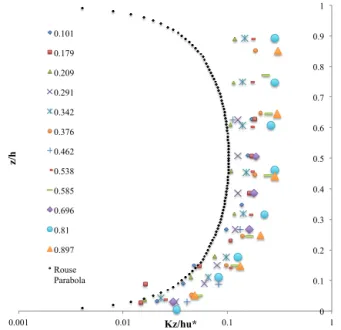
In the above equation, H is depth of the flow,κ is the von Karman constant, u∗ is the bed shear velocity andzis the normal distance from the bed. Even though Prandtl’s anal-ogy might not perfectly hold under all circumstances, the above relation (also known as the Rousian formulation for vertical eddy viscosity) has been used extensively in the field of suspended sediment transport. One of the first studies to question the universal applicability of the Rousian formula-tion was Coleman (1970); he used suspended sediment mea-surements from lab experiments and field meamea-surements to calculate Kz/H u∗ for sands with different values ofV /u∗.
Rearranging Eq. (3) and dividing both sides byH u∗gives us the formula used for calculatingKz/H u∗:
Kz
H u∗ = −
¯˜
cV˜
dc/¯˜ dz˜. (5)
0 0.1 0.2 0.3 0.4 0.5 0.6 0.7 0.8 0.9 1
0.001 0.01 0.1 1
z/h Kz/hu* 0.101 0.179 0.209 0.291 0.342 0.376 0.462 0.538 0.585 0.696 0.81 0.897 Rouse Parabola
Figure 1.Vertical sediment diffusivityKz/H u∗profiles for
sed-iments with differentV˜ =V /u∗. The data has been reproduced
from calculations done by Coleman (1970) on field data of Ander-son (1942). The generic Rousian profile of kinematic eddy viscosity has also been plotted. For most cases the Rousian profile underes-timates sediment diffusivity. There is a trend that vertical sediment diffusivity increases with increase inV˜; but the trend is not obvious for some of the cases plotted above (e.g. between 0.585 and 0.696).
In the above equation V˜ is V /u∗, z˜ is z/H and c¯˜ is the mean volumetric suspended sediment concentration normal-ized by volume-averaged concentration c(υ). In his study
Coleman (1970) used field data of Anderson (1942) to cal-culate Kz/H u∗, and the same data has been reproduced
here (Fig. 1) along with the Rousian profile calculated us-ing Eq. (4). It can be observed in Fig. 1 that Kz/H u∗ is
parabolic only in the lower portion of the domain; also for most cases the Rousian profile underestimates vertical sed-iment diffusivity. Van Rijn (1984) put forward the idea that the ratio of sediment diffusivity and kinematic eddy diffu-sivity is always greater than 1 and suggested the use of an empirical coefficient to adjust kinematic eddy diffusivity to match the vertical sediment diffusivity. However, Bennett et al. (1998) attributed the disparity to the use of suspended sed-iment concentration profiles to calculate sedsed-iment diffusivity, and instead recommended the use of direct turbulence mea-surements. In general, the common consensus has been that the Rousian profile is not an appropriate surrogate for vertical sediment diffusivity.
of the most prominent one is the inertial effect of relatively large sediment particles (Nielsen, 1992). Further, Nielsen and Teakle (2004) used the finite-mixing-length theory to justify their interpretation of Coleman’s (1970) data, in which they point out that vertical sediment diffusivity increases with in-crease in V /u∗ (dubbed as the Rouse number, though ex-act definition of the Rouse number is V /κu∗). In Fig. 1 data from Coleman (1970) has been reproduced; an obvious trend emerges whereKz/H u∗for cases with higherV /u∗is
higher than those with lowerV /u∗. But the aforementioned trend is not universal, and there are cases where the sedi-ment with relatively lowerV /u∗has higher or almost equal sediment diffusivity when compared with sediment with rel-atively higher V /u∗ (e.g. compare the cases withV /u∗ of 0.585 and 0.696). This may be an artefact of an unrecog-nized competing mechanism that tends to reduce the vertical sediment diffusivity with increase inV /u∗.
The hypothesis is that the aforementioned anomaly can be explained if the effect of self-stratification due to sus-pended sediment on sediment diffusivity is accounted. The settling sediment particles form a continuous concentra-tion profile, with higher concentraconcentra-tion near the bottom and lower at the top. This concentration gradient causes stratification in the fluid, and as the suspended sediment particles themselves cause stratification, the phenomenon is also referred to as self-stratification. This concentra-tion gradient is known to modulate turbulence and affect bulk properties of the flow (Cantero et al., 2009b, 2012; Shringarpure et al., 2012). Wright and Parker (2004) showed the importance of sediment-induced stratification in large low-gradient streams/rivers. Smith and McLean (1977) and McLean (1992), among others, proposed the use of simple algebraic closures based on the gradient Richardson number (Rig)to take into account the effect of self-stratification on
the Rousian profile. Through laboratory experiments, Cellino and Graf (1999) reported the suppression of turbulence due to presence of suspended sediment. In their experiments, they found the estimated momentum and sediment diffusivity to be smaller than the theoretically predicated value (the Rou-sian profile). Cellino and Graf (2000) also studied the effect of bed-forms on vertical sediment and momentum diffusivity, and found that presence of bed-forms increases the ratio of vertical sediment and momentum diffusivity from less than 1.0 to greater than 1.0 (Graf and Cellino, 2002).
The aim of the present study is to explore the effect of self-stratification on vertical sediment diffusivity under two dif-ferent configurations: first for channel flows, which is an ana-logue for flow in a pipe or a duct; and second for a boundary-layer configuration, which is similar to an open-channel flow. For the first portion of the study, we have used steady-state sediment concentration profiles from direct numerical sim-ulations (DNS) of sediment-laden flows. For the DNS, sed-iment has been modelled using an Eulerian approach with the assumption that the sediment particles do not have any inertia. Though this is not true for larger sediment in
na-ture, it is a good assumption for fine sediment. It was also done this way to explore the effect of self-stratification with-out other mechanisms (like inertial effects; see for example Cantero et al., 2008) coming into play. DNS was done for a constant shear Reynolds number (Reτ)but for different
lev-els of self-stratification, which depend on the sediment par-ticle settling velocity (parameterized usingV˜ =V /u∗)and volume-averaged suspended sediment concentration (param-eterized using shear Richardson numberRiτ). Traditionally,
sediment diffusivity under different circumstances has pri-marily been studied for the open-channel-like configuration; so the present study also explores it in the channel flow set-ting. Apart from using data from DNS, data from experi-ments by Ismail (1952) and Coleman (1986) have been used to study the effect of stratification on sediment diffusivity. The aim of the current study is to extend our understanding of the effects of self-stratification on sediment diffusivity in channel and open-channel-like flows.
2 Mathematical formulation
DNS were conducted for a horizontal channel, where the flow is driven by a constant pressure gradient. The constant pressure gradient here is a surrogate for a constant slope in a stream/river that drives the flow, especially for the open-channel-like configuration. Suspended sediment particles are assumed to be of constant size, negligible inertia, and hav-ing a constant settlhav-ing velocityV˜. Eulerian representation has been used to represent the suspended sediment particles, and this has been found to be valid for sediment particles that are small enough (Ferry and Balachandar, 2001). The flow is assumed to be dilute enough that the Boussinesq approxima-tion holds. The set of dimensionless equaapproxima-tions used to model the flow is
∂u˜i
∂t˜+ ˜uj
∂u˜i
∂x˜j= ˜
Gδi1− ∂pˆ ∂x˜i+
1 Reτ
∂2u˜i
∂x˜j∂x˜j−
Riτcδ˜ i3, (6a) ∂u˜i
∂x˜i =
0, (6b)
∂c˜ ∂t˜+
˜
uj− ˜V δi3 ∂c˜
∂x˜j =
1 Sc Reτ
∂2c˜ ∂x˜j∂x˜j
. (6c)
In the above equations,u˜i is the velocity of the fluid phase,
˜
might look out of place, but it serves multiple purposes. Even though the sediment particles are assumed to be big enough that their Brownian motion can be ignored, it is well estab-lished that relatively large particles can also diffuse due to long-range hydrodynamic interactions (Mucha and Brenner, 2003) and the diffusive term takes into account the aforemen-tioned mechanism. The diffusion term also provides a way to resuspend sediment from the bed (Garcia and Parker, 1993), while providing numerical stability (Cantero et al., 2009a) to the simulation.
In the above set of equations, all the variables are di-mensionless. Velocity has been made dimensionless using average shear velocity (u∗); the parameter used for scaling length is the channel half-heighth (where 2h is the height of the channel) and the parameter used for scaling pressure is ρfu2∗, where ρf is ambient fluid density. Equation (6)
has four dimensionless numbers, which together define var-ious properties of the flow; shear Reynolds number (Reτ),
shear Richardson number (Riτ), Schmidt number (Sc) and
the non-dimensional particle fall velocity (V )˜ . These non-dimensional numbers are defined as
Reτ=u∗νh Riτ=gRc
(υ)h
u2
∗ ,
Sc=Kν
s V˜ =
V u∗,
(7)
whereν is the kinematic viscosity,gis acceleration due to gravity,Ksis diffusivity of the sediment particles (this
diffu-sion of sediments arise from their long-range hydrodynamic interaction; see for example Segre et al., 2001), c(υ)is the volume-averaged concentration,R=ρs/ρf−1 andρsis the
density of the sediment particles. In the current study all the DNSs were done for Reτ=180. The shear Reynolds
num-ber of the flow was kept constant, as the aim of the study was to understand the effect of self-stratification when the flow remains the same. The shear Richardson number (Riτ)is
used to parameterize the initial volume-averaged suspended sediment concentration (c(υ)), and Riτ has been found to
play an important role in influencing the final degree of self-stratification (Dutta, 2012).V˜ has also been found to influ-ence the degree of self-stratification by defining the sediment concentration profile among different cases having constant
Riτ (initial sediment concentration) andReτ (Cantero et al.,
2009b). Dutta (2012) showed that bothV˜ andRiτhave an
ef-fect on the final degree of self-stratification, so in the current study bothV˜ andRiτ have been varied to impose different
levels of self-stratification. Based on observations made in previous studies (Cantero et al., 2009b), in the present study the Schmidt number (Sc) has been kept equal to 1.
The above-stated governing equations were solved using a dealiased pseudo-spectral code. The setup is exactly the same as the one used by Cantero et al. (2009b), so further details of the exact numerical methods adopted can be found there. Dimensions of the rectangular domain used for the nu-merical simulations were L˜x=4π,L˜y=4π /3 andL˜z=2,
and the domain was discretized using a computational grid
having Nx=96, Ny=96 and Nz=97 nodes in the x, y
andz(wall-normal) directions respectively. The grid size is uniform in the longitudinal and transverse directions, and in terms of wall units (z˜+)they are 23.562 and 7.854 respec-tively. For the wall-normal direction a Chebyshev expansion with Gauss–Lobatto quadrature points has been used. This allows for a very high resolution near the boundaries and rel-atively lower resolution at the centre of the domain. In terms of wall units, the distance between two nodes is 0.0964 for the nodes near the wall and 5.889 at the centre of the do-main. Cantero et al. (2009b) had found the aforementioned computation-grid resolution sufficient for capturing all the relevant flow statistics. Periodic boundary conditions were used in the longitudinal and transverse directions. The top and bottom walls of the domain were assumed to be smooth; and depending on the configuration simulated, a no-slip or slip boundary condition was imposed on the fluid phase at the top wall. At the bottom wall a no-slip condition was em-ployed for all simulations. Sediment particles were assumed to be fine enough to have zero net deposition; thus a boundary condition was imposed, which instantly re-entrains all set-tled sediment particles. For the channel flow configuration, the imposed boundary conditions are mathematically repre-sented as
˜
ui=0 at z˜= −1 and z˜=1, (8a)
˜
cV˜+ 1 ReτSc
∂c˜
∂z˜ =0 at z˜= −1 and z˜=1. (8b)
For the open-channel-like configuration (boundary-layer configuration), the imposed boundary conditions are
˜
ui=0 at z˜= −1 and
∂u˜ ∂z˜ =
∂v˜
∂z˜ = ˜w=0 at z˜=1, (9a)
˜
cV˜+ 1 ReτSc
∂c˜
∂z˜ =0 at z˜= −1 and z˜=1. (9b)
The boundary condition imposed for suspended sediment al-lows the net amount of sediment in suspension to remain con-stant throughout the simulation. When integrated over time, the aforementioned condition allows the flow to reach a sta-tistically steady state (Cantero et al., 2009b).
3 Results
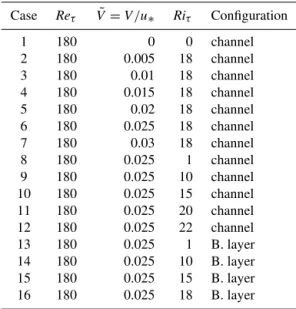
Sixteen DNS simulations were run for the present study. They were all run for the same shear Reynolds number of 180, but different particle fall velocities (V )˜ and shear Richardson number (Riτ). All the simulated cases have been
Table 1.The table lists all the cases of direct numerical simulations
used in the current study. All the simulations have the sameReτ.
Cases 1–12 correspond to the simulations for channel configura-tion and 13–16 correspond to the simulaconfigura-tions for open-channel-like configuration. Case 1 corresponds to the case with no sediment in suspension, and was simulated to compare with the self-stratified cases.
Case Reτ V˜ =V /u∗ Riτ Configuration
1 180 0 0 channel
2 180 0.005 18 channel
3 180 0.01 18 channel
4 180 0.015 18 channel
5 180 0.02 18 channel
6 180 0.025 18 channel
7 180 0.03 18 channel
8 180 0.025 1 channel
9 180 0.025 10 channel
10 180 0.025 15 channel
11 180 0.025 20 channel
12 180 0.025 22 channel
13 180 0.025 1 B. layer
14 180 0.025 10 B. layer
15 180 0.025 15 B. layer
16 180 0.025 18 B. layer
sediment diffusivity profiles, three different parameters were defined and calculated for each of the sediment diffusivity profiles. The parameters (also referred to asshape factors) are mean sediment diffusivityKzµ, variance within the
sed-iment diffusivity profile Kzσ and skewness of the sediment
diffusivity profileKzγ. Three parameters were used in order
to take care of ambiguity that may arise due to two different profiles having almost the same mean or/and variance. The three parameters have been defined below.
Kzµ= H
Z
0 Kz(z)
H dz (10a)
Kzσ =
H
Z
0
Kz−Kzµ
2
H dz
1/2
(10b)
Kzγ = H
R
0
(Kz−Kzµ)3
H dz H
R
0
(Kz−Kzµ)2
H dz
!3/2 (10c)
In the equations defined above, H corresponds to the total depth of the flow.
3.1 Channel flow configuration
Among the twelve simulations done for the channel flow con-figuration, the first one was done without any suspended
sed-Table 2.The table lists all the cases of direct numerical simulations
used in the current study along withV Ri˜ τ for each of the cases.
˜
V Riτis a parameter which represents the level of self-stratification;
and a higher value of V Ri˜ τ corresponds to a higher level
self-stratification ifReτremains constant. Cases 1–12 correspond to the
simulations for channel configuration and 13–16 correspond to the simulations for open-channel-like configuration. The corresponding sediment diffusivity profiles were quantified using Eq. (10), and the
calculated parametersKzµ,Kzσ,Kzγ have also been listed in the
table.Kzµparameterizes the mean sediment diffusivity,Kzσ
pa-rameterizes the variance in the sediment diffusivity profile andKzγ
parameterizes the skewness of the sediment diffusivity profile.
Case V Ri˜ τ Kzµ Kzσ Kzγ
2 0.090 0.0607 0.0231 −0.9897
3 0.180 0.0485 0.0212 −0.3191
4 0.270 0.0412 0.0231 0.3853
5 0.360 0.0426 0.0310 0.6639
6 0.450 0.0602 0.0516 0.3016
7 0.540 0.0610 0.0523 0.2976
8 0.025 0.0724 0.0272 −1.3216
9 0.250 0.0452 0.0272 0.5594
10 0.375 0.0618 0.0525 0.2931
11 0.500 0.0592 0.0511 0.31162
12 0.550 0.0582 0.0507 0.3255
13 0.025 0.1927 0.0882 −0.7991
14 0.25 0.1430 0.0716 −0.5649
15 0.375 0.1278 0.0676 −0.4417
16 0.450 0.1204 0.0653 −0.3882
iment. A set of simulations (set1) was done for constant shear Richardson number but increasingV˜. This set is equivalent to the situation where the initial volume-averaged suspended sediment concentration is constant but the sediment particle size increases. The other set of simulations (set2) done for the same configuration is with a constantV˜ equal to 0.025 but increasing shear Richardson number. This set is equiv-alent to the situation where the particle size of sediment is constant but the initial volume-averaged suspended sediment concentration increases. For bothset1 andset2increase in
˜
V orRiτwhile keeping the other parameters constant results
in an increase in the degree of stratification. Dutta (2012) showed that increase in eitherV˜ orRiτ increases the degree
of self-stratification caused by suspended sediment and the extent to which a flow will stratify depends on the parameter
˜
V Riτ. Cantero et al. (2012) made similar observations for
turbidity currents.
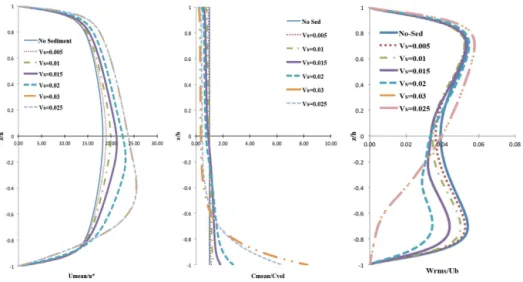
Figure 2.Results from the DNSs in a channel flow setting, for increasingV˜ andRiτ=18. The mean streamwise velocity and asymmetry of
the flow increase with increase inV˜. Increase inV˜ increases the degree of self-stratification of the flow; this leads to increase in the sediment concentration gradient and higher amount of turbulence damping near the channel bottom. In the channel, normalized turbulence intensity
(Wrms/Ub)is modulated, with a decrease in the lower half of the channel and slight increase in the upper half of the channel.
Figure 3.Results from the DNSs in a channel flow setting, for increasingRiτandV˜=0.025. The mean streamwise velocity and asymmetry
of the flow increase with increase inRiτ. Increase inRiτ increases the degree of self-stratification of the flow; this leads to increase in the
sediment concentration gradient and higher amount of turbulence damping near the channel bottom. In the channel, normalized turbulence
intensity (Wrms/Ub)is modulated, with a decrease in the lower half of the channel and slight increase in the upper half of the channel.
decrease in drag results in an increase in the flow discharge in the channel, as the force driving the flow remains the same (the constant unit pressure gradientG)˜ . Even though the bulk streamwise velocity increases, turbulence intensity (Wrms)in
the channel decreases, especially near the channel bottom. The reduction in bottom drag is connected to the reduction of turbulence activity near the bottom of the channel. Reduced turbulence activity in turn reduces the Reynolds stress, thus eventually reducing the total drag at the bottom. Flow in the channel at different levels of self-stratification can be clearly divided into two regimes: first regime (for V Ri˜ τ≤0.36)
in which the turbulence near the bottom of the channel is
damped but the flow in general is still turbulent. Second regime (forV Ri˜ τ ≥0.45)in which turbulence near the
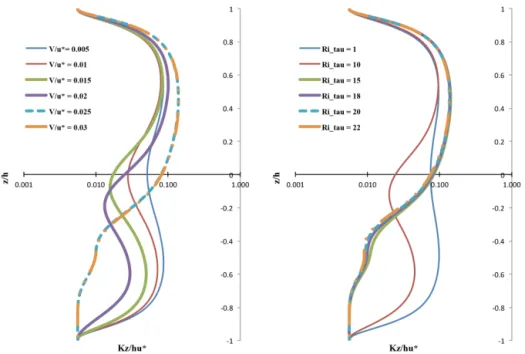
turbulence intensity profiles in Figs. 2 and 3. The aforemen-tioned similarity is along the expected lines because the ex-act definition of vertical sediment diffusivity is nothing but a surrogate used to model the vertical sediment flux due to tur-bulence (w′c′). So wherever turbulence is damped,Kz/H u∗
decreases and wherever turbulence increases Kz/H u∗ also
increases. The effect of self-stratification on sediment diffu-sivity is similar to the effect it has on turbulent intensity. The calculated sediment diffusivity profiles (Fig. 4) were quan-tified using Eq. (10a–c), and the parametersKzµ,Kzσ and
Kzγ have been listed in Table 2. The mean sediment
diffu-sivity shows a counterintuitive trend, initially mean diffusiv-ity (Kzµ)decreases with increase in stratification (V Ri˜ τ)but
then it suddenly increases and then starts to decrease again (see Fig. 5). The sudden increase is associated with increase of sediment diffusivity in the upper part of the domain. The presence of a top wall which continues to pump turbulent energy into the system, even after the flow at the bottom has relaminarized, is responsible for the variation in the ex-pected trend of decrease of mean sediment diffusivity with increase in stratification, which can be observed in Fig. 5 for the case of open-channel flow.Kzµfor the open-channel flow
cases was obtained from DNS simulations that are discussed in the next section. The above-mentioned trend is also re-flected in the parameter describing the variation of sediment diffusivity within each profile (Kzσ). The trends reflected
by all the parameters clearly show the presence of two dis-tinct regimes in the flow. Additionally, the normalized sedi-ment concentration profiles of the simulated cases were plot-ted with the corresponding analytically obtained suspended sediment concentration profiles. The sediment concentration profiles were normalized using a reference concentration at a height of b=0.05H, where H is the total depth of the channel. For the boundary-layer (open-channel-like) config-uration, which will be discussed in the next section, the an-alytical sediment concentration is given by the well-known Rouse–Vanoni–Ippen suspended sediment distribution (Gar-cia, 2008):
¯
c
¯
cb =
(H
−z)/z
(H−b)/b V /u∗κ
, (11)
wherec¯b is the reference sediment concentration that is the
sediment concentration at a heightb, andbas defined above. H is the total depth of the flow and rest of the parameters are as previously defined. For the channel flow configuration, a similar relationship was not available. Thus a relationship for suspended sediment concentration in a channel was derived using Eq. (5), an approximate relationship for eddy viscosity in a pressure-driven-channel flow, and the appropriate bound-ary conditions (Schlichting and Gersten, 2000). The derived
relationship for sediment concentration is
¯
c
¯
cb =
exp
− V
u∗κ
ln
z/(z
−2H )
b/(b−2H )
+√8 (12)
tan−1
√
2(z−H ) H
!
−tan−1
√
2(b−H ) H
!!)# .
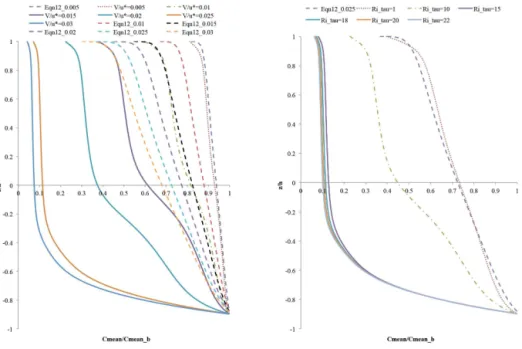
In the above relationshipHis the channel half depth and the rest of the parameters are as earlier. Equation (12) was used along with the sediment concentration profiles from the DNS simulations to plot Fig. 6. The normalized sediment concen-tration profile predicated by Eq. (12) was found to match very well with the DNS-predicted normalized sediment concen-tration profiles for the cases having relatively small stratifica-tion (V Ri˜ τ<0.1). The performance of Eq. (12) deteriorated
with increase inV Ri˜ τ, so it clearly shows that the
relation-ship is not able to accommodate the effect self-stratification might have on the suspended sediment concentration pro-files, especially the one induced by increase in the concen-tration of suspended sediment.
3.2 Boundary-layer configuration
Four numerical simulations were done for the boundary-layer configuration. The boundary-boundary-layer configuration is sim-ilar to the open-channel configuration but not exactly the same. Like the open-channel configuration, a slip boundary condition is imposed at the top wall for the fluid phase. In Fig. 7, bulk streamwise velocity, steady-state sediment con-centration profile and normalized turbulence intensity have been plotted. The four simulations for the open-channel-like configuration have the same particle fall velocity (V )˜ but increasing shear Richardson number. Similar to the chan-nel flow configuration, bulk streamwise velocity was found to increase with increase in shear Richardson number. Tur-bulence intensity was found to decrease with increase in shear Richardson number, and unlike the channel flow con-figuration where turbulence intensity decreases in the lower half of the channel and increases in the upper half; turbu-lence intensity was found to decrease throughout the chan-nel. Though, the extent of damping in the upper half was found to be slightly more than the extent of damping in the lower half of the boundary layer. The steady-state sed-iment concentration profiles in Fig. 7 were used to calcu-late vertical sediment diffusivity profiles (Fig. 8) for the four cases simulated. Reflecting the trend shown by turbu-lence intensity, vertical sediment diffusivity was found to de-crease with inde-crease in level of self-stratification. The sedi-ment diffusivity profiles were quantified using Eq. (10) and the parametersKzµ, Kzσ andKzγ have been listed in
Ta-ble 2. Unlike the channel flow cases where the trend was counterintuitive, the mean sediment diffusivity (Kzµ) and
variation (Kzσ)decreases with increase in stratification (see
Figure 4. The trend for vertical sediment diffusivity mirrors the trend found for turbulence intensity. An increase in degree of self-stratification is found to decrease sediment diffusivity in the lower half of the channel and increase sediment diffusivity in the upper half of the channel. This is not completely unexpected because mixing of suspended sediment is primarily dependent on turbulence in the flow.
0.1 0.11 0.12 0.13 0.14 0.15 0.16 0.17 0.18 0.19 0.2
0.03 0.035 0.04 0.045 0.05 0.055 0.06 0.065 0.07 0.075
0 0.1 0.2 0.3 0.4 0.5 0.6
Kz_
mu
VRi_tau
channel_Ri_tau=18.0 channel_V=0.025 och_V=0.025
Figure 5.Mean sediment diffusivity (Kzµ)calculated from all the
DNS simulations has been plotted against the corresponding level of stratification (V Ri˜ τ).Kzµfor the boundary-layer cases
(open-channel-like configuration) has been plotted on the secondary y
axis.Kzµfor the open-channel cases decrease monotonically with
increase in stratification (V Ri˜ τ). The aforementioned trend is not
reflected in the channel flow configuration. Kzµ for the channel
flow configuration has been plotted on the primaryyaxis, and show
a counterintuitive trend of first decreasing, then increasing and then again decreasing with increase inV Ri˜ τ.
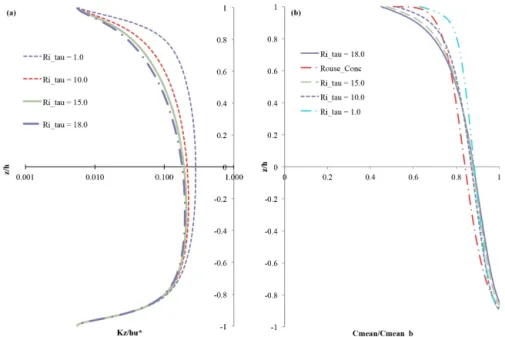
with the corresponding analytically obtained suspended sed-iment concentration profile using the Rouse–Vanoni–Ippen relationship (Eq. 11). The normalized sediment concentra-tion profile predicted by the Rouse–Vanoni–Ippen relaconcentra-tion-
relation-ship was found to match well with the DNS simulations for relatively lower stratification, and the difference increased appreciably with increase in stratification. In the next section the larger implication of the results presented in the previous sections will be discussed. Additionally, the trends observed in the DNS results will be compared with data from lab ex-periments and field measurements.
4 Discussion
In the preceding sections we saw how self-stratification due to suspended sediments can reduce sediment diffusivity in a flow. All the discussed results were on the basis of high-resolution numerical simulations, which were set up to ex-clusively capture the effect of self-stratification on sediment diffusivity. In order to vet our hypothesis further, we have compared our results with experimental observations of Is-mail (1952) and Coleman (1986).
Figure 6.Normalized sediment concentration profiles from DNS simulations of the channel flow have been plotted with the sediment profile obtained using Eq. (12). The results from the DNS simulations matched very well with the derived relationship (Eq. 12) for relatively lower stratification (V Ri˜ τ<0.1).
Figure 7. Results from the DNS simulations in a boundary-layer (open-channel-like) setting, for increasingRiτ andV˜ =0.025. Mean
streamwise velocity of the flow increases with increase inRiτ. An increase inRiτ increases the degree of self-stratification of the flow; this
leads to an increase in the sediment concentration gradient and higher amount of turbulence damping through out the domain. Normalized
turbulence intensity (Wrms/Ub)is damped throughout the boundary layer but the level of suppression is slightly higher in the upper half.
(Ismail, 1952; Cellino and Graf, 2000). But as the compar-ison between the numerical and the experimental results is strictly qualitative, the effect of the dunes has been neglected. Mean streamwise velocity profiles for cases with (case 117) and without sediment (case 5) have also been reproduced from Ismail (1952), in order to compare the effect suspended sediment has on mean streamwise velocity. Figure 9a reflects the trend shown for streamwise velocity in the DNS results. Compared with the case without sediment, we clearly see in the case with sediment that streamwise velocity in the upper
half of the channel increases whereas in the lower half de-creases. Suspended sediment concentration profiles for cases 74–76 and 78 were used to calculate the sediment diffusivity profiles (Fig. 9b). All the cases used in the present study have been listed in Table 3; along with their corresponding shear Reynolds number,Riτ,V˜ andV Ri˜ τ. Amongst the cases
plot-ted in Fig. 9, case 74 has the highest level of self-stratification (V Ri˜ τ)and case 78 the lowest. And moving from case 78 to
Figure 8.In(a), the trend for vertical sediment diffusivity mirrors the trend found for turbulence intensity. An increase in the degree of self-stratification is found to decrease sediment diffusivity in the boundary layer. The extent to which sediment diffusivity decreases in the upper half of the boundary layer is slightly higher than the lower half of the boundary layer. This is not completely unexpected because
mixing of suspended sediment is primarily dependent on turbulence in the flow. In(b), normalized sediment concentration profiles from
DNS simulations have been plotted along with the sediment profile obtained using the Rouse–Vanoni–Ippen relationship.
Figure 9.Streamwise velocity for cases 5 and 117 have been reproduced from Ismail (1952). Case 5 has no sediment in suspension and case 117 has suspended sediment. Vertical sediment diffusivity for cases 74–76, and 78 was calculated from sediment concentration profiles from
experiments performed by Ismail (1952). With an increase inV Ri˜ τ, vertical sediment diffusivity in the channel slightly increases in the top
half of the channel and decreases in the lower half of the channel; this completely agrees with the DNS results.
The trend shown by sediment diffusivity calculated from the experimental data of Ismail (1952) concur with the trend ob-served in the DNS results (Fig. 4). The parametersKzµ,Kzσ
andKzγ were calculated using the sediment diffusivity
pro-files in Fig. 9 and Eq. (10) and have been listed in Table 4. The mean sediment diffusivity (Kzµ)showed a trend similar
to the one observed for the DNS results.
Table 3.List of all the experiments of Ismail (1952) used in the present study.
Case Reτ V˜ =V /u∗ Riτ V Ri˜ τ
74 1409 0.25 3.629 0.90723
75 1546 0.197 4.426 0.87192
76 1978 0.176 3.192 0.56179
78 2698 0.133 1.729 0.22996
5 1768 0 0 0
117 2188 0.359 2.926 1.05043
Table 4.List of the parametersKzµ,Kzσ, andKzγ, calculated from
the sediment diffusivity profiles of the cases listed in Table 3.
Case V Ri˜ τ Kzµ Kzσ Kzγ
74 0.90723 0.0907 0.0276 −0.0819
75 0.87192 0.0893 0.0302 0.4050
76 0.56179 0.0896 0.0257 0.6515
78 0.22996 0.0898 0.0142 −0.9668
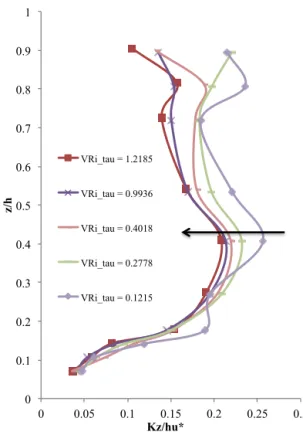
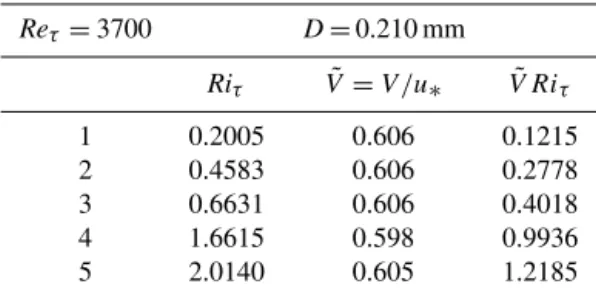
found the presence of suspended sediment slightly decreased the streamwise velocity near the bottom of the channel and slightly increased it in the upper half of the channel. An increase in streamwise velocity in the upper portion of the boundary layer is also consistent with observations by Baren-blatt and Golitsyn (1974) for “mature dust storms”. For the present study, we only used the suspended sediment concentration profiles for sediment with a diameter (D)of 0.210 mm. Coleman, in his experiments, used sediment of three different mean diameters, but the hydraulic condition (constant slope and discharge) was kept constant. For each sediment size, sediment was added to the flow till the amount of sediment suspended in the flow reached its maximum (also called the capacity condition). So, for a particular sediment size and flow condition, there are suspended sediment pro-files for different net sediment concentrations. The sediment concentration profiles were used to calculate vertical sedi-ment diffusivity profiles (Fig. 10). The cases used for the present study have been listed in Table 5, along with the cor-responding V˜,Riτ andV Ri˜ τ.V Ri˜ τ increases from case 1
to case 5. In Fig. 10 vertical sediment diffusivity decreases with increase inV Ri˜ τ, especially if the difference between
case 1 and case 5 is observed; though it is noticeable that the trend of decreasing sediment diffusivity with increase in V Ri˜ τ is not monotonic. This may be attributed to two
or more competing mechanisms trying to influence the sed-iment diffusivity in opposite directions. For example, it is known that depending on the size of the sediment particles in suspension, suspended sediment can increase turbulent ki-netic energy (Niño and Garcia, 1998) of the flow, which can then lead to higher sediment diffusivity; whereas increase in self-stratification tends to lower sediment diffusivity. An-other factor that might be contributing to this slight
incon- 0 0.1 0.2 0.3 0.4 0.5 0.6 0.7 0.8 0.9 1
0 0.05 0.1 0.15 0.2 0.25 0.3
z/h
Kz/hu* VRi_tau = 1.2185
VRi_tau = 0.9936
VRi_tau = 0.4018
VRi_tau = 0.2778
VRi_tau = 0.1215
Figure 10.Vertical sediment diffusivity was calculated using sed-iment concentration profiles from expersed-iments performed by Cole-man (1986). With an increase inV Ri˜ τ(cases 1–5), the vertical
sed-iment diffusivity in the open-channel flow decreases.
sistency of the trend in the present case is irregularity of the
˜
V values for different cases (refer to Table 5). Even though theoretically all the cases should have the sameV˜, the ex-perimental observations actually have some inconsistencies (we checked a copy of the actual data set of N. L. Coleman). As change inV˜ has an influence on the mixing length of the fluid (Nielsen and Teakle, 2004), these small inconsistencies inV˜ might be obfuscating the expected trend of decrease of sediment diffusivity with an increase inV Ri˜ τ. Apart from
the above-mentioned issue with the size of sediment in sus-pension, there are inherent uncertainties in estimation of sed-iment diffusivity, which stem from calculation of shear ve-locityu∗and correct measurement of the sediment concen-tration. The calculated values ofu∗ in each of the experi-ments fall within 2.5 % of each other, but this variation was not found to cause any substantial change to the calculated values of sediment diffusivity. The parametersKzµ,Kzσ and
Kzγ were also calculated (Table 6); as expected, Kzµ was
found to decrease with an increase in stratification. Whereas there was no appreciable change inKzσ andKzγ.
A significant point to come out of the preceding discus-sions is that along with the particle settling velocity (V )˜ , suspended sediment concentration (Riτ)is an important
Table 5.List of all the experiments of Coleman (1986) used in our study.
Reτ=3700 D=0.210 mm
Riτ V˜ =V /u∗ V Ri˜ τ
1 0.2005 0.606 0.1215
2 0.4583 0.606 0.2778
3 0.6631 0.606 0.4018
4 1.6615 0.598 0.9936
5 2.0140 0.605 1.2185
Table 6.List of the parametersKzµ,Kzσ, andKzγ, calculated from
the sediment diffusivity profiles of the cases listed in Table 5.
Reτ=3700 D=0.210 mm
Kzµ Kzσ Kzγ
1 0.2009 0.5404 1.2555
2 0.1862 0.5404 1.2561
3 0.1748 0.5435 1.2565
4 0.1603 0.5403 1.2569
5 0.1560 0.5467 1.2571
increase sediment diffusivity with the increase in V˜ (van Rijn, 1984; Nielsen and Teakle, 2004) of the suspended sed-iment, the increase in stratification due to suspended sedi-ment decreases sedisedi-ment diffusivity. And this effect of self-stratification on sediment diffusivity can explain the anomaly in the expected trend of increasing sediment diffusivity with an increase ofV˜ in Fig. 1.
5 Conclusions
In the present study sediment concentration profiles from di-rect numerical simulations of sediment-laden flow through a channel were used, to calculate sediment diffusivity pro-files for the channel flow and boundary-layer configuration. The DNS simulations facilitated the evaluation of the ef-fect sediment-induced self-stratification has on sediment dif-fusivity, without any other competing mechanism playing a role. For the channel flow configuration, an increase in stratification was found to decrease sediment diffusivity in the lower half of the channel and slightly increase sedi-ment diffusivity in the upper half of the channel. For the boundary-layer (open-channel-like) configuration, through-out the channel, sediment diffusivity was found to decrease with the increase in stratification. Though the extent of sup-pression of sediment diffusivity in the lower half of the boundary layer is appreciably lower than rest of the boundary layer; along the expected lines, the sediment diffusivity pro-files reflected the computed turbulence intensity propro-files. Ob-servations from the DNS results were vetted against experi-mental results from Ismail (1952) and Coleman (1986).
Sed-iment diffusivity profiles calculated using concentration pro-files from Ismail’s closed-channel experiments were found to be consistent with the DNS results. Sediment diffusivity profiles calculated using sediment concentration data from Coleman’s (1986) experiments were more or less consistent with the DNS results, but the trend of decrease of sediment diffusivity with increase in stratification was erratic. For the present study only one set of Coleman’s (1986) experiments was used; it would be interesting to repeat the calculations using data from the rest of Coleman’s (1986) experiments and other similar experiments (Cellino, 1998). Through the current study, sediment-induced stratification has been put forth as a plausible explanation for the inconsistencies seen in the expected trends of sediment diffusivity profiles in Fig. 1. There are still other mechanisms (Niño and Garcia, 1998) whose effects on sediment diffusivity have to be even-tually evaluated, because a better understanding of sediment diffusivity and the various factors it depends on will eventu-ally help us to ascertain the suspended load in rivers/streams more accurately. At the end of the day, the interaction be-tween suspended sediment and the ambient fluid is highly non-linear and will require further exploration to reveal more of its secrets.
Acknowledgements. We would like to thank Gary Parker, Carlos Pantano and Tzu-Hao Yeh for all the thought provoking and helpful discussions on the topic. This research was possible thanks to the Chester and Helen Siess Professorship in Civil Engineering at the University of Illinois. The support received by the junior author from a CSE Graduate Student Fellowship and the Ravindar K. and Kavita Kinra Fellowship in Civil and Environmental Engineering is gratefully acknowledged. We would also like to thank the two anonymous reviewers for their cogent and insightful remarks, which have contributed towards improving this work. Finally, we would like to thank handling associate editor Francois Metivier for his help during the whole process.
Edited by: F. Metivier
References
Anderson, A. G.: Distribution of suspended sediment in a natural stream, Trans. Amer. Geophys. Union, 23, 678–683, 1942. Barenblatt, G. I. and Golitsyn, G. S.: Local structure of mature dust
storms, J. Atmos. Sci., 31, 1917–1933, 1974.
Bennett, S. J., Bridge, J. S., and Best, J. L.: The fluid and sediment dynamics of upper-stage plane beds, J. Geophys. Res.-Oceans, 103, 1239–1274, 1998.
Cantero, M. I., Balachandar, S., and Garcia, M. H.: An Eulerian-Eulerian model for gravity currents driven by intertial paritcles, Int. J. Multiphas. Flow, 34, 484–501, 2008.
Cantero, M. I., Balachandar, S., and Parker, G.: Direct Numerical Simulation of stratification effects in a sediment-laden turbulent channel flow, J. Turbul., 10, p. N27, 1–28, 2009b.
Cantero, M. I., Shringarpure, M., and Balachandar, S.: Towards a universal criteria for turbulence suppression in dilute turbidity currents with non-cohesive sediments, Geophys. Res. Lett., 39, L14603, doi:10.1029/2012GL052514, 2012.
Cellino, M.: Experimental study of suspension flow in open chan-nels, Doctoral dissertation 1824, Ecole Polytechnique federale de Lausanne, Switzerland, 1998.
Cellino, M. and Graf, W. H.: Sediment-laden flow in open-channels under non-capacity and capacity conditions, J. Hydraul. Eng., 125, 455–462, 1999.
Cellino, M. and Graf, W. H.: Experiments on suspension flow in open channels with bed forms, J. Hydraul. Res., 38, 289–298, 2000.
Coleman, N. L.: Flume studies of the sediment transfer coefficient, Water Resour. Res., 6, 801–809, 1970.
Coleman, N. L.: Effects of suspended sediment on the open-channel velocity distribution, Water Resour. Res., 22, 1377–1384, 1986. Dutta, S.: Effect of self-stratification on channel flows and
bound-ary layers: a study using direct numerical simulations, MS thesis, University of Illinois at Urbana-Champaign, USA, 2012. Ferry, J. and Balachandar, S.: A fast Eulerian method for disperse
two-phase flow, Int. J. Multiphas. Flow, 27, 1199–1226, 2001. Garcia, M. H. (Ed.): Manual 110. Sedimentation Engineering:
pro-cesses, measurements, modelling and practice, ASCE, 46, Re-ston VA, USA, 2008.
Garcia, M. H. and Parker, G: Experiments on the entrainment of sediment into suspension by a dense bottom current, J. Geophys. Res., 98, 4793–4807, 1993.
Graf, W. H. and Cellino, M: Suspension flows in open channels; experimental study, J. Hydraul. Res., 40, 435–447, 2002. Ismail, H. M.: Turbulent transfer mechanisms and suspended
sedi-ment in closed channels, T. Am. Soc. Civ. Eng., 117, 409–434, 1952.
McLean, S. R.: On the calculation of suspended load for non-cohesive sediments, J. Geophys. Res., 99, 5759–5770, 1992. Mucha, P. J. and Brenner, M. P.: Diffusivities and front propagation
in sedimentation, Phys. Fluids, 15, 1305–1313, 2003.
Nielsen, P.: Coastal bottom boundary layer and sediment transport, World Scientific, River Edge NJ, USA, 1992.
Nielsen, P. and Teakle, I. A. L.: Turbulent diffusion of momentum and suspended particles: A finite-mixing-length theory, Phys. Fluids, 16, 2342–2348, 2004.
Niño, Y. and Garcia, M. H.: On Engelund’s analysis of turbulent energy and suspended load, J. Eng. Mech-ASCE, 124, 480–483, 1998.
Rouse, H.: Modern conceptions of the mechanics turbulence, T. Am. Soc. Civ. Eng., 102, 463–543, 1937.
Rouse, H.: Experiments on the mechanics of sediment suspension. Proceedings, 5th International Congress for Applied Mechanics, Vol. 55, 550–554, John Wiley & Sons, New York, 1938. Schlichting, H. and Gersten, K.: Boundary Layer Theory,
Springer-Verlag, 8th Edn., 2000.
Segre, P. N., Liu, F., Umbanhowar, P., and Weltz, D. A.: An effective gravitational temperature for sedimentation, Nature, 409, 594– 597, 2001.
Shringarpure, M., Cantero, M. I., and Balachandar, S.: Dynamics of complete turbulence suppression in turbidity currents driven by monodisperse suspensions of sediment, J. Fluid Mech., 712, 384–417, 2012.
Smith, J. D. and McLean, S. R.: Spatially averaged flow over a wavy surface, J. Geophys. Res., 82, 1735–1746, 1977.
Vanoni, V. A.: Transportation of sediment by water, Trans. AGU, 3, 67–133, 1946.
Van Rijn, L. C.: Sediment Transport, part II: suspended load trans-port, J. Hydraul. Eng.-ASCE, 110, 1613–1641, 1984.