Journal homepage:www.ijaamm.com
International Journal of Advances in Applied Mathematics and Mechanics
A study on fractional order magneto-thermoelasticity with
three-phase-lag
Research Article
Sandeep Singh Sheorana,∗, Sandeep Kundua, Pradeep Kundub
aDepartment of Mathematics, Guru Jambheshwar University of Science&Technology, Hisar, Pin-125001, Hisar, India bDepartment of Mechanical Engineering, Indian Institute of Technology, Delhi, Pin-110016, Delhi, India
Received 24 June 2016; accepted (in revised version) 02 July 2016
Abstract: In this work, we consider a two-dimensional fractional order generalized thermoelastic problem in a homogeneous, isotropic and perfectly conducting thermoelastic half-space subjected to a moving load. The surface of half-space is initially placed in an external magnetic field with constant intensity and therefore, Maxwell’s theory of electrody-namics has been effectively introduced. The basic governing equations of the problem are derived in the context of fractional order three phase lag model of generalized thermoelasticity (Ezzat et al. [35]). The formulation is solved by using Laplace-Fourier transform technique and inversion is carried out numerically. Numerical results are computed and represented graphically for the displacement, temperature and stress distributions. Effects of fractional order pa-rameter and magnetic field on the different thermoelastic fields are analyzed on the basis of analytical and numerical results. Some special cases have also been deduced from the present investigation.
MSC: 74A15• 80A20
Keywords:Fractional order three-phase-lag model • Generalized thermoelasticity • Magnetic field • Laplace-Fourier transforms •Moving load
© 2016 The Author(s). This is an open access article under the CC BY-NC-ND license(https://creativecommons.org/licenses/by-nc-nd/3.0/).
1. Introduction
Based on thermodynamical principle of irreversible processes, Biot [1] proposed the coupled theory of ther-moelasticity by including the coupling between thermal and strain fields. This theory removes the first drawback but shares the second defect of the uncoupled theory due to the presence of parabolic type heat conduction equation. Many approaches were introduced to overcome this unacceptable prediction of the classical uncoupled and coupled theories. The general notion of relaxing the heat flux in the classical Fourier heat conduction equation is the basis of these approaches.
Lord and Shulman [2] introduced the theory of generalized thermoelasticity for an isotropic body, referred to as L-S theory or extended thermoelasticity theory. The L-S theory postulated a wave-type heat conduction law to re-place the classical Fourier’s law and ensures finite speed of propagation of the thermal and elastic waves. Green and Lindsay [3] proposed another generalized thermoelasticity theory termed as G-L theory or temperature-rate depen-dent theory of thermoelasticity. G-L theory modified both the energy equation and the Duhamel-Neumann relation and incorporates two relaxation times. The extension of the L-S theory to the anisotropic case has been established by Dhaliwal and Sherief [4]. The development of the generalized theories has been reviewed by Chandrasekharaiah [5]. Green and Naghdi [6–8] formulated three models of thermoelasticity for homogeneous and isotropic materials referred to as G-N models of type I, II and III. Sur and Kanoria [9] presented an analysis of thermoelastic response in a functionally graded infinite space subjected to a Mode-I crack under Green-Naghdi generalized thermoelasticity theory using normal mode analysis.
∗ Corresponding author.
Subsequently, Tzou [10] proposed a dual-phase-lag heat conduction model to incorporate the effects of mi-croscopic interactions in the fast-transient process of heat transport mechanism in a mami-croscopic formulation. Two different phase-lagsτTandτqhave been introduced in the constitutive relation between heat flux vector and the tem-perature gradient. The delay timeτT is interpreted as that caused by the micro-structural interactions and is called the phase-lag of the temperature gradient. The other delay timeτqis interpreted as the relaxation time due to the fast transient effects of the thermal inertia, which is called the phase-lag of the heat flux.
Roy Choudhuri [11] proposed a generalized mathematical model of a coupled thermoelasticity theory that in-cludes three-phase-lagτT,τqandτνfor the heat flux vector, the temperature gradient and the thermal displacement
gradient respectively. Quintanilla and Racke [12] discussed the stability in the three-phase-lag heat conduction equa-tion and the relaequa-tions among the three different phase lagsτT,τqandτνto be satisfied. Deswal and Kalkal [13] solved
a three-dimensional problem by employing normal mode analysis under two-temperature thermo-viscoelasticity the-ory with three-phase-lag heat transfer. Sur and Kanoria [14] investigated the elasto-thermodiffusive interactions in a homogeneous and isotropic half-space under initial hydrostatic stress in the context of three-phase-lag theory, Green-Naghdi type II theory and Green-Green-Naghdi type III theory of generalized thermoelasticity.
Kaliski and Nowacki [15] investigated the magneto-thermoelastic disturbances generated by a thermal shock in an elastic half-space, having a finite conductivity. A survey of relevant magneto-thermoelasticity theories was stud-ied by Willson [16], Purushothama [17], Paria [18] etc., in the second half of the last century. Nayfeh and Nemat-Nasser [19] studied the propagation of plane waves under generalized magneto-thermoelasticity for a solid medium. Deswal and Kalkal [20] considered Green and Lindsay theory to study a problem on generalized magneto-thermo-viscoelasticity with diffusion in an elastic half-space subjected to different loadings. Deswalet al. [21] illustrated a magneto-thermoelastic problem with laser pulse heating in the context of Green-Naghdi theory of type III.
In recent years, there has been a growing interest in the area of fractional calculus and its applications, which includes mechanics of solids, field theory and control theory etc. By applying fractional calculus, several interesting models have been established successfully to study the physical processes particularly in electricity, heat conduction, dielectrics and semiconductors, glasses, porous, polymer chains, biological systems, diffusion problems, viscoelastic-ity etc. There are some materials (e.g. porous materials, polymers and colloids, glassy etc.) and physical situations (like low-temperature, amorphous media and transient loading etc.) where the classical thermoelasticity theory based on the classical Fourier’s law is inconsistent. In such cases, one needs to use a generalized thermoelastic (more generally thermo-viscoelastic) model based on time-fractional anomalous diffusion equation. The most important advantage of using fractional differential equations in these and other applications is their non-local property.
The first application of the fractional derivative was given by Abel [22], who applied fractional calculus in the solution of an integral equation that arises in the formulation of the tautochrone problem. A survey of many emerg-ing applications of the fractional calculus in the area of science and engineeremerg-ing has appeared in the text of Podlubny [23]. The review article by Rossikhin and Shitikova [24] is devoted to the analysis of new trends and results in the field of fractional calculus and its application to dynamic problems of solid mechanics. The results obtained are crit-ically estimated in view of the role of fractional calculus in engineering problems. A quasi-static uncoupled theory of thermoelasticity based on a fractional heat conduction equation was introduced by Povstenko [25]. Many appli-cations have been solved in the context of the fractional order generalized thermoelasticity by Povstenko [26], who investigated stresses due to the fractional heat conduction law in an infinite body with a circular cylindrical hole.
Youssef [27] established a theory of generalized thermoelasticity in the context of a new consideration of the heat conduction equation with fractional order time derivatives, proved uniqueness theorem and presented one-dimensional application. Sheriefet al. [28] introduced a new model of thermoelasticity using fractional calculus, proved a uniqueness theorem and derived a reciprocity relation and a variational principle. Ezzat [29] introduced an-other new model of fractional heat conduction equation by using the new Taylor’s series expansion of time-fractional order, developed by Jumarie [30]. Several authors studied a number of problems by employing the above mentioned theories of fractional order generalized thermoelasticity in solid medium. Some of them are found in the references [31–34].
Ezzatet al. [35] proposed a new model of thermoelasticity with three-phase-lag heat conduction in the context of a new consideration of time-fractional order Fourier’s law of heat conduction, proved uniqueness and reciprocity theorems, and solved one-dimensional problem for an elastic half-space in the presence of heat sources. In this model, time-fractional order heat conduction equation takes the form
Ã
1+ τ α
q
Γ(α+1)
∂α ∂tα+
τ2qα
Γ(2α+1)
∂2α ∂t2α
!
~q= − ·µ
τ∗ν+k
ταT
Γ(α+1)
∂α ∂tα

~∇θ+k∗~∇ν
¸
,
whereτ∗ν=k+k∗
τα ν
Γ(α+1)
∂α−1
∂tα−1, 0<α≤1. Ezzatet al. [36] solved one dimensional problem in a homogeneous
isotropic infinitely extended thermoelastic medium with a periodically varying heat source.
nu-merically for copper material and the results are presented in graphical form. Effects of fractional order parameter and magnetic field on the variation of different field quantities are also analyzed.
2. Formulation of problem and solution
The constitutive equations and field equations for a homogeneous, isotropic and perfectly conducting elastic solid under the fractional order theory of generalized magneto-thermoelasticity can be written as (Ezzatet al. [35]): (i) Equation of motion:
σj i,j+Fi=ρu¨i, (1)
whereui are the components of displacement vector,ρis the density of the medium,σi j are the components of the stress tensor andFi are the components of the Lorentz body force vector~F given by~F=µ0~J×H~,µ0is the
magnetic permeability,H~is the applied magnetic field,~Jis the current density vector, a comma followed by a suffix denotes spatial derivative and a superposed dot denotes the derivative with respect to timet.
(ii) Time-fractional heat conduction equation with three-phase-lag
·
k∗
µ
1+ τ α ν
Γ(α+1)
∂α ∂tα
¶ +k ∂
∂t
µ
1+ τ α
T
Γ(α+1)
∂α ∂tα
¶¸
θ,i i= Ã
1+ τ α
q
Γ(α+1)
∂α ∂tα+
τ2qα
Γ(2α+1)
∂2α ∂t2α
! ¡
ρCEθ¨+β1T0e¨
¢
, (2)
whereθ=T−T0,Tis the absolute temperature,T0is reference temperature assumed to obey the inequality|θ/T0| ≪1,
CEis the specific heat,k∗is material constant given byk∗=CE(
λ+2µ)
4 ,kis the thermal conductivity,β1=(3λ+2µ)αt,
αtis the coefficient of linear thermal expansion,λandµare the Lame’s constants,τT,τνandτqare relaxation times,
e=ekkis the cubical dilatation.
(iii) The stress-strain-temperature relations
σi j=2µei j+(λekk−β1θ)δi j, (3)
ei j= 1
2(ui,j+uj,i), (4)
whereei jare the components of strain tensor,δi jis the Kronecker delta function. The linearized equations of Maxwell’s theory of elctromagnatism are
curl~h=~J+ε0∂
~
E
∂t, (5)
curl~E= −µ0
∂~h
∂t, (6)
~
E= −µ0
µ
∂~u
∂t ×H~

, (7)
div~h=0, (8)
where
~h=curl(~u×H~), (9)
and magnetic fieldH~produces an induced magnetic field~hand an induced electric field~E,ε0is the electric
permit-tivity.
We have considered a two-dimensional problem inxz-plane withx-axis is along the direction of the bounding plane andz-axis is vertically downward in the medium such that the half-space occupies the regionz≥0. A uniform magnetic fieldH~ =(0,H0, 0) is acting on thexz-plane, which produces an induced magnetic field~h=(0,h2, 0) and induced electric field~E=(E1, 0,E3). The displacement vector~uhas the components
u=ux=u(x,z,t), v=uy=0, w=uz=w(x,z,t). (10)
Using Eqs. (5)-(9) in the relation~F=µ0~J×H~, we get the components of Lorentz’s force as
~
F=(Fx,Fy,Fz)= −ε0µ20H02
µ
∂2u
∂t2, 0,
∂2w
∂t2

. (11)
It is more convenient to introduce non-dimensional variables as follows:
(x′,z′,u′,w′)=c0η0(x,z,u,w), (t′,τ′T,τ′q,τ′ν)=c02η0(t,τT,τq,τν),
σ′i j=1
µσi j, θ
′= β1
(λ+2µ)θ, F ′
0= F0
where c02=
λ+2µ ρ , η0=
ρCE
k .
By introducing the above dimensionless quantities, Eqs. (1)-(3) assume the form (where the primes are sup-pressed for convenience)
α1
∂2u
∂t2 =
1
β2∇ 2
u+β
2
−1
β2
∂e
∂x−
∂θ
∂x, (13)
α1
∂2w
∂t2 =
1
β2∇ 2
w+β
2−1
β2
∂e
∂z−
∂θ
∂z, (14)
·
k1
µ
1+ τ α ν
Γ(α+1)
∂α ∂tα

+ ∂
∂t
µ
1+ τ α
T
Γ(α+1)
∂α ∂tα
¶¸ ∇2θ=
Ã
1+ τ α
q
Γ(α+1)
∂α ∂tα+
τ2qα
Γ(2α+1)
∂2α ∂t2α
! ¡¨
θ+εe¨¢
, (15)
σzx=
∂u
∂z +
∂w
∂x, (16)
σzz=2
∂w
∂z +(β 2
−2)e−β2θ, (17)
where
α1=1+
ε0µ20H02
ρ , β
2
=λ+2µ
µ , k1=
k∗ CE(λ+2µ)
, ε= β
2 1T0
ρCE(λ+2µ) .
By using the Helmholtz decomposition~u= ∇φ+ ∇ ×~ψ, ψ~=(0,−ψ, 0), the displacement components can be written in the form
u=∂φ
∂x +
∂ψ ∂z, w=
∂φ ∂z −
∂ψ
∂x. (18)
where the two functionsφand~ψare known in the theory of elasticity as Lame’s potentials, resulting in irrotational and rotational parts respectively of the displacement vector~u.
Simplifying Eqs. (13)-(17) using the relations in Eq. (18), we obtain
µ
α1
∂2 ∂t2− ∇
2

φ+θ=0, (19)
µ
α1
∂2 ∂t2−
1
β2∇ 2

ψ=0, (20)
·
k1
µ
1+ τ α ν
Γ(α+1)
∂α ∂tα

+ ∂
∂t
µ
1+ τ α
T
Γ(α+1)
∂α ∂tα
¶¸ ∇2θ=
Ã
1+ τ α
q
Γ(α+1)
∂α ∂tα+
τ2α
q
Γ(2α+1)
∂2α ∂t2α
! ¡¨
θ+ε∇2φ¨¢
, (21)
σzx=2 ∂
2φ
∂x∂z+
∂2ψ ∂z2−
∂2ψ
∂x2, (22)
σzz=2
∂2φ
∂x∂z−
∂2ψ
∂x2 +(β 2
−2)∇2φ−β2θ. (23)
Now, we define the Laplace transform of the functionf(x,z,t) with respect to variabletas
L[f(x,z,t)]=f¯(x,z,s)= Z∞
0 f(x,z,t)e
−st
d t, (24)
and the Fourier transform of the function ¯f(x,z,s) with respect to variablexas
F[ ¯f(x,z,s)]=fˆ(ξ,z,s)= Z∞
−∞ ¯
f(x,z,s)eιξsd x, (25)
wheresandξare the Laplace and Fourier transform parameters respectively.
Introducing Laplace and Fourier transforms into Eqs. (19)-(21) and employing elimination procedure, we get the following differential equations
µ
d4 d z4+L
d2 d z2+M
¶ ¡ˆ
φ, ˆθ¢
=0, (26)
and
µ
d2 d z2−λ
2 3

ˆ
where
L= −2ε1ξ
2
+(α1ε1+ε2(1+ε))s2
ε1
,
M=ε1ξ
4
+(α1ε1+ε2(1+ε))s2ξ2+α1ε2s4
ε1
,
λ23=ξ2+α1β2s2.
Now, Eq. (26) can be factorized as
µ
d2 d z2−λ
2 1
¶ µ
d2 d z2−λ
2 2
¶ ¡ˆ
φ, ˆθ¢
=0, (28)
whereλ21=
−L+pL2−4M
2 andλ
2 2=
−L−pL2−4M
2 .
Following the regularity condition that the solution is bounded at infinity, the solution of Eqs. (27) and (28) can be expressed as
ˆ
φ=A1e−λ1z+A2e−λ2z, (29)
ˆ
θ=B1e−λ1z+B2e−λ2z, (30)
ˆ
ψ=A3e−λ3z, (31)
where Ai,Bi (i =1, 2) and A3are the unknown coefficients dependent ons andξsuch thatBi =biAi withbi =
εε2s2
Ã
λ2
i−ξ2
ε(λ2i−ξ2)−ε2s2
!
(i=1, 2).
3. Application
We have considered a fractional order generalized thermoelastic half-space with magnetic field. The bounding surfacez=0 is subjected to moving load with velocityv. Mathematically, the boundary conditions of the problem can be expressed as:
σzz(x,z,t)= −F0δ(x−v t)H(t), (32)
σzx(x,z,t)=0, (33)
θ(x,z,t)=0, (34)
whereδ(.) is a Dirac delta function andH(.) is a Heaviside unit step function.
Applying Laplace-Fourier transform to Eqs. (32), (33) and using the relevant expressions of Eqs. (22), (23) and (29)-(31), we obtain the following linear system of equations
P1A1+P2A2+P3A3=0, (35)
Q1A1+Q2A2+Q3A3=0, (36)
R1A1+R2A2=0, (37)
where
Pi=
£¡
β2−2¢
(λ2i−ξ2)+2ιξλi−β2bi
¤
,Qi=2ιξλi,Ri=bi(i=1, 2),
P3=2ξ2, Q3=λ23+ξ2, P= − F0
s−ιξv. (38)
Solving Eqs. (35)-(37), we obtain
A1=∆1
∆, A2=
∆2
∆, A3=
∆3
∆, (39)
where
∆=R1(P2Q3−Q2P3)−R2(P1Q3−Q1P3),
Now, using the solution obtained in Eq. (39) along with Eqs. (18), (22)-(25) and (29)- (31) simultaneously, we obtain the expressions of the fields in the Laplace-Fourier transform domain as
ˆ
u= −1
∆
h
ιξ³∆1e−λ1z+∆2e−λ2z´+λ
3∆3e−λ3z
i
, (41)
ˆ
w= −1
∆
h
λ1∆1e−λ1z+λ2∆2e−λ2z+ιξ∆3e−λ3z
i
, (42)
ˆ
θ= 1
∆
h
b1∆1e−λ1z+b2∆2e−λ2zi, (43)
ˆ
σzz= 1
∆
h
C1∆1e−λ1z+C2∆2e−λ2z−C3∆3e−λ3zi, (44)
ˆ
σzx= 1
∆
h
D1∆1e−λ1z+D
2∆2e−λ2z+D3∆3e−λ3z
i
, (45)
where
Ci=(β2−2)(λ2i−ξ2)+2ιξλi−β2bi (i=1, 2), C3=2ξ2,
Di=2ιξλi (i=1, 2), D3=¡λ23+ξ2
¢
.
4. Special cases
4.1. Neglecting fractional order effect
To discuss the phenomenon of wave propagation in the context of generalized magneto-thermoelasticity with three-phase-lag, we substituteα=1 in the heat conduction equation. Hence, we get the following modifications:
η1=1+τνω, η2=1+τTω, ε2=1+τqω+
τ2q 2 ω
2
. (46)
4.2. Neglecting magnetic effect
If we assume that H0=0 i.e. half-space is free from magnetic field. In this case, the Maxwell’s equations of electromagnetism will disappear from the formulation and therefore, the components of Lorentz’s force vector~Fwill vanish. Now, considering above modifications in the equation of motion, we shall be left with the relevant problem in fractional order generalized tharmoelasticity with three-phase-lag and the corresponding expressions for displace-ments, temperature and stresses can be obtained from Eqs. (41)-(45).
5. Inversion of integral transforms
We shall now outline the numerical inversion method used to find the solution in the physical domain. The fields in the Laplace-Fourier transform domain are the functions of the form ˆf(ξ,z,s). To find the functions in the physical domain i.e. in the formf(x,z,t), we first invert the Fourier transform by using
F−1[ ˆf(ξ,z,s)]=f¯(x,z,s)= 1
2π
Z∞ −∞ ˆ
f(ξ,z,s)e−ιξs dξ. (47)
Now, for fixed values ofξ,xandz, the function ¯f(x,z,s) in Eq. (47) can be considered as the Laplace transform ¯
f(s) of the function f(t). In order to find Laplace inverse transform of the function ¯f(s) to get the function f(t), we apply a numerical inversion method based on Fourier series expansion explained by Honig and Hirdes [37]. The integral in Eq. (47) is evaluated by following the procedure given in Rakshit and Mukhopadhyay [38].
6. Numerical results and discussion
To illustrate the analytical procedure presented earlier, we now consider a numerical example and give compu-tational results, which depict the variation of temperature, displacement and stress fields in the context of fractional order magneto-thermoelasticity with three-phase-lag. The copper material is chosen for the purposes of numerical evaluations and the constants of the problem are taken as
k=386W m−1K−1,ρ=8954kg m−3,CE=383.1J kg−1K−1,
αt=1.78×10⁻⁵K−1,λ=7.76×10¹⁰kg m−1s−2,T0=293K,
µ=3.86×10¹⁰kg m−1s−2,ε0=10−9/36πF m−1,H0=107/4πAm−1,
The relaxation time parameters are taken asτν=0.001s,τT=0.0015s,τq=0.002s, which agree with stability condi-tion in [12]. Also, we have takenF0=10,v=1.0,x=1.0 andt=0.1 for computational purpose.
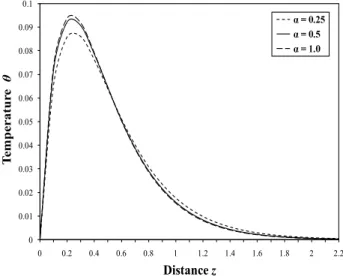
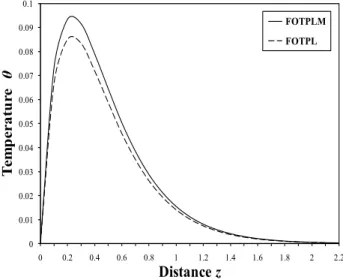
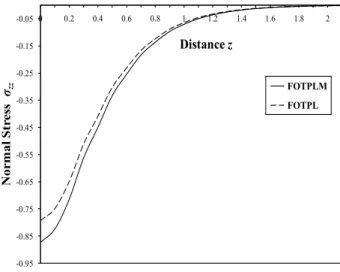
Figs. 1-3are plotted to show the variations of displacementw, temperatureθand normal stressσzzagainstz for three different values of fractional order parameterαi.e.α=0.25, 0.5, 1.0. In figures 4-6, we have demonstrated the effect of magnetic field on the spatial variation of the physical fieldsw,θandσzzatα=0.5. In figures 4-6, the following abbreviations are used: (i) FOTPLM (Fractional order three-phase-lag thermoelasticity with magnetic field) i.e.H06=0 and (ii) FOTPL (Fractional order three-phase-lag thermoelasticity) i.e.H0=0.
0 0.05 0.1 0.15 0.2 0.25 0.3 0.35 0.4 0.45 0.5
0 0.1 0.2 0.3 0.4 0.5 0.6 0.7 0.8 0.9 1 1.1 1.2 1.3
D
is
p
la
c
e
m
e
n
t
w
Distance z
✁ ✂ ✄ ☎✆ ✁ ✂ ✄✆
✁ ✝✄✂
Fig. 1.Effect of fractional parameterαon the distribution of displacementwatt=0.1
InFig. 1, we have observed that the variations of displacementwcorresponding to different values of fractional order parameterαfollow almost similar pattern with difference in magnitudes and restricted to a bounded region. Outside this region, the variations vanish identically. Also, increase in the values of fractional parameterαacts to decrease displacement significantly.
It is evident fromFig. 2that the profiles of temperatureθforα=0.25, 0.5, 1.0 have coincident initial point with zero value, which is consistent with the boundary conditions applied, afterward jump to attain maximum values and finally decrease gradually to diminish to zero value. It is also clear from the figure that the fractional order parameter
αsignificantly affects the temperature distribution.
It is apparent from Fig. 3that normal stressσzz begins with maximum modulus values for the casesα= 0.25, 0.5, 1.0, afterward decreases gradually with an increase in distancezuntil reaches to the steady state. More-over, fractional order parameterαhas prominent effect on this fields.
It is revealed from theFigs. 4-6that the magnetic field shows significant dominance on displacement component
w, temperatureθand normal stressσzz. It is also concluded from these figures that all the variations show similar pattern for FOTPLM and FOTPL, and as the medium is made free from magnetic field (i.e. for FOTPL), the variations
0 0.01 0.02 0.03 0.04 0.05 0.06 0.07 0.08 0.09 0.1
0 0.2 0.4 0.6 0.8 1 1.2 1.4 1.6 1.8 2 2.2
T
e
m
p
e
r
at
u
r
e
✂
Distance z
✁ ✄ ☎✆ ✝ ✁ ✄ ☎✝ ✁ ✞☎ ✄
-0.95 -0.85 -0.75 -0.65 -0.55 -0.45 -0.35 -0.25 -0.15
-0.05 0 0.2 0.4 0.6 0.8 1 1.2 1.4 1.6 1.8 2
N
or
m
al
S
t
r
e
s
s
✁
z
z
Distance z
✂✄ ☎ ✆✝
✂✄ ☎✝
✂✞☎✄
Fig. 3.Effect of fractional parameterαon the distribution of normal stressσzzatt=0.1
0 0.05 0.1 0.15 0.2 0.25 0.3 0.35 0.4 0.45
0 0.1 0.2 0.3 0.4 0.5 0.6 0.7 0.8 0.9 1 1.1 1.2 1.3
D
is
p
la
c
e
m
e
n
t
w
Distance
z
FOTPLM
FOTPL
Fig. 4.Effect of magnetic field on the distribution of displacementwatt=0.1 andα=0.5
0 0.01 0.02 0.03 0.04 0.05 0.06 0.07 0.08 0.09 0.1
0 0.2 0.4 0.6 0.8 1 1.2 1.4 1.6 1.8 2 2.2
T
e
m
p
e
r
a
tu
r
e
✂
Distance
z
FOTPLM
FOTPL
-0.95 -0.85 -0.75 -0.65 -0.55 -0.45 -0.35 -0.25 -0.15
-0.05 0 0.2 0.4 0.6 0.8 1 1.2 1.4 1.6 1.8 2
N
o
r
m
al
S
t
r
e
s
s
✁
z
z
Distance z
FOTPLM
FOTPL
Fig. 6.Effect of magnetic field on the distribution of normal stressσzzatt=0.1 andα=0.5
of the fieldsw,θandσzzdecrease numerically. Moreover, the phenomenon of finite wave speed is also predicted by these fields.
7. Conclusions
In the present paper we have constructed a model of fractional order generalized magneto-thermoelasticity with three-phase-lag for an elastic half-space and the general solutions are applied to a specific problem of a half-space subjected to moving load with a constant velocity.
It is clear from all the figures that all the field variables have nonzero values only in the bounded region of space. Outside this region, the values vanish identically. Hence, all the results are in agreement with the generalized theory of thermoelasticity.
We have observed from theFigs. 1-3that the value of fractional order parameter plays a vital role on the wave propagation phenomenon of the displacement, temperature and stress fields. Also, the fractional order parameter has significant effect on all the studying fields.
It is concluded from theFig. 4-6that magnetic field has significant effect on all the field variables and in the absence of magnetic field the magnitude of the field variables decreases.
The profiles of temperatureθand normal stressσzzat the surfacez=0 are in accordance with the boundary conditions applied.
Theory of thermoelasticity with fractional order time derivatives is a new branch of research. The results pre-sented in this paper should prove useful for researchers in material science, designers of new materials, low tem-perature physicists, as well as for those working on the development of a theory of hyperbolic thermoelasticity with fractional order.
8. Acknowledgement
References
[1] M.A. Biot, Thermoelasticity and irreversible thermodynamics, J. Appl. Phys. 27(3) (1956) 240-253.
[2] H.W. Lord, Y. Shulman, A generalized dynamical theory of thermoelasticity, J. Mech. Phys. Solid. 15(5) (1967) 299-309.
[3] A.E. Green, K.A. Lindsay, Thermoelasticity, J. Elast. 2(1) (1972) 1-7.
[4] R.S. Dhaliwal, H.H. Sherief, Generalized thermoelasticity for anisotropic media, Quart. Appl. Math. 38(1) (1980) 1-8.
[5] D.S. Chandrasekharaiah, Thermoelasticity with second sound: A review, Appl. Mech. Rev. 39(3) (1986) 355-376. [6] A.E. Green, P.M. Naghdi, A re-examination of the basic postulates of thermo-mechanics, Proc. Royal Soc. London
A 432(1885) (1991) 171-194.
[7] A.E. Green, P.M. Naghdi, On undamped heat waves in an elastic solid, J. Therm. Stress. 15(2) (1992) 253-264. [8] A.E. Green, P.M. Naghdi, Thermoelasticity without energy dissipation, J. Elast. 31(3) (1993) 189-208.
[9] A. Sur, M. Kanoria, Analysis of thermoelastic response in a functionally graded infinite space subjected to a Mode-I crack, Mode-Int. J. Adv. Appl. Math. Mech. 2(2) (2014) 139-149.
[10] D.Y. Tzou, A unified field approach for heat conduction from macro- to micro-scales, J. Heat Trans. 117(1) (1995) 8-16.
[11] S.K. Roy Choudhuri, On a thermoelastic three-phase-lag model, J. Therm. Stress. 30(3) (2007) 231-238.
[12] R. Quintanilla, R. Racke, A note on stability in three-phase-lag heat conduction, Int. J. Heat Mass Trans. 51(1) (2008) 24-29.
[13] S. Deswal, K.K. Kalkal, Three-dimensional half-space problem within the framework of two-temperature thermo-viscoelasticity with three-phase-lag effects, Appl. Math. Model. 39(23) (2015) 7093-7112.
[14] A. Sur, M. Kanoria, Three-phase-lag elasto-thermodiffusive response in an elastic solid under hydrostatic pres-sure, Int. J. Adv. Appl. Math. Mech. 3(2) (2015) 121-137.
[15] S. Kaliski, W. Nowacki, Combined elastic and electromagnetic waves produced by a thermal shock in the case of a medium of finite electric conductivity, Bull. De L’acad. Polon. Sci. 10(4) (1962) 159-169.
[16] A.J. Willson, The propagation of magneto-thermo-elastic plane waves, Math. Proc. Camb. Phil. Soc. 59(2) (1963) 483-488.
[17] C.M. Purushothama, Magneto-thermo-elastic plane waves, Math. Proc. Camb. Phil. Soc. 61(4) (1965) 939-944. [18] G. Paria, Magneto-elasticity and magneto-thermo-elasticity, Adv. Appl. Mech. 10 (1966) 73-112.
[19] A.H. Nayfeh, S. Nemat-Nasser, Electro-magneto-thermoelastic plane waves in solids with thermal relaxation, J. Appl. Mech. 39(1) (1972) 108-113.
[20] S. Deswal, K. Kalkal, A two-dimensional generalized electro-magneto-thermo-viscoelastic problem for a half-space with diffusion, Int. J. Therm. Sci. 50(5) (2011) 749-759.
[21] S. Deswal, S.S. Sheoran, K. Kalkal, A two-dimensional problem in magneto-thermoelasticity with laser pulse un-der different boundary conditions, J. Mech. Mat. Struct. 8(8) (2013) 441-459.
[22] N.H. Abel, Solution de quelques problemes a l’aide d’integrales definies, Oevres Completes, Grondahl, Chris-tiana, Norway, 1 (1823) 16-18.
[23] I. Podlubny, Fractional Differential Equations, Academic Press, New York, 1999.
[24] Y.A. Rossikhin, M. V. Shitikova, Application of fractional calculus for dynamic problems of solid mechanics: novel trends and recent results, Appl. Mech. Rev. 63(1) (010801) (2010) 1-52.
[25] Y.Z. Povstenko, Fractional heat conduction equation and associated thermal stress, J. Therm. Stress. 28(1) (2004) 83-102.
[26] Y.Z. Povstenko, Fractional radial heat conduction in an infinite medium with a cylindrical cavity and associated thermal stresses, Mech. Res. Comm. 37(4) (2010) 436-440.
[27] H. Youssef, Theory of fractional order generalized thermoelasticity, J.Heat Transf. 132(6) (061301) (2010) 1-7. [28] H. Sherief, A.M.A. El-Sayed, A.M.A.El-Latief, Fractional order theory of thermoelasticity, Int. J. Solid. Struct. 47(2)
(2010) 269-275.
[29] M.A. Ezzat, Magneto-thermoelasticity with thermoelectric properties and fractional derivative heat transfer, Physica B 406(1) (2011) 30-35.
[30] G. Jumarie, Derivation and solutions of some fractional Black-Scholes equations in coarse-grained space and time. Application to Merton’s optimal portfolio, Comp. Math. Appl. 59(3) (2010) 1142-1164.
[31] S. Kothari, S. Mukhopadhayay, A problem on elastic half space under fractional order theory of thermoelasticity, J. Therm. Stress. 34(7) (2011) 724-739.
[32] A.E. Abouelregal, Fractional order generalized thermo-piezoelectric semi-infinite medium with temperature-dependent properties subjected to a ramp-type heating, J. Therm. Stress. 34(11) (2011) 1139-1155.
[33] H.M. Youssef, E.A. Al-Lehaibi, Fractional order generalized thermoelastic infinite medium with cylindrical cavity subjected to harmonically varying heat, Engineering 3(1) (2011) 32-37.
[35] M.A. Ezzat, A.S. El-Karamany, M.A. Fayik, Fractional order theory in thermoelastic solid with three-phase-lag heat transfer, Arch. Appl. Mech. 82(4) (2012) 557-572.
[36] M.A. Ezzat, A.A. El-Bary, M.A. Fayik, Fractional Fourier law with three-phase-lag of thermoelasticity, Mech. Adv. Material. Struct. 20(8) (2013) 593-602.
[37] G. Honig, U. Hirdes, A method for the numerical inversion of Laplace transforms, J. Comp. Appl. Math. 10(1) (1984) 113-132.
[38] M. Rakshit, B. Mukhopadhyay, A two dimensional thermoviscoelastic problem due to instantaneous point heat source, Math. Comp. Model. 46(1) (2007) 1388-1397.
Submit your manuscript to IJAAMM and benefit from:
◮ Regorous peer review
◮ Immediate publication on acceptance
◮ Open access: Articles freely available online
◮ High visibility within the field
◮ Retaining the copyright to your article
—————————————————————————————