Volume 3 PROGRESS IN PHYSICS July, 2009
Dual Phase Lag Heat Conduction and Thermoelastic Properties of
a Semi-Infinite Medium Induced by Ultrashort Pulsed Laser
Ibrahim A. Abdallah
Department of Mathematics, Helwan University, Ain Helwan, 11795, Egypt E-mail: [email protected]
In this work the uncopled thermoelastic model based on the Dual Phase Lag (DPL) heat conduction equation is used to investigate the thermoelastic properties of a semi-infinite medium induced by a homogeneously illuminating ultrashort pulsed laser heating. The exact solution for the temperature, the displacement and the stresses distributions ob-tained analytically using the separation of variables method (SVM) hybrid with the source term structure. The results are tested numerically forCuas a target and pre-sented graphically. The obtained results indicate that at very small time duration distur-bance by the pulsed laser the behavior of the temperature, stress and the displacement distribution have wave like behaviour with finite speed.
1 Introduction
Heat transport and thermal stresses response of the medium at small scales becomes recently in the spot of interest due to application in micro-electronics [1] and biology [2, 3] and due to its wide applications in welding, cutting, drilling sur-face hardening, machining of brittle materials. Because of the unique capability of very high precision control of the ultra-short pulsed laser it is interesting to investigate the thermoe-lastic properties of the medium due to the ultrashort pulsed laser heating. The different models of thermoelasticity the-ory based on the equation of heat convection and the elastic-ity equations. The main categories of these models are the coupled thermoelasticity theory formulated by Biot [4], and the coupled thermoelasticity theory with one relaxation time [5], the two-temperature theory of thermoelasticity [6], the uncoupled classical linear theory of thermoelasticity based on Fourier’a law [7], the uncoupled thermoelasticity theory based on the Maxwell-Cattaneo modification of heat convec-tion to include one time lag between heat flux and the tem-perature gradient [8, 9].
The coupled and uncoupled models have been used to solve some problems on the macroscale where the length and time scales are relatively large. The technological needs of a high precision control of the ultrashort pulsed laser appli-cations processes at the microscales (< 10 12s), with high heating rates processes are not compatible with the Fourier’s model of heat conduction because it implies to an infinite speed for heat propagation and infinite thermal flux on the boundaries. To overcome the deficiencies of Fourier’s law in describing high rate heating processes the concept of wave nature of heat convection had been introduced [10]. Tzou [11, 12] had introduced another modification to Fourier law, by inventing two time lags, Dual Phase Lag (DPL), between the heat flux and the temperature gradient namely the heat flux time lag and the temperature gradient time lag.
There-fore he had used the dual phase lag heat convection equation with the energy conservation law to obtain the dual phase lag model for heat convection.
The purpose of the present work is to study the induced thermoelastic waves in a homogeneous isotropic semi-infinite medium caused by an ultrashort pulsed laser heating expo-nentially decay, based on the dual phase lag modification of Fourier’s law. The problem is formulated in the dimension-less form and then solved analytically by inventing a new sort of the separation of variables hybridized by the source struc-ture function. The stress, the displacement and the temper-ature solutions are obtained and tested by a numerical study using the parameters ofCuas a target. The results performed and presented graphically and concluding remarks are given.
2 Problem formulation
In this investigation I considered a homogeneous isotropic semi-infinite medium with mass density, specific heatcE, thermal conductivity k, and thermal diffusivity = ckE. The medium occupy the half space regionz >0considering
the Cartesian coordinates(x; y; z). the medium is assumed to be traction free, initially at uniform temperatureT0, and subjected to heating process by a ultrashort pulsed laser heat
source its structure function;g(z; t) = It0(1 R)
pp e z 'e
t tp tp ,
at the surfacez = 0as in Fig. 1. where the constants charac-terize this laser pulse are:I0, the laser intensity,Rthe reflec-tivity of the irradiated surface of the medium,the absorption depth, andtpthe laser pulse duration. The Cartesian coordi-nates(x; y; z)are considered and z-axis pointing vertically into the medium. Therefore the governing equations are: The equation of motion in the absence of body forces
ji;j= ui i; j = x; y; z ; (1)
whereijis the stress tensor components,ui = (0; 0; w)are the displacement vector components. The constitutive
July, 2009 PROGRESS IN PHYSICS Volume 3
tion
ij =divui (T T0)ij+ 2eij (2)
by which the stress components are
xx= yy= wz (T T0) zz= ( + 2)wz (T T0) xy= 0; xz = 0; yz = 0 :
(3)
The volume dilationetakes the form
e = exx+ eyy+ ezz= @w@z : (4)
Where the strain-displacement componentseij, read;
eij= 12(ui;j+ uj;i) i; j = x; y; z ;
ezz=@w@z ; exx= eyy= exy= exz= eyz = 0 ; (5)
substituting from the constitutive relation into the equation of motion using the equation of motion we get:
The displacement equation
( + 2) wzz (T T0)z= w ; (6)
The energy conservation
cE_T = qz: (7)
Since the response of the medium to external heating ef-fect comes later after the pulsed laser heating interacts with the medium surface then there is a time lag, and by using the dual phase lag modification of the Fourier’s law as invented by Tzou;
q(z; t + q) = k Tz(z; t + T) ; q + q_q = k Tz k T _Tz:
(8)
Then the energy transport equation of hyperbolic type can be obtained by substituting in the energy conservation law and considering the laser heat source
q T +
1
_T = Tzz+ T _Tzz 1
cEg(z; t) q_g(z; t) : (9)
This equation shows that the dual lagging should be con-sidered for the processes whose characteristic time are scale comparable to q and T. It describes a heat propagation with finite speed. whereq is represents the effect of ther-mal inertia, it is the delay in heat flux and the associated con-duction through the medium, andT is represents the delay in the temperature gradient across the medium during which conduction occurs through its microstructure. For T = 0
one obtain the Maxwell-Cattaneo model, and Fourier law ob-tained ifT = q= 0.
The boundary conditions are;
k Tz(z; t) = g(z; t) ; w = 0 ; zz = 0; at z = 0 ; zz= 0; w = 0 ; T = 0 ; as z ! 1 :
(10)
Introducing the dimensionless transformations
z= z pq, w
= w
pq,
ij = ij, t= tq, t p = tpq,
' = '
pq,
= T
q, 0
= T T
0, 1 = ,
2 = +2 , 0 = 0, 0= I0(1 R)k q
q, substituting
in the governing equations and in boundary conditions of the problem by the above dimensionless transformations and then omitting the()from the resulting equations we obtain the dimensionless set of the governing equations and boundary conditions:
The dimensionless temperature equation
+ _ = zz+ _zz+ 1 t
p t2
p'
e z'e t 2tptp ; (11)
The dimensionless displacement equation
wzz B2w = G z; (12)
whereB2=
qt2p(+2)andG = 00 (+2); The dimensionless stresses equations
zz = 2wz 0 ; xx = yy= 1wz 0 ;
(13)
Dimensionless boundary conditions
w = 0 ; zz= 0 ; at z = 0 ;
z(z; t) = k p1 q e
t 2tp
tp ; at z = 0 ;
zz= 0 ; w = 0 ; T = 0 ; as z ! 1 :
(14)
3 Solution of the problem
In this section I introduced the hybrid separation of variables method (HSVM) to get the solution of equations (11) and (12). Using this method one can construct the analytic so-lution for some type of nonhomogeneous partial differential equations (or system). Its idea based on using the structure of the nonhomogeneous term to invent the form of separa-tion of variables. Therefore the PDE (or system) will reduced to ODE (or system) which can be solved. To illustrate the (HSVM) we use it to solve the problem in this paper. In-troducing the following separation of variables based on the structure of the source function, which represents the inho-mogeneous term,
(z; t) = Z(z)e t 2tptp ; w(z; t) = W (z)e t 2tptp (15)
Volume 3 PROGRESS IN PHYSICS July, 2009
Fig. 1: The strcture function of the ultrashort pulsed laser of expo-nentially decay.
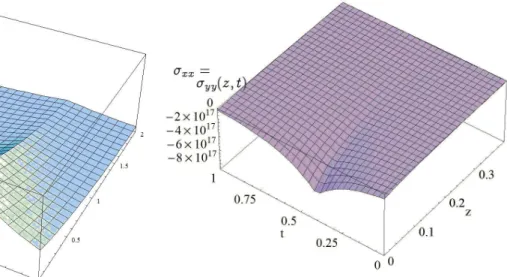
Fig. 2: The dimensionless temperature distribution.
Fig. 3: The dimensionless w-displacement distribution.
Fig. 4: The dimensionless stressesxx= yydistributions.
Fig. 5: The dimensionless volume dilatione.
Fig. 6: The dimensionless stresseszzdistributions.
July, 2009 PROGRESS IN PHYSICS Volume 3
the equations (11) and (12) will be reduced to a separable form and can be solved directly and therefore using the di-mensionless boundary conditions we obtain:
The solution of the dimensionless temperature equation
(z; t) =h#1e Az+ #2e z' i
e t 2tptp ; (16)
whereA2= t(1 tp)
p(tp ), H = (tp 1)
tp' ,
#1=Atp' p1 p A'(1H '2 A2)
, #2= (1H '2 A2);
The solution of the dimensionless displacement equa-tion
w(z; t) =hW1e Bz+W2e Az+W3e z '
i
e t 2tptp ; (17)
where W1= h
GA#1 (A2 B2
t2p)
+ G#2 '(A2 B2
t2p)
i
, W2= (AGA#2 B21 t2p)
,
W3= '( G#1 2 '2 B2t2p)
;
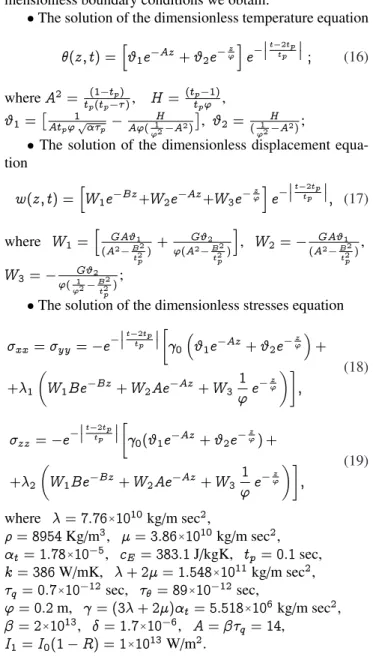
The solution of the dimensionless stresses equation
xx= yy= e t 2tp
tp 0#1e Az+ #2e z'
+
+1
W1Be Bz+ W2Ae Az+ W3'1 e z'
;
(18)
zz= e t 2tp
tp 0(#1e Az+ #2e 'z) +
+2
W1Be Bz+ W2Ae Az+ W3'1 e z '
;
(19)
where = 7:761010kg/m sec2,
= 8954Kg/m3, = 3:861010kg/m sec2,
t= 1:7810 5, cE= 383:1J/kgK, tp= 0:1sec,
k = 386W/mK, + 2 = 1:5481011kg/m sec2,
q= 0:710 12sec, = 8910 12sec,
' = 0:2m, = (3 + 2)t = 5:518106kg/m sec2,
= 21013, = 1:710 6, A = q= 14,
I1= I0(1 R) = 11013W/m2.
4 Discussion and conclusion
In this paper the thermoelastic waves in a homogeneous iso-tropic semi-infinite medium caused by an ultrashort pulsed laser heating having exponentially decay, based on the dual phase lag modification of Fourier’s law have been investi-gated. The problem formulated in the dimensionless form and then solved analytically for the temperature, the stress, and the displacement by inventing a new sort of the hybridized separation of variables by the source structure function. The obtained analytical solutions are tested numerically using for
Cuas a target medium.
The results are presented graphically. The obtained re-sults indicated that due to the very high power of the laser
pulse at the surface in a very short duration the temperature distribution possessing a wave nature with finite speed as in Fig. 2. The medium responses to the laser heating by increas-ing change in the displacement distribution with increasincreas-ing time duration as in Fig. 3. The thermoelastic characteristics (stresses componentsxx= yyand volume dilatione = @w@z) of the medium possess wave nature as in Fig. 4 and Fig. 5. Fig. 6. depicts that the stress componentzz have wave na-ture with wave front has its maximum at the average of the laser pulse duration. By these results it is expected that the dual phase lag heat conduction model will serve to be more realistic to handle practically the laser problems with very high heat flux and/or ultrashort time heating duration.
Submitted on May 06, 2009/Accepted on May 15, 2009
References
1. Kulish V.V., Lage J.L., Komarov P.L., and Raad P.E.,ASME J.
Heat Transfer, 2001, v. 123(6), 1133–1138.
2. Kuo-Chi Liu and Han-Taw Chen.Int. J. Heat and Mass
Trans-fer, 2009, v. 52, 1185–1192.
3. Zhou J., Chen J.K., Zhang Y. Computers in Biology and
Medicine, 2009, v. 39, 286–293.
4. Biot M.J. Appl. Phys., 1956, v. 27, 240–253.
5. Lord H. and Shulman Y.J. Mech. Phys. Solid., 1967, v. 15, 299–
309.
6. Youssef H.M. and Al Lehaibi A. Eman.I. J. of Sol. and Struct.,
2007, v. 44, 1550–1562.
7. Chadwick 1.P. Thermoelasticity: the dynamic theory. In:Prog.
in Sol. Mech., v. I, Hill R. and Sneddon I.N. (eds.),
North-Holland, Amsterdam, 1960, 263–328.
8. Abdallah A.I.Progress in Physics, 2009, v. 2, 12–17.
9. Andrea P.R., Patrizia B., Luigi M., and Agostino G.B.Int. J.
Heat and Mass Trans., 2008, v. 51, 5327–5332.
10. Ozisik M.N. and Tzou D.Y.¨ ASME J. of Heat Transfer, 1994,
v. 116, 526–535.
11. Tzou D.Y.ASME J. of Heat Transfer, 1995, v. 117, 8–16.
12. Tzou D.Y. Macro-to-micro scale heat transfer: the lagging
be-havior. Taylor and Francis, Washington (DC), 1997.