Integration technique method using
Kekre transform
H. B. Kekre1, V. R. Lakshmi Gorty2
1
Senior Professor, Department of Computer Engineering, SVKM’s NMIMS, MPSTME Mumbai-400056, India
Associate Professor, Department of Computer Engineering, SVKM’s NMIMS, MPSTME Mumbai-400056, India
Abstract
In this work, a new approach of the Kekre transform in the integral form is introduced. A theory of operation matrix is developed by numerical computation and by partitioning of the matrices in four submatrices which is proved as the same. An operational matrices of integration based on Kekre transform are applied to the dynamic systems with distributed parameters to analyse their applications. A matrix method is used at the end of this paper which contributes to operation matrix in dynamic systems.
Keywords: Kekre transform, operational matrix,partitioning matrices, integral technique. 2010
Mathematics Subject Classification: 42C40, 35C15 , 40C05.
1. Introduction
Transform methods are typically used in many image processing applications such as compression, filtering, enhancement, feature extraction, image texture analysis etc. Using transform domain techniques, it is possible to embed a secret message in different frequency bands of the cover image. Using orthogonal functions to construct the operational matrix for solving and optimization of dynamic systems was first studied by Chen et al. 1977 in [13]. Most commonly used Haar wavelets has been studied by Kekre and Haar as orthogonal functions. In 1997 in [1], the author Chen and Hsiao use the Haar wavelet to explore the new direction in system analysis, establishing an operational matrix for integration via Haar wavelets the drawbacks were eliminated. The authors Chen and Hsaio in 1965 in [6] studied a state-space approach to Walsh series solution of linear systems. Using Fourier series, operational matrix of integration was studied
by Paraskevopoulos et al. 1985 in [7]. In transforms applied to Kekre's function in the paper, Laplace Transforms to Kekre's functions 2013 and 2014 in [2,3], Fourier Transforms to Kekre's function, the work can be used for various image processing applications as applied in Sudeep et al. 2008 in [4]. Pathak in his book presented the Wavelet transform in mathematical concepts in 2009 in [12]. The author studied Wavelet transforms versus Fourier transforms by Strang 1993 in [10]. In [9] Haar explained the orthogonal functions and system. The Chang et al. 1984 in [8] and Cheng 1961 in [11], have studied the applications used in the analysis of linear systems. Author Lakshmi Gorty et al. in the study of their work in Laplace Transforms to Kekre's functions 2013 and 2014, Fourier Transforms to Kekre's function, proposed solutions to some problems using Kekre's function and studied Laplace and Fourier transforms using Kekre's function and its applications in form of examples. In continuation of the paper Kekre and Gorty 2013, using inverse Laplace Transforms, the results in the form of Kekre's function were analyzed. In this paper the author presents a new approach of the Kekre transforms in the integral form. Some corollary and theorems are proved in terms of operation matrix in this work. An operational matrix of integration based on Kekre transforms are applied to the distributed parameters dynamic systems to show its applications at the end of this paper.
2. Preliminary Results
Kekre function is defined as
( )
(
)
(
(
)
)
(
)
(
)
1 = 1
a
K + t − N−a ⎣⎡u t− a− −u t−a ⎤⎦+u t−a
for any order, a= 1, 2, 3,...N and a<N t; ≥0. Here N is the order of the Kekre's function. First Kekre's function will be always
( )
( )
1 =
K t u t (2.2)
always for N; with reference to the function Kekre and Gorty in 2013, the generalized Kekre's function is given by
( )
(
)
{
(
(
)
)
(
)
}
(
)
= 1 2 1
1 . a
K t N a u t a u t a
u t a
− − + − − − − +
+ − +
(2.3) for any order, a= 2, 3,...N and a<N t; ≥0.
When the order of Kekre's function is 4, the Kekre's function can be represented as:
( )
(
) (
)
(
)
(
)
(
) (
)
(
)
(
)
(
) (
)
(
)
(
)
1
2
3
4
=
= 3 0 1 1
= 2 1 2 2
= 1 2 3 3
K u t
K u t u t u t
K u t u t u t
K u t u t u t
− − − − + −
− − − − + −
− − − − + −
Fig 1. Kekre’s function and its corresponding integral
Kekre's transforms are orthogonal to each other as considered by the author in [5]:
( ) ( )
1
0
= .
i l il
k t k t dt δ
∫
(2.4)Therefore, they form a transform basis. Any function y t
( )
, which is a square integrable in the interval( )
0,1 , namely( )
1 2
0
y t dt
∫
is finite. It can be expanded into Kekre transforms as( )
= 1 1( )
2 2( )
3 3( )
4 4( )
... =( )
t
y t c k t +c k t +c k t +c k t + c K t (2.5) where
( ) ( )
1
0
= 2j .
i i
c
∫
y t k t dt (2.6) The series expansion as expressed in equation( )
2.5 contains infinite terms for approximating smooth y t . If( )
y t is piecewise constant by( )
itself, or may be approximated as piecewise constant during each subinterval, then equation
( )
2.5 will be terminated at finite terms. The row vectors are used to denote time functions for input vectors; and coulumn vectors x u t,( ) ( )
,y t todenote the state functions as output vectors.The first four Kekre's function can be expressed as follows:
( )
[
]
1 = 1 1 1 1
k t (2.7)
( )
[
]
2 = 3 1 1 1
k t − (2.8)
( )
[
]
3 = 0 2 1 1k t − (2.9)
( )
[
]
4 = 0 0 1 1
k t − (2.10)
( )
( )
( )
( )
( )
1
2 4
3
4
1 1 1 1
3 1 1 1
= .
0 2 1 1
0 0 1 1
k t
k t
K t
k t
k t
⎡ ⎤ ⎡ ⎤
⎢ ⎥ ⎢− ⎥
⎢ ⎥ ⎢ ⎥
Δ ⎢ ⎥ ⎢ − ⎥
⎢ ⎥ ⎢ − ⎥
⎢ ⎥ ⎣ ⎦
⎣ ⎦
(2.11)
The Kekre coefficient ci can be obtained by
applying equation (2.6) directly; also it is more easy to evaluate it by matrix inversion.
( )
14
=
t
c y t K− (2.12)
1 4
3 3 0 0
3 1 4 0
1
= .
3 1 2 6
12
3 1 2 6
K−
−
⎡ ⎤
⎢ − ⎥
⎢ ⎥
⎢ − ⎥
⎢ ⎥
⎣ ⎦
(2.13)
Equation (2.12) is called the forward transform, which turns the time function y t into the
( )
coefficient vector ct and equation (2.5) is known
as inverse transform, which recovers y t from
( )
.t
c Since K4 and 1 4
K− contain many zeros, this phenomenon makes the Kekre's Transform much faster than the many renowned transforms.
3. Integration of Kekre transforms
Studying the models of dynamic systems and image processing to understand a continuous system it is required to perform integrations in order to get the dynamic problem solved. The new approach developed here is by using integration technique. Let us consider 4th order system. The integrals of the first four Kekre transforms can be expressed as:
( )
{
}
[
]
1 0
1
= ; 0 < 1 10 4 2 0
8 t
k τ τd t t≤
∫
(3.1)( )
[
]
2 0
1 1 ; 0 <
1 2
= 2 0 4 2
1 8
; < 1 2
t t t
k d
t t
τ τ
⎧ − ≤ ⎫
⎪ ⎪
⎪ ⎪
⎨ ⎬
⎪ ≤ ⎪
⎪ ⎪
⎩ ⎭
∫
(3.2)( )
[
]
3 0
1 1
; 0 <
1
2 4
= 2 0 0 0
1 1 8
; <
4 2
t t t
k d
t t
τ τ
⎧ − ≤ ⎫
⎪ ⎪
⎪ ⎪
⎨ ⎬
⎪ ≤ ⎪
⎪ ⎪
⎩ ⎭
∫
(3.3)( )
[
]
4 0
1 3
1 ; <
1
2 4
= 1 1 1 1
1 3 8
; < 1 2 4
t t t
k d
t t
τ τ
⎧ − ≤ ⎫
⎪ ⎪
⎪ ⎪ −
⎨ ⎬
⎪ − ≤ ⎪
⎪ ⎪
⎩ ⎭
∫
(3.4)Writing equations from
( )
3.1 to( )
3.4 , the results obtained are( )
4 0
10 4 2 0
2 0 4 2
1
.
2 0 0 0
8
1 1 1 1
t
K τ τd
⎡ ⎤
⎢ ⎥
⎢ ⎥
⎢ ⎥
⎢− ⎥
⎣ ⎦
∫
(3.5)Let the integrals be expanded into Kekre series. Thus
( )
( )
4 4 4
0
= .
t
K τ τd P K t
∫
(3.6)Here
4
4 2 1 1
2 0 1 1
1
= .
1 / 2 1 / 2 0 0
8
1 / 2 1 / 2 0 0
P
− − −
⎡ ⎤
⎢ − ⎥
⎢ ⎥
⎢ − ⎥
⎢ ⎥
⎣ ⎦
(3.7)
In general for an th
m order system with = 2 , j
m j is a positive integer, the Pm is given as
/ 2 / 2
1 / 2
2 1
= .
0 2
m m
m
m
mP K
P
K
m −
−
⎡ ⎤
⎢ ⎥
⎣ ⎦ (3.8)
To prove matrix equation
( )
3.8 , it is firstly numerically verified. For an mthorder system the Kekre matrix Km is defined with m Kekre
functions in row vector form as for matrix equation
( )
3.7 . In other words,( )
( )
( )
( )
( )
( )
12
4
. =
. .
m
m k t
k t
k t
K t
k t
⎡ ⎤
⎢ ⎥
⎢ ⎥
⎢ ⎥
⎢ ⎥
⎢ ⎥
⎢ ⎥
⎢ ⎥
⎢ ⎥
⎢ ⎥
⎣ ⎦
(3.9)
In other words
( )
[ ]
1( )
[ ]
1 = 1 ; 1 = 1K t K− t (3.10)
( )
1( )
2 2
1 1 1 1 1
= ; = .
1 1 2 1 1
K t ⎡⎢ ⎤⎥ K− t ⎡⎢ − ⎤⎥
−
( )
( )
4
1 4
1 1 1 1
3 1 1 1
= ;
0 2 1 1
0 0 1 1
3 3 0 0
3 1 4 0
1
= .
3 1 2 6
12
3 1 2 6
K t
K− t
⎡ ⎤
⎢− ⎥
⎢ ⎥
⎢ − ⎥
⎢ ⎥
−
⎣ ⎦
−
⎡ ⎤
⎢− − ⎥
⎢ ⎥
⎢ − ⎥
⎢ ⎥
⎣ ⎦
(3.12)
The operation matrix Pm is the Kekre transform
coefficient matrix of these integrals as defined by equation
( )
3.8 :( )
1( )
0
= .
t
m m m
P ⎡⎢ K τ τd ⎤⎥K− t
⎣
∫
⎦ (3.13)Thus
( )
1( )
1 1 1
0
= .
t
P ⎡⎢ K τ τd ⎤⎥K− t
⎣
∫
⎦ (3.14)1
1
= .
2
P ⎡ ⎤⎢ ⎥
⎣ ⎦ Thus for m= 2;
1 1
2 1 2
1
4 2 1
1 1
= ; = .
0 1 0
2 4
P K
P P
K−
− −
⎡ ⎤ ⎡ ⎤
⎢ ⎥ ⎢ ⎥
⎣ ⎦
⎣ ⎦ (3.15)
Also for m= 4;
2 2
4 1
2
4
2.4 1
= ;
0 2.4
8 4 2 2
4 0 2 2
1
= .
1 1 0 0
16
1 1 0 0
P K
P
K
P
−
−
⎡ ⎤
⎢ ⎥
⎣ ⎦
− − −
⎡ ⎤
⎢ − ⎥
⎢ ⎥
⎢ − ⎥
⎢ ⎥
⎣ ⎦
(3.16)
For 4 4
( )
8 1
4
2.8 1
= 8; = .
2.8 0
P K t
m P
K−
−
⎡ ⎤
⎢ ⎥
⎣ ⎦
8
8 4 2 2 1 1 1 1
4 0 2 2 3 1 1 1
1 1 0 0 0 2 1 1
1 1 0 0 0 0 1 1
3 3
0 0
1 12 12
= ;
0 0 0 0
16 3 1 4
0
0 0 0 0
12 12 12
3 1 2 6 0 0 0 0
12 12 12 12 0 0 0 0
3 1 2 6
12 12 12 12
P
− − − − − − −
⎡ ⎤
⎢ − − − − ⎥
⎢ ⎥
⎢ − − − ⎥
⎢ − ⎥
⎢ ⎥
⎢ − ⎥
⎢ ⎥
⎢ ⎥
⎢− − ⎥
⎢ ⎥
⎢ ⎥
−
⎢ ⎥
⎢ ⎥
⎢ ⎥
⎢ ⎥
⎢ ⎥
⎣ ⎦
8
96 48 24 24 12 12 12 12
48 0 24 24 36 12 12 12
12 12 0 0 0 24 12 12
12 12 0 0 0 0 12 12
1
= .
36 36 0 0 0 0 0 0
2304
36 12 48 0 0 0 0 0
36 12 24 72 0 0 0 0
36 12 24 72 0 0 0 0
P
− − − − − − −
⎡ ⎤
⎢ − − − − ⎥
⎢ ⎥
⎢ − − − − ⎥
⎢ − ⎥
⎢ ⎥
⎢ − ⎥
⎢ ⎥
− −
⎢ ⎥
⎢ − ⎥
⎢ ⎥
⎢ ⎥
⎣ ⎦
(3.17) All these matrices P P P2, 4, 8 satisfy equation
(
3.13 .)
Theorem and corollary based on operational matrix are given below:
Corollary 3.1 Let Pa be the transform of the
integrals of first two Kekre funtion k t and 1
( )
( )
2 ;
k t Then Pa =Pm/ 2 for value of = 2 ,
j m
consider for j= 2.
Proof. Choose m= 4; since Pa be the
transform of the integrals of first two Kekre funtion
( )
1
k t and k t , 2
( )
P4 of equation(
3.16 and)
4P of equation
( )
3.7 are equal even though evaluated in two different methods =1 2 1 .1 0
4 a
P ⎡⎢ − ⎤⎥
⎣ ⎦
Hence the proof of the corllary.
Corollary 3.2 Let Pb be the transform of the
integrals of Kekre funtion k t and 1
( )
k t into 2( )
the series of k t and 3
( )
k4( )
t Then ./ 2
1 =
2
b m
P K
m −
(3.19) for value of = 2 , j
m consider for j= 2.
Proof. By definition, Pb is the transform of the integrals of first two Kekre funtion k t and 1
( )
( )
2
k t into the series of k t and 3
( )
k4( )
t .( )
( )
1 0
2 0
10 4 2 0
1
2 0 4 2
8 t
t
k d
k d
τ τ
τ τ
⎡ ⎤
⎢ ⎥
⎡ ⎤
⎢ ⎥
⎢ ⎥
⎢ ⎥ ⎣ ⎦
⎢ ⎥
⎢ ⎥
⎣ ⎦
∫
∫
(3.20)
which shows that the Kekre's integral of k t is a 1
( )
ramp function. Kekre's integral of k t is a 2
( )
triangular function consisting of rising ramp and falling ramp.
( )
( )
1 0
2 0
3 3 0 0
3 1 4 0
1 =
3 1 2 6
12
3 1 2 6
t
b t
k d
P
k d
τ τ
τ τ
⎡ ⎤ ⎡ − ⎤
⎢ ⎥ ⎢− − ⎥
⎢ ⎥∗ ⎢ ⎥
⎢ ⎥ ⎢ − ⎥
⎢ ⎥ ⎢ ⎥
⎢ ⎥ ⎣ ⎦
⎣ ⎦
∫
∫
(3.21)
0 0 1 1
10 4 2 0 4 0
1 1 8 8
= =
2 0 4 2 2 6 1 1
8 12
8 8
2 6
⎡ ⎤ ⎡ ⎤
− −
⎢− ⎥ ⎢ ⎥
⎡ ⎤ ⎢ ⎥
∗ ⎢ ⎥
⎢ ⎥ ⎢ − ⎥
⎢ ⎥
⎣ ⎦ ⎢ −
⎥ ⎢⎣ ⎥⎦
⎣ ⎦
2
1 1
1 1
= = .
1 1
8 8
b
P − K − ⎢⎡ ⎤⎥
−
⎣ ⎦ (3.22)
Hence proved the corollary.
Corollary 3.3 Let Pc be the transform of the
integrals of Kekre funtion k t and 3
( )
k t 4( )
into the series of k t and 1
( )
k2( )
t Then . 1/ 2
1 =
2
c m
P K
m −
(3.23) for value of = 2 , j
m consider for j= 2.
Proof. Here Pc be the transform of the integrals of first two Kekre funtion k t and 3
( )
k t into the 4( )
series of k t1
( )
and k t2( )
. In numerical expression,the average value is taken to represent these functions:( )
( )
3 0
4 0
2 0 0 0
1
.
1 1 1 1
8 t
t
k d
k d
τ τ
τ τ
⎡ ⎤
⎢ ⎥
⎡ ⎤
⎢ ⎥
⎢ ⎥
⎢ ⎥ ⎣− ⎦
⎢ ⎥
⎢ ⎥
⎣ ⎦
∫
∫
(3.24)
Comparing the first two columns of K41
−
and
1 2
K− that can be found the former is a dilution of the later. Therefore
( )
( )
3 0
4 0
3 3 0 0
3 1 4 0
1 =
3 1 2 6
12
3 1 2 6
t
c t
k d
P
k d
τ τ
τ τ
⎡ ⎤ ⎡ − ⎤
⎢ ⎥ ⎢− − ⎥
⎢ ⎥∗ ⎢ ⎥
⎢ ⎥ ⎢ − ⎥
⎢ ⎥ ⎢ ⎥
⎢ ⎥ ⎣ ⎦
⎣ ⎦
∫
∫
3 3 0 0
2 0 0 0 3 1 4 0
1 1
1 1 1 1 3 1 2 6
8 12
3 1 2 6
−
⎡ ⎤
⎢− − ⎥
⎡ ⎤ ⎢ ⎥
∗
⎢− ⎥ ⎢ − ⎥
⎣ ⎦
⎢ ⎥
⎣ ⎦
( )
1 2
1 1
1 1
= .
1 1
8K t 16
− ⎡ − ⎤
⎢ ⎥
⎣ ⎦
Hence proved.
Corollary 3.4 Let Pd be the transform of the
integrals of Kekre funtion k t and 3
( )
k4( )
t . Then Pd = 0 (null Matrix).Proof. Let Pd be the transform of the integrals of
Kekre funtion k t and 3
( )
k4( )
t .0 0
2 0 0 0 4 0
1 1
=
1 1 1 1 2 6
8 12
2 6
0 0
= = nullmatrix.
0 0
d
P
⎡ ⎤
⎢− ⎥
⎡ ⎤ ⎢ ⎥
∗
⎢− ⎥ ⎢ − ⎥
⎣ ⎦
⎢ ⎥
⎣ ⎦
⎡ ⎤
⎢ ⎥
⎣ ⎦
(3.26) It indicates that these rows and coulums are
orthogonal to each other. Thus Pd = 0 (a null Matrix).
Theorem 3.5 Let Pm be partitioned into four
submatrices: m a b
c d
P P
P
P P
⎡ ⎤
Δ ⎢ ⎥
⎣ ⎦ (3.27)
where
/ 2
=
a m
P P
/ 2
1 =
2
b m
P K
m −
1 / 2
1 =
2
c m
P K
m −
= 0 (nullMatrix). d
P
Proof. Considering corollary 2.1,2.2,2.3 and 2.4,
4
P can be obtained as
4
1 / 2 1 / 4 1 / 8 1 / 8
1 / 4 0 1 / 8 1 / 8
.
1 / 16 1 / 16 0 0
1 / 16 1 / 16 0 0
a b
c d
P P
P
P P
− − −
⎡ ⎤
⎢ − ⎥
⎡ ⎤ ⎢ ⎥
Δ ⎢ ⎥ ⎢ − ⎥
⎣ ⎦
⎢ ⎥
⎣ ⎦
It is same as P4 calculated by numerical computation in equation
( )
3.7 . It completes the proof of equation (3.27).4. Applications
Example: Consider a unit step voltage is applied to the leakage-free noninductive cable. The voltage
( )
,v x t and the current i x t must be found. For
( )
, leakage free non-inductive cable where the conductance is zero and the inductance is zero, equations are written as( )
, = /Ri x t −∂ ∂v x (4.1)
( )
2
2
,
= /
v x t
RC v t
x ∂
∂ ∂
∂ (4.2)
with initial conditions x
( )
0 = 0 and x'( )
0 = 4. Equation (4.2) is known as diffussion equation. Solution: Let Kekre's transforms be used to solve these partial differential equations. Assume ∂ ∂v/ t can be expanded in a Kekre series as( ) ( )
/ = t .
m
v t x K t
∂ ∂ a (4.3)
Integrating equation
( )
4.3 and applying the integration matrix P4 , from(
3.16)
( )
, = t( )
0t m( )
= t( )
m m( )
.v x t a x K t dt a x P K t (4.4)
Differentiating equation
( )
4.4 , the result obtained is( )
( )
( )
( )
( )
2 2
2 2
,
= t = t
m m m m
v x t
x P K t x P K t
x x
∂ ∂ ⎡
⎤
⎣ ⎦
∂ ∂ a a
(4.5) From equation
( )
4.2 and( )
4.5 and comparingthe values, we obtain
/ =
( )
( )
t
m m
RC v∂ ∂t a x P K t (4.6)
( ) ( )
=( )
( )
t t
m m m
RCa x K t a x P K t (4.7)
Thus
( )
=( )
.t t
m
RCa x a x P (4.8) Since
( )
2
2
t d t
x dx
a a (4.9)
The differential equation becomes
( )
2
2 = 0.
t m
d
P RC x
dx
⎛ ⎞
−
⎜ ⎟
⎝ ⎠a (4.10)
Here a
( )
x is an m -vector function of x,denotes the space distance. a0 is constant vector
satisfying the boundary conditions.
( )
( )
10
= RCP x
t x t x e− m−
a a (4.11)
The voltage v x t is finite as
( )
, x→ ∞.( )
( )
1( )
0
, = t RCPmx .
m m
v x t x e P K t
− −
a (4.12)
( )
( )
1( )
0
, = / = t RCPm x .
m m
Ri x t v x x e P K t
x
− −
∂
−∂ ∂ −
∂ a (4.13)
The current i x t is calculated as
( )
,( )
( )
1( )
0
, = / = t RCPm x .
m m
C
i x t v x x e P K t
R
− −
−∂ ∂ − a (4.14)
At x= 0 and m= 1 , the unit step voltage will become
( )
0, = 0( ) ( ) ( )
0 1 1 = 1,t
v t a P t K t (4.15)
where
( )
[
]
0 0 = 1, 0, 0, 0,.... .
t
a The voltage v x t and the
( )
, current i x t( )
, from equation(
4.12)
and(
4.14 respectively given by)
( )
1, = RCPm x.
v x t e− − (4.16)
( )
1, = C RCPmx.
i x t e
R − −
(4.17) When m= 1,
1 1
1
= = 2.
m
P− P− (4.18)
When m= 2,
1 1
2
0 4
= = .
4 8
m
P− P− ⎡⎢ ⎤⎥
−
⎣ ⎦ (4.19)
When m= 4,
1 1
4
0 0 8 8
0 0 8 8
= = .
4 4 16 0
4 4 32 16
m
P− P−
⎡ ⎤
⎢ − ⎥
⎢ ⎥
⎢− ⎥
⎢− − ⎥
⎣ ⎦
(4.20)
The corresponding value of voltage v x t and
( )
, the current i x t is given from( )
,(
4.16 and)
(
4.17 ,)
1 . 1
Form= 1, =v e RCP x
− −
1 1
Form= 1, =i Ce RCP x.
R − −
The analytic solutions have been described by Cheng in 1961,
( )
, = .2
x RC v x t erfc
t
⎛ ⎞
⎜ ⎟
⎜ ⎟
⎝ ⎠ (4.21)
( )
, = 24 .RC x
t C
i x t e
Rt −
(4.22) The analytic solution of equation
(
4.21 and)
Fig. 2 describing v x t
( )
, and time tFig. 3 describes plot of driving current versus time t Let
( )
11
0 = 1and = 2;
RCP x
t x e m x dx x
dt −
−
a (4.23)
then equation
(
4.10 becomes)
2
1
2 = 0;
m
d
P RC x
dx
⎛ ⎞
−
⎜ ⎟
⎝ ⎠ (4.24)
1 1
1
= m .
dx d
RCP x dx dt
−
⎛ ⎞
⎜ ⎟
⎝ ⎠ (4.25)
1 2
1
= m .
dx
RCP x dt
−
(4.26) Equations
(
4.25 and)
(
4.26 are written in)
matrix form
1 1
1
2 2
0 1
= .
0 m
x x
d
RCP
x x
dt −
⎡ ⎤
⎡ ⎤ ⎡ ⎤
⎢ ⎥
⎢ ⎥ ⎢ ⎥
⎣ ⎦ ⎣ ⎦⎣ ⎦ (4.27)
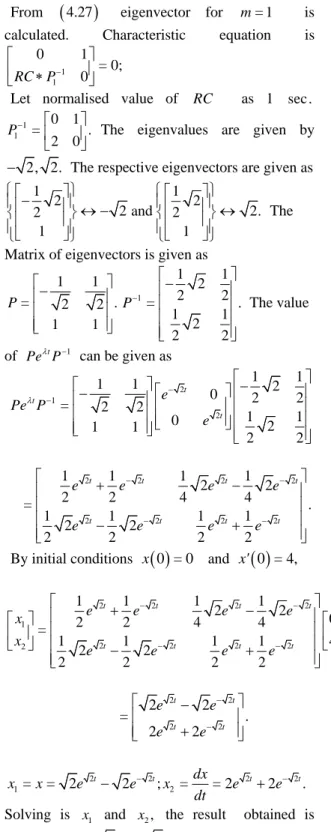
From
(
4.27 eigenvector for)
m= 1 is calculated. Characteristic equation is1 1
0 1
= 0; 0
RC P−
⎡ ⎤
⎢ ∗ ⎥
⎣ ⎦
Let normalised value of RC as 1 sec.
1 1
0 1
= .
2 0
P− ⎡⎢ ⎤⎥
⎣ ⎦ The eigenvalues are given by
2, 2.
− The respective eigenvectors are given as
1 1
2 2
2 and 2.
2 2
1 1
⎧⎡− ⎤⎫ ⎧⎡ ⎤⎫
⎪⎢ ⎥⎪↔ − ⎪⎢ ⎥⎪↔
⎨⎢ ⎥⎬ ⎨⎢ ⎥⎬
⎪⎣ ⎦⎪ ⎪⎣ ⎦⎪
⎩ ⎭ ⎩ ⎭
The Matrix of eigenvectors is given as
1 1
= 2 2 .
1 1
P
⎡− ⎤
⎢ ⎥
⎢ ⎥
⎢ ⎥
⎣ ⎦
1
1 1
2
2 2
= .
1 1
2
2 2
P−
⎡− ⎤
⎢ ⎥
⎢ ⎥
⎢ ⎥
⎢ ⎥
⎣ ⎦
The value
of Pe Pλt −1 can be given as 2 1
2
1 1
1 1 2
0 2 2
= 2 2
1 1
0 2
1 1
2 2
t t
t
e Pe P
e
λ − −
⎡ ⎤
⎡− ⎤⎡ ⎤ ⎢− ⎥
⎢ ⎥ ⎢ ⎥ ⎢ ⎥
⎢ ⎥ ⎢ ⎥ ⎢ ⎥
⎣ ⎦
⎢ ⎥
⎣ ⎦ ⎢⎣ ⎥⎦
2 2 2 2
2 2 2 2
1 1 1 1
2 2
2 2 4 4
= .
1 1 1 1
2 2
2 2 2 2
t t t t
t t t t
e e e e
e e e e
− −
− −
⎡ + − ⎤
⎢ ⎥
⎢ ⎥
⎢ − + ⎥
⎢ ⎥
⎣ ⎦
By initial conditions x
( )
0 = 0 and x'( )
0 = 4,2 2 2 2
1
2 2 2 2
2
1 1 1 1
2 2
0
2 2 4 4
=
1 1 1 1 4
2 2
2 2 2 2
t t t t
t t t t
e e e e
x
x
e e e e
− −
− −
⎡ + − ⎤
⎢ ⎥
⎡ ⎤ ⎡ ⎤
⎢ ⎥
⎢ ⎥ ⎢ ⎥
⎣ ⎦
⎢ ⎥
⎣ ⎦ − +
⎢ ⎥
⎣ ⎦
2 2
2 2
2 2
= .
2 2
t t
t t
e e
e e
−
−
⎡ − ⎤
⎢ ⎥
⎢ + ⎥
⎣ ⎦
2 2 2 2
1= = 2 2 ; 2 = = 2 2 .
t t dx t t
x x e e x e e
dt
− −
− +
Solving is x1 and x2, the result obtained is given by x= 2 2 sinh 2 .t
0 1 2 3 4 5 6 7 8 9 10
0 0.1 0.2 0.3 0.4 0.5 0.6 0.7
time t
v(
x,
t)
Plot of v(x,t) versus t
0.1 0.2 0.3 0.4 0.5 0.6 0.7 0.8 0.9 1
0.5 1 1.5 2 2.5 3 3.5
time t
d
riv
in
g
p
o
in
t c
u
rr
e
n
t
i(
x
,t
)
Fig. 4 Plot of t versus x
To find eigenvector for 21
0 4
= 2. = .
4 8
m P− ⎡⎢ ⎤⎥
−
⎣ ⎦
Characteristic equation is 1
2
0 1
= 0; 0
RC P−
⎡ ⎤
⎢ ∗ ⎥
⎣ ⎦
Let normalised value of RC as 1 sec.
1 2
0 0 1 = 0 4 0 ;
4 8 0
P−
⎡ ⎤
⎢ ⎥
⎢ ⎥
⎢− ⎥
⎣ ⎦
For eigenvalues: 4, 2 , 2 ,− i i the eigenvectors are given as
1
1 1
4
2 2
5
4, 0 2 , 0 2 .
8
1 1
1
i i
i i
⎧⎡ ⎤⎫ ⎧⎡ ⎤⎫ ⎧⎡ ⎤⎫
⎪⎢ ⎥⎪ ⎪⎢ ⎥⎪ ⎪⎢− ⎥⎪
⎪⎢ ⎥⎪ ⎪ ⎪ ⎪ ⎪
⎢ ⎥ ⎢ ⎥
⎪⎢ ⎥ ↔⎪ ⎪ ⎪↔ − ⎪ ⎪↔
⎨⎢ ⎥⎬ ⎨⎢ ⎥⎬ ⎨⎢ ⎥⎬
⎪⎢ ⎥⎪ ⎪⎢ ⎥⎪ ⎪⎢ ⎥⎪
⎪⎢ ⎥⎪ ⎪⎢ ⎥⎪ ⎪⎢ ⎥⎪
⎪⎣ ⎦⎪ ⎪⎣ ⎦⎪
⎪⎢ ⎥⎣ ⎦⎪ ⎩ ⎭ ⎩ ⎭
⎩ ⎭
1
2 2
Matrix of eigenvectors is given as 8
1 1 1
0 0
5
4 2 2
5 4 2 1
= 0 0 ; = .
8 5 5 2
1 1 1 4 2 1
5 5 2
i i
P P i i
i i
−
⎡ ⎤
⎡ − ⎤
⎢ ⎥
⎢ ⎥
⎢ ⎥
⎢ ⎥
⎢ ⎥
⎢ ⎥ − − +
⎢ ⎥
⎢ ⎥
⎢ ⎥
⎢ ⎥
⎢ ⎥
⎢ ⎥ − −
⎢ ⎥
⎢ ⎥
⎣ ⎦ ⎣ ⎦
The value of 2 21
t
P e Pλ − is given below as:
1
2 2
t P e Pλ −
4
2
2
8
1 1 1
0 0
5
4 2 2 0 0
5 4 2 1
= 0 0 0 0
8 5 5 2
0 0
1 1 1 4 2 1
5 5 2
t
it
it
i i
e
e i i
e
i i
−
⎡ ⎤
⎡ − ⎤
⎢ ⎥
⎢ ⎥
⎡ ⎤ ⎢ ⎥
⎢ ⎥
⎢ ⎥ ⎢ ⎥
⎢ ⎥ − − +
⎢ ⎥ ⎢ ⎥
⎢ ⎥
⎢ ⎥ ⎢ ⎥
⎢ ⎥ ⎣
⎦ ⎢ ⎥
⎢ ⎥ − −
⎢ ⎥
⎢ ⎥
⎣ ⎦ ⎣ ⎦
2 2 4 2 2 2 2
4
2 2 4 2 2 2 2
1 1 2 1 2 1 2 1 1
2 2 5 5 5 5 5 4 4
= 0 0
8 4 2 4 2 1 1
5 5 5 5 5 2 2
it it t it it it it
t
it it t it it it it
e e e i e i e ie ie
e
ie ie e i e i e e e
− − −
− − −
⎡ + −⎛ + ⎞ −⎛ − ⎞ − ⎤
⎜ ⎟ ⎜ ⎟
⎢ ⎝ ⎠ ⎝ ⎠ ⎥
⎢ ⎥
⎢ ⎥
⎢ ⎥
⎛ ⎞ ⎛ ⎞
⎢ − −⎜ − ⎟ −⎜ + ⎟ + ⎥
⎢ ⎝ ⎠ ⎝ ⎠ ⎥
⎣ ⎦
By initial conditions x
( )
0 = 0 x'( )
0 = 4and( )
0 0x′′ =
1
3
2
=
x
x
x
⎡ ⎤ ⎢ ⎥ ⎢ ⎥ ⎢ ⎥ ⎣ ⎦
2 2 4 2 2 2 2
4
2 2 4 2 2 2 2
1 1 2 1 2 1 2 1 1
0
2 2 5 5 5 5 5 4 4
= 0 0 4
0
8 4 2 4 2 1 1
5 5 5 5 5 2 2
it it t it it it it
t
it it t it it it it
e e e i e i e ie ie
e
ie ie e i e i e e e
− − −
− − −
⎡ + −⎛ + ⎞ −⎛ − ⎞ − ⎤
⎜ ⎟ ⎜ ⎟
⎢ ⎝ ⎠ ⎝ ⎠ ⎥ ⎡ ⎤
⎢ ⎥ ⎢ ⎥
⎢ ⎥ ⎢ ⎥
⎢ ⎥ ⎢ ⎥
⎛ ⎞ ⎛ ⎞ ⎣ ⎦
⎢ − −⎜ − ⎟ −⎜ + ⎟ + ⎥
⎢ ⎝ ⎠ ⎝ ⎠ ⎥
⎣ ⎦
2 2
2 2
= 0 .
2 2
it it
it it
ie ie
e e
−
−
⎡ − ⎤
⎢ ⎥
⎢ ⎥
⎢ + ⎥
⎣ ⎦
Thus
2 2
1= = 2sin 2
it it
x x ie− −ie = t
and
2 2
2= = 2 2 4 cos 2 .
it it
dx
x e e t
dt
− + =
5. Conclusion
A new approach of the Kekre transform in the integral form is introduced in this paper. A theory of operation matrix is developed by numerical computation and by partitioning of the matrices in four submatrices which is proved as the same. An operational matrices of integration based on Kekre transform have been analysed with their applications. A matrix method is used at the end of this paper which contributes to operation matrix in dynamic systems.
References
[1] C. F. Chen, and C. H. Hsiao, “Haar wavelet method for solving lumped and distributed-parameter system”', IEE Proc.-Control Theory Appl. Vol. 144, No. 1, 1997, 87-94.
[2] H. B. Kekre and V. R. Lakshmi Gorty “Laplace Transforms to Kekre's functions”, International Journal of Innovative Research in Science,
-2 -1.5 -1 -0.5 0 0.5 1 1.5 2
-25 -20 -15 -10 -5 0 5 10 15 20 25
Time in sec
x
Engineering and Technology, Vol 2,10, 2013, pp 5240-5252.
[3] H. B. Kekre and V. R. Lakshmi Gorty, “Fourier Transforms to Kekre's function”, International Journal of Advanced Research in Electrical, Electronics and Instrumentation Engineering, Vol. 3, Issue 2, 2014, pp 7067-7076.
[4] H. B. Kekre and Sudeep D. Thepade, “Image Blending in Vista Creation using Kekre's LUV Color Space”, SPIT-IEEE Colloquium and Int. Conference, SPIT, Andheri, Mumbai, 2008. [5] H. B. Kekre Sarode, T. K. Shachi, Natu J.,
Prachi J. Natu, “Performance Comparison of Speaker Identification Using DCT, Walsh, Haar on Full and Row Mean of Spectrogram”, Int J of Comp Appl. Volume 5, 2010, No.6. [6] C. F. Chen, and C. H. Hsaio, “A state-space
approach to Walsh series solution of linear systems”, Int. J. System Sci, 6, (9), 1965, pp. 833-858.
[7] P. N. Paraskevopoulos, P. D., and S. G. Sparcisand Monroursos, “The Fourier series operational matrix of integration”, Int. J. System Sci., 16, 1985, pp. 171-176.
[8] R. Y. Chang, and M. L. Wang, “Legendre polynomials approximation to dynamical linear state space equations with initial and boundary value conditions”, Znt. J. Control, 40, 1984, pp. 215-232.
[9] A. Haar, “Zur Theorie der orthogonalen functionen Systeme”, Math. Ann., 69, 1910, pp. 331-371.
[10] G. Strang, “Wavelet transforms versus Fourier transforms”, Research notes, MIT, 1993. [11] D. K. Cheng, “Analysis of linear systems”.
Addison-Wesley, New York, 1961.
[12] R. S. Pathak, “The Wavelet Transform”, Atlantis Studies in Mathematics for Engineering and Science: Atlantis Press, Vol. 4, 2009.
[13] C.F. Chen, Y. T. Tsay, and T. T. Wu, “Walsh operational matrices for fractional calculus and their applications to distributed systems”, J. Franklin Inst., vol.303, 1977, pp. 267-284. Dr. H. B. Kekre has received B.E (Hons.) in Telecomm. Engineering from Jabalpur University in 1958 M. Tech (Industrial Electronics) from IIT Bombay in 1960 M. S. Engg (Electrical Engg.) from University of Ottawa Canada in 1965 and Ph.D. (System Identification) from IIT Bombay in 1970. He has worked as Faculty of Electrical Engg. and then HOD Computer Science and Engg. at IIT Bombay. After serving IIT for 35 years he retired in 1995. After retirement from IIT for 13 years he was working as a professor and head in the Department
of Computer Engg. and Vice Principal at Thadomal Shahani Engineering College Mumbai. Now he is Senior Professor at MPSTME SVKM’s NMIMS University. He has guided 17 Ph. Ds more than 100 M. E./ M.Tech and several B. E./ B. Tech projects while in IIT and TSEC. His areas of interest are Digital Signal processing Image Processing and Computer Networking. He has more than 450 papers in National / International Journals and Conferences to his credit. He was Senior Member of IEEE. Presently He is Fellow of IETE Life Member of ISTE and Senior Member of International Association of Computer Science and Information Technology (IACSIT). Recently fifteen students working under his guidance have received best paper awards. Currently eight research scholars working under his guidance have been awarded Ph.D.by NMIMS (Deemed to be University). At present eight research scholars are pursuing Ph.D. program under his guidance.