Tensor coupling and pseudospin symmetry in nuclei
P. AlbertoDepartamento de F´ısica and Centro de F´ısica Computacional, Universidade de Coimbra, P-3004-516 Coimbra, Portugal
R. Lisboa1and M. Malheiro1,2
1Instituto de F´ısica, Universidade Federal Fluminense, 24210-340 Niter´oi, Brazil
2Departamento de F´ısica, Instituto Tecnol´ogico de Aeron´autica, CTA, 12228-900, S˜ao Jos´e dos Campos, Brazil
A. S. de Castro
Departamento de F´ısica e Qu´ımica, Universidade Estadual Paulista, 12516-410 Guaratinguet´a, SP, Brazil
(Received 30 November 2004; published 22 March 2005)
In this work we study the contribution of the isoscalar tensor coupling to the realization of pseudospin symmetry in nuclei. Using realistic values for the tensor coupling strength, we show that this coupling reduces noticeably the pseudospin splittings, especially for single-particle levels near the Fermi surface. By using an energy decomposition of the pseudospin energy splittings, we show that the changes in these splittings come mainly through the changes induced in the lower radial wave function for the low-lying pseudospin partners and through changes in the expectation value of the pseudospin-orbit coupling term for surface partners. This allows us to confirm the conclusion already reached in previous studies, namely that the pseudospin symmetry in nuclei is of a dynamical nature.
DOI: 10.1103/PhysRevC.71.034313 PACS number(s): 21.10.Hw, 21.30.Fe, 21.60.Cs
I. INTRODUCTION
Pseudospin symmetry is a concept that appeared in nu-clear physics more than 30 years ago [1,2] to account for the observation, in heavy nuclei, of the quasidegeneracy of orbitals with quantum numbers (n, l, j =l+1/2) and (n−1, l+2, j =l+3/2) (for fixed n and l). Such pairs of single-particle states are known as pseudospin partners. This doublet structure is related to the pseudo-orbital angular momentum and pseudospin quantum numbers ˜l =l+1 and ˜
s=s=1/2 [3–7], respectively. The former, as noted by Ginocchio [7], is just the orbital angular momentum of the lower component of the Dirac spinor. Pseudospin partners are doublets with the same ˜l. For example, for the partners [ns1/2,(n−1)d3/2],l˜=1, and for [np3/2,(n−1)f5/2] one has ˜l=2.
The existence of degenerate or quasidegenerate pseudospin partners is connected to a SU(2) symmetry of the Dirac equation with only scalar S and vector V potentials such that V = −S, regardless of the particular shapes of these potentials [8]. It happens that in the relativistic mean-field theories of nuclei (RMF) [9–11], the sum =S+V is small at the nuclear energy scale, so this symmetry, known as pseudospin symmetry, provides a natural explanation of the existence of quasidegenerate pseudospin partners in nuclei referred to previously [7,12–14]. However, because in RMF theoriesacts as binding potential for the nucleons, it is not possible to have exact pseudospin symmetry in nuclei. Further works have shown that the particular shape of, not just its smallness, can affect the pseudospin energy splittings and also explain the isospin dependence of these splittings [14–17]. Moreover, using an energy decomposition coming from the Schr¨odinger-like equation for the lower component of the Dirac spinor, it was shown that the observed pseudospin
splitting arises from a cancellation of the several energy components and not primarily from the pseudospin-orbit term, which is proportional to the derivative of [15,16]. Altogether, this led us to conclude that, in nuclei, pseudospin symmetry is realized in a dynamical way. A similar conclusion was reached by Marcoset al.[18,19].
The tensor coupling has been used in studies of nuclear properties with effective Lagrangians, including RMF theories by Furnstahlet al.in Ref. [20], and in the relativistic Hartree approach model, studied by Mao in Ref. [21]. Those works assessed its influence on nuclear observables, namely the spin-orbit splitting of single-particle levels in nuclei, the result being that the tensor coupling, a higher order term in a relativistic expansion, increases significantly the spin-orbit coupling. This suggests that the tensor coupling could have a significant contribution to pseudospin splittings in nuclei as well. This contribution is expected to be particularly relevant for the levels near the Fermi surface, because the tensor coupling depends on the derivative of a vector potential, which has a peak near the Fermi surface for typical nuclear mean-field vector potentials.
The tensor coupling has also been used as a natural way to introduce the harmonic oscillator in a relativistic (Dirac) formalism. In a recent article, it was shown that the harmonic oscillator with scalar and vector potentials can exhibit an exact pseudospin symmetry [22,23]. When this symmetry is broken (=0), the breaking term is quite large, manifesting its nonperturbative behavior. However, if a tensor coupling is introduced, the form of harmonic-oscillator potential can still be maintained with =0, but the pseudospin symmetry is broken perturbatively [24].
strange sector (case of ) the tensor coupling is large and the spin-orbit term obtained from this interaction can cancel in part the contribution coming from the scalar and vector interactions. This result shows that the tensor interaction can change strongly the spin-orbit term. In this spirit, we want to investigate if this interaction can also affect the pseudospin-orbit term (spin-pseudospin-orbit of the lower component) [5,6,15]. We address this problem by performing a mean-field calculation for the neutron levels of 208Pb, using mean-field Lorentz vector and scalar potentials with a Woods-Saxon shape. These potentials were used in the previous works that revealed the dynamical nature of pseudospin symmetry. In this work we will perform a similar calculation, including now a tensor coupling term, and using again an energy decomposition similar to the one used in [15]. We find that the tensor coupling potential has a noticeable effect on the pseudospin splittings. We study in particular detail the changes of the radial wave functions for the pseudospin partners and the differences between low-lying and near-the-Fermi-surface pseudospin doublets.
This article is organized as follows. In Sec. II A we present the Lagrangian for Fermion fields coupled to external scalar, vector, and tensor fields and obtain the corresponding single-particle Dirac Hamiltonian. The Dirac equations of motion are obtained in Sec. II B, with emphasis on the second-order differential equations for the upper and lower components of the Dirac spinor. In Sec. II C we perform the energy decom-position based on the second-order differential equation for the lower component of the spinor, which will allow us to analyze the contribution of the radial tensor potentialUfor the pseudospin energy splittings. The results of the calculation using mean-fields with Woods-Saxon shape for S and V radial potentials (thereby also fixing the tensor potential) are presented in Sec. III, together with a discussion of the effects of the tensor potential on the neutron pseudospin partners, both for deep levels and levels near the Fermi surface. The wave functions for the radial lower components of those levels are also plotted and their influence on the pseudospin splittings are discussed. Finally, our conclusions are summarized in Sec. IV.
II. DIRAC EQUATION WITH ISOSCALAR TENSOR COUPLING
A. Dirac Hamiltonian
Using the conventions of G. Mao [21], the nucleon-meson Lagrangian density of a nuclear mean-field theory with nucleons interacting with σ, ω, andρ mesons, in which a tensor (derivative) coupling is included, reads (¯h=c=1) as follows:
L=¯(iγµ∂µ−M)−gσσ ¯ −gωγ¯ µωµ−gργ¯ µ
×τ
2 ·ρ µ− fω
4Mσ¯
µνω µν−
fρ 4Mσ¯
µντ
2 ·ρµν(1).
In this Lagrangian, ωµν =∂µων−∂νωµ, ρµν =∂µρν−
∂νρµ, andσµν =i/2[γµ, γν]. Here the only vector mesons we are going to consider are the isoscalarωmesons. Furthermore, in a mean-field theory, the meson fields are static and only the timelike component is considered, that is, we have the
following:
σ =σ(r) ωµ=ω(r)δµ0.
The Hamiltonian density is then given by the following: H= ∂L
∂(∂0)
∂0−L=γ¯ 0∂0−L= −i†α· ∇
+M¯ +gσσ ¯ +gω† ω−ifω
2M
†βα· ∇ω .
(2) The corresponding single-particle (Dirac) Hamiltonian is as follows:
H = −iα· ∇ +β(M+gσσ)+gωω−i
fω
2Mβα· ∇ω.
If we now define the scalarSand vectorV potentials as, respectively,S=gσσ andV =gωω, this last equation reads as follows:
H= −iα· ∇ +β(M+S)+V −iβα·U, (3)
whereU=fω/(2M)∇ω. Moreover, if the fieldω(r) is just a function of the radial coordinater, this Hamiltonian becomes the following:
H= −iα· ∇ +β(M+S)+V −iβα·rˆU, (4)
whereUis the radial function as follows:
U(r)= fω
2Mω
′= 1 2M
fω
gω
V′. (5)
In the remainder of the article we use the notationfv≡fω/gω for the sake of simplicity.
B. Equations of motion
The Dirac equation for nucleons with tensor coupling is written as follows:
H =E, (6)
whereHis given by Eq. (4).
It is instructive to decompose this equation into two second-order equations for the upper and lower components of the spinor but retaining their spinor structure. To this end, we use the projectorsP±=(I±β)/2 applied to, that is, define the spinors±=P±. ApplyingP±to the left of the Dirac equation (6) we obtain the following:
α·p−+(M+S+V)+−iα·ˆrU −=E+, (7) α·p++(−M−S+V)−+iα·rˆU +=E−, (8)
or, defining=V +S, =V −S, andE=E−M, (α·p−iα·rˆU)−=(E−)+, (9)
(α·p+iα·ˆrU)+=(E+2M−)−. (10) Using the formulas in the Appendix we finally obtain the following:
p2− +
U2−U′−2U
r − ′U E−
−
−
′
E− ∂−
∂r +
−4U+2
′
E− L·S
r −
p2++
U2+U′+2U
r +
′U E+2M−
+
−
′
E+2M− ∂+
∂r +
4U +2
′
E+2M−
×L·S
r +=(E−)(E+2M−)+. (12)
The terms withL·Sfor the upper and lower components are spin-orbit and pseudospin orbit coupling terms, respec-tively. We can note immediately that the tensor potential contributes to both. A full analysis is done in the next section. IfS, V, andUare radial functions, then the general solution of Eq. (6) is as follows:
κm(r)=
igκ(r) r Yκm(ˆr) fκ(r)
r Y−κm(ˆr)
. (13)
Here κ is the quantum number related to the total angular momentumjand orbital momentumlby the following:
κ = −(l+1)= −(j+1/2), j =l+1/2, l = +(j+1/2), j =l−1/2. (14)
The spinor spherical harmonics Yκm result from the coupling of the two-dimensional spinors to the eigenstates of orbital angular momentum and form a complete orthonormal set. Through the following relations:
j = |κ| −1
2, (15)
ℓ= |κ| +1 2
κ
|κ|−1
, (16)
one sees that if the upper component of the spinor in Eq. (13) has a orbital quantum numberl, the lower component (which has quantum number−κ) must have a orbital angular momentum ˜l=l−κ/|κ|. This quantum number has been associated with the pseudospin symmetry [7].
Using the propertyσ·rˆYκm= −Y−κm, Eqs. (9) and (10)
reduce to a set of two coupled first-order ordinary differential equations for the radial upper and lower componentsgκ and
fκ, namely
d
dr + κ
r −U(r)
gκ(r)=[E+2M−(r)]fκ(r), (17)
d
dr − κ
r +U(r)
fκ(r)= −[E−(r)]gκ(r). (18)
Similarly, from Eqs. (11) and (12) we arrive at the following second-order differential equations forgκ andfκ as follows:
d2
dr2−
κ(κ+1)
r2 +
′ E+2M−(r)
d
dr + κ
r −U(r)
+2κU(r) r −U
′
(r)−U2(r)
gκ(r)
= −[E−(r)][E+2M−(r)]gκ(r), (19)
d2
dr2 −
κ(κ−1)
r2 +
′ E−(r)
d
dr − κ
r +U(r)
+2κU(r) r +U
′
(r)−U2(r)
fκ(r)
= −[E−(r)][E+2M−(r)]fκ(r). (20) These two equations show explicitly the new terms that depend onU(r) and are originated by the tensor interaction. In particular, the term 2κU(r)/r, which is the same for the upper and lower component, is the modification in the spin-orbit and pseudospin-orbit terms, respectively, generated by the tensor interaction.
C. Energy decomposition and sum rule
The terms in Eq. (11) with denominator E−, which have a singularity in E=, fulfill a sum rule coming from Eq. (A2). If one divides each member of that equation by 2M∗=E+2M−, left multiply them by−† and integrate, one obtains the following:
−†iα·rˆ
2M∗ ′
+d3r
=P −† ′ E− 1 2M∗
∂−
∂r −d
3r +P −† ′ E− U
2M∗−d 3r −P −† ′ E− 1 M∗ L·S
r −d
3r, (21)
wherePstands for the principal value of the integral. In terms of the radial functionsgκandfκthe sum rule reads as follows:
−
∞
0
fκ
′
2M∗ gκdr=P
∞
0
′ E−
1 2M∗ fκ
f κ r ′ r dr +P ∞ 0 ′ E− U
2M∗f
2 κ dr +P
∞
0
′ E−
1−κ
2M∗ f
2 κ dr.
(22) This sum rule can be used to check the numerical results.
The energy decomposition of Eq. (11) can be performed by dividing it by 2M∗and computing its expectation value for the spinor−, yielding the following:
p2
2M∗
+ VU + V′U + VDarwin + VPSO + =E,
(23)
VU = 1 2M∗
U2−U′−2U
r
,
V′U = − 1 2M∗
′U E−,
VDarwin = − 1 2M∗
′ E−
∂
VPSO= 1
M∗
−2U+
′
E− L·S
r ,
O ≡
−†O−d3r
−† −d3r
.
For the terms withE− in the denominator the integral is taken in the principal value sense.
III. TENSOR COUPLING WITH MEAN-FIELD WOODS-SAXON POTENTIALS
As stated above, the aim of this article is to study the effect of the tensor coupling on the pseudospin splitting in nuclei. In previous works, in which we studied pseudospin symmetry in nuclei [14], we solved numerically the Dirac equation with central mean-field potentials with Woods-Saxon shapes. Although these potentials are not full self-consistent relativistic potentials derived from meson fields, they are realistic enough to be applied to many nuclei. In this article we follow the same approach, namely we consider the sum and difference potentialsandto be of the following general form:
P(r)= P0
1+exp[(r−R)/a], (25) whereas the tensor potentialU(r) is obtained by the following:
U(r)= fv
2MV
′= fv 2M
′+′
2 . (26)
The depth,P0, the radius (range),R, and the diffusivity,a, forandare fitted to reproduce the single-particle spectrum of208Pb [14,15].
0
-5
-10
-15
Energy (MeV)
G1 WS Exp.
FIG. 1. Calculated neutron single-particle energy levels of the pseudospin partners [2f7/2−1h9/2],[2f5/2−3p3/2], and [1i11/2−
2g9/2] in208Pb. The left-most values are the corresponding values of
the model G1 of Furnsthalet al.[26] and the experimental values [27] are in the right-most column. In the middle column (WS) is our calculation with Woods-Saxon potentials for three values of the tensor coupling strengthfv, corresponding to lines of different thickness. Pseudospin-partner levels withκ <0 are represented by solid lines, whereas those with κ >0 have dashed lines. The Woods-Saxon parameters used to fit 208Pb neutron energy levels are R=7 fm, 0=650 MeV,0= −66 MeV, anda=0.6 fm.
Using the general Woods-Saxon form in Eq. (25) for
and, and withUgiven by Eq. (26), we solved numerically the coupled first-order Dirac equations [Eqs. (17) and (18)]. The single-particle energy levels are shown in Fig. 1, whenfv varies from 0 to 1.3. This range of values is consistent with
TABLE I. Values of energies and terms in the decomposition (23) for the pseudospin partners [2s1/2−
1d3/2],[2p3/2−1f5/2], [3p3/2−2f5/2], and [2g9/2−1i11/2] for two values offv. The energies and expectation
values are given in MeV.
Partners fv p2/2M∗ VU V′
U VDarwin VPSO E
0.0 24.4396 0.0000 0.0000 3.9527 −0.5852 −61.4644 −41.5627
2s1/2
1.3 23.9037 0.2351 −0.0943 −3.6870 −0.5632 −61.9114 −42.1170
0.0 21.1032 0.0000 0.0000 −0.8106 0.0966 −64.4159 −44.0266
1d3/2
1.3 20.7075 0.1459 −0.0712 −0.4170 0.1559 −64.6181 −44.1170
0.0 33.2950 0.0000 0.0000 −2.7538 −1.6340 −60.2687 −31.3615
2p3/2
1.3 32.7195 0.2465 0.1223 −2.7319 −1.5835 −60.8762 −32.1033
0.0 28.5114 0.0000 0.0000 0.7303 0.5384 −64.5165 −34.7365
1f5/2
1.3 28.2218 0.2598 −0.0021 0.9522 0.6780 −64.6667 −34.5571
0.0 52.9135 0.0000 0.0000 0.8482 −1.6013 −59.8025 −7.6420
3p3/2
1.3 52.6913 0.5000 0.1669 0.9638 −1.9231 −60.2278 −7.8280
0.0 50.1727 0.0000 0.0000 2.3696 1.0254 −62.2874 −8.7197
2f5/2
1.3 50.0072 0.6256 0.1427 2.3831 1.3089 −62.3270 −7.8595
0.0 55.7666 0.0000 0.0000 2.8295 −6.4555 −53.3816 −1.2410
2g9/2
1.3 56.0706 0.5622 0.2855 2.6487 −7.2110 −54.4705 −2.1140
0.0 51.2033 0.0000 0.0000 3.1788 3.3530 −61.0308 −3.2958
1i11/2
that found in Ref. [20] for fittings of RMF and point coupling models to nucleon observables.
One sees clearly from Fig. 1 that turning on the tensor coupling decreases the pseudospin splittings of the levels near the Fermi surface. Forfv=1.3 the pair [2f5/2−3p3/2] be-comes almost degenerate, whereas the [1i11/2−2g9/2] doublet even reverses its order. Interestingly, the experimental energy values for these two pairs show this order reversal, which is not reproduced by the model calculations without tensor coupling. In Fig. 1, when we increase the tensor coupling
fv, the energy for pseudospin partners with κ <0 become deeper and those withκ >0 become more unbounded. This systematics indicates that pseudospin symmetry is improved by the tensor interaction.
To better understand why and how tensor coupling affects pseudospin splittings, we computed the contributions from the terms of the energy decomposition in Eq. (23) to the energy splittings for both low-lying and close-to-the-Fermi-surface pseudospin partners.
In Table I we can see what is the contribution of all the terms of that energy decomposition for the two lowest neutron pseudospin partners ([2s1/2−1d3/2] and [2p3/2− 1f5/2]) and for the two top-most neutron pseudospin partners ([3p3/2−2f5/2] and [2g9/2−1i11/2]) for two values of the tensor coupling strength:fv =0.0 (no tensor coupling) and
fv=1.3. As expected, because tensor interaction is a higher order interaction in the Lagrangian (derivative term) scaled by 1/M, the changes in the energy produced by the potential termsVU andV′U are small in comparison with the kinetic and potential terms, as shown in Table I. This table also shows that these terms, together with the pseudospin-orbit term, are significantly bigger for the surface levels than for the lower levels. This agrees with our expectations, referred before, that the effect of the tensor coupling is larger for the surface levels, because the potentialUis proportional to the derivative of the vector potential. Conversely, changes induced by the tensor coupling inV′U andVDarwin for surface levels are smaller. The smallness of the terms containing the tensor potential in regard to the kinetic and potential terms is misleading concerning the effect in the pseudospin symmetry, because the changes of these last terms withfvare small, whereas the corresponding changes inVPSO andVU can be significant for the surface levels, especially when compared with the energies of these levels. Note that the values ofVPSO can have quite different values for different levels. This is because of the respective values of theκquantum number, as explained below.
To have a better understanding of the influence of all these terms in the pseudospin splittings, we plot in Figs. 2(a) and (b) the splittings and thedifferencesof the terms in Eq. (23) for the pseudospin doublets [2s1/2−1d3/2] and [2g9/2−1i11/2] as a function of fv. From these figures is clear that the decrease of the pseudospin energy splittingEis much more pronounced for the surface doublet than for the low-lying one and would be even more if we considered the relative energy variations.
A more detailed analysis of the several contributions to the pseudospin energy splittings reveals that for the deep pseudospin doublet the contribution of the pseudospin-orbit
FIG. 2. The contributions from the terms of the energy decom-position [Eq. (23)] for pseudospin doublets (a) [2s1/2−1d3/2] and
(b) [2g9/2−1i11/2] whenfvvaries from 0 to 1.3.
potential VPSO almost does not change withfv, whereas the contribution of terms such as p2/2M∗ and , which do not depend explicitly on the tensor potential U, is greater. This means that the main contribution to the change of pseudospin splitting with the strength of the tensor potential results mainly via the change of the wave function induced by U. Furthermore, the energy-splitting results for the most part from a cancellation of the andVDarwin contributions and also fromp2/2M∗ , the contribution fromV
PSOhaving a lesser role. This agrees with previous findings of similar studies of pseudospin splittings [15,16].
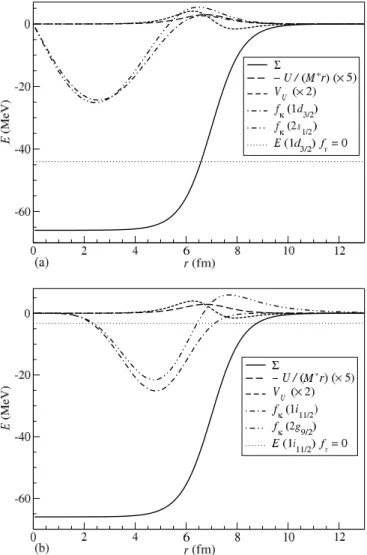
FIG. 3. The potentials, VU, and−U/(M∗r) and the lower radial wave functions fκ for the pseudospin partners (a) [2s1/2−1d3/2]
and (b) [2g9/2−1i11/2] when fv=1.2. The wave functions were
normalized such that they could be plotted side by side with the potentials.
[becauseV′<0, so that, from Eq. (5),−U >0], the effective contribution depends on the sign of ′/(E−)×L·S/r. Because it changes sign whenr > rs, in whichrsis the radius for which =E, the net change ofVPSO depends on how the wave functionfκ(r) behaves nearrs for both pseudospin partners. What we found is that for these surface levels, the followingUcontribution for the pseudospin-orbit potential:
VPSOU = − 2 M∗U
L·S
r (27)
is the dominant one. The reason why the contribution of this potential toVPSOfor the pair [2g9/2−1i11/2] is so big lies in the fact that it is proportional to2L·S = −(1−κ), which is equal to−6 and 5 for 2g9/2and 1i11/2respectively. Because Uis negative,VPSOU (2g9/2)− VPSOU (1i11/2) is negative and more so asfv increases [see Fig. 2(b)], thus explaining why pseudospin splitting decreases with the increase offv.
Note that, from Table I, one is able to see directly the different effects that the tensor coupling has on VPSO in low-lying ([2p3/2−1f5/2]) and surface ([3p3/2−2f5/2])
pseudospin partners that have thesameκ values. The values of VPSO and their differences change significantly withfv for the surface partner.
Figs. 3(a) and (b) show, VU, the radial part of theVPSOU potential [Eq. (27)], given by −U/(M∗r), which is always positive, as discussed, and the lower radial wave functions
fκ for the pseudospin partners [2s1/2−1d3/2] and [2g9/2− 1i11/2], respectively, whenfv =1.2. Also plotted is the energy of the lowest lying level of each doublet forfv=0, allowing to have a rough estimate of the valuersmentioned above by the intersection of its horizontal line with the potential curve. From these figures one sees clearly why the tensor potential Uhas a much larger effect for a surface pseudospin doublet. Indeed, the lower radial wave functions for these levels have a significant strength near the nucleus surface, such thatVU
PSO can have a significant value and have a sizeable contribution to the pseudospin splitting.
IV. CONCLUSIONS
In this article we assessed the importance of the isoscalar tensor coupling to pseudospin symmetry as is realized in heavy nuclei, using as an example the neutron pseudospin partners of208Pb, calculated within a relativistic theory with scalar and vector mean fields parametrized with Woods-Saxon potential forms. By looking into the second-order equation for the lower component of the Dirac spinor, we obtained an expression for the pseudospin-orbit potential, showing its explicit dependence on the radial tensor potential. Because this potential comes from a derivative coupling (higher order term in the Lagrangian), the contribution for the energy from the potentials originated by that interaction are all scaled by 1/M (M is the nucleon mass) and, because of that, is very small in comparison with kinetic and potential terms. However, because the spin-orbit interaction (and pseudospin) is a term of the same order, the effect of the tensor coupling can be significant in this case. In fact, we conclude that the contribution fromUto the pseudospin potentialVPSO is the dominant one for the surface levels.
We have shown that the surface pseudospin partners were the most affected by the tensor coupling, as was expected, and that this coupling reduces pseudospin splitting. This reduction can be significative to the point of inverting the level order, with the states with aligned spin (j =l+1/2) having higher energy than the states with antialigned spin.
potential part, gives a significant contribution to the change of the energy splitting. This finding is compatible with the dynamical character of the pseudospin symmetry.
ACKNOWLEDGMENTS
We acknowledge financial support from CNPq, FAPESP, and FCT (POCTI) scientific program. R.L. and M.M. ac-knowledge, in particular, the CNPq support and A.S.C was also supported by FAPESP.
APPENDIX
In this Appendix we present the derivation of Eqs. (11) and (12).
If we define the operatorO=α· p+iα·rˆU, the
second-order differential equations are obtained by applying OO†
andO†Oto
− and+, respectively. For − we have the following:
OO†− =O(E−)+
=[α·p(E−)]++(E−)O+ =iα·rˆ′++(E−)(E+2M−)−
=
p2+U2−U′−2U
r −4U
L·S
r
−, (A1)
where , , and U are radial potentials, primes denote derivatives with respect tor, and Sstands for the 4×4 spin matrix. Conversely, from the equationO†
−=(E−)+
we obtain the following:
O†− =(α· p−iα·rˆU)−
=α·ˆr(ˆr·p+irˆ× p·−i U)− = −iα·ˆr
∂
−
∂r +U −−2
L·S
r −
=(E−)+, which allows us to write the following:
iα·rˆ′+ =iα·rˆ′ O
†
−
E−
=
′
E−
∂
−
∂r +U −−2
L·S
r −
.
(A2) In the same way, for+we have the following:
O†O+=iα·ˆr′−+(E−)(E+2M−)+
=
p2+U2+U′+2U
r +4U
L·S
r
+, (A3) and, using equation O+=(E+2M−)−, we get the following:
iα·rˆ′− =
′
E+2M− ×
∂
+
∂r −U +−2
L·S
r +
. (A4) Using Eqs. (A1) and (A2) for−and Eqs. (A3) and (A4) for
+, we get finally Eqs. (11) and (12).
[1] K. T. Hecht and A. Adler, Nucl. Phys.A137, 129 (1969). [2] A. Arima, M. Harvey, and K. Shimizu, Phys. Lett.B30, 517
(1969).
[3] C. Bahri, J. P. Draayer, and S. A. Moszkowski, Phys. Rev. Lett. 68, 2133 (1992).
[4] A. L. Blokhin, C. Bahri, and J. P. Draayer, Phys. Rev. Lett.74, 4149 (1995).
[5] J. Meng, K. Sugawara-Tanabe, S. Yamaji, P. Ring, and A. Arima, Phys. Rev. C58, 628(R) (1998).
[6] J. Meng, K. Sugawara-Tanabe, S. Yamaji, and A. Arima, Phys. Rev. C59, 154 (1999).
[7] J. N. Ginocchio, Phys. Rev. Lett.78, 436 (1997); Phys. Rep. 315, 231 (1999).
[8] J. S. Bell and H. Ruegg, Nucl. Phys.B98, 151 (1975). [9] J. D. Walecka, Ann. Phys. (NY)83, 491 (1974).
[10] B. D. Serot and J. D. Walecka, inAdvances in Nuclear Physics, edited by J. W. Negele and E. Vogt (Plenum, New York, 1986), Vol. 16.
[11] R. J. Furnstahl and B. D. Serot, Phys. Rev. C41, 262 (1990). [12] J. N. Ginocchio and A. Leviatan, Phys. Lett.B245, 1 (1998). [13] J. N. Ginocchio and A. Leviatan, Phys. Rev. Lett.87, 072502
(2001).
[14] P. Alberto, M. Fiolhais, M. Malheiro, A. Delfino, and M. Chiapparini, Phys. Rev. Lett.86, 5015 (2001).
[15] P. Alberto, M. Fiolhais, M. Malheiro, A. Delfino, and M. Chiapparini, Phys. Rev. C65, 034307 (2002).
[16] R. Lisboa, M. Malheiro, and P. Alberto, Phys. Rev. C67, 054305 (2003).
[17] R. Lisboa, M. Malheiro, and P. Alberto, Braz. J. Phys.34, 293 (2004).
[18] S. Marcos, L. N. Savushkin, M. L´opez-Quelle, and P. Ring, Phys. Rev. C62, 054309 (2000).
[19] S. Marcos, M. L´opez-Quelle, R. Niembro, L. N. Savushkin, and P. Bernardos, Phys. Lett.B513, 30 (2001).
[20] R. J. Furnstahl, J. J. Rusnak, and B. D. Serot, Nucl. Phys.A632, 607 (1998).
[21] G. Mao, Phys. Rev. C67, 044318 (2003).
[22] R. Lisboa, M. Malheiro, A. S. de Castro, P. Alberto, and M. Fiolhais, Phys. Rev. C69, 024319 (2004).
[23] J. N. Ginocchio, Phys. Rev. C69, 034318 (2004).
[24] R. Lisboa, M. Malheiro, A. S. de Castro, P. Alberto, and F. Fiolhais, Int. J. Mod. Phys. D13, 1447 (2004).
[25] M. Chiapparini, A. O. Gatone, and B. K. Jennings, Nucl. Phys. A529, 589 (1991).
[26] R. J. Furnstahl, B. D. Serot, and H.-B. Tang, Nucl. Phys.A615, 441 (1997).
![FIG. 1. Calculated neutron single-particle energy levels of the pseudospin partners [2f 7/2 − 1h 9/2 ], [2f 5/2 − 3p 3/2 ], and [1i 11/2 − 2g 9/2 ] in 208 Pb](https://thumb-eu.123doks.com/thumbv2/123dok_br/16327237.187928/4.891.462.828.101.377/calculated-neutron-single-particle-energy-levels-pseudospin-partners.webp)
![FIG. 2. The contributions from the terms of the energy decom- decom-position [Eq. (23)] for pseudospin doublets (a) [2s 1/2 − 1d 3/2 ] and (b) [2g 9/2 − 1i 11/2 ] when f v varies from 0 to 1.3.](https://thumb-eu.123doks.com/thumbv2/123dok_br/16327237.187928/5.891.461.829.96.648/contributions-terms-energy-decom-position-pseudospin-doublets-varies.webp)