Brazilian Journal of Physics, vol. 33, no. 2, June, 2003 297
Polarization Effects in Relativistic Nuclear Pairing
E.F. Batista, B.V. Carlson, C. De Conti, and T. Frederico
Departamento de F´ısica, ITA-CTA, S˜ao Jos´e dos Campos, SP, Brasil
Received on 30 October, 2002
In the present work we discuss the effects of the medium polarization on the nuclear pairing, in the context of the relativistic Hartree-Fock-Bogoliubov (HFB) approximation. The medium polarization effects on the scalar and vector masses, as well on the pairing, as a function of Fermi momentum, are shown for several values of the coupling constants scaled by a parameter x. We find have obtained that the nuclear pairing is strongly affected by the medium polarization.
For nearly three decades the nuclear pairing model has played an important role in the description of nuclear spec-tra. The mean field BCS method has been the most used approximation to solve this problem. However, the BCS theory is a very simple approximation which neglects any contribution to the nucleon-nucleon interaction beyond the bare potential. In order to account for many nuclear proper-ties it is necessary to go beyond the pure BCS approach and add other effects to the nucleon-nucleon interaction, such as the medium polarization and other corrections to the self-energy.
In models of pairing, one of the most important quan-tities to be evaluated is the gap equation. In the BCS ap-proach it is possible to obtain an analytical solution for the gap equation as opposed to potential models where this is possible only with a numerical treatment. However, go-ing consistently beyond the BCS approximation includgo-ing the medium polarization is a difficult task. Analytical re-sults can be obtained only at low density where it has been noted that the medium effect modifies the effective nucleon-nucleon interaction by adding a repulsive term, thus causing a reduction in the1
S0gap.
Understanding the role played by the nuclear medium in modifying hadronic properties is one of the most inter-esting problems facing nuclear physics today. One of the most interesting effects of the nuclear medium is the mixing of vector and scalar mesons. In lowest order this mixing is generated by the coupling of the mesons to particle-hole ex-citations. In the isoscalar channel, the coupling of theσand
ωfields through particle-hole excitations is extremely large and is therefore expected to strongly affect the propagation of mesons in nuclear matter [1].
In this work, we intend to use the effective nucleon-nucleon interaction in the1S0 pairing channel to study the effect of the medium-modified meson masses. We use a rela-tivistic Hartree-Fock-Bogoliubov formulation, developed in Ref. [2], in which, the QHD formulation is used to describe the nucleon-nucleon interaction in terms of the self-energy, Σ, and the pairing field,∆. This model is an improvement over the non-relativistic formulation because it allows a
si-multaneous description of many nuclear matter properties such as the saturation point, the effective mass of the nu-cleon and the pairing energy.
Using a Dirac-HFB approximation to pairing in symmet-ric nuclear matter, the consistency equation for the self-energy and pairing field are written respectively as [2]
Σ(k) = −iΓa(0)Dab(0)
Z d4
q
(2π)4 T r[Γb(0)G(q)]
+ i
Z d4
q
(2π)4Γa(q)D
ab(k−q)G(q)Γ
b(q) (1)
and
∆(k) =
Z d4
q
(2π)4Γa(q)D
ab(k−q)F(q)BΓT b(−q)B†
(2) where, Γjα represents the meson-baryon vertex ( we will
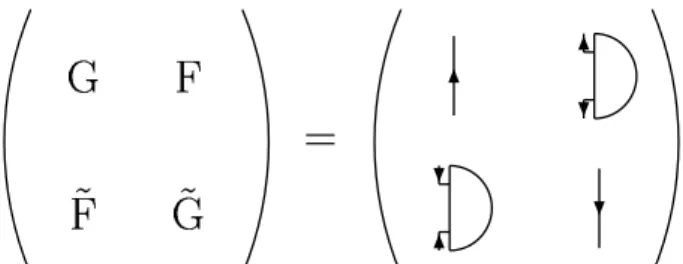
consider only the scalar and vector vertices),Dαβj (k−q)is the meson propagator, the matrix B relates transposed quan-tities to the complex conjugates of the time-reversed ones. It is given byB=τ2⊗γ5C, where C is the charge conjugation andτ2is a Pauli matrix that acts in the isospin space. F(q) is the anomalous propagator that is one of the components of the baryon propagatorSF(q), which, in the Dirac-HFB
formalism, takes the form shown in Fig. 1.
✁
✂
✂
✁
✄
298 E.F. Batistaet al.
in which G is the usual baryon propagator andF˜ andG˜are the corresponding time-reversed propagators. The Dyson equation for the usual baryon propagator is given by,
G(k) =G0(k) +G0(k)Σ(k)G(k). (3) The diagramatic representation for the baryon propaga-tor in a Hartee-Fock approximation is shown in Fig. 2 where the double line denotes the full propagator and the single line denotes the free propagator.
✂✁✄✆☎ ✝✟✞✡✠✁☛✆☎ ☞ ✌✎✍ ✏ ✠✍
✑
✌✎✑
☞
✌✎✍ ✌✎✑
✏ ✍✑
✒
Figure 2. Baryon propagator in HF approximation.
To compute the meson propagator, we sum over ring dia-grams, which consist of repeated insertions of the lowest-order one-loop proper polarization part. The sum, which is shown in Fig. 3, yields the relativistic random-phase ap-proximation(RRPA),
Figure 3. Random-phase approximation for the effective interaction.
The Dyson’s equation for the full propagator,D, is given in a matrix form as,
Dad=D
0 ad+D
0
abΠbcDcd (4)
whereD0
is the lowest order meson propagator andΠis the polarization tensor. Since we want to includeσ−ωmixing, it is convenient to use a meson propagator in the form of a 5 X 5 matrix. The lowest order meson propagator is given by a block-diagonal matrix as,
D0a
b=
µ
D0µ ν 0
0 ∆0
¶
. (5)
The noninteracting propagators for theσandωmesons are given respectively by,
∆0
(q) = 1
q2
µ−m2s+iε
, (6)
D0µν(q) = −gµν
q2 µ−m
2 v+iε
. (7)
The polarization tensor is obtained from the ring dia-gram, shown in Fig. 4
✂✁
✂✄
☎✝✆ ✞✠✟☛✡✌☞ ☎✝✆ ✞✠☞
Figure 4. The lowest-order polarization diagram.
where theΓ’s are the vertex function. The polarization in-sertion is given by,
Πab(q) =
µ
Πµ
ν Πmν
Πµ
m Πs
¶
. (8)
The polarizationsΠµ
ν andΠµsatisfy current conservation
conditions,
qµΠµν = Πµνqν= 0
qµΠµm = 0. (9)
The lowest order scalar, vector and scalar-vector-mixed polarization are given respectively as
Πs(q) = −ig 2 s
Z d4
k
(2π)4T r[G(k)G(k+q)],
Πµ
ν(q) = −ig 2 s
Z
d4
k
(2π)4T r[γ µG(k)γ
νG(k+q)],
ΠM
µ (q) = −igsgv
Z d4
k
Brazilian Journal of Physics, vol. 33, no. 2, June, 2003 299
G(k) = GF(k) +GD(k),
GF(k) = (γµk⋆µ+M⋆) 1
k⋆2
µ −M⋆2+iε
,
GD(k) = (γµk⋆µ+M⋆)iπ
E⋆ k
δ(k0⋆−Ek⋆)θ(kF − |~k(11)|),
wherek⋆
µ = (k0−gvV0, ~k)andEk⋆=
p
~k2+
M⋆2 . With this form of the baryon propagator, each polariza-tion inserpolariza-tion can be divided into two pieces: the Feynman part or vacuum polarization that does not involve the delta-function and the delta-delta-function density-dependent part. In this work we are not interested in the vacuum contribution and thus will disconsider the term containing only vacuum contributions. We will consider only the density-dependent part of the polarization insertion that also contains a vacuum contribution.
For symmetry of the integrals given by Eq.[10] and cur-rent conservation, the only nonnull conponents, at low en-ergy and neglecting recoil, are
ΠS(kf, M⋆) =
g2 s
2π2
·
kf Ef+ 3M⋆ 2
ln M
⋆
Ef+kf
¸
,
ΠL(kf, M⋆) =−
g2 v
π2kf Ef ,
ΠM(kf, M⋆) =
gsgv
π2 kf M ⋆,
ΠT(kf, M⋆) =−
g2 v
π2
·
kf Ef+M⋆ 2
ln M
⋆
Ef+kf
¸
,
where,ΠS,ΠL,ΠM,ΠT are the scalar, longitudinal, mixed
and transversal polarizations respectivily, with
ΠL=−¡Π 3
3+ Π 4
4¢ e ΠM =
p
−q2
q3 Π4
.
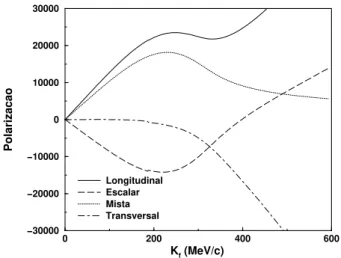
The sum over ring diagrams to all orders produces a ex-tremely strong polarizability and an instability of nuclear matter. To reduce this effect we are introduce a free pa-rameter x, which scales the coupling constants in the inte-grals. In Fig. [5] we plot the polarizations as a function of the Fermi momentum forx = 0.1, in which, we show the density-dependence of the polarization. We note the strong sensitivity of polarizations with the density.
0 200 400 600
Kf (MeV/c) −30000
−20000 −10000 0 10000 20000 30000
Polarizacao
Longitudinal Escalar Mista Transversal
Figure 5. Polarization as a function of the fermi momentum.
The effective mass of the mesons in nuclear matter is obtained by diagonalizing the meson propagator,
(D−1 )a
b= (q 2
−m2)δba−Πa
b. (12)
After obtaining the eigenvectors, the meson propagators can be written in the form,
Dab=X
i
ua
i Diubi =
X
i
ua i
1
q2−
m2 i
ub
i, (13)
whereua
i are the eigenvectors of meson propagator.
In the Figs. 6, 7, 8 we show the modified meson masses as a function of the Fermi momentum for several values of the free parameter x. We note that the polarization contri-bution increases rapidly with the free parameter x. The po-larization contributions decrease the scalar meson mass and increase the vector meson mass. Their combined effect is to make the effective nucleon-nucleon interation more atrac-tive.
0 100 200 300 400
Kf (MeV/c) 410
430 450 470 490 510 530 550
ms
(MeV)
x = 0.1 x = 0.2 x = 0.3 x = 0.4
300 E.F. Batistaet al.
0 100 200 300 400
Kf (MeV/c)
750 800 850 900 950
m
L
(MeV)
x = 0.1 x = 0.2 x = 0.3 x = 0.4
Figure 7. Longitudinal vector meson mass.
0 100 200 300 400
Kf (MeV/c) 760
780 800 820 840 860 880 900
mT
(MeV)
x = 0.1 x = 0.2 x = 0.3 x = 0.4
Figure 8. Transversal vector meson mass.
The Hermiticity and transposition invariance conditions, as well as the requirements of invariance under Lorentz and parity transformation reduce the possible form of the self-energy, in symmetric nuclear matter, to
Σ(k) = ΣS(k)−γ0Σ0(k) +~γ.~kΣT(k); (14) while, the pairing field can be taken to be,
∆(k) = [∆S(k)−γ0∆0(k)−iγ0~γ.~k∆T(k)]~τ .~n. (15)
0 100 200 300
kf (MeV/c) 0
1 2 3 4 5 6
∆G
(MeV)
x = 0.0 x = 0.1 x = 0.2 x = 0.3 x = 0.4
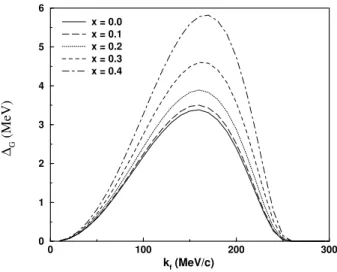
Figure 9. Pairing gap.
In Fig. 9 we plot the pairing gap as a function of Fermi momentum for several values of free parameter. The in-creasingly attractive effective nucleon-nucleon interaction causes a strong increase on the pairing gap.
We conclude that, the polarization effect is very strong changing drastically the effective nucleon-nucleon interac-tion. The pairing field is extremely sensitive to the medium effect.
Acknowledgments
E.F.B acknowledges the support of FAPESP. B.V.C. and T. Frederico acknowledge partial support from FAPESP and CNPq.
References
[1] L.S. Celenza, A. Pantzires and C.M. Shakin, Phys. Rev. C45, 205 (1992). H.-C.Jean, J. Piekarewicz and G. A. Williams, Phys. Rev. C49, 1981 (1994).
[2] F.B. Guimar˜aes, B.V. Carlson and T. Frederico, Phys. Rev. C54, 2385 (1996); F.B. Guimar˜aes, B.V. Carlson and T. Fred-erico, Phys. Rev. C56, 3097 (1997).