Albanian j. agric. sci. 2013;12 (2): 283 -287 Agricultural University of Tirana
Correspondence: HairiIsmaili, Agricultural University of Tirana, Albania; Email: [email protected]
RESEARCH ARTICLE
(Open Access)
The study of rhizogenesis in the vegetative sprigof the olive (
Oleaeuropaea
L.
) through the method of mist propagation.
HAIRI ISMAILI1,VASIL LANI2
1 Agricultural University of Tirana, Albania
²Research Station on Olive, Peze e vogel, Tirana, Albania
Abstract
The object of this research is propagation through green macroexplants derived from the apical, medial and basal segment of the sprig in the variety “I BardhiTiranes” (BT). The partswere treated with Indole-3 Butyric Acid (IBA), (1gl¯ ¹, 3gl¯ ¹, 5gl¯ ¹ and Control), mist-propagation. The procedure took place in two phases of the meristematic development; May (active) and December (asleep). The percentage of rooting fluctuated from 6.1 and 68.3%.The concentrations of IBAs 3gl¯ ¹ were more efficient during the active cambial development; whereas the high concentrations 5gl¯ ¹, during the phase of low development of the cambium. In May the apical parts rooted at e higher percentage for all the treatments: (1gl¯ ¹, 3gl¯ ¹, 5gl¯ ¹ IBA and Control), compared to the medial and basal parts of the sprig.IBA in high concentrations during the phases of active vegetation has become an inhibitor of rooting. The concentration of 1gl¯ ¹, had weak reactions and was inefficient. (P=0.05).The olive BT displays the best endogenous predisposition in May. The presence of the leaves has been a stimulating factor for rooting (r²=0.88). The number of roots has increased in parallel with the increase of concentration, (r²=072), whereas the length of roots has not been influenced by the concentrations and the phase of rooting.
Key words.Olive, OleaeuropaeaL., propagation, nebulization, IBA, hidrooalcoolic, in vivo culture.
Introduction
The method of propagation in vivo culture of the olive ensures a high coefficient of propagation, [5]. But there are different factors which influence the process of rhizogenesis such as: endogenous hormonal concentrations [3], the application of exogenous hormonal stimulants [6], the different concentrations of hormonal acids [1],the origin of the green part as well as its positioning on the olive sprig [2],the influence of the period of time chosen for the propagation and the correlation with the meristematic activity of the tissues, [2], etc. In the meantime a lot of hormonal acids have been experimented in different hydroalcoholic concentrations and the results have changed based on the genotype of the olive.
This research clarifies the physiological effects that derive from the origin of the green part, extracted by the same sprig at the apical, medial and basal part and the influence of the extreme IBA concentrations in correlation with the meristematic activity of three different segments of the olive sprig “I BardhiTiranes” [1].
Material and method
Scheme: different apical, medial and basal parts were prepared and tested for their rooting abilityin the vegetative sprig of I BardhiTiranescv. Each segment was treated with the Indole-3 Butyric Acid (IBA) in
hydroalcoholic concentrations 1gl¯ ¹,3gl¯ ¹, 5gl¯ ¹as well as Control. The study consisted of two moments of the meristematic development; May (active) and December (asleep).
Vegetal material:macroexplants of 8-10 cm in length, with two pairs of leaves were stimulated 3-5 seconds with IBA hydroalcoholic solution (alcohol 32%). For 70-80 days, with constant temperature: in substrate 24⁰C, whereas within the bank 20⁰C (± 2⁰C). Air humidity 80-85% was enabled through the mist method. The mist lasted for 5 sec per each 11-13 wh/m². Light 6000 lux. [4,7].
Indices and statistical analysis: The end of the rooting process estimated the following results: (i) Rooting percentage, (ii) number of roots, (iii) length of first roots,(iv) percentage of defoliation.Statistical analysis through Jmp software, for the variance analysis, (p=0.05), coefficient of variation, bivariate analysis and the coefficient of correlation through the apical, medial, basal segments in correlation with the concentrations ofIBA, time, diameter, number and length of roots.
Results and discussion
par the the ma con an of con Tre Ap Me Ba Ap Me Ba Ap me Ba Ap me Ba Ap me Ba Ap me Ba Ap me Ba Ap me Ba Le
renchyma a esclerenchym e sclerenchy ass, [6].of ho
nic grouping d the phloem the sprigs.T ntact with t
Figure 1 supplied with root Table 1: from the I eatment pical/M/cont edial/M/cont asal/M/cont pical/D/cont edial/D/cont asal/D/cont pical/M/ IBA1 edial/M/ IBA1 asal/M/ IBA1g pical/D/ IBA1 edial/D/ IBA1 asal/D/ IBA1g pical/M/ IBA3 edial/M/ IBA3 asal/M/ IBA3g pical/D/ IBA3 edial/D/ IBA3 asal/D/ IBA3g pical/M/ IBA5 edial/M/ IBA5 asal/M/ IBA5g pical/D/ IBA5 edial/D/ IBA5 asal/D/ IBA5g vels not conn
and the phlo matic ring. T matic ring, b omogenous t gs are differ matic parenc
The vascula the xyleme
: Morphologi
with two pair
t meristems.,th
The effect of
apical, media
Indice R
19.6± 13.7± 11.9± 7.1±1 8.3±1 6.4±1 1gl¯ ¹ 37.4± 1gl¯ ¹ 33.2± gl¯ ¹ 33.9± gl¯ ¹ 25.5± gl¯ ¹ 24.3± gl¯ ¹ 25.1± 3gl¯ ¹ 68.3± 3gl¯ ¹ 59.2± gl¯ ¹ 57.7± gl¯ ¹ 27.7± gl¯ ¹ 25.8± gl¯ ¹ 24.1± 5gl¯ ¹ 59.3± 5gl¯ ¹ 55.2± gl¯ ¹ 54.7± gl¯ ¹ 34.8± gl¯ ¹ 35.8± gl¯ ¹ 32.1± ected by same
oem, inside The cells ap
break it and tissues. At th rentiated nea hyma, which ar tissue is r of the part,
ical exchanges
rs of leaves.,ne
he completed
f both IBA con
al and basal se
Rooting% ±0.90i ±0.90j ±0.90j 1.10k 1.10k 1.10k ±1.20d ±0.88ef ±0.90ef ±1.21gh ±1.00h ±0.85gh ±1.31a ±1.31b ±1.31bc ±0.85g ±0.90 gh ±0.93h ±1.20b ±1.10c ±1.10c ± 1.10 def ± 0.94de ±0.90f e letter are sig
and outside pply pressure are unified hat time cell ar the camb h are the stra rapidly put , and the sp
s and the main
ebulizing bank
rooting proce
ncentrations o
egment of the
N⁰ of prim
3.7ghu 3.3ijkl 3.9fghi 2.5mn 2.9klm 2.1n 4.4f 3.9fghi 4fgh 3.2jkl 3kl 2.9lm 5.6de 5.1e 6.0cd 3.6hijk 4.3fg 3.9fghi 6.3bc 6.9ab 7.1a 3.5hijkl 4.1fgh 3.8fghij gnificantly diff e of e on as a lular bium ands into prigs gro app mm the [6].
n stages of the
k.,the bank wi
ess.
on rooting perc
sprig in the va
mary Roots
ferent.
w fast towar pear outside. m, the cortex
marrow are
e process. from
ith the green p
centage, Numb
ariety “I Bardh
Length of p
4.3ghijk 3.9 ijk 3.9 ijk 4.2hijk 4.9 cdefg 3.7kl 4.6defgh 4.4 efghi 4.5efgh 3.8jkl 4.4 fghij 5.1abcde 5.3abc 5bcdef 5.2abcd 4.9cdefg 5.2abcd 5.6a 5.7a 4.0 hijk 3.2 L 4.1 hijk 4.5 efghi 4 hijk
rds the perip The sprigs with the peri observed an
m left to right:
pieces during
mber and length
hiTiranes”
primary Root
phery, break have just a iderma and t nd they beco
: the green pie
rooting., callu
h of primary R
ts(cm) Dia
2.1 3.3 4.2 1.9 3.3 4.1 2.0 3.1 4.2 2.2 3.2 4.3 2.1 3.3 4.1 2.1 3.2 4.3± 2.0 3.1 4.1 2.1 3.1 4.2
k the callus a appeared, a f
The study of rhizogenesis in the vegetative sprig of the olive ( ) through the method of mist propagation.
Rooting variance:The derived partsfrom the apical to the basal part of the sprig had different reactions for their rootingwhen treated with1gl¯ ¹, 3gl¯ ¹, 5gl¯ ¹ IBA. The apical segments always displayed an active cambium in May, the highest value of rooting (9.1 and 10.6%),compared to the medial and basal part of the sprig. When the cambium’s meristem was asleep the rooting percentage of the three segments of the sprig did not display considerable obvious changes, but it was easily observed in favour of the medial segment of the sprig.
In Table1,there are different obvious changes of the rooting ability onthe effect of the three IBA concentrations in correlation withthe apical, medial and basal segment of the sprig. In Maywhen the meristematic development is active the apical parts rooted at e higher percentage in all the treatments:(1gl¯ ¹, 3gl¯ ¹, 5gl¯ ¹ IBA and Control), compared to the medial and basal parts of the sprig. Especially, 3gl¯ ¹ IBA incited the highest rooting value (68.3%),compared to the medial parts (59.2%)and the basal parts (57.7%). In May the IBA treatments 1gl¯ ¹ and 5gl¯ ¹ influenced better on the apical segments than on those of medial and basal parts of the sprig.
In December, when the meristem is inactive or asleep, IBA 5gl¯ ¹ in each segment of the sprig influenced better than the concentrations 3gl¯ ¹ and 1gl¯ ¹.(34.8%, 35.8%, 32.1%).Rooting ability in December decreased (27.4%) compared to May, and the differences between treatments are low, Tukey-kramer lsd.2.43 q=0.05Table 1.
The basal parts of the sprig in both phases of the meristem development had a lower rooting ability than those of the apical or medial parts. The decrease of rooting capacity in December occurs because of the lack of enzyme activators that synthesize the auxinic complexes assimilated by the phloem, because the meristematic development is low or zero. [2].Whereas during the phase of active meristematic development (in May) vegetative growth is intensive, the endogenous auxins are active and they are to be found in high concentrations in the apical parts [3]
Correlation of rhizogenous factors: Vegetative growth: Generallythe apical, medial and basal parts of the sprigs had a better promontory activity in May as compared to December. Figure-3 (a.b)
The most efficient concentration was 3gl¯ ¹IBA, when vegetative growth was intensive, because the
endogenous auxins are in maximal concentrations (r=0.94); on the contrary when vegetative growth stopped (in December), the high concentrations of the IBA had better effects, because the lack of promontory
was in minimal quantities (r=0.67). The highest rooting capacity of the three promontory segments pursuant to the sprig matches the period of time when vegetative growth was intensive. When growth is inhibited by the lowering of the temperature, the values of rhizogenesis are limited by undergoing a significant decrease. This pheophase corresponds with the time when the inhibitors especially the phenols are in high concentrations. [8]. Vegetative growth begins in March, becomes intensive in May (0.7mm/day)and is gradually reduced to reach point zero during winter sleep.
The effect of defoliation: the high percentage of rooting in the apical parts was associated with low defoliation percentage (r²=0.88). The basal parts at each phase had a higher defoliation percentage which caused a lower percentage of their rooting (r²=0.31). The parts preserved their leaves depending on the position of the sprig and the concentration ofIBA(r²=0.83). Defoliation has been decreasing from the basal to the apical part of the sprig. The apical parts preserved a higher percentage of leaves in both phases of the meristematic development (56%, 87%, and 75%) compared to the other segments of the sprig. The basal segments have always expressed a higher percentage of defoliation. Cv=12%. Table-1.
The effect of the diameter of the parts:the diameter changes from the basal to the apical part and has acoefficient of significant variation(cv=21%). The values of the diameter fluctuated from 2.1 mm (apical part), up to 4.6mm (basal part)Table-1.The greater thickness of the base has negatively influenced on the rooting percentage of both experimental phases. This phenomenon is explained by the older age of the basal part of the sprig as well as its availability in low concentrations of the endogenous promontories, [3,5].
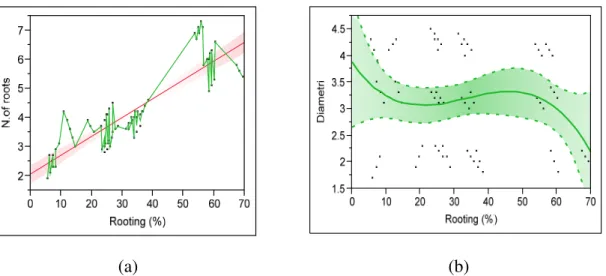
The number of promontory sprigswas higher when the following concentrations were applied 3gl¯ ¹ and 5gl¯ ¹ (5.6 and 5.7), (r²=0.89),whereas the length of the roots was not influenced by the IBA concentrations,Figure-2 (b).
Statistical evaluation of rhizogenesis:
that the factorial group influences 87% on the rooting percentage, Figure-3 (a), Figure-2 (a.b).
The type of the green part, the phase, the IBA concentrationas well as the relation among these is strong (Apical treatment /May/ IBA3gl¯ ¹). Itdisplays a higher rooting percentage (a = 0.05), which statistically is important becausetf<tk. (
t>2).
The treatments simultaneously (13,14, 19) have values oftf>tk, (2.23, 2.45, 2.12), thus in this way it is proved that the apicalparts stimulated with IBA, 3gl¯ ¹ and 5gl¯ ¹ in May have a positive influence on the rooting percentage.
Whereas all the treatments in December gave unimportant results because the value tf<tk,(1.5099<2), and in this case the hypothesis of this phase at any part and at any concentration is not proved statistically and economically, thus they do not have a value, [7,8].
(a) (b)
Figure 2: (a, b) Analysis of coefficient of regression,Bivariate Fit of Number of roots by Roting (%) and
bivariate fit of diameter by roting (%) of the apical, medial and basal segment.
(a) (b)
Figure 3:(a, b)Analysis of Distributions of Rooting (%) and effect of the three IBA concentrations in correlation
The study of rhizogenesis in the vegetative sprig of the olive ( ) through the method of mist propagation.
Conclusions:
The apical segments of the sprig displayed higher rooting ability during the phase of intensive meristematic development compared to the medial and basal part of the sprig. Especially 3gl¯ ¹ IBA incited the highest rooting values, compared to the medial and basal partsThe increase of the IBA dosage from 3gl¯ ¹ up to the hydroalcoholic solution 5gl¯ ¹significantly inhibits rooting when the presence of endogenous auxins is high. The contrary occurs when they are in low concentrations (December) which confirmed that the presence of high exogenous concentration is a stimulant.
References
1. Bartolini G., Leva AR., Benelli A: 1989: Advances in vitro culture of the
live:propagation of cv. Maurino. 1989. Acta Hort. 286, 41–44.
2. Caballero JM: 1983 La multiplication de l’olivier par bouturage semi-ligneux sous nebulisation. 1983. Bul.FAO. P 13-36
3. Fiorino P.& Cimato A, 1980: Stato attuale delle conoszenze sulla moltiplicazione dell’olivo con
la tecnica della nebulizzazione. L’informatore agrario, 38; 12-30.
4. Gonda L., Cugnasca, C.E. 2006 A proposal of greenhouse control using wireless sensor networks. In Proceedings of 4thWorld Congress Conference on Computers in Agriculture and Natural Resources, Orlando, Florida, USA, 2006. 5. Ismaili H: 2010 The influence of indole buturic
acid (IBA) in different concentrations in the percentage of olive cv. Rooting in Albania. Alb-Shkenca, 2010 (5) 321.
6. Leva R., Petrucceli R. Goretti., Panicucci M. 1992. Ruolo di alcuni microelementie carboidrati nella proliferazione in vitro di cv. Di olivo (Olea europaea L.) In Atti quatità olio extravergine di oliva, Firenze, 1-3 Decembre, 1992, 333.
7. Rodríguez F., Guzmán J.L.; Berenguel, M.; Arahal, M.R. 2008. Adaptive hierarchical control of greenhouse crop production. Int. J. Adap. Cont. Signal Process. 2008, 22, 180–197. 8. Sas/Stat: Statistical Analysis with Software.