Behavior of
Staphylococcus aureus
and autochthone microbiota
in fresh sausages added
of sodium nitrite and stored under refrigeration
Comportamento de Staphylococcus aureus e microbiota autóctone frente à ação de nitrito de sódio em linguiças frescais estocadas sob refrigeração
Lucyanne Maria Moraes CorreiaI Juliano Gonçalves PereiraII
José Paes de Almeida Nogueira PintoIII Vinicius Cunha BarcellosI
Luciano dos Santos BersotI
ISSN 0103-8478
ABSTRACT
Fresh sausages are cured meat products that may be contaminated with Staphylococcus aureus during the manufacturing procedure, which is frequently related with inadequate handling practices. The use of nitrite in meat products
has proven effi cacy against Clostridium botulinum, and studies indicate that bactericidal action against S. aureus depends on factors that are intrinsic and extrinsic to the product. The objective of the present study was to evaluate the effect of nitrite concentration, and pH on S. aureus and psychrotrophic autochthone microbiota in fresh sausages stored at different times and temperatures. Fresh sausage were produced at nitrite concentrations 50, 150 and 200ppm and contaminated with S. aureus. The sausages were storage at refrigeration (7 and 12C) and the quantifi cation of S. aureus and psychrotrophic microorganisms was carried out on days 0, 2, 4, 7, and 10. Results showed that nitrite concentrations and the temperatures used had minimal effect on the multiplication of S. aureus and psychrotrophic autochthone microbiota. Final counts depended only on the length of storage: at the end of 10 days, counts were statistically similar in the different groups, showing that temperature and nitrite concentrations used did not control microbial growth effectively. It is suggested that the product should be stored below 7C or at freezing temperatures for greater microbiological stability.
Key words: Fresh sausage, nitrite, psychrotrophic, S. aureus, temperature.
RESUMO
A linguiça frescal é um embutido curado que, devido à manipulação durante as etapas de produção, pode se tornar contaminado com S. aureus, patógeno frequentemente relacionado com práticas inadequadas de higiene durante a produção de
alimentos. A utilização de nitrito em embutidos tem sua efi cácia
comprovada contra C. botulinum e, para o S. aureus, estudos indicam que a ação bactericida depende de fatores extrínsecos e intrínsecos. O objetivo do presente estudo foi avaliar o efeito da concentração de nitrito e do pH frente à contaminação por S. aureus e microbiota autóctone em linguiças frescais estocadas em diferente tempos e temperaturas. Linguiças foram produzidas com concentrações de 50, 150 e 200ppm de nitrito e contaminadas com S. aureus. As linguiças foram armazenadas sob refrigeração (7e 12°C) e a quantifi cação de S. aureus e psicrotrófi cos foi realizada
nos dias 0, 2, 4, 7 e 10. Os resultados demonstraram que a infl uência
das concentrações de nitrito e temperaturas utilizadas sobre a multiplicação de S. aureus e da microbiota autóctone foi mínima, sendo dependente apenas do período de estocagem. Entretanto, ao
fi nal de dez dias, as contagens foram estatisticamente iguais nos
grupos analisados, mostrando que as condições de temperatura e concentrações de nitrito utilizadas não exerceram controle efetivo no desenvolvimento destes micro-organismos. Sugere-se que este produto seja armazenado sob temperaturas inferiores a 7°C ou sob congelamento para maior estabilidade microbiológica.
Palavras-chave: Linguiça frescal, nitritos, psicrotrófi cos, S. aureus, temperatura.
INTRODUCTION
In Brazil, fresh sausage is one of the most commonly consumed meat products, once manufacture does not require sophisticated technology, and generates, at the end of the process, a product with great sensory acceptance at attractive prices (TERRA, 1998).
Fresh sausages, as other raw meat products, are great substrates for microbial growth
IDepartamento de Ciências Veterinárias. Universidade Federal do Paraná (UFPR), Setor Palotina, Palotina, PR, Brasil.
IICurso de Medicina Veterinária. Universidade Federal do Pampa (UNIPAMPA), Campus Uruguaiana. BR 472, Km 585, CP 118, 97500-701,
Uruguaiana, RS, Brasil. E-mail: [email protected]. Autor para correspondência.
IIIDepartamento de Higiene Veterinária e Saúde Pública, Faculdade de Medicina Veterinária e Zootecnia (FMVZ), Universidade Estadual
due to a series of factors. Among them, high water activity, low acidity, and presence of ingredients that may enable the development of undesirable microorganisms. Besides, as they are intensively handled during manufacture, these products may contain pathogenic microorganisms (SILVA et al., 2004).
Among microorganisms recognized
as pathogenic and involved in outbreaks caused by incorrect handling of foodstuffs, S. aureus is widespread and able to survive and multiply in foods
when it fi nds adequate conditions (DO CARMO et
al., 2004; JAY, 2005). S. aureus is a saprophytic microorganism that inhabits the skin and nostrils of healthy individuals, giving it an important role in the epidemiological chain of foodborne diseases (DO CARMO et al., 2004; JAY, 2005).
In the USA, in 2008, enterotoxigenic Staphylococci were responsible for 2% of the outbreaks of bacterial foodborne diseases related with food ingestion, and ranked 6th in terms of occurrence (CDC, 2011). In the European Union, in 2010, Staphylococcus intoxication was responsible for 5.21% of the total of outbreaks and ranked 4th in occurrence, with pork and pork products as the 5th most important foodstuff involved in outbreaks (EFSA, 2012). In Brazil, data of the Ministry of Health indicate greater epidemiological importance of enterotoxigenic Staphylococcusin the occurrence of outbreaks, ranking second among bacterial pathogens and corresponding to 20.5% of the total of outbreaks that occur every year (BRASIL, 2013).
After technological processing and during commercialization, fresh sausages are basically preserved by the action of curing salts and low temperatures. The curing salts can be used in fresh sausages at a concentration of 150ppm (nitrite) and 300 ppm (nitrate) (BRASIL, 1999), but the use of this additive above the limits representing a factor for toxicological risks to human health. Curing salts delay rancidity, inhibit some pathogenic and spoilage microorganisms, and contribute to the development
of fl avor and color in cured meats (HONIKEL, 2008).
Low temperatures delay enzymatic reactions that are vital for microbial development (JAY, 2005).
It is well-known that C. botulinum is the main microorganism affected by nitrite and nitrate action in cured foods (SOFOS et al., 1979; TOMPKIN, 2005; DOYLE & BEUCHAT, 2007), and antimicrobial properties of nitrite were also tested against several other microorganisms, including S. aureus (BANG et al., 2008). However, effective concentration against this microorganism depends
on parameters that are intrinsic and extrinsic to the product.
Based on these facts, the objective of the present study was to evaluate the effect of temperature of storage time, sodium nitrite concentration, and pH on enterotoxigenic S. aureus and psychrotrophic autochthone microbiota in fresh sausages.
MATERIAL AND METHODS
Processing of the sausages and sampling method Sausages were processed in the Pilot Plant for Meat Processing at the Veterinary School of Federal University of Paraná (UFPR), Palotina Campus, Paraná, Brazil. Pork jowl and shoulder were ground and mixed for three minutes with the rest of the ingredients (2% salt, 0.1% sugar, 0.2% garlic paste, 0.05% black pepper, 0.03% red pepper, 0.05% nutmeg, 2.0% water, and 0.055% erythorbate). The mixture was divided into three portions of 5.5kg each, and placed on trays for the
curing salt to be added in fi nal concentrations equal to
50, 150, and 200ppm of sodium nitrite (treatments A, B, and C, respectively). These procedures were carried out in an adequately sterilized microbiological safety cabinet. After that, trays were kept at 2°C for 24h for the
curing process to completed.
S. aureus inoculum was prepared with six reference enterotoxigenic strains (ATCC 13565, ATCC 14458, ATCC 19095, ATCC 27664, FRI 137, and FRI 361). Each strain, kept in preservation agar, was individually cultured in BHI broth (brain heart infusion) and incubated at 37°C/24h. Each culture
was streaked on BHI agar plates and incubated at 37°C/24h. One colony was transferred to fl asks
containing 100mL of BHI broth and incubated at 37°C/24h. These subcultures were serially diluted
ten-fold up to 10-12 in 0.9% saline solution. From each dilution, S. aureuswas quantifi ed in BHI pour plates
incubated at 37°C24h. This protocol was carried out
in order to obtain the 3-log CFU g-1 inoculum to be used in the study. Immediately before inoculation in the pork mixture, S. aureus cultures were mixed in
one sterile fl ask for all the six cultures to be added to
the mixture in a single step.
After the curing process, S. aureus inoculum with the six strains was uniformly poured on the surface of each of the pork mixtures (treatment A, B, or C), and aseptically homogenized for 5min. After that, sausages were stuffed, packed,
and identifi ed. Groups of three sausage links were
placed on the tray, they were wrapped in PVC, and
identifi ed by labels (treatment A, B, or C).
Each treatment were subdivided into two groups that were stored under refrigeration, one at 7°C (ideal cooling) and the other at 12°C (marginal
cooling), in BOD. Sausages were stored for 10 days, and S. aureus and psychrotrophic microorganisms
were quantifi ed on days 0, 2, 4, 7, and 10.
Physical-chemical analyses pH
The pH of the sausages was measured
according to offi cial Brazilian methods (BRASIL, 1981).
Microbiological analyses
The microbiological analyses were carried in Laboratory of Inspection and Quality Control of Food and Water (UFPR).
S. aureus counts
S. aureus counts were carried out in two sausage links of each treatment (A, B, or C). Links were ground and homogenized in a sterile stomacher plastic bag. From these pooled sample, a 25-g analytical sample was collected and homogenized with 225mL of 0.9% saline solution in a stomacher, producing a 10-1 dilution. From this dilution, two other were produced, 10-2 and10-3. S. aureus was
quantifi ed in Petrifi lm STX (3M), included in the
AOAC Offi cial Methods (AOAC, 2000). Analyses
were carried out according to the manufacturer’s instructions (3M, 2002). Plates were incubated at 35°C/24h, and typical colonies were detected by the
presence of characteristic purple color (3M, 2002).
Psychrotrophic microorganism counts
Psychrotrophic microorganisms were counted in the dilutions obtained above, cultured in
spread plates with plate count agar (PCA). Plates were incubated at 7°C/10 days (APHA, 2001).
Statistical analysis
All experiments were carried out in triplicate, and experimental data were submitted to the Analysis of Variance. In order to assess differences between the treatments and variation in counts throughout storage,
one-way ANOVA was used (P≤0.05). Student’s t-test
was used to assess variations between temperatures
(P≤0.05). All statistical analyses were carried out in
SigmaStat for Windows®3.0.1, SPSS Inc., Chicago, Illinois, USA (2003).
RESULTS AND DISCUSSION
Table 1 shows that there was no signifi cant variation (P≥0.05) in pH throughout storage of
the product in two different temperatures and three treatments, demonstrating that there was no interference of pH in the multiplication of the microorganisms analyzed.
The pH values recorded during storage at the two temperatures and three treatments ranged from 5.93 to 6.37, which is the normal pH of raw, unfermented meat and meat products. This factor may have negatively influenced the action of curing salts on the microorganisms as, according to the ICMSF (ICMSF, 1985), optimum nitrite action occurs between pH 5.5 and 4.5. LUCK & JAGER (2000) argue that the concentration of curing salts to exert antimicrobial effects on S. aureus was lower as the pH decreased from 7.0 to 4.5.
In Italy, KAMDEM et al. (2007), found similar results in the evaluation of Tuscan sausage during 14 days of storage, demonstrating small variations in pH, no matter the initial formula, which was probably due to low development of lactic acid bacteria in the product.
Table 1 - Mean pH of fresh sausages during storage at two different temperatures (7 and 12°C) in treatments A, B, and C.
---A--- ---B--- ---C---Day
7°C 12°C 7°C 12°C 7°C 12°C
0 6.23 6.23 6.27 6.27 6.20 6.20
2 6.24 6.19 6.24 6.24 6.25 6.25
4 5.99 6.15 6.27 6.15 6.37 6.24
7 6.34 6.06 6.36 6.30 6.21 6.12
10 6.19 6.21 6.32 5.93 6.17 5.96
Table 2 shows the effect of storage temperatures (7 and 12°C) and the different treatments (A, B, and C) in the development of S. aureus. At
7°C, S. aureus counts did not differ statistically
(P≥0.05), no matter the treatment. BIRZELE et al.
(2005) showed that development of S. aureus fresh sausage with different concentrations of nitrite and stored under refrigeration (12°C) did not differ
signifi cantly.
However, keeping sausages at 12°C was not enough to control the pathogen, as determined by
the comparison of initial (day zero) and fi nal counts (day 10; P≤0.05), no matter the treatment.
When the effect of 12°C storage is analyzed throughout the study, it was observed that S. aureus population inoculated in the product
increased signifi cantly (P≤0.05) since the 7th day
in the three treatments, and that fi nal populations
obtained were statistically similar on the 10th day
(P≤0.05), indicating that there was no effect of curing
salt concentration on the adaptation of S. aureus to the product.According to JAY (2005), there are some observable effects of nitrite on the preservation of cured meats especially when they are
vacuum-packed. However, this effect seems to be a result of nitrite action together with other factors of the packaging environment.
S. aureuscounts over 5log CFU.g-1 were observed in the three treatments at 12oC since the 7th day in treatments A and B, and since the 10th day in treatment C. Counts above this limit may potentially cause foodborne disease due to enterotoxin production (CUNHA NETO et al., 2002; JAY, 2005). Considering that all strains inoculated in the product were enterotoxigenic, it may be said that, if the product was contaminated with an inoculum similar to the one used in this study, the product would pose a public health risk. However, enterotoxin production was not evaluated in the present study.
Other authors reported fresh sausages that were inadequate for consumption due to high Staphylococcus counts. Intensive handling of
the product from manufacturing to consumption was considered to be a predisposing factor for the detection of these microorganisms in the samples analyzed (MARQUES et al., 2006).
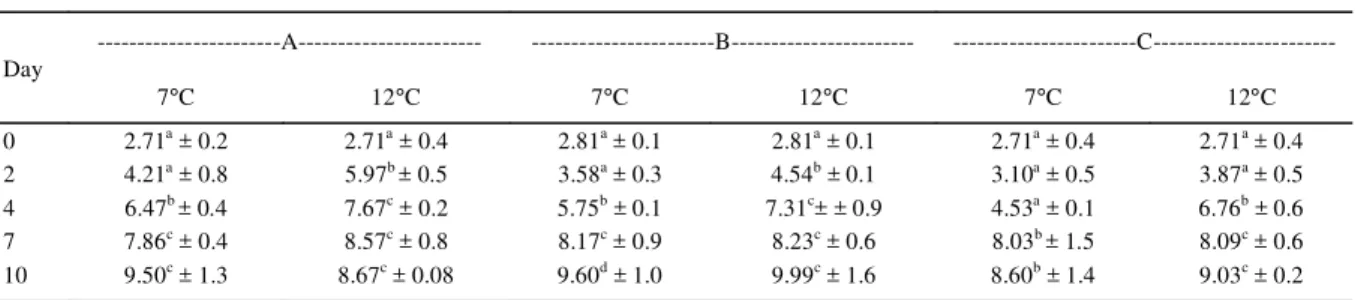
Table 3 showed mean counts and standard deviations of psychrotrophic counts. In this table,
Table 2 - Mean counts and standard deviation (log CFU g-1) of
S. aureus recovered after inoculation and throughout storage at two different temperatures (7 and 12°C) in fresh sausages submitted to treatments A, B, or C.
---A--- ---B--- ---C---Day
7°C 12°C 7°C 12°C 7°C 12°C
0 2.97 ± 0.5 2.97a ± 0.5 3.06± 0.5 3.06a ± 0.5 3.03 ± 0.4 3.03a ± 0.4 2 3.36 ± 0.3 3.50a ± 0.7 3.38± 0.3 3.17a ± 0.2 3.40 ± 0.2 3.42a ± 0.3 4 3.36 ± 0.3 4.46ab ± 0.6 3.40± 0.2 3.93ab± 0.4 4.00 ± 0.7 3.37a ± 0.0 7 3.87 ± 0.5 5.75b ± 1.7 3.78± 0.3 5.30b ± 1.1 3.48 ± 0.1 4.88b ± 0.8 10 4.66 ± 1.0 5.71b ± 1.3 5.07± 1.3 5.22b ± 0.8 4.49 ± 1.1 5.39b ± 0.9 * Different lowercase letters in the same column are significantly different for S. aureus counts(P0.05) throughout the study.
** Results are the mean of three analysis per treatment (± standard deviation). ***treatments: A = 50ppm; B = 150 ppm; C = 200ppm
Table 3 - Mean counts and standard deviation (log CFU g-1) of psychrotrophic microorganisms recovered after inoculation and throughout storage at two different temperatures (7 and 12°C) in fresh sausages submitted to treatments A, B, or C.
---A--- ---B--- ---C---Day
7°C 12°C 7°C 12°C 7°C 12°C
0 2.71a ± 0.2 2.71a ± 0.4 2.81a ± 0.1 2.81a ± 0.1 2.71a ± 0.4 2.71a ± 0.4 2 4.21a ± 0.8 5.97b ± 0.5 3.58a ± 0.3 4.54b ± 0.1 3.10a ± 0.5 3.87a ± 0.5 4 6.47b ± 0.4 7.67c ± 0.2 5.75b ± 0.1 7.31c± ± 0.9 4.53a ± 0.1 6.76b ± 0.6 7 7.86c ± 0.4 8.57c ± 0.8 8.17c ± 0.9 8.23c ± 0.6 8.03b ± 1.5 8.09c ± 0.6 10 9.50c ± 1.3 8.67c ± 0.08 9.60d ± 1.0 9.99c ± 1.6 8.60b ± 1.4 9.03c ± 0.2 * Different lowercase letters in the same column are not significantly different for psychrotrophic counts (P0.05) throughout the study. ** Results are the mean of three analysis per treatment (± standard deviation).
it may be observed that multiplication in this group
of microorganisms increased signifi cantly with the
temperature, throughout the study. At 7°C, counts
increased signifi cantly (P≤0.05) since the 4th day in treatments A and B, and since the 7th day in treatment C. At 12°C, the same phenomenon was observed since
the 2nd day in treatments A and B, and since the 4th day in treatment C. However, on the 10th day of storage,
there was no difference in fi nal counts when the
different temperatures and treatments were compared, indicating that this group of microorganisms was not controlled by these parameters: psychrotrophic counts showed an almost 6-log increase throughout storage.
Some authors observed inhibition of psychrotrophic counts in sausages formulated with curing salts, an effect that was only observed when pH of the product was reduced (LUECKE, 1987; SANZ et al., 1997).
CONCLUSION
The pH values obtained during storage in the two temperatures and three treatments were constant, and did not affect the multiplication of the microorganisms analyzed.
In the present study, control of S. aureus in fresh sausages was dependent on the temperature of
storage, and was not infl uence by the concentration of
curing salt. Temperature abuse during the storage of the product at 12°C may pose a risk to the health of
the consumer due to counts over 5log CFU g-1. Neither nitrite concentrations used in the manufacture of fresh sausages, nor storage temperatures effectively controlled the development of autochthone psychrotrophic microbiota.
REFERENCES
AOAC (ASSOCIATION OFFICIAL ANALYTICAL CHEMISTS) - HORWITZ, W. Offi cial methods of analysis of the Association of Offi cial Analytical Chemists. 17.ed. Arlington, 2000. 2200p. APHA (AMERICAN PUBLIC HEALTH ASSOCIATION). Compendium of methods for the microbiological examination of foods. 4.ed. Washington, 2001. 676p.
BANG, W. et al. Effect of salt and sodium nitrite on growth and enterotoxin production of Staphylococcus aureus during the production of air-dried fresh pork sausage. Journal of Food Protection, v.71, p.191-195, 2008. Available from: <http://www. ncbi.nlm.nih.gov/pubmed/18236683>. Accessed: Ago. 20, 2013. BIRZELE, B. et al. A study of the role of different nitrite concentrations on human pathogenic bacteria in fresh spreadable ham and onion sausage. Food Control, v.16, p.695-699, 2005. Available from: <http:// www.sciencedirect.com/science/article/pii/S0956713504001252>. Accessed: Out. 16, 2013. doi: 10.1016/j.foodcont.2004.06.006.
BRASIL. MINISTÉRIO DA AGRICULTURA, PECUÁRIA E ABASTECIMENTO. Portaria n.1, de 07 de outubro de 1981. Métodos analíticos para controle de produtos de origem animal e seus ingredientes. Diário Ofi cial da União, Brasília, DF, 1981. BRASIL. MINISTÉRIO DA SAÚDE. Portaria n.1004, de 11 de
dezembro de 1998, republicada no Diário Ofi cial da União em 22
de março de 1999. Atribuição de função de aditivos, aditivos e seus limites máximos de uso para a categoria 8 - Carne e produtos cárneos. Diário Ofi cial da União, Brasília, DF, 1999.
BRASIL. MINISTÉRIO DA SAÚDE. Secretaria de Vigilância em Saúde, Coordenação de Vigilância das Doenças de Transmissão Hídrica e Alimentar. Análise epidemiológica dos surtos de doenças transmitidas por alimentos no Brasil. Available from: <http://portal.saude.gov.br/portal/arquivos/pdf/surtos_dta_15. pdf>. Accessed: Ago. 20, 2013.
CDC CENTERS FOR DISEASE CONTROL AND PREVENTION). U.S. Department of Health and Human Services. MMWR - Morbidity and Mortality Weekly Report, v.60, p.1199, 2011. Available from: <http://www.cdc.gov/mmwr/PDF/ wk/mm6035.pdf>. Accessed: Ago. 20, 2013.
CUNHA NETO, A. et al. Staphylococcus enterotoxigênico em alimentos in natura e processados no estado de Pernambuco,
Brasil. Ciência e Tecnologia de Alimentos, v.22, p.263-271, 2002. Available from: <http://www.scielo.br/scielo.php?pid=S0101-20612002000300012&script=sci_arttext>. Accessed: Ago. 20, 2013. doi: 10.1590/S0101-20612002000300012.
DO CARMO, L.S. et al. A case study of a massive staphylococcal food poisoning incident. Food Borne Pathogens and Disease, v.1, p.241-246, 2004. Available from: <http://www.ncbi.nlm.nih. gov/pubmed/15992286>. Accessed: Ago. 20, 2013. doi: 10.1089/ fpd.2004.1.241.
DOYLE, M.P.; BEUCHAT, L.R. Food microbiology: fundamentals and frontiers. 3.ed. Washington: ASM, 2007. 1038p.
EFSA (EUROPEAN FOOD SAFETY AUTHORITY). European Centre for Disease Prevention and Control. The European Union Summary Report on Trends and Sources of Zoonoses, Zoonotic Agents and Food-borne Outbreaks in 2010. EFSA Journal, v.10, p.442, 2012.
HONIKEL, K.O. The use and control of nitrate and nitrite for the processing of meat products. Meat Science, v.78, p.68-76, 2008. Available from: <http://www.ncbi.nlm.nih.gov/ pubmed/22062097>. Accessed: Ago. 20, 2013. doi: 10.1016/j. meatsci.2007.05.030.
ICMSF (INTERNATIONAL COMMISSION ON MICROBIOLOGICAL SPECIFICATIONS FOR FOODS). Ecología microbiana de los alimentos. II. Productos alimenticios. Zaragoza: Acribia, 1985.
JAY, J. Microbiologia de alimentos. 6.ed. Porto Alegre: Artmed, 2005. 711p.
LUECKE, F.K. Microbiological process in the manufacture of dry sausage and raw ham. Fleischwirtschaft, v.66, p.1505-1509, 1987.
LUCK, E.; JAGER, M. Conservacion química de los alimentos. Zaragoza: Acribia, 2000.
MARQUES, S. et al. Avaliação higiênico-sanitária de lingüiças tipo frescal comercializadas nos municípios de Três Corações e Lavras, MG. Ciência e agrotecnologia, v.30, p.1120-1123, 2006. Available from: <http://www.scielo.br/scielo.php?script=sci_artte xt&pid=S1413-70542006000600012>. Accessed: Ago. 20, 2013. doi: 10.1590/S1413-70542006000600012.
SANZ, Y. et al. Effect of nitrate and nitrite curing salts on microbial changes and sensory quality of rapid ripened sausages. International Journal of Food Microbiology, v.37, p.225-229, 1997. Available from: <http://www.ncbi.nlm.nih.gov/ pubmed/9310859>. Accessed: Ago. 20, 2013. doi: 10.1016/ S0168-1605(97)00060-3.
SILVA, W.P. et al. Listeria spp. no processamento de lingüiça frescal em frigorífi cos de Pelotas, RS, Brasil. Ciência Rural, v.34, p.911-916, 2004. Available from: <http://www.scielo. br/scielo.php?pid=S0103-84782004000300039&script=sci_ arttext>. Accessed: Ago. 20, 2013. doi: 10.1590/S0103-84782004000300039.
SOFOS, J.N. et al. Botulism control by nitrite and sorbate in cured meats: a review. Journal of Food Protection, v.42, p.739-770, 1979.
TERRA, N.N. Apontamentos de tecnologia de carnes. São Leopoldo: Unisinos, 1998. 216p.
TOMPKIN, R.B. Nitrite. In: DAVIDSON, P.M. et al. (Eds.). Antimicrobials in food. 3.ed. Boca Raton: CRC, Taylor & Frances Group, 2005. p.169-236.
3M do Brasil LTDA. “3M Petrifi lm Staph Express Count