ACPD
15, 19305–19323, 2015Influence of tropical cyclones on tropospheric ozone: possible implication
S. S. Das et al.
Title Page
Abstract Introduction
Conclusions References
Tables Figures
◭ ◮
◭ ◮
Back Close
Full Screen / Esc
Printer-friendly Version
Interactive Discussion
Discussion
P
a
per
|
Discussion
P
a
per
|
Discussion
P
a
per
|
Discussion
P
a
per
|
Atmos. Chem. Phys. Discuss., 15, 19305–19323, 2015 www.atmos-chem-phys-discuss.net/15/19305/2015/ doi:10.5194/acpd-15-19305-2015
© Author(s) 2015. CC Attribution 3.0 License.
This discussion paper is/has been under review for the journal Atmospheric Chemistry and Physics (ACP). Please refer to the corresponding final paper in ACP if available.
Influence of tropical cyclones on
tropospheric ozone: possible implication
S. S. Das1, M. V. Ratnam2, K. N. Uma1, K. V. Subrahmanyam1, I. A. Girach1, A. K. Patra2, S. Aneesh1, K. V. Suneeth1, K. K. Kumar1, A. P. Kesarkar2, S. Sijikumar1, and G. Ramkumar1
1
Space Physics Laboratory, Vikram Sarabhai Space Centre, Trivandrum-695022, India
2
National Atmospheric Research Laboratory, Gadanki-517112, India
Received: 9 June 2015 – Accepted: 28 June 2015 – Published: 15 July 2015 Correspondence to: S. S. Das ([email protected])
ACPD
15, 19305–19323, 2015Influence of tropical cyclones on tropospheric ozone: possible implication
S. S. Das et al.
Title Page
Abstract Introduction
Conclusions References
Tables Figures
◭ ◮
◭ ◮
Back Close
Full Screen / Esc
Printer-friendly Version
Interactive Discussion
Discussion
P
a
per
|
Discussion
P
a
per
|
Discussion
P
a
per
|
Discussion
P
a
per
|
Abstract
The present study examines the role of tropical cyclones in the enhancement of tropo-spheric ozone. The most significant and new observation is the increase in the upper tropospheric (10–16 km) ozone by 20–50 ppbv, which has extended down to the mid-dle (6–10 km) and lower troposphere (<6 km). The descending rate of enhanced ozone
5
layer is found to be 0.87–1 km day−1. Numerical simulation of potential vorticity, verti-cal velocity and potential temperature indicate the intrusion of ozone from the upper troposphere to the surface. Space borne observations of relative humidity indicate the presence of sporadic dry air in the upper and middle troposphere over the cyclonic region. These observations constitute quantitatively an experimental evidence of en-10
hanced tropospheric ozone during cyclonic storms.
1 Introduction
The behaviour of ozone (O3) in the Earth’s atmosphere is different in the low latitude troposphere (∼0–16 km) and stratosphere (∼16–50 km). Ozone in the stratosphere,
which is maximum in the altitude of 25–30 km, regulates the amount of ultraviolet (UV) 15
radiation coming from the Sun to the Earth’s surface. There are ample studies indicat-ing depletion of stratospheric ozone since 1890’s and its consequences of impairindicat-ing the entire ecological system. Ozone in the troposphere is an important greenhouse gas, which acts as an oxidant and also controls the radiative budget of the atmosphere (Forster et al., 2007). The tropopause is a layer that separates the troposphere and the 20
stratosphere, and plays a key role in controlling the mixing of minor constituents, viz., ozone and water vapour between these layers. One of the major consequences of the tropospheric ozone enhancement is on the living organism, as it acts as a toxic agent among the air pollutants. Thus, while the effect of ozone in the former case is good, in the later case it is bad.
ACPD
15, 19305–19323, 2015Influence of tropical cyclones on tropospheric ozone: possible implication
S. S. Das et al.
Title Page
Abstract Introduction
Conclusions References
Tables Figures
◭ ◮
◭ ◮
Back Close
Full Screen / Esc
Printer-friendly Version
Interactive Discussion
Discussion
P
a
per
|
Discussion
P
a
per
|
Discussion
P
a
per
|
Discussion
P
a
per
|
Owing to the importance of ozone chemistry and its implication for air quality and cli-mate change, studies focusing on the origin of ozone enhancement in the troposphere, its trends and distributions need immediate consideration. Increase in the tropospheric ozone is considered to be due to (1) in-situ photochemical formation associated with lightning, advection, anthropogenic (e.g., Jacobson, 2002 and references therein), and 5
(2) stratospheric flux (Wild, 2007 and reference therein). Increase of the ozone flux from the stratosphere to the troposphere (stratospheric intrusion) not only increases the tropospheric ozone, but also decreases the stratospheric ozone, which in principle enhances the penetration of UV to reach the Earth’s surface.
In general, stratospheric intrusion is a slow process and is a mid- and high-latitude 10
phenomenon linked with synoptic scale disturbances (Holton et al., 1995). Liang et al. (2009) have described the time scale of stratospheric ozone intrusion that occurs in 3 steps, and takes about three months to reach from stratosphere to lower tropo-sphere. Maximum ozone forms over the tropics, moves upward and then pole-ward by Brewer–Dobson circulation, which further descends to the lower stratosphere and tro-15
posphere at high latitudes. There is much observational evidence supporting the slow intrusion of stratospheric air into the troposphere during cut-off lows (Vaughan and Price, 1989), high/low pressure systems (Davies and Schuepbach, 1994), tropopause folds (Sprenger and Wernli, 2003) and in a rapid episodic manner which generally trig-gered by overshooting convection, like a tropical cyclones (Loring et al., 1996; Baray 20
et al., 1999; Cairo et al., 2008 and references therein; Das, 2009; Das et al., 2011, Zhan and Wang, 2012). The tropical cyclones are the synoptic-scale disturbances of organ-ised convective systems which weaken the tropopause by overshooting convection and enhancing the stratosphere–troposphere exchange in a spontaneous manner. Slow stratospheric intrusion is reasonably well understood and is a regular phenomenon, 25
whereas the rapid intrusion needs to be understood in detail and possibly its ill effect on living organisms.
ACPD
15, 19305–19323, 2015Influence of tropical cyclones on tropospheric ozone: possible implication
S. S. Das et al.
Title Page
Abstract Introduction
Conclusions References
Tables Figures
◭ ◮
◭ ◮
Back Close
Full Screen / Esc
Printer-friendly Version
Interactive Discussion
Discussion
P
a
per
|
Discussion
P
a
per
|
Discussion
P
a
per
|
Discussion
P
a
per
|
cyclone using high power radar system (VHF radar). Subsidence of stratospheric air is generally observed in the vicinity of cyclone (Baray et al., 1999; Cairo et al., 2008; Leclair De Bellevue et al., 2006, 2007; Das, 2009, 2011). Appenzeller and Davies (1992) have shown the intrusion of the stratospheric air into the troposphere due to disturbed weather condition over mid-latitude, combining weather prediction model and 5
satellite observations. In addition to the stratospheric intrusion associated with organ-ised convections, there are ample observations, which reveal that humid air from the troposphere could penetrate into the stratosphere. Further, stratospheric ozone will get destroyed by the humid air, which penetrates beyond the tropopause (Rossow and Pearl, 2007; Cairo et al., 2008). A complete review on the effect of tropical cyclones 10
on the upper troposphere and lower stratosphere can be found in Cairo et al. (2008). Inspite of many observational and modelling studies, the cross-tropopause transport in short-time scale associated with tropical cyclones is still unclear.
The present study addresses the influence of tropical cyclones quantitatively on en-hancement of tropospheric ozone by stratospheric intrusion. This ozone intrusion ob-15
served in the lower troposphere not only acts as a pollutant but also cool the strato-sphere and warm the tropostrato-sphere, hence plays a vital role in the Earth’s radiation budget.
2 Campaign details
An intense campaign, named as “Troposphere–Stratosphere Exchange-Cyclone (TSE-20
C)” under the Climate And Weather of Sun-Earth System (CAWSES)-India phase-II programme was conducted during two cyclone events. Under this campaign, a series of ozonesondes were launched from Trivandrum (8.5◦N, 76.5◦E) during the intense
period of cyclonic storm Nilam from 30 October to 07 November 2012 and a very-severe cyclonic storm Phailin from 11 to 15 October 2013.The ozonesondes used are 25
Concentra-ACPD
15, 19305–19323, 2015Influence of tropical cyclones on tropospheric ozone: possible implication
S. S. Das et al.
Title Page
Abstract Introduction
Conclusions References
Tables Figures
◭ ◮
◭ ◮
Back Close
Full Screen / Esc
Printer-friendly Version
Interactive Discussion
Discussion
P
a
per
|
Discussion
P
a
per
|
Discussion
P
a
per
|
Discussion
P
a
per
|
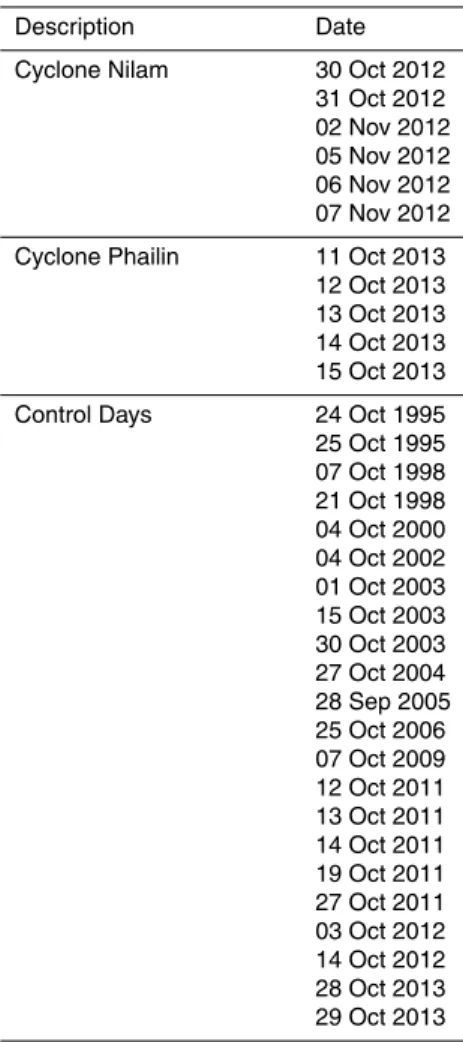
tion Cell (ECC) (Komhyr et al., 1995). The uncertainty in the ozone measurements is 5–10 %. Table 1 also provides the details of ozonesonde measurements conducted during the passage of cyclonic storm Nilam and very-severe cyclonic storm Phailin. Ozonesonde data was obtained at a fixed height resolution by down sampling at 100 m height resolution by linear interpolation method. The India Meteorological Department 5
(IMD) also conduct 1–2 ozonesonde launches per month. The background profiles (non-convective day at least for 3 days) is constructed by averaging the ozone data (23 profiles) obtained from IMD combined with our observations from 1995–2013 for the month October over Trivandrum. There is no ozonesonde launch by IMD in campaign mode (daily one launch) during the low pressure system. The measurements of near-10
surface ozone are carried out using the online UV photometric ozone analyser (Model AC32M) of Environment S.A, France. This ozone analyser works on the principle of UV absorption of ozone at the wavelength 253.7 nm. The instrument has a lower detection limit of 1 ppbv and 1% linearity. The data is sampled with an interval of 5 min.
The SAPHIR (Sondeur Atmospherique du Profild’ Humidite Intertropical par Ra-15
diometrie) onboard Megha-Tropiques satellite is a multichannel passive microwave hu-midity sounder, measuring brightness temperatures in six channels located close to the 183.31 GHz water vapor absorption line (±0.15,±1.20, ±2.80, ±4.30, ±6.60, and ±11.0 GHz). These channels allow retrieving the integrated relative humidity
respec-tively between the levels of 1000–850, 850–700, 700–550, 550–400, 400–250, and 20
250–100 hPa. The radiometer has a cross-track scan of ±43◦, providing a swath of
1705 km and a 10 km resolution at nadir. This data is also used to do the qualitative analysis of stratospheric air. The detail instrumentation can be found in Raju (2013), and retrieval algorithm and validation can be found in Gohil et al. (2012), Mathur et al. (2013) and Venkat Ratnam et al. (2013), Subrahmanyam and Kumar (2013), respec-25
ACPD
15, 19305–19323, 2015Influence of tropical cyclones on tropospheric ozone: possible implication
S. S. Das et al.
Title Page
Abstract Introduction
Conclusions References
Tables Figures
◭ ◮
◭ ◮
Back Close
Full Screen / Esc
Printer-friendly Version
Interactive Discussion
Discussion
P
a
per
|
Discussion
P
a
per
|
Discussion
P
a
per
|
Discussion
P
a
per
|
3 Meteorological background
The present experiments were conducted during the passage of the (1) cyclonic storm “Nilam” from 28 October to 01 November 2012 and (2) very severe cyclonic storm “Phailin” from 04–14 October 2013 over the Bay of Bengal (BOB). The details of each tropical cyclone are as follows:
5
3.1 Case-1 (Nilam)
A depression formed over the southeast of BOB (∼9.5◦N, 86.0◦E) at 11:30 IST of
28 October 2012. It moved westwards and intensified into a deep-depression on the morning of 29 October 2012 over southwest BOB, about∼550 km south-southeast of
Chennai. It continued to move westwards and intensified into a Cyclonic Storm, “Nilam” 10
in the morning of 30 October over southwest BOB. Then it moved north-northwest, crossed the north Tamilnadu coast near Mahabalipuram (12.6◦N, 80.2◦E), south of Chennai in the evening hours of 31 October 2012. After the landfall the cyclonic storm, Nilam moved west-northwest and weakened gradually into a deep depression and then into a depression in the morning hours of 01 November 2012.
15
3.2 Case-2 (Phailin)
A low pressure system was formed over Tenasserim coast (∼12.◦N, 96◦E), on early
morning of 06 October 2013. It intensified into a depression over the same region on 08 October and then moved towards the west-northwestwards. It further intensified into a deep depression on early morning of 09 October 2013 and then into a cyclonic 20
storm, “Phailin” in the evening hours. Moving northwestwards, it finally converted into a severe cyclonic storm in the morning hours of 10 October 2013 over east central BOB. The very severe cyclonic storm continued to move northwestwards and crossed Andhra Pradesh and Odisha coast near Gopalpur (19.2◦N, 84.9◦E) in the late evening
ACPD
15, 19305–19323, 2015Influence of tropical cyclones on tropospheric ozone: possible implication
S. S. Das et al.
Title Page
Abstract Introduction
Conclusions References
Tables Figures
◭ ◮
◭ ◮
Back Close
Full Screen / Esc
Printer-friendly Version
Interactive Discussion
Discussion
P
a
per
|
Discussion
P
a
per
|
Discussion
P
a
per
|
Discussion
P
a
per
|
for some time and then northward and finally north-northeastwards up to southwest Bihar. The system weakened gradually into a cyclonic storm from 13 October 2013 and finally the intensity decreased to a low pressure system on 14 October 2013.
The track of each tropical cyclones and outgoing long wave radiation (OLR) images (date and time are stamped) are shown in Fig. 1a and b, respectively. The detailed bul-5
letin can be found in www.imd.gov.in. During these campaigns, several ozonesondes were launched from Trivandrum (8.5◦N, 76.5◦E), whenever the intensity of cyclones were maximum and the path/eye was close to the launching site.
4 Numerical simulation
Apart from the radiosonde/ozonesonde observations, a high resolution numerical sim-10
ulation using the Advanced Research Weather Research and Forecast (WRF-ARW) model version 3.6 has also been carried out for both cases of cyclones. The model domain has been configured with two nested domains of 60 and 20 km horizontal res-olution, and covers an area extending from 1◦S to 25◦N and 60 to 100◦E. The in-nermost domain has been used for the present study. The initial and lateral boundary 15
conditions have been taken from ERA-Interim reanalysis on 0.75◦×0.75◦ continuously
at every 6 h. The present simulation was carried out with the model Physics options: (i) New Simplified Arakawa–Schubert (NSAS) (Han and Pan, 2011), (ii) Yonsei Univer-sity (YSU) boundary layer scheme (Hong et al., 2006), (iii) Rapid Radiative Transfer Model (RRTM) long wave radiation scheme (Mlawer et al., 1997), (iv) WRF Single 20
Moment (WSM) 5 class microphysical scheme (Hong et al., 2004), and (v) NOAA land-surface scheme (Smirnova et al., 2000).
5 Results and discussion
ACPD
15, 19305–19323, 2015Influence of tropical cyclones on tropospheric ozone: possible implication
S. S. Das et al.
Title Page
Abstract Introduction
Conclusions References
Tables Figures
◭ ◮
◭ ◮
Back Close
Full Screen / Esc
Printer-friendly Version
Interactive Discussion
Discussion
P
a
per
|
Discussion
P
a
per
|
Discussion
P
a
per
|
Discussion
P
a
per
|
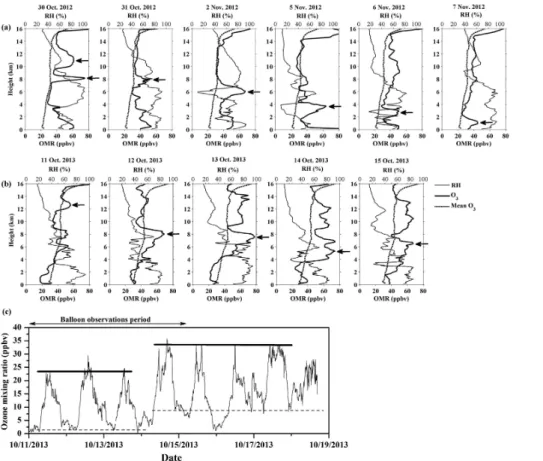
(top panels) and Phailin (bottom panels). The background ozone profile is obtained by averaging individual profile (23 profiles) of October from 1995–2013 and shown by dot-ted lines in Fig. 2. During the passage of Nilam on 30 October 2012, enhancement in tropospheric ozone (marked by horizontal arrows) from background by 40–50 ppbv was observed in the height region between 8–9 km (∼1 km width) and 11–14 km (∼3 km
5
width).This enhancement persisted till 31 October 2012 but at the height region be-tween 6–7 km with a reduced width. However, the enhancement of about ∼40 ppbv
was still observed on 02 November 2012 but the height region decreased to 5–6 km. After two days, we had again observations from 05–07 November 2012. The height of enhancement in the ozone profiles were reduced to∼4,∼3 and ∼1.5 km by 40,
10
30, and 20 ppbv on 05, 06 and 07 November 2012, respectively. The present observa-tion reveals that the intrusion of the enhanced upper tropospheric ozone into the lower troposphere occurs in episodic manner, sloping down from the upper troposphere to near surface. The descending rate of the ozone rich layer from the upper troposphere to the boundary layer during Nilam is approximately estimated to be∼875 m day−1. It
15
is also noted that the corresponding relative humidity profiles during Nilam did not de-crease with increasing ozone mixing ratio except on 02 November 2012. A significant sudden decrease in relative humidity is observed on 02 November 2012 at ∼6 km,
where the maximum enhancement of tropospheric ozone is observed. This is due to the presence or accumulation of dry air, which is believed to have been originated 20
from the stratosphere. A similar phenomenon is also observed during the passage of Phailin. Intrusion from∼14 to 6 km (marked by horizontal arrows) is clearly observed
in the ozone profiles from 11–15 October 2013. During Phailin, tropospheric ozone en-hancement by 20–30 ppbv is observed and the width of the enhanced ozone layer is larger than that during Nilam. During Phailin, descending rate of enhanced ozone layer 25
from the upper troposphere to the boundary layer is estimated to be∼1000 m day−1.
ACPD
15, 19305–19323, 2015Influence of tropical cyclones on tropospheric ozone: possible implication
S. S. Das et al.
Title Page
Abstract Introduction
Conclusions References
Tables Figures
◭ ◮
◭ ◮
Back Close
Full Screen / Esc
Printer-friendly Version
Interactive Discussion
Discussion
P
a
per
|
Discussion
P
a
per
|
Discussion
P
a
per
|
Discussion
P
a
per
|
during the Phailin. Figure 2c shows the time series of near-surface ozone mixing ratio from 11 to 19 October 2013. As expected, clear diurnal variability is observed in the time-series of ozone. From 11 to 14 October the maximum and minimum average peak of ozone are observed to be 24 and 1 ppbv, respectively, whereas after 14 up to 18 Oc-tober 2013, the maxima and minima is observed to be 35 and 10 ppbv, respectively. 5
The upper and lower average is indicated by horizontal solid and dash lines respec-tively. The ozone profiles also show that enhanced ozone layer propagates downward from the upper troposphere starting on 11 October, reaches to the lower troposphere and near-surface on 15 October 2013. In addition to the intrusion of ozone from the upper troposphere to the surface, there are three main mechanisms for the production 10
of ozone in the atmospheric boundary layer: (1) photochemical reaction via NOx
chan-nel, (2) bio-mass burning/fossils fuel, and (3) lightning. During the passage of tropical cyclone, there is a substantial reduction in the solar radiation, no bio-mass burning and no lightning and thus, the formation of ozone by any of the above three mechanisms will be very low. Thus, increase of 10–15 ppbv in near-surface ozone is mainly attributed 15
due to the intrusion of air from the higher heights.
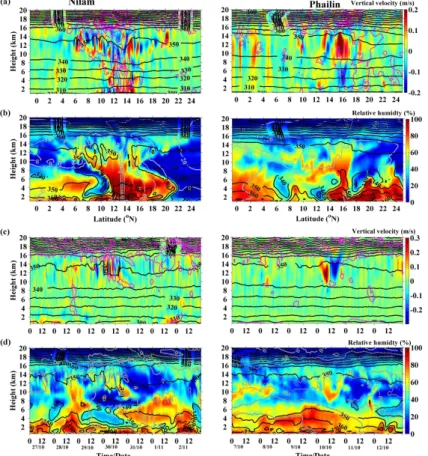
Further, dynamical analysis is carried out using WRF-ARW simulation. Figure 3 shows the height-latitude cross-section of (a) vertical velocity along with potential vor-ticity and potential temperature contours, and (b) relative humidity cross-section along with equivalent potential temperature and zonal wind at 79◦E at 18:00 GMT on 30
Oc-20
tober 2012 for Nilam (left panels) and 20:00 GMT on 10 October 2013 for Phailin (right panels). The vertical velocity profiles shows the presence of downdraft (blue) followed by updraft (red) between 8–17◦N at the UTLS region in both the cyclone cases.
En-hanced potential vorticity 0.5–1.5 PVU is also observed vertically down from the strato-sphere to the surface, overlapping the downdraft regions. The potential temperature 25
contours indicate the presence of unstable atmosphere at this location and noticed that stable stratospheric air penetrated downward at 12–14◦N for Nilam and 16–18◦N for Phailin. Relative humidity profiles indicate the presence of dry air at∼8◦N which is
ACPD
15, 19305–19323, 2015Influence of tropical cyclones on tropospheric ozone: possible implication
S. S. Das et al.
Title Page
Abstract Introduction
Conclusions References
Tables Figures
◭ ◮
◭ ◮
Back Close
Full Screen / Esc
Printer-friendly Version
Interactive Discussion
Discussion
P
a
per
|
Discussion
P
a
per
|
Discussion
P
a
per
|
Discussion
P
a
per
|
contours in Fig. 3b indicate that from surface to 10 km it is highly unstable for vertical motion and favourable condition for the convection to take place at 6–12◦N for Nilam and 12–18◦N for Phailin. In the same latitude regions, from 10 km to the tropopause level, the vertical motion is suppressed and the atmosphere is found to be statically sta-ble to the unstaturated atmosphere. The present condition indicates the presence of 5
statically stable stratospheric air in the upper and middle troposphere. Similarly, Fig. 3 shows the height-time cross-section of (a) vertical velocity along with potential vortic-ity and potential temperature contours, and (b) relative humidvortic-ity cross-section along with equivalent potential temperature and zonal wind at Trivandrum at 18:00 GMT on 30 October 2012 for Nilam (left panels) and 20:00 GMT on 10 October 2013 for Phailin 10
(right panels). From these figures, presence of strong downdrafts of dry air is clearly seen during 29–31 October 2012 (10–12 October 2013) for Nilam (Phailin). Numerical simulation confirms the presence of stratospheric intrusion in to the troposphere.
To get further insight, relative humidity derived from SAPHIR onboard the Megha-Tropiques satellite is used. The relative humidity shown is an average over 12– 15
14 passes day−1. Figure 4a shows the height-time intensity plot of relative humidity during the passage of the cyclones: Nilam (left panel) and Phailin (right panel). The grid is averaged from 4–8◦N and 83–88◦E. Strong dry air intrusion originated from lower stratosphere is observed between 23–27 October 2012 (Nilam) and 12–18 Oc-tober 2013 (Phailin). In both cyclones, dry air (low humidity region) reached down 20
to the height of 8 km. For the perception of spatial distribution of relative humidity, latitude–longitude plot of relative humidity averaged over different height level is shown in Fig. 4b. The low value of relative humidity i.e., the presence of dry air on the same day of enhanced ozone mixing ratio in between 5 and 10 km prove that the dry air present in the upper and middle troposphere is of stratospheric origin. The present ob-25
ACPD
15, 19305–19323, 2015Influence of tropical cyclones on tropospheric ozone: possible implication
S. S. Das et al.
Title Page
Abstract Introduction
Conclusions References
Tables Figures
◭ ◮
◭ ◮
Back Close
Full Screen / Esc
Printer-friendly Version
Interactive Discussion
Discussion
P
a
per
|
Discussion
P
a
per
|
Discussion
P
a
per
|
Discussion
P
a
per
|
6 Summary and conclusions
Important results brought out in the present analysis during the passage of a cyclonic (Nilam) and a very-severe cyclonic (Phailin) storms:
a. Enhancement of the ozone by 20–50 ppbv is observed between 11 and 14 km as compared to that of the background average profile.
5
b. Enhanced ozone in the upper troposphere descend down to surface and the de-scent rate is found to be 0.87–1 km day−1.
c. Presence of dry air in the upper and middle troposphere during the period of enhancement of ozone in the middle/lower troposphere, which is of stratospheric origin is also been reported in both the cases.
10
The present observation emphasizes the influence of tropical cyclones in enhance-ment of the tropospheric and surface ozone. The study clearly reveals that cyclone plays a vital role in changing the atmospheric composition apart from general weather phenomena.
Acknowledgements. Results reported in this manuscript are from the experimental campaign,
15
TSE-C, conducted under the CAWSES-India Phase-II program, which is fully funded by the Indian Space Research Organisation (ISRO), Government of India and authors sincerely ac-knowledge the same. The authors would like to thank all the technical and scientific staffof the Space Physics Laboratory (SPL) who participated in this STE-C campaign. The India Meteoro-logical Department (IMD) is highly acknowledged for providing the climatoMeteoro-logical ozonesonde
20
data. K. V. Suneeth and S. Aneesh are thankful to ISRO for providing doctoral fellowship during the study period.
References
Appenzeller, C. and Davies, H. C.: Structure of stratospheric intrusions into the troposphere, Nature, 358, 570–572, 1992.
ACPD
15, 19305–19323, 2015Influence of tropical cyclones on tropospheric ozone: possible implication
S. S. Das et al.
Title Page
Abstract Introduction
Conclusions References
Tables Figures
◭ ◮
◭ ◮
Back Close
Full Screen / Esc
Printer-friendly Version
Interactive Discussion
Discussion
P
a
per
|
Discussion
P
a
per
|
Discussion
P
a
per
|
Discussion
P
a
per
|
Baray, J. L., Ancellet, G., Randriambelo, T., and Baldy, S.: Tropicalcyclone Marlene and stratosphere–troposphere exchange, J. Geophys. Res., 104, 13953–13970, 1999.
Cairo, F., Buontempo, C., MacKenzie, A. R., Schiller, C., Volk, C. M., Adriani, A., Mitev, V., Matthey, R., Di Donfrancesco, G., Oulanovsky, A., Ravegnani, F., Yushkov, V., Snels, M., Cagnazzo, C., and Stefanutti, L.: Morphology of the tropopause layer and lower stratosphere
5
above a tropical cyclone: a case study on cyclone Davina (1999), Atmos. Chem. Phys., 8, 3411–3426, doi:10.5194/acp-8-3411-2008, 2008.
Das, S. S.: A new perspective on MST radar observations of stratospheric intrusions into troposphere associated with tropical cyclone, Geophys. Res. Lett., 36, L15821, doi:10.1029/2009GL039184, 2009.
10
Das, S. S., Sijikumar, S., and Uma, K. N.: Further investigation on stratospheric air intrusion into the troposphere during the episode of tropical cyclone: numerical simulation and MST radar observations, Atmos. Res., 101, 928–937, 2011.
Davies, T. D. and Schuepbach, E.: Episodes of high ozone concentration at the earth’s surface resulting from transport down from the upper troposphere-lower stratosphere: a review and
15
case studies, Atmos. Environ. 28, 53–68, 1994.
Forster, P. M., Bodeker, G., Schofield, R., Solomon, S., and Thompson, D.: Effect of ozone cooling in the tropical lower stratosphere and upper troposphere, Geophys. Res. Lett., 34, L23813, doi:10.29/2007GL031994, 2007.
Gohil, B. S., Gairola, R. M., Mathur, A. K., Varma, A. K., Mahesh, C., Gangwar, R. K., and
20
Pal, P. K.: Algorithms for retrieving geophysical parameters from the MADRAS and SAPHIR sensors of the Megha-Tropiques satellite: Indian scenario, Q. J. Roy. Meteor. Soc., 139, 954– 963, 2012.
Han, J. and Pan, H. L.: Revision of convection and vertical diffusion schemes in the NCEP global forecast system, Weather Forecast., 26, 520–533, 2011.
25
Hocking, W. K., Smith, T. C., Tarasick, D. W., Argall, P. S., Strong, K., Rochon, Y., Awadzki, I., and Taylor, P. A.: Detection of stratospheric ozone intrusions by wind profiler radars, Nature, 450, 281–284, 2007.
Holton, J. R., Haynes, P. T., and Mclntyre, M. E.: Stratosphere–troposphere exchange, Rev. Geophys., 33, 403–439, 1995.
30
ACPD
15, 19305–19323, 2015Influence of tropical cyclones on tropospheric ozone: possible implication
S. S. Das et al.
Title Page
Abstract Introduction
Conclusions References
Tables Figures
◭ ◮
◭ ◮
Back Close
Full Screen / Esc
Printer-friendly Version
Interactive Discussion
Discussion
P
a
per
|
Discussion
P
a
per
|
Discussion
P
a
per
|
Discussion
P
a
per
|
Hong, S. Y., Noh, Y., and Dudhia, J.: A new vertical diffusion package with an explicit treatment of entrainment processes, Mon. Weather Rev., 134, 2318–2341, 2006.
Jacobson, M. Z.: Control of fossil-fuel particulate black carbon and organic matter, possibly the most effective method of slowing global warming, J. Geophys. Res., 107, 16–22, 2002. Komhyr, W. D., Barnes, R. A., Brothers, G. B., Lathrop, J. A., and Opperman, D. P.:
Electrochem-5
ical concentration cell ozonesonde performance evaluation during STOIC 1989, J. Geophys. Res., 100, 9231–9244, 1995.
Leclair, De Bellevue, J., R’echou, A., Baray, J. L., Ancellet, G., and Diab, R. D.: Signatures of stratosphere to troposphere transport near deep convective events in the southern subtrop-ics, J. Geophys. Res., 111, D24107, doi:10.1029/2005JD006947, 2006.
10
Leclair, De Bellevue, J., Baray, J. L., Baldy, S., Ancellet, G., Diab, R. D., and Ravetta, F.: Sim-ulations of stratospheric to tropospheric transport during the tropical cyclone Marlene event, Atmos. Environ. 41, 6510–6526, 2007.
Liang, Q., Douglass, A. R., Duncan, B. N., Stolarski, R. S., and Witte, J. C.: The governing processes and timescales of stratosphere-to-troposphere transport and its contribution to
15
ozone in the Arctic troposphere, Atmos. Chem. Phys., 9, 3011–3025, doi:10.5194/acp-9-3011-2009, 2009.
Loring Jr., R. O., Fuelberg, H. E., Fishman, J., Watson, M. V., and Browell, E. V.: Influence of a middle-latitude cyclone on tropospheric ozone distributions during a period TRACEA, J. Geophys. Res., 101, 23941–23956, 1996.
20
Mathur, A. K., Gangwar, R. K., Gohil, B. S., Deb, S. K., Kumar, P., Shukla, M. V., Simon, B., and Pal, P. K.: Humidity profile retrieval from SAPHIR on-board the Megha-Tropiques, Curr. Sci., 104, 1650–1655, 2013.
Mlawer, E, J., Taubman, S. J., Brown, P. D., Iacono, M. J., and Clough, S. A.: Radiative transfer for inhomogeneous atmosphere: RRTM, a validated correlated-k model for the long wave,
25
J. Geophys. Res., 102, 16663–16682, 1997.
Raju, G.: Engineering challenges in the Megha-Tropiques, Curr. Sci., 104, 1662–1670, 2013. Rossow, W. B. and Pearl, C.: 22-year survey of tropical convection penetrating into the lower
stratosphere, Geophys. Res. Lett., 34, L04803, doi:10.1029/2006GL028635, 2007.
Sprenger, M. and Wernli, H.: A northern hemispheric climatology of cross-tropopause
30
ACPD
15, 19305–19323, 2015Influence of tropical cyclones on tropospheric ozone: possible implication
S. S. Das et al.
Title Page
Abstract Introduction
Conclusions References
Tables Figures
◭ ◮
◭ ◮
Back Close
Full Screen / Esc
Printer-friendly Version
Interactive Discussion
Discussion
P
a
per
|
Discussion
P
a
per
|
Discussion
P
a
per
|
Discussion
P
a
per
|
Smirnova, T. G., Brown, J. M., Benjamin, S. G., and Kim, D.: Parameterization of cold season processes in the MAPS land-surface scheme, J. Geophys. Res., 105, 4077–4086, 2000. Subrahmanyam, K. V. and Kumar, K. K.: Megha-Tropiques/SAPHIR measurements of humidity
profiles: validation with AIRS and global radiosonde network, Atmos. Meas. Tech. Discuss., 6, 11405–11437, doi:10.5194/amtd-6-11405-2013, 2013.
5
Vaughan, G. and Price, J.: Ozone transport into the troposphere in a cut-offlow event, in: Ozone in the Atmosphere, edited by: Bojkov, R. and Fabian, P., A. Deepak Publishing, Hampton (USA), 415–418, 1989.
Venkat Ratnam, M., Basha, G., Murthy, B. V. K., and Jayaraman, A.: Relative humidity distri-bution from SAPHIR experiment on board Megha-Tropiques satellite mission: comparison
10
with global radiosonde and other satellite and reanalysis data sets, J. Atmos. Res., 118, 9622–9630, 2013.
Wild, O.: Modelling the global tropospheric ozone budget: exploring the variability in current models, Atmos. Chem. Phys., 7, 2643–2660, doi:10.5194/acp-7-2643-2007, 2007.
Zhan, R. and Wang, Y.: Contribution of tropical cyclones to stratosphere–troposphere exchange
15
ACPD
15, 19305–19323, 2015Influence of tropical cyclones on tropospheric ozone: possible implication
S. S. Das et al.
Title Page
Abstract Introduction
Conclusions References
Tables Figures
◭ ◮
◭ ◮
Back Close
Full Screen / Esc
Printer-friendly Version
Interactive Discussion
Discussion
P
a
per
|
Discussion
P
a
per
|
Discussion
P
a
per
|
Discussion
P
a
per
|
Table 1.Details of ozonesonde launched from Trivandrum including the historical data for con-trol day analysis.
Description Date
Cyclone Nilam 30 Oct 2012
31 Oct 2012 02 Nov 2012 05 Nov 2012 06 Nov 2012 07 Nov 2012
Cyclone Phailin 11 Oct 2013
12 Oct 2013 13 Oct 2013 14 Oct 2013 15 Oct 2013
Control Days 24 Oct 1995
ACPD
15, 19305–19323, 2015Influence of tropical cyclones on tropospheric ozone: possible implication
S. S. Das et al.
Title Page
Abstract Introduction
Conclusions References
Tables Figures
◭ ◮
◭ ◮
Back Close
Full Screen / Esc
Printer-friendly Version
Interactive Discussion
Discussion
P
a
per
|
Discussion
P
a
per
|
Discussion
P
a
per
|
Discussion
P
a
per
|
ACPD
15, 19305–19323, 2015Influence of tropical cyclones on tropospheric ozone: possible implication
S. S. Das et al.
Title Page
Abstract Introduction
Conclusions References
Tables Figures
◭ ◮
◭ ◮
Back Close
Full Screen / Esc
Printer-friendly Version
Interactive Discussion
Discussion
P
a
per
|
Discussion
P
a
per
|
Discussion
P
a
per
|
Discussion
P
a
per
|
ACPD
15, 19305–19323, 2015Influence of tropical cyclones on tropospheric ozone: possible implication
S. S. Das et al.
Title Page
Abstract Introduction
Conclusions References
Tables Figures
◭ ◮
◭ ◮
Back Close
Full Screen / Esc
Printer-friendly Version
Interactive Discussion
Discussion
P
a
per
|
Discussion
P
a
per
|
Discussion
P
a
per
|
Discussion
P
a
per
|
Figure 3.Height-latitude cross-section of(a)vertical velocity along with potential vorticity (ma-genta) and potential temperature (black) contours, and(b)relative humidity cross-section along with equivalent potential temperature (black) and zonal wind (grey) at 79◦E at 18:00 GMT on
ACPD
15, 19305–19323, 2015Influence of tropical cyclones on tropospheric ozone: possible implication
S. S. Das et al.
Title Page
Abstract Introduction
Conclusions References
Tables Figures
◭ ◮
◭ ◮
Back Close
Full Screen / Esc
Printer-friendly Version
Interactive Discussion
Discussion
P
a
per
|
Discussion
P
a
per
|
Discussion
P
a
per
|
Discussion
P
a
per
|
Figure 4. (a) Pressure-time variation of relative humidity obtained from SAPHIR onboard Megha-Tropiques satellite during the cyclones Nilam (left panel) and Phailin (right panel).