Acta Limnol. Bras., 2009, vol. 21, no. 1, p. 123-134.
B
iological L
imnolog
y
Structure and feeding of a stream fish assemblage in
Southeastern Brazil: evidence of low seasonal influences
Estrutura e alimentação de uma comunidade de peixes em um riacho no
sudeste do Brasil: evidências de baixa inluência sazonal
Rocha, FC. da1, Casatti, L.1 and Pereira, DC.2
1Departamento de Zoologia e Botânica, Instituto de Biociências, Letras e Ciências Exatas – IBILCE, Universidade Estadual Paulista – UNESP,
Rua Cristóvão Colombo, 2265, Jardim Nazareth, CEP 15054-000, São José do Rio Preto, SP, Brazil e-mail: [email protected], [email protected]
2Departamento de Química e Ciências Ambientais, Instituto de Biociências, Letras e Ciências Exatas – IBILCE, Universidade Estadual Paulista – UNESP,
Rua Cristóvão Colombo, 2265, Jardim Nazareth, CEP 15054-000, São José do Rio Preto, SP, Brazil e-mail: [email protected]
Abstract:Aim: he present study was developed in a deforested stream located in a region that exhibits marked seasonality with the purpose to investigate whether ecological descriptors of the quantitative structure (i.e., composition, abundance, biomass, species richness, diversity) and feeding of ishes do change between the dry and wet periods. Methods: Sampling was conducted bimonthly from April 2004 to February 2005 by using a standardized efort with electroishing equipment and environmental variables measurements. Results: We collected 713 ishes belonging to 23 species. he most abundant species were Gymnotus carapo (24.0%) and Poecilia reticulata (23.8%). Species richness, abundance, and biomass showed to be higher in the wet period, but these diferences were not signiicant and did not inluence the multivariate pattern of the assemblage (ANOSIM, R = 0.148). Nevertheless, average dissimilarity between community structure in the dry and wet periods was 52.7%, mainly due to the diferential contribution of P. reticulata, notably more abundant in the wet season, under quasi-hypoxic water conditions. Examination of 333 gastric contents of 12 species evidenced that food variety was higher in the dry period. Of these species, 67% (Astyanax altiparanae, Astyanax fasciatus, Geophagus brasiliensis, Gymnotus carapo, Hypostomus ancistroides, Phalloceros harpagos, Poecilia reticulata, and Rhamdiaquelen) kept the diet throughout the year, being classiied in the same trophic groups in both periods, and detritus was the most important item for half of them, followed by aquatic insects. Overall, no signiicant diferences in the community’s diet between periods were registered (ANOSIM, R = –0.04). Conclusions: his relative constancy suggests a quite regular availability of resources (mainly shelters in submerged marginal grasses and detritus) along the year.
Keywords: pasture, Upper Paraná, temporal variation, detritus.
Resumo:Objetivo: O presente estudo foi desenvolvido em um riacho deslorestado localizado em uma região que exibe marcada sazonalidade com o propósito de investigar se descritores ecológicos da estrutura da comunidade (i.e., composição, abundância, biomassa, riqueza de espécies, diversidade) e alimentação dos peixes variam entre os períodos seco e chuvoso. Métodos: As amostragens foram realizadas bimestralmente de abril de 2004 a fevereiro de 2005, empregando-se um esforço padronizado com equipamento de pesca elétrica e medidas de variáveis do ambiente. Resultados: Foram coletados 713 exemplares de peixes, pertencentes a 23 espécies. As espécies mais abundantes foram Gymnotus carapo (24,0%) e Poecilia reticulata (23,8 %). Riqueza de espécies, abundância e biomassa foram mais elevadas no período chuvoso do que no seco, porém essas diferenças não foram signiicativas e não inluenciaram o padrão multivariado da estrutura da ictiofauna (ANOSIM, R = 0,148). Apesar disso, a dissimilaridade média entre os períodos foi de 52,7%, principalmente devido à contribuição diferencial de P. reticulata, notavelmente mais abundante no período chuvoso, em condições quase hipóxicas. O exame de 333 conteúdos gástricos de 12 espécies mostrou que a variedade de itens alimentares foi maior no período seco. Destas espécies, 67% (Astyanax altiparanae, Astyanax fasciatus, Geophagus brasiliensis, Gymnotus carapo, Hypostomus ancistroides, Phalloceros harpagos, Poecilia reticulata e Rhamdiaquelen) mantiveram a dieta ao longo do ano, sendo classiicadas nos mesmos grupos tróicos em ambos os períodos e detrito foi o item mais importante para metade delas, seguido por insetos aquáticos. No geral, não foram registradas alterações signiicativas na dieta da comunidade entre os períodos (ANOSIM, R = –0,04). Conclusões: Esta relativa constância sugere uma disponibilidade regular dos recursos (principalmente abrigos entre gramíneas marginais submersas e detrito) ao longo do ano.
124 Rocha, FC. da, Casatti, L. and Pereira, DC.
Acta Limnol. Bras., 2009, vol. 21, no. 1, p. 123-134.
1. Introduction
Seasonality, hydrological regime (Horwitz, 1978; Pof and Allan, 1995), habitat diversity on several scales (Gorman and Karr, 1978; Angermeier and Karr, 1984; Schlosser, 1982), and predation (Glasser, 1979; Schlosser, 1987) are all ecological factors that commonly inluence stream ish communities. he magnitude of such inluence is often constrained to topography, geomorphology, and other hydraulic descriptors, which, in turn, determine a set of important structural features for composition and abundance of ish species in streams, such as width, depth, discharge, and substrate (see studies of Angermeier and Schlosser, 1989; Súarez, 2008).
Variations in seasonality and physical habitat structure may explain not only the quantitative structure of the stream ish fauna (Galacatos et al., 2004; Fialho et al., 2007), but also the trophic structure and food networks (Winemiller, 1990; Winemiller and Jepsen, 1998). Seasonal changes in feeding between dry and wet seasons may (Prejs and Prejs, 1987; Deus and Petrere-Jr., 2003) or not (Esteves and Lobón-Cerviá, 2001; Novakowski et al., 2008) occur, meaning that there is no general pattern of seasonal change within trophic guilds and no agreement about the seasonal efects on the organiza-tion of ish assemblages (Novakowski et al., 2008), reinforcing the need of more ecological studies on this issue.
During seasonal looding, small tropical rivers often show less expansion than larger rivers; this factor together with the poor connection of surrounding loodplain and anthropogenic disturbance may force ishes to rely more on habitats within the main channel (Rayner et al., 2008), sug-gesting less seasonal variation in several ecological attributes of the community. Anthropogenic disturbance is marked in the northwestern region of São Paulo state, in where only 4% of native vegetation remains (SMA/IF, 2005), which makes this region as one of the most degraded in the state (Casatti et al., 2008) and of high priority for ecological studies. Despite the extensive ongoing deforestation in tropical areas, little information concerning its impacts on ish assemblages in streams or even on the processes structuring these assemblages exists (Esteves et al., 2008). he present study was developed in a deforested stream located in a region that presents marked seasonality but it not exhibits a pattern of looding pulses. Our purpose was to investigate whether ecological descriptors of the quan-titative structure (i.e., composition, abundance, biomass, species richness, diversity) and feeding of ishes do change between dry and wet periods.
2. Material and Methods
2.1. Study area
he study region is located in the northwestern por-tion of the Planalto Ocidental Paulista, Brazil, in the
Rio Turvo-Grande basin, which was, up to the end of sampling period (February 2005), mostly used for live-stock grazing. Due to this, grasslands occupied more than 60% of the area (Silva et al., 2007). It is now mainly used for sugar cane crops. Climate is hot tropical (Nimer, 1989) with the beginning of the rainy season (September to March) shown to be variable year to year (Rossa-Feres and Jim, 2001). he rainy season receives 85% of annual rainfall, while cold and dry season (April-August) receives only 15% of
an-nual rainfall, ranging from 1100 to 1250 mm (±225 mm)
(Barcha and Arid, 1971).
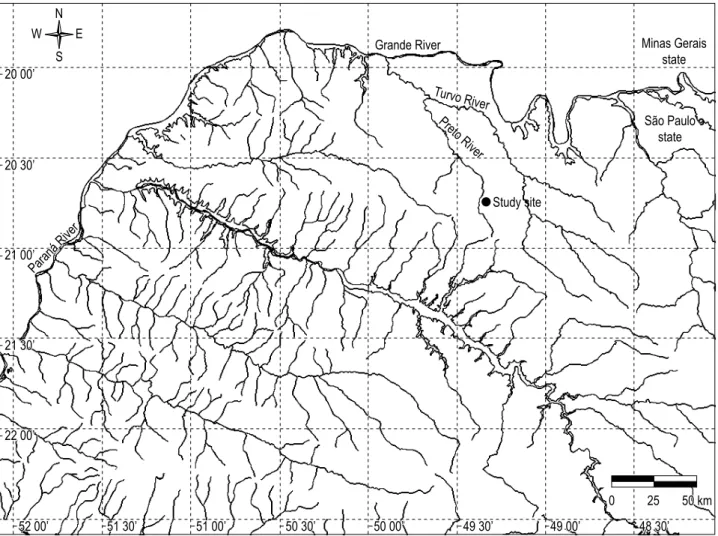
Field work was carried out in an 75 m third order stretch of the Córrego da Felicidade (20° 45’ S and 49° 20’ W, Figure 1), a low gradient stream that is a tributary of the Rio Preto, the main river that drains the urban area of the São José do Rio Preto city. he selected stretch shows sandy bottom and is located 6 km downstream from the spring and 7 km upstream from the Rio Preto main channel, in such a way that the sampling stretch is not subjected to sea-sonal looding inluences from the Rio Preto. Predominant marginal vegetation includes Cyperaceae (Eleocharis elagans (Kunth)), Poaceae (Brachiaria sp., Echinochloa sp.), and Typhaceae (Typha sp.), all occasionally submerged.
Sampling was conducted bimonthly from April/04 to February/05, totaling three samples in the dry (April, June, August/04, corresponding to Dry 1, Dry 2, and Dry 3) and three in the wet period (October and December/04, February/05, corresponding to Wet 1, Wet 2, and Wet 3). Average monthly rainfall and air temperature was obtained from the Centro de Informações Agrometeorológicas. In each collection ive physico-chemical descriptors of water were measured in the ield with Horiba® electronic equip-ment: dissolved oxygen, conductivity, pH, turbidity, and temperature. Diferences between dry and wet periods in relation to the environmental descriptors were investigated using univariate tests (T-test, 0.05 of signiicance level).
Fishing efort was standardized across all samplings with the stretch blocked up and downstream by 5 mm-mesh stop nets and then submitted to two electric ishing passes for a total of 40-50 minutes. Electroishing equipment consisted of a stationary generator of alternate current (220 V, 50-60 Hz, 3.4-4.1 A, 1000 W), as detailed by Castro et al. (2003). Fish were ixed in 10% formalin, and after 48 hours were transferred to 70% ethanol. Fish were identiied by species, counted, and weighed. All specimens were deposited at the ish collection of the Departamento de Zoologia e Botânica da Universidade Estadual Paulista (DZSJRP), São José do Rio Preto, São Paulo, Brazil.
Structure and feeding of a stream ish assemblage in Southeastern Brazil: evidence of low seasonal inluences 125
Acta Limnol. Bras., 2009, vol. 21, no. 1, p. 123-134. Shannon-Wiener index with base 10 logarithm (Magurran,
2004). Univariate comparisons were investigated using T-test (0.05 of signiicance level).
An exploratory ordination technique (NMDS - non-metric multidimensional scaling analysis) was employed to evaluate the qualitative (taxonomic composition) and quantitative (species abundance) similarities between the dry and wet periods. he Jaccard coeicient was computed for composition and the Bray-Curtis similarity index for abundance. Calculations, after log(x+1) data transforma-tion, were performed by using the Primer 6 (Clarke and Gorley, 2006) software, after specifying 25 random re-starts. Using the same software, a similarity analysis (ANOSIM) was performed to test the null hypothesis that there are no assemblage diferences between dry and wet groups of samples speciied by the levels of a single factor (seasonality). According to procedures described by Clarke and Gorley (2006), the output of the analysis is the value of R; if it is close to zero the null hypothesis is accepted. To highlight the species principally responsible for determining the sample ordination between the dry and wet periods (factors) a spe-cies similarity analysis was conducted using the SIMPER routine in the Primer 6 software. SIMPER procedures
decompose average Bray-Curtis dissimilarities between all pairs of samples into percentages from each species, list-ing the species in decreaslist-ing order of such contributions, being an especially interesting method to interpret difer-ences when they have been show to exist after ANOSIM procedures (Clarke and Gorley, 2006).
Diet was evaluated for the 12 resident species (i.e., those present in more than 50% of the samples) and the number of specimens selected for feeding analysis ranged from seven to 15, according to the abundance of species per sample (with exception of Hoplosternum littorale and Tilapia rendalli, which were resident, but represented by only a few specimens along the sampled period). After gastric contents removal, food items were identiied with the view to achieve the most detailed taxonomic resolution. Detritus was deined as the combination of animal and vegetal coarse matter of unknown origin (Uieda and Motta, 2007), discriminated from ine particulate organic matter by having size larger than 1 µm (Allan, 1995). Frequency of occurrence, dominance, and percentage composition (Hynes, 1950) were calculated for each item. he most im-portant feeding items were determined using Bennemann’s et al. (2006) method, an adaptation of Costello’s (1990)
Paraná River
Grande River
Preto River
Turvo River
Study site
São Paulo state Minas Gerais
state N
S
W E
20 00’
20 30’
21 00’
22 00’
52 00’ 51 30’ 51 00’ 50 30’ 50 00’ 49 30’ 49 00’ 48 30’
21 30’
0 25 50 km
126 Rocha, FC. da, Casatti, L. and Pereira, DC.
Acta Limnol. Bras., 2009, vol. 21, no. 1, p. 123-134.
method, in which dominance of each item – instead of item weight as proposed by Costello (1990) – is used in combination with its frequency of occurrence; items with highest frequencies and dominances are assumed to be more important for species diet, and, hence, used to classify spe-cies into trophic groups.
To identify multivariate patterns in the feeding of com-munity a second NMDS ordination was carried using the percentage composition data for each item. his analysis was followed by ANOSIM using the Primer 6 software, according to procedures mentioned before, in order to test the null hypothesis that diet is similar in both dry and wet periods.
3. Results
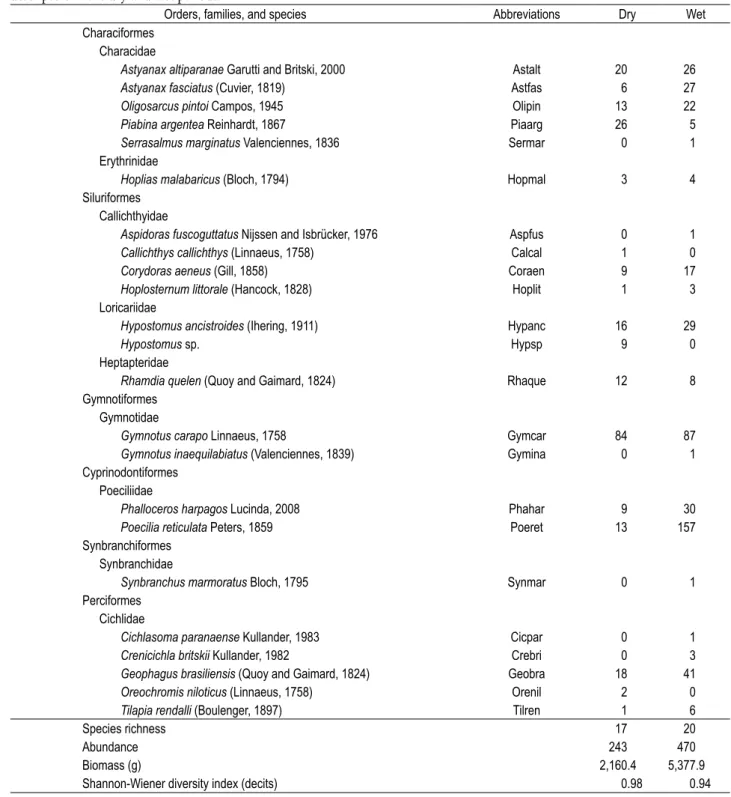
Rainfall throughout the year, dissolved oxygen, pH, turbidity, and water temperature exhibited signiicant variation between the dry and wet periods (Table 1). A total of 713 specimens of ish, belonging to six orders, 9 families, 20 genera, and 23 species (Table 2), making a total biomass of 7.5 kg, were recorded. Orders Siluriformes and Characiformes made up 56.5% of the set of species; Cyprinodontiformes and Gymnotiformes made up 53.4% of the overall abundance. he most abundant species were Gymnotus carapo (24.0%) and Poecilia reticulata (23.8%);
those with higher biomass were Gymnotus carapo (29.6%)
and Tilapia rendalli (20.2%). Estimates of species richness indicated ten more species to the ACE and six more species to the ICE (Figure 2). Overall species richness, abundance, and biomass showed to be higher in the wet period than in the dry, whereas diversity was shown to be similar across periods (Table 2), but these diferences were not statistically signiicant (T-test for independent samples, prichness = 0.37,
pabundance = 0.30, pbiomass = 0.13, pdiversity = 0.94).
Ordination analysis with NMDS revealed a tendency to segregation of dry and wet groups of samples both in
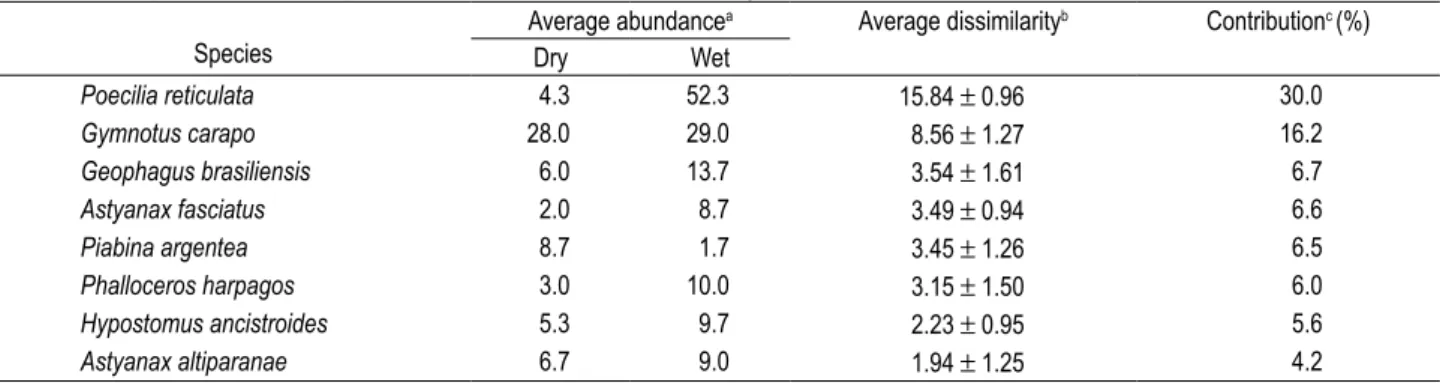
com-position and abundance (Figure 3a,b), but diferences in the multivariate structure of the abundance matrix were not signiicative when considering the factor season (ANOSIM, R = 0.148, signiicance level of sample statistic = 40%). he few observed diferences between the dry and wet periods were due to the diferential contribution of Poecilia reticulata and Gymnotuscarapo (Table 3).
Examination of 333 gastric contents (149 from the dry period and 184 from the wet) of 12 species evidenced that food variety was higher in the dry period (Tables 4-5). Of these species, 67% (Astyanax altiparanae, Astyanax fasciatus, Geophagus brasiliensis, Gymnotus carapo, Hypostomus ancistroides, Phalloceros harpagos, Poecilia reticulata, and Rhamdiaquelen) kept the diet throughout the year, being classiied in the same trophic groups in both periods, and detritus was the most important item for half of them, followed by aquatic insects (Tables 4-5, Figure 4). In fact, NMDS (Figure 3) and ANOSIM analyses revealed no signiicant diferences in the com-munity’s diet between periods (R = –0.04, signiicance level of sample statistic = 83.8%). Considering overall abundance and biomass of these 12 species, in the dry pe-riod omnivores and detritivores dominated in abundance (27 and 24%, respectively) and insectivores/detritivores and detritivores in biomass (57 and 23%, respectively). In the wet period, detritivores and insectivores/detritivores dominated in abundance (61 and 22%, respectively) and biomass (37 and 38%, respectively).
4. Discussion
Values of pH and turbidity were higher in the wet than in the dry period, which are consequences, among several factors, of particles (ions, sediment) inputs under rainfall conditions. In contrast, dissolved oxygen exhibited lower concentrations during the wet period, with similar results already registered in water courses close to the studied area
Table 1. Environmental descriptors evaluated in the Córrego Felicidade, southeastern Brazil, during the dry and wet periods.
Descriptors Dry 1 Dry 2 Dry 3 Wet 1 Wet 2 Wet 3
Average rainfall (mm)* 76.1 57.0 0 95.2 160.0 80.9
Average air temperature (ºC) 25.3 20.1 23.0 24.4 26.9 27.9
Dissolved oxygen (mg.L–1)** 6.65 6.5 5.65 2.22 3.07 2.7
Conductivity (µS.cm–1) 69 64 60 76 54 64
pH** 7.23 7.17 7.38 5.93 6.38 6.32
Turbidity (NTU)** 4 5 5 10 14 10
Current (cm.s–1) 45 38 25 36 23 15
Water temperature (°C)** 23.8 18.6 19.9 24 27.5 27.8
Width (m) 2.3 2.5 2.2 1.6 2 2.2
Depth (cm) 75 72 72 50 76 80
*Statistically signiicant when compared all months of the dry (March to September) and wet (October to February) periods (T-test for Independent Samples, p < 0.05).
Structure and feeding of a stream ish assemblage in Southeastern Brazil: evidence of low seasonal inluences 127
Acta Limnol. Bras., 2009, vol. 21, no. 1, p. 123-134. Table 2. Taxonomic classiication (according to Buckup et al., 2007), abbreviations, species abundance, and ichthyofauna structure descriptors in the dry and wet periods.
Orders, families, and species Abbreviations Dry Wet Characiformes
Characidae
Astyanax altiparanae Garutti and Britski, 2000 Astalt 20 26
Astyanax fasciatus (Cuvier, 1819) Astfas 6 27
Oligosarcus pintoi Campos, 1945 Olipin 13 22
Piabina argentea Reinhardt, 1867 Piaarg 26 5
Serrasalmus marginatus Valenciennes, 1836 Sermar 0 1
Erythrinidae
Hoplias malabaricus (Bloch, 1794) Hopmal 3 4
Siluriformes Callichthyidae
Aspidoras fuscoguttatus Nijssen and Isbrücker, 1976 Aspfus 0 1
Callichthys callichthys (Linnaeus, 1758) Calcal 1 0
Corydoras aeneus (Gill, 1858) Coraen 9 17
Hoplosternum littorale (Hancock, 1828) Hoplit 1 3
Loricariidae
Hypostomus ancistroides (Ihering, 1911) Hypanc 16 29
Hypostomus sp. Hypsp 9 0
Heptapteridae
Rhamdia quelen (Quoy and Gaimard, 1824) Rhaque 12 8
Gymnotiformes Gymnotidae
Gymnotus carapo Linnaeus, 1758 Gymcar 84 87
Gymnotus inaequilabiatus (Valenciennes, 1839) Gymina 0 1
Cyprinodontiformes Poeciliidae
Phalloceros harpagos Lucinda, 2008 Phahar 9 30
Poecilia reticulata Peters, 1859 Poeret 13 157
Synbranchiformes Synbranchidae
Synbranchus marmoratus Bloch, 1795 Synmar 0 1
Perciformes Cichlidae
Cichlasoma paranaense Kullander, 1983 Cicpar 0 1
Crenicichla britskii Kullander, 1982 Crebri 0 3
Geophagus brasiliensis (Quoy and Gaimard, 1824) Geobra 18 41
Oreochromis niloticus (Linnaeus, 1758) Orenil 2 0
Tilapia rendalli (Boulenger, 1897) Tilren 1 6
Species richness 17 20
Abundance 243 470
Biomass (g) 2,160.4 5,377.9
Shannon-Wiener diversity index (decits) 0.98 0.94
(Branco and Necchi-Jr., 1997; Ferreira and Casatti, 2006a). Our results seems to correspond to literature data which assumes that low dissolved oxygen values in wet period are related with the greater solubility of this gas in higher temperatures (Allan, 1995), the expansion of looded grasses in marginal areas that increases respiration rates (Pusey and Arthington, 2003) and, as consequence, higher decomposi-tion rates (Allan, 1995).
128 Rocha, FC. da, Casatti, L. and Pereira, DC.
Acta Limnol. Bras., 2009, vol. 21, no. 1, p. 123-134.
Table 3. Comparison between species contributions to ish assemblage structure in the dry and wet period samples.
Species
Average abundancea Average dissimilarityb Contributionc (%)
Dry Wet
Poecilia reticulata 4.3 52.3 15.84 ± 0.96 30.0
Gymnotus carapo 28.0 29.0 8.56 ± 1.27 16.2
Geophagus brasiliensis 6.0 13.7 3.54 ± 1.61 6.7
Astyanax fasciatus 2.0 8.7 3.49 ± 0.94 6.6
Piabina argentea 8.7 1.7 3.45 ± 1.26 6.5
Phalloceros harpagos 3.0 10.0 3.15 ± 1.50 6.0
Hypostomus ancistroides 5.3 9.7 2.23 ± 0.95 5.6
Astyanax altiparanae 6.7 9.0 1.94 ± 1.25 4.2
a Contribution of each species to the average dissimilarity between groups. b Average dissimilarity between groups ± standard deviation.
c Percentage of contribution of each species (>3.0%) for the dissimilarity between groups.
1 2 3 4 5 6
Samples 0
20 40 60 80 100 120
Species richness
Sobs ICE ACE
2D Stress: 0 Wet 1
Wet 2
Wet 3 Dry 1
Dry 2
Dry 3
a
2D Stress: 0
Wet 1
Wet 2 Wet 3
Dry 1
Dry 2
Dry 3 b
Figure 2. Accumulation curve of the observed number of spe-cies and curve of estimated number of spespe-cies derived from ACE (Abundance Coverage Estimator) and ICE (Incidence Coverage Estimator) by 50 randomizations against cumulative samples.
Figure 3. Two-dimensional plot of six samples from dry and wet periods, showing the ordination resulting from the NMDS based on a Jaccard coeicient. a,b) Bray-Curtis coeicient of similarity. Stress value indicates an excellent representation with no prospect of data misinterpretation (Clarke and Warwick, 2001).
lowest values of dissolved oxygen, mirroring the great abil-ity of this species to live in hypoxic environments (Kramer and Mehegan, 1981) and its dominance is indicative of possible anthropogenic environmental impacts (Kennard et al., 2005; Cunico et al., 2006).
he estimate of species richness based on abundance indicates the probable occurrence of ten more species, highlighting the fact that 12 species itted the rare species deinition according to the ACE algorithm, i.e. species with abundance between 1 and 10 individuals (Santos, 2003). By contrast, six more species were estimated by ICE, probably relecting the local migration of individu-als belonging to species which are typical of deeper waters that, in the wet period, reached the studied stretch from the Rio Preto, like Cichlasoma paranaense, Crenicichla britskii, Serrasalmus marginatus, Hoplias malabaricus, Gymnotus
Str
uctur
e and feeding of a str
eam ish assemblage in S
outheastern B
razil: evidence of lo
w seasonal inluences
129
A
cta L
imnol. B
ras
., 2009, v
ol. 21, no
. 1, p
. 123-134.
Table 4. Frequency of occurrence (FO, %) and dominance (D, %) of food items of the ish species in the Córrego Felicidade, during the dry period. For species names see Table 2. Bold numbers indicate the most important items. OMNI, omnivores; DETR, detritivores; INSET, insetivores; CARN, carnivore.
Astalt Astfas Coraen Geobra Gymcar Hopmal Hypanc Olipin Phahar Piaarg Poeret Rhaque
N/Nempty 15/0 6/0 9/0 15/0 15/0 3/0 15/1 13/0 9/0 25/0 12/0 12/0
Items FO D FO D FO D FO D FO D FO D FO D FO D FO D FO D FO D FO D
Autochthonous
Algae 6.7 - 66.7 33.3 11.1 - 26.7 - - - 7.1 - - - 11.1 - - - 16.7 - -
-Testate amoeba - - - - 66.7 - 13.3 - - - 7.1 - - - 8.0 - - - -
-Nemathelmintes - - - 6.7 - - -
-Gastropoda 6.7 - - - 60.0 33.3 - - - 15.4 - - - 16.0 - - - 16.7
-Bivalvia - - - 6.7 - - - 4.0 - - - -
-Crustacea - - - - 22.2 - - - 4.0 - - - -
-Ephemeroptera nymphs - - 66.7 16.7 - - 46.7 6.7 33.3 - 33.3 33.3 - - 38.5 23.1 11.1 - 80.0 12.0 8.3 8.3 50.0 8.3
Odonata nymphs - - 16.7 - - - 6.7 - 40.0 13.3 - - - - 7.7 7.7 - - -
-Hemiptera - - 16.7 - 77.8 - 53.3 - 20.0 - - -
-Trichoptera larvae 13.3 - 16.7 - 22.2 - 40.0 - 33.3 6.7 - - - - 7.7 - - - 12.0 - - - 58.3 25.0
Coleoptera larvae 6.7 - 16.7 - - - 13.3 - 40.0 6.7 - - - 40.0 - - - -
-Ceratopogonidae larvae 6.7 6.7 50.0 - 66.7 22.2 60.0 - 26.7 - - - 30.8 - 22.2 - 72.0 4.0 8.3 - 25.0 8.3
Simuliidae larvae - - 66.7 - 22.2 - 13.3 - - - 46.2 - 11.1 - 32.0 - - - -
-Chironomidae larvae - - - 6.7 - - -
-Diptera larvae 13.3 - - - 20.0 - 33.3 - - -
-Diptera pupae - - 100.0 - 22.2 - 46.7 - 6.7 - - - 38.5 - - - 36.0 - - - 33.3
-Aquatic insect debris 46.7 26.7 100.0 33.3 22.2 - 66.7 - 66.7 26.7 - - - - 76.9 53.8 33.3 22.2 100.0 12.0 50.0 8.3 91.7 25.0
Aquatic Acari - - - 13.3 - - - 11.1 - - -
-Fish - - - 33.3 33.3 - - -
-Allochthonous
Vegetal debris 93.3 66.7 100.0 16.7 77.8 77.8 - - - 64.3 7.1 69.2 - 11.1 - 96 16 100 - -
-Araneae - - - 6.7 - 46.7 - - - 15.4 - - -
-Hymenoptera 6.7 - - - 6.7 - - -
-Odonata - - - - 11.1 - - -
-Coleoptera 6.7 - - - 13.3 6.7 13.3 - - -
-Formicidae 13.3 - - - 6.7 - 6.7 - - - 4.0 - - - -
-Adult Diptera 26.7 - 16.7 - - - 13.3 - - -
-Terrestrial insect debris - - - 6.7 - - -
-Unknown origin
Detritus - - 33.3 - 11.1 - 93.3 53.3 100.0 46.7 33.3 33.3 100.0 92.9 92.3 15.4 100.0 77.8 64.0 56.0 91.7 83.3 91.7 33.3
Fine organic matter - - - - 88.9 - 6.7 - - - 11.1 - - -
-Trophic classiication OMNI OMNI OMNI DETR INSET/DETR CARN DETR INSET DETR OMNI DETR INSET/
130
R
ocha, FC. da, Casatti, L. and P
er
eira, DC.
A
cta L
imnol. B
ras
., 2009, v
ol. 21, no
. 1, p
. 123-134.
Table 5. Frequency of occurrence (FO, %) and dominance (D, %) of food items of the ish species in the Córrego Felicidade, during the wet period. For species names see Table 2. Bold numbers indicate the most important items. OMNI, omnivores; HERB, herbivores; INSET, insetivores; DETR, detritivores; PISC, piscivore.
Astalt Astfas Coraen Geobra Gymcar Hopmal Hypanc Olipin Phahar Piaarg Poeret Rhaque
N / N empty 15/0 24/0 17/0 15/0 15/0 4/3 15/0 17/0 21/0 5/0 18/0 18/0
Items FO D FO D FO D FO D FO D FO D FO D FO D FO D FO D FO D FO D
Autochthonous
Algae 6.7 6.7 83.3 33.3 - - 13.3 - - - 100.0 - 26.7 - 11.8 - 14.3 4.8 - - -
-Testate amoeba - - - - 41.2 - 6.7 - - - 6.7 - - -
-Nemathelmintes - - 16.7 - 17.6 - 13.3 - - -
-Gastropoda - - - 40.0 40.0 20.0 - - - 5.9 5.9 - - - 12.5 12.5
Bivalvia - - - - 11.8 5.9 - - -
-Ephemeroptera nymph - - 25.0 4.2 29.4 - 66.7 6.7 - - - 29.4 17.6 4.8 - 20.0 - 22.2 16.7 12.5
-Odonata nymph - - - 40.0 6.7 - - - - 11.8 11.8 - - -
-Hemiptera - - - - 5.9 - - - 11.8 - - -
-Trichoptera larvae 6.7 - 16.7 - 5.9 - 40.0 6.7 40.0 - - - 20.0 - - - 12.5
-Coleoptera larvae 6.7 - 12.5 - - - 20.0 - 20.0 - - - 20.0 - - - -
-Ceratopogonidae larvae 26.7 - 37.5 - 76.5 5.9 80.0 - 26.7 6.7 - - 6.7 - 11.8 - 23.8 9.5 100.0 60.0 33.3 5.6 25.0
-Simuliidae larvae - - 4.2 - 5.9 - 6.7 - - - 17.6 5.9 - - -
-Diptera larvae - - - 6.7 - 6.7 - - -
-Diptera pupae 6.7 - 33.3 - 5.9 - 40.0 - 6.7 - - - 17.6 5.9 4.8 4.8 80.0 - - - -
-Aquatic insect debris 20.0 20.0 66.7 16.7 11.8 - 53.3 - 73.3 46.7 - - - - 88.2 5.9 23.8 14.3 100.0 - 27.8 5.6 62.5 25.0
Aquatic Acari - - - 5.9 5.9 - - - - 5.6 -
-Fish - - - 100.0 100.0 - - -
-Allochthonous
Vegetal debris 100.0 73.3 95.8 45.8 94.1 88.2 - - - 33.3 - - - 80 - - - -
-Hymenoptera 6.7 - - - 6.7 - - -
-Odonata - - - 13.3 - - - 5.9 5.9 - - -
-Coleoptera - - 8.3 - - - 13.3 - 26.7 20 - - -
-Formicidae 13.3 - 4.2 - 5.9 - - - 13.3 - - -
-Diptera - - - - 5.9 - - - 5.9 5.9 - - -
-Terrestrial insect debris - - - 5.9 5.9 - - -
-Unkown origin
Detritus - - - - 58.8 - 100.0 46.7 86.7 20.0 - - 100.0 100.0 88.2 23.5 100.0 66.7 100.0 40.0 77.8 72.2 100 62.5
Trophic classiication OMNI OMNI HERB DETR INSET/
DETR PISC DETR DETR DETR
INSET/
DETR DETR
Structure and feeding of a stream ish assemblage in Southeastern Brazil: evidence of low seasonal inluences 131
Acta Limnol. Bras., 2009, vol. 21, no. 1, p. 123-134. Figure 4. Two-dimensional plot of 12 species’ diet from dry
(black circles) and wet (crosses) periods, showing the ordination resulting from the NMDS based on the Bray-Curtis coeicient of similarity. See Table 2 for species names. Stress value indicates a good representation with no real prospect of a misleading in-terpretation (Clarke and Warwick, 2001).
Hopmal
Hopmal
Piarg Phahar
Olipin
Rhaque Gymcar
Geobra Piaarg Olipin Poeret Poeret Astfas
Astalt Coraen
2D Stress: 0.13
Hypanc
homas and Hayes, 2006). Notably, Rio Preto received (and still receives) all the sewage from a city of approxi-mately 380,000 inhabitants (IPT, 2007) and the Córrego da Felicidade could be a less polluted alternative used by upriver migrating ish during the wet period. Currently, even the studied stream is receiving sewage from new urban districts around it.
Overall, the species richness, abundance, and biomass were higher during the wet period and these indings are in agreement with previous studies in the Neotropical region (Garutti, 1988; Mazzoni and Lobón-Cerviá, 2000; Casatti, 2005; Ferreira and Casatti, 2006a). his increase is common and usually explained by the intensiication of the reproductive period along with the recruitment of individuals from adjacent areas (Lowe-McConnell, 1999) and may also relect ish preference for expanded habitats which would provide refuge against predators (Angermeier and Karr, 1984). Multivariate patterns on abundance, however, did not demonstrate diferences between periods, indicating a weak efect of the seasonality in the assemblage structure. In fact, strong seasonal variation on the stream ish assemblage structure was detected in some studies (Medeiros and Maltchik, 2001, in the semiarid region; Galacatos et al., 2004, in Ecuadorian Amazon; Langeani et al., 2005, and Fialho et al., 2007, in Upper Rio Paraná) but in others not (Bührnheim and Cox-Fernandes, 2001, in Amazonian streams; Súarez, 2008, in Upper Rio Paraná streams). In a seasonal lowland stream in the pampean plain, for example, loods and droughts are common events, be-ing expected high seasonal variation of the ish assemblage attributes, but actually the number and relative abundance of ish species was relatively constant throughout the year (Almirón et al., 2000). Even in a coastal stream commonly afected by spates, ish richness and density assessed along
the year did not show inluence of these events, except when considering some species separately (Esteves and Lobón-Cerviá, 2001). hese examples reveal that more ecological investigations are needed to better understand this dynamic in streams of Neotropical region, using reined scales and conined to similar ecoregions.
Proliferation of pasture grasses at the banks in the stud-ied site was noteworthy, especially during the wet period, although the quantiication of grasses was not the main objective of this study. Pasture grasses lead to several changes in the aquatic habitats (i.e., physical structure, water quality, trophic web structure, see Pusey and Arthington, 2003 and authors therein) that cause impacts on ish fauna. In the studied stream, grass dominance on the banks is a favor-able condition to Poecilia reticulata and Gymnotus carapo, which were the most important species contributing to the (few) dissimilarity between dry and wet groups of samples. Individuals of Poecilia reticulata are active during the day-time, swim close to the water surface in small marginal ponds among grass roots and leaves whereas individuals of Gymnotus carapo were seen to have nocturnal activity and, during the daytime, remain motionless among submerged roots of marginal vegetation (observations in loco). hus, the architecture created by roots and leaves of marginal pasture grasses are of fundamental importance to species selection in streams, and would contribute to provide structural com-plexity to stream habitat (Collier et al., 1999), but, when dominant, grasses may render negative consequences to the aquatic biota, for instance, habitat diversity reduction, secondary production depression, and low channelization (Pusey and Arthington, 2003).
Besides providing microhabitat for some species, the structure formed by submerged roots probably also pro-motes the accumulation of organic debris, which was mir-rored in the ishes’ diet as detritus. Its origin is unknown, but a considerable fraction of it may be associated with the greater primary productivity, typical of pasture streams (Burcham, 1988; Esteves et al., 2008). Importance of detritus in ish feeding is documented to several localities and species, often associated to some level of degradation (Oliveira and Bennemann, 2005; Ferreira and Casatti, 2006b). In the present study, the contribution of this food item to the ishes’ diet was remarkable, especially in species that were known to typically feed on invertebrates, like Gymnotus carapo (Saul, 1975; Ferreira and Casatti,
2006b) and Rhamdia quelen (Casatti, 2002; Gomiero
et al., 2007).
132 Rocha, FC. da, Casatti, L. and Pereira, DC.
Acta Limnol. Bras., 2009, vol. 21, no. 1, p. 123-134.
References
ALLAN, JD. Stream ecology: structure and function of running waters. Dordrecht: Kluwer Academic Publishers, 1995. 388p.
ALMIRÓN, AE., GARCIA, ML., MENNI, RC., PROTOGINO, LC. and SOLARI, LC. Fish ecology of a seasonal lowland stream in temperate South America. Mar. Fresh. Res. 2000, vol. 51, no. 3, p. 265-274.
ANGERMEIER, PL. and KARR, JR. Fish communities along environmental gradients in a system of tropical streams. In ZARET, TM. (Ed.). Evolutionary ecology of neotropical freshwater ishes. he Hague: Dr. W. Junk Publisher, 1984. p. 39-57.
ANGERMEIER, PL. and SCHLOSSER, IJ. Species-area relationships for stream ishes. Ecology, 1989, vol. 70, no. 5, p. 1450-1462.
BARCHA, SF. and ARID, FM. Estudo de evapotranspiração na região Norte-Ocidental do Estado de São Paulo. Rev. Ciências, 1971, vol. 1, p. 99-122.
BENNEMANN, ST., CASATTI, L. and OLIVEIRA, DC. Alimentação de peixes: proposta para análise de itens registrados em conteúdos gástricos. Biota Neotrop. 2006, vol. 6, no. 2, p. 1-8.
BOWEN, SH. Detritivory in neotropical ish communities. In ZARET, TM. (Ed.). Evolutionary ecology of neotropical freshwater ishes. he Hague: Dr. W. Junk Publisher, 1984. p. 59-66.
BRANCO, LHZ. and NECCHI Jr., O. Variação longitudinal de parâmetros físicos e químicos em três rios pertencentes a diferentes bacias de drenagem na região noroeste do Estado de São Paulo. Acta Limnol. Bras. 1997, vol. 9, no. 1, p. 165-177.
BUCKUP, PA., MENEZES, NA. and GHAZZI, MS. Catálogo das espécies de peixes de água doce do Brasil. Rio de Janeiro: Série Livros; Museu Nacional, 2007. 195p.
BÜHRNHEIM, CM. and COX-FERNANDES, C. Low seasonal variation on ish assemblages in Amazonian rain forest stream. Ichthyol. Explor. Freshwaters, 2001, vol. 12, no. 1, p. 65-78. BURCHAM, J. Fish communities and environmental
characteristics of two tropical streams of Costa Rica. Rev. Biol. Trop. 1988, vol. 36, no. 2A, p. 273-285.
CASATTI, L. Alimentação dos peixes em um riacho do Parque Estadual Morro do Diabo, bacia do Alto Paraná, sudeste do Brasil. Biota Neotrop. 2002, vol. 2, no. 2, p. 1-14.
CASATTI, L. Fish assemblage structure in a irst order stream, southeastern Brazil: longitudinal distribution, seasonality, and microhabitat diversity. Biota Neotrop. 2005, vol. 5, no. 1, p. 1-9.
CASATTI, L., LANGEANI, F., MENEZES, NA., OYAKAWA, OT. and BRAGA, FMS. Peixes de água-doce. In RODRIGUES, RR. and BONONI, VLR. (Orgs.). Diretrizes para conservação e restauração da biodiversidade no Estado de São Paulo. São Paulo: Instituto de Botânica, 2008. p. 95-98.
CASTRO, RMC., CASATTI, L., SANTOS, HF., FERREIRA, KM., RIBEIRO, AC., BENINE, RC., DARDIS, the lack of seasonality in their diet and the dominance of
few guilds. Our results agree with the statement of Esteves et al. (2008), that the predominance of a few feeding guilds seems to relect the presence of a pre-selected species group which adapted to consume the most abundant resources in a site.
Nutritionally, the relevance of detritus is questionable (Bowen, 1984), but it was consumed by individuals of spe-cies with diferent foraging behavior, in agreement with the fact that tropical ishes have high trophic adaptability in response to environmental variation (Hahn et al., 2004). To illustrate this plasticity, in preserved streams Phalloceros harpagos (= Phalloceros caudimaculatus), Hypostomus ancistroides, and Geophagus brasiliensis have their diets based on aquatic insects, periphyton, and a mixture of vegetal/ animal items, respectively (Uieda et al., 1997; Casatti, 2002; Mazzoni and Lobón-Cerviá, 2000, respectively), but they can be essentially detritivorous in urban (Oliveira and Bennemann, 2005) and pasture streams (Ferreira and Casatti, 2006b). Finally, the importance of detritus is reinforced when considered the abundance and biomass percentages of the ishes that are maintained by this resource in the Córrego da Felicidade, contrasting with clear water and more preserved streams in which terrestrial insects (Esteves and Lobón-Cerviá, 2001) or periphyton (Uieda et al., 1997; Casatti, 2002) seem to provide an important forage base for ish.
Despite the species richness, abundance, and biomass increased in the wet period, these changes were not strong enough to show a remarkable efect of seasonality in the multivariate pattern of the assemblage structure. Neither diet has shown signiicative seasonal changes, with several ish species maintaining their trophic classiication along the time and using detritus as the main food item. In synthesis, these results suggest a quite regular availability of resources at the studied site along the year, given by the presence of shelters among submerged marginal grasses which facilitates detritus accumulation.
Acknowledgements
Structure and feeding of a stream ish assemblage in Southeastern Brazil: evidence of low seasonal inluences 133
Acta Limnol. Bras., 2009, vol. 21, no. 1, p. 123-134. within the lower Yasuni River basin of the Ecuadorian Amazon. Env. Biol. Fishes, 2004, vol. 71, no. 1, p. 33-51. GARUTTI, V. Distribuição longitudinal da ictiofauna em
um córrego da região noroeste do Estado de São Paulo, bacia do Rio Paraná. Rev. Bras. Biol. 1988, vol. 48, no. 4, p. 747-759.
GLASSER, JW. he role of predation in shaping and maintaining the structure of communities. Am. Nat. 1979, vol. 113, no. 5, p. 631-641.
GOMIERO, LM., SOUZA, UP. and BRAGA, FMS. Reprodução e alimentação de Rhamdia quelen (Quoy & Gaimard, 1824) em rios do Núcleo Santa Virgínia, Parque Estadual da Serra do Mar, São Paulo, SP. Biota Neotrop. 2007, vol. 7, no. 3, p. 127-133.
GORMAN, OT. and KARR, JR. Habitat structure and stream ish communities. Ecology, 1978, vol. 59, no. 3, p. 507-515. HAHN, NS., FUGI, R. and ANDRIAN, IF. Trophic ecology of
the ish assemblages. In THOMAZ, SM., AGOSTINHO, AA. and HAHN, NS. (Eds.). he Upper Paraná River and its loodplain: physical aspects, ecology and conservation. Leiden: Backhuys Publishers, 2004. p. 247-269.
HORWITZ, RJ. Temporal variability patterns and the distributional patterns of stream ishes. Ecol. Monogr. 1978, vol. 48, no. 3, p. 307-321.
HYNES, HBN. he food of fresh-water sticklebacks (Gasterosteus aculeatus and Pygosteus pungitius), with a review of methods used in studies of the food of ishes. J. Anim. Ecol. 1950, vol. 19, no. 1, p. 36-57.
Instituto de Pesquisas Tecnológicas - IPT. Relatório um de situação dos recursos hídricos da bacia do Turvo/Grande. São Paulo: Comitê da Bacia Hidrográica do Turvo/Grande – CBH-TG; Fundo Estadual de Recursos Hídricos – FEHIDRO, 2007. 274p.
KENNARD, MJ., ARTHINGTON, AH., PUSEY, BJ. and HARCH, BD. Are alien ish a reliable indicator of river health? Fresh. Biol. 2005, vol. 50, no. 1, p. 174-193. KRAMER, DL. and MEHEGAN, JP. Aquatic surface respiration,
an adaptative response to hypoxia in the guppy, Poecilia reticulata (Pisces, Poeciliidae). Environ. Biol. Fishes, 1981, vol. 6, no. 3-4, p. 299-313.
LANGEANI, F., CASATTI, L., GAMEIRO, HS., CARMO, AB. and ROSSA-FERES, DC. Rile and pool ish communities in a large stream of southeastern Brazil. Neotrop. Ichthyol. 2005, vol. 3, no. 2, p. 305-311.
LEE, SM. and CHAO, A. Estimating population size via sample coverage for closed capture-recapture models. Biometrics, 1994, vol. 50, no. 1, p. 88-97.
LOWE-McCONNELL, RH. Estudos ecológicos de comunidades de peixes tropicais. São Paulo: Edusp, 1999. 535p.
MAGURRAN, AE. Measuring biological diversity. Oxford: Blackwell Publishing, 2004. 256p.
MAZZONI, R. and LOBÓN-CERVIÁ, J. Longitudinal structure, density and production rates of a neotropical stream ish assemblage: the river Ubatiba in the Serra do Mar, southeast Brazil. Ecography, 2000, vol. 23, no. 5, p. 588-602.
GZP., MELO, ALA., STOPIGLIA, R., ABREU, TX., BOCKMANN, FA., CARVALHO, M., GIBRAN, FZ. and LIMA, FCT. Estrutura e composição da ictiofauna de riachos do Rio Paranapanema, sudeste e sul do Brasil. Biota Neotrop. 2003, vol. 3, no. 1, p. 1-31.
CENTRO DE INFORMAÇÕES AGROMETE OROLO- GICAS – CIAgro. Available from: <http://www.ciagro.sp.gov.br/>. Acess in: 10 July 2008.
CLARKE, KR. and GORLEY, RN. Primer v6: user manual/ tutorial. Plymouth: Plymouth Marine Laboratory, 2006. 190p.
CLARKE, KR. and WARWICK, RM. Change in marine communities: an approach to statistical analysis and interpretation. Plymouth: Plymouth Marine Laboratory, 2001. 144p.
COLLIER, KJ., CHAMPION, PD. and CROCKER, GF. Patch- and reach-scale dynamics of a macrophyte-invertebrate system in a New Zealand lowland stream. Hydrobiol. 1999, vol. 392, no. 2, p. 89-97.
COSTELLO, MJ. Predator feeding strategy and prey importance: a new graphical analysis. J. Fish Biol. 1990, vol. 36, no. 2, p. 261-263.
COWELL, RK. EstimateS 7.0: statistical estimation of species richness and shared species from samples. [S.L.]: University of Connecticut, 2004. Software, version 7.5. User’s Guide and Application. Available from: <http://purl.oclc.org/ estimates>.
CUNICO, AM., AGOSTINHO, AA. and LATINI, JD. Inluência da urbanização sobre as assembléias de peixes em três córregos de Maringá, Paraná. Revta Bras. Zool. 2006, vol. 23, no. 4, p. 1101-1110.
DEUS, CP. and PETRERE Jr., M. Seasonal diet shifts of seven ish species in an Atlantic rainforest stream in Southeastern Brazil. Braz. J. Biol. 2003, vol. 63, no. 4, p. 579-588. ESTEVES, KE. and LOBÓN-CERVIÁ, J. Composition and
trophic structure of a ish community of a clear water Atlantic rainforest stream in southeastern Brazil. Env. Biol. Fishes, 2001, vol. 62, no. 4, p. 429-440.
ESTEVES, KE., LOBO, AVP. and FARIA, MDR. Trophic structure of a ish community along environmental gradients of a subtropical river (Paraitinga River, Upper Tietê River basin, Brazil). Hydrobiol. 2008, vol. 598, no. 1, p. 737-387. FERREIRA, CP. and CASATTI, L. Inluência da estrutura do
hábitat sobre a ictiofauna de um riacho em micro-bacia de pastagem no sudeste do Brasil. Revta Bras. Zool. 2006a, vol. 23, no. 3, p. 642-651.
FERREIRA, CP. and CASATTI, L. Integridade biótica de um córrego na bacia do Alto Rio Paraná avaliada por meio da comunidade de peixes. Biota Neotrop. 2006b, vol. 6, no. 3, p. 1-25.
FIALHO, AP., OLIVEIRA, LG., TEJERINA-GARRO, FL. and GOMES, LC. Fish assemblage structure in tributaries of the Meia Ponte River, Goiás, Brazil. Neotrop. Ichthyol. 2007, vol. 5, no. 1, p. 53-60.
134 Rocha, FC. da, Casatti, L. and Pereira, DC.
Acta Limnol. Bras., 2009, vol. 21, no. 1, p. 123-134.
SCHLOSSER, IJ. Fish community structure and function along two habitat gradients in a headwater stream. Ecol. Monogr. 1982, vol. 52, no. 4, p. 395-414.
SCHLOSSER, IJ. he role of predation in age- and size- related habitat use by stream ishes. Ecology, 1987, vol. 68, no. 3, p. 651-659.
SILVA, AM., CASATTI, L., ÁLVARES, C., LEITE, AM., MARTINELLI, LA. and DURRANTI, SF. Soil loss risk and habitat quality in streams of a meso-scale river basin. Sci. Agric. 2007, vol. 64, no. 4, p. 336-343.
Secretaria do Meio Ambiente – SMA and Instituto Florestal - IF. Inventário lorestal da vegetação natural do Estado de São Paulo. São Paulo: Imprensa Oicial, 2005. 200p.
SMITH, TA. and KRAFT, CE. Stream ish assemblage in relation to landscape position and local habit variables. Trans. Am. Fish. Soc. 2005, vol. 134, no. 2, p. 430-440.
SÚAREZ, YR. Spatial and temporal variation in ish species diversity and composition in streams of Ivinhema River basin, upper Paraná River. Biota Neotrop. 2008, vol. 8, no. 3, p. 197-204.
THOMAS, DA. and HAYES, DB. A comparison of fish community composition of headwater and adventitious streams in a coldwater river system. J. Fresh. Ecol. 2006, vol. 21, no. 4, p. 265-275.
UIEDA, VS. Ocorrência e distribuição dos peixes em um riacho de água doce. Rev. Bras. Biol. 1984, vol. 44, no. 2, p. 203-213.
UIEDA, VS. and MOTTA, RL. Trophic organization and food web structure of southeastern Brazilian streams: a review. Acta Limnol. Bras. 2007, vol. 19, no. 1, p. 15-30.
UIEDA, VS., BUZZATO, P. and KIKUCHI, RM. Partilha de recursos alimentares em peixes em um riacho de serra do sudeste do Brasil. An. Acad. Bras. Ci. 1997, vol. 69, no. 2, p. 243-252.
WINEMILLER, KO. Spatial and temporal variation in tropical ish trophic networks. Ecol. Monogr. 1990, vol. 60, no. 3, p. 331-367.
WINEMILLER, KO. and JEPSEN, DB. Efects of seasonality and ish movements on tropical river food webs. J. Fish Biol. 1998, vol. 53, supl. A, p. 267-296.
Received: 13 February 2009 Accepted: 20 March 2009 MEDEIROS, ESF. and MALTCHIK, L. Fish assemblage stability
in an intermittently lowing stream from the Brazilian semiarid region. Aus. Ecol. 2001, vol. 26, no. 2, p. 156-164.
NIMER, E. Climatologia do Brasil. Rio de Janeiro: Secretaria de Planejamento; Coordenação da Presidência da República; IBGE, 1989. 421p.
NOVAKOWSKI, GC., HAHN, NS. and FUGI, R. Diet seasonality and food overlap of the fish assemblage in a Pantanal pond. Neotrop. Ichthyol. 2008, vol. 6, no. 4, p. 567-576.
OLIVEIRA, DC. and Bennemann, ST. Ictiofauna, recursos alimentares e relações com as interferências antrópicas em um riacho urbano no sul do Brasil. Biota Neotrop. 2005, vol. 5, no. 1, p. 1-13.
POFF, NR. and ALLAN, JD. Functional organization of stream ish assemblages in relation to hydrological variability. Ecology, 1995, vol. 76, no. 2, p. 606-627.
PREJS, A. and PREJS, K. Feeding of tropical freshwater ishes: seasonality in resource availability and resource use. Oecologia, 1987, vol. 71, no. 3, p. 397-404.
PUSEY, BJ. and ARTHINGTON, AH. Importance of the riparian zone to the conservation and management of freshwater ish: a review. Mar. Fresh. Res. 2003, vol. 54, no. 1, p. 1-16.
RAYNER, TS., PUSEY, BJ. and PEARSON, RG. Seasonal looding, instream habitat structure and ish assemblages in the Mulgrave River, north-east Queensland: towards a new conceptual framework for understanding ish-habitat dynamics in small tropical rivers. Mar. Fresh. Res. 2008, vol. 59, no. 2, p. 97-116.
ROSSA-FERES, DC. and JIM, J. Similaridade no sítio de vocalização em uma comunidade de anfíbios anuros na região noroeste do estado de São Paulo, Brasil. Revta Bras. Zool. 2001, vol. 18, no. 2, p. 439-454.
SANTOS, AJ. Estimativas de riqueza em espécies. In CULLEN Jr., L., RUDRAN, R. and VALLADARES-PÁDUA, C. (Orgs.). Métodos de estudos em biologia da conservação e manejo da vida silvestre. Curitiba: Editora UFRP, 2003. p. 19-41 SAUL, WG. An ecological study of ishes at a site in Upper