ECONOMIC IMPLICATIONS OF CHURCHES IN THE DEVELOPMENT
OF HUMAN SETTLEMETS. STUDY CASE: IASI CITY
Alexandra Georgiana PARASCA*
Abstract:It is not wrong said that monasteries and churches were one of the elements that led to the development of human settlements in Iasi, especially the city of Iasi. Most churches/monasteries from the feudal period, received from princes / noblemen vast areas of land in order to develop economically, so buildings can survive in time, but also the administrators. Gradually, this lands got to be populated by those who worked and eventually they built houses to live closer to the land they worked on. Subsequently, these small settlements led to the formation of rural settlements and with time they gained an urban character. Today, we have reached the stage where these religious buildings have grown importance in the development of tourism, attracting tourists from around the country and abroad.
Keywords: churches; human settlements; development; Iasi
JEL Classification: N93; N94
Introduction
We tend to label buildings like mosques, synagogues and churches as sacred, while villages,
suburbs, employment places by the definition of secular spaces. Contemporary research has
considered many issues such as religious adherent’s mobility on pilgrimage and tourist heritage,
sacred dimensions of domestic space, iconography and symbolism of religious spaces, sacralization
of nature, the contribution of religion in the workplace and the economy, geopolitical dimension of
religion, mediation of national and ethnic religious entities, postcolonial perspectives of religion
(Brace, Bailey, Harvey, 2006).
In the urban context, sacred and secular varieties go hand in hand. Theories of urban space and
society take into account how social constructions religious overlap, complement or conflict with
secular locations, but with other religious and social constructions. It is necessary to identify the link
between church and human settlements, the church being a fulcrum for the development of towns and
villages. As we will see in this paper, churches/monasteries were the basis for the development of
villages in the city of Iasi, as they subsequently become an integral part of the city, these are actual
neighbourhoods. Identifying this link will help understanding the evolution of Iasi, this perspective
is one less exploited.
* Ph.D. Student, Alexandru Ioan Cuza University of Iasi, Faculty of Geography and Geology, e-mail:
1. Research Issues
This research considers space analysis, faith and religion. In order to understand the layout of
settlements and the sense of space and society, it is essential to know religious practices, both
institutionally and in terms of personal experiences. It is important for the spiritual life of society and
the building and reconstruction of that society.
The purpose of this paper is to observe the dynamics of settlements regarding the evolution of
Iasi county, especially the city of Iasi and what impact did monasteries and churches have on the
development of these settlements and the influence they have on the present day in tourism.
2. Literature review
The most relevant studies are those that consider space as a point of contact, exchange and
conflict between religion and culture. Such spaces cannot be seen just as sacred or profane, but also
as a reflection or reproduction of religious and social aspirations. A culture cannot be understood
without understanding firstly the implicated connections and their development, regarding the
religious beliefs and practices. It is vital to understand the historical constitution of religious identities
in space (Weidenfeld, 2006).
In the urban context, sacred, secular and sacred varieties go hand in hand. Theories of urban
space and society takes in consideration the way how religious social constructions overlap,
complement or enters in conflict with secular sites, but also with other religious social constructions.
Mircea Eliade believes that the man who belongs to a traditional society can only live in an area
which offers access "to high" and whatever the space that he chooses to live he feels the need to live
in an organized world. Thus, like the universe has developed from a central point, the most settlements
were established at a crossroad. Given this, in the centre of the settlement r a portion of the territory
was left, so it could be constructed a house of worship / church. People lived with the idea that human
settlements amounted to the foundation of a world and assume its creation. Assume responsibility to
preserve and renew. It can be said that the settlement represented the universe which man was
building it so, feeling closer to divinity, trying to imitate the creative process (Eliade, 2000).
There are a number of researchers that identified construction policies of sacred spaces, and
among them we can remember Van der Leeuw. These are:
Property policy, in which any sacred place is held, his sacrality is maintained through claims
by the owner;
Exclusion policy, in which the sanctity of the sacred space is maintained by imposing limits;
Exile policy, under a form of a loss or nostalgia for the sacred (Kong, 2001).
Besides sacred spaces, we should also take in consideration religious routes. Thus, we can bring
into question the pilgrimage routes. They are acquired by local authorities, giving them a commercial
side, in addition to the spiritual one, considering this a marketing strategy (Graham, Murray, 1997).
An example is the route to Santiago de Compostela in Spain, where a prayer becomes tourist
attraction, a ritual is an event for tourism, the difficulty route is seen as a route for adventure tourism,
etc. (Kong, 2001).
Michell believes that while sacred places are a result of sacralization processes such as rituals,
landscapes are also designed to recreate the sacred world seen by different religious groups (Michell,
1994).
Tourism often has been associated with the pilgrimage. Although religious heritage has
attracted millions of people, churches, temples, monasteries and other sacred sites have attracted
tourists for various reasons. Pilgrimage depends on several factors such as income, leisure and social
rules allowed for travel (Smith, 1989). Others describe tourism as a sacred journey in which the
individual escapes from everyday life in another realm (Graburn, 1989).
There are a number of features that describe the phenomenon of religious tourism:
• Tourists are becoming sophisticated in terms of their requirements for travel and are willing
to pay more for the experience and facilities.
• Almost all communities around the world want tourism to be developed to achieve an
economic boom and communities around sacred places want to take advantage of what tourism offer
them.
• Religious organizations and sacred places partner cannot operate separately from each other.
Community needs money generated by religious tourism and religious organizations need the support
of the community (Brace, Bailey and Harvey, 2006).
However there is a concern regarding the development of tourism marketing of these sacred
spaces, considering that it could have a significant socio-cultural and environmental impact to their
detriment. It would be required a trusting relationship between civil authorities responsible for
tourism and heritage, church authorities and travel agencies (Tilson, 2001).
This type of tourism should come in hand for a new ethical dimension. It is essential that
that sacred spaces might become too commercial and that the primary purpose of these locations
could be overshadowed by economic issues. A balance between these it is necessary and managers
should not become profane through aggressive selling souvenirs, design and excessive promotion of
products (Weidenfeld, 2006).
3. Method and Methodology
This work is based on bibliographic study given the history of Iasi, how the city evolved from
pre-Cucuteni phase until today, how religious elements contributed to the development / extension of
settlements. I analyzed a series of bibliographic resources containing historical research and then
synthesizing this information. The methods used were theoretical, descriptive.
4. Relationship between settlements and territory
4.1. The evolution of Iasi city from pre-Cucuteni phase until early feudal period.
Arguably, Iasi was first developed as a rural settlement, knowing some progress by the name
of "fair". He noted the presence of traces of civilization in this territory following the discovery of
primitive tools of flint split in 1954, on the territory of current antibiotic enterprises, leading to the
conclusion that in this area had lived a band of hunters, living now approx. 200 000 b. c. (Bogdan,
1997). It began a series of investigations that led to the discovery of tools from different periods, and
remains of animals including the mammoth bones.
Also, were discovered traces of pottery in pre-Cucuteni and Cucuteni phase, reported around
the area Palace of Culture, Targul Cucului area, Nicolina and Valea Lupului. Observing the findings
it was concluded that their main occupation consists in agriculture, here being found charred wheat
grains and bones of domestic animals.
Later, they discovered Bronze Age material or ceramic pots with characteristic paintings, with
shaped mound settlements, with activities such as grazing. Such settlements are found in "Ceairul lui
Peretz" and "Crucea Armeneasca", near the Galata monastery (Cihodaru and Platon, 1980). The Iron
Age is characterized by other findings of pottery near the Frumoasa monastery, areas near the
Nicolina stream, Cetatuia, Galata hill. It was also discovered Dacian pottery type inside the Royal
The Dacian Period made its presence felt through the discovery of some tombs, pottery remains,
Dacian vessels, ornaments, mirrors, beads, found at Valea Lupului, Tatarasi neighbourhood, Cetatuia
hill etc.
The beginning of feudal period had known civilizations like Cumans, Vlachs, Tatars, and the
excavations led to discovering sickles, axes, knives, ceramics shaped as jars or ornated bowls, furnace
for reducing iron ore, tartar coin silver etc. (Barbu and Ungureanu, 1987).
4.2. Iasi City in feudal period
In this period, predominated constructions with a religious character, only this ones being built
of stone, the rest of buildings being built from wood, because the nobles were afraid of the Turkish
people, some of the historians assumed the fact that building a house of stone was considered an
affront brought to the Turkish people. Most of the foreign travellers, at that time, noticed the multitude
of churches, 60 in total.
It goes on the principle that the church was the main ideological support of feudalism, putting
his mark on schools and everything that involves feudal philosophy and art. The monasteries stands
out in the city life through the mills they held, also being a source of income, generating conflicts
however. Such mills were owned by the monastery Socola, Hlincea by the eighteenth century. They
also had in their property the so-called "booths" in the seventeenth and eighteenth centuries, bought
by the monastery Dealul Mare, Trei Ierarhi, Galata, St. Sava, Barnova etc., being used for marketing
products made by them (Cihodaru and Platon, 1980).
In addition to booths they had inns which traded food and beverages, owned by monasteries
like Barnovschi, Golia, and Armenian Church etc., which are exempt from paying taxes to the Royal
Court. Following these tax exemptions, monasteries were able to win over the market and achieve
significant revenue. Another occupation of the monasteries was gardening, such land is owned by the
monastery Barnova and Dealul Mare, which were maintained by Greek gardeners (Vasiliu, 2008).
Many monasteries were built in this period by the princes and boyars, to every monastery being
assigned the surrounding territories. Such a monastery is Socola, whose founder was Lapusneanu, in
1557, he also was the one who assigns its surrounding territory till Vasluiet (Erhan, 2003).
Galata din Vale Monastery, built between 1577 and 1579, followed the same pattern. Its
founder, Petre Schiopul, was the one who gave to the monastery several villages and a pond. As a
result of poor positioning, the monastery collapsed, Petre Schiopul will raise the current monastery
village. Bishop Teofan offers apiary near the monastery, and hermitages. Finally the monastery
reaches to own the territory of Miroslava Vorovesti, Mihailesti, Petresti villages and also the
vineyards (Bogdan, 1997). These are just some examples, since most monasteries at that time received
properties, among them counting monasteries like Aron Voda, Hlincea, Barnova, Cetatuia, but also
monasteries that in the present day does not exist anymore.
Another fact which attests orientation onto religion since ancient times, is when Lapusneanu
initiated in Iasi in 1558, a school of religious songs, where recruited students learned Slavonic and
Greek, and religious songs in those languages. Later, in the 1600s, such schools have appeared at Trei
Ierarhi monastery, bringing as teachers, priests who teach in Latin, but the church is serving in
Slavonic. Also during this time, at Trei Ierarhi monastery religious books were printed and another
Greek typography was set up at Cetatuia monastery (Iacob, 2009).
At that time, was started another school at monastery of St. Sava and the language of instruction
was Greek. First of all, in the existing schools, they were teaching theology and then other areas of
interest such as rhetoric, grammar, arithmetic, astronomy, etc., which shows interest in religion. There
was a Catholic mission school founded by the Jesuits, having in his property also a library (Erhan,
2003). Later, in 1700 schools came under Metropolitan Administration at the request of Grigore
Ghica, providing its money to support them, but it exempted from certain taxes. Among students of
these schools were chosen future priests who will serve in churches and monasteries. Students studied
in these schools only 4 days a week, the remaining time is allocated for individual study and
homework. In the eighteenth century functioned Jesuit, Armenian and Jewish school (Cihodaru and
Platon, 1980).
5. The link between church and territory
On Iasi territory we can find many churches, the oldest ones being Sfantul Nicolae Domnesc
church, Armenian church, Catholic church, Nicorita church, Cetatuia church, Galata church, Sfantul
Sava church etc. I chose to talk about some of the most known churches at a local and regional level,
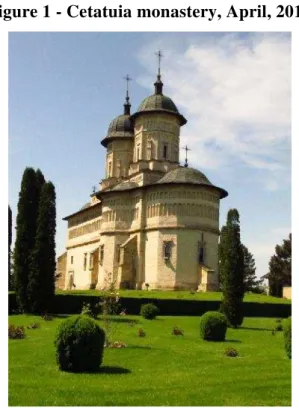
Figure 1 - Cetatuia monastery, April, 2014
Source: Author’s representation
The oldest church is Sfantul Nicolae Domnesc church or the “Royal Church”, which started to
be built in 1491, being finished in 1492, during the reign of Stefan cel Mare. It can be said that it was
built during the clotting of Moldavian style, with characteristic elements such as Moldavian arch, star
shaped basis on which towers relied, carved stone, brick etc. This was subject to frequent disasters
such as fires and earthquakes, and restoration became necessary. In the church were officiate
marriages of the daughters of Vasile Lupu, here were appointed rulers and Constantin Cantemir was
buried in 1863, (Tofan, 2008).
With the appointment of Iasi as capital, it becomes a major monastic center. It still feels some
influence of the characteristic elements of the Tara Romaneasca, because of the architects who
contributed to their construction, these elements can be observed for the first time at Galata and
Aroneanu church. In the eighteenth century Italian, architectural elements make their presence felt.
The current Galata monastery, at that time Galata din Deal, was built starting with 1583, the
construction having Moldavian elements, but also from Tara Romaneasca. Here are buried 2 children
of Petre Schiopul ruler and his wife, this being discovered in 1963, after some diggings, the signet
ring having engraved the following message ”Maria’s seal of Petru Voda”. Beside this monastery
there were built other buildings, but they got ruined through time, being exposed to deterioration1
1For further details see: http://www.crestinortodox.ro/biserici-manastiri/manastirea-galata-68011.html (accessed on 8th
The old construction of Sf. Sava church is since the 18th century, although there is no trace
until now from the old construction, the actual building being built in 1625, the architecture having
powerful oriental influences, the door being rebuilt in 19th century (Bogdan, 1997).
During Vasile Lupu reign, Trei Ierarhi church was built, between 1638 and 1639. The architect,
according to the Greek inscription, was Gheorghe from Constantinopole, while other researchers
sustain that the architect was another Greek named Enache2. The church was restored by Lecomte de
Nouy between 1882 and 1884, and it suffered some modifications. Here we have the Gothic Hall,
modified ulterior in a chapel. Over time, the church was reconditioned in 1905, 1952-1953. Among
all the religious objects and the ones which ornated the church, until now there are preserved artistic
embroidery, and the objects made of gold and silver were taken to National Museum of Arts from
Bucharest (Cihodaru and Platon, 1980). Here are submitted the remains of Vasile Lupu ruler, some
members of his family, Dimitrie Cantemir, but also Alexandru Ioan Cuza ruler (Vasiliu, 2008).
Figure 2 - Sfintii Trei Ierarhi Church, November 2012
Source: Author’s representation
Another old church is Golia (XVth century), the founder being Ioan Golia scribe, and it was
dedicated by his wife and son to a monastery from Athos mountain. Its construction started during
Vasile Voda reign and ended during Stefanita reign, as it was engraved in Greek on top of an entrance
(Erhan, 2003). In the following years it was subjected to fires and earthquakes, and sometimes people
who served the church lost their lives. Vasile Lupu gave as a gift to the church a bronze candelabrum
with Moldavian coat of arms and the two-headed eagle3.
One of the most important churches is Cetatuia, this one being built in the second half of the
XVIIth century (1666-1670), and the founder was Gheorghe Duca. By 1800, the church suffered from
fires, afterwards fell into ruin, but the church got restored between 1910 and 1912. Inside the
monastery there is also a building which served as a private residence for Gheorghe Duca (Vasiliu,
2008).
Nicorita church was built by 1500, the first time built from wood, and by the 1626 to be built
the current church instead of the wood one4. The founder of this church was Ioan Nicoara, hetman
and chief magistrate from Suceava (Tofan, 2008). This church was positioned on Tatarasi hills, as it
is today, and Miron Barnovschi gave as a gift to Nicoara some land surrounding the church to build
houses, an inn and a pond in the Ciric area. Thus, a little rural settlement was developed and over
time got an urban aspect (Cihodaru and Platon, 1980).
Figure 3 - Nicorita church, January 2013
Source: Author’s representation
In terms of religious buildings of Jewish affiliation, most of them could be found on Cucu
Street. This street was named Fainariei street, bordered by Fainei fair (in the present day, Cucu fair),
this fair being situated at a crossroads between Cuza Voda, Cucu and Costache Negri. After the
research of Gh. Ghibanescu, Fainei fair was situated in front of Saint Pantelimon church, down of
3For further details see: http://www.golia.ro (accessed at 8th May 2014).
4For further details see: http://bisericanicorita.blogspot.ro/2012/02/istoricul-bisericii-nicorita-iasi.html (accessed at 8th
present Cucu fair. It’s said that it was the second most important market from the South Fair (Bogdan,
1997).
After analysing a map of Iasi city having mapped Jewish buildings, the map being a property
of Jewish Community of Iasi, on Cucu Street were numerous Jewish buildings, such as Furriers
Synagogue, Haif Hoffman Synagogue, Big Synagogue, Meniche Synagogue. This fact shows that on
this street there were many Jewish buildings (Bogdan, 1997), and through time they were subject to
degradation and in the end they disappeared, in their place being built collective housing in the
communist period.
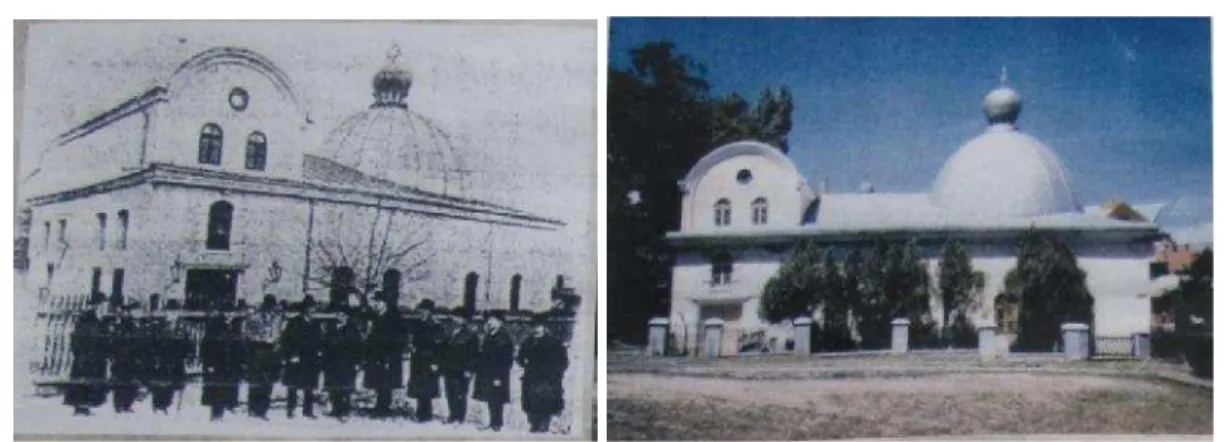
There are many opinions regarding the building of Synagogue. Thus, it is said the land on which
is built the Big Synagogue was bought in 1657, afterwards the rabbi Natan Nata Hanover insisted that
this synagogue to be completed in 1670-1671. Another story tells us that she was built between 1657
and 1682 and the land which was built on belonged to Aron-Voda monastery5.
Figure 4 - Big Synagogue between 1939 and 1980
Source: Jewish Community from Iasi
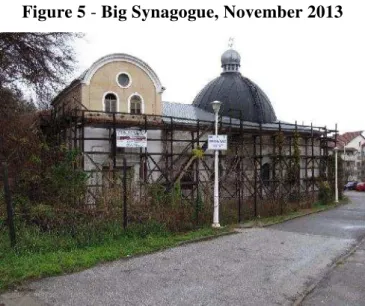
The Big Synagogue was reconditioned over time, in 1762, 1914, 1924-1925, 1980, the
synagogue being subject to fires during 1800s. All this time it existed beside the synagogue, other
ones of much smaller dimensions which belonged to different guilds, the oldest one belonging to
Jewish tailors. In the present day the synagogue is in restauration6.
5For further details see: http://www.turismland.ro/sinagoga-mare-din-iasi/ (accessed on 8th May 2014).
6 For further details see:
Figure 5-Big Synagogue, November 2013
Source: Author’s representation
On the one side and the other side of the entry in the synagogue there are two inscriptions, one
of this inscriptions being in Hebrew, giving thanks to rabbi Moses Rosen and Caufman pharmacist,
president of Jewish Community of Iasi.
Figure 6 - Saint Pantelimon church, November 2012
Source: Author’s representation
Another interesting church, although little publicized, is the Saint Pantelimon church, situated
on Cucu Street. It was built in 1762 at the initiative of several merchants from Iasi, using as
construction material rolls and beams. Her building had a purpose – the merchants believed that it
ground, but this time from stone.Saint Pantelimon was considered the protector of guilds of doctors,
barbers, being described as a healer (Cihodaru and Platon, 1980).
Here it was found a book, which currently is at the Metropolitan typography of Iasi, printed in
1797, and it was written the following text: ”This book is called Ciaslov, given by His Grace
Metropolitan James Stamati when I became a priest along with a liturgy, and a sum of 100 lei and 12
for all my priesthood, for the Bishop who have consecrated catachismus, for the soul of the deceased
nephew of His Hollines Grigorie, who died of plague in 1799, and who would feel tempted to steal
to be unforgivable by me forever and ever – September 1799” (Bogdan, 1997).
Conclusions
After this research, I can firmly say that churches and monasteries contributed to the
development of human settlements, due to economic activities that churches and monasteries had and
land they received from their founders and noblemen. Most of the churches had inns, stores in which
they commercialized their own products, they had farmlands and houses. Thus, they contributed at
the economic development, but also at the expansion of the city. These churches had the support of
the rulers, most of them being built by them.
We can observe from the analysed documents that across Iasi we can find many churches,
including between the oldest ones churches like Sfantul Nicolae Domnesc, Armenian, Catholic,
Nicorita, Cetatuia, Galata, Sfantul Sava etc. Thus, I chose to write about some of the most known
churches at a local and regional level, to highlight their importance for the community and tourism.
Iasi became a monastic centre of great importance, once it became the capital of Moldova. In
their architecture we can feel some Vallachian elements, because of those who contributed at their
building, these elements being noticed for the first time at Galata and Aroneanu church.
Due to the many religious buildings that our city enjoys, we can rely on religious tourism, even
though it is not as developed as we wish. The most promoted event from a touristic point of view it
is represented by the pilgrimage at the relics of Saint Parascheva which gathers year by year many
Christians. On the basis of this religious celebration, accommodation units can enjoy, also the food
establishments, traders from all over the country, in this period of the year being an entire
Acknowledgement
"This work was published with the support of the ERASMUS MUNDUS Project EMERGE
(Erasmus Mundus European Mobility with Neighbouring ReGion in the East), Action 2 – Strand 1
(2009-2013), Grant Agreement no. 2011-2576/001-001-EMA2, (Lot 8: Moldova, Ukraine, Belarus),
funded by the European Union”.
References
Barbu, N., Ungureanu, A. (1987),Geografia orasului Iasi, Ed. Univ. Al. I. Cuza, Iasi.
Bogdan, N. A. (1997),Orasul Iasi. Monografie istorica si social, ilustrata, Ed. Tehnopress, Iasi.
Brace, C., Bailey, R. and Harvey, D. (2006), "Religion, place and space: a framework for
investigating historical geographies of religious identities and communities”, Progress in
Human Geography, Vol. 30, pp. 28-43.
Cihodaru, C. and Platon, Gh. (1980),Istoria orasului Iasi, Ed. Junimea, Iasi.
Eliade, M. (2000),Sacru si profan, Editura Humanitas, Bucuresti.
Erhan, V. (2003),Manastiri si biserici din orasul Iasi, Ed. Tehnopress, Iasi.
Graburn, N.H. (1989), “Tourism: The Sacred Journey”, in: Smith, L.V. (ed.),Hosts and Guests-The
Anthropology of Tourism, University of Pennsylvania Press.
Iacob, G. (2009),Iasi – memoria unei capitale, Ed. Univ. Al. I. Cuza, Iasi.
Kong, L. (2001), “Mapping new geographies of religion: politics and poetics in modernity”,Progress
in Human Geography, Vol. 25, pp. 211-233.
Michell, G. (1994), “City as cosmogram: the circular plan of Warangal”. National Geographical
Journal of India, Vol. 40, pp. 217–37.
Murray, M. and Graham, B.(1997) “Exploring the dialectics of route-based tourism: theCamino de
Santiago”,Tourism Management, Vol. 18, pp. 513–24.
Smith, L.V. (1989), Hosts and Guests–The Anthropology of Tourism, University of Pennsylvania
Press, Pennsylvania.
Tilson, D. J. (2001), “Religious Tourism, Public Relations and Church-State Partnerships”, Public
Relations Quarterly, Vol. 46, Issue 3, pp. 35-39.
Tofan, I. (2008),Iasi – ghid turistic, Ed. Stef, Iasi.
Wall, G. and Mathieson, A. (2006),Tourism: Change, Impacts and Opportunities, Pearson Education
Ltd, Harlow, UK.
Weidenfeld, A. (2006), “Religious Needs in the Hospitality Industry”, Tourism and Hospitality