1 Division of Pediatric Cardiology, Department of Pediatrics, Faculty of Medicine, Celal Bayar University, Manisa, Turkey 2 Department of Pediatrics, Faculty of Medicine, Celal Bayar University, Manisa, Turkey
3 Department of Pediatrics, Istanbul Hospital, Van, Turkey
4 Division of Pediatric Cardiology, Department of Pediatrics, Faculty of Medicine, Ege University, İzmir, Turkey Yazışma Adresi /Correspondence: Mecnun Çein, Pediatric Cardiology,
Department of Pediatrics, Faculty of Medicine, Celal Bayar University, Manisa, Turkey Email: [email protected]
Geliş Tarihi / Received: 21.10.2012, Kabul Tarihi / Accepted: 09.12.2012 © Dicle Tıp Dergisi 2013, Her hakkı saklıdır / All rights reserved
ORIGINAL ARTICLE / ÖZGÜN ARAŞTIRMA
Tissue doppler echocardiography for evaluating left ventricular functions in obese
children
Obez çocuklarda sol ventrikül fonksiyonlarının değerlendirilmesinde doku doppler
ekokardiyograi
Mecnun Çetin1, Mustafa Çağlayan2, Münevver Yıldırımer1, Baran Serdar Kızılyıldız3,
Murat Deveci4, Şenol Coşkun1
ÖZET
Amaç: Bu çalışmada obez çocuklarda transtorasik doku
Doppler ekokardiyograik yöntemle sol ventrikül sistolik ve diyastolik fonksiyonlarının değerlendirilmesi amaçlandı.
Gereç ve yöntem: Mitral doku Doppler sinyalleri, mitral
annulus lateral duvarlarına yerleştirilen örnek hacmi ile apikal dört boşluktan kaydedildi. Pulse Doppler örneği apikal dört boşluk görüntüde mitral kapak uçlarına, akı-ma paralel olacak şekilde yerleştirilerek mitral akım tra-sesi elde edildi. Çalışmaya 20 obez (161,5±25,8 ay) ve 20 (151,2±33,5 ay) sağlıklı çocuk alınarak gerçekleştirildi.
Bulgular: Vücut kitle indeksi (VKİ) obez grupta belirgin
yüksekti (30,92±6,87). Sol ventrikül (LV) diyastolik fonk-siyon parametrelerinden izovolemik relaksasyon zamanı (IVRT) obez grupta 66,10±7,30 msn, kontrol grubunda ise 58,70±9,06 msn ile obez grupta anlamlı artış saptandı (p=0,007). Obez grubunda mitral anulus doku Doppler E akım hızı azalmış, A akım hızı artmış ve Em/Am oranının anlamlı derecede azalmış olduğu görüldü. VKİ ile LV Em/ Am oranı arasında anlamlı negatif ilişki saptandı. Miyo-kardiyal performans indeksi (MPİ) obez grupta 0,50±0,07, kontrol grubunda ise 0,41±0,04 (p<0.001) bulundu. MPİ ile LV Em/Am oranı arasında anlamlı negatif ilişki sap-tandı. MPİ ile VKİ arasında anlamlı pozitif ilişki sapsap-tandı. Obez grupta kontrol grubuna göre interventriküler septum ve LV arka duvar kalınlığının önemli derecede artmış ol-duğu gösterildi (p<0.001).
Sonuç: Bu bulgular, pediatrik yaş grubunda obezite ve
kardiyovasküler risk faktörleri arasındaki ilişkiyi belirle-mek için önemli bulgular olabilir. Doku Doppler ekokardi-yograik görüntüleme yöntemi ise aralarındaki bu ilişkinin belirlenmesinde yararlı olabilir.
Anahtar kelimeler: Obezite, doppler ekokardiyograi,
ventriküler disfonksiyon
ABSTRACT
Objective: The aim of this study was to investigate the
impact of childhood obesity on ventricular functions using tissue Doppler echocardiography.
Materials and methods: The mitral tissue Doppler signals
were recorded in the apical four-chamber view, with the sample volume placed at the lateral walls of mitral annulus. The mitral low was examined with the sample Pulse Dop-pler positioned parallely to low just at the oriice of the mi-tral lealets. Twenty obese (mean age, 161.5±25.8 months) and 20 healthy children (mean age, 151.2±33.5 months) were included to this study.
Results: Body mass index (BMI) was signiicantly higher
in obese group (30.92±6.87). Isovolumic relaxation time (IVRT) which is one of the left ventricular (LV) diastolic function parameters was 66.10±7.30 ms in obese group, and 58.70±9.06 ms in the control group. IVRT was sig-niicantly higher in the obese group (p=0.007). In obese group, the mitral annulus tissue Doppler E velocity was decreased, low velocity was increased and decrement in Em/Am ratio was signiicant. We found signiicant negative correlation between BMI and LV Em/Am ratio. Myocardial performance index (MPI) in obese group and control group was 0.50±0.07 and 0.41±0.04, respectively (p<0.001). Between MPI and LV Em/Am ratio there was a signiicant negative correlation while MPI showed positive correlation with BMI. In obese group septal and LV posterior wall thick-ness was shown to be signiicantly increased compared to the control group (p<0.001).
Conclusion: Our indings, may be important for
determina-tion of the reladetermina-tionship between obesity and cardiovascular risk factors in children. Tissue Doppler echocardiographic imaging may be useful in revealing this relationship.
Key words: obesity, doppler echocardiography, ventricular
INTRODUCTION
Childhood obesity is one of major public health problem affecting children in developed countries. Obese children have increased risk for cardiovas -cular complications and if childhood obesity would not be treated in early ages; cardiovascular risk for acute myocardial infarction, congestive heart failure and arrhythmias increases in adult ages.1,2,3 Obesity
is a chronic disease and early diagnosis and appro
-priate treatment is essential to prevent from com
-plications in both childhood and adult ages.4 Tissue
Doppler echocardiography is a recent echocardio
-graphic imagine technique that allows evaluation of
regional myocardial systolic and diastolic function.5
In literature, there are few studies which evaluate
effects of obesity in cardiovascular system in child
-hood.6,7 In many of these studies, only left ventricu -lar diastolic functions were evaluated. In this study, our aim is to determine whether there is an effect of childhood obesity in left ventricular functions by using tissue Doppler echocardiography.
MATERIALS AND METHODS
The study was performed in patients admitted
to Celal Bayar University Pediatric Endocrinol
-ogy and Metabolism department for overweight complaint and diagnosed as exogenous obesity by clinical and laboratory indings. A total of 20 pa -tients (8-18 years) that have not hypertension and with normal basal insuline levels enrolled as study group. The control group consisted of 20 patients that referred to pediatric cardiology department for cardiac murmur or chest pain. The patients in control group were considered as healthy after
electrocardiographic, telecardiographic and echo
-cardiographic examinations. Informed consent was obtained from all parents. The patients who have a comorbid cardiac or extracardiac disease and under 8 ages or over 18 ages were excluded.
Patients were separated into two groups de
-pends on their body mass index (BMI). BMI was calculated as weight in kilograms divided by the
square of height in meters (weight/height2 expressed
in kg/m2). Patients’s BMI scores were determined
by the curves of Turkish children reported by Ol
-cay Neyzi.3 For these standards between 10 and 85
percentiles was normal and over 95th percentiles
deined as obese. The overweighed children (per
-centiles between 85-95th) were excluded. Antropo
-methric examination was performed by a pediatric endocrinologist. Echocardiography was performed in all patients by the same physician.
Echocardiography
Echocardiograhic examination was performed us
-ing a GE Vivid 3 Pro device with 1.5-3.6 MHz phase transducer. Examinations have been made in left lateral position on standard parasternal long axis and apical four chamber views.
Tissue doppler echocardiography
The mitral Doppler signals were recorded in the apical four-chamber view, with the sample volume placed at the lateral walls of mitral annulus. The early (Em) diastolic, late (Am) diastolic myocardial velocities and systolic (Sm) movement velocities,
isovolumetric relaxation time (IVRT) and isovolu
-metric contraction time (IVCT) were measured. The highest values of Em and Am were founded and then Em/Am was calculated. IVCT was deined as the duration of the bidirectional spike between the ending of Am and the beginning of Sm. IVRT was deined as the duration of the bidirectional spike
between Sm and Em. Tei (MPI: Myocardial perfor
-mance index) index was calculated from the sum of
isovolumetric contraction time (IVCT) and isovolu
-metric relaxation time (IVRT), divided by ejection time (ET). (Figure 1) Left ventricule systolic and diastolic functions were determined by using this index.
Standard doppler echocardiography
The mitral low was examined with the sample pulse Doppler positioned parallely (<200) to low just at the oriice of the mitral lealets. Measure -ments obtained by maximum velocities. The peak early diastolic velocity (E) and peak atrial illing velocity (A) were measured. E wave, deceleration
time (DT) and E/A ratios were calculated. E veloc
-ity was deined as peak veloc-ity of fast illing phase
of left ventricule; A velocity deined as peak veloc
-ity of slow illing low of ventricule; DT deined as
the interval between peak E velocity and the end
-ing of fast ill-ing phase. (Figure 2) Posterior wall of left ventricule and septum thickness were measured
from the two dimensional targeted M-mode echo
Statistical analysis
Statistical analysis was performed using dedicated software (SPSS 15.0). All data are presented as mean ± standard deviation. The case and control groups were including 20 children and so Kolmogorov-Smirnov test was used to analyze the numerical results. The statistical signiicance for all analyses was set at p<0.05. Student’s T test was used to com -pare numerical data in independent groups.
RESULTS
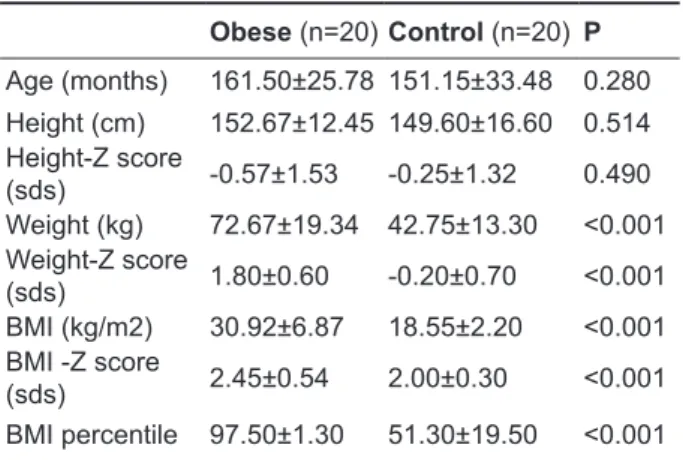
There was no statistically signiicant difference be
-tween two groups regarding age, gender and body height. In obese group the mean body weight was 72.67±19.34 kg, mean height 152.66±12.45 cm, mean body mass index 30.92±6.87 kg/m². These values were 42.75±13.30 kg, 149.60±16.60 cm and 18.55±2.20 kg/m2 in control group, respectively. Mean BMI was signiicantly higher in obese group (p<0.001) (Table 1).
In echocardiographic examination, there was no statistically signiicant difference between two groups regarding early diastolic wave velocity
(Em) (p=0.514). The mean late diastolic wave ve
-locity (Am) was signiicant higher in obese group (8.67±3.10 / 6.80±2.30 cm/sn, p=0.022). Em/Am
value (2.40±0.90 / 3.10±0.80, p=0.016) among obe
-ses was less than control group (Figure 3).
Tissue Doppler IVRT was detected 66.1±7.3
msn in obese group and 58.70±9.06 msn in con
-trol group. The difference of IVRT between obeses and controls was statistically signiicant (p=0.007). There was no signiicant difference between groups respect to total systolic time (TsT) 372.70±30.90 msn in obeses and 373.50±38.90 msn in control group, p=0.940. The ET value was 248.50±18.30 msn and 268.50±36.18 msn in obeses and controls, respectively. ET value was signiicantly lower in obeses compared to controls (p=0.034) (Table 2).
Left ventricular MPI was higher in obese group compared to the control group (obese:0.50±0.07; control:0.41±0.04 p<0.001) (Figure 4).
There was no signiicantly difference between obeses and controls regarding early diastolic wave velocity (E), late diastolic wave velocity (A) and deceleration time (DT). The E/A ratio was similar
in both groups (p=0.066). Mean left ventricular pos
-terior wall (LVPW) thickness was 7.40±1.30 mm in obeses and 5.57±0.97 mm in controls (p<0.001).
The mean value of interventricular septum thick
-ness was 7.30±1.40 mm and 5.40±0.90 mm respec
-tively (p<0.001) (Table 3).
Table 1. General characteristics of the groups
Obese (n=20)Control (n=20) P
Age (months) 161.50±25.78 151.15±33.48 0.280 Height (cm) 152.67±12.45 149.60±16.60 0.514 Height-Z score
(sds) -0.57±1.53 -0.25±1.32 0.490 Weight (kg) 72.67±19.34 42.75±13.30 <0.001 Weight-Z score
(sds) 1.80±0.60 -0.20±0.70 <0.001 BMI (kg/m2) 30.92±6.87 18.55±2.20 <0.001 BMI -Z score
(sds) 2.45±0.54 2.00±0.30 <0.001 BMI percentile 97.50±1.30 51.30±19.50 <0.001 BMI: Body mass index
Table 2. Pulse-wave tissue Doppler echocardiographic
characteristics
Obese (n=20) Control (n=20) P
Sm cm/sec 9.90±2.58 8.35±1.47 0.024 Em cm/sec 19.20±5.10 20.24±4.72 0.514 Am cm/sec 8.67±3.10 6.80±2.30 0.022 Em/Am 2.40±.90 3.10±0.80 0.016 IVRT msec 66.10±7.30 58.70±9.06 0.007 IVCT msec 54.20±10.60 59.25±13.11 0.188 ET msec 248.50±18.30 268.50±36.18 0.034 TsT msec 372.70±30.90 373.50±38.90 0.940 MPI 0.50±0.07 0.41±0.04 <0.001 Sm: mitral systolic movement velocity, Em: early mitral diastolic velocity, Am: late mitral diastolic velocity. IVRT: isovolumetric relaxation time, IVCT: isovolumetric con-traction time, ET: ejection time, TsT: total systolic time, MPI: Myocardial performance index.
Table 3. Transmitrale low pulse wave Doppler
echocar-diographic characteristics and Two-dimensional-guided M-mode tracing echocardiography.
Obese (n=20) Control (n=20) P
Fig. 1. Tissue Doppler time intervals,
S, E, A waves and Tei index. [MPI (Tei index): IVRT+IVCT/ET]. (IVCT: metric contraction time, IVRT: isovolu-metric relaxation time, ET: ejection time, MPI: Myocardial performance index)
Fig. 2. Mitral Doppler low (E: early
mi-tral diastolic velocity, A: late mimi-tral dia-stolic velocity, DT: Deceleration time)
Fig. 3. E/A ratios in obese and control group
Fig. 4. MPI values of obese and control group (MPI:
DISCUSSION
Obesity is a chronic and insidious disease that specially effects cardiovascular system.1,3 Major
complications of cardiovascular system are dys
-lipidemia and hypertension. Childhood obesity is
a predictor of adult obesity and of increased coro
-nary heart disease and stroke risk later in life.8 Bo -galusa Heart Study have been shown that coronary
atherosclerosis was usually begun in childhood.9
Also obese adolescents are more likely to have hy
-pertension in adulthood (8.5 fold compared to nor
-mal weighted).10 Tissue Doppler Echocardiography
(TDE) is a modiied form of conventional pulse
Doppler echocardiograpy that is used for research
-ing negative effects of obesity on the heart and it
provides to analysis cardiac functions.11 Before us
-ing of tissue Doppler imag-ing digital ventriculogra
-phy and regional M-mode echocardiogra-phy were been used for quantitative assessment of regional functions. But it was so dificult to determine wall
motion by these techniques.12 TDE allows region
-al assessment of myocardi-al systolic and diastolic functions.13 This technique can detect subclinical left ventricle dysfunctions more sensitively than conventional echocardiography in many diseases
which standard LV parameters were normal.1 In ad
-dition, when compared to conventional Doppler pa
-rameters, TDE data are relatively independent from preload and afterload so it is useful in assessment of diastolic functions. TDE is a recently used new technique; for that reason there are a few studies for usage of TDE in childhood in literature.14,15 Also we used this technique at obese and normal children in our study. Diastolic dysfunction characterized by prolonged IVRT is the earliest abnormality in heart
in obese patients. It can be deined as an abnormali
-ty of ventricular illing with normal cardiac function and compensatory increased atrial pressure.16 In this condition, E wave depressed due to decreased fast illing and A wave upraises. In our study IVRT was signiicantly higher in obeses compared to healthy
controls (p=0.007). Prolonged IVRT shows diastol
-ic dysfunction as relaxation impairment in ventr-icle.
Em/Am ratio and A values were signiicantly differ
-ent from those of the control group similar to other studies in literature.13,17 And so it can postulated that impairment of left ventricle relaxation has begun in obese children. Mehta et al. reported no difference in LV diastolic functions between obese and healthy
controls by conventional Doppler echocardiogra
-phy but similar to our study they found signiicant
-ly increase of E and decrease of A wave in obese
children.6 On the other hand contrary to our study
Harada et al. have been found signiicant difference in obese children by using conventional Doppler echocardiography as well as TDE.18 Diagnosis of diastolic dysfunction can be made by invasive and noninvasive methods such as echocardiography
(M-mode, Doppler, TDE), magnetic resonance imag
-ing, radionuclide ventriculography. Doppler echo
-cardiography is the common and acceptable method
recently. But TDE can detect regional diastolic dys
-function in patients that pulse wave Doppler trace
was normal.16
One of the important results of our study was the signiicantly decrease of Em/Am ratio measured by TDE in obese children compared to controls (p=0.016). But there was no differences between
two groups by conventional Doppler echocardiog
-raphy. This result suggested that TDE was superior
to conventional Doppler echocardiography in de
-tecting subclinical abnormalities.
Myocardial performance index is a new echo
-cardiographic parameter which had a prognostic value in many cardiac disease and used to evalu -ate both systolic and diastolic functions.19 In our study we detected signiicantly higher MPI in obese group compared to controls by using pulse wave TDE (p=0.000). This result suggested that there
was impairment in both systolic and diastolic func
-tions in obeses. So improving our understanding of cardiac dysfunction related to obesity becomes very important to lead the way for new preventive and therapeutic strategies. However Van Putte-Katier
et al. have been reported decreased MPI in obeses,7
review of the literature revealed many studies whic have concordant results to ours.20,21 Other important
parameters of LV functions are interventricular sep
-tum thickness and left ventricule end-diastolic di
-mension (LVDD). Obesity together with increased blood volume and hypertension may lead over time
to increase in LV mass.22 In our study we found that
LVDD and IVS were signiicantly higher in obeses compared to controls similarly the other studies in
literature.23-25 Hypertrophy of LV can decrease LV
compliance and so diastolic dysfunction can be oc
and Em/Am ratio. This inding suggested that BMI was closely associated with diastolic dysfunction.
Contrastly, Sharpe et al. have been reported no dif
-ference between these parametres.26 One possible
reason for this may be older ages of our obese pa
-tients and so long duration of obesity and also may be higher BMI’s in our study.
We showed subclinical changes in LV diastol
-ic functions by using TDE in our study. MPI is an useful parameter in determining both systolic and diastolic functions of LV and could be effected
negatively in obese children. For that reason to de
-termine early effects of obesity on cardiovascular system it would be better to use TDE plus normal echocardiographic imagine and that provides early
prevention and treatment for patients. Our data sup
-port the use of TDE in obese children, because it can detect early effects of obesity in LV functions.
In conclusion, TDE is a useful method in de
-termining the effects of obesity in cardiac functions and the subclinical changes of diastolic functions of left ventricule, right ventricule and interventriculer
septum. We believe that TDE will place to conven
-tional methods, as a useful and noninvasive method
in obese children by the contribution of future stud
-ies in larger obese groups.
REFERENCES
1. Schonfeld-Warden N, Warden CH. Pediatric obesity. An over -view of etiology and treatment. Pediatr Clin North Am 1997;44:339-61.
2. Yerlikaya HF, Mehmetoğlu İ. Investigation of plasma conjugated linoleic acid levelsin obese and healthy subjects. J Clin Annal Med 2012;3:190-3.
3. Cinaz P, Bideci A. [Obesity]. In: Günöz H, Öcal G, Yordam N, Kurtoğlu S.(eds). Pediatrik endokrinoloji. 1.Basım. Pediatrik Endokrinoloji ve Oksoloji Derneği Yayınları 1;2003.p.487-505. 4. Rössner S. Childhood obesity and adulthood consequences. Acta
Pediatrica 1998;87:1-5
5. Sutherland GR, Stewart MJ, Groundstroem KWE, et al. Color Doppler myocardial imaging: a new technique for assessment of myocardial function. J Am Soc Echocardiogr 1994;7:441-58.
6. Mehta SK, Holliday C, Hayduk L, Wiersma L, Richards N, You -noszai A. Comparison of myocardial function in children with body mass indexes > 25 versus those < 25 kg/m2. Am J Cardiol 2004;293:1567-9.
7. Van Putte-Katier N, Rooman RP, Haas L, et al. Early cardiac abnormalities in obese children: importance of obesity per se versus associated cardiovascular risk factors. Pediatr Res 2008;64:205-9.
8. Freedman DS, Srinivasan SR, Harsha DW, Webber LS, Beren -son GS. Relation of body fat patterning to lipid and lipoprotein
concentrations in children and adolescents: the Bogalusa Heart Study. AM J Clin Nutr 1989;50:930-9.
9. Freedman DS, Dietz WH, Srinivasan SR, Berenson GS. The relation of overweight to cardiovascular risk factors among children and adolescents: Bogalusa Heart Study. Pediatrics 1999;103:1175-82.
10. Daniels S. Morrison J, Sprecher DL, Khoury P, Kimball TR. Association of body fat distribution and cardiovascular risk fac -tors in children and adolescents. Circulation 1999; 99:541-5. 11. Isaaz K, Thompson A, Ethevenot G, Cloez JL, Brembilla B, Per
-not C. Doppler echocardiographic measurement of low veloc -ity motion of the left ventricular posterior wall. Am J Cardiol 1989;64:66-75.
12. McCarthy HD, Jarrett KV, Crawley HF. Original communica -tion the development of wrist circumference percentiles in Brit -ish children aged 5.0-16.9 y. Eur J Clin Nutr 2001;55:902-7. 13. Dagdelen S, Eren N, Karabulut H, et al. Estimation of left ven
-tricular end-diastolic pressure by color M-mode doppler echo -cardiography and tissue doppler imaging. J Am Soc Echocar -diogr. 2001;14:951-8.
14. Yazıcı HU, Şen N, Tavil Y, et al. Left ventricular functions in patients with cardiac syndrome X: a tissue Doppler study. An -adolu Kardiyol Derg 2009;9:467-72.
15. Kapusta L, Thijssen JM, Cuypers NHN, Peer PGM, Daniels O. Assessment of myocardial velocities in healthy children using tissue Doppler imaging. Ultrasound Med Biol 2000;26:229-37. 16. Çaylı M, Usal A, Kanadaşı M, Demir M, Akpınar O. Assess -ment of Left ventricular diastolic dysfunctions with a new method: Tissue Doppler echocardiography. Türk Kardiyol Dern Arş 2004;32:618-25.
17. Oğuzhan A, Abacı A, Eryol NK, et al. Doppler Tissue Imaging: A noninvasive technique for estimation of left ventricular end-diastolic pressure. Arch Turk Soc Cardiol 2000;28:82-7. 18. Harada K, Orino T, Takada G. Body mass index can predict
left ventricular diastolic illing in asymptomatic obese children. Pediatr Cardiol 2001;22:273-8.
19. Tei C. New non-invasive index for combined systolic and dia -stolic ventricular function. J Cardiol. 1995;26:135-6.
20. Abstract 1472: Obesity-related left ventricular functional change starts in early childhood Kenji Harada. Harada Kid’s Clinic, Akita, Japan. Turk J Pediatr 2005;47:34-8.
21. Levent E, Gökşen D, Ozyürek AR, Darcan S, Coker M. Useful -ness of the myocardial performance index (MPI) for assessing ventricular function in obese pediatric patients. Turk J Pediatr 2005;47:34-8.
22. Sasson Z, Rasooly Y, Bhesania T, Rasooly I. Insulin resistance is an important determinant of left ventricular mass in obese. Circulation 1993;88:1431-6.
23. Wong CY, O’Moore-Sullivan T, Leano R, Byrne N, Beller E, Marwick TH. Alterations of left ventricular myocardial charac-teristics associated with obesity. Circulation 2004;110:3081-7. 24. Ehud G, Oren S, Messerli FH. Left ventricular illing in the
systemic hypertension of obesity. Am J Cardiol 1991;68:57-60. 25. Berkalp B, Cesur V, Corapcioglu D, Erol C, Baskal N. Obe -sity and left ventricular diastolic dysfunction. Int J Cardiol. 1995;10:52:23-6.