EVAL U A TION OF RA DI A TION HEAT TRANS FER IN PO ROUS ME DIA
Ap pli ca tion for a peb ble bed mod u lar re ac tor cooled by CO
2gas
by
Kamel SIDI-ALI 1*, Khaled OUKIL1, Tinhinane HASSANI 2,
Yasmina AMRI 2, and Abdelmoumane ALEM 3
1
Nu clear Safety and Ra di a tion Pro tec tion Di vi sion, Nu clear Re search Cen ter of Draria, Al giers, Al ge ria
2
Thermo-En er getic De part ment, Mechanical and Pro cess En gi neer ing Fac ulty, Sci ence and Tech nol ogy Houari Boumedienne Uni ver sity, Alger, Algeria
3
De part ment of Me chan ics, En gi neer Sci ence Fac ulty, Uni ver sity of Saad Dahleb, Blida, Algeria Scientific pa per
DOI: 10.2298/NTRP1302118S
This work anal y ses the con tri bu tion of ra di a tion heat trans fer in the cool ing of a pebble bed modular reactor. The math e mat i cal model, de vel oped for a po rous me dium, is based on a set of equa tions ap plied to an an nu lar ge om e try. Pre vi ous ma jor works deal ing with the sub ject have con sid ered the forced con vec tion mode and of ten did not take into ac count the ra di a tion heat trans fer. In this work, only free con vec tion and ra di a tion heat trans fer are con sid ered. This can oc cur dur ing the re moval of re sid ual heat af ter shut down or dur ing an emer gency sit u a tion. In or der to de rive the gov ern ing equa tions of ra di a tion heat trans fer, a steady-state in an iso tro pic and emissive po rous me dium (CO2) is con sid ered. The ob tained sys tem of equa tions is writ ten in a dimensionless form and then solved. In or der to eval u ate the ef fect of ra di a tion heat trans fer on the to tal heat re moved, an an a lyt i cal method for solv ing the sys tem of equa tions is used. The re sults al low quan ti fy ing both ra di a tion and free con vec tion heat trans fer. For the stud ied sit u a tion, they show that, in a pebble bed modular reactor, more than 70% of heat is re moved by ra di a tion heat trans fer when CO2 is used as the cool ant gas. Key words: heat trans fer, po rous me dium, pebble bed modular reactor, ra di a tion, free con vec tion, gas,
cool ing, car bon di ox ide
INTRODUCTION
Ra di a tion heat trans fer can be found in many in -dus trial ap pli ca tions. In the nu clear field, this mode of heat trans fer is en coun tered in high tem per a ture gas re ac tors (HTGR). Peb ble bed mod u lar re ac tors (PBMR) fall into the cat e gory of HTGR. In nor mal sit u a tions, the re moval of heat from a PBMR's core is en -sured by a gas flow ing through fuel spheres by forced con vec tion, while in ac ci den tal sit u a tions this is done by free con vec tion. If a tri-atomic gas is used, in some ac ci den tal sit u a tions, heat can be re moved by both ra -di a tion and free con vec tion.
The best an a lyt i cal mod els for study ing heat trans -fer in PBMR are those de vel oped for the po rous me dia the ory. Among the first an a lyt i cal works done on PBMR by con sid er ing a po rous me dium equa tion setup is that of Dzung [1] and one of its find ings was that the max i mum gas tem per a ture is much higher than the mixed mean value. Af ter this, more stud ies deal ing with ther mal hy drau lics of PBMR were car ried out. Stroh et al. [2] pre
Havstad and Burns [7]. They pro posed an as ymp totic so lu tion valid for very tall cyl in ders and all tem per a ture dif fer ences. They also pre sented some Nusselt re sults, ac -cord ing to the re ac tor core as pect ra tio and ra dius ra tio. Com bined ra di a tion and forced con vec tion heat trans fer in po rous me dia was in ves ti gated by Talukdar et al. [8]. They used a dis crete trans fer method to solve the ra di a -tive part of the en ergy equa tion and found that ra di a tion has a sig nif i cant ef fect on var i ous pa ram e ters stud ied. Free con vec tion and ra di a tion was stud ied for a ver ti cal wall with vary ing tem per a tures em bed ded in a po rous me dium by Badruddin et al. [9]. They pre sented nu mer i -cal re sults for the lo -cal Nusselt num ber con cern ing cases both with and with out ra di a tion. In an other work, Badruddin et al. [10] eval u ated ra di a tion and free con vec tion heat trans fer through a ver ti cal an nu lus em bed -ded in a po rous me dium. They showed the in flu ence of as pect ra tio and ra dius ra tio on the Nusselt num ber, as done by Havstad and Burns [7] for con vec tion heat trans -fer and com mented on the ef fect of ra di a tion on heat trans fer be hav ior.
Most works do not take into ac count ra di a tion heat trans fer be tween the cool ing gas and the solid sur -faces and con sider only forced con vec tion, due to the fact that the cool ing gas is mono-atomic. In the pres ent work, a tri-atomic gas is used as the cool ant for the PBMR core and the study is done in a sit u a tion where the CO2 gas flows solely by its den sity dif fer ence. Un der these cir cum stances, only free con vec tion and ra di -a tion he-at tr-ans fer t-ake pl-ace in the PBMR core. In this study, ra di a tion heat trans fer oc curs be tween the sphere sur faces and CO2 in a po rous me dium in the an nu lar part of the nu clear re ac tor core. The ul ti mate aim of our work is to eval u ate the rate of ra di a tion heat trans fer in com par i son to the to tal heat trans fer in a PBMR core.
MATH E MAT I CAL FOR MU LA TION
This study deals with ra di a tion heat trans fer in a po rous me dium where a tri-atomic gas is in volved. As said, it is typ i cally the case of ther mal hy drau lics in a PBMR where a gas is used to re move the heat pro -duced in the nu clear re ac tor core. Fig ure 1(a) shows the gas flow in a PBMR core in a nor mal sit u a tion, while fig. 1(b) de picts an equiv a lent po rous me dium in an an nu lar vol ume. The flow in fig. 1(b) is up ward and gov erned solely by the dif fer ence in gas den sity. This con fig u ra tion is the case stud ied and pre sented in this work. More tech no log i cal PBMR de tails are to be found in Singh [11].
The as sump tions adopted con sider a sta tion ary re gime, two di men sions in space and one phase flow. The ther mal equi lib rium be tween the fluid and the solid phase is also sup posed, per formed for a re frac -tion num ber cho sen to be equal to 1, as de fined by Bousri et al. [12]. The equa tions gov ern ing the flow of an in com press ible and inviscid fluid in an an nu lar ver -ti cal cyl in der filled with a re ac -tive po rous me dium are
de duced from the prin ci ples of the con ser va tion of mass, mo men tum and en ergy, as given by Bories et al. [13]. The math e mat i cal for mu la tion is es tab lished by de vel op ing the con ser va tion equa tions, tak ing into ac count the ra di a tion heat flux oc cur ring in an nu lar ge om e try. This set of equa tions is writ ten as those de -fined by Darby [14].
The pro ce dure is a pro jec tion of eqs. (1)-(3) in cy lin dri cal co or di nates to de ter mine the sys tem of equa tions gov ern ing the heat trans fer.
Mass conservation
The equa tion of mass con ser va tion is writ ten in its gen eral form as fol lows
¶ 
r r
t + Ñ( )=
r
U 0 (1)
Mo men tum conservation
The equa tion of mo tion, as given by the Darcy model in Kaviany [15], is writ ten as fol lows
r
U= -k Ñ +
m( p rg) (2)
En ergy con ser va tion: ra di a tion ef fects con sid ered
In a po rous me dium, two en ergy equa tions are writ ten for both the solid and the fluid phase, as men tioned by Kaviany [15]. At ther mal equi lib rium, the fi -nal en ergy equa tion is the sum of these two en ergy equa tions. The last term in eq. (3) is added to ac count for the ra di a tion heat trans fer.
(rmC )* (r ) (l* ) T
t C T T
pm f pf U qr

¶ + Ñ = Ñ Ñ - Ñ
r
r
(3) where rm and rf are the me dium and fluid den si ties, re
-spec tively, Cpm and Cpf – the spe cific heat at con stant
pres sure of the me dium and the fluid. The first term in eq. (3) is given by (rmCpm)
*
= (1 – e)(rsCps) +.e(rf Cpf),
where e is the po ros ity of the me dium, rs and Cps are,
re spec tively, the solid den sity and spe cific heat at a con stant pres sure of the solid. The sub scripts “m”, “s”, and “f” re fer, re spec tively, to the me dium, solid phase and the fluid phase.
r
U is the ve loc ity vec tor of the fluid, T – the me dium tem per a ture, and l* – the ef fec tive ther mal con duc tiv ity of the me dium given by l* = (1 – –,e)ls + elf, where ls and lf are, re spec tively, the ther
-mal con duc tiv ity of the solid and the fluid phase. The last term Ñr
qr rep re sents the gra di ent vec tor of the to tal ra di a tion heat flux den sity, ex pressed by
r
r r
qr ) d d c
c
( , )sD L v ( ,sD D
p
=
ò
ò
W W0 4
0 4
n (4)
where L
c Wn(s,
r
D) is the spec tral di rec tional ra di ance at the co-or di nate point s in di rec tion D and the solid an -gle dW, for fre quency uc.
To find out L
c
Wn in eq. (4), it is es sen tial to solve the equa tion de fined by Bories et al. [13]
1 1 4 0 b w w v v
v v v
v c c c c c L s
s L s L T s
d d c W W ( , ) ( , ) ( ) [ ( )] D D + = - + +
p D D) D)
p
pv L v s
c( , ` c( , `
`
`
W W
0 4
ò d (5)
where bvc =cuc+sucis the ex tinc tion co ef fi cient, cucis
the ab sorp tion co ef fi cient, suc– the dif fu sion co ef fi cient as 1- wuc = cuc/buc, wuc = suc/buc – the albe do L T s
c u
0
[ ( )] – the mono chro matic ra di ance of the blackbody and is cal cu lated by
L T s h
C h k T c c c c u u n u 0 3 2 2 1 [ ( )] exp = æ è çç öø ÷÷-é ë ê ù û ú B
The ra di a tion in the en vi ron ment is c C n
c c
u = o/ u , where the wave ve loc ity in the vac uum is given by: Co = 299.792.458 m/s, n
c
u – the re frac tive in dex and pnc–
the phase func tion, while h = 6.626×10⁻³⁴ J/s – the Planck
con stant and kB = 1.381×10⁻²³ J/K – the Boltzmann con
-stant. p
c
n ( , ` )D D is the phase func tion or dif fu sion in di -ces in the me dium. It is in ter preted phys i cally as the ra tio of the in ten sity of scat tered ra di a tion in a di rec tion by the in ten sity of the ra di a tion scat tered if the dif fu sion is iso -tro pic in the same di rec tion as de fined by Kamdem [16] then
1
4 0 1
4
p D D
p
p
c
n ( , ` )dW=
ò (6)
When in te grat ing eq. (5) over the en tire solid an -gle W, from 0 to 4p, tak ing into ac count eq. (6), ac -cord ing to Kamdem [16], we get
d
d d d
L s
s L s +
L T v v v v v c c c c c ( , ) ( , ) [ ( D D p p p 0 4 0 4 0 4
ò
= -ò
+
W b W
c s v
c
)]+s (7a)
We have Lv s Lv s
c c 0 4 0 4 p p D D
ò
( , ` )dW`=ò
( , )dWEqua tion (7a) is trans formed as d
d d
L s
s L T s
L s v v v v v c c c c c ( , ) [ ( )] ( , ` D p D p
W= +
+
ò
ò
0 4 0 0 4 4 p cs ) `dW (7b)
and, tak ing into ac count eq. (4), Ñr
qr is writ ten as fol -lows
Ñ = Ñ
ò
ò
=ò
r
q d d
= 4 d
r
0
L s v
L T s v
v c
v v c
c c c 0 4 0 0 p D D p ( , ) [ ( )] W 4 4
c -cvc
ò
ò
Lvc( , )sD D vc p d d 0 0 W 4 4 (8)Fig ure 2 rep re sents the pro jec tion of the ra di ance de scrib ing the ra di a tion of the solid par ti cle S in a di -rec tion D through a solid an gle W in the ra dial di rec tion r, ax ial di rec tion z and an gu lar di rec tion q.
Fig ure 3 rep re sents the pro jec tion of the solid an -gle W ac cord ing to space co-or di nates r, z, and q and the def i ni tion of the curvilinear de riv a tive in space di -rec tion z. Di rec tion D is de fined ac cord ing to space co-or di nates (r, z, q) with, re spec tively: sin qcos f
along r, sin f sin q along z, and cos q fol low ing q, as ex -pressed by Kamdem [16].
The vari a tion of the solid an gle is given by dW = sinqdqdf (9) where, q and f are, re spec tively, the po lar and the az i -muthal solid an gle W.
Ac cord ing to Kamdem [16]: m = cos q and its de -riv a tive is dm = –sin q and when re placed in eq. (9), one ob tains
dW= – dmdf (10)
Now, con sid er ing a sur face in plane (r, q) and the ra di a tion heat trans fer tak ing place only in the z di rec -tion, the curvilinear de riv a tives are given by: d/ds = =.¶/¶z dz/ds
With d dz s/ =m, one can write d
ds=m z 
¶ (11)
Tak ing into ac count eq. (11), the ra di a tion bal -ance eq. (5) leads to
m L s
z L m
L T v v v v v c c c c c ¶ D ¶ D p p p ( , )
( , ) [ (
dW+ dW =
=
ò
ò
b c 0 4 0 4 04 s v Lv m
c c
)]a ( , ` ) `
0 4p
D
ò
dW (12)It is con sid ered herein that the spheres are ran -domly dis persed in the me dium and that the ra di a tion prop er ties are in de pend ent of the az i muth so that, con -se quently, one can write
L s L z m m
p p m m
vc( , ) vc( , )
` ) ( ` , ) D p D, D p = = ò = ì
-ò
Kd Kd( W 2 1 1 0 4 í ïï î ï ï
Let us con sider a sphere sur face el e ment, as pre -sented in fig. (3), de fined by r, q, and z. Ra di a tion heat trans fer oc curs only in the di rec tion of the vec tor nor mal to this sur face and thus the vec tor gra di ent of the ra di a -tion heat flux den sity is writ ten as: Ñr = r
qr ¶qr/¶z and the eq. (8) be comes
Ñ =
-ò
ò ò
-r q d d r 4 2 0 0 0 1 1 p p c cv v c
v v
c c
c c
L T s v
L z m m
4
4
[ ( ) ]
( , ) dvc (13)
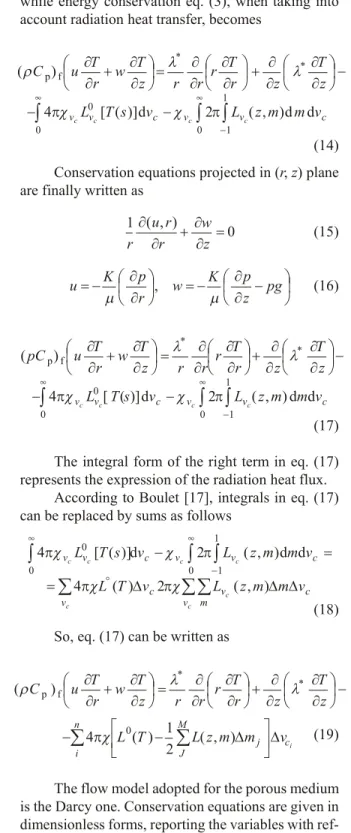
while en ergy con ser va tion eq. (3), when tak ing into ac count ra di a tion heat trans fer, be comes
( )
*
*
rC u T l l
r w T
z r r r T r z T p f ¶ ¶ ¶ ¶ ¶ ¶ ¶ ¶ ¶ ¶ ¶ ¶ + æ è ç ö ø ÷= æ è ç ö ø ÷ + z
L T s v L z m m
vc vc c vc vc
æ è
ç ö
ø ÷
--
ò
-ò
-4 2 0 0 1 1 p p 4
c [ ( )]d c ( , )d dvc 0
4
ò
(14) Con ser va tion equa tions pro jected in (r, z) plane are fi nally writ ten as
1 0 r u r r w z ¶ ¶ ¶ ¶ ( , )+ = (15)
u K p
r w
K p z pg = - æ
è
ç ö
ø
÷ = - æ
-è ç ö ø ÷ m m ¶ ¶ ¶ ¶ , (16) ( ) * * pC u
r w z r r r r z
p f ¶ ¶ ¶ ¶ ¶ ¶ ¶ ¶ ¶ ¶ ¶ 
T+ T T T
æ è
ç ö
ø
÷ = æ
è ç ö ø ÷+ l l z
L T s v L z m m
vc vc c vc vc
æ è
ç ö
ø
÷--
ò
4 0 -ò
20 0
pc [ ( )]d c p ( , )d d
4 4
vc -
ò
11
(17) The in te gral form of the right term in eq. (17) rep re sents the ex pres sion of the ra di a tion heat flux.
Ac cord ing to Boulet [17], integrals in eq. (17) can be re placed by sums as fol lows
4 2 4 0 0 0 1 1
pcvcLvc T s vc cvc p Lvc z m m vc
4 4
ò
-ò ò
==
-[ ( )]d ( , )d d pcL T Dvc pc Lv z mD Dm vc
m v
vc c c
°
å
å
å
( ) 2 ( , )(18) So, eq. (17) can be writ ten as
( )
*
*
rC u T l l
r w T
z r r r T r z T p f ¶ ¶ ¶ ¶ ¶ ¶ ¶ ¶ ¶ ¶ ¶ ¶ + æ è ç ö ø
÷ = æ
è
ç ö
ø ÷ +
z
L T L z m mj v
J M c i n i æ è ç ö ø ÷
-- é
-ë
ê ù
û ú
å
å
4 12
0
pc ( ) ( , )D D (19)
The flow model adopted for the po rous me dium is the Darcy one. Con ser va tion equa tions are given in dimensionless forms, re port ing the vari ables with ref -er ence to vari ables such as out-er ra dius re, ve loc ity Ue and tem per a ture Te of the fluid. Ac cord ing to Bories et al. [13], if the fol low ing dimensionless quan ti ties are con sid ered
` / , ` / , ` / / , , ` u u r w w r P P K K T T Ti T z
= = = +
=
-a a am
r am t e e e e e gz
= 1 = ¢ =
4 r r r r L L Te e e , ` , s
then the mass, mo men tum, and en ergy con ser va tion equa tions are writ ten, re spec tively, as
¶ ¶ ¶ ¶ ( ` ` ) ` ` ` ` ` u r
r r r w
z
+ =0 (20)
¶ ¶ ¶ ¶ ¶ ¶ ` ` ` ` ` * u z w
r Ra r
- = - t (21)
` `
`
` ` ` ` `
u
r w z r r r
¶ ¶ ¶ ¶ ¶ ¶ ¶ ¶ ¶ ¶ 2 2
t + t t t t
æ è
ç ö
ø
÷ - æ
è ç ö ø ÷ + + 1 2 z
T r T
L L z m m
e e m 2 4 2 0 4 1 2 é ë ê ù û ú =
- - é
-ë
ê
å
ùs w
l b t
( ) ( ) ( , ) * D p p û ú
å
vc vc (22) where, `u and `w are the dimensionless forms of ve loc -ity com po nents, `r and `z – the dimensionless forms of spa tial co-or di nates, t is the dimensionless form of the me dium tem per a ture, `L – the dimensionless form of ra -di ance, K – the per me abil ity, a – the ther mal diffusivity,m – the dy namic vis cos ity, b – the ex pan sion co ef fi cient,
w – the albedo, g – the grav ity ac cel er a tion, r – den sity, DT – the tem per a ture dif fer ence, re – the outer ra dius of
the cyl in der m = cos f, and Ram = Kregre bDT/am is the
mod i fied Ray leigh num ber, as given by Incropera [18], de fined as be ing the prod uct of the Ray leigh num ber Ra = gbDTre3/va and the Darcy num ber Da = K/r2e. The
ex pan sion co ef fi cient b is cal cu lated, as pro posed by Serth [19], as sum ing Te = (800 + 273) K, by b = 1/Te =
= 0.0009319 K–1, while the peb ble bed per me abil ity is eval u ated by K = d 2 (e5.5/5.6).
We note the ap pa ri tion of the cou pled pa ram e ter as the one cal cu lated for con duc tion-ra di a tion by Kamdem [16]. This cou pling pa ram e ter is the in verse ra tio of the quan ti ties given in the term sum in eq. (22), noted as N=l b s e
*
/4 T4.In sum mary, one can write the fol low ing sim ple equa tion
Q r
N Q
e r v =
4w 2
(23) where, Qv and Qr are, re spec tively, the con vec tive and
ra di a tive heat trans fer.
Bound ary con di tions
The in ner wall of the bed re gion is adi a batic (eq. 24), while the outer one ex changes heat with the sur round ings (eq. 25). The Biot num ber de fines the con -duc tion ther mal re sis tance on the con vec tive one. In this study one fo cused on Biot num bers greater than unity, such as the val ues taken to be 5, 10, 30, 50, and 70, and pre sented in tab. (6) be cause, the con duc tion is slow in the sphere body, then at its sur face, the tem per -a ture gr-a di ents in the sphere body -are not neg li gi ble and the ther mal re sis tance is lo cal ized at the sphere side. These Biot val ues are much closer to the real the -o ret i cal be hav i-or -of a PBMR. The case where Bi-ot num ber = 0.5 is taken to es tab lish the ef fect of ther mal
re sis tance, when it is lo cal ized in the fluid, on the to tal heat trans fer.
The ra dius ra tio is de fined as h = ri/re, the height
ra tio by A = H/re and, there fore, `r var ies from h to 1 and `z var ies from 0 to A.
– At the in ner wall of the an nu lus `
r r r
i
= Þ =
e
t 1 (24)
– At the outer wall of the an nu lus `
` r
r = Þ1 ¶ =
-
t t
Bi (25)
– At the in let of the an nu lus `
` z A
z
= Þ ¶ =

t
0 (26)
– At the out let of the an nu lus `
` z
z = Þ0 ¶ =0

t
(27) A stream func tion is in tro duced to solve the sys tem of eqs. (20)(22), giv ing the con vec tive heat trans -fer Qv. In or der to cal cu late the ra dial ve loc ity com po -nent, one has to con sider the tem per a ture ex pres sion ap pear ing in the heat trans fer equa tion. This method is well ex plained by Havstad and Burns [7]. Af ter cal cu -la tions, a dimensionless form of the con vec tive part is found Q -n g h
h h h
h h h
=
- +
- + - +
2 1 2 1 2
2 1 1
2 2 2 2 Ra Bi ( Bi Bi Bi p ln )
ln / /
( 3 3
3 3 3 3
1
2 2 2
ln )
ln ln
h h
h h h h h h
-
-é
ë ê ê
- + + - + - ù
û ú ú Bi
Bi Bi Bi
(28) where g = 0.57 is a pro por tion al ity con stant given by Havstad and Burns [7].
The dimensionless to tal ra di a tion heat flux is writ ten ac cord ing to Kamdem [16] as
Qr = L z m d dm vc -
ò
ò
2 1 1 0p `( , )
4
(29) Tak ing into ac count ther mal equi lib rium, ra di a -tion heat trans fer and con stant iso tro pic ra di a -tion, one can es tab lish a sim ple for mula be tween ra di ance and the emit ted ra di a tion L = M/p known as Lam bert's law, with M given by M =ess T( s4-Ti4). So, this al lows re -plac ing the in te gral in eq. (29) by a sum. The ra di a tion heat flux be comes
Q e Ts Ti m v
m v
r =2
å
å
s - c4 4
s( )D D (30)
where es is the car bon emissivity, s – the
Stephan--Boltzmann con stant, Ts – the sphere sur face tem per a
-ture, Ti the CO2 in let tem per a ture, m – the value given
The to tal heat flux can now be eval u ated thanks to eqs. (23), (28), and (30). It is ex pressed by the sum of the con vec tive part and the ra di a tive part
Q Q Q N q Q r T
q Q
v v
e
e
v r
t
as
= v+ r = + r = 2 +
4 (31)
where Nv =re2/asTe4 is the num ber that re lates the ra -di a tion to the con vec tion in the global ther mal eq. (28).
The PBMR geo met ri cal char ac ter is tics are taken from Venter et al. [20]. The gen er ated power, the pres -sure of the sys tem, the in let and out let gas tem per a ture dif fer ence and the CO2 mass flow rate are main tained the same as when us ing he lium gas. These quan ti ties are sum ma rized in tab. 1
The con sid ered study data taken from Incropera et al. [18] are pre sented in tab. (2). The phys i cal prop er ties are cal cu lated for an arith me tic av er aged tem -per a ture be tween the en try and the exit of the gas.
Venter et al. [20] used a Com puter Aided De sign (CAD) to cre ate the com plex ge om e try of the re ac tor core in 3D and to ex tract ac cu rate geo met ric in for ma -tion such as vol umes. In our work, this is not the case; the an nu lar vol ume is de vel oped in a Car te sian sys tem to ren der a cu bic vol ume. The vol ume is cal cu lated, for an inline dis po si tion of spheres, by mul ti ply ing the height by width by length: 50d ´ 82d ´ 110d, re spec -tively, which gives ex actly 451000 d3 m3. Where d is
the sphere di am e ter. This vol ume has been rounded to 450000 d3 m3. We con sider the dis po si tion of the
spheres in the an nu lus of the PBMR core as an inline dis po si tion.
Some po rous me dium spe cific quan ti ties are cal -cu lated and pre sented in tab. 3. It must be stressed that all re sults pro duced are di rectly de pend ent on the cal -cu lated po ros ity.
In tab. 4, in or der to cal cu late the ra dius ra tio h = = ri/re and eval u ate the mod i fied Ray leigh num ber, the val ues for the in ner and outer ra dius of the PBMR core are given.
Cal cu la tions have to be done con sid er ing a con -stant core vol ume and a con -stant num ber of spheres. Any changes in the core height will au to mat i cally in -duce a change in the core ra dius and vice versa.
In tab. 5, the val ues for core re ac tor height H are given. The val ues of the outer ra dius re (tab. 4) are used to cal cu late ra tio A = H/re. This part of the work re stricts para met ric stud ies in or der to al ways keep the core vol ume and the num ber of spheres con stant.
The val ues of the Biot num ber used in the cal cu -la tions are re ported in tab. 6.
The val ues of the cou pling pa ram e ter Nv, pre sented in tab. 7, are cal cu lated by vary ing the outer ra -dius of the nu clear re ac tor core from 3.7 m to 8.7 m. Ta ble 1. PBMR characteristics
Parameters Identity Generated power 400 MW CO2 inlet temperature 400 °C
CO2 outlet temperature 800 °C
Pressure of the system 9 MPa CO2 mass flow 192 kg/s
PBMR core outside diameter 3.7 m PBMR core inside diameter 2.0 m Fuel spheres number 450000 Fuel sphere diameter 0.06 m Enrobing fuel material Carbon
Ta ble 2. Con sid ered study data from Incropera et al. [18]
Quantity Value Temperature at the surface of the sphere [°C] 1000 Carbone emissivity 0.98 CO2 inlet temperature [°C] 400
CO2 cinematic viscosity [m2s–1] 8.424×10⁻⁵
CO2 diffusion coefficient [m2s–1] 1.153×10⁻⁴ Gravity [ms–2] 9.81 CO2 outlet temperature [°C] 800
Stephan-Boltzsmann constant [Wm–2k–4]
5.67×10⁻⁸
Ta ble 3. Ap pli ca tion results
Quantity Equation Value Total volume [m3] Vt = 450000 d 3 97.2
Volume of the solid phase [m3] Vs = (4/3)p×
(d/2)3× 450000 50.8938
Volume of the fluid phase [m3] Vf = Vt – Vs 46.3062
Porosity ef = Vf/Vt 0.4764
Permeability [m2] K=e d 5 5
2
5 6
.
. 1.08883×10
–5
Ta ble 4. Ray leigh num ber calculation for the given ra dii ratio
h re [m] ri [m] Ram
0.54 3.7 2.0 15153.0312 0.63 4.7 3.0 19248.4451 0.7 5.7 4.0 23343.8589 0.74 6.7 5.0 27439.2727 0.77 7.7 6.0 31534.6866 0.8 8.7 7.0 35630.1004
Ta ble 5. Form fac tor and height values
A 0.5 1 2 5 10 20
H 1.85 4.7 11.4 33.5 77 174
Ta ble 6. Biot number values
Bi 0.5 5 10 30 50 70
Ta ble 7. Coupling parameter values
re
[m] 3.7 4.7 5.7 6.7 7.7 8.7
The fre quency F, the po lar an gle q, and the cos (q) val ues used to eval u ate the dimensionless to tal ra -di a tion heat flux in eq. (30) are pre sented in tab. 8.
Ra di a tion heat trans fer cal cu la tions
The ra di a tion heat trans fer in a PBMR oc curs be -tween a gray sur face rep re sented by the car bon that cov ers the spher i cal fuel pel lets and the gas, in this case CO2, used as cool ant, as shown in fig. 4. A model de scrib ing this heat trans fer was pro posed by Jannot [21]. To de scribe the ra di a tion heat trans fer oc cur ring in a PBMR core, the fol low ing gov ern ing equa tions are es tab lished and the cal cu lat ing flowchart is pre sented in fig. 5. In fig. 4, only the mech a nism of ra di a -tion heat trans fer be tween the spheres and the gas is shown. The solid and gas heat con duc tion are taken into ac count in eq. (3).
Car bon emits to the gas a ra di a tion den sity equal to se Ts s4, where es is the car bon emis sion fac tor. The gas re flects an amount of the ra di a tion heat flux equiv -a lent to se Tg g4 and ab sorbs a quan tity of a ss e Tg g4, where as is the ab sorp tion fac tor. Af ter bal anc ing, the net flux den sity ob tained is
Qsnet =sa Ts s4-a ss e Tg g4 =ass(e Ts s4-Tg4) (32)
RE SULTS AND DIS CUS SION
Vari a tions of the to tal heat flux re cov ered by the CO2 gas are pre sented. Firstly, cal cu la tions are done
re gard less of the ra di a tion heat trans fer. Sec ondly, cal -cu la tions are done tak ing into ac count the ra di a tion heat trans fer. A com par i son be tween the two sit u a tions is then made. The pre sented re sults con cern the vari a tions of the to tal heat flux as a func tion of the ra dius ra -tio vary ing from 0.54 to 8.0, for the given dif fer ent Biot num ber val ues be tween 0.5 and 70, and for dif fer -ent Ray leigh num ber val ues.
Pre sented in fig. 6 the dimensionless to tal heat flux vari a tions, with out con sid er ing the radiation heat trans fer, as a func tion of the ra dius ra tio vary ing be -tween 0.54 and 0.8 and the dif fer ent val ues of the Biot num ber be tween 0.5 and 70 and for a fixed Ray leigh num ber equal to 15153. One can note that, for the small val ues of the ra dius ra tio rang ing from 0.54 to 0.63, the heat flux takes val ues be tween 0 and 200000. For a Biot num ber equal to 5 and 10, the heat flux var -ies be tween 100,000 and 500,000; but, for the large val ues of the Biot be tween 30 and 70, the heat trans fer in creases with the ra dius ra tio and be comes more im -por tant, rang ing from 150,000 to 1,000,000. It can also be noted that for a Biot num ber equal to 0.5, the heat flux is al most zero. One ob serves the same vari a tions of the heat flux as a func tion of the ra dius ra tio for very large Biot num ber val ues.
Fig ure 4. Ilustration of ra di a tion heat trans fer be tween CO2 and the solid sur faces
Ta ble 8. Val ues of fre quency, po lar an gle and m
F 6 8 10 12 14 16
qo 0 15 30 45 60 85
m = cos q 1 0.96596017 0.86615809 0.70738827 0.50045969 0.08790494
Fig ure 5. Ra di a tion heat
Pre sented in fig. 7 the dimensionless vari a tions of the to tal heat flux ac cord ing to the ra dius ra tio be tween 0.54 and 0.8, for dif fer ent val ues of the Biot num ber and for a con stant value of the Ray leigh num ber equal to 15153, tak ing into ac count the ra di a tion heat trans fer. One can note that for each value of the Biot num ber, for small ra dius ra tios less than 0.55, the heat flux takes al -most iden ti cal val ues and the flux in creases ac cord ing to the ra dius ra tio, ex cept for a Biot num ber equal to 0.5 where it re mains con stant. It can also be noted that the heat flux has iden ti cal vari a tions as a func tion of the ra -dius ra tio for large val ues of the Biot num ber.
Fig ure 8 shows the dimensionless heat trans fer vari a tions for dif fer ent val ues of the ra dius ra tio be -tween 0.54 and 0.8, and for dif fer ent val ues of the Biot num ber and con stant value of the Ray leigh num ber equal to 19248, re gard less of the ra di a tion heat flux. For all val ues of the Biot num ber and for small ra dius ra tios less than 0.55, the heat flux var ies be tween 0 and 200000. Upon this, the heat flux in creases with the in -crease in the ra dius ra tio for all Biot num bers, ex cept for those equal to 0.5, where it re mains con stant.
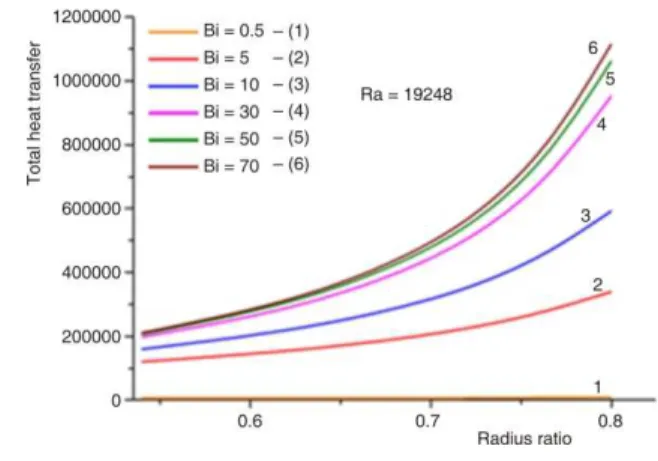
Heat flux vari a tions are plot ted in fig. 9, ac cord ing to the ra dius ra tio for the val ues of the Biot num ber be -tween 0.5 and 70 and a con stant Ray leigh num ber equal to 19248, tak ing into ac count ra di a tion heat trans fer. One no tices that for a Biot num ber equal to 0.5, the heat flux is low and al most con stant. It can also be noted that for Biot num bers be tween 5 and 70, for small val ues of the ra dius ra tio less than 0.55, the heat flux var ies be tween 0 and 1.5×10⁷, af ter which the heat flux in creases sig nif i cantly, along with the in crease in the ra dius ra tio.
When com par ing figs. 6 and 7 and figs. 8 and 9, one can see that when tak ing into ac count the ra di a tion heat trans fer, the dimensionless to tal heat flux evac u -ated from the PBMR core in creases and be comes more im por tant.
CON CLU SIONS
This work shows that the ra di a tion heat trans fer plays a ma jor role in the ex trac tion of heat from a Fig ure 7. Dimensionless heat flux vari a tions de pend ing
on the to tal ra dius ra tio for dif fer ent val ues of the Biot num ber and a num ber of the Ray leigh con stant equal to 15153, tak ing into ac count ra di a tion heat trans fer
Fig ure 8. Dimensionless vari a tions of the to tal heat trans fer as a func tion of the ra dius ra tio for dif fer ent val ues of the Biot num ber and for a Ray leigh num ber equal to 19248, re gard less of the radiation heat trans fer
Fig ure 9. Dimensionless heat trans fer vari a tions de pend ing on the ra dius ra tion for dif fer ent val ues of the Biot num ber of a Ray leigh num ber equal to 19248, tak ing into ac count ra di a tion ef fects
PBMR core, even more so if forced con vec tion is avoided. Ap plied to a PMBR, the heat flux through an an nu lar ge om e try filled with a po rous me dium de pends on sev eral pa ram e ters, such as the ra tio of the in -ner and outer ra dius of the an nu lus core (as dis cussed by Havstad and Burns [7], as well as by Badruddin et al. [10)]), and the mod i fied Ray leigh and Biot num bers. Ob tained re sults show that the to tal heat flux re moved from a PBMR core, with or with out the con sid -er ation of ra di a tion heat trans f-er, in creases when the Biot num ber in creases, as well as upon an in crease in the mod i fied Ray leigh num ber. On the other hand, if tak ing into ac count the ra di a tion heat trans fer, this sig -nif i cantly in creases the to tal heat flux re cov ered by the cool ant. This study shows that, for a po ros ity of 0.47, when us ing CO2 as a cool ant in a PBMR, the heat re -moved by the ra di a tion heat trans fer amounts to about 70% to 80 % of the to tal re moved heat. This ra di a tion heat trans fer rep re sents more than eight times the heat re moved by free con vec tion, mak ing CO2 a good gas cool ant in post shut down or emer gency sit u a tions. This tech nique of cool ing the PBMR core may be re -fined with time, af ter the po rous me dia con fig u ra tion un der goes an up grade.
AUHTOR CONTRIBUTIONS
The o ret i cal anal y sis was car ried out by all au -thors. All au thors ana lysed and dis cussed the re sults. The manu script was writ ten by T. Hassani, K. Sidi-Ali, and K. Oukil, and the fig ures were pre pared by Y. Amri and T. Hassani.
REF ER ENCES
[1] Dzung, L. S., A Cool ing Prob lem of Peb ble Bed Nu -clear Re ac tors, lnt. J. Heat Mass Trans fer, 1 (1960), 2-3, pp. 236-241
[2] Stroh, K. R., Jiacoletti, R. J., Olson, H. J., Ther malHy -drau lic Anal y sis Tech niques for Axisymmetric Peb ble Bed Re ac tor Cores, Nu clear En gi neer ing and De sign, 52 (1979), 3, pp. 343-347
[3] Kugeler, K., Phlippen, P. W., Schmidtlein, P., Swatoch, R., Pas sive Heat Re moval from the Core of Small and Me dium Sized Peb ble Bed Re ac tors, Nu -clear En gi neer ing and De sign, 136 (1992), 1-2, pp. 143-148
[4] Achenbach, E., Heat and Flow Char ac ter is tics of Packed Beds, Ex per i men tal Ther mal and Fluid Sci -ence, 10 (1995), 1, pp. 17-27
[5] Dudley, T., et al., The Ther mal-Hy drau lic Model for the Peb ble Bed Mod u lar Re ac tor (PBMR) Plant Op er -a tor Tr-ain ing Sim u l-a tor Sys tem, Nu clear En gi neer ing and De sign, 238 (2008), 11, pp. 3102-3113
[6] Kim, H., Lee, J. I., No, H. C., Ther mal Hy drau lic Be -hav ior in the De te ri o rated Tur bu lent Heat Trans fer Re gime for a Gas-Cooled Re ac tor, Nu clear En gi neer -ing and De sign, 240 (2010), 4, pp 783-795
[7] Havstad, M. A., Burns, P. J., Con vec tive Heat Trans -fer in Ver ti cal Cy lin dri cal Annuli Filled with a Po rous
Me dium, Int. J. Heat Mass Trans fer, 25 (1982), 11, pp. 1755-1766
[8] Talukdar, P., et al., Com bined Ra di a tion and Con vec -tion Heat Trans fer in a Po rous Chan nel Bounded by Iso ther mal Par al lel Plates, In ter na tional Jour nal of Heat and Mass Trans fer, 47 (2004), 5, pp. 1001-1013
[9] Badruddin, I. A., et al., Free Con vec tion and Ra di a -tion for a Ver ti cal Wall with Vary ing Tem per a ture Em bed ded in a Po rous Me dium, Int. J. of Ther mal Sci ences, 45 (2006), 5, pp. 487-493
[10] Badruddin, I. A., et al., Heat Trans fer by Ra di a tion and Nat u ral Con vec tion through a Ver ti cal An nu lus Em bed ded in Po rous Me dium., Int. Com mu ni ca tions in Heat and Mass Trans fer, 33 (2006), 4, pp. 500-507
[11] Singh, J., Hohn, H., Barnert, H., Ad vanced Peb ble Bed High Tem per a ture Re ac tor with Cen tral Graph ite Col umn for Fu ture Ap pli ca tions, Nu clear En gi neer -ing and De sign, 128 (1991), 3, pp. 383-390
[12] Bousri, A., Bouhadef, Kh., Nu mer i cal Study of Heat and Mass Transfer in a Cylinder Filled with a Porous Medium, Orig i nal title in French: Etude Numérique duTransfert de Chaleur et de Masse Dans un Cylindre Rempli d'un Milieu Poreux, Euro therm Sem i nar N°81 Re ac tive Heat Trans fer in Po rous Me dia, Albi, France, June 4-6, 2007
[13] Bories, S., Prat, M, Heat Transfer in Porous Me dia; Orig i nal title in French: Transfert de Chaleur Dans les Milieux Poreux, Tech niques de l'Ingénieur, Traité Génie Energétique, B8250, pp. 1-33, 1994
[14] Darby, R., Chem i cal En gi neer ing Fluid Me chan ics, 2nd edi tion, Dekker, New York, 2001
[15] Kaviany, M., Prin ci ples of Heat Trans fer in Po rous Me dia, 2nd ed, Springer-Verlag, New York, 1995
[16] KamdemTagne, H. T., Study of Heat Transfer in an Anisotropic Porous Medium, Application to Thermal Insulation in Silica Fiber, Orig i nal title in French: Etude du Transfert Thermique Dans un Milieu Poreux Anisotrope, Application Aux Isolants Thermiques en Fibre de Silice, Ph.D. thesis, INSA Lyon, France, 2008
[17] Boulet, P., Jeandel, G., Morlot, G., The o ret i cal Study of non Fibred Ma te rial In flu ence on the Ra di a tion Be -hav ior of Fibred In su la tors, Orig i nal ti tle in French: Etude Theorique de l'Influence des Infibres sur le Comportement Radiatif des Isolants Fibreux, Int. J. Heat Mass Trans fer, 39 (1996), 15, pp. 3221-3231
[18] Incropera, F. P., Fun da men tals of Heat and Mass Trans -fer, 6th ed., John Wiley & Sons, New York, USA, 2006
[19] Serth, R. W., Pro cess Heat Trans fer, Prin ci ples and Ap pli ca tions, Elsevier Sci ence and Tech nol ogy Books, 2007
[20] Venter, P. J., Mitch ell, M. N., In te grated De sign Ap proach of the Peb ble Bed Mod u lar Re ac tor Us ing Mod -els, Nu clear En gi neer ing and De sign, 237 (2007), pp. 1341-1353
[21] Jannot, Y., Heat Trans fer, Orig i nal ti tle in French: Transferts Thermiques, Nancy School of Mines, France, 2008
Kamel SIDI-ALI, Haled UKIL, Tininane HASANI, Jasmina AMRI, Abdelmuman ALEM
PROCENA PRENOSA TOPLOTE ZRA^EWEM U POROZNIM SREDINAMA Primena na modularni re aktor sa svernim gorivnim elementima hla|en ugqendioksidom
U radu se analizira doprinos prenosa toplote zra~ewem, hla|ewu modularnog reaktora sa svernim gorivnim elementima. Matemati~ki model razvijen za poroznu sredinu zasniva se na skupu jedna~ina primenqivom za kru`nu geometriju. U prethodnim va`nijim radovima o ovom predmetu, razmatran je model prinudne konvekcije, ~esto bez ura~unavawa prenosa toplote zra~ewem. Ovde se prou~ava slobodna konvekcija i prenos toplote zra~ewem, koji se javqaju tokom uklawawa zaostale toplote posle prestanka rada ili tokom vanrednog doga|aja. U nameri da se izvedu kqu~ne jedna~ine prenosa toplote zra~ewem, razmatrano je stacionarno stawe izotropne emisione sredine ugqendioksida. Dobijeni sistem jedna~ina zapisan je u bezdimenzijalnom obliku i potom re{en. Radi procene u~inka prenosa toplote zra~ewem na ukupnu uklowenu toplotu, sistem jedna~ina re{en je analiti~kim postupkom. Rezultati omogu}uju kvantifikovawe prenosa toplote, kako zra~ewem tako i slobodnom konvekcijom. U prou~avanom primeru modularnog reaktora sa svernim gorivnim elementima, pokazano je da se vi{e od 70% toplote uklawa prenosom toplote zra~ewem ukoliko je ugqendioksid kori{}en kao hladilac.
Kqu~ne re~i: prenos toplote, porozna sredina, modularni reaktor sa svernim gorivnim