Binding energies of excitons trapped by ionized donors in semiconductors
A. S. dos Santos,1Mauro Masili,2and J. J. De Groote3
1Instituto de Fı´sica de Sa˜o Carlos, Universidade de Sa˜o Paulo–USP, Caixa Postal 369, 13 560-970 Sa˜o Carlos, SP, Brazil 2
Associac¸a˜o de Escolas Reunidas–ASSER, Rua Miguel Petroni 5111, 13 563-470 Sa˜o Carlos, SP, Brazil
3Instituto de Quı´mica de Araraquara, Universidade Estadual Paulista–UNESP, Caixa Postal 355, 14 801-970 Araraquara, SP, Brazil
~Received 8 May 2001; published 26 October 2001!
Using the hyperspherical adiabatic approach in a coupled-channel calculation, we present precise binding energies of excitons trapped by impurity donors in semiconductors within the effective-mass approximation. Energies for such three-body systems are presented as a function of the relative electron-hole masssin the range 1<1/s<6, where the Born-Oppenheimer approach is not efficiently applicable. The hyperspherical approach leads to precise energies using the intuitive picture of potential curves and nonadiabatic couplings in anab initioprocedure. We also present an estimation for a critical value ofs(scrit) for which no bound state can be found. Comparisons are given with results of prior work by other authors.
DOI: 10.1103/PhysRevB.64.195210 PACS number~s!: 71.35.2y, 71.15.2m
I. INTRODUCTION
The existence of bound exciton complexes in semicon-ductors was predicted by Lampert1in 1958, and since then such systems have been theoretically and experimentally studied.2–12 Within the effective-mass approximation in which effective masses are attributed to both electron (me) and hole (mh), interacting through a Coulombian field in the semiconductor, Thomas and Hopfield4 used a Born-Oppenheimer approach to perform qualitative calculation of binding energies of such complexes in the presence of an impurity donor. These systems behave as three-body com-plexes, and the possibility of binding together depends on the electron-hole mass proportion. Thus the system can be ana-lyzed as a function of the ratios5me/mh. For small values of s the hole is much more massive than the electron, and the system behaves as a diatomic molecule. As s becomes larger, the number of vibrational binding energies decreases up to the point where there is only one stable state, with a very small binding energy. For values of s above a critical point calledcritical mass(scrit), the hole is no longer bound to the electron-impurity ‘‘atom.’’
The analysis of these D1X complexes for light holes is
very difficult due to the very small dissociation energy. The Born-Oppenheimer approach is inappropriate since the dis-tance between the hole and the impurity cannot be consid-ered an adiabatic variable. The independent particle approxi-mation is also difficult to apply due to the hole-impurity repulsive potential field, whose correlation effects are impor-tant. The variational approach, however, has been used by many authors5,7–9with precise results, but it lacks the intui-tive description and visibility of the methods previously cited. An alternative approach, i.e., the hyperspherical~HS! adiabatic method, has been used with efficiency to deal with systems with light holes.13–15 This method brings together the high precision aspect of the variational calculation with the potential curves intuitive picture. The HS treatment is based on the use of hyperspherical coordinates, which are defined to correlate the radial variables of the electron (re) and hole (rh) in an analogous way as the two-dimensional Cartesian coordinates are related to the polar coordinates.
For the D1X systems the HS coordinates are the hyper-radiusRand the hyperangle a, defined asR25mere
2 1mhrh
2 and tana5
As
re/rh. The hyperradius is the unique radial variable of the rewritten Schro¨dinger equation, while the hy-perangle a is compact. The original spherical variables are not changed by the coordinate transformation. The main ad-vantage of these new coordinates is thatRis a good adiabatic variable since it is related to the particles moment of inertia, which changes slowly ~adiabatically! compared to a. The adiabatic approach using the HS coordinates is developed similarly to the Born-Oppenheimer approximation for di-atomic molecules. For fixed values of R, taken as a param-eter, the angular part of the HS Schro¨dinger equation is solved. The outcome is a set of potential curves and channel functions which are the input for the obtaining of the nona-diabatic couplings; both potential curves and couplings are further used in the solution of the radial equations. The pro-cedure is ab initio and its simplest radial approximation, where all the nonadiabatic terms are neglected, is good enough to give the position of the binding energy within a 1% error. Moreover, as the couplings are introduced into the radial equations the calculated energy approaches the exact value in a systematic and controllable way.14 –19The HS adiabatic approach was introduced in atomic calculations by Macek20in the late 1960s for the qualitative study of resonant states of the helium atom. Since then it has evolved to become a very precise method,21–25,16 –18allowing the calculation of energies of the ground state up to highly excited states16,17 of atomic systems, as well as of general three-body problems.24 –27The method has also been applied to four-body systems.28 –37 The application of this method for bound excitons without the nonadiabatic couplings has given good qualitative results.13,14Recently15a HS coupled-channel calculation has been performed, proving that this method also leads to very accurate results, with precision comparable to the variational energy values found in litera-ture. Those results have been achieved for excitons bound to donor impurities in CdS@1/s55~Ref. 9!#and ZnSe@1/s56 ~Ref. 8!# semiconductors with a nonadiabatic calculation coupling only four hyperspherical radial channels.15
hyperspherical adiabatic approach to excitons bound to sin-gly ionized impurity donors within the range 1<1/s<6, which corresponds to systems with a unique binding energy, where the Born-Oppenheimer approach is not adequate. This range comprehends excitons for a large variety of semicon-ductors, like ZnSe ~1/s56!, CdS ~1/s55!, and CdSe @1/s
54.23~Ref. 12!#; it also allows a study of the system behav-ior as s approaches the region of critical mass, where the limit for the binding of these three-body systems is ap-proached. There does not exist a good consensus among dif-ferent calculations by others since it is necessary extremely precise wave functions in the region of the critical mass.
In Sec. II we outline the theoretical aspects of the hyper-spherical adiabatic approach and discuss the corresponding equations. In Sec. III the angular equation is solved to obtain the potential curves and channel functions, which are used for the calculation of the nonadiabatic couplings. In Sec. IV the results are discussed and Sec. V presents the conclusions.
II. HYPERSPHERICAL ADIABATIC APPROACH
Excitonic complexes within the effective-mass approxi-mation are represented by an electron and a hole with effec-tive mass me and mh, respectively, interacting through a Coulombian field and composing a hydrogenlike atom. In the presence of an impurity donor the system may form a bound three-body complex with the spectral characteristics pro-vided by the proportion between the electron and hole effec-tive masses. The Hamiltonian for such system in spherical coordinates is given by
Hˆ52 \ 2 2me
¹e22 \ 2 2mh
¹h22Ze 2
ere 1Ze
2
erh 2 e
2
eurWe2rWhu , ~1!
wheree is the dielectric constant of the semiconductor,Z is the effective atomic number of the impurity, and rWe andrWh are the radial coordinates of the electron and the hole with respect to the impurity, taken as the center of mass.
The properties of these systems can be analyzed in terms of s. As the value ofs decreases, the ground-state energy becomes lower and the vibrational levels are present, in a similar way as the diatomic spectral lines. As the hole effec-tive mass approaches the value of the electronic effeceffec-tive mass, the number of vibrational states decreases up to the point where s reaches scrit and no binding energy is ob-served. There is not an agreement in literature for the value ofscrit. One of the reasons for the disparities is that the hole wave function is very delocalized, requiring very precise nu-merical methods.
The hyperspherical coordinates are defined in terms of the radial spherical coordinates as
R5
A
mere 21mhrh
2 ~2!
and
a5tan21
S
As
rerh
D
. ~3!
This relation maps the set of six coordinates of the system
$re,rh,ue,fe,uh,fh% into a set with five angular coordi-nates and only one radial coordinate, $R,a,ue,fe,uh,fh% ~the spherical angles are not changed by the introduction of the hyperspherical coordinates!. Even for more complex sys-tems with more particles, the hyperspherical coordinates are constructed in such a way that they generate only one radial coordinate.38 This is very useful for the numerical develop-ment of the Schro¨dinger equation. Using arbitrary units (\5me5e2/e51) the Schro¨dinger equation rewritten in hy-perspherical coordinates is given by
S
]2]R21
Uˆ~R;V !11/4
R2 12E
D
~R5/2sinacosa!21C~
R;V !
50. ~4!
The angular operator Uˆ(R;V) contains all the angular vari-ables, i.e.,
Uˆ~R;V !5 ] 2
]a22
Lˆe2
sin2a2 Lˆh2
cos2a2RV
ˆ~ V !, ~5!
where V denotes the set of angular coordinates
$a,ue,fe,uh,fh% and
Vˆ~ V !52 2Z
sina1
2Z
A
scosa2
2
Asin
2a1scos2a
2
A
ssin 2acosueh~6!
contains the terms of the interaction potential, where cosueh5rˆe•rˆh. The operator Uˆ(R;V) can be written in a compact form as a function of the Casimir operator of the groupO(6),
Uˆ~R;V !5C2@O~6!#2RVˆ~ V !, ~7! which is useful in the classification scheme of the states.25 This equation shows explicitly the simple linear dependence of the angular operator with respect to the hyperradius, which suggests the adiabatic separation of the total wave function,
C~R;V !5
(
m Fm~R!Fm~R;V !, ~8! where the basis set is formed by eigenstatesFm(R;V) of the angular operator, i.e.,
num-bers$n,le,lh% of the solution atR50.20 Substituting expan-sion~8!into the Schro¨dinger equation, using the angular ei-genvalue Eq. ~9! and projecting into the basis set
$Fm(R;V)%, the following set of coupled radial equations is obtained:
S
d2 dR21Um~R!11/4
R2 12E
D
Fm~R!1
(
n
S
2Pmn~R!d
dR1Qmn~R!
D
Fn~R!50. ~10!
The couplings of this set of radial equations are the nonadia-batic couplings, namely
Pmn~R!5
K
FmU
d
dR
U
FnL
~11!and
Qmn~R!5
K
FmU
d2
dR2
U
FnL
. ~12!Equation ~10!is an infinite coupled set of equations for the radial amplitudes, which must be truncated in practical cal-culations.
At this point one of the fundamental reasons for the use of the hyperspherical adiabatic approach ~HAA! can be dis-cussed. The exact energy Eexact of the system is systemati-cally closer to the energy obtained by the solution of the truncated coupled equations as the number of couplings in-creases. This is the coupled adiabatic approximation~CAA!. Following the variational principle, this behavior determines an upper bound energy for the exact value. Now, unlike the variational approach, the crudest approximation in whichall
couplings are disregarded provides a lower bound energy for the exact value. That is the extreme uncoupled adiabatic ap-proximation ~EUAA!. This behavior can be summarized by the inequality39,40
EEUAA<Eexact<ECAA<EUAA, ~13! where the uncoupled adiabatic approximation ~UAA! is the approximation where only the diagonal nonadiabatic cou-pling is taken into account. The efficiency of the HAA is evident by observing that in the simple EUAA the lowest potential curve gives rise to a bound energy. In conjunction with the second approach~UAA!, which is also numerically simple, a well defined energy range is obtained, where the exact value is enclosed. The use of these two approaches is sufficient to predict the energy with an error of about 0.3% for the bound excitons considered in this paper. As more couplings are taken into account, the error drops as, for in-stance, for four coupled channels it will be of order of 0.01%. Another important characteristic is that the potential curves and nonadiabatic couplings are energy independent,
which means that once calculated, all bound states and con-tinuum solutions are obtained using Eq. ~10! with proper boundary conditions.
III. SOLUTION OF THE ANGULAR EQUATION: POTENTIAL CURVES
The angular Eq. ~9! contains all information about the particle interactions. Consequently, the efficiency of the hy-perspherical adiabatic approach depends upon the determina-tion of accurate potential curves and channel funcdetermina-tions, which are used in the nonadiabatic couplings and radial equations. The establishment of precise angular solutions is not an easy task due to the different contributions of particle interactions in the angular equation asRchanges.
At R50 the potential vanishes and consequently the an-gular function is distributed along the whole range of the hyperanglea. For large values ofRthe angular functions are localized arounda50, which corresponds to the wave func-tion of the electron bound to the impurity center, forming a hydrogenic atom, and the scattered hole.
For small values of R the angular solution behavior is similar to the exactR50 solution, given by the hyperspheri-cal harmonics,
Fnl
elh~0;V !5~sina!
le11~cosa!lh11P n
le11/2,lh11/2
3~cos 2a!Yl
elh L M~ V
e,Vh!, ~14! where Yl
elh L M(V
e,Vh) are the coupled two-body spherical harmonics and le,lh are the individual angular momentum quantum numbers of both electron and hole. The functions
Pna,b(z) are the Jacobi polynomials.41The exact eigenvalues of Eq.~9!atR50 are calculated by
Um~0!52~le1lh12n12!2. ~15! In the asymptotic limit (R→`) the potential curves be-have as20,42
2Um~R!
R2 52
Z2 Nm2
22~Z21!
R 1
Um(2)
R2 1. . . , ~16!
where the parameterNm is the principal quantum number of the hydrogenic impurity-electron system. For the lowest po-tential curve (m51), U1(2)5L(L11)21/2,42whereLis the total angular momentum of the system.
coefficients into an equation with rational coefficients, allow-ing the use of the Frobenius method. The resultallow-ing series convergence is very stable, precise, and numerically much faster than direct numerical methods. The angular function is then defined as
Fm~R;V !5
(
lelh~sina!le11~cosa!lh11e2ZRa/Nm
3GmLlelh~R,a!YlL Melh~ Ve,Vh!, ~17!
wherea52 tan21(x). The exponential term is introduced to obtain the correct asymptotic behavior and depends on pa-rameterNm. For small and large values ofRthe convergence of the channel function expansion in power series is very fast, which shows the importance of the analytical solution obtained from a single recurrence series.
The nonadiabatic couplings involve the first and second derivatives of the channel functions with respect to R, and consequently are very sensitive to any imprecision, espe-cially sensitive when the potential curves approach to each other. With the procedure used in this work to build the chan-nel functions, the nonadiabatic couplings become very stable. TheQmn(R)’s, which involve second derivatives and
are usually very small, are obtained numerically by standard five-point algorithms, but the Pmn(R)’s are calculated using the expression
Pmn~R!52
^
FmuVˆ~ V !uFn&
Um2Un
, UmÞUn, ~18!
which is much less sensitive to numerical fluctuations than the one which uses numerical derivatives. With the potential curves and nonadiabatic couplings determined it is then pos-sible to obtain the energy and the radial amplitudes Fm(R) by solving the radial equation. The solutions are obtained starting the numerical propagation of the radial functions from the analytical solutions at R;0, which involves logarithmic singularities,45,46 and matching with the func-tions propagated from the asymptotic region, as described in Ref. 15.
IV. RESULTS
This section presents the binding energies for excitons bound to impurities for systems with 1<1/s<6. Initially the precision of potential curves and nonadiabatic couplings as well as the accuracy of binding energies are analyzed.
The ground-state solutions for the bound excitons are
cal-TABLE I. Convergence of the point of minimum for the lowest potentialUm(R)/R2(m51) as a function
oflmax@see Eq.~17!#, for each mass ratio 1/s ranging from 1 to 6.
lmax\1/s 1 2 3 4 5 6
7 21.064 508 1 21.091 076 4 21.109 996 3 21.123 291 8 21.132 988 3 21.140 312 6 9 21.064 890 7 21.092 255 6 21.111 888 2 21.125 751 8 21.135 891 8 21.143 575 3 11 21.065 071 1 21.092 824 5 21.112 810 4 21.126 958 7 21.137 325 9 21.145 201 9 13 21.065 166 6 21.093 129 8 21.113 308 7 21.127 616 2 21.138 118 2 21.146 117 7 15 21.065 165 6 21.093 142 9 21.113 341 9 21.127 668 3 21.138 187 2 21.146 204 5 17 21.065 168 4 21.093 154 6 21.113 363 2 21.127 698 7 21.138 226 8 21.146 253 4 19 21.065 169 5 21.093 159 1 21.113 371 4 21.127 710 7 21.138 243 2 21.146 273 6 21 21.065 169 9 21.093 160 8 21.113 374 4 21.127 715 5 21.138 249 9 21.146 281 3 23 21.065 170 0 21.093 161 3 21.113 375 4 21.127 717 2 21.138 252 3 21.146 283 8
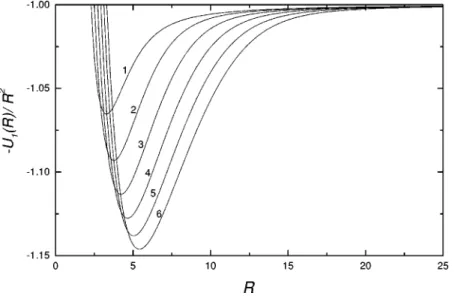
FIG. 1. The lowest potential curves for differ-ent values of 1/s(1, . . . ,6). The potential curves become deeper as the holes become heavier than the electrons, i.e., as 1/s increases. For the masses shown in this work these potential curves hold only one binding energy, but ass5me/mh
culated for total angular momentumL50, which means that the individual angular momentum for the electron and hole are given by le5lh5l. To obtain the angular solutions it is necessary to truncate the number of coupled components used in expansion~17!for the solution of the angular Eq.~9!, defining a maximum value for l5lmax. Figure 1 shows the lowest potential curves U1(R) divided by R2 for different values of 1/s, using lmax523. The convergence of these curves can be analyzed at their point of minimum with re-spect to the value of lmax, as listed in Table I. This table shows that a very good convergence for the minimum of the potential is achieved, which is the most difficult point to calculate. The first potential curve of each system is the most important one for our calculations since it contains the bound state energies. The remaining potential curves ~m52,3,4! were calculated using lmax513. This is an improvement of the calculation from Ref. 15 in which all potential curves have been calculated using lmax513. For small and large values of R the convergence is much faster, reflecting the appropriate choice of variable x5tan(a/2) to expand the channel functions and the introduction of the exact R
50 andR→` behavior in expansion~17!. One of the char-acteristics of these potential curves is the absence of vibra-tional levels. They support only a weak bound state, whose energy becomes smaller as s approaches the critical mass. Figure 1 also shows that the potentials become deeper as the mass ratio 1/sincreases from 1 to 6, allowing larger binding energies.
For the CdS semiconductor, in which the hole is five times heavier than the electron,9 the first four potential curves ~m51, . . . ,4! used in the calculation are shown in Fig. 2. Note the avoided-crossing region (R;11.5!between the curves withm53 andm54. In such region, the nonadia-batic couplings present peaks, where it is more difficult to calculate the channel functions. In practice, the peaks do not have a significative contribution for the calculation of the ground-state energy.
The hyperspherical adiabatic approach is appropriate for the energies calculation sinceRis a good adiabatic variable. This is reflected in the results shown in Table II, where the
binding energy can be estimated qualitatively in the simplest radial equation approximation @EUAA result, cf. Eq. ~13!#, where all nonadiabatic couplings are disregarded. Aside from the numerical work to solve the angular equation@Eq.~9!#to obtain the potential curves, the energies are easily obtained from a single one-dimensional second order radial differen-tial equation @Eq. ~10!#. In Table II we also compare the calculated energy using the EUAA with our best, four coupled-channel calculation @CAA result, cf. Eq. ~13!#. We see that the differences between our best values and the EUAA values are around only 1%, showing the accuracy of the method. For values of 1/s,2.5, there is not a binding energy in a coupled calculation, as we shall discuss further. A better result than the EUAA calculation is also obtained from a single differential equation, when the diagonal nonadia-batic couplingQ11(R) is taken into account@UAA result, cf. Eq. ~13!#. These two approximations restrict with upper and lower bounds the region where the exact energy is found. To further improve the results the nondiagonal nonadiabatic TABLE II. Comparison between the ground-state energy, ob-tained in the approximation where all nonadiabatic couplings are disregarded @EUAA result, cf. Eq. ~13!#, with our best coupled-channel calculation@CAA result, cf. Eq.~13!#in which it has been used for coupled radial equations. ED is the donor ground-state energy.
1/s (EEUAA2ED)/ED (%) (EEUAA2ECAA)/ECAA (%)
1.0 0.075
1.5 0.176
2.0 0.509
2.5 0.997 0.923
3.0 1.636 1.077
3.5 2.247 1.086
4.0 2.907 1.043
4.5 3.547 0.984
5.0 4.153 0.922
5.5 4.718 0.865
6.0 5.240 0.812
FIG. 2. The lowest four potential curves (m
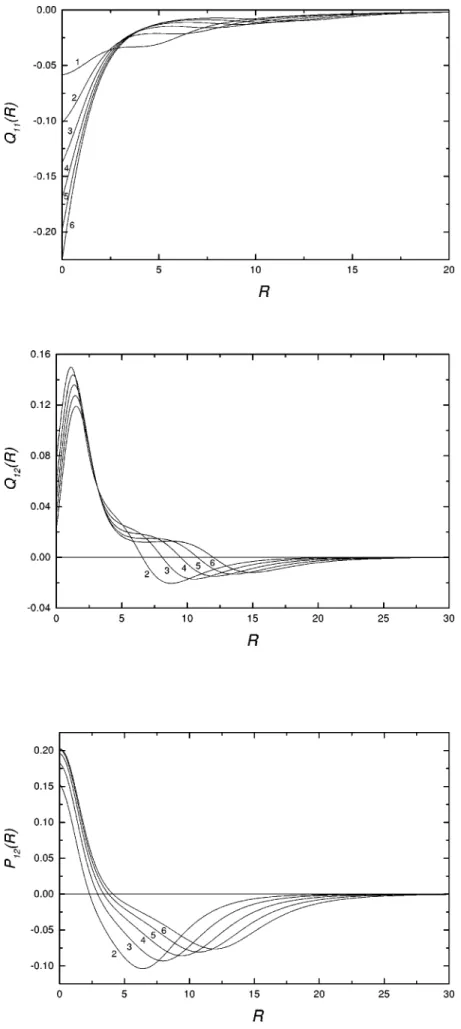
FIG. 3. Behavior of the diagonal nonadiabatic coupling Q11(R) for 1/s51, . . . ,6~from top to
bottom, at the origin!. The introduction of this function into the radial equation rises the lower bound energy obtained with only the first poten-tial curve to an upper bound energy, which is much more precise.
FIG. 4. Nonadiabatic couplings Q12(R) for
the mass relation 1/s52, . . . ,6~from bottom to top, at the peak region!. The nonadiabatic cou-plingsQmn(R) are the most difficult to be
calcu-lated as they involve the second derivative of the channel functions and demand the use of finite step derivatives. They are particularly unstable close to the avoided-crossing region of the poten-tial curves.
FIG. 5. The same as in Fig. 4 but for the
P12(R) couplings. These couplings involve the
couplings were calculated and the coupled radial equation for up to four coupled radial components were solved. Some significative samples of the couplings are shown in Figs. 3–5. The resulting energies from this procedure are listed in Table III and also shown in Fig. 6, where one can see how the binding energy as a function of 1/s converges as the number of coupled radial channel is increased. The highest curve in Fig. 6 corresponds to the calculation using the ex-treme uncoupled adiabatic approximation ~EUAA!, where only the potential curve U1(R) is considered in the radial equation. This curve defines a lower bound for the exact energy. The lowest curve represents the uncoupled approxi-mation ~UAA!, which adds the nonadiabatic diagonal cou-plingQ11(R) to the lowest potential curve. As the nonadia-batic couplings are taken into account the curve rises toward the exact energies. An interesting behavior observed in this figure is how the energy decreases when 1/sapproaches the region of the critical mass. One could expect that the energy would reach zero quasilinearly if the energies of 1/s<3 had not been calculated. In this case, the value for a critical mass
scritaround 1/scrit52.7 could be prematurely estimated. In-stead, the curve changes its curvature, which pushes the pre-dicted critical mass to a smaller value of 1/scrit. Our estima-tion for scrit in the one-channel approximation ~UAA! is close to 1/scrit52.32. This behavior is shown in the inset of Fig. 6. Table IV shows the comparison between our esti-mated value for scrit and those of other references. Large discrepancies among different authors can be found, where the majority of the calculations is based upon variational techniques. Our value for scrit is best compared with that from Skettrupet al.,9which have added a long-range tail to their variational trial function.
In Ref. 9 Skettrupet al.have listed experimental data for CdS ~1/s55! and ZnO ~1/s54.762!. For CdS, the experi-mental value for the difference between the bound-state en-ergy ~E! and the binding energy of the free exciton (Eex) ranges from 4.66 –7.10 meV. Their computed value for E
2Eex is 6.4 meV which compares with our best four coupled-channel calculation result of 6.437 meV. For ZnO,
E2Eex514.3 meV which is compared with our value of 14.453 meV. According to Ref. 9, the experimental value for ZnO ranges from 11.3 to 20.9 meV.
TABLE IV. Comparison between our estimated value for the critical mass scrit and those calculated by other authors. Our esti-mation has been done in the adiabatic, quasiseparable approxima-tion~UAA!.
Reference 1/scrit
Present work 2.32
Jiang~Ref. 13! 2.94
Ste´be´ and Stauffer~Ref. 47! 2.78 Skettrupet al.~Ref. 9! 2.35 Geltleret al.~Ref. 48! 0.75 Suffczynskiet al.~Ref. 8! 3.0 Sharma and Rodriguez~Ref. 7! 5.0 Frostet al.~Ref. 49! 2.62
Hopfield~Ref. 5! 1.4
FIG. 6. Energy of excitons bound to an impu-rity donor as a function of the relative electron-hole mass. The highest and lowest curves are the EUAA and UAA calculations, respectively. The other curve is a CAA calculation. In the inset one can see the curvature change for the UAA calcu-lation, whose estimation for 1/scrit52.32.
TABLE III. Convergence of the ground-state energy @(E
2ED)/ED (%)# as a function of number Nc of coupled radial equations @see Eq. ~10!# for some representative values of the mass relation 1/s. Both EUAA and UAA calculations use a single uncoupled radial equation. The EUAA calculation ~lower bound!
neglects all nonadiabatic couplings while the UAA calculation
~upper bound! only introduces the diagonal coupling Q11(R) @see
Eq.~13!#.
Nc\1/s 2.5 3.0 3.5 4.0 4.5 5.0 5.5 6.0
1a 0.997 1.636 2.247 2.907 3.547 4.153 4.718 5.240 1b 0.039 0.461 1.032 1.717 2.409 3.076 3.702 4.282 2 0.056 0.510 1.095 1.786 2.479 3.143 3.764 4.339 3 0.071 0.546 1.140 1.835 2.529 3.192 3.812 4.386 4 0.074 0.553 1.149 1.844 2.538 3.201 3.820 4.392
V. CONCLUSIONS
The adiabatic approach using hyperspherical coordinates has proved to be a precise, intuitive, and elegant procedure to analyze the weak binding energies of excitons bound to im-purity donor centers. An important aspect of the hyperspheri-cal adiabatic approach is: as the nonadiabatic couplings are introduced into the radial equations, the energy approaches the exact value. A demonstration of the appropriateness of the method is the determination of the energy using the sim-plest one potential curve approximation, with an error of only 1%, which is usually a good value for such solid-state excitonlike approximated systems. The precision was further improved by the inclusion of up to four potential curves and the corresponding nonadiabatic couplings in the radial equa-tions. The resulting energies can be compared with the most accurate variational results. One of the objectives of using high-precision calculation is to make possible a better analy-sis of the critical mass region.
This paper presented the calculations of the binding ener-gies of excitons bound to impurity donors for holes with six times the electron effective mass up to systems where s is close to the critical values. This treatment is a good
alterna-tive to the adiabatic molecular approaches, which are inap-propriate due to the small mass of the hole. The HAA is an
ab initio approach and uses the potential curve picture to locate the energies. It is more practical than a variational approach, especially considering that compared with the re-sults in literature, the rere-sults presented here have comparable precision and accuracy.
The improvement of our result for scritdemands a much more elaborated numerical work since the energy is very small. Nevertheless, such precision is not meaningful from a solid-state point of view since the errors of the effective-mass approximation are much more significant. Anyhow this is an interesting theoretical problem which may be better analyzed in more detailed studies.
ACKNOWLEDGMENTS
The authors would like to thank Fundac¸a˜o de Amparo a` Pesquisa do Estado de Sa˜o Paulo ~FAPESP, Brazil! for the financial support, under Processes No. 97/06271-1 and No. 99/11363-8. A.S.S. would also like to acknowledge the fi-nancial support from CNPq and Capes~Brazilian agencies!.
1M.A. Lampert, Phys. Rev. Lett.1, 450~1958!. 2J.R. Haynes, Phys. Rev. Lett.4, 361~1960!.
3D.G. Thomas and J.J. Hopfield, Phys. Rev. Lett.5, 505~1960!. 4D.G. Thomas and J.J. Hopfield, Phys. Rev.128, 2135~1962!. 5J. J. Hopfield, inProceedings of the Seventh International
Con-ference on the Physics of Semiconductors, Paris, 1964, edited by M. Hulin~Dundod, Paris, 1964!, p. 725.
6Y.S. Park, C.W. Litton, T.C. Collins, and D.C. Reynolds, Phys. Rev.143, 512~1966!.
7R.R. Sharma and S. Rodriguez, Phys. Rev.153, 823~1967!. 8M. Suffczynski, W. Gorzkowski, and R. Kowalczyk, Phys. Lett.
24A, 453~1967!.
9T. Skettrup, M. Suffczynski, and W. Gorzkowski, Phys. Rev. B 4, 512~1971!.
10S.G. Elkomoss and A.S. Amer, Phys. Rev. B
11, 2222~1975!. 11M. Suffczynski and L. Wolniewicz, Phys. Rev. B
40, 6250
~1989!.
12A.C. Cancio and Y.-C. Chang, Phys. Rev. B47, 13 246~1993!. 13T.-F. Jiang, Solid State Commun.74, 899~1990!.
14J.J. De Groote, J.E. Hornos, H.T. Coelho, and C.D. Caldwell, Phys. Rev. B46, 2101~1992!.
15J.J. De Groote, A.S. dos Santos, M. Masili, and J.E. Hornos, Phys. Rev. B58, 10 383~1998!.
16M. Masili, J.E. Hornos, and J.J. De Groote, Phys. Rev. A52, 3362
~1995!.
17J.J. De Groote, M. Masili, and J.E. Hornos, J. Phys. B
31, 4755
~1998!.
18M. Masili, J.J. De Groote, and J.E. Hornos, J. Phys. B33, 2641
~2000!.
19J.J. De Groote, M. Masili, and J.E. Hornos, Phys. Rev. A 62, 032508~2000!.
20J.H. Macek, J. Phys. B1, 831~1968!.
21U. Fano, Phys. Today29~9!, 32~1976!. 22C.H. Greene, Phys. Rev. A23, 661~1981!.
23J.E. Hornos, S.W. MacDowell, and C.D. Caldwell, Phys. Rev. A 33, 2212~1986!.
24H.T. Coelho, J.J. De Groote, and J.E. Hornos, Phys. Rev. A46, 5443~1992!.
25C.D. Lin, Phys. Rep.257, 1~1995!, and references therein. 26C.D. Lin and X.H. Liu, Phys. Rev. A37, 2749~1988!.
27J.Z. Tang, S. Watanabe, and M. Matsuzawa, Phys. Rev. A46, 2437~1992!.
28C.W. Clark and C.H. Greene, Phys. Rev. A
21, 1786~1980!. 29C.H. Greene and C.W. Clark, Phys. Rev. A
30, 2161~1984!. 30C.H. Greene, Phys. Rev. A
22, 149~1986!. 31C.G. Bao and C.D. Lin, Few-Body Syst.
16, 47~1994!. 32X. Yang, J. Xi, C.G. Bao, and C.D. Lin, Phys. Rev. A
52, 2029
~1995!.
33X. Yang, C.G. Bao, and C.D. Lin, Phys. Rev. Lett. 76, 3096
~1996!.
34T. Morishita, O.I. Tolstikhin, S. Watanabe, and M. Matsuzawa, Phys. Rev. A56, 3559~1997!.
35T. Morishita and C.D. Lin, J. Phys. B
31, L209~1998!. 36T. Morishita and C.D. Lin, Phys. Rev. A57, 4268~1998!. 37T. Morishita and C.D. Lin, Phys. Rev. A59, 1835~1999!. 38Yu.F. Smirnov and K.V. Shitikova, Fiz. Elem. Chastits At. Yadra
8, 847~1977! @Sov. J. Part. Nucl.8, 344~1977!#. 39A.F. Starace and G.L. Webster, Phys. Rev. A
19, 1629~1979!. 40H.T. Coelho and J.E. Hornos, Phys. Rev. A43, 6379~1991!. 41Handbook of Mathematical Functions, 3rd ed., edited by M.
Abramowitz and I. A. Stegun~Dover, New York, 1965!. 42Z. Zhen and J. Macek, Phys. Rev. A
34, 838~1986!.
44Y.D. Wang and J. Callaway, Phys. Rev. A
48, 2058~1993!. 45J.H. Bartlett, Phys. Rev.51, 661~1937!.
46V.A. Fock, Izv. Akad. Nauk SSSR, Ser. Fiz.18, 161~1954!. 47B. Ste´be´ and L. Stauffer, in Proceedings of the Fourth
Inter-national Conference on Superlattices, Microstructures, and
Microdevices, Trieste, 1988.
48T.H. Geltler, H.B. Snodgrass, and L. Spruch, Phys. Rev.172, 110
~1968!.
49A.A. Frost, M. Inokuti, and J.P. Lowe, J. Chem. Phys.41, 482