v. 22, n. 1, p. 7-15, jan./mar. 2011
THERMOANALYTICAL STUDY OF NATIVE CASSAVA
STARCH AND TREATED WITH HYDROGEN PEROXIDE*
Fernanda Janaína Oliveira Gomes da COSTA** Rafael Ramirez de ALMEIDA** Luiz Gustavo LACERDA*** Marco Aurélio da Silva CARVALHO-FILHO*** Gilbert BANNACH**** Egon SCHNITZLER*****
* Research carried out with fi nancial support from CNPq and CAPES.
** Program of Post-Graduation in Science and Food Technology – Master’s Degree – Ponta Grossa State University – UEPG –– 84030-900 – Ponta Grossa – PR – Brasil.
*** Analytical Central – Positivo University – 81280-330 – Curitiba – PR – Brasil.
**** Chemistry Department – Faculty of Science – UNESP – 17033-360 – Bauru – SP – Brasil.
***** Chemistry Department, Science and Food Tecnology – UEPG –– 84030-900 – Ponta Grossa – PR – Brasil. E-mail: [email protected].
ABSTRACT: Starch is one of the most important sources of reserve of carbohydrate in plants and the main source in the human diet due to its abundance in the nature. There no other food ingredient that can be compared with starch in terms of sheer versatility of application in the food industry. Unprocessed native starches are structurally too weak and functionally too restricted for application in today’s advanced food and industrial technologies. The main objective of this study was to compare the thermal behavior of native cassava starch and those treated with hydrogen peroxide, as well as those treated with hydrogen peroxide and ferrous sulfate. The cassava starch was extracted from cassava roots (Manihot esculenta, Crantz) and treated by standardized hydrogen peroxide (H2O2) solutions at 1, 2 and 3% (with or without FeSO4). Investigated by using they are thermoanalytical techniques: thermogravimetry - TG, differential thermal analysis – DTA and differential scanning calorimetry - DSC, as well as optical microscopy and X-ray powder diffractometry. The results showed the steps of thermal decomposition, changes in temperatures and in gelatinization enthalpy and small changes in crystallinity of the granules.
KEYWORDS: Starch; cassava; hydrogen peroxide; thermal analysis.
INTRODUCTION
Starch granules are made of glucose polymers, named amylose and amylopectin and they are found inside the vegetable cells from where they are extracted and treated for the industrial applications by food, textile, pulp and paper industry. These glucose polymers that make up the starch come in two molecular forms, linear and branched. The fi rst is referred to as amylose and the latter as amylopectin. Amylose, mostly a linear chain,
typically consists up to 3,000 anhydroglucose units (AGU) interconnected primarily by α-1.4 glycosidic linkages and is reported that it contains a few branched networks.5, 11
The selection of the starch for industrial uses is made considering its availability and also its physicochemical characteristics that vary depending on the source. 10, 13
Cassava (Manihot esculenta, Crantz) is an important vegetable crop in tropical regions where on a food energy production basis, it is ranked forth after rice, wheat and corn as source of complex carbohydrates.4, 12 the typical
composition of cassava root is moisture (70%), starch (24%), fi ber (2%), protein (1%) and other substances including lipids and minerals (3%). The cassava starch has special technological properties, wich allow its utilization in many industrial applications. Among these properties, there are the absence of the typical “cereal fl avor” of corn and other cereal starches, its ability of higher swelling degree during cooking, and its lower pasting temperature, if compared again with cereal starches. Its low protein and lipid contents must also be valued contributing to its neutral fl avor and white color. 6, 16, 17
Starches may be oxidized by different chemicals as sodium hypochlorite, 9 bromine, 14 potassium and ammonia
persulphate, 8 potassium permanganate17 and hydrogen
peroxide. 7
The oxidation process aims to introduce carbonyl and carboxyl groups which increases clarity and reduces retrogradation of cooked starch pastes providing lower viscosity and low temperature stability. 3, 6
When starch is heated in the presence of enough water, its crystalline organization decomposes to form amorphous regions. This molecular disordering is called gelatinization and is frequently observed as endothermic phenomenon using differential scanning calorimetry (DSC).11 Thermogravimetry can be helpful to show
depolymerization.2, 15 X-ray diffraction powder has been
also used to study the starch granules structural changes.1
There are few papers about modifi ed starches considering their thermoanalyticalbehavior due to the fact that starch studies are often developed by private companies. They produce highly valued and specialized modifi ed starches for several industrial applications, especially for the food sector.
The objective of this work was to evaluate by thermoanalytical techniques cassava natural and oxidized starches aiming to understand their behavior when treated with hydrogen peroxide in the presence and absence of ferrous sulphate. The thermogravimetry (TG), differential thermal analysis (DTA) and differential scanning calorimetry (DSC), as well as optical microscopy and X-ray powder diffractometry, were used to describe selected properties of the cassava starches.
MATERIAL AND METHODS
Hydrogen peroxide and other chemicals used in this study were analytical reagent grade (Merck). Cassava starch was extracted in laboratory according to the literature: 4 Cassava roots were washed, peeled, milled,
sieved and the mash was washed. The solid was retained on the sieve (200 mesh) and the suspension kept for two hours decanting; then the starch was fi ltered, washed and dried in an oven at 35ºC. The obtained cassava starch was maintained in a desiccator over anhydrous calcium chloride until constant mass (sample “a”).
Solutions of hydrogen peroxide (perhydrol at 30%) were prepared at 1, 2 and 3% (v/v) and standardized by iodometric method. In each ten grams (10.0g) of the obtained cassava starch was added at 50.0mL of H2O2 at 1, 2 or 3% (samples “b”, “c” and “d”, respectively), and stirred for 15 minutes (magnetic stirrer); after this time each suspension was fi ltered, washed, dried at room temperature and kept in a desiccator over anhydrous calcium chloride until constant mass.
Solutions of hydrogen peroxide (perhydrol at 30%) were prepared at 1, 2 and 3% (v/v) and standardized by iodometric method. In each ten grams (10.0g) of the obtained cassava starch was added at 50mL of standard H2O2 at 1, 2 or 3% and 0.01% of FeSO4 (samples “e”, “f” and “g”, respectively). Each suspension was stirred by 15 minutes. After this time each one was fi ltered, washed, dried at room temperature and kept in a desiccator over anhydrous calcium chloride until constant mass. The samples treated with H2O2 and FeSO4 showed rapid darkening what was not noticed for the starch treated only with H2O2.
Thermal Analysis
TG and DTA curves were registered using a simultaneous TG 60 system (Shimadzu) under an air fl ow at 100mL min-1 and at a heating rate of 10°C min-1. Alumina
crucibles were used for the TG and DTA experiments.
Mass and baseline calibrations were realized according to manufacturer and an empty alumina crucible was used as reference.
DSC curves were registered using a DSC 60 (Shimadzu) under an air fl ow at 100mL min-1, and heating
rate of 3°C min-1. A 4:1 (8μL of water: 2 mg of starch).
The mixture was prepared and left for two hours in order to equilibrate the moisture content. Sealed aluminum crucibles were used and the studies were carried out in order to study the gelatinization. For the DSC curves, the instrument was calibrated with indium, and an empty aluminum crucible was used as reference. The characteristics of the transitions, including onset temperature (To), peak temperature (Tp) and gelatinization enthalpy (ΔH
gel) were calculated.
Microscopy
Microscopy analysis was carried out using a stereoscopic microscope (Olympus SZX9), with polarizing
fi lter and camera (Cybernetic’s Cool Snap Pro Color). The photographs were identifi ed and scaled using Image Pro Plus.
X Ray Diffraction
X-ray powder patterns were obtained by using a model D-5000 X-Ray diffractometer (Siemens), with Cu Kα radiation (λ = 1,544 Å) and a setting of 40kV and
20mA.
All the experiments, including the extraction of starch, thermal methods and X ray diffractometry were made in triplicate.
RESULTS AND DISCUSSION Thermal Analysis
The TG curve of the obtained and untreated cassava starch is shown in the Figure 1a, the treated cassava starches with H2O2 (1, 2 or 3%) are shown in the Figures 1b-d and the treated cassava starches with H2O2 (1, 2 or 3%) each with FeSO4 0.01 % are in the Figures 1e-g.
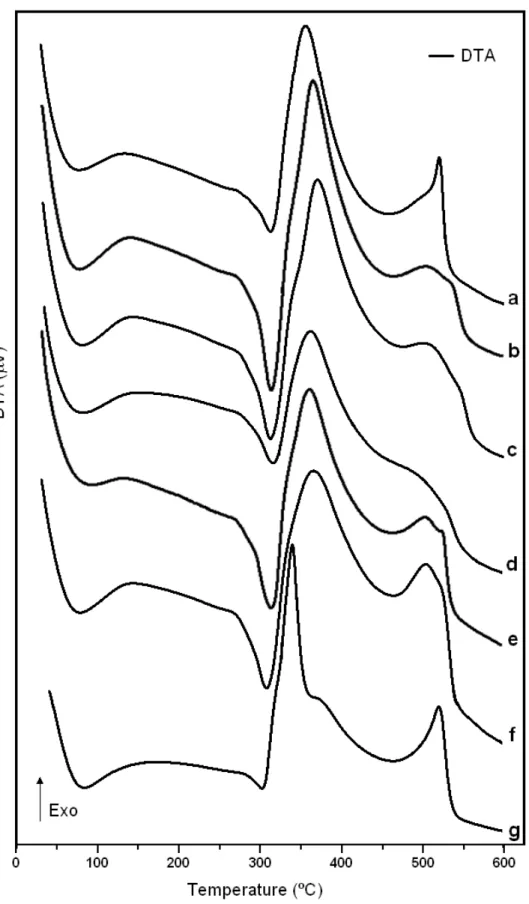
These curves showed mass losses in three steps and thermal events corresponding to these losses. A great similarity is observed in the DTA profi les, as shown in the Figures 2a-g.
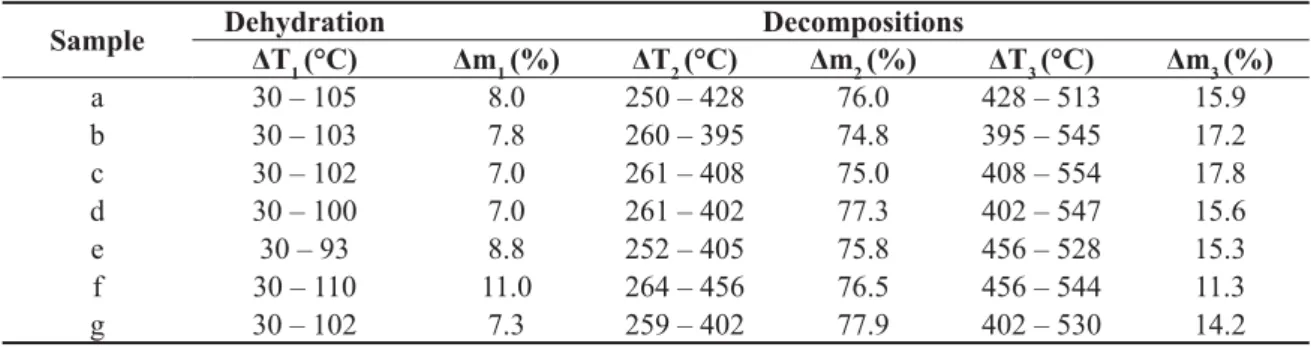
The TG of the obtained cassava starch (Figure 1a) showed mass losses in three steps and thermal events corresponding to these losses. The fi rst mass loss was between 30 – 105oC (8.0 %) corresponding to the
endothermic peak at 70oC (Figure 1a), which is attributed
to the dehydration that occurs in a single step (Figure 2a). Once dehydrated, the compound is stable up to 250oC and
above this temperature the thermal decomposition occurs in two consecutive and/or overlapping steps between 250 and 513oC. The fi rst mass loss (76%) of the anhydrous compound
endothermic peak at 304ºC without oxidative process and exothermic at 355ºC with oxidative process. The last mass loss (15.9%) was between 428 – 513ºC corresponding to the sharp exothermic peak, ascribed to the oxidation of the organic matter.
The TG of the obtained cassava starches treated with standard H2O2 solutions at 1, 2 or 3% are shown in the Figures 1 b–d, respectively. It can be observed mass losses in three main steps and four thermal events corresponding
to these losses. The fi rst mass loss (7.8%), occurs between 30–103oC (Figure 1b), 30 – 102oC (7.0%) (Figure 1c) and
30 – 100oC (7.0%) (Figure 1d), which are attributed to the
dehydration that occurs in a single step corresponding to the endothermic peaks at 71, 70 and 70ºC, respectively (Figures 2 b-d).
Once dehydrated, the compounds are stable up to 260, 261 and 261oC, respectively, and above this temperature
the thermal decomposition occurs in two consecutive and/ FIGURE 1 – TG curves of the studied cassava starches – (a) untreated; (b) treated with
or overlapping steps between 260 – 545oC (Figure 1b),
261 - 554ºC (Figure 1c) and 261 – 547ºC (Figure 1d). The fi rst mass loss (74.8%) of the anhydrous compound (Figure 1b) observed between 260 – 395ºC corresponding to the endothermic peak at 311ºC and exothermic at 357ºC (Figure 2b), which are attributed to the thermal decomposition that occurs initially without oxidative process followed by oxidative process. The last mass loss (17.2%), between 395 – 545ºC corresponding to the exotherm is ascribed to the slow oxidation of the organic matter.
The fi rst mass loss (75.0%) of the anhydrous compound (Figure 1c) observed between 261 – 408ºC corresponding to the endothermic peak at 307ºC and exothermic at 365ºC (Figure 2c), which are attributed to the thermal decomposition that occurs initially without oxidative process followed by oxidative process. The last mass loss (17.8%), between 408 – 554ºC corresponding to the exotherm is ascribed to the slow oxidation of the organic matter.
The fi rst mass loss (77.3%) of the anhydrous compound (Figure 1d) observed between 261 – 402ºC corresponding to the endothermic peak at 311 and exothermic at 357ºC (Figure 2d), which are attributed to the thermal decomposition that occurs initially without oxidative process followed by oxidative process. The last mass loss (15.6%), between 402 – 547ºC corresponding to the shoulder exotherm is ascribed to the very slow oxidation of the organic matter.
The TG of cassava starch treated with standard H2O2 solutions at 1, 2 or 3% and 0.01% of FeSO4 are shown in Figures 1 e-g, respectively. It can be observed mass losses in three main steps and four thermal events corresponding to these losses.
The fi rst mass loss (8.8%) occurs between 30 – 93oC
(Figure 1e), 30 – 110oC (11.0%) (Figure 1f) and 30 – 102oC
(7.3%) (Figure 1g), corresponding to the endothermic peaks at 73oC, 64ºC and 73ºC respectively (Figures 2e-g), which
are attributed to the dehydration that occurs in a single step. Once dehydrated, the compounds are stable up to 252, 264 and 259oC, respectively, and above this temperature the
thermal decomposition occurs in two consecutive and/or overlapping steps between 252–528oC, Figure 1e, 264 -
544ºC (Figure 1f) and 259 – 530ºC (Figure 1g).
The fi rst mass loss (75.8%) of the anhydrous compound (Figure 1e) observed between 252 – 405ºC corresponding to the endothermic peak at 314 and exothermic at 362ºC (Figure 2e), which are attributed to the thermal decomposition that occurs initially without oxidative process followed by oxidative process. The last mass loss (15.3%), between 456 – 528ºC corresponding to the exotherm at 504ºC is ascribed to the slow oxidation of the organic matter.
The fi rst mass loss (76.5%) of the anhydrous compound (Figure 1f) observed between 264 – 456ºC corresponding to the endothermic peak at 309 and exothermic at 360ºC, (Figure 2f), which are attributed to the thermal decomposition that occurs initially without oxidative process followed by oxidative process. The last mass loss (11.3%), between 456–544ºC corresponding to the exotherm at 500ºC is ascribed to the oxidation of the organic matter.
The fi rst mass loss (77.9%) of the anhydrous compound (Figure 1g) observed between 259–402ºC corresponding to the endothermic peak at 286 and exothermic at 326ºC (Figure 2g) which are attributed to the thermal decomposition that occurs initially without oxidative process followed by oxidative process. The last mass loss (14.2%), between 402 – 530ºC corresponding to the exothermic peak at 506ºC is ascribed to the oxidation of the organic matter. All the thermal events are shown in the Table 1.
The fi nal mass of the residues of each sample were: a = 0.11%, b = 0.12%, c = 0.15%, d = 0.16%, e = 0.33%, f = 0.35% and g = 0.39%.
The energy required for the molecular order disruption in the starches differs in the botanical source, thus, the gelatinization occurs in a temperature range rather than at a defi nite temperature. 6
The DSC curves of the studied samples are shown in the Figure 3 and the experimental values obtained for the onset temperature (To), peak temperature (Tp) and gelatinization enthalpy (ΔH
gel) are shown in the Table 2.
Somehow, the DSC curves showed that the onset temperatures (To) were only higher for the starch samples treated with H2O2 at 2 and 3%, containing FeSO4. The peak temperature (Tp), was higher only for the untreated starch at 58ºC and maintained at 57ºC for all the treated starches. The gelatinization enthalpies of the treated samples were lower than those of the untreated starch.
Table 1 – Temperature ranges and mass losses observed for each step of the TG curves.
Sample Dehydration Decompositions
ΔT1 (°C) Δm1 (%) ΔT2 (°C) Δm2 (%) ΔT3 (°C) Δm3 (%)
a 30 – 105 8.0 250 – 428 76.0 428 – 513 15.9
b 30 – 103 7.8 260 – 395 74.8 395 – 545 17.2
c 30 – 102 7.0 261 – 408 75.0 408 – 554 17.8
d 30 – 100 7.0 261 – 402 77.3 402 – 547 15.6
e 30 – 93 8.8 252 – 405 75.8 456 – 528 15.3
f 30 – 110 11.0 264 – 456 76.5 456 – 544 11.3
Microscopy
Cassava presented regular morphology confi rming what was previously observed by other researchers. 6 The
microscopic study of the morphological alterations of
the granules was made with each sample and showed no
apparent differences in their shape and size, Figure 4. FIGURE 3 – DSC curves of cassava starch granules: (a) untreated; (b, c and d) treated with
H2O2 at 1, 2 and 3% respectively; (e, f and g) treated with H2O2 at 1, 2 and 3% containing FeSO4 at 0.01%.
Table 2 – Obtained values of onset temperature (To), peak tempera-ture (Tp) and gelatinization enthalpy (∆H gel).
Sample T0 (°C) Tp (°C) ΔHgel (J g-1)
a 53 59 3.05
b 53 58 2.19
c 53 58 2.33
d 53 58 2.39
e 53 58 2.23
f 54 58 2.27
(a) (b) (c)
FIGURE 4 – Photomicrograph of: (a) untreated cassava starch; (b) cassava starch treated with standard H2O2 at 3%, (c) cassava starch treated with standard H2O2 at 3% and FeSO4 at 0.01%. Magnifi cation 400X.
X-ray Diffraction
X-ray diffraction studies proved that the modifi ed starches showed change in crystallinity, as shown in the Figure 5. Starches tend to present pertinent crystalline arrangements depending on their botanical origin.6,11
Native cassava starch had a typical B-type X-ray diffraction pattern. The tuberous starch pattern are recognized by the intensity of the corresponding band to one small peak at 2 θ = 5.5°; doublet at 2 θ = 17° and one
doublet at 2 θ = 22 and 24°. X-ray diffraction patterns of cassava starch are shown in Figure 5a. Thus native cassava starch displayed a doublet at 17 and 18° and a single peak at 2 θ = 23°. In addition, after modifi cation, we observed
lower intensity of diffraction peaks with concentration increase of H2O2, and mainly with addition of FeSO4.
CONCLUSIONS
All the TG curves showed similarity with mass loss in three steps. Signifi cant difference is observed in DTA profi les, especially in starches after the treatment with H2O2 and H2O2 with FeSO4. The DSC curves allowed us to determine the onset temperature, peak temperature and gelatinization enthalpy. All the values of peak temperature (Tp) and gelatinization enthalpy (ΔH
gel) of the treated
starches were lower than those untreated.
The major quantity of fi nal product of the treated starches with H2O2 and FeSO4 was attributed to incorporation of the iron at the starch. Maintained all the experimental conditions (starch extraction, treatment of each sample and equipments calibrations and parameters) the results are reproductive. X-ray diffraction confi rmed the characteristic of native pattern and the decrease of intensity of main peaks suggesting that the crystallinity has little infl uence of the treatment.
COSTA, F. J. O. G.; ALMEIDA, R. R.; LACERDA, L. G.; CARVALHO-FILHO, M. A. S.; BANNACH, G.; SCHNITZLER, E. Estudo termoanalítico do amido de mandioca nativo e tratado com peróxido de hidrogênio.
Alim. Nutr., Araraquara, v. 22, n. 1, p. 7-15, jan./mar. 2011.
RESUMO: O amido é uma das mais importantes fontes de reserva de carboidratos nas plantas e também a princi-pal fonte destes compostos na dieta humana, devido à sua abundância na natureza. Nenhum outro ingrediente alimen-tício se compara ao amido em termos de sua versatilidade de aplicações industriais. Entretanto, os amidos nativos são estruturalmente fracos e de aplicações muito restritas nas tecnologias industriais, sendo necessárias modifi cações. O principal objetivo deste estudo foi a comparação entre o comportamento térmico do amido de mandioca nativo e os tratados com peróxido de hidrogênio, bem como aqueles
tratados com peróxido de hidrogênio e sulfato de ferroso. O amido de mandioca foi extraído das raízes de Manihot esculenta, Crantz e tratado por soluções padronizadas de peróxido de hidrogênio (H2O2) em concentrações a 1, 2 e 3% (com ou sem FeSO4) e investigados utilizando as técni-cas termoanalítitécni-cas: termogravimetria - TG, análise térmica diferencial – DTA e calorimetria exploratória diferencial - DSC, bem como microscopia óptica e difração de raios-X pelo método do pó. Os resultados obtidos permitiram
veri-fi car etapas da decomposição térmica, alterações nas tem-peraturas e entalpias de gelatinização e pequenas modifi ca-ções na cristalinidade dos grânulos.
PALAVRAS-CHAVE: Amidos; mandioca; peróxido de hidrogênio; análise térmica.
REFERENCES
AGGARWALL, P.; DOLLIMORE, D. A thermal 1.
analysis investigation of partially hydrolyzed starch.
Thermochim. Acta, v. 319, p. 17-25, 1998.
AGGARWALL, P.; DOLLIMORE, D.; HEON
2. , K.
Comparative thermal analysis study of two biopolymers, starch and cellulose. J. Thermal Anal., v. 50, p. 7-17, 1997.
APLEVICZ, K. S.; DEMIATE, I. M. Caracterização de 3.
amidos de mandioca nativos e modifi cados e utilização em produtos panifi cados. Ciênc. Tecnol. Aliment., v. 27, n. 3, p. 478-484, 2007.
BELEIA, A.; BUTARELO, S. S.; SILVA, R. S. F. 4.
Modeling of starch gelatinization during cooking of cassava (Manihot esculenta, Crantz) Lebensm.-Wiss. u-Technol., v. 39, p. 399-404, 2006.
BENINCA, C. et al. Thermal behavior of corn starch 5.
granules modifi ed by acid treatment at 30 and 50ºC.
Ecl. Quím., v. 33, n. 3, p. 13-18, 2008. CEREDA, M. P. et al.
6. Tecnologia, usos e potencialidades de tuberosas amiláceas latino americanas. São Paulo: Fundação Cargill, 2003. cap. 12, p. 246-332.
DEMIATE, I. M. et al. Relationship between baking 7.
behavior of modifi ed cassava starches and starch chemical structure determined by FTIR spectroscopy.
Carbohydr. Polym., v. 42, p. 149-158, 2000.
HARMON, R. E.; GUPTA, S. K.; JOHNSON, J. 8.
Oxidation of starch catalyzed by persulfate. Starch-Stärke, v. 23, n. 6, p. 197-199, 2006.
KUAKPETOON, D.; WANG, Y.-J. Structural 9.
characteristics and physicochemical properties of oxidized corn starches varying in amylose content.
Carbohydr. Res., v. 341, p. 1896-1915, 2006.
LACERDA, L. G. et al. Thermal characterization 10.
of partially hydrolyzed cassava (Manihot esculenta)
LACERDA, L. G. et al. Thermal behavior of corn starch 11.
granules under action of fungal α-amylase. J. Therm. Anal. Cal., v. 93, n. 2, p. 445-449, 2008.
LACERDA, L. G. et al. Thermoanalytical and starch 12.
content evaluation of cassava bagasse as agro-industrial residue. Braz. Arch. Biol. Technol., v. 52, n. esp., p. 143-150, 2009.
MATSUGUMA, L. S. et al. Characterization of native 13.
and oxidized starches of two varieties of Peruvian carrot (Acacia xanthorriza, B.) from two production areas of Paraná state, Brazil. Braz. Arch. Biol. Technol., v. 52, n. 3, p. 701-713, 2009).
MUHRBECK, P.; ELIASSON, A.C.; SALOMONSSON, 14.
A–C. Physical characterization of bromine oxidized potato starch. Starch-Starke, v.42, p. 418-420, 1990.
RUDNIK, E. et al. Thermal stability and degradation 15.
of starch derivatives. J. Therm. Anal. Cal., v. 85, p. 267-270, 2006.
TAKIZAWA, F.F. et al. Characterization of tropical 16.
starches modified with potassium permanganate and lactic acid. Braz. Arch. Biol. Technol., v. 47, p. 921-931, 2004.
WURZBURG, O. B.
17. Modifi ed starches: properties and uses. Boca Raton: CRC, 1989. 277 p.
Recebido em: 22/07/2010