ISSN 0104-6632 Printed in Brazil
Brazilian Journal
of Chemical
Engineering
Vol. 21, No. 02 pp. 203 - 209, April - June 2004
CHARACTERIZATION OF STEAM-REFORMING
CATALYSTS
D. C. R.M. Santos
1, J. S. Lisboa
1, F. B. Passos
1*and F. B. Noronha
2 1Departamento de Engenharia Química, Universidade Federal Fluminense (UFF), Phone: +(55) (21) 26295600, Fax: +(55) (21) 2717-4446, Rua Passo da Pátria 156, 24210-240, Niterói - RJ, Brazil.
E-mail: [email protected]
2
Instituto Nacional de Tecnologia (INT), Laboratório de Catálise, Phone: +(55) (21) 2123-1163, Fax: +(55) (21) 2123-1164, Av. Venezuela 82, 20084-310, Rio de Janeiro - RJ, Brazil.
E-mail:[email protected]
(Received: February 13, 2003 ; Accepted: December 15, 2003)
Abstract - The effect of the addition of Mg and Ca to Ni/D-Al2O3 catalysts was studied, aiming to address
their role as promoters in the steam reforming reaction. Temperature-programmed reduction and H2 and
CO temperature-programmed desorption experiments indicated that Mg interacts with the metallic phase. Mg-promoted catalysts showed a greater difficulty for Ni precursor reduction besides different probe molecule (H2and CO) adsorbed states. In the conversion of cyclohexane, Mg inhibited the formation of
hydrogenolysis products. Nonetheless, the presence of Ca did not influence the metallic phase. Keywords: steam reforming, Ni, promoters.
INTRODUCTION
The process of steam reforming of hydrocarbons, developed in 1924 (Rostrup-Nielsen, 1984), is the main industrial method for production of hydrogen. Hydrogen is a fundamental feedstock for refining processes such as hydrotreating and hydrocracking and for petrochemical processes such as the synthesis of methanol, methanol to gasoline, and the synthesis of ammonia (The British Sulpur Corp. LTD. 1992; Twigg, 1997) and hydrocarbon synthesis via Fischer-Tropsch preocesses (Dry, 1984; Anderson, 1984).
The demand for hydrogen has been increasing during the past years due to the need to reduce the sulfur content in fuels. Thus, the production of hydrogen has become relevant in both economic and social terms, as it is related to quality of life (Peña et. al., 1996; Rostrup-Nielsen, 1984; Lercher et al., 1999).
As steam reforming of methane is a highly endothermic process ('H = +49.6 kcal/mol), it has to
be carried out at high temperatures. Under these reaction conditions, deactivation of the catalyst due to carbon deposition on its surface occurs (Rostrup-Nielsen, 1984).
Cyclohexane Conversion model reaction which allows probing of the metallic
surface of the catalyst.
This reaction was performed at 105Pa in a flow microreactor. The samples (100mg) had been previously dried at 150oC for 30 min under N2flow (30 mL/min) and reduced at 500ºC under H2 flow (30 mL/min). The reactant mixture was obtained by bubbling hydrogen through a saturator containing cyclohexane at 12ºC (H2/C6 H12 = 13.6). The temperature was kept at 320o C and the conversion was kept below 10%. The effluent gas phase was analyzed by an on-line gas chromatograph (HP 5890) equipped with a flame ionization detector and an HP-Innowax capillary column. Under these conditions, there was no significant deactivation of the catalysts.
EXPERIMENTAL
Preparation of Catalysts
The support used was D-Al2O3 (ALCOA 1.5 m2/g). Ni catalysts with 5 wt%, 10 wt% and 20 wt% were prepared by incipient wetness, using Ni(NO3)2.6H2O as precursor. After impregnation, the samples were dried at 120oC and calcined at 650°C for 6 hours. A 20 wt% Ni/D-Al2O3 sample was also prepared by wet impregnation. The drying and calcination procedures were the same as those used for the samples prepared by incipient wetness.
Mg- and Ca-containing catalysts were prepared by impregnating D-Al2O3 (incipient wetness) with Mg(NO3)2.6H2O or Ca(NO3)2.4H2O precursors, followed by drying at 120oC and calcination at 650°C (Cheng et al., 1996). The samples were then impregnated with the Ni(NO3)2.6H2O aqueous solution, followed by the drying and calcination procedures already cited. By this procedure, 5% MgO-10% Ni/D-Al2O3, 5% CaO-10% Ni/D-Al2O3 and 5% MgO-5% CaO-10% Ni/D-Al2O3 catalysts were obtained.
RESULTS AND DISCUSSION
Temperature-Programmed Reduction (TPR)
The temperature-programmed reduction profiles of the catalysts with Ni contents of 5, 10 and 20 wt% supported on D-Al2O3 are presented in Figure 1. The 5% Ni/Al2O3 catalyst showed reduction peaks at 450oC and 516oC. The lower temperature peak may be attributed to the reduction of NiO with less interaction with the support, while the peak with the higher temperature corresponds to the reduction of NiO by incorporation of Al+3 ions originating in the dissolution of D-Al2O3 during the impregnation step (Richardson and Twigg, 1998, Agnelli et al., 1987). For the samples with higher Ni contents there was a shift in the reduction peak to higher temperatures.
Temperature-Programmed Reduction (TPR)
TPR experiments were performed in a multipurpose unit coupled to a Balzers Omnistar quadrupole mass spectrometer . The samples (150 mg) had been previously dried at 150oC for 30 min under He flow (30 mL/min). For the TPR a 5% H2/Ar gas mixture, a heating rate of 10
o C/min and a final temperature of 1000oC were used.
The reduction profile of the catalysts with promoters are presented in Figure 2. The reduction peaks occurred at higher temperatures, because Ca and Mg hydrophilic promoters increase the incorporation of water on the catalyst surface, inhibiting the reduction. As observed in Figure 1, the peak at the lower temperature corresponds to NiO reduction while the peak at the higher temperature is related to NiO with Al+3. A greater difference in the temperature of the peaks was observed for Mg promoted catalysts. With Ca the effect is reduced as observed by Dias and Assaf (2001). These results point out to an greater influence of Mg on the Ni precursor, which probably affects the final state the catalyst after activation. The following temperature-programmed desorption results confirmed this hypothesis.
Temperature-Programmed Desorption (TPD)
H2 and CO TPD experiments were conducted in the same unit as that used for the TPR experiments. The pretreatment of the samples consisted in drying at 150oC for 30 min under He flow (30 mL/min), followed by reduction in H2 at 800
o
0 200 400 600 800 1000 (d)
(c)
(b)
(a) 564
378
480
568 504
532 473
516 450
M
S
s
ig
n
a
l
(A
.U
.)
Temperature (°C)
Figure 1: TPR profiles for Ni catalysts: (a) 5% Ni/D-Al2O3, (b) 10% Ni/D-Al2O3,
(c) 20% Ni/D-Al2O3, (d) 20% Ni/D-Al2O3(wet impregnation).
0 200 400 600 800 1000 1200 550
470
(d)
(c)
(b)
(a)
890 600
830
600 450
MS
s
ig
n
a
l(
A
.U
.)
Temperature (°C)
Figure 2: TPR profiles for Ni catalysts: (a) 10% Ni/D-Al2O3, (b) 5% MgO-10% Ni/D-Al2O3, (c) 5%
MgO-5% CaO-10% Ni/D-Al2O3, (d) 5% CaO-10% Ni/D-Al2O3.
Temperature-Programmed Desorption (TPD)
The H2TPD results are presented in Figures 3 and 4. The H2 desorption profiles for Ni/D-Al2O3 catalysts had desorption peaks between 170oC and 400oC. The first peak is usually attributed to H2 desorbed from the metal particles and indicates the exposed fraction of Ni atoms. The peaks at the higher temperatures are attributed to hydrogen located in the subsurface layers or to H2 due to spillover on the support. In the case of 5% Ni/D-Al2O3, only one peak was observed, while in the case
of the 10% Ni/D-Al2O3 catalyst a larger amount of desorbed hydrogen from the metal surface was observed.
For Mg-promoted catalysts (Figure 4), the peaks are broader, pointing to a continuous distribution of adsorption strength on the catalyst support. The Ca-containing catalysts had only two desorption peaks.
peak at the higher temperature is attributed to CO dissociatively adsorbed on the steps (Hu and Ruckenstein, 1996).
The 5% MgO-10%Ni/Į-Al2O3 catalyst showed a decrease on the desorption peak at higher temperature, indicating the influence of Mg on the Ni surface. With Ca, a different effect was observed, with the higher temperature peaks being more important. Furthermore, CO2 desorption was also observed during the high temperature CO desorption peak. This CO2 formation results probably from the Boudouard reaction (2CO o C + CO2). The CO2 release was more intense for the Ca-containing
catalysts than for the Mg-containing catalysts. This result is consistent with the temperature-programmed reduction results that showed Mg modifies the Ni phase. NiO and MgO may form solid solutions (Hu and Ruckenstein, 1996), which may explain the dilution of Ni atoms by Mg after reduction of the catalyst. This dilution inhibits the Boudouard reaction (Ruckenstein and Hu, 1995). This effect impacts the performance in the steam reforming of hydrocarbons, for which Ni is the active phase. The modification of Ni active phase by Mg was further demonstrated by the following conversion of cyclohexane catalytic runs.
0 200 400 600 800 1000
(d)
(c)
(b)
(a)
293 178
305 170
360 180
205
M
S
s
ig
n
a
l
(A
.U
.)
Temperature (°C)
Figure 3: H2TPD profiles for Ni catalysts: (a) 5% Ni/D-Al2O3, (b) 10% Ni/D-Al2O3,
(c) 20% Ni/D-Al2O3, (d) 20% Ni/D-Al2O3(wet impregnation).
0 200 400 600 800 1000
(d)
(c)
(b)
(a)
320 205
250 250
320 180
M
S
s
ig
n
a
l
(A
.U
.)
Temperature (°C)
Figure 4: H2TPD profiles for Ni catalysts: (a) 10% Ni/D-Al2O3, (b) 5% MgO-10% Ni/D-Al2O3,
0 200 400 600 800 (d)
(c)
(b)
(a)
480 200
500
260
470 180
400 175
M
S
s
ig
n
a
l
(A
.U
.)
Temperature (°C)
Figure 5: CO TPD profiles for Ni catalysts: (a) 5% Ni/D-Al2O3, (b) 10% Ni/D-Al2O3,
(c) 20% Ni/D-Al2O3(d) 20% Ni/D-Al2O3(wet impregnation).
0 200 400 600 800
(d)
(c)
(b)
(a)
470 180
512
96
515 125
265
M
S
s
ig
n
a
l
(A
.U
.)
Temperature (°C)
Figure 6: CO TPD profiles for Ni catalysts: (a) 10% Ni/D-Al2O3, (b) 5% MgO-10% Ni/D-Al2O3,
(c) 5% MgO-5%CaO-10% Ni/D-Al2O3, (d) 5%CaO-10% Ni/D-Al2O3.
Conversion of Cyclohexane
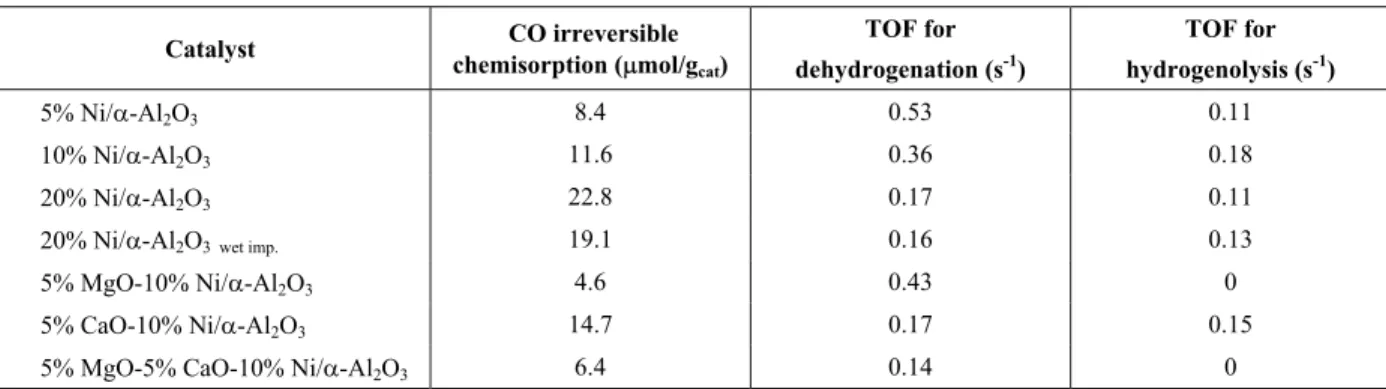
For Ni catalysts, the conversion of cyclohexane caused not only the formation of benzene, through the dehydrogenation reaction, but also the formation of n-hexane through the hydrogenolysis reaction.
Table 1 shows the dehydrogenation reaction rates. The different catalysts had dehydrogenation reaction rates of the same order of magnitude. The addition of the promoters altered the reaction rates
with a more important effect in the case of the addition of Mg.
Table 1 also contains the hydrogenolysis reaction products. The addition of Mg suppressed the formation of hydrogenolysis products, indicating a modification of Ni by this promoter. The presence of Ca, however, did not cause this effect.
chemisorption at room temperature (CO/Nis = 1). Essentially, the turnover frequency for the dehydrogenation reaction was not modified by the promoter. This is consistent with the structure insensitivity of this reaction. However, the hydrogenolysis reaction is structure sensitive. Thus, suppression of the hydrogenolysis reaction indicates a modification of Ni particles by Mg. This may explain the promoter role in the steam-reforming catalysts. Mg hinders the structure-sensitive reactions that result in coke formation. This is a mechanism similar to that observed for bimetallic catalysts: the promoter suppresses the
structure-sensitive reactions, which require large ensembles of atoms in order to occur, while structure-insensitive reactions require smaller ensembles of atoms and are pratically not influenced at all (Sinfelt, 1983). The geometric model of dilution of active phase atoms by the promoters atoms seems to be suitable in our case, with the Mg ion particles diluting Ni particles. These results are in agreement with the findings of Rostrup-Nielsen and Alstrup (1999) who showed that the dilution of Ni atoms by Cu atoms affects the catalyts behavior in the steam reforming reaction. Additional experiments are necessary to evaluate possible electronic effects.
Table 1: Cyclohexane conversion at 320°C on Ni Catalysts.
Catalyst Dehydrogenation Rate (x10-3mol/h/g
cat)
Hydrogenolysis Rate
(x10-3mol/h/g cat)
5% Ni/D-Al2O3 16.0 3.2
10% Ni/D-Al2O3 15.0 7.6
20% Ni/D-Al2O3 14.0 9.3
20% Ni/D-Al2O3 wet imp. 11.0 8.8
5%MgO-10% Ni/D-Al2O3 7.0 0
5%CaO-10% Ni/D-Al2O3 9.1 8.1
5%MgO-5%CaO-10% Ni/D-Al2O3 3.3 0 Table 2: TOF for Cyclohexane Conversion
Catalyst chemisorption (Pmol/g CO irreversible cat)
TOF for
dehydrogenation (s-1)
TOF for
hydrogenolysis (s-1)
5% Ni/D-Al2O3 8.4 0.53 0.11
10% Ni/D-Al2O3 11.6 0.36 0.18
20% Ni/D-Al2O3 22.8 0.17 0.11
20% Ni/D-Al2O3 wet imp. 19.1 0.16 0.13
5% MgO-10% Ni/D-Al2O3 4.6 0.43 0
5% CaO-10% Ni/D-Al2O3 14.7 0.17 0.15
5% MgO-5% CaO-10% Ni/D-Al2O3 6.4 0.14 0
CONCLUSIONS
The effect of the addition of Mg and Ca to Ni/D-Al2O3 catalysts was studied in this work. From the experimental results the following conclusions were drawn:
1) Addition of Mg causes the Ni precursor reduction to occur at a higher temperature.
2) The spillover and metal-adsorbed hydrogen states are modified by Mg. Similar experiments were observed for adsorbed carbon monoxide.
3) Mg inhibits the hydrogenolysis reaction, indicating a dilution of Ni atoms by Mg.
4) Ca does not strongly modify the metallic phase. The role of Ca is probably related only to decrease the acidity of the support.
ACKNOWLEDGEMENTS
REFERENCES
Agnelli, M.E., Demichelli, M.C. and Ponzi, E.N., Catalytic Deactivation of Methane Steam Reforming Catalysts. 1. Activation., Ind. Eng. Chem. Res.,26, pp. 1704-1707 (1987).
Anderson, R.B. The Fischer-Tropsch Synthesis. Academic Press, New York (1984).
Cheng, Z., Wu,Q. and Yoshuda, Z. Effect of Promoters and Preparation Procedures on Reforming of Methane with Carbon Dioxide over Ni/Al2O3. Catal. Today, 30, pp.147-155 (1996). Dias, J.A.C.and Assaf, M.A. Catalisadores
Ni/CaO/Al2O3 para Reforma do Metano com CO2. In: 11° Congresso Brasileiro de Catálise e 1° Congresso de Catálise no Mercosul, Gramado (2001).
Dry, M.E., The Fischer-Tropsch Synthesis, In: Catalysis: Science and Technology, J.R. Anderson and M. Boudart (ed.), Springer Verlag, New York, Vol.1, Chap.3, pp. 106-256 (1984). Hu, Y.H. and Ruckenstein, E.
Temperature-Programmed Desorption of CO Adsorbed on NiO/MgO, Journal of Catalysis, 163, p.p. 306-311 (1996).
Lercher, J.A , Bitter, J.H., Steghuis, A.G., Van Ommen, J.G. and Seshan, K., Methane Utilization via Synthesis Gas Generation - Catalytic Chemistry and Technology. Environmental Catalysis. Catalytic Science Series. v. 1, p.p. 12-19 (1999).
Peña, M.A., Gómez, J.P. and Fierro, J.L.G., New Catalytic Routes for Syngas and Hydrogen Production, Appl. Catal. A: Gen., 144, pp. 7-57 (1996).
Richardson, J.T. and Twigg, M.V. Reduction of impregnated NiO/D-Al2O3, association of Al+3 ions with NiO, Appl. Catal. A: Gen., 167, pp. 57-64 (1998).
Rostrup-Nielsen, J.R., Catalytic Steam Reforming. In: Catalysis: Science and Technology, J.R. Anderson and M. Boudart. New York: Springer Verlag , Vol.5, pp.1-117, 1984.
Rostrup-Nielsen, J.R. and Alstrup, I., Innovation and Science in the Process Industry. Steam reforming and hydrogenolysis, Catalysis Today, 33, pp. 311-316, 1999.
Ruckenstein, E. and Hu, Y.H., Carbon Dioxide Reforming of Methane over Nickel/Alkaline Earth Metal Oxide Catalysts, Appl. Catal. A: Gen., 133, pp. 149-161(1995)
Sinfelt, J.H., Bimetallic Catalysts: Discoveries, Concepts and Applications, Wiley, New York (1983).
The British Sulpur Corp. LTD. Ammonia Manufacture. Reforming the Front End, Nitrogen, 195, p.p.22-36 (1992).