Threshold
efFects
on heavy quark
production
in
pp interactions
O.
J.
P.
EboliInstituto de Fisica, Universidade de Sao Paulo, Caiza Postal 20516, CEP 01/98 Sao Paulo, Brazil M.
C.
Gonzalez-Garcia andI".
HalzenPhysics Department, University ofWisconsin, Madison, Wisconsin 55'706
S.
F.
NovaesInstituto de Fzsica Teorica, Universidade Estadual Paulista, Rua Pamplona
I)5,
CEP OI)05-900 SaoPaulo, Brazil (Received 22 May 1992;revised manuscript received 30 October 1992)The exchange ofgluons between heavy quarks produced in e+e interactions results in an
en-hancement of their production near threshold W.e study QCD threshold effects in pp collisions.
The results are relevant toheavy quark production by beamstrahlung and laser backscattering in
fu-ture linear collider experiments. Detailed predictions fortop-, bottom-, and charm-quark production
are presented.
PACS number(s): 13.65.
+i,
14.40.Gx, 29.27.Bd, 41.75.HtI.
INTRODUCTION
The @CDthreshold enhancement
of
heavy quark pro-duction ine+e
[1,
2] and hadronic collisions [3]has beenprofusely studied. In this paper we analyze this effect in pp collisions and we find a significant enhancement
of
top-quark production at future linear colliders. We con-sider two possibilities for the sources of photons in an
e+e
machine: beamstrahlung and laser backscattering. In studying the prospects for the commissioningof
fu-turee+e
linear colliders [4], it has become clearthat
their physics exploitation is inevitably affected by the fact
that
very dense electron and positron bunches are alsoa
very luminous source of photons. The strong electromagnetic fields associated with the high charge density in such bunches subject particlesto
very strong accelerating forcesjust
priorto
or during the collision. Asa
result photons are radiated. This is known as beamstrahlung [5—7].
The photon luminosity generated by beamstrahlung depends on the characteristicsof
the beams, in particular on their transverse shape, the lengthof
the bunches, the number of electrons per bunch, and the nominal beam energy. The desired photon luminosity can, in fact, beachieved by tuning these parameters. Wewill focus our attention on the design for the 500 GeV Next Linear Collider (NLC) [8,9],which is the set G of parameters
of
Ref. [9], and occasionally illustrate how results change for different beam profiles and increased energy.Beamstrahlung photons have a relatively soft spec-trum. Hard photons can be obtained by laser backscat-tering. Here intense p beams are generated by backward Compton scattering
of
soft photons froma
laser ofafeweV energy
[10].
The luminosity distribution over the pp invariant mass is broad and contains an abundant num-ber ofvery energetic photons. The angular spread from the Compton collision is small comparedto
the intrin-sic spreadof
the original electron beam and, therefore, the hard photon beam has approximately the samecross-sectional area as the original electron beam.
The enhanced two-photon luminosity, whether from beamstrahlung or laser back-scattering origin, is the source of
a
large numberof
qq pairs via two distinct mechanisms. The quarks can be generated by a direct photon process, where the photons couple directlyto
charged quarks. Alternatively, photons can interact via their quark and gluon constituents
[11].
This is referredto
asa
"resolved" photon process.The
interactionof
high energy photons via their quark or gluon structure leadsto
the abundant productionof
hadron secondaries, thus giving riseto
an underlying event which gives the once cleane+e
event the appearanceof
a hadron collider in-teraction[12].
Similarly the productionof
heavy quarks by the two-photon process sprays the interaction region witha
blizzardof
charm and beauty quarks and their associated prompt leptons[13].
Two-photon processes also provide unique physics opportunities such as the en-hanced productionof
top quarks[13].
We revisit this problem paying particular attentionto
@CD enhance-mentof
the threshold productionof
the top quark in the pp process.The layout
of
this paper is as follows. InSec.
II
webriefly review the main features
of
heavy quark produc-tion by photons. InSec.
III
we exhibit explicit expres-sions for the differential luminosities dL,s/dz for difFerentsources
of
photons and partons. The implementationof
the @CD corrections for heavy quark production near threshold are discussed in
Sec. IV.
Section V contains our results and finally we summarize our conclusions inSec.
VI.
II.
HEAVY QUARK PRODUCTION
IN
ppCOLLISIONS
The production
of
heavy quarks in pp collisions can proceed either by direct photons or by "resolved"1890 EBOLI,GONZALEZ-GARCIA, HALZEN, AND NOVAES 47
&max
min
dz dz
"o.(i+
j
~
QQ)(s
=
zs).
(2)
Here z2
=
7=
s/s,
where s is thetotal e+e
c.
m. en-ergy squared and s theij
pairc.
m. energy squared, anddI;~/dz
stands for the differential luminosityof
the par-tonsi
andj.
In order
to
obtain thetotal
cross section, we must Gxthe characteristic scales
of
the coupling constants and structure functions, We evaluate all photon structure functionsat
the scale Q2=
s/4.
The running strong coupling constant is determined by the renormalization group equationwith
d~.
(Q')
=
—
boa.2 s,
—
brn,+
O(n,
),
din
(3)
33
—
2Nf153
—
19Nf
24 2 (4)
tons. "Resolved" photons produce heavy quark pairs via their quark and gluon constituents, which are described in terms
of
the structure function of the partons in the photon[11].
At the tree level, there are four distinct contributionsto
heavy quark pair production:&+~
QQ,v+
v(g) QQv(e)
+
v(g) QQ, v(~)+
~(~)
QQ,where p(g) and p(q) denotes a gluon or
a
quark compo-nentof
the photon respectively. The expressions forthese cross sections arewell known and can be found elsewhereThe
total
cross section is obtained by folding the ele-mentary cross section for the processes(1)
with the pho-ton luminosityo(e+e
~
pp—
+i+
j
—
+QQ)(s)
1
128
—
saln(~s/Mz)
(6)III.
DISTRIBUTION
FUNCTIONS
The interpenetration
of
the dense electron and positron bunches in futuree+e
colliders generates strong accel-erations on the electrons and positrons near the inter-action point. This acceleration gives riseto
abundant bremsstrahlung. This phenomenon is known as beam-strahlung [5—7],and the distribution functionof
photons created this way can be written in the formF
/, (x,
b)=
F
/, (x,
b)O(x,
—
x)
+
F(/,
)(x,
b)O(x
—x,
).
Here
x
isthe fractionof
the beam energy carried by the photon, bisthe impact parameterof
the produced p, andx,
separates low and high photon-energy regions where different approximationsto
F
&,are used. The distribu-tionF
/,
adequate for small and intermediate values ofx
is given by [6,8]where
Nf
is the numberof
active Havors. For tree-level cross sections we will use the first-order (b1=
0)
solution2
12'
(33
—
2N )ln(Q2/A2) 'At second-order we will solve
Eq. (3)
numerically. Fla-vor thresholds are incorporated by choosing an appropri-ate value forA„which
guarantees thatn,
is continuous through the thresholds Q2=
rn2 fori
=
c,b,t.
Different valuesof
A4 will be chosen correspondingto
the differ-ent parametrizationsof
the photon structure functions. Finally, we employa
running electromagnetic coupling, which in our energy range iswell described by( )
CK
1+(1
—
x)2 1(
x
T'/'
*'/'(1 —
)'/'
6CT'/'
~q1—
—1
2
x
3T
(1
—
x)
(8)where
C
=
—
Ai'(0)=
0.
2588, andAi(x)
is the Airy's function. On the other hand, for large valuesof x,
wehave
original design for NLC. The dimensionless quantities
K
and
T
are deGned as(+)
K
1—
x(l
—
x)
P/e
(
&)
2~~F1/2
xl/2(j
x)1/22
x
3T
(1
—
x)
(9)
Z=
2~an
'
~,
—
m
pg~
—
m3
(10)
The value
x,
inEq. (7)
issuchthat
F
/,
iscontinuousat
x
=
x„
i.e.
,F,
(x„b)
=
F
/,
(x„b).
The value ofx,
depends on the machine design,
e.
g.,x,
0.
48 for thewhere m and p are the electron mass and momentum, and
Na
lb~2~3(O'
+
0'y)CT(&
&ilj
where
N
is the number of particles in the bunch. For the original NLC design the valueof
these parameters iso.
=1.
7x10
5cm,
o&—
—
6.
5x10
Tcm,
o,
=0.
011cm,
andN
=
1.
67x 10 .
We also study the efFectof
tuningto
round beams by choosing a~f„~=
3.
3x 10
s cm. For this casex,
0.
64.
Notice
that
F+&,(x,
b) depends on the impactparame-ter
throughK
andT.
In pp collisions we should average over the impact parameters in orderto
obtain the actual photon-photon luminosity:=
2F i,
(,
b)F
i,
(/,
b) .dz 4'7to~oy z
x
(12)
Therefore the necessity
to
average over the impact pa-rameter impliesthat
we cannot decompose the effectof
beamstrahlung into photon structure functions [8]. The photon luminosity ofbeamstrahlung isvery sensi-tive
to
the transverse shape of the beam [6]. The aspect ratio1 doc
F
g,(x,
():——
Oc dX
4x
((1 —
x)
4x
(2(I
x)2(14)
where o.
,
is thetotal
Compton cross section. For thephotons going in the direction
of
the initial electron, the fractionx
represents the ratio between the scattered pho-ton and the initial electron energy(x
=
u/E).
InEq.
(14),
we definedD(()
=
I 1—
—
—
—
I
»(1+()+
+
(
48)
1 8 1(')
2(
2(1
+
()'
'(»)
with
Abundant large invariant mass photons can also be obtained by the process
of
laser backscattering. When a laser light isfocused almost headto
head on an energetic electron or positron beam we obtaina
large quantityof
photons carrying
a
great amountof
the fermion energy.The
energy spectrumof
backscattered laser photons is[15]
4Ecdp ~ Ap 2~8(dp
2 cos 2 )
m 2 m
(16)
provides
a
good measure of beamstrahlung, with large photon luminosities associated with small values ofG.
For high photon luminosity one tunes
to
round beams, i.e.
,G=
1.
For the NLC original design G 2.7 [8,9].
Conventional bremsstrahlung
of
photons by electrons further contributesto
the photon luminosity. This can be computed in the lowest-order approximation using thewell-known Weiszacker-Williams distribution
Fww(x,
E
~ )=
n
1+
(1
x
—x)'
(E',
qm'y
1118,„&X 'where
E
is the electron beam energy. Thetotal
p distribution is obtained by addingF~~
to
the beam-strahlung distribution function F+&,.
The logarithm in
Eq.
(13)
arises from the integration over the momentum squared (p2) ofthe photon propaga-tor upto
the maximum valueE~
~„=
s/2.
When com-puting cross sections we fold this distribution with an ele-mentary cross section which is evaluated for on-shell pho-tons. The effective photon approximation isvalid only inthe kinematical regime where the elementary cross sec-tion does not depend onp2.
It
overestimates the numberof
off-shell photons. In orderto
avoid this, we introduce a cutoffE
=
E,
„qin the integration over the photonpropagator which guarantees
that
the effective photon approximation is used only in the kinematic range where it is strictly valid.E~~„will
be in general process de-pendent: in direct pp we will use the transverse momen-tumof
the heavy quark asa
cutoff, otherwise we chooseE
„=
1 GeV. This procedure makes the evaluationof
the luminosities and cross sections conservative.
where wp is the laser photon energy and (ap
~
0) is theelectron-laser collision angle. The maximum value
of
x
1s
E
1+(
(17)
From
Eq. (14)
we can seethat
the fractionof
photons with energy closeto
the maximum value grows withE
and up. Usually, the choiceof
wp is such that it is notpossible forthe backscattered photon
to
interact with the laser and createe+e
pairs, otherwise the conversion of electronsto
photons would be dramatically reduced. In our numerical calculations, we assumed cup1.
26 eV for the NLC which is below the thresholdof e+e
pair creation(a~up
(
m~). Thus for the NLC beams we have(
4.
8,D(()
1.
9,andx~
0.
83.
In this case, half or more of the scattered photons are emitted insidea
small angle (8(
5x 10
rad) and are very energetic (w)
100GeV).
The pp luminosity from laser backscattering is then
Xm,
~~-
=
2zk2F~(,
(x,
()F
],
(z/x,
(),
dz / X
(18)
where the conversion coeKcient k represents the average number
of
high-energy photons per one electron. We assume A:=
1 in our calculations.1892 EBOLI,GONZALEZ-GARCIA, HALZEN, AND NOVAES 47
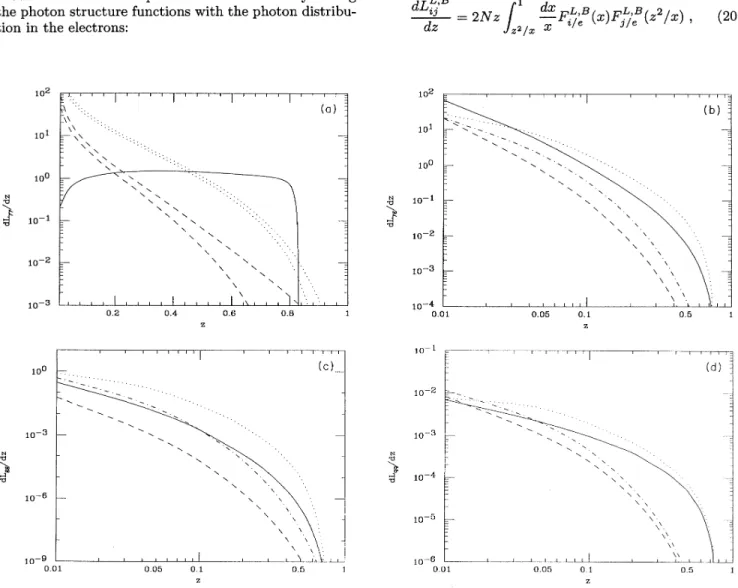
the pp luminosity for beamstrahlung with and without considering the bremsstrahlung photons. The actual pp luminosity will be somewhat reduced because no E~~x cutofF was implemented in the bremsstrahlung contribu-tion in this figure.
It
is interestingto
notice the very steep dependenceof
the luminosity onz.
In this figurewe have also shown the differential luminosity,
Eq.
(18),
for laser backscattering. This luminosity is roughly con-stant in most
of
the z(
x
range, as aconsequenceof
the hard photon spectrum.
The luminosities shown in Fig.
1(a)
are valid for interactions where the photon couples directlyto
the quarks. Interactions initiated by "resolved" photons are described in termsof
structure functionof
partons, quarks, and gluons, inside the photon[llj.
We define anefFective distribution
of
partons in the electron by foldingthe photon structure functions with the photon
distribu-tion in the electrons: (20)
I.
a
2 d'gI.
,a
&/~. (&
Q')
=
—
+,
'j.
(&)P'(&it
Q')
(»)
where
P~
=
q~ (G~)isthe quark (gluon) structure func-tion. Here, we also add the bremsstrahlung photonsto
the beamstrahlung ones, and in this case an addi-tional integration over impact parameter must be per-formed. For "resolved" photons the natural cutofF on the bremsstrahlung contribution isof
order AqoD. We useE«t
—
—
1 GeV. Also, the suppression of the parton contentof
highly oK-shell photons isnot aproblem with this choice, since we evaluate the parton distributions at Qs=
s/4 with Q2)
E2„t,
which guaranteesthat
we do not include highly ofF-shell photons.Finally, we define the parton-parton luminosity for once and twice "resolved" photons as
I
a
I
a
F;.
(*)&'.
("i*)
I
2
101
I I I I
I
I I I I
I
I I I I I I I I
I
(a):
102101
1oo
N d
10—1
1oo
N 10—1
10—2
10 2
10 I I I I I I I I I I I I I
0.2 0.4
I
0.6
I +I I I
0.8 1O-40.01 0.05 0.1
Z
0.5
1OO
I I I I I I I 10
—1
10 2
10
1O-6
10—4
1O-5
1O-9
0.01 0.05 O.i
2
0.5
1O-6
0.01 0.05 0.1 0.5
FIG.
1.
DifFerential luminosities in pp collisions at~s =
500 GeV. In (a) the direct photon luminosities are shown forbackscattered laser photons (solid line), beamstrahlung photons for "ribbonlike" beam with
G=2.
7(dashed lines), and round beam (dotted lines). The lower dashed and dotted lines show the luminosity without including the bremsstrahlung photons andthe upper ones include the bremsstrahlung photons according to the EPA distribution ofEq.
(13).
In (b) the once "resolved"pg luminosities are shown for backscattered laser photons (solid and dotted lines) and beamstrahlung for "ribbonlike" beam
(dashed and dot-dashed lines). The solid and dashed lines correspond tothe DG parametrization of partons inside the photons
and the dotted and dot-dashed ones correspond to the LAC3 parametrization. (c)and (d) show the twice "resolved" gg and
where
i
=
p,j
=
g for once "resolved" luminosity, andi
=
j
=
g ori
=
q andj
=
q for twice "resolved" luminosities. The statistical factorN
assumes the valueN
=
2for distinct partons (ig
j)
andN
=
1for identical partons (t'=
j).
The structure functions for partons inside the pho-ton, q~(x, Q ) and
G~(x,
Q2), are obtained fora
givenvalue
of
Qz=
Qo by fitting the experimental data[16].
The Q evolution is obtained, as usual, bysolv-ing an inhomogeneous set
of
Altarelli-Parisi equations [17,18].
Several parametrizations have been proposed inthe literature [17,
19, 20].
They leadto
different predic-tions asa
consequenceof
the large uncertainties dueto
the small number of experimental results. In particular very different parametrizations for
G~(z,
Q ) can fit thedata.
We will present predictions for the parametriza-tionsof
Drees-Grassie(DG)
[19]and Levy-Abramowicz-Charchula (LAC3) [17],which are respectively charac-terized bya
soft anda
hard gluon distribution. We take A4—
—
0.
4 GeV for the DG parametrizationof
the pho-ton structure functions and A4=
0.
2 GeV for the LAC parametrizations.In
Fig. 1(b)
we show the once "resolved" pglu-minosities for backscattered laser photons and beam-strahlung for "ribbonlike" beams, using DG and LAC3 parametrizations of the parton distributions. This figure illustrates well the different behavior
of
the distributions DG and LAC3: for backscattered photons, the LAC3 pg luminosity islarger (smaller) than the corresponding one for DGat
large (small)z.
Figures
1(c)
and1(d)
show the twice "resolved" gg and qq luminosities (summed over the light quarkfla-vors). LAC3 parametrization predicts
a
twice "resolved" luminosity always larger than the one obtained with the DG parametrization.IV.
THRESHOLD BEHAVIOR
4o,
sVg(r)
=
—
——
3
r
(21)
in the color singlet channel, and by arepulsive potential 1A8
Vs(r)
=
——
6
r
(22)in the color
octet state.
Since the interaction isattrac-The exchange of gluons between associatively pro-duced heavy quarks modifies significantly their produc-tion cross secproduc-tion near the threshold. Moreover, for a very heavy quark, such as the top quark, nonperturba-tive QCD efFects are small, and the threshold behavior can be computed perturbatively [21, 22], since the top-quark width acts as an infrared cutoff . In this case, the modification
of
the cross section near threshold dueto
QCD can be calculated in terms
of
a
Coulomb-like inter-action betweent
andt.
In pp collisions the
tt
pair ean be produced in eithera
color singlet or an
octet
state, depending on the produc-tion mechanism. The threshold interaction between thet
andt
can be described by an attractive Coulomb-like potentialtive in the singlet channel, the formation
of
bound states by multiple gluon exchanges between thet
and thet
can in principle occur. However, if the top quark is heavier than 140 GeV, the formation timeof
the boundstate
by gluon exchange is larger than the lifetime
of
toponium and the resonance structure disappears [21,23].
These in-teractions nevertheless leadto a
significant modificationof
the cross section near threshold. This mechanism is analogousto
the Coulomb rescattering inQED
discussed by Sommerfeld [24] and Sakharov [25].In the narrow width approximation, we can obtain the QCDeffects near the threshold replacing, inthe tree-level cross sections, the usual threshold factor
by
4m2,
7
8
Pl@s,
s(0)l'
=
P
1
—
exp—
A's,s (24)where 4'g
s(0)
isthe wave functionat
the origin anderas
8—
6
p
(25)+top mt
+
+~t +
2 2 2 2
where
E =
~i
—
2mt. We thus include the effertof
the finite top widthI't
—
175mts/Mss, MeV.In pp collisions we have four contributions
to
top pro-duction [seeEq.
(1)].
In the direct pp interactions, thett
pair is produced ina
singletstate.
Therefore the ele-mentary cross section must be replaced byfor the color singlet
state
(S),
andoctet (8)
channels respectively.Equation (24) can be interpreted as the exponenti-ated version
of
the first-order QCD corrections near the threshold. The first term in its expansion in powersof
o;,coincides with the one-loop QCD corrections. The ex-pression (24) does not include the efFects ofbound states below threshold [2,
3].
These states are confined into a very small energy region and their contributionto
thetotal
cross section, which is obtained by integration over allc.
m.energies, is rather small. Furthermore, unlike thee+e
machines,it
isnot possibleto
observe the effectof
bounds states in the cross section through the
tt
excita-tion curve dueto
the smearing introduced by the parton distribution functions.Near threshold
(P —
+0),
the cross section in the color singlet channel is increased sinceP
issubstituted by the nonvanishing factor 4vro.,
/3 On the.other hand, theoctet
channel cross section is exponentialy suppressed inthis limit. Therefore, the factors in
Eq.
(24) are large, especially in the color singlet channel, and this gives riseto a
substantial enhancementof
the production cross sec-tion.When computing the
tt
cross sections we usea,
inEq.
(5).
The tree-level cross sections are evaluatedat
EBOLI,GONZALEZ-GARCIA, HALZEN, AND NOVAES 47
tt)
=
~o(qq (&g) tt&Rs . (28) Inp(g) +
p(g) fusion the final state isa
mixture of color singlet andoctet
states in a ratio 2to
5given by the color factors. Therefore, we are ledto
5
cr' (gg
~
tt)
=
rro(gg—
+tt)
I
Rs+
-—
Rs ~7 7 (29)
Since the enhancement in the singlet channel is much larger than the suppression in the
octet
channel the net correctionto
gg ispositive. For the sakeof
comparison wealso include the cross sections fortop production in direct
e+e
annihilation.tt
pairs produced in this channel are in the color singletstate.
Therefore we will haveo
(e+e
~
ttQ=
Rso'o(e+e
~
tt).
The previous analysis, valid for nonrelativistic parti-cles, cannot be applied
to
charm and bottom produc-tion. In this case boundstate
eKects play a critical role and the computationof
the @CDenhancement becomes nonperturbative near threshold. Here, we will compute the fullO(n
n,
)+
O(nn,
)+
O(n,
) inclusive cross sec-tion, pp~
QQ[g, q,q] [27,26], in the modified minimal subtraction(MS)
scheme as defined in [26].We use the valueof
n,
obtained by solvingEq. (3) at
second order. We will show the results for two different scales Q=
m2and Q
=
4m,,i
=
c,b This pro.cedure does notincor-porate bound-state effects but should nevertheless repre-sent an adequate estimate of the efFect
of
the threshold enhancement. The results will indicatethat
thesecor-(27) where pro is the Born cross section. In p(g)
+
p collision thett
is produced in the coloroctet
channel because the gluon is a coloroctet.
The same is true in p(q)+
p(q) annihilation wherea
gluon is exchanged in thes
channel. In these cases we haverections are small relative
to
the uncertainty associated with the charm- and bottom-quark masses. Again, we in-clude the tree level and one-loop cross sections for charm and bottom production in directe+e
annihilation. The one-loop cross section is given by [28]The function
f(P)
[29] is rather complicated involvingseveral Spence functions. Schwinger [29] has constructed the interpolating formula
( )
vr
3+x
(vr3&
4
P
4)
which agrees with the exact result
to 1%
in the interval of interest.V.
RESULTS
We are now ready
to
performa
full computationof
heavy quark production in pp interaction including di-rect and "resolved" photons and incorporating @CD cor-rections near threshold. In Table
I
we list the produc-tion cross secproduc-tions for top assuming m~ ~—
—
120 GeV and v s=
500 GeV.Contributions from different subpro-cesses are shown separately, with and without threshold factors included for the sakeof
comparison. Results areshown for beamstrahlung, laser backscattering, and
di-rect
e+e
production.As pointed out in Ref. [12],in the case
of
top produc-tion the contribuproduc-tion of "resolved" photonsto
the total pp cross section is small asa
result of the suppression of their luminosityat
high values ofx,
as can be seen fromFig.
l.
Even for the LACS parametrization, character-ized by a very hard gluon spectrum, the contribution isat
most 3'%%uo forvs
=
500 GeV. Since the directsin-glet channel dominates, the threshold eiFect results in
a
significant enhancement ofthe total cross section. This
TABLE
I.
Cross sections for tt production at~s
=
500 GeVfor rnid—
—
120 GeV.The first row corresponds to e+e annihilation production and the others correspond
to photon-photon production. For each process the left (right) column is the cross
section without (with) the threshold factors. We separate the different contributions
to the photon-photon cross sections from direct photons,
p+
p, once "resolved"gluon-photon fusion,
p+
p(g), and twice "resolved" gluon fusion, p(g)+
p(g), audp(q)
+
p(q) annihilation. For "resolved" photon processes the upper number is thecross section with DG parametrization and the lower one is the cross section with
LAC3 parametrization. Process
e+e Photon-photon
Y+ Y
0.70 Laser 0.74
1.
24.2x 10
3.
8x 10+
()
5.4x
10-'
7.1x10-'
9.
7x10-'
1.
2xIo-'
2.5x 10 2.2x 10&(q)+&«)
2.8 x10⁻⁴
2.5x10⁻⁴
G=2.
79.
0 x 10'
1.81.
2x 10'
l.
l
4.8x 10 5 4.4
1.
4x 10"
1.
82.4x 10
3.
18.8x 10 7.8
9.
7x 10 ~ 8. 7x 10
x10
'
x10-'
x10"
xlo
'
xl0
'
x10
~Cross section (pb)
0.94 0.18
3.
5x 101.
4x10
33.
1x 10"
5.5x10
72.
6x10
'
2.9 x 100.36 3,
lxl0
'
1.3x10
31o-1 I 1 I I I l I I I
I I i
l
' ' ' ' I
(a):
enhancement is roughly
a
factorof
2 for beamstrahlung and more than 50%for laser backscattering.In
Fig.
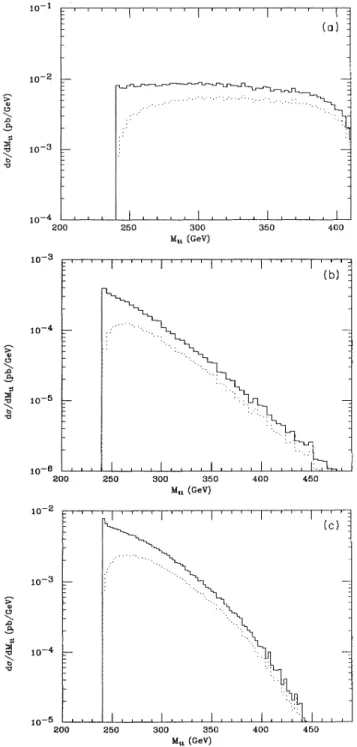
2 we show the invariant mass distribution o thett
pair. The modifications dueto
threshold effects are larger for small invariant masses, correspondingto
tt pair production near threshold. This explains why
the @CD corrections are larger in pp than in
e+e
pro-duction. For the same reason the correction is small for laser backscattering where the luminosity at lowx
is sup-pressed. Despite the factthat
the corrections look big far from threshold we have checkedthat
at
least93% of
the eKect in thetotal
cross section comes from the regionof
invariant mass less than mt ~ above thres ol
.
The dependence on the top mass and on the collider energy is shown in
Fig.
3.
As expected, the @CD cor-rections increase slightly with the mass and decrease with thec.
m. energy. As pointed out in Ref. [13]beam-C4
b
10 2
10
10
CL
b
I I
I
I I I I
I
I I I
1O-4 200
I
250
I
300
M„(cev)
I
350 400 10
C4
'a b
10
1O-4
1O-5
I I I I I 1 I I I I I
I I I
I
I I I I
I
l I I I I
I I I
(b):
'i'i
'i
'i
'i
i 1
'I 'i 'i 'I
i
I i
1 \
—2
10
230 m.
.
.
(GeV) 10J3
CL
I I
I I I II I
I
I I I I I
I I I I I I
1
—3
I
'
I I I I I
10 I I I I I I I
90 125 160 195
10—8
200
10
250 300 350 400 450
M„(cev)
I I
I l I I I
I
I I I I
10
10
-2 10
'a b
1O—4
I
450
5 I I I
200 250 300 350 4oo
M„(cev)
FIG.
2. Invariant mass distributions ofthett
pairspro-duced in pp collisions for mq
=
120 GeV. (a) corresponds tobackscattered laser photons while (b) and (c)correspond to
beamstrahlung photons for
G=2.
7andG=1,
respectively. Inall cases the solid (dotted) lines show the distributions with
(without) the threshold factors.
I I I I I I I I I I I I I I I I I I I I I I I I I I I I'j
10
90 120 150 180 210 240 270 300
mi~ (GeV)
FIG.
3.
Total tt production cross section asafunction ofmq for v s
=
500 GeV (a)and Vs=
1TeV(b).
Solid lines are+ '
ashed lines for
the cross sections fordirect e e production, as e
pp product'ion wiith backscattered laser photons, and dotted (dot-dashed) lines forpp production with bearnstrahlung p
o-tons with
G=2.
7(G=l).
In all cases the upper (lower) lines1896 EBOLI,GONZALEZ-GARCIA, HALZEN, AND NOVAES 47
strahlung, for round beams, can give
a
substantial contri-butionto tt
production. The threshold corrections make this contribution even larger. At Vs=
500 GeV the two photon contributions areat
most 1070 for the "ribbon-like" design. However, for a circular beam more than 50'Fo of thett
pairs withmt»
(
110
GeV are producedin two photon collisions. Since the pp cross section in-creases with energy while the
e+e
one decreases, the two photon contributions are much more important at1TeV. However top quarks produced by beamstrahlung
photons preferentially populate the low pz region and so do the prompt leptons from their decay [see Figs.
4(a)
and
4(b)j.
In this case their signature suffers from alarge background from b andc
produced both in directe+e
annihilation and in two photon processes.
The advantage
of
photon interactions ismore dramatic forlaser backscattering. We first noticethat
at
Vs=
500(1000)
GeV, for m«p(
130 (250) GeV, a "pp collider"I.
I
CL
I I I
( I I I I l tI I I I
I T I I I j
I I I I
(
I I I I
t I
)
—I lCL —;I
I I I
I
I I I I
(b}
t I
10
;'I
:I
'
I
\
1 I
i
\
'I I
—3 10
I I
—I
—I
I i
10
i
I' i
I I
—2
10
—5
10 I I l I I I I l I I I I I I I I I
0 50 100 150 200 250 300
p, lepton (GeV)
1 I
10
1 I I I 1
I I
!
2 10
—3 10
—4
10
—5 10
0 50 200 250 300
p, lepton (GeV)
i
I I
I I
'I 'I
1
1 \
'I
1
10 b
I —
t I I I
[
I I I I
/
I I I I
f
I I I I
I
I I I I [
I I I I
)
C9
(c}
C3 CL
—4.
10
—5
10
0 100 150
I I L I I !
200 250 300
p, lepton (GeV)
I'IG. 4. Transverse momentum distribution of the lepton produced in the heavy quark decay. Dashed, dotted, and
dot-dashed lines correspond respectively to charm, bottom, and top produced in pp process with backscattered laser photons (a)
and beamstrahlung photons for
G=2.
7 (b)andG=l
(c).
Solid lines correspond to annihilation production of the heavy quarkscan produce more
tt
pairs than the correspondinge+e
collider . The background fromc
and b quarks can be efficiently suppressed becauseit
is concentratedat
lower pz values than the one from the top signal. Furthermore, the separation of the signal from the background iseasier in this case than for directe+e
production [compare Figs.4(a)
and4(b)].
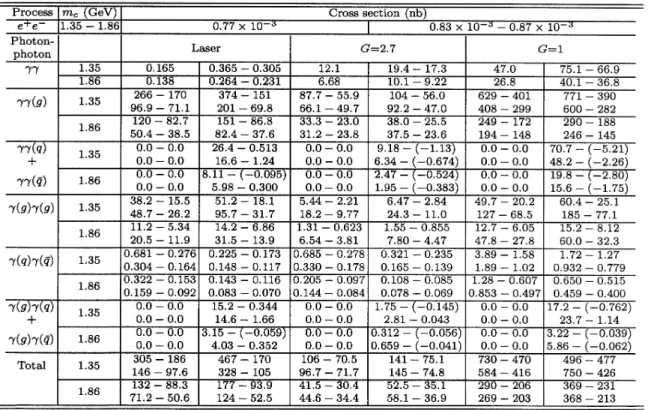
The cross sections at
~s =
500 GeV for inclusive charm and bottom production are listed in TablesII
and
III.
At orderas,
withn
=
cr, ora„
there are four new contributionsto
the inclusive cross section apart from thoseof Eq.
(1):
pp(q[q])~
QQq[q] and 7(g)p(q[q])~
QQq[q]. Notethat
negative corrections only appear because we have separated the leading-order parton diagram from the @CD corrections; they should be added [26].The
cross sections depend upon various factors, like the quark mass, factorization scale, A, and the choiceof
parametrizationof
the photon structure functions. Although the correctionsto
individual chan-nels can be large, the net modi6cationof
thetotal
yieldof
heavy quarks is smaller asa
resultof
cancellation be-tween opposite behaviorsof
the different channels. Even the signof
the correction depends on the quark mass, the scaleof
the coupling constant, the photon spectrum, and the parametrizationof
the photon structure functions.We show results for two extreme values
of
the massesm,
=
1.
35and1.
86 GeV, and mt,=
4.
5 and5.
2GeV. The strong dependence on the mass makes predictions rela-tively imprecise. In particular, the results are extremelysensitive
to
the charm mass (bya
factorof
2),
whilefor bottom the uncertainty is
of
the orderof 40%.
This sensitivityto
the heavy quark mass was observed before in hadronic collisions and in ep collisions [26].The dominant contribution
to
thetotal
cross section comes from the once "resolved" pg process, dueto
the large pg luminosity. In orderto
analyze the dependence onthe parametrization of the structure functions we eval-uated the cross sections for DG and LAC3 parametriza-tions. In contrast with the top case, the DG cross sections can be larger than those computed with LAC3 structure functions. This isa
resultof
a smaller A4 value and a harder gluon spectrum in the LAC3 parametrization. In fact, we have checkedthat
LAC1 indeed givesa
5—10
times bigger result for the once "resolved" process since parametrizations with softer spectra give rise
to
larger cross sections. Moreover, uncertainty in the cross sec-tion dueto
the structure functions is smaller for bottom production than for charm.Finally, in order
to
estimate the sizeof
higher-order @CD corrections, we computed cross sections for two dif-ferent factorization scales: Q2=
m, and Q2=
4m2, withi
=
e,b respectively. For charm production the results vary as much as50%,
while for bottom the variations areof
the orderof
20%.
Despite the large values
of
the cross sections for charm and bottom, mostof
them are producedat
very lowtransverse momentum as shown in
Fig.
(4).
Therefore they will be hardto
observe.If
we imposea
transverseTABLE
II.
Same as TableI
for charm production. The cross sections are listed for two quark masses. For each process the two right (left) numbers are the tree-level (one loop) cross sections. In each case the leftnumber is for
q
=
m,
and the right one forq
=
4m,.1.35 1.86 1.35 1.86 1.35 1.86
W(9)~(9) 1.35
1.86 v(c)~(q) 1.35
~(g)~(q)
~(9)~(q) 1.86
1.35
1.86
Total 1.35
1.86
Process m (GeV)
e+'e 1.35
—
1.86Photon-photon
'y'Y
0.77x10 Laser
0.165
0.138
266
—
17096.9
—
71.1120
—
82.750.4
—
38.50.0
—
0.00.0
—
0.00.0
—
0.00.0
—
0.038.2
—
15.548.7
—
26.211.2
—
5.3420.5
—
11.90.681
—
0, 276 0.304—
0.1640.322
—
0.1530.159
—
0.0920.0
—
0.00.0
—
0.00.0
—
0.00.0
—
0.0305
—
186146
—
97.6132
—
88.371.2
—
50.60.365
—
0,3050.264—0.231
374
—
151201
—
69.8151
—
86.882.4
—
37.626.4
—
0.513 16.6—
1.24 8.11—
(—
0.095)5.98
—
0.30051.2
—
18.1 95.7—
31.714,2
—
6.8631.5
—
13.90.225
—
0.1730.148
—
0.117 0.143—
0.116 0.083—
0.07015.2
—
0.34414.6
—
1.663.15
—
(—
0.059) 4.03—
0.352467
—
170328
—
105177
—
93.9124
—
52.512.1
6.68
87.7
—
55.966.1
—
49.733.3
—
23.031.2
—
23.80.0
—
0.00.0
—
0.00.0
—
0.00.0
—
0.05.44
—
2.2118.2
—
9,771.31
—
0.6236.54
—
3.810,685
—
0.278 0.330—
0.1780.205
—
0.0970.144
—
0,0840.0
—
0,00.0
—
0,00.0
—
0,00.0
—
0.0106
—
70.596.7
—
71.741.5
—
30.444.6
—
34.419.4
—
17.310.1
—
9.22104
—
56.092.2—47.0
38.0—25.5 37.5
—
23.69.18
—
(—
1.13)6.34
—
(—
0.674)2.47
—
(—
0.524)1.95
—
(—
0.383) 6.47—
2.8424.3
—
11.01.55
—
0.8557.80
—
4.470.321—0.235 0.165—0,139
0.108—0.085
0.078—0.069
1.75
—
(—
0.145)2.81
—
0.0430.312
—
(—
0.056)0.659
—
(—
0.041)141
—
75.1145
—
74.852.5
—
35.158.1
—
36.947.0
26.8
629
—
401408
—
299249
—
172194
—
1480.0
—
0.00.0
—
0.00.0
—
0.00.0
—
0.049.7
—
20,2127
—
68.512.7—6.05
47, 8
—
27.8 3.89—
1.581.89
—
1.021.28
—
0.6070.853
—
0.4970.0—0.0
0.0
—
0.00,0
—
0.00,0
—
0.0730
—
470584
—
416290
—
206269
—
20375.1
—
66.940.1
—
36.8771
—
390600
—
282290
—
188246
—
14570.7
—
(—
5.21)48.2
—
(—
2.26)19.8
—
(—
2.80)15.6
—
(—
l.
75)60.4
—
25.1185
—
77.115.2
—
8.1260.0
—
32.31.72
—
1.270.932
—
0.7790.650
—
0.5150,459
—
0.40017.2
—
(—
0.762)23.7
—
1.143.22
—
(—
0.039)5.86
—
(—
0.062)496
—
477750
—
426369
—
231368
—
213Cross section (nb)
1898 EBOLI,GONZALEZ-GARCIA, HALZEN, AND NOVAES 47
TABLE
III.
Same as TableII
for the bottom quark.4.5 5.2
45
~~(9) ~~(9) 5.2 4.5 4.5 5.245
~(9)~(~) ~(g)v(v) 5.2 4.5 5.2Total 4.5
5.2
Process mb (GeV)
e+e 4.5
—
5, 2Photon-photon 'yy Laser 0.41 4.91 4.43
1820
—
14401590
—
13201140
—
9101090
—
9150.0
—
0.00.0
—
0.00.0
—
0.00.0
—
0.0287
—
1791310
—
898156
—
99.8794
—
55524.1
—
15.022.5
—
15.415.7
—
10.115.8
—
11.10.0
—
0.00.0
—
0.00.0
—
0.00.0
—
0.02140
—
16402930
—
22401320
—
10201900
—
14907.21
—
6.806.31
—
5.992030
—
16001860
—
13401250
—
10101240
—
93399.6
—
(—
10.2)93.7
—
(—
5.23)61.1
—
(—
7.63)58.9
—
(—
4.96)331
—
2411510
—
1080178
—
135898
—
67714.5
—
13.014.0
—
12.99.64
—
8.7910.0
—
9.3948.9
—
(—
11.8)107
—
(—
9.68)24.5
—
(—
7.52)57.3
—
(—
8.14)2530
—
18403590
—
24301530
—
11502270
—
1610G=2.7 74.6 55.3
371
—
293644
—
533218
—
175409
—
3420.0
—
0.00.0
—
0,00.0
—
0.00.0
—
0.021.7
—
13.5244
—
16710.8
—
6.94134
—
93.910.7
—
6.6811.9
—
8.196.66
—
4.277.70
—
5.39 0.0—
0.00.0
—
0,00.0
—
0.00.0
—
0.0478
—
388974
—
783291
—
242606
—
497101
—
96.373.9
—
70.9398
—
343675
—
574233
—
205426
—
37218.7
—
(—
11.1)17.5
—
(—
10.9)10.2
—
(—
7.27)9.62
—
(—
7.35)25.1
—
19.6269
—
21912.5
—
10.1148
—
1256.63
—
6.027.76
—
7.334.20
—
3.885.11
—
4.882.54
—
(—
2.25)9.06
—
(—
5.52)1.09
—
(—
1.26)4.18
—
(—
3.38)552
—
4521080
—
880335
—
281667
—
562Cross section (pb)
0,44
332 251
3030
—
23904430
—
36701810
—
14502870
—
24000.0
—
0.00.0
—
0.00.0
—
0.00.0
—
0.0242
—
1512080
—
1430124
—
79.61180
—
82673.8
—
46.080.6
—
55.3 46.6—
29.9 53.2—
37.2 0.0—
0.00.0
—
0.00.0
—
0.00.0
—
0.03680
—
29206920
—
54902230
—
18104350
—
3510445
—
425332
—
3193260
—
27504720
—
38901940
—
16803020
—
2570178
—
(—
69.8)168
—
(—
66.8)101
—
(—
47.0)96.7
—
(—
46.8)278
—
2132300
—
1820143
—
1141300
—
107045.1
—
40.951.7
—
48.629.0
—
26.834.8
—
33.133.2
—
(—
19.9)101
—
(—
39.6)15.2
—
(—
11.5)49.2
—
(—
25.5)4240
—
33407790
—
60702560
—
20804830
—
3920momentum cut onthe prompt lepton of
10
GeV, all cross sections are reducedto
less than 5pb. The main contri-butionto
large p2 comes from the direct pp process.solved"
p+
p(g) process. The effectof
the correction is always smaller than the uncertainty dueto
the choice of the bottom and charm masses.VI.
CONCLUSIONS
In this paper we have studied the @CDthreshold ef-fectson heavy quark production in pp collisions. We have consistently taken into account production by direct and "resolved" photons. We also studied how the cross sec-tion depends upon several factors such as quark mass, factorization scale, and choice
of
the structure functions. Top quarks are predominantly produced in the direct pp channel. In this case, thett
pair isproduced througha
color singlet channel and the threshold effect results in a substantial enhancementof
thetotal
cross section. At~s
=
500GeV the enhancement isa
factorof
2 for beamstrahlung and more than1.
5 for laser backscatter-ing. Fora
given collider energy,it
will increase with the top mass, while fora
given mass it decreases with the collider energy.For charm and bottom the contributions due
to
"re-solved" photons are dominant, mainly via the once"re-ACKNOWLEDGMENTS
This work was supported in part by the U.
S.
De-partment of Energy under Contract No.DE-AC02-76ER00881,
and in part by the Universityof
Wiscon-sin Research Committee with funds granted by the Wis-consin Alumni Research Foundation. Further support was given by Conselho Nacional de Desenvolvimento Cientifico eTecnologico (CNPq) and Fundagao de Am-paro
a
Pesquisa do Estado de Sao Paulo(FAPESP).
We would liketo
thankJ.
Smith for providing us with the @CD corrections for the charm and bottom production andS.
Keller for supplying us with the photon distribu-tion funcdistribu-tions. We also thankD.
Zeppenfeld for useful discussions. Twoof
us(O.
J.
P.
E.
andS.
F.
N. ) are very gratefulto
the Institute for Elementary Particle Physics Research, Universityof
Wisconsin —Madison for their kind hospitality during the initial stepof
this work.[1]C. Berger et at., Phys. Lett.
86B,
413 (1979);I.
S.
Gusken,
J.
H. Kiihn, and P.M.Zerwas, ibid.155B,
185(1985);
J.
Feigenbaum, Phys. Rev. D43,
264(1991);
W.Kwong, ibid. 48, 1488
(1991);
M.J.
Strassler and M.E.
Peskin, ibid.
48,
1500(1991);R.
J.
auth andJ.
H.Kiihn,Nucl. Phys.
B368,
38(1992).and
V.
A. Khoze, Yad.Fiz.48,
487(1988)[Sov.J.
Nucl.Phys.
48,
309 (1988)].[3]
V.
Fadin, V.A. Khoze, andT.
Sjostrand, Z.Phys. C48,
613
(1990).
[4] Proceedings ofthe Workshop onPhysics and Experiments
with Linear Colliders, Saariselka, Finland, 1991,edited
by
R.
Orava,P.
Eerola, and M. Nordberg (WorldScien-tific, Singapore, in press).
[5] R.
J.
Noble, Nucl. Instrum. Methods A256, 427(1987).[6]
R.
Blankenbecler andS. D.
Drell, Phys. Rev. D86,
277 (1987);
37,
3308(1988);Phys. Rev. Lett.61,
2324 (1988);R.
Blankenbecler,S.
D.Drell, and N. Kroll, Phys. Rev. D40,
2462(1989).
[7]M. Jacob and
T. T.
Wu, Phys. Lett.B 197,
253 (1987);Nucl. Phys.
B308,
373(1988);B308,
389(1988);B314,
334(1989);
B318,
53(1989).
[8) D. V.Schroeder, "Beamstrahlung and
/ED
backgroundsat future linear colliders,
"
Ph.D. thesis, SLAG ReportNo. 371, 1990.
[9]
R.
B.
Palmer, Annu. Rev.Nucl. Part. Sci.40,529(1990).[10
F.
R.
Arutyunian and V.A.Tumanian, Phys. Lett. 4,176(1963);
R.
H.Milburn, Phys. Rev. Lett.10,
75(1963).
[ll]
E.
Witten, Nucl. Phys.B120,
189(1977).[12]M. Drees and
R.
M. Godbole, Report No. DESY90-044(unpublished); Report No.BU 92/1 (unpublished); Phys.
Rev. Lett.
67,
1189(1991).
[13]
F.
Halzen, C.S.
Kim, and M. L. Stong, Phys. Lett.B
274,489 (1992).
[14]V. Barger and
R.
J.
N. Phillips, Collider Physics(Addison-Wesley, New York, 1987).
[15]
I.
F.
Ginzburg, G. L. Kotkin, V. G. Serbo, and V.I.
Telnov, Nucl. Instrum. Methods
205,
47 (1983);219,
5(1984); V.
I.
Telnov, ibid.A294,
72(1990).
[16]AMY Collaboration,
R.
Tanaka etal.,Phys. Lett.B 277,
215 (1992);AMY Collaboration,
T.
Sazaki et aL, ibid.252,
491 (1990); PLUTO Collaboration, Ch. Berger etal., Z. Phys. C 26, 353 (1984);Phys. Lett.
142B,
ill
(1984);
149B,
421(1984);Nucl. Phys.B281,
365(1987); TASSO Collaboration, H. Altho8' et aL, Z. Phys. C31,
527 (1986); JADE Collaboration, W. Bartel et aL, ibid.
24, 231 (1984);CELLO Collaboration, H.
J.
Behrend etal., in Proceedings ofthe XXVth International Confer
ence on High Energy Physics, Singapore, 1990,edited by
K. K.
Phua andY.
Yamaguchi (World Scientific,Singa-pore, 1991); TPC/2p Collaboration, D.Bintinger et al.,
Phys. Rev. Lett. 54, 763
(1985).
[17]H. Abramowicz,
K.
Charchula, and A. Levy, Phys. Lett.B 269,
458(1991).
18]
R.
J.
DeWitt et al, Phy.s.Rev. D19,
2046(1979).
19 M.Drees and
K.
Grsssie, Z. Phys. C28,451 (1985). 20 D. W. Duke andJ.
F.
Owens, Phys. Rev. D 26, 1600(1982).
[21]
I.
Bigi,Y.
Dokshitzer, V.Khoze,J.
H. Kiihn, and P.M.Zerwas, Phys. Lett.
B
181,
157(1986).
[22] M.
B.
Voloshin, Nucl. Phys.154,
365 (1979); M.B.
Voloshin, Yad. Fiz.
36,
247 (1982) [Sov.J.
Nucl. Phys.36,
143(1982)];H. Leutwyler, Phys. Lett.98,
447(1981).
[23]
K.
Fujikawa, Prog. Theor. Phys.61,
1186 (1979);I.
S.
Gusken,
J.
H. Kuhn, and P. M. Zerwas, Nucl. Phys.B262,
393 (1985).[24] A. Sommerfeld, Atombau und Spektrallinien (Vieweg,
Braunschweig, 1939),Band 2.
[25] A. D.Sakharov, Zh. Eksp. Teor. Fiz.
18,
631 (1948).[26] P.Nason, S.Dawson, and
R.
K.Ellis, Nucl. Phys.B303,
607 (1988); P. Nason and
R. K.
Ellis, ibidB812,
5.51 (1989).[27]
J.
Smith and W. L.van Neerven, Nucl. Phys.B874,
36 (1992),and references therein.[28)
T.
Appelquist and H.D.Politzer, Phys. Rev. D12,
1404(1975).
[29]