Crop Breeding and Applied Biotechnology 7: 340-344, 2007
Brazilian Society of Plant Breeding. Printed in Brazil
Received 07 May 2007
Accepted 25 August 2007
Effect of self-pollination monitored by microsatellite
Effect of self-pollination monitored by microsatellite
Effect of self-pollination monitored by microsatellite
Effect of self-pollination monitored by microsatellite
Effect of self-pollination monitored by microsatellite
markers on maize kernel weight
markers on maize kernel weight
markers on maize kernel weight
markers on maize kernel weight
markers on maize kernel weight
ABSTRACT - The objective of this study was to evaluate the effect of fertilization by autopollen on maize kernel weight. Five single cross hybrids (30F90. A2555, DKB333B, 2223, and 2324) were planted and hybrid leaf samples taken for DNA extraction. The crosses 2223XDKB333B; 2223XA2555; 2324XDKB333B and 2324XP30F90 were performed. Ten kernels of each ear of each cross were separated, sown in a greenhouse and the DNA of the respective seedlings was extracted, to identify the kernel origin. The results obtained here demonstrated that allopollen increased the mean kernel weight by 16.5mg (gain of 4.65%). The proportion of sampled allopollen to self pollen was statistically equal, according to the c2 test, demonstrating that there were no significant differences between the proportion of fertilized and sampled allopollen and autopollen in the ear. It was concluded that compared to autopollen, allopollen increases the mean weight of fertilized grain.
Key words: xenia effect, allopollen, SSR, kernel weight.
Marcio Balestre1*, João Cândido de Souza1, João Bosco dos Santos1, Reginaldo Roberto Luders2, and José Luiz Lima1
INTRODUCTION
In the last years, breeders have tried to increase yields of maize crops in several attempts, avoiding a proportional increase of production costs. The search for novel breeding methods has therefore become a great challenge for professionals in plant breeding.
Recent studies have demonstrated that pollen of a different origin, that is, pollen of a genotype other than the mother plant (allopollen), increases kernel weight (Lopes and Larkins 1993, Seka and Cross 1995b, Bulant and Gallais 1998, Mercer 2002, Balestre et al. 2007). This increase may be correlated with the activity of the enzyme ADPGPPase (E.C. 2.7.7.27), mainly responsible for starch synthesis in the maize kernel endosperm (Bulant et al. 2000). According to this author, the ADPGPPase activity in grains fertilized by non-self
pollen was higher, resulting in higher kernel weight. The activity of this enzyme in allopollen-derived kernel was 19% higher 14 days after pollination and dropped to 8% after 74 days, compared to autopollen-fertilized kernel. Mercer (2002) observed a preference of allopollen over autopollen fertilization in maize plants, with an average frequency of 73.27% in the ear, similarly to the mean frequency of 80.06% observed by Balestre et al. (2007).
The maize embryo and principally the endosperm corresponded to over 95% of the kernel weight and presented the phenomenon of xenia, i.e., the trait expression is a direct result of fertilization. The xenia effect in the traits related to endosperm and embryo was reported elsewhere (Davarynijad et al. 1994, Seka et al. 1995a, Bulant et al. 2000).
The results of xenia can be interpreted as an early manifestation of heterosis, which increases the ability of the endosperm, genetically modified by cross pollination, to accumulate photoassimilates, thus determining the final kernel weight. The greater the genetic difference between the allopollen receiver and donor plant, the greater are the chances that the phenomenon will occur (Denney 1992).
Based on this observation some studies were conducted, aiming to increase the yield in commercial plantings by hybrid mixtures (Bulant and Gallais 1998, Mercer 2002).
There is also evidence that certain hybrids perform better in experiments of cultivar competition than in isolated plantings. The most likely reason is that in the experiments the hybrids are fertilized by different pollen, resulting in greater vigor (David et al. 2001).
The effects of allopollen in reciprocal crosses are not significant, that is, the inversion of the mother plant does not result in gains (Tsai and Tsai 1990, Weiland 1992, Andrade and Pereira 2005). The effect can vary with the kernel size of the hybrid involved in the cross (Hoekstra et al. 1985, Pinter et al. 1987), although grain size effect was not observed by Andrade and Pereira (2005).
Microsatellite markers are of codominant nature, that is, are capable of distinguishing homozygous from heterozygous plants, besides being obviously highly efficient in the identification of polymorphism in maize. Some studies have reported successful identification of parents by these markers (Sefc et al. 1998, Luders 2006).
The purpose of this study was to evaluate the effect of autopollen fertilization on maize kernel weight, using SSR markers to monitor the pollen origin.
MATERIAL AND METHODS
Five single cross hybrids of maize were used, three with grains of yellow endosperm (DKB333B, A2555 and 30F90), genotype YYY , andtwo with white endosperm (2223 and 2324), genotype yyy. This simplification corresponds to the triploid genome in the endosperm. The trait endosperm color is controlled by a gene with two alleles. Crosses were performed at the same location and in the same growing season as by Balestre et al.
(2007), who obtained the reciprocals of the crosses used here. The white endosperm hybrids were obtained from lines of the maize breeding program of the Department of Biology of the Universidade Federal de Lavras and the yellow endosperm hybrids were bought (single cross hybrid 30F90 - company Pioneer; single cross hybrid A2555 - company Bayer Seed; modified single cross hybrid DKB333B - company Dekalb).
The five single cross hybrids mentioned above were sown in a field of the Department of Biology of the Universidade Federal de Lavras in the growing season 2004/2005, in 15-m rows with 90-cm spacing between rows and 25-cm between plants. To ensure flowering coincidence, sowing was split in two, the second one week after the first.
Upon hybrid germination the leaves were collected for posterior DNA extraction of the parents to identify polymorphism. The ears of the yellow endosperm hybrids were covered at flowering and the tassels the of white and yellow endosperm hybrids at pollen shed. Pollen of all hybrids was collected at about 9 o’clock in the morning to perform the following crosses: 2223XDKB333B, 2223XA2555, 2324XDKB333B and 2324X30F90. The same volume of allopollen as of autopollen was used to fertilize the cobs. The hybrids DKB333B, A2555 and 30F90 were used as mother plant, that is, autopollen donors and the hybrids 2223 and 2324 served as allopollen donors. Balestre et al. (2007) used these same crosses, however with inversion of the mother plants. To prove the pollen viability of both hybrids, the hybrids of white as well as of yellow endosperm were selfed.
SSR reactions were prepared for a final volume of 11.06 mL containing 2.25 mL genomic DNA; 1.96 mL buffer (50 mMol.L-1 tris; 2.0 mMol.L-1 MgCl
2; 20 mMol.L-1 KCl; 250 mg/mL bovine serum albumin; 1 % of ficoll 400; 1 mMol.L-1 of tartrazine); 100 mMol.L-1 dNTPs; 4.45 mL pure water; 0.6 mL Taq DNA polymerase and 0.2 mMol.L-1 of each primer (Forward and Reverse).
The amplifications were performed in a Mastercycler Gradient thermocycler with 0.2 mL microtubes. The initial denaturation at 95 ºC for 2 min was followed by 32 cycles each, which consisted of denaturation at 95 ºC for 20 s, annealing at 55 ºC for 20 s, and a final extension step at 72 ºC for 20 s.
The fragments were separated in 3 % agarose gel (Invitrogen), a concentration that ensures a clear polymorphism in the selected primers, and prepared with TBE 0.5X buffer and electrophoresed at a constant voltage of 100 v, for approximately 3 hours in horizontal cube. Thereafter, the gels were stained with ethidium bromide (0.5 mg mL-1) for 20 minutes, visualized under UV light, and the images captured by digital camera EDAS 290 (Kodak Digital Science).
The polymorphic DNA fragments in the hybrids of yellow and white kernels were used to identify the pollen origin of the crosses. Based on the c2 test the observed allopollen and autopollen frequency was tested and compared with the allo and autopollen volume used for ear fertilization.
The analysis of variance was performed for the trait kernels weight, considering the treatments weight of allopollen-derived kernels and weight of autopollen-derived kernels, where the randomized block effect was attributed to each ear.
Heterosis by allopollen was estimated by the expression:
100 )
( x
b b a h=
-where:
a = mean weight of allopollen-derived kernels
b = mean weight of autopollen-derived kernels
RESULTS AND DISCUSSION
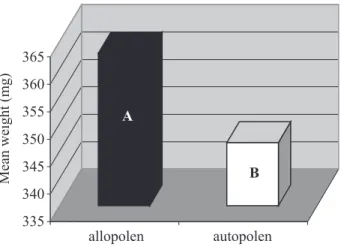
A mean weight increase of 16.25 mg per kernels was observed in kernels fertilized by allopollen, compared to fertilized by autopollen (Figure 1).
This increased mean kernels weight can be due to several factors. One of them may be related to inbreeding depression, which occurs in the kernels that receives plant-own pollen. In other words, since the deleterious alleles are masked in heterozygous loci in the hybrids, there is the chance of a meeting in self-fertilization. This can occur principally in plantations of single cross hybrids, where in spite of high heterosis manifested in the F1 plants, these plants hypothetically have the same genotype. Therefore, even in cross pollinations within this single cross hybrid population, the resulting kernels would be selfed. Combinations of dominant or partially dominant alleles can also affect phases or specific grain development processes that reduce the final weight (Leng 1949).
In this experiment heterosis caused by allopollen was 4.65%, compared to autopollen. This gain, despite lower than the 11.90 % observed by Balestre et al. (2007), demonstrated that even in reciprocal crosses, allopollen ensures an increase in mean kernel weight. These data differ from those obtained by Tsai and Tsai (1990); Weiland (1992) and Andrade and Pereira (2005) who studied single, double and also triple cross hybrids, and observed no effect of allopollen on reciprocal crosses. The autopollen effect can be different in reciprocal crosses, since the proportion between maternal and paternal genomes differs in the triploid endosperm. This, together with the genetic effects in the control loci of the trait and also with a possible Figure 1. Mean weight of kernels originated by allopollen and autopollen, respectively, in the growing season 2004/2005. La-vras, MG
335 340 345 350 355 360 365
allopolen autopolen
Meanweight(mg)
Means followed by the same letter did not differ from each other at 5% probability
A A
maternal effect, can lead to differentiated allopollen effects in reciprocal crosses. Another factor that can interfere with the heterotic effect in the embryo and endosperm is the hybrid combining ability, since, as well as the lines, the hybrids differ in the general and specific ability. In other words, there is a difference in heterosis, that is related to the existence of dominance and divergence in the lines and, consequently, of the hybrids (Falconer and Mackay 1997). Even under the influence of the maternal effect, the most contrasting pairs have chances of higher gains.
The cross effect within each ear was highly significant (Table 1), demonstrating that the weight of allopollen or autopollen-originated kernel varies from ear to ear. This variation was observed in all crosses. There was also a highly significant difference in the increase obtained by allopollen compared to the crosses. This demonstrates that the increase by allopollen varies according to the hybrid pair used, that is, depends on the specific combining ability of these hybrids.
The mean square for treatment, in this case mean weight of autopollen or allopollen-derived kernel was significant, which shows that pollen origin and kernel weight are indeed correlated (Table 1).
There was no interaction between crosses and mean kernel weight. This shows that allopollen ensured kernel weight increase independently of the crosses.
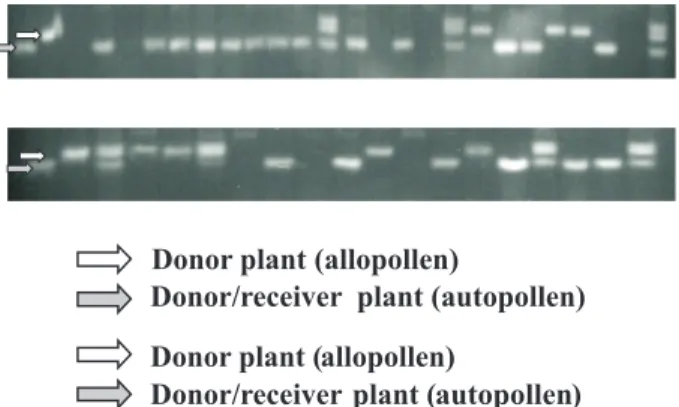
Of the 50 primers used, two were selected to identify polymorphism in the five hybrids (BNLG 1016 and UMC 1653) (Figure 2). These primers were chosen due to the distinctness of polymorphic bands found in the agarose gels. In a similar study, Luders (2006) tested 100 SSR primers to find one primer that could differentiate the three single hybrids simultaneously.
Table 1.Mean square of errors of the comparison of weight of kernels originated by allopolen and kernels originated by autopollen
SV df MS
Ear (Cross) 16 3900.09**
Cross 3 38052.63**
Treatment 1 2640.63*
Cross*Treatment 3 751.83ns
Error 16 388.59
CV 5.56
χ χ χ χ
χ2 2.69
ns
** Significant at 1% probability by the F test * Significant at 5% probability by the F test
Since it was not possible to find a single primer that could separate all five hybrids used here, two sets of primers were used.
The frequency of allo and autopollen-derived kernel sampled in the ears and identified by microsatellite markers coincided with the pollinated volume of the same in the ears (50 % of each). The c2 test demonstrated that the deviations were non-significant, that is, the variation in the percentage from allopollen to autopollen was random, showing that the grain frequency fertilized by allopollen was not higher, as observed in previous studies (Mercer 2002, Balestre et al. 2007). This information must however be interpreted with caution since only 10 grains per ear had been sampled, while in the previous studies all grains had been used, principally owing to easy identification of the origin when using a morphological marker for the trait endosperm color.
It was concluded that allopollen induced a significant increase in kernel weight. The data were obtained experimentally which makes field tests with mixtures of single cross hybrid cultivars necessary to prove the viability of this technique. The simple fact of using hybrid mixtures in the field to test combining ability would increase the farmers’ yields, without increasing production costs.
ACKNOWLEDGEMENTS
We would like to thank FAPEMIG for funding this research and Prianda Rios Laborta and Professor Doctor Anete Pereira de Souza for donating the microsatellite primers.
Donor plant (allopollen)
Donor/receiver plant (autopollen)
Donor plant (allopollen)
Donor/receiver plant (autopollen)
Efeito da autopolinização monitorada por marcadores
Efeito da autopolinização monitorada por marcadores
Efeito da autopolinização monitorada por marcadores
Efeito da autopolinização monitorada por marcadores
Efeito da autopolinização monitorada por marcadores
microssatélites no peso de grãos em milho
microssatélites no peso de grãos em milho
microssatélites no peso de grãos em milho
microssatélites no peso de grãos em milho
microssatélites no peso de grãos em milho
RESUMO - O objetivo deste trabalho foi avaliar o efeito da fertilização por autopólen no peso dos grãos de milho. Utilizaram-se cinco híbridos simples (30F90, A2555, DKB333B, 2223 e 2324). Após a emergência dos híbridos foram retiradas amostras das folhas para posterior extração de DNA. Realizaram-se os cruzamentos: 2223XDKB333B; 2223XA2555; 2324XDKB333B e 2324XP30F90. Foram separados 10 grãos de cada espiga de cada cruzamento. Esses grãos foram semeados em casa de vegetação e o DNA dos respectivos seedlings foram extraídos, para identificação da origem do grão. Os resultados obtidos neste trabalho demonstraram que o alopólen proporcionou um incremento médio no peso dos grãos de 16,25mg, sendo este ganho da ordem de 4,65%. A proporção amostrada de alopólen a autopólen foi estatisticamente igual segundo o teste do c2, demonstrando que não ocorreram desvios significativos entre a proporção de alo e autopólen fertilizados e amostrados na espiga. Conclui-se que o alopólen proporciona um aumento no peso médio dos grãos em relação aos fertilizados pelo autopólen.
Palavras-chave: efeito xênia; alopólen, SSR, peso de grãos.
REFERENCES
Andrade JAC and Pereira FCD (2005). Uso do efeito de xênia
em híbridos comerciais de milho (Zea mays L.). Revista
Brasileira de Milho e Sorgo 4: 65-78.
Balestre M, Souza JC, Luders, RR and Silva NO (2007). Effect o f a l l o p o l l e n i n a r t i f i c i a l c r o s s e s o f w h i t e a n d y e l l o w
endosperm maize hybrids. Crop Breeding and Applied
Biotechnology 7: 82-87.
Bulant C and Gallais A (1998). A. Xenia effects in maize with
n o r m a l e n d o s p e r m : I . I m p o r t a n c e a n d s t a b i l i t y. C ro p
Science 39: 1517-1525.
Bulant C, Gallais A, Matthys-Rochon E and Prioul JL (2000). Xenia effects in Maize with normal endosperm: II. Kernel
growth and enzyme activities during grain filling. Crop
Science 40: 182-189.
Davarynejad GH, Nyéki J, Hámori Szabó J and Lakner Z (1994) Relationship between pollen donors and quality of fruits of
1 2 a p p l e c u l t i v a r s . I n : I n t e r n a t i o n a l S y m p o s i u m o n
p o s t h a r v e s t t re a t m e n t o f h o r ticultural crops. Acta Horticultura, Keeskemet, p. 344-354.
David O, Monod H, Lorgeou J and Philippeau G (2001). Control o f i n t e r p l o t i n t e r f e r e n c e i n g r a i n m a i z e : a m u l t i - s i t e
comparison. Crop Science 41: 406-414.
Denney J (1992) Xenia includes metaxenia. HortScience 27:
722-728.
F a l c o n e r D D a n d M a c k a y T F C . (1997) I n t r o d u c t i o n t o
quantitative genetics. Longman, New York 464p.
Hoekstra G J, Kannenberg LW and Christie BR (1985). Grain yield comparison of pure stands and mixture of different
proportions for two hybrids of maize. Canadian Journal
of Plant Science 65: 481-485.
Leng ER (1949) Direct effect of pollen parent on kernel size in
dent corn. Agronomy journal 41: 555-558.
Lopes MA. and Larkins BA (1993) Endosperm origin, development
and function. The Plant Cell 5: 1383-1399.
Luders RR (2006) Efeito de Xênia em híbridos comerciais
de milho visando ao aumento de produtividade. PhD Thesis, Universidade Federal de Lavras, Lavras,113p.
Mercer J (2002) Implicações do fenômeno xênia nos programas de
melhoramento de milho. Ciênciae Agrotecnologia 26:
1338-1343.
Pinter L, Szabo J and Horompoli E (1987). Effect of metaxenia on
the grain weight of the corn (Zea mays L.). Maydica 32: 81-88.
Saghai-Maroof MA, Soliman KM, Jorgensen RA and Allard RW (1984). Ribosomal DNA spacer length polymorphism in barley: Mendelian inheritance, chromosomal location, and
p o p u l a t i o n d y n a m i c s . P r o c e e d i n g s o f t h e N a t i o n a l
Academy of Science of the United States of America, Washington, vol. 83, p. 1757-1761
Sefc KM, Steinkellner H, Glössl J, Kampfer S and Regner F (1998) Reconstruction of a grapevine pedigree by microsatellite
analysis. Theoretical and Applied Genetics 97: 227-231.
Seka D, Cross HZ and McClean PE (1995a) Maize kernel development In vitro: sucrose concentration, xenia, and
maternal effects. Crop Science 35: 74-79.
Seka D and Cross HZ (1995b) Xenia and maternal effects on
m a i z e a g r o n o m i c t r a i t s a t t h r e e p l a n t d e n s i t i e s . C r o p
Science 35: 86-90.
Tsai CL and Tsai CY (1990). Endosperm modified by cross-pollinating maize to induce changes in dry matter and
nitrogen accumulation. Crop Science30: 804-808.
Weiland RT (1992) Cross-pollination effects on maize ( Zea
mays L . ) , h y b r i d y i e l d s . C a n a d i a n J o u r n a l o f P l a n t