J. Evid. Based Med. Healthc., pISSN- 2349-2562, eISSN- 2349-2570/ Vol. 3/Issue 66/Aug. 18, 2016 Page 3561
A STUDY OF SYMPATHETIC FUNCTION TESTS DURING NORMAL MENSTRUAL CYCLE IN
YOUNG FEMALES IN THE AGE GROUP OF 18-25 YEARS
Aparajita Chakraborty1, Shrabani Barman2, Jyotismita Deka3
13rdYear Postgraduate, Department of Physiology, Silchar Medical College & Hospital. 2Professor & HOD, Department of Physiology, Silchar Medical College & Hospital. 3Associate Professor, Department of Physiology, Silchar Medical College & Hospital.
ABSTRACT
BACKGROUND
The menstrual cycle is not only a monthly cycle involving endometrial and cervical changes, but also is associated with many physical, psychological and behavioural changes.
AIMS
The study we have undertaken here was conducted to assess the blood pressure changes in response to isometric hand grip exercise test, cold pressor test and postural challenge test during the three different phases of the menstrual cycle in normal healthy females.
SETTINGS AND DESIGN
The present study was a cross-sectional study involving a study group of thirty healthy females. The tests were done in Department of Physiology, Silchar Medical College & Hospital.
METHODS AND MATERIALS
We randomly selected thirty healthy young girls in the age group of 18-25 years for our study. The resting blood pressure was recorded and the cardiovascular sympathetic function tests performed were Isometric handgrip exercise test, cold pressor test and postural challenge test.
STATISTICAL ANALYSIS USED
Statistical analysis was obtained by using ANOVA and paired-t test techniques. SPSS 18.0 and MS Excel software were used to perform the analysis.
RESULTS
Secretory (luteal) phase presented with a significant increase in the resting systolic blood pressure (119.1±4.41) and diastolic blood pressure (74.43±4.26), as compared to menstrual phase (SBP 116.11±4.23 & DBP 72.13±3.44) and proliferative (Follicular) phase (SBP 110.23±4.46 & DBP 69.13±3.13). This shows a sympathetic hyperactivity in luteal phase (p<0.05). The systolic and diastolic blood pressure also showed significant increase (p<0.05) in response to three tests. 1. Isometric handgrip exercise, 2. Cold pressor tests and 3. Postural challenge test, during their luteal phase as compared to the other two phases of menstrual cycle.
CONCLUSION
Our study shows that sympathetic activity is highest during luteal phase and lowest in the follicular phase as compared to the menstrual phase.
KEYWORDS
Follicular Phase, Luteal Phase, Sympathetic Function Tests, Menstrual Cycle.
HOW TO CITE THIS ARTICLE: Chakraborty A, Barman S, Deka J.A study of sympathetic function tests during normal menstrual cycle in young females in the age group of 18-25 years. J. Evid. Based Med. Healthc. 2016; 3(66), 3561-3566. DOI:10.18410/jebmh/2016/764
INTRODUCTION: The menstrual cycle apart from being a cycle of monthly periods involving endometrial and cervical
changes, also is associated with many physical, psychological and behavioural changes. It is purely a neurohormonal cycle controlled by hypothalamo-pituitary-ovarian axis.1 The cyclical hormonal changes include firstly
a phase of oestrogen, the follicular phase which is influenced by follicular stimulating hormone, secondly a phase of progesterone called the luteal phase which is influenced both by follicular stimulating hormone and luteinising hormone and thirdly the menstrual phase which is due to the withdrawal of hormonal effect on endometrium.2 It is reported that these hormonal Financial or Other, Competing Interest: None.
Submission 09-07-2016, Peer Review 19-07-2016, Acceptance 08-08-2016, Published 17-08-2016. Corresponding Author:
J. Evid. Based Med. Healthc., pISSN- 2349-2562, eISSN- 2349-2570/ Vol. 3/Issue 66/Aug. 18, 2016 Page 3562
fluctuations may result in some autonomic function alterations. Reproductive hormones like oestrogen, are known to modulate cardiovascular function through multiple mechanisms, including stress induced activation of the hypothalamic pituitary adrenal and sympatho-adrenomedullary systems.3
Also the physiological changes observed during the luteal phase of menstrual cycle mimic early pregnancy.4
Normally, the sympathetic nerves discharge in a tonic fashion which constricts the arterioles and veins, increases the heart rate and stroke volume. The blood pressure is also adjusted by variable rate of this tonic discharge.5 The
incidence of coronary artery disease and hypertension is comparatively lower in women of reproductive age, but rises sharply after menopause. These initial CVS benefits are due to the action of oestrogen which decreases LDL cholesterol and increases HDL cholesterol. It also causes vasodilatation by an endothelial nitric oxide synthase dependent genomic mechanism and also via calcium dependent nitric oxide synthase.6 The previous studies
conducted on autonomic functions during various phases of menstrual cycle show varying results. Such study is also not conducted recently in our zone so hereby the study is selected and conducted.
MATERIALS AND METHODS: Thirty unmarried
nulliparous young healthy females were selected as subjects. A detailed menstrual history was obtained. General and systemic examination done. The ethical clearance was obtained from the institutional ethical committee. Subjects were explained the purpose and procedures of the study and written informed consent for the study was taken.
Inclusion Criteria: Young girls (18-25 years) having regular 28- day menstrual cycles for last 6 months and normal BMI (18.5-24.9 kg/m²).
Exclusion Criteria: Subjects having irregular menstrual cycle, Anovulatory cycles (If diagnosed), taking any medicines or hormonal preparation that could alter the menstrual hormonal milieu, any illness, smokers, alcoholics, athletes (Severe physical activity). Height and weight were measured with standard stadiometer and weighing machine and BMI calculated by Quetelet’s index (Wt. in kg)/(Height in m)².
Subjects were examined on the 1-5th day, 9-12th day and 19-22nd day to represent the menstrual, proliferative and secretory phases respectively.
The following Sympathetic function tests were performed: a. Blood pressure response to immediate standing. b. Cold Pressor Test.
c. Blood pressure response to sustained hand-grip exercise.
Resting blood pressure of the subjects was recorded by following auscultatory method using a mercury sphygmomanometer (DIAMOND).
The subjects were asked to rest for few minutes in our research lab (Silent room) to reduce their apprehension, if any. Then the resting blood pressure was recorded. First appearance of Korotkoff sound was taken as systolic blood pressure and the point it disappeared is taken as the diastolic blood pressure.3
Cold Pressor Test: The procedure was explained to the girls. After recording resting blood pressure, subjects were asked to dip left arm in the ice cold water (2-40 C).3 for 60
seconds.7 and blood pressure was recorded from the right
arm. At the end of one minute, systolic and diastolic blood pressures were recorded, prior to removing the hands from cold water.8 The blood pressure response to cold pressor
test is taken as the increase in systolic and diastolic blood pressure from resting blood pressure.
Isometric Handgrip Exercise Test: After recording resting blood pressure in sitting posture, the subject was instructed to grip the handgrip dynamometer maximally with their dominant hand. It was repeated thrice with rest in between to prevent fatigue. Mean of the three readings was referred as maximal isometric tension (Tmax).3 Then,
they were asked to grip the dynamometer and maintain the pressure on dynamometer for 2 min. at 30% of Tmax and the blood pressure was recorded from the non-exercising arm one minute after onset of hand grip and just prior to release of hand grip at 2 minutes.9 The test was done with
the arm outstretched forming an angle of 30° with respect to the trunk, and with the palm of the hand perpendicular to the shoulder line.10 The result is expressed as the
difference between the highest systolic and diastolic blood pressure during the test and the resting blood pressure before the test.
Postural Challenge Test: The subject was asked to lie down quietly for 10 minutes and the resting blood pressure was recorded. Then, they were asked to stand up, unaided, within 5 seconds and remain standing quietly for 1 minute, then the systolic and diastolic blood pressure was measured at the end of 1 minute.7 The postural fall of
blood is taken as the difference of the systolic and diastolic blood pressure on lying posture with that obtained on standing.
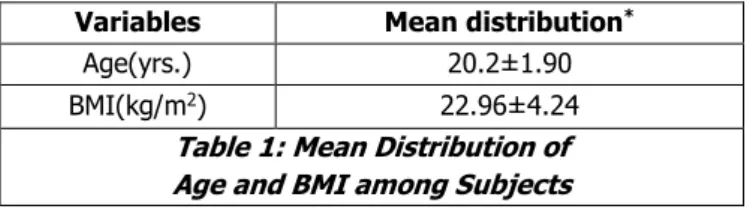
RESULTS: Statistical analysis was obtained by using ANOVA and paired-t test techniques. SPSS 18.0 and MS Excel software were used to perform the analysis. As ANOVA revealed significant variation of Blood Pressure across the different phases, students’ paired-t tests were carried out to study significance of variations between different groups.
Variables Mean distribution*
Age(yrs.) 20.2±1.90
BMI(kg/m2) 22.96±4.24
Table 1: Mean Distribution of Age and BMI among Subjects
J. Evid. Based Med. Healthc., pISSN- 2349-2562, eISSN- 2349-2570/ Vol. 3/Issue 66/Aug. 18, 2016 Page 3563
Parameters Menstrual
Phase(MP)
Follicular Phase (FP)
Luteal phase (LP)
MP vs FP (p-value)
MP vs LP (p-value)
FP vs LP (p-value)
Resting SBP 117.53±13.70 110.93±13.56 121.80±12.86 <0.001** <0.001** <0.001**
Resting DBP 84.07±10.30 78.33±10.21 91.53±10.31 <0.001** <0.001** <0.001**
IHG SBP 135.60±12.77 128.47±12.67 145.13±13.16 <0.001** <0.001 <0.001**
IHG DBP 99.67±8.12 92.27±12.91 105.20±11.72 <0.001** 0.004** <0.001**
Postural SBP 110.93±13.63 105.60±13.98 114.00±13.19 <0.001** <0.001** <0.001 **
Postural DBP 80.53±11.03 74.73±10.29 82.87±9.51 <0.001** 0.138 <0.001**
CPT SBP 130.07±11.17 124.67±11.41 138.47±11.78 <0.001 ** <0.001** <0.001 **
CPT DBP 96.80±8.97 90.07±10.73 106.47±8.05 <0.001 ** <0.001** <0.001 **
Table 2: Comparative Analysis of Sympathetic Function Tests during Different Phases of the Menstrual Cycle
J. Evid. Based Med. Healthc., pISSN- 2349-2562, eISSN- 2349-2570/ Vol. 3/Issue 66/Aug. 18, 2016 Page 3564 DISCUSSION: In the present study, the luteal (Secretory)
phase showed significant increase in the resting systolic and diastolic blood pressure (BP) and also increase in BP in response to Isometric Handgrip Exercise, Cold Pressor Test and posture challenge test as compared to the menstrual phase and follicular (Proliferative) phase. Studies show that premenopausal women are safe from coronary heart disease (CHD) as compared with age-matched men. But this protective phenomena disappears after menopause. This suggests female sex hormones like oestrogen and progesterone on the cardiovascular system have some
beneficial effects. Oestrogens also are known to prevent the occurrence of atherosclerosis by beneficial effects on the intact endothelium, but once the vascular endothelium is injured, the prothrombotic and proinflammatory effects of oestrogens may predominate.8
It has been documented that oestrogen causes release of prostacyclin and nitric oxide and also inhibits the production of potent vasoconstrictors like endothelins and angiotensinogen II.3 Nitric oxide, also called EDRF
J. Evid. Based Med. Healthc., pISSN- 2349-2562, eISSN- 2349-2570/ Vol. 3/Issue 66/Aug. 18, 2016 Page 3565
NO formed in endothelium diffuses into surrounding smooth muscle cells, activates soluble enzyme named guanylyl cyclase and produce cGMP. This is responsible for causing vascular smooth muscle relaxation.11 As a
consequence oestrogen can cause the vessels to relax and this may be a reason for getting less blood pressure rise in the follicular phase.3 It has been reported that endogenous
progesterone was known to have hypertensive effect, whereas administration of oestrogen promoted vasodilator effect by increased prostacyclin and nitric oxide synthesis.4
In the follicular phase, increase in the density and function
of presynaptic α2 adrenoreceptors is a known effect of the
hormone oestrogen. This results in decrease in the secretion of noradrenaline.12 Estradiol might also be
associated with increase in acetylcholine concentration.13
Estradiol increases progesterone receptors. There is increased action of progesterone during the luteal phase and this may be responsible for increased sympathetic activity. During the luteal phase, progesterone may increase cardiac excitability by opposing effects of oestrogen.14 Progesterone also exerts an inhibitory effect
on the cardiovagal baroreflex responses. All of these results in parasympathetic predominance in the follicular phase and sympathetic dominance in the luteal phase.
On sudden change of posture from supine to standing, there is peripheral pooling of blood in the dependent parts of the body which decreases the venous return and cardiac output so the systolic blood pressure decreases. This via the sino-aortic reflex, which operates within seconds, stabilises the blood pressure.15 But the autonomic function
alteration in the different phases of menstruation results in alteration of the baroreflex caused by posture changes and this explains the results. Increased sympathetic activity induced by cold water stress causes norepinephrine release and elevates blood pressure.
Also release of endothelins, prostaglandins and angiotensin II may be contributing factors.16 When
isometric handgrip exercise is performed, there is local collection of chemical substances like lactic acid, adenosine etc. These accumulated metabolites are detected by metabolite-sensitive free afferent nerve endings distributed in and around the skeletal muscle tissue. These substances can increase the discharge of a special type of chemoreceptor called metaboreceptor (Group IV, unmyelinated), which generates a reflex resulting in increased sympathetic nerve activity. This constricts vessels and hence raises blood pressure.3 In the menstrual phase,
due to reduced progesterone levels, resting blood pressure and the blood pressure response to the tests like isometric handgrip exercise, cold pressor tests and postural challenge test is significantly less than during luteal phase. The blood pressure is also significantly lower in follicular phase for all the tests due to raised oestrogen levels. Again, the blood pressure for all the applied tests in this study is significantly higher in the luteal phase.17,18
CONCLUSION: Our study shows that maximum
sympathetic drive is in luteal phase. This can be explained by the higher oestrogen and progesterone levels during this phase of menstrual cycle. Our study is not free from the drawbacks of having a small sample size. But the variations in blood pressure noticed may also open path for further studies to find if any alteration of the dose of antihypertensive drugs is beneficial in the management of the hypertensive women of reproductive age group. Such work may also direct towards the need of more research work in the field of finding the benefits of using oestrogen or Hormone Replacement Therapy in postmenopausal women for enjoying the cardiovascular protective benefit.
ACKNOWLEDGEMENT: The authors thank the subjects for their co-operation and participation without which the study would not have been a success.
REFERENCES
1. Kavitha C, Jamuna BL, Vijaykumar GS. Pressor response during normal menstrual cycle. Int J Biol Med Res 2012;3(3):1975-1981.
2. Williams. Pregnancy planning and antepartum management. Text book of obstetrics. 22ndedn.
McGraw-Hill 2006:p. 226.
3. Garg R, Malhotra V, Dhar U, et al. A study of sympathetic function tests during different phases of menstrual cycle in normal healthy females. J of Evolution of Med and Dent Sci 2014;3(24):6590-6600.
4. Chapman AB, Zamudio S, Woodmansee W, et al. Systemic and renal haemodynamic changes in the luteal phase of the menstrual cycle mimic early pregnancy. Am J Physiol 1997;273(5Pt 2):777-782. 5. Ganong WF. Dynamics of blood flow and lymph
flow. Cardio vascular regulatory mechanisms, Review of medical physiology. 22nd edn. Lange
2005;30:590.
6. Arifuddin MS, Hazari AH, Reddy R. Blood pressure variations during different phases of menstrual cycle. International Journal of Science and Nature 2012;3(3):551-554.
7. Misra UK, Kalita J. Autonomic nervous system testing. Clinical neurophysiology 3rd edn. Elsevier
2014:106-117.
8. Gouva L, Tsatsoulis A. The role of estrogens in cardiovascular disease in the aftermath of clinical trials. Hormones (Athens) 2004;3(3):171-183. 9. Kumar M, Verma NS, Tiwari S, et al. Sympathetic
hyperactivity in patients of bronchial asthma. Indian J Physiol Pharmacol 2005;49(1):89-94.
J. Evid. Based Med. Healthc., pISSN- 2349-2562, eISSN- 2349-2570/ Vol. 3/Issue 66/Aug. 18, 2016 Page 3566
11. Barret K, Brooks H, Boitano S, et al. Ganong’s review of medical physiology. 23rd edn. Tata McGraw
Hill 2010:p. 564.
12. Salch TM, Connell BJ. Role of 17 beta-estradiol in the modulation of baroreflex sensitivity in male rats. Am J Physiol 1998;275(3 Pt 2):R770-R778.
13. Constantini NW, Dubnov G, Lebrun CM. The menstrual cycle and sport performance. Clin Sports Med 2005;24(2):51-82.
14. Kondo M, Hirano T, Okamura Y. Changes in autonomic nerve function during the normal function measured by the coefficient of variation of R-R intervals. Nippon Sanka Fujinka Gakki Zasshi 1989;41(5):513-518.
15. Hassan AAK, Carter G, Tooker JE. Postrual vasoconstriction in women during normal menstrual cycle. Clin Sci 1990;78(1):39-47.
16. Velasco M, Gomez J, Blanco M, et al. The cold pressor test: pharmacological and therapeutic aspects. American Journal of Therapeutics 1997;4(1):34-38.
17. Das TK. Effects of the menstrual cycle on timing and depth of breathing at rest. Indian J Physiol Pharmacol 1998;42(4):498-502.