Secretion System (T4SS) Common Existing in
Gram-Positive Genus
Streptococcus
Wen Zhang1., Chengbo Rong2., Chen Chen1
*, George F. Gao1,2,3*
1National Institute for Communicable Disease Control and Prevention, Chinese Center for Disease Control and Prevention/State Key Laboratory for Infectious Disease Prevention and Control, Beijing, China,2CAS Key Laboratory of Pathogenic Microbiology and Immunology, Institute of Microbiology, Chinese Academy of Science, Beijing, China,3Beijing Institutes of Life Science, Chinese Academy of Sciences, Beijing, China
Abstract
A growing number of pathogens are being found to possess specialized secretion systems which they use in various ways to subvert host defenses. Type IV secretion system (T4SS) is one of versatile secretion systems essential for the virulence and even survival of some bacteria species, and they enable the secretion of protein and DNA substrates across the cell envelope. T4SS was once believed to be present only in Gram-negative bacteria. In this study, we present evidence of a new subclass of T4SS, Type-IVC secretion system and indicate its common existence in the Gram-positive bacterial genus Streptococcus.We further identified that VirB1, VirB4, VirB6 and VirD4 are the minimal key components of this system. Using genome comparisons and evolutionary relationship analysis, we proposed that Type-IVC secretion system is movable via transposon factors and mediates the conjugative transfer of DNA, enhances bacterial pathogenicity, and could cause large-scale outbreaks of infections in humans.
Citation:Zhang W, Rong C, Chen C, Gao GF (2012) Type-IVC Secretion System: A Novel Subclass of Type IV Secretion System (T4SS) Common Existing in Gram-Positive GenusStreptococcus. PLoS ONE 7(10): e46390. doi:10.1371/journal.pone.0046390
Editor:Patrick M. Schlievert, University of Iowa Carver College of Medicine, United States of America
ReceivedJuly 12, 2012;AcceptedAugust 29, 2012;PublishedOctober , 2012
Copyright:ß2012 Zhang et al. This is an open-access article distributed under the terms of the Creative Commons Attribution License, which permits unrestricted use, distribution, and reproduction in any medium, provided the original author and source are credited.
Funding:Our work was supported by the Young Scholar Scientific Research Foundation of China CDC (No. 2010A104), the Priority Project on Infectious Disease Control and Prevention (No. 2008ZX10004–008), National Natural Science Foundation of China (NSFC, Grant No. 81021003), the China Postdoctoral Science Foundation (20100470590) and the National Key Program of Mega Infectious Diseases (Grant No.2013ZX10004-221). There has been no significant financial support for this work that could have influenced its outcome.
Competing Interests:The authors have declared that no competing interests exist.
* E-mail: [email protected] (GFG); [email protected] (CC)
.These authors contributed equally to this work.
Introduction
A growing number of pathogens are being found to possess specialized secretion systems which they use in various ways to subvert host defenses [1]. Type IV secretion system (T4SS) is one of versatile secretion systems essential for the virulence and even survival of some bacteria species, and they enable the secretion of protein and DNA substrates across the cell envelope [2,3,4,5].
Based on a number of characteristics, including, the organiza-tion of genetic determinants, shared homologies and evoluorganiza-tionary relationships, T4SSs have been divided into several subgroups: Type-IVA, Type-IVB systems and other T4SSs [6,7]. The
Agrobacterium tumefaciensVir system is considered to be the paradigm of Type-IVA, which consists of 12 components, VirB12VirB11 and VirD4 [7]. VirB1, with its lytic transglycosylase subunits, can create holes in the cell wall to enable the movement of T4SS [3,8]. VirB2 and VirB5 are pilus components [3,9,10]. Three cytoplas-mic ATPases, VirB4, VirB11, and VirD4, provide energy for substrate secretion and assist in the assembly of the T4SS [3]. VirD4 is referred to as a coupling protein which recruit the substrates to the T4SS for translocation [11,12]. VirB6 and VirB8 are polytopic inner membrane proteins essential for substrate secretion through the inner membrane in Gram-negative bacteria [3,13], while VirB7-VirB9-VirB10 forms a stable core complex that spans the cell membrane [3,14]. The type-IVB secretion
system was initially found inLegionella pneumophilaand is composed of 25 genes on two separate regions. Region I contains seven genes (icmV, W and X, and dotA, B, CandD), and Region II contain the other 18 genes (icmT, S, R, Q, P, O, N, M, L, K, E, G, C, D, J, B, F
andH) [15]. The majority of these genes were also found in the genome sequences of Coxiella burnetti [15,16]. More recently, a novel lineage of T4SSs classified as ‘‘others’’ have been identified on the genomic island ICEHin1056ofHaemophilus influenza[7,17]. T4SS was once believed to be present only in Gram-negative bacteria but has been found in Gram-positive organisms as well. Our previous work support that in Gram-positive species of
Streptococcus suis(S. suis), a GI-type T4SS-like system was identified in a new pathogenicity island (PAI) with a length of 89 kb [18], which was further proven to be a new subgroup of T4SS in this study.S. suis, a Gram-positive species ofStreptococcusfound in pigs, has recently caused a rash of human infections in China and gained public attention [19,20,21,22]. In these epidemic S. suis
isolates related to two recent large-scale outbreaks of human infection in China, we identified this new 89 kb PAI with GI-type T4SS-like system [18]. Our works also showed that this 89K PAI can spontaneously excise to form an extrachromosomal circular product, laterally conjugally transfer to non-89KS. suisrecipients through the 89K-encoded GI-type T4SS [23]. Based on genome comparisons and evolution relationship analysis in the current
study, we identified that this GI-type T4SS-like system is a new subgroup T4SS named as Type-IVC secretion system for its clearly different genetic organization with type-IVA and type-IVB in Gram-negative bacteria. VirB1, VirB4, VirB6 and VirD4 were proven to be the minimal key component of type-IVC secretion system. We further identified that type-IVC secretion system is unexpectedly popular in the genus Streptococcus. This system is movable with the help of transposon factors (such as Tn916), which could also mediate the conjugative transfer of DNAs and enhance bacterial pathogenicity.
Materials and Methods
1. Genome Sequences ofStreptococcus
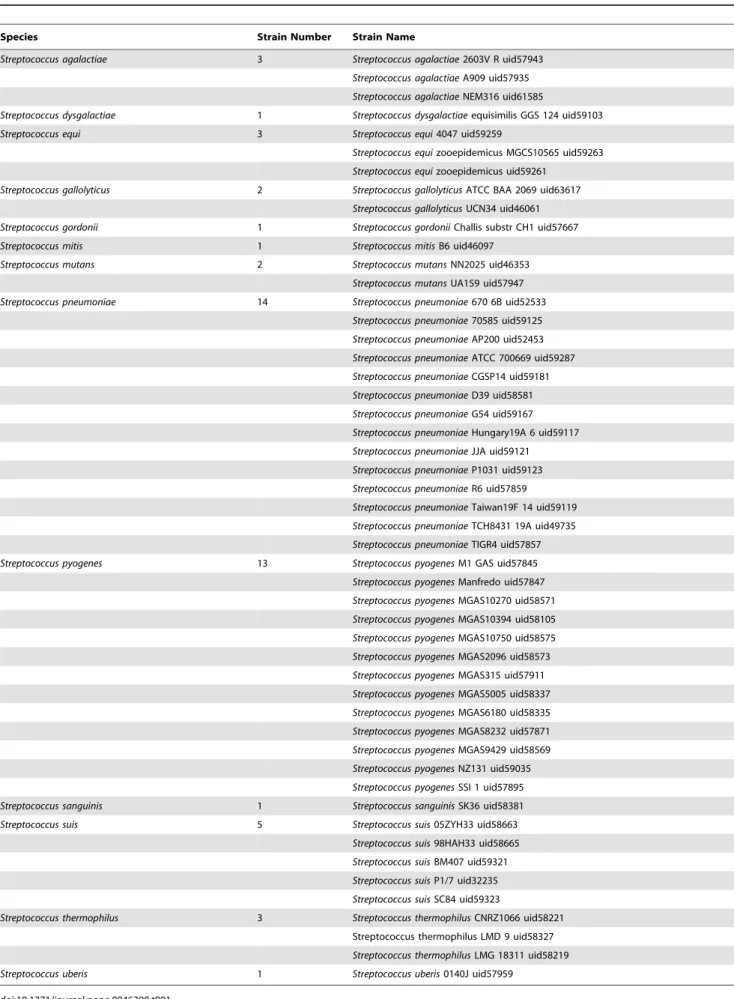
TheStreptococcus strains used in the current study are listed in Supplemental Tables. Whole genome sequences of 50 strains of
Streptococcus(Table 1) were downloaded from the NCBI ftp (ftp:// ftp.ncbi.nih.gov/genomes). Draft genome sequences of 67 Strepto-coccusstrains were also obtained from the NCBI database (Table S2).
We manually collected 839 gene sequences of the 12 components of T4SS (virB12virB11 and virD4) from the NCBI and UniprotKB database [24,25].
2. Genome-wide Search for T4SS Genes andvirB/D Cluster
To search for genes in the T4SS, a new program (TFSP) was used (http://t4ss.bioinfo-icdc.org/). This program combines the alignment algorithm approaches, prediction of protein functions, and domain evaluation to detect candidate T4SS genes (virB1211 andvirD4) in genomes of bacteria (the detailed method is shown in the Protocol S1) with good precision.
Based on the locations of identified T4SS genes (virB/Dgenes), we foundvirB/Dclusters in genomes ofStreptococcus. In this study, determination of virB/D clusters conformed to the following criteria: (1) the distance between two nearbyvirB/Dgenes is less than 5 kb, (2) the total length of the virB/D cluster is less than 50 kb, and (3) the number ofvirB/Dgenes in avirB/Dcluster is
$3.
3. Identification of Genomic Islands (GI) withvirB/D Cluster
For co-lineage comparisons, Blast similarity searches were performed using local BLAST software [26]. Based on the Blast results, the GI and its precise location in the genome were determined by the co-lineage comparison between a genome with avirB/Dcluster and one without it [27]. The GC content skew of GI was step-analyzed in a window of 2,000 bp by a self-developed Perl program (draw_GC_content.pl) [27]. The function of genes in the GI was annotated by the method of Clusters of Orthologous (COG) [28].
4. Construction of Phylogenetic Tree
rpoB is a housekeeping gene and highly conserved in many bacteria. We usedrpoBgene sequences in 50 species to generate a phylogenetic tree ofStreptococcus. Multiple sequence alignments of these gene sequences were performed using MEGA [29]. A phylogenetic tree was constructed using the neighbor-joining algorithm in Mega, and 1,000 subsets were generated for bootstrapping re-sampling of the data. Another tree was built based on the concatenated sequences of virB4, virB6, and virD4
genes using the same method.
Results
A New Subgroup of T4SS in Gram-positiveS. suis: Type-IVC Secretion System
A new subgroup of T4SS (GI-type T4SS) was identified in Gram-positive strainS. suis [18,23]. Genetic organization repre-sented that this GI-type T4SS in Gram-positive strain S. suisis clearly different with type-IVA, type-IVB and other T4SS in Gram-negative bacteria, thus it is classified as Type-IVC secretion system in this study (Figure 1). Different with other T4SS systems, only 4 proteins (VirB1, VirB4, VirB6, and VirD4) were identified in Type-IVC secretion systems, which mainly work in three fields: (1) transglycosylases (VirB1), working for degrading peptidoglycan outside the plasma membrane of bacteria, could reduce the resistance for the secretion of substrates; (2) ATPases (VirB4, and VirD4) play essential roles in supplying the energy for substrates translocation and apparatus assembly [4]; (3) a gene contributing to the assembly of the secretion channel across inner cell membrane(VirB6). These genes clustered together with the same direction in the chromosome. Those genes correspondent to channel subunit across outer membrane, such as VirB7/VirB9/ VirB10 in type-IVA and DotD/DotC/DotH/DotG/DotF in type-IVB, were lost in type-IVC secretion system (Figure 1 and Figure 2).
Popular Existence of Type-IVC Secretion System in Genus Streptococcus
To more fully understand the distribution of Type-IVC secretion system in genus Streptococcus, we used bioinformatic methods to predict T4SS genes (Figure S2) in 50 Streptococcus
strains with published genome sequences (Table 1). Detailed methods are described in the Method section. 15 Type-IVC secretion systems were identified in 14 of 50 Streptococcus strains (Table S1).S. suisBM407 (NC_012926) has two copies of T4SS, while the other 13 genomes have only one. All 15 Type-IVC secretion systems own clustered virB1-like/virB4/virB6/virD4 or
virB4/virB6/virD4genes in the same direction and order (Table S1 and Figure S2). The Type-IVC secretion system in S. pyogenes
MGAS2096 also has homolog ofvirB2gene. Our genome analysis represent that, most strains in Streptococcus were identified with
virB/Dgenes (Figure S1) and approximately 28% of allStreptococcus
strains have Type-IVC secretion system (Table S1).
Additional investigations into the 67 draft genomes of Strepto-coccusstrains (Table S2) further supported the belief that Type-IVC secretion system are popular inStreptococcus; in these studies, 19 Type-IVC secretion system were identified (Table S2).
Evolutionary Relationship Among Type-IVC Secretion Systems in GenusStreptococcus
Among 50 strains ofStreptococcus, 14 strains own additional DNA fragments (GI, 50–89 kb) with Type-IVC secretion system by co-lineage comparisons genomic comparison. Compared with the 89 kb PAI ofS. suis, the structures of these GIs are significantly variable (Figure S2): Their locations in the genomes are different and genes in these GIs are also variable. However, they retain some common features. First, all the GIs havevirB/Dgene clusters with similar genes. Second, genes in the virB/D clusters always have the same order and direction. Third, most of the clusters own a transposon, such as Tn916.
The phylogenetic tree obtained from the housekeeping gene
Table 1.List ofStreptococcusstrains with whole genomes used in the current study.
Species Strain Number Strain Name
Streptococcus agalactiae 3 Streptococcus agalactiae2603V R uid57943 Streptococcus agalactiaeA909 uid57935
Streptococcus agalactiaeNEM316 uid61585
Streptococcus dysgalactiae 1 Streptococcus dysgalactiaeequisimilis GGS 124 uid59103 Streptococcus equi 3 Streptococcus equi4047 uid59259
Streptococcus equizooepidemicus MGCS10565 uid59263
Streptococcus equizooepidemicus uid59261 Streptococcus gallolyticus 2 Streptococcus gallolyticusATCC BAA 2069 uid63617
Streptococcus gallolyticusUCN34 uid46061
Streptococcus gordonii 1 Streptococcus gordoniiChallis substr CH1 uid57667 Streptococcus mitis 1 Streptococcus mitisB6 uid46097
Streptococcus mutans 2 Streptococcus mutansNN2025 uid46353
Streptococcus mutansUA159 uid57947
Streptococcus pneumoniae 14 Streptococcus pneumoniae670 6B uid52533 Streptococcus pneumoniae70585 uid59125
Streptococcus pneumoniaeAP200 uid52453
Streptococcus pneumoniaeATCC 700669 uid59287 Streptococcus pneumoniaeCGSP14 uid59181
Streptococcus pneumoniaeD39 uid58581
Streptococcus pneumoniaeG54 uid59167 Streptococcus pneumoniaeHungary19A 6 uid59117
Streptococcus pneumoniaeJJA uid59121
Streptococcus pneumoniaeP1031 uid59123 Streptococcus pneumoniaeR6 uid57859
Streptococcus pneumoniaeTaiwan19F 14 uid59119
Streptococcus pneumoniaeTCH8431 19A uid49735 Streptococcus pneumoniaeTIGR4 uid57857
Streptococcus pyogenes 13 Streptococcus pyogenesM1 GAS uid57845
Streptococcus pyogenesManfredo uid57847 Streptococcus pyogenesMGAS10270 uid58571
Streptococcus pyogenesMGAS10394 uid58105
Streptococcus pyogenesMGAS10750 uid58575 Streptococcus pyogenesMGAS2096 uid58573
Streptococcus pyogenesMGAS315 uid57911
Streptococcus pyogenesMGAS5005 uid58337 Streptococcus pyogenesMGAS6180 uid58335
Streptococcus pyogenesMGAS8232 uid57871
Streptococcus pyogenesMGAS9429 uid58569 Streptococcus pyogenesNZ131 uid59035
Streptococcus pyogenesSSI 1 uid57895
Streptococcus sanguinis 1 Streptococcus sanguinisSK36 uid58381 Streptococcus suis 5 Streptococcus suis05ZYH33 uid58663
Streptococcus suis98HAH33 uid58665
Streptococcus suisBM407 uid59321
Streptococcus suisP1/7 uid32235 Streptococcus suisSC84 uid59323
Streptococcus thermophilus 3 Streptococcus thermophilusCNRZ1066 uid58221 Streptococcus thermophilus LMD 9 uid58327
Streptococcus thermophilusLMG 18311 uid58219
Streptococcus uberis 1 Streptococcus uberis0140J uid57959
not be caused by a mutation, but could perhaps be caused by several rounds of DNA acquisition from other strains. Our previous experiment proved that a GI with Type-IVC secretion system can spontaneously excise to form an extrachromosomal circular product and laterally transfer to another strain [23]. Considering the proven mobility of Type-IVC secretion system, we believe that Horizontal Transfers (HT) between species brought about the acquisition of Type-IVC secretion system in
Streptococcus. Figure 3B further shows thatvirB/D genes in Type-IVC secretion system have higher similarity in the same species
than that between two species, suggesting that the movement of GIs caused by HT occurs more easily within strains of a species than that between species.
Discussion
Minimal Components of Type-IVC Secretion System
In Gram-negative bacteria, Type-IVA secretion system usually consists of 12 components to work together just as the figure 2 shown. Thorough investigations about functions of these 12
Figure 1. Genetic organization of T4SS. For A. tumefaciens, gene names B =virB and D4 =virD4. For L. pneumophila, upper-case gene names =dotand lower-case gene names =icm. Genes in orange correspondents to periplasmic lytic transglycosylase, in green ATPase, in yellow T pilus, in red channel subunit across inner membrane, in blue channel subunit across outer membrane, in grey no T4SS genes or genes with the unclear function.
doi:10.1371/journal.pone.0046390.g001
Figure 2. Hypothetical model for Type-IVC secretion system.The colored parts are the components of the Type-IVC secretion system system. The grey parts are objects present in the canonical T4SS of Gram-negative strains but lost in the Gram-positive Type-IVC secretion system, e.g., the outer membrane, VirB2, and VirB5.
components showed that these genes mainly work in three fields: (1) transglycosylases (such as VirB1), working for degrading peptidoglycan outside the plasma membrane of bacteria, could reduce the resistance for the secretion of substrates; (2) ATPases (VirB4, VirD4 and VirB11) play essential roles in supplying the energy for substrates translocation and apparatus assembly [4]; (3) these are still some genes contributing to the assembly of the secretion channel across inner (VirB6 and VirB8) and outer membranes (VirB7, VirB9 and VirB10).
In Type-IVC secretion system ofStreptococcus, although only four components were identified (VirB1, VirB4, VirB6, and VirD4), they still work in same three fields (Figure 2). VirB1-like protein, with CHAP domain, could encode amidohydrolases and is responsible for punching holes through the peptidoglycan outside of the gram-positive cell membrane. VirB4 and VirD4 could supply energizes necessary for the substrate transport [4]. VirB6, the inner-membrane protein, is to compose the transport channel across the cell membrane. Since the lack of the outer membrane in
Figure 3. The phylogenetic tree.(A) The neighbor-joining (NJ) tree obtained on the basis of the housekeeping generpoB. The red solid circles represent GIs withvirB/Dclusters. (B) NJ tree obtained on the basis of a concatenated sequence ofvirB4,virB6, andvirD4genes in GI.
Gram-positive bacteria, it is not a surprise that proteins contributing to the assembly of the secretion channel across outer membranes (VirB7, VirB9 and VirB10) in type-IVA secretion systems have not been found in Type-IVC secretion system. The other components in 89K PAI may also play role in substrates transport but the determination of their functions requires further investigation. We propose that VirB1, VirB4, VirB6 and VirD4 are the minimal key component of Type-IVC secretion system (Figure 2).
The function of these four proteins (VirB1, VirB4, VirB6, and VirD4) for the secretion of DNA has been proven by making individual knockouts of T4SS gene homologues (DvirB1-89K,
DvirB4-89K, DvirB6-89K and DvirD4-89K) [23]. Our previous results showed that no transconjugants were obtained when
DvirB4-89K,DvirB6-89KandDvirD4-89Kwere used as donors. And the transfer frequency ofDvirB1-89K(9.261027) was six-fold less
than that of wild type strains [23]. Our other experiments in experimental infection of mice showed that knockout of VirB4 and VirD4 in this Type-IVC secretion system also eliminated the lethality of the highly virulent strain and impaired its ability to trigger host immune response [30].
Mobility of Type-IVC Secretion System
The phylogenetic tree of the housekeeping gene rpoB clearly showed that Type-IVC secretion system is movable, for strains with and without Type-IVC secretion system co-existing in several branches (Figure 3A). The popular existence of Type-IVC secretion system could not be only caused by mutations. HT between species underlie the presence of GIs with T4SS in
Streptococcus. Figure 3B further indicates that the movement of type-IVC secretion system occurs more easily within the strains of a species than that between species.
Our previous experimental work also proved that type-IVC secretion system was movable. InS. suis05ZYH33, 89-kb GI that could spontaneously excise to form an extrachromosomal circular product and lateral transfer from a donor to a recipient cell at a frequency of 1026
transconjugants/donor [23].
The HT of type-IVC secretion system is under the help of transposons. In the nearby DNA sequences of 15 Type-IVC secretion system inStreptococcus sp., 9 of 15 (60%) were identified with Tn916 transposons (Figure S2). Although without Tn916 nearby Type-IVC secretion systems, two strains (S. pneumoniae CGSP14 and S. pyogenes MGAS2096) harbored Tn916 residues, whereas the other two strains (S. pneumoniae Hungary19A and S. agalactiae 2603V) had Tn916 at another position on the chromo-some (Figure S2). Of the 4 strains without Tn916, 3 were found to have other transposons, like Tn5252 and Tn5421. Considering the surprisingly high correlation between transposons and Type-IVC secretion system, we could reasonably assume that some mobile elements necessary for the HT of T4SS were introduced by transposons. These mobile elements help T4SS move between cells, and the T4SS enables transposons to cross the barriers between donor and recipient cells. We believe that a random confusion between a transposon and minimal T4SS led to the formation of Type-IVC secretion system. Type-IVC secretion system gradually accumulated inStreptococcusspecies by HT, and an increasing number of strains harbor this system. During transport, the loss or acquisition of variable elements in this Type-IVC secretion system is ongoing. Further experimental work is necessary to support our hypothesis and answer questions regarding when the random event leading to the formation of Type-IVC secretion system occurred and whether HT of this system occurs between different species.
Function of Type-IVC Secretion System in Pathogenicity ofStreptococcus
The Type-IVC secretion system could enhance bacterial pathogenicity and mediate the injection of virulent proteins into host cells. Our previous study showed that the two component system SalK/R within the 89-kb island controls the virulence of the highly pathogenic strainS. suis2 [23]. Recently, using NimbleGen tiling arrays, Zhu and colleagues found this 89-kb fragment in 9 other virulentS. suis2 lineages, all of which were sampled from two recent large-scale outbreaks of human infection in China [31]. The 89-kb GI which include Tn916 with tetracycline-resistance genes of theS. suis2 strain was proved could laterally transfer to otherS. suis
2 strains with the help of Type-IVC secretion system [23]. Knockout of the 2 key components (VirD4 and VirB4) of theS. suis2 T4SS system eliminated the lethality of the highly virulent strain and impaired its ability to trigger host immune response in experimental infection of mice [30]. All of this evidence together suggests that Type-IVC secretion system contributes to the pathogenicity ofS. suis 2, particularly in the two outbreaks ofS. suis2 infections in China.
Conclusions
In this paper, we present evidence that the GI-type T4SS-like system we experimentally defined earlier inS. suisis unexpectedly popular in the genusStreptococcusbased on an analysis of deposited genome sequences. It always located in a GI with abnormal GC content. VirB1, VirB4, VirB6 and VirD4 are the minimal key component of this system in Streptococcus. We propose that this system in Gram-positive bacteria is a new subclass of T4SS (Type-IVC secretion system). Further, it is movable with the help of transposon factors, which could mediate the conjugative transfer of plasmid DNA/transposons and enhance bacterial pathogenicity.
Supporting Information
Figure S1 Strain numbers in whichvirB1–virB11andvirD4genes were identified. The blue columns are the number ofStreptococcus
strains with virB/D genes, whereas the red columns are the number ofStreptococcusstrains withvirB/Dclusters.
(DOC)
Figure S2 Genome islands with T4SS in 10 strains of
Streptococcus compared to the 89-kb GI in S. suis 05ZYH33. GC%, locations of thevirB/Dgenes, Tn916, and other important genes in GI are shown. A) S. suis SC84; B) S. suis BM407
(1000794,1091159); C) S. suis BM407(499472,585444); D) S.
pneumoniae P1031; E) S. pneumoniae G54; F) S. pneumoniae ATCC 700669; G) S. pneumoniae CGSP14; H)S. agalactiae 2603V R; I)S. agalactiae NEM316; J)S. pyogenes MGAS2096. Genes with varying functions are presented in different colors.
(DOC)
Table S1 List of virB/D clusters identified in 14 Streptococcus
strains. ID:virB/Dcluster ID in a genome; S: start site ofvirB/D
gene in genome; E: end site of virB/D gene in genome; D: direction ofvirB/Dgene.
(DOC)
Table S2 List ofStreptococcusstrains with draft genomes used in this study. ‘‘+’’ indicates that there is an identified virB/D gene cluster in this strain.
(DOC)
Author Contributions
Conceived and designed the experiments: CC GFG. Analyzed the data: WZ. Contributed reagents/materials/analysis tools: WZ CR. Wrote the paper: WZ. Prepared the figures: CR. Edited the manuscript: CR.
References
1. Sexton JA, Vogel JP (2002) Type IVB Secretion by Intracellular Pathogens. Traffic 3: 178–185.
2. Cascales E, Christie PJ (2003) The versatile bacterial type IV secretion systems. Nat Rev Micro 1: 137–149.
3. Fronzes R, Christie PJ, Waksman G (2009) The structural biology of type IV secretion systems. Nat Rev Micro 7: 703–714.
4. Waksman G, Fronzes R (2010) Molecular architecture of bacterial type IV secretion systems. Trends in biochemical sciences 35: 691–698.
5. Engel P, Salzburger W, Liesch M, Chang C-C, Maruyama S, et al. (2011) Parallel Evolution of a Type IV Secretion System in Radiating Lineages of the Host-Restricted Bacterial Pathogen Bartonella. PLoS Genet 7: e1001296. 6. Wallden K, Rivera-Calzada A, Waksman G (2010) Microreview: Type IV
secretion systems: versatility and diversity in function. Cellular Microbiology 12: 1203–1212.
7. Juhas M, Crook DW, Hood DW (2008) Type IV secretion systems: tools of bacterial horizontal gene transfer and virulence. Cellular Microbiology 10: 2377–2386.
8. Zupan J, Hackworth CA, Aguilar J, Ward D, Zambryski P (2007) VirB1* Promotes T-Pilus Formation in the vir-Type IV Secretion System ofAgrobacterium tumefaciens. The Journal of Bacteriology 189: 6551–6563.
9. Lai E-M, Kado CI (1998) Processed VirB2 Is the Major Subunit of the Promiscuous Pilus ofAgrobacterium tumefaciens. Journal of Bacteriology 180: 2711– 2717.
10. Schmidt-Eisenlohr H, Domke N, Angerer C, Wanner G, Zambryski PC, et al. (1999) Vir Proteins Stabilize VirB5 and Mediate Its Association with the T Pilus ofAgrobacterium tumefaciens. Journal of Bacteriology 181: 7485–7492.
11. Christie PJ, Atmakuri K, Krishnamoorthy V, Jakubowski S, Cascales E (2005) BIOGENESIS, ARCHITECTURE, AND FUNCTION OF BACTERIAL TYPE IV SECRETION SYSTEMS. Annual Review of Microbiology 59: 451– 485.
12. Tato I, Zunzunegui S, de la Cruz F, Cabezon E (2005) TrwB, the coupling protein involved in DNA transport during bacterial conjugation, is a DNA-dependent ATPase. Proceedings of the National Academy of Sciences of the United States of America 102: 8156–8161.
13. Cascales E, Christie PJ (2004) Definition of a Bacterial Type IV Secretion Pathway for a DNA Substrate. Science 304: 1170–1173.
14. Chandran V, Fronzes R, Duquerroy S, Cronin N, Navaza J, et al. (2009) Structure of the outer membrane complex of a type IV secretion system. Nature 462: 1011–1015.
15. Segal G, Feldman M, Zusman T (2005) The Icm/Dot type-IV secretion systems ofLegionella pneumophilaandCoxiella burnetii. FEMS Microbiology Reviews 29: 65– 81.
16. Seshadri R, Paulsen IT, Eisen JA, Read TD, Nelson KE, et al. (2003) Complete genome sequence of the Q-fever pathogenCoxiella burnetii. Proceedings of the National Academy of Sciences 100: 5455–5460.
17. Juhas M, Crook DW, Dimopoulou ID, Lunter G, Harding RM, et al. (2007) Novel Type IV Secretion System Involved in Propagation of Genomic Islands. Journal of Bacteriology 189: 761–771.
18. Chen C, Tang J, Dong W, Wang C, Feng Y, et al. (2007) A Glimpse of Streptococcal Toxic Shock Syndrome from Comparative Genomics ofS. suis2 Chinese Isolates. PLoS ONE 2: e315.
19. Tang J, Wang C, Feng Y, Yang W, Song H, et al. (2006) Streptococcal toxic shock syndrome caused byStreptococcus suisserotype 2. PLoS Med 3: e151. 20. Ye C, Zhu X, Jing H, Du H, Segura M, et al. (2006)Streptococcus suissequence
type 7 outbreak, Sichuan, China. Emerg Infect Dis 12: 1203–1208. 21. Feng Y, Zhang H, Ma Y, Gao GF (2010) Uncovering newly emerging variants
ofStreptococcus suis, an important zoonotic agent. Trends in Microbiology 18: 124–131.
22. Xu L, Huang B, Du H, Zhang X, Xu J, et al. (2010) Crystal structure of cytotoxin protein suilysin fromStreptococcus suis. Protein & Cell 1: 96–105. 23. Li M, Shen X, Yan J, Han H, Zheng B, et al. (2011) GI-type T4SS-mediated
horizontal transfer of the 89K pathogenicity island in epidemicStreptococcus suis
serotype 2. Molecular Microbiology 79: 1670–1683.
24. The UniProt C (2011) Ongoing and future developments at the Universal Protein Resource. Nucleic Acids Research 39: D214–D219.
25. Magrane M, Consortium U (2011) UniProt Knowledgebase: a hub of integrated protein data. Database 2011.
26. Altschul SF, Gish W, Miller W, Myers EW, Lipman DJ (1990) Basic local alignment search tool. Journal of Molecular Biology 215: 403–410.
27. Du P, Yang Y, Wang H, Liu D, Gao G, et al. (2011) A large scale comparative genomic analysis reveals insertion sites for newly acquired genomic islands in bacterial genomes. BMC Microbiology 11: 135.
28. Tatusov R, Fedorova N, Jackson J, Jacobs A, Kiryutin B, et al. (2003) The COG database: an updated version includes eukaryotes. BMC Bioinformatics 4: 41. 29. Tamura K, Dudley J, Nei M, Kumar S (2007) MEGA4: Molecular Evolutionary
Genetics Analysis (MEGA) Software Version 4.0. Mol Biol Evol 24: 1596–1599. 30. Zhao Y, Liu G, Li S, Wang M, Song J, et al. (2011) Role of a Type IV-Like Secretion System ofStreptococcus suis2 in the Development of Streptococcal Toxic Shock Syndrome. Journal of Infectious Diseases 204: 274–281.