Social Media + Society October-December 2016: 1 –11 © The Author(s) 2016 Reprints and permissions:
sagepub.co.uk/journalsPermissions.nav DOI: 10.1177/2056305116683206 sms.sagepub.com
Creative Commons Non Commercial CC-BY-NC: This article is distributed under the terms of the Creative Commons Attribution-NonCommercial 3.0 License (http://www.creativecommons.org/licenses/by-nc/3.0/) which permits non-commercial use, reproduction and distribution of the work without further permission provided the original work is attributed as specified on the SAGE and Open Access pages (https://us.sagepub.com/en-us/nam/open-access-at-sage).
Article
This article argues for the relevance of reception analysis (for a presentation, see Schrøder, 2016), and by implication the notion of audience, for the study of user agency on social media. In the first part of the article, a brief overview of the literature concerning user agency within the “participation paradigm” (Livingstone, 2013) points to gaps which can be filled by adopting an explicit focus on reception analysis and exploring the socio-cultural practices of ordinary audiences in their encounter with media discourses. This focus is then developed with regard to theories of the publics (Warner, 2002) and of the media–audience relationship (Livingstone, 1998), the latter providing the backbones of the methodology.
The article then turns to the empirical part of this study, which consists in a rudimentary-yet-comprehensive discourse analysis of Facebook pages and groups on the topics of health, lifestyle, and consumption. The article suggests looking at the media–audience relationship from the vantage of three per-spectives (power structure, nexus, and reception) in an effort to acknowledge the multifaceted complexity of the concept of user agency in its application to social media. The findings, presented for each of the three kinds of relationship, confirm
previous research to the effect that the textual structure of Facebook does not encourage user agency (Van Dijck, 2013), but they also reveal the roles that interaction and reception play for user agency.
The Participation Paradigm: User
Agency on Social Media
Much research on agency has turned to online environments (Bennett, 2008). The question of online agency has been extensively researched within what Livingstone (2013) calls the “participation paradigm” in which the notion of audience is replaced by “produser” (Bruns, 2008), a contraction between “production” and “user” to signify the new produc-tive capabilities of the audience, whose role had been
Roskilde University, Denmark
Corresponding Author:
David Mathieu, Roskilde University, Universitetsvej 1, Postboks 260, Roskilde 4000, Denmark.
Email: [email protected]
Users’ Encounter With Normative
Discourses on Facebook: A
Three-Pronged Analysis of User Agency as
Power Structure, Nexus, and Reception
David Mathieu
Abstract
This study asks whether users’ encounter with normative discourses of lifestyle, consumption, and health on social media such as Facebook gives rise to agency. The theoretical framework draws on reception analysis, for its implied, but central interest in agency that lies at the intersection of texts and audiences. Based on a critique of the “participatory paradigm,” a paradigm that situates the locus of agency in the structural opposition between senders and users, in the norms of rational deliberation or in the figure of the activist, gaps are identified which can be filled by adopting an explicit focus on the socio-cultural practices of ordinary audiences in their encounters with media discourses. The study investigates user agency on seven Facebook groups and pages with the help of a three-pronged perspective based on the notion of the media–audience relationship as (1) power structure, (2) nexus, and (3) reception. The analysis reveals that the structure at play on these Facebook groups and pages does not encourage user agency. However, user agency manifests itself through user interactions and expressive sense-making processes associated with reception. The benefits of such audience agency are a public, collective, and communicative sense-making process and an expansion of the professionally controlled text.
Keywords
traditionally limited to media consumption.1 Optimistic voices argue that users are taking over the means of media production or otherwise functions that were traditionally reserved to senders (Bruns, 2008; Jenkins, 2008; Rosen, 2006), while critical voices underline the failure of users to reverse the structural relation between senders and users and conceive social media as a prolongation of the status quo (Carpentier, 2011a, 2011b; Milioni, Vadratsikas, & Papa, 2012; Van Dijck, 2013). While much research has been directed toward the study of produsage and participation, other agentic aspects of social media uses have not received as much attention.
Three Main Research Positions on User Agency
Despite the extensive attention given to the question of agency on social media within the participation paradigm, there remain gray zones that are less covered by research. These gray zones concern the socio-cultural practices of ordinary users, understood as audiences or publics, in their experiential, interactional, and converging encounters with media discourses. Research on social media agency has con-centrated in three areas of research, which, without being mutually exclusive, have produced specific bodies of knowl-edge. While research is more porous than classifications usu-ally suggest, the identification of these three trends reveals gaps in the literature on agency, gaps which have informed the conceptualization of this study (Table 1).
1. Divergent interests between senders and users. A first body of research assumes diverging interests between users and senders. A main assumption of the partici-pation paradigm is that, as the audience engages in acts of production, they take over various tasks, roles, responsibilities, or powers—that is, agency—that were once the privilege of senders or content produc-ers. This separation and opposition between senders and audiences has a long history and is of crucial importance in the field of media studies (Livingstone, 2004, p. 79). For example, in his seminal work, Stuart Hall (1980) associated the notion of audience agency with resistance to media influence, and since then, audience agency has been conceptualized in struc-tural opposition with the agency of media senders. While scholars such as Jenkins and Carpentier (2013) may disagree on the outcome of participation, they both discuss user agency from a sort of Lavoisier’s law in which nothing is created that is not loss. The structural opposition created between senders and (prod)users assumes that agency is a competitive resource, that is, a resource for which citizens appear to be in competition with traditional producers and senders of media content. More agency to the sender means less agency to the user, and vice versa.
My contention with this body of research is that it ignores the role that experience or interaction can play in the constitution of agency and tends to analyze agency solely in terms of its structural con-figuration. Moreover, this position is only valid if one assumes diverging interests between senders and users, but one can certainly imagine that users gain agency in independence of or in collaboration with senders. Many of the interactions observed on the Facebook pages and groups under scrutiny for this research do not conform to the divergence model of agency, as many users express converging interests with the senders. In the current media landscape, both divergence and convergence need to be consid-ered (Mathieu, 2015b).
2. The normative approach of rational deliberation. A second body of research within the participation paradigm is conducted under the influence of a normative approach, inspired in one way or another by the original work of Habermas (1989/2008). To caricature, the approach consists in stating a nor-mative ideal for users’ participation, for example, the ideal of deliberative rationality, and conducting empirical research that concludes, unsurprisingly, to the non-alignment of practices to these standards. There is an alternative to the normative approach which reception analysis has contributed to establish: the socio-cultural tradition. There are debates as to the legacy of the socio-cultural tradition in media research,2 but the approach has successfully been applied to Internet and digital media research (Bakardjieva, 2011). In the present case, the useful-ness of the socio-cultural tradition resides in its con-siderations for the perspective of users, in its genuine interest for what participants are trying to accomplish through their often mundane cultural practices. The socio-cultural tradition assumes that people’s prac-tices carry or express meanings that are to be valued in their own terms and not in relation to some norma-tive ideals.
3. The activist-citizen. Finally, a third body of research can be identified around the figure of the activist. Research in participation has amply documented ways by which activists use new and social media for purpose of organization, communication, and
Table 1. Three Research Positions on User Agency and Their
Possible Counter-Positions.
The participation paradigm Gaps
Divergent interests Convergent interests
Normative approach Socio-cultural approach
diffusion. Conducted on the impulse of online eth-nography (Camerini & Diviani, 2012; Mascheroni, 2013), such research has contributed to establish a non-media-centric approach to questions of agency (Couldry, 2011) that also moves concerns away from the notion of audience.
Neveu (2014) makes a distinction between the “activ-ist citizen” and the “active citizen” in order to d“activ-istin- distin-guish the two categories of citizens concerned by the study of agency. While the activist citizen is heralded for its efforts at disrupting social orders that maintain or promote inequalities and injustices in society, by contrast, warnings are issued concerning the (lack of) agency of ordinary citizens, who are said to be apa-thetic, disinterested in the political, or disaffiliated from one another.3
As argued by Neveu (2014), who remarks that “order” is etymologically related to “ordinary,” prac-tices of ordinary citizens manifest themselves within the social order, while the activist’s ambition is to disrupt and replace an existing social order. Contrary to the activist, the agency of the ordinary citizen is one that is located within the established resources and limitations available ordinarily. Thus, in order to be properly understood, the parameters by which ordinary agency can express itself by ordinary citi-zens demand a different set of concepts and methods than what has been used for the study of the activist citizen, which the notion of audience can provide.
Users as Publics
Following Scannell (1998, 2007), it is easy to recognize how the converging socio-cultural practices of ordinary citizens are regarded from the vantage point of a “hermeneutics of suspicion” in the three research positions presented above (see also Mathieu, 2015a). While, ordinary audiences may seem to be participating, or given the illusion that they are, their contribution is not meaningful if it does not involve a gain of power over senders, disrupt the social order, or live up to some standards established by prescriptive theory. As a result, ordinary audiences are often seen as victims, dupes, or fakes. While there is surely some truth in these observations, this ingrained suspicion in research limits the scope of evi-dences that can be collected about user agency.
Recent thinking on the notion of “public” (Warner, 2002) provides a different understanding of the role of users in the new media environment, and consequently of agency. This approach to agency, in which users of new and social media are predominantly understood as citizens-audiences, under-lines the capacity of the audience to organize itself as public around social media texts. Different concepts have been sug-gested to capture this new reality: “recursive publics” (Kelty, 2005), “networked publics” (boyd, 2011), or “ad hoc pub-lics” (Bruns & Burgess, 2015).
Loosen and Schmidt (2012) suggest the apparition of new forms of public spheres that are provisionary, formed, for example, around a Facebook page created spontane-ously about a specific issue. Blondeau and Allard (2010) suggest that, through their reflexive engagement on social media, users constitute themselves as public of texts, and by the same token contribute to define and expand these texts. The public engagement with the text can take many forms in online environments, such as curation (Macek, 2013), redistribution (Jenkins, Ford, & Green, 2013), gate-keeping (Kwon, Oh, Agrawal, & Rao, 2012; Singer, 2014; Tandoc, 2014), remixing (Lessig, 2009), or positioning (Mathieu, 2015b).
Fish, Murillo, Nguyen, Panofsky, and Kelty (2011) observed in a variety of participatory contexts on the Internet that, as publics start to take over the roles and responsibili-ties of senders (or what they call “organizations”), they abandon the very qualities that defined them as audience of text, that is, those qualities that make it possible for them to organize themselves as publics of texts. This approach con-trasts with the understanding of agency as a competitive resource between senders and users and rather argues for two distinct forms of agency. The notion of public clarifies that user agency belongs to a different ontology than the agency of senders and that there is indeed agency in the notion of audience.
For example, as underlined by Warner, publics are critical and speculative in their use of texts, which contrasts, accord-ing to Fish et al. (2011), to the ascendant that senders exert over texts. Sender agency differs from the contextualization operated by publics in that, according to Fish et al., it tends to be strategic and managerial, to depend on hierarchical and accountable decision-making, to be narrowly defined and oriented toward closure, action, goals, and the doable. By contrast, audiences’ appropriation of texts attempts to open up the text (in the semiotic sense of the term), is speculative, deliberative, critical, and independent, only constituted through voluntary attention, as publics are not accountable to any stakeholders but themselves.
The dilemmas that arise between audience agency and sender agency can be observed in the difficulties that bot-tom-up, citizens-led social movements such as the Indignados face as they organize themselves and claim their own means of representation (Montero, 2014). Tensions between the multiplicity of voices in the movement against the need to voice a common narrative are telling of the different agency at play in publics and senders.
Methodological Considerations
notion of active audience has contributed to situate agency within a media–audience relationship (Livingstone, 1998; Livingstone & Das, 2013). The methodological framework of this study borrows the conception of agency developed through the theory of the media–audience relationship.
The advent of new and social media has seen the exploration of new methodological venues, also for the study of reception. This study follows the lead suggested by Livingstone (2004) to the effect that reception and uses are reunited in online environment. The technology-mediated activities of the users of online platforms, such as selecting, sharing, liking, commenting, and remixing, leave traces that are observable to the analyst. Much of these traces are expressed through language, making it possible to apply some form of discourse analysis to social media, such as an analysis of online interactions (Steensen, 2014). This meth-odology is rather unusual in relation to reception analysis, which has traditionally relied on the interview method in order to invite respondents to elaborate on their reception of mediated content.
A reliance on discourse analysis offers some advan-tages, such as being unobtrusive and providing access to naturally occurring data, two aspects on which the method-ology of reception analysis has struggled with. It also avoids problems with sampling such as self-selection bias (Marichal, 2013). However, it presents limitations, some of which can appear serious in light of methodological principles well established in reception analysis. It is not possible to contextualize textual data into organizing cat-egories that have been used in reception analysis, such as gender and education, to situate audience interpretations nor to explore the motivations of users or disambiguate the evidences produced about reception. Moreover, so-called lurkers (Bechmann & Lomborg, 2013) are being excluded de facto from such analysis, although they may arguably
form the main category of audience of these Facebook pages.
Facebook Pages on Health, Lifestyle, and
Consumption
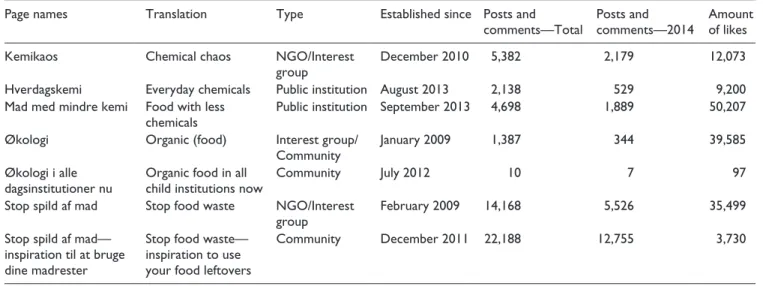
The analysis rests upon a corpus of seven Danish Facebook pages or groups on the topic of health, lifestyle, and con-sumption (Table 2). The existence of these pages and groups, and their investment by users, is a relatively recent phenomenon. In 2007, Facebook allowed non-profit orga-nizations to present pages that users could like and follow (Marichal, 2013). Facebook developed this model to include commercial presence on the network and allowed organizations to operate more control over their “text.” As such, the development of Facebook pages followed a model that was originally and primarily user-based to become a sender-based network. A distinction was then introduced between Facebook pages, which represent official public presence of for-profit or non-profit organizations, and Facebook groups, organized around grassroots communi-ties of interest.4 Each type sees a particular design and layout and entails different administrative tools and rights.
Users’ participation in these Facebook pages and groups should be considered in light of an increasing burden of responsibility placed on individual citizen-consumers to face lifestyle risks and problems (Halkier, 2015). As Halkier argues, the mere presence of these discourses in the public sphere makes them normative and hence invites citizens to position themselves toward these norms. Yet, the stream of users flowing to these pages could also signal a change of paradigm concerning the production and communication of knowledge related to lifestyle, consumption, and health, which Van Zoonen (2012) suggests is increasingly organized around an “I-pistemology.”
Table 2. Pages and Groups Considered for the Study.
Page names Translation Type Established since Posts and
comments—Total
Posts and comments—2014
Amount of likes
Kemikaos Chemical chaos NGO/Interest
group
December 2010 5,382 2,179 12,073
Hverdagskemi Everyday chemicals Public institution August 2013 2,138 529 9,200
Mad med mindre kemi Food with less chemicals
Public institution September 2013 4,698 1,889 50,207
Økologi Organic (food) Interest group/
Community
January 2009 1,387 344 39,585
Økologi i alle dagsinstitutioner nu
Organic food in all child institutions now
Community July 2012 10 7 97
Stop spild af mad Stop food waste NGO/Interest group
February 2009 14,168 5,526 35,499
Stop spild af mad— inspiration til at bruge dine madrester
Stop food waste— inspiration to use your food leftovers
Community December 2011 22,188 12,755 3,730
The pages and groups retained for this study were chosen because they involved different issues within the theme of food consumption, hence providing a broad view of the phenomenon. Some pages belong to official institu-tional sources, such as the Danish Ministry of health (Sundhedstyrrelsen), and others to the organized civil soci-ety, such as the consumer right association Tænk, who administers the Facebook page Kemikaos, while others are the creation of grassroots communities.
Table 2 shows the amount of page members, on official count or appreciated by the amount of likes, which has been rising exponentially over the past years. This investment can be seen in the amount of posts published during the year 2014 alone compared to the total amount of posts, in some cases accounting for about half of these posts. A noticeable difference between these pages and groups concerns the much smaller amount of interactions on community-based groups compared to sender-based pages.
Even though the topic of this research is not particularly controversial and the participants do not appear to constitute a vulnerable group—quite the contrary—a decision was made to completely render anonymous their presence in this report. These Facebook pages and groups are public spaces of discussion, but their participants are unaware of being research objects. It is important that these spaces remain owned by the people who invest them, despite an increasing surveillance of citizens, which the research community should not be a part of. The anonymity of the participants is furthermore justified as the focus of the study is not on peo-ple, but on the interactions that take place on Facebook.
A Three-Pronged Analytical
Framework on User Agency
Following the tradition of reception analysis, and especially its investigation of the relationships between media and audiences, I suggest examining agency from three varieties of media–audience relationships: (1) as a power structure, (2) as a nexus, and (3) as reception. The three types of rela-tionship can be represented along a continuum from struc-ture to interaction to experience, which relate respectively to three main interpretative epistemological positions known as (post-)structuralism, interactionalism, and phenomenol-ogy. By looking at these three different perspectives on agency side by side, the analysis is able to draw conclusions about agency that are multifaceted. Table 3 presents a sche-matic overview of the main components of the analytical framework.
The Media–Audience as Power Structure
Within this category are analyzed the structural relations between senders and users, and in particular how the struc-ture of Facebook articulates these relations and governs the
dynamics of interaction between senders and users.5 The analysis of the power structure considers the disposition of the page and the valorization of the sender or the user on these pages, in terms of the editing capacities that are imparted to them. Also, attention is paid on how interactions are structurally organized.
As part of this analysis, the classical encoding/decoding model formulated by Stuart Hall (1980) is considered, espe-cially as it refers to notions of textual power and resistance from the part of the audience. The notion of textual power takes special significance in light of recent research showing how technological affordances constrain and orient user interactions (Van Dijck, 2013). Finally, the notion of genre, including an attention to the speech acts that are performed on its name, is also considered. Here, the interest is to find out whether users’ interactions conform themselves to the expectations created by the genre or whether their contribu-tion attempts to challenge established norms.
The Media–Audience Relationship as Nexus
The interest of this category is in the materiality of the media–audience relationship, in the negotiation of meaning that takes place between the media text and the audience. At stake is an assessment of the respective contribution of the text and of the context of the audience in the negotiation of meaning. What aspects of the text are allowed to enter the sense-making activity of users? And what aspects of the users’ context contribute to inform their interpretation?
In this analysis, attention is paid to establish categories that are sensitive to the interactions taking place on the Facebook pages. It draws on various discourse analytical notions relevant to the study of interactions indebt to prag-matics and conversation analysis. The interactions between senders and users, as well as between users themselves, are coded as adjacency pairs (Sacks & Jefferson, 2006).6 For the purpose of this analysis, the first hundred posts on each page were considered.7
Table 3. The Three-Pronged Analytical Framework.
Media–audience as power structure Structure of the page
Structure of interactions Textual power and resistance Genre, expectations, and normality Media–audience as nexus
Adjacency pairs Speech acts
Text–Context relationships
Media–audience as reception (Schrøder, 2000, 2003) Motivation
In terms of their functioning, these interactions can uncover how text and context relate to each other in interpre-tation. For example, contextual insertions concern the aspects of contexts that are brought forth in the interpretation of the text and at times visible in the comments of users. Here, a basic categorization was done on the basis of four main dimensions of contextual experience: knowledge, values, emotions, or actions (Gjedde & Ingemann, 2001). These four dimensions are useful in that they can reveal priorities in the form of experience by which users encounter these norma-tive discourses.
The Media–Audience Relationship as Reception
The analysis of reception directly follows the suggestions made by Kim Schrøder (2000, 2003) in his multidimensional model of reception. The model includes five dimensions that are meant to describe the audience’s experience of the media text. In this study, these categories are, however, adapted to the reality of studying online interactions via discourse analysis.
In short, motivation concerns any interventions that rise or signal interest in the text. User posts are categorized as comprehension when they facilitate the understanding of the text. Discrimination is used when a comment points to the constructed character of the message. The dimension position is used when an intervention supports or rejects the normative discourse at play in the page. Finally, the cate-gory implementation is applied when a comment deals with the implementation of the normative discourse in everyday life. As for the previous analysis, the first hundred posts of
each page and group were considered for the analysis of reception.
Findings
Analysis of the Power Structure
There are noticeable differences between the structure of pages and groups. An analysis of the structure of pages leads to the conclusion that the power structure does not encourage user agency. Most pages are structured around a diffusion model of communication from sender to users. Some pages do not even allow users to post on their own initiative, but limit them to commenting posts published by the sender. And when allowed, user posts are visually marginalized in the overall architecture of the page. Specimen 1 from Figure 1 provides an example of a page that only allows reactive posts (highlighted in green). Specimen 2, a page that allows users to post on their own initiative, provides additional space for user posts, yet their interventions are confined to the bottom left of the screen. Specimen 3 is a Facebook community group and is therefore essentially constituted of user posts that occupy the center of attention.
There are few interactions between users on pages that are administered by an institutional sender. The adjacency pairs concerned are mostly sender–user and user–sender, often of the question–answer form. In contrast to the community-based groups, which rely exclusively on user posts without a clearly identifiable sender, the Facebook pages give the impression that it is the sender who initiates interaction, even
when this possibility is provided to users. Typically, a post is created by the sender, who often shares some resources that fall under its interests and presumably its audiences, for example, a link to a press release of another organization, a video on YouTube, or a news article. These texts are then reacted upon or commented by users. An example is the page “Stop food waste” that announces the work done by its vol-unteers at a music festival and link to an article in a local newspaper, which is reacted upon by 19 users expressing their support and comments to the announcement.
In both pages and groups, there is not much discord between the participants, contrary to what is observed in online news forums, which are known to encourage bigotry and other “carnivalesque” expressions of the audience (Bakardjieva, 2008). In fact, most users can be said to be sympathetic toward the sender or other users, expressing their support, also via the like button. These expressions of support and sympathy indicate that Facebook pages and groups function for the most along a model of converging interests. Of the 19 users who responded to the announce-ment announce-mentioned above, 8 expressed their support to the send-ers, with comments as short as “Great!.”
When the power structure established by the relationship between the media text and the audience is considered from the perspective of the genre, which falls essentially within two main relationships, statement–reaction and question– answer, the reading of users indicates for the large part a “preferred reading” (Hall, 1980). In Facebook groups, few infringements to the genre, as established in the “about” sec-tion, are attempted. In Facebook pages, instances in which users explicitly challenge the sender are rare. On the whole, users offer little resistance to the control that the sender oper-ates on the agenda and the content presented to them. The example of an exception may serve to illustrate the rule: a rare instance in which a user contests the claims made by the sender Kemikaos following the divulgation of results show-ing the presence of suspicious chemicals in the product of company X:
Fair enough! I know that you have refused to talk to one who is called [name] from [company X] who knows all about these things and you neither relate to the fact that it has never been proven that the fluoride gets into the food . . . I still mean that it is a storm in a glass of water and that you have not investigated
the matter properly. (My translation from Danish8)
Analysis of the Nexus
While the previous analysis described the structure of inter-action at play on Facebook pages and groups, and showed how senders have ascendency over users, an analysis of the nexus pays attention to “what is going on” in these interac-tions, including the speech acts performed. The analysis of the nexus reveals a more nuanced picture.
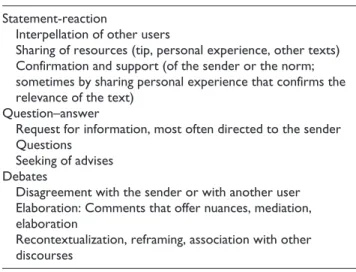
Table 4 presents the main categories describing specific adjacency pairs and the speech acts taking place for the majority of users’ interventions, sometimes as a response to the sender, sometimes initiated by the users themselves.
All of these speech acts encourage normative discourses to enter the concrete experience of users, engaging with their implications and applications in everyday life. But there are main differences between pages and groups in this regard.
The raison d’être of the Facebook group dealing with the prevention of food waste is chiefly concerned with the appli-cation of the normative discourse in everyday life. Most interactions are request for and sharing of advises, tips, reci-pes, rules of thumb, and so on. Few users take the occasion to assert their favorable views toward the norm, which is for the most taken-for-granted and accepted. Interactions on these groups are not extensive, but rather instrumental, and they do not approach normative discourse outside of its prac-tical application in everyday life. However, many of these interactions provide elaborations and additional resources, and requests for information are almost always answered by other users.
The interactions taking place on Facebook pages are often initiated by the institutional senders of these pages and here user agency appears in contrast to the abstract and disembod-ied articulation of normative discourse in institutional dis-course. In these interactions, users display agency in at least two ways. First, even though users can be said to comply with the control that senders exert over the structure of inter-actions, they display agency by taking the text out of its pre-ferred canons and by opening it up via various contextual insertions. Second, users are able to exert interactional pres-sure on the sender, which encourages the latter to make mod-ifications, adaptations to its original discourse.
The last two categories of speech acts, question–answer and debates, are especially interesting because they invite the
Table 4. Main Speech Acts Performed on Facebook Pages and
Groups.
Statement-reaction
Interpellation of other users
Sharing of resources (tip, personal experience, other texts) Confirmation and support (of the sender or the norm;
sometimes by sharing personal experience that confirms the relevance of the text)
Question–answer
Request for information, most often directed to the sender Questions
Seeking of advises Debates
Disagreement with the sender or with another user Elaboration: Comments that offer nuances, mediation,
elaboration
sender to come out of its institutional canons and enter other discourses that are sometimes more relevant to the users. The interventions of users bring other realities at play and some-times force the sender to adopt different modes of expres-sion, such as emotions, that are not often considered in the institutional articulation of normative discourse. That is, through their interventions, users are able to modify the text or invite the sender to do so. In their comments, users make apparent the contexts in which normative discourse is meant to acquire its relevance. Some users invite senders to anchor more clearly their texts into context and these invitations are sometimes (but not always) fulfilled by senders.
For example, users do not necessarily want to know which chemicals are present in a given product, but want to know whether the product is “dangerous” or what “consequences” its use may have for their health. Consider this response pro-vided by Kemikaos to a user who asks about microwaved popcorn, after a test revealed the presence of dangerous chemicals in the packaging: “Dear [name], it is not sure that it has a consequence, as it is not the single product that is
necessarily problematic. It is the additive and overall
con-sumption of many products that can be problematic . . .” (my emphasis). Applied to everyday life, the normative discourse changes substantially from a factual assertion about the pres-ence of dangerous chemicals to a much more relative state-ment about risk.
The interactions at play on Facebook pages encourage the sender to establish relationship with the users that are more complex than what the diffusion model of communication implies. Senders may be pushed to side with users, to give concessions or admit the shortcomings or the difficulties of application of normative discourse in everyday life. Such invitations can be interpreted in a model of divergence, as an opportunity for senders to maintain or reclaim control over the message. But the same phenomenon can also be seen as a convergence of interests, as it provides the opportunity for senders to clarify, diversify, and increase the relevance of their message for users. Even if the sender can be said to give its message more impact, privileging its own version, the text enters the realm of context and is transformed by it.
As remarked before, few questions openly challenge the authority of the sender. But a closer look reveals that senders often engage in various forms of repairs in their answers. That is, they attempt fixing something they believe has been broken by the comments or questions of the users. These repairs concern issues that are only presupposed in the com-ments of the users, and while highly implicit, they provide some evidence of the agency that users can exert on senders. For example, while apologizing that a particular product was not part of those tested by its team, the sender Kemikaos points to the right of consumers to obtain information from producers about the presence of dangerous chemicals.
At times, the senders can be said to benefit from the work done by users, as users expand the original discourses in ways that would be difficult to achieve without compromis-ing their official position or their role and responsibility as an
institutional sender. For example, consider how the technical language of the sender “you risk to have dangerous chemi-cals enter your food” quickly become for a user “the confir-mation that this is unhealthy.” Complex factual information is translated into simple dichotomies fit to the need of every-day life.
Senders can be restrained from engaging in some aspects of sense-making, such as discussing controversies, attribut-ing blame, disciplinattribut-ing other users, and hence leave this “dirty work” to the discretion of users. As users embark in such activities, it is quite telling that senders remain silent and do not engage directly. For example, users who make “incorrect” assumptions or make erroneous statements about the science behind normative discourses are rarely shamed by the sender, but often put to their place by other users. “There is a difference between bacteria and chemicals,” says one user to another who attempted to contest the merits of biological agriculture with a claim that city kids are not enough exposed to bacteria.
A telling instance that illustrates the complexities of this kind of interactional agency can be found in the scientific discourse adopted by the sender in their presentation and promotion of normative discourse. Senders often rely on sci-ence to ascertain their discourse, for example by presenting the latest research associated with the theme of the page. Reliance on this scientific discourse makes the text formal, univocal, abstract, predictable, technical, and factual. The interventions of users open up the text toward their lifeworld and expand the horizon of the text. Yet, it is also interesting that some users align to the discourse of the sender and dis-cipline other users by relying as much on a factual–technical language in their comments.
Analysis of Reception
Notions such as produsage have emphasized the idea that users also produce as they consume content, but the opposite is also true: users “receive” as they produce. While the notion of produsage emphasizes the agentic–productive activities of users, I want to suggest the notion of expressive reception to cover the same empirical reality, yet with a theoretical emphasis placed on reception and its agentic implications. Throughout expressive reception, users make their reception visible to themselves and to others. Expressive reception is primarily defined by its public character, rather than by what it can say about private, individual, or mental reception. As users comment, share, and circulate meaning, they engage into visible, public, and collectively articulated processes of reception. What can be observed through a discourse analy-sis such as the one suggested in this study creates limitations about what can be known of reception, but its public nature is however more clearly articulated.
through expressive reception is the dimension of motivation and is visible in the interpellation of other users. The com-menting function of the Facebook pages allows users to attract the attention of other users in their network on given posts by typing their username. Such behavior expresses the dimension of motivation because users assume that a post is relevant to one or more of their connections. In doing so, users contribute actively to establish and expand the rele-vance of the text.
The dimension of comprehension is underlined in the requests for information and the questions that users ask, especially concerning the technical–factual aspects of a nor-mative discourse. Although the asking of questions presumes a more powerful sender as the repository and authority of knowledge, in doing so users invite senders to clarify, disam-biguate, illustrate, and explain their discourse, which can only be beneficial for its comprehension, even for the users who are simply lurking. For example, following the news of a new project on packaging, one user asks, “Aren’t there newer forms of packaging that decompose fast and are not damaging the environment?”
Comprehension also concerns the reactions and the con-textual insertions of users. As such, this dimension often flirts with that of implementation, that is, the extent to which the text is implemented in everyday life. As hinted before, the dimension of implementation is crucial, especially for Facebook groups whose genre and interactions are defined by this dimension, as in the case of the prevention of food waste. Implementation is first and foremost a way to bring normative discourse in the context of everyday life. Here are few examples of suggestions and tips that signal the imple-mentation of normative discourses on food waste in every-day life:
Maybe we should give leftover foods to nursing homes, so they could get a good meal on that day!
Frozen grapes are really good as eatable ice cubes:)
While the dimensions of motivation, comprehension, and implementation shine in the produsage activities of users, the dimensions of discrimination and position are less common, without being completely absent. On the whole, few posts will bring to light the constructed character of the text or contest the position articulated by the sender. When users position themselves, it is in general favorably toward the sender, expressing their converging interests. They accept the semiotic universe in which these normative discourses are articulated. As mentioned before, users who contest these discourses are often reprimanded by other users.
Conclusion
In the existing literature, user agency is often conceptualized as participation opposed to the agency of the sender, mea-sured against normative ideals or belonging to a particular
group of users. In this article, I have argued for the relevance of the notion of audience in exploring user agency.
To some extent, the participation paradigm denies agency to ordinary users, but as pointed out, these findings are often confined to a specific perspective on agency, be it structural, normative, or social. In order to recognize the complex char-acter of agency in the notion of audience, this analysis resorted to a three-pronged perspective stressing the roles of structure, interaction, and experience as sources of audience agency. The result is a more nuanced understanding of the agentic possibilities provided by the use of Facebook by ordinary users in their encounter with normative discourses on health, lifestyle, and consumption.
The analysis of power structure reveals that a conver-gence of interests between users, and between senders and users, animates most encounters with normative discourses on lifestyle, consumption, and health. On one hand, the structure of Facebook groups, which are anchored in a com-munity of users, provides more agency to users, but these groups display considerably less interactions compared to Facebook pages, and the nature of these interactions is also less varied and does not engage crucially with normative dis-courses. On the other hand, for Facebook pages, this conver-gence is to the structural advantage of senders, given their privileged position on these pages.
The growing popularity of Facebook pages seems to wit-ness the return to a sender-based regime of meaning on Facebook. Increasingly, user activity is organized around senders and their discourses, in which users perform the role of audience, albeit in an expressive way. Thus, the notion of audience has not disappeared entirely from the current media landscape and is even being emphasized on Facebook pages. This does not need to spell the end of user agency on social media, however, as this three-pronged analysis reasserts that there is agency in the notion of audience.
The analysis of nexus shows how users of both Facebook groups and pages insert normative discourses in concrete experience and everyday life. However, for Facebook pages, these contextual insertions are more varied and they contrast with the agency of senders, encouraging them to take users into account and to make compromises to the institutional articulation of normative discourses. The analysis also sug-gests the notion of expressive reception as a form of user agency situated in the prolongation of the analysis of power structure and nexus. Expressive reception helps connect nor-mative discourses with users and contextualize such dis-course in everyday life.
is more useful when users take upon the role of audience, as visible sense-making processes contribute to articulate these users into a visible public of normative discourses.
Declaration of Conflicting Interests
The author(s) declared no potential conflicts of interest with respect to the research, authorship, and/or publication of this article.
Funding
The author(s) received no financial support for the research, author-ship, and/or publication of this article.
Notes
1. Hence the activity of “produsage,” in which the use of social
media refers to productive activities such as commenting, lik-ing, or circulating content.
2. See the interventions of Couldry (2015) and Scannell (2015)
concerning the work of Hall and the Birmingham center for cultural studies.
3. See, for example, Dahlgren (2006) for a presentation of this argument and its counter-argumentation within the framework of Cultural Studies.
4. Information retrieved on 28 October 2015 from https://www.
facebook.com/notes/facebook/facebook-tips-whats-the-differ-ence-between-a-facebook-page-and-group/324706977130
5. Here, “sender” refers to the institutional administrator of a page,
such as the organization Tænk that administers the page
kemi-kaos. Ordinary citizens who interact on these pages are referred
to as users, even when they post content and hence also occupy the position of sender. The dichotomy between sender and user is maintained in order to distinguish their respective agency. Even if ordinary users can be said to be senders, they do not perform the same agency as traditional, institutional senders. 6. The concept of adjacency pair proved useful for the overall
analysis, as it can also reveal the structural quality of an inter-action, and can be useful to contextualize aspects of reception. 7. These data were harvested with help of the software NVivo
and converted into an MS Excel document for coding and analysis, which was conducted on the first hundred posts from the day data were collected in June 2015.
8. All following quotes are also translated from Danish.
References
Bakardjieva, M. (2008). Bulgarian online forums as carnival. Popular political forms and new media. In F. Sudweeks, H.
Hrachovec, & C. Ess (Eds.), Proceedings cultural attitudes
towards communication and technology 2008 (pp. 286–300). Perth, Australia: Murdoch University.
Bakardjieva, M. (2011). The Internet in everyday life: Exploring the tenets and contributions of diverse approaches. In M. Consalvo
& C. Ess (Eds.), The handbook of Internet studies (pp. 59–82).
Malden, MA: Wiley–Blackwell.
Bechmann, A., & Lomborg, S. (2013). Mapping actor roles in social media: Different perspectives on value creation in
theo-ries of user participation. New Media & Society, 15, 765–781.
doi:10.1177/1461444812462853
Bennett, W. L. (Ed.). (2008). Civic life online: Learning how digital
media can engage youth. Cambridge, MA: MIT Press.
Blondeau, O., & Allard, L. (2010). UGC 4 Politics! De
l’“empowerment” au “campaigning.” [UGC 4 politics! From empowerment to campaigning]. Retrieved from http://www. fondapol.org/politique-2-0/1734/
boyd, D. (2011). Social network sites as networked publics: Affordances, dynamics, and implications. In Z. Papacharissi
(Ed.), A networked self: Identity, community and culture on
social network sites (pp. 39–58). New York, NY: Routledge.
Bruns, A. (2008). Blogs, Wikipedia, second life, and beyond: From
production to produsage. New York, NY: Peter Lang. Bruns, A., & Burgess, J. (2015). Twitter hashtags from ad hoc to
calculated publics. In N. Rambukkana (Ed.), Hashtag publics:
The power and politics of discursive networks (pp. 13–28). New York, NY: Peter Lang.
Camerini, L., & Diviani, N. (2012). Activism, health and the Net: Are new media shaping our perception of uncertainty?
Interactions: Studies in Communication & Culture, 3, 335– 343. doi:10.1386/iscc.3.3.335_1
Carpentier, N. (2011a). Contextualising author-audience conver-gences: “New” technologies’ claims to increased participation,
novelty and uniqueness. Cultural Studies, 25, 517–533. doi:10
.1080/09502386.2011.600537
Carpentier, N. (2011b). New configurations of the audience? The challenges of user-generated content for audience theory and
media participation. In V. Nightingale (Ed.), The handbook
of media audiences (pp. 190–212). Hoboken, NJ:
Wiley-Blackwell.
Couldry, N. (2011). The necessary future of the audience . . . and how
to research it. In V. Nightingale (Ed.), The handbook of media
audiences (pp. 213–229). Hoboken, NJ: Wiley-Blackwell. Couldry, N. (2015). Illusions of immediacy: Rediscovering Hall’s
early work on media. Media, Culture & Society, 37, 637–644.
doi:10.1177/0163443715580943
Dahlgren, P. (2006). Doing citizenship: The cultural origins of civic
agency in the public sphere. European Journal of Cultural
Studies, 9, 267–286. doi:10.1177/1367549406066073
Fish, A., Murillo, L. F. R., Nguyen, L., Panofsky, A., & Kelty, C. M. (2011). Birds of the Internet: Towards a field guide to
the organization and governance of participation. Journal of
Cultural Economy, 4, 157–187. doi:10.1080/17530350.2011.5 63069
Gjedde, L., & Ingemann, B. (2001). In the beginning was the
expe-rience. The experimental reception studies. Nordicom Review,
2(2), 49–60.
Habermas, J. (2008). The structural transformation of the
pub-lic sphere: An inquiry into a category of bourgeois society
(Reprinted). Cambridge, UK: Polity Press. (Original work published 1989)
Halkier, B. (2015). Contested food consumption and every-day agency in a Danish context. In E. Stø, J. Gronow, &
P. Strandbakken (Eds.), The consumer in society: A tribute to
Eivind Stø (pp. 191–206). Oslo, Norway: Abstract.
Hall, S. (1980). Encoding and decoding in the television discourse.
In S. Hall, D. Hobson, A. Low, & P. Willis (Eds.), Culture,
media, language: Working papers in cultural studies, 1972–79
(pp. 197–208). London, England: University of Birmingham.
Jenkins, H. (2008). Convergence culture: Where old and new media
collide. New York: New York University Press.
Jenkins, H., & Carpentier, N. (2013). Theorizing participatory intensities: A conversation about participation and politics.
New Media Technologies, 19, 265–286. doi:10.1177/ 1354856513482090
Jenkins, H., Ford, S., & Green, J. (2013). Spreadable media:
Creating value and meaning in a networked culture. New York: New York University Press.
Kelty, C. (2005). Geeks, social imaginaries, and recursive
pub-lics. Cultural Anthropology, 20, 185–214. doi:10.1525/
can.2005.20.2.185
Kwon, K. H., Oh, O., Agrawal, M., & Rao, H. R. (2012). Audience gatekeeping in the Twitter service: An investigation of tweets
about the 2009 Gaza conflict. AIS Transactions on
Human-Computer Interaction, 4, 212–229. Retrieved from http://aisel. aisnet.org/thci/vol4/iss4/1/
Lessig, L. (2009). Remix: Making art and commerce thrive in the
hybrid economy. New York, NY: Penguin Books.
Livingstone, S. M. (1998). Making sense of television: The
psychol-ogy of audience interpretation. London, England: Routledge. Livingstone, S. M. (2004). The challenge of changing audiences:
Or, what is the audience researcher to do in the age of the
Internet? European Journal of Communication, 19, 75–86.
doi:10.1177/0267323104040695
Livingstone, S. M. (2013). The participation paradigm in audience
research. The Communication Review, 16, 21–30. doi:10.1080
/10714421.2013.757174
Livingstone, S. M., & Das, R. (2013). The end of audiences? Theoretical echoes of reception amidst the uncertainties of
use. In J. Hartley, J. Burgess, & A. Bruns (Eds.), A companion
to new media dynamics (pp. 104–121). Chichester, UK: John Wiley.
Loosen, W., & Schmidt, J.-H. (2012). (Re-)discovering the audi-ence: Relationship between journalism and audience in
net-worked digital media. Information, Communication & Society,
15, 867–887. doi:10.1080/1369118X.2012.665467
Macek, J. (2013). More than a desire for text: Online
partici-pation and the social curation of content. Convergence:
The International Journal of Research Into New Media Technologies, 19, 295–302. doi:10.1177/1354856513486530 Marichal, J. (2013). Political Facebook groups: Micro-activism
and the digital front stage. First Monday, 18(12). doi:10.5210/
fm.v18i12.4653
Mascheroni, G. (2013). Performing citizenship online: Identity,
subactivism and participation. Observatorio (OBS*), 7(3),
93–119. Retrieved from http://obs.obercom.pt/index.php/obs/ article/view/656/601
Mathieu, D. (2015a). Audience research beyond the
hermeneu-tics of suspicion. International Journal of Media & Cultural
Politics, 11, 251–258. doi:10.1386/macp.11.2.251_3
Mathieu, D. (2015b). The continued relevance of reception analysis
in the age of social media. Trípodos, 36, 13–34. Retrieved from
http://www.tripodos.com/index.php/Facultat_Comunicacio_ Blanquerna/article/view/240
Milioni, D. L., Vadratsikas, K., & Papa, V. (2012). “Their two cents worth”: Exploring user agency in readers’ comments in online
news media. Observatorio (OBS*), 6(3), 21–47.
Montero, D. (2014, January). “They do not represent us!” The
“Indignados” movement and participatory filmmaking on the Internet. Presented at the Community Filmmaking and Cultural Diversity, BFI Southbank, London, England.
Neveu, C. (2014). Practicing citizenship from the ordinary to the
activist. In E. F. Isin & P. Nyers (Eds.), Routledge handbook
of global citizenship studies (pp. 86–95). Abingdon, UK: Routledge.
Rosen, J. (2006). The people formerly known as the audience.
Retrieved from http://archive.pressthink.org/2006/06/27/ppl_ frmr.html
Sacks, H., & Jefferson, G. (2006). Lectures on conversation:
Volumes I, II. Oxford, UK: Blackwell.
Scannell, P. (1998). Media-language-world. In A. Bell & P. Garrett
(Eds.), Approaches to media discourse (pp. 251–267). Oxford,
UK: Blackwell.
Scannell, P. (2007). An interview with professor Paddy Scannell, Oxford, July 2006 [Interview conducted by T. Sabry].
Westminster Papers in Communication and Culture, 4(2), 3–23.
Scannell, P. (2015). Cultural studies: Which paradigm? Media, Culture
& Society, 37, 645–654. doi:10.1177/0163443715580948 Schrøder, K. C. (2000). Making sense of audience discourses:
Towards a multidimensional model of mass media
recep-tion. European Journal of Cultural Studies, 3, 233–258.
doi:10.1177/136754940000300205
Schrøder, K. C. (2003). Generelle aspekter ved mediereception?— Et bud på en multidimensional model for analyse af
kvalita-tive receptionsinterviews. MedieKultur: Journal of Media and
Communication Research [General aspects of media reception? A proposal for a multi-dimensional model of reception for the
analysis of qualitative interviews], 19(35), 63–73. Retrieved
from http://ojs.statsbiblioteket.dk/index.php/mediekultur/article/ viewArticle/1236
Schrøder, K. C. (2016). Reception analysis. In G. Mazzoleni, K. G.
Barnhurst, K. Ikeda et al. (Eds.), The international
encyclope-dia of political communication (pp. 1–9). Hoboken, NJ: John Wiley.
Singer, J. B. (2014). User-generated visibility: Secondary
gatekeep-ing in a shared media space. New Media & Society, 16, 55–73.
doi:10.1177/1461444813477833
Steensen, S. (2014). Conversing the audience: A methodological exploration of how conversation analysis can contribute to the
analysis of interactive journalism. New Media & Society, 16,
1197–1213. doi:10.1177/1461444813504263
Tandoc, E. C. (2014). Journalism is twerking? How web analytics
is changing the process of gatekeeping. New Media & Society,
16, 559–575. doi:10.1177/1461444814530541
Van Dijck, J. (2013). The culture of connectivity: A critical history
of social media. Oxford, UK: Oxford University Press. Van Zoonen, L. (2012). I-Pistemology: Changing truth claims
in popular and political culture. European Journal of
Communication, 27, 56–67. doi:10.1177/0267323112438808 Warner, M. (2002). Publics and counterpublics (abbreviated
ver-sion). Quarterly Journal of Speech, 88, 413–425. doi:10.1080/
00335630209384388
Author Biography