REGULAR ARTICLE
EXPLORATION OF GENETIC RELATIONS BETWEEN WINTER TRITICALE (XTriticosecale Witt.) AND RYE (Secale cereale L.) CULTIVARS USING
RETROTRANSPOSON-BASED MARKERS
Andrej Trebichalský1*, Alan Schulman2, Ruslan Kalendar2, Olga Stratula3, Zdenka Gálová1
Address: 1Slovak University of Agriculture in Nitra, Faculty of Biotechnology and Food
Sciences, Department of Biochemistry and Biotechnology, Tr. A. Hlinku 2, 949 76 Nitra, Slovak Republic
2MTT/BI Plant Genomics Lab, Institute of Biotechnology, University of Helsinki, Biocentre
3, P.O. Box 65, Viikinkaari 1, 00014, Finland
3South Plant Biotechnology Center, Ovidiopolskaya doroga 3, Odessa-36, 65036, Ukraine
* Corresponding author: [email protected]
ABSTRACT
Retrotransposons can be used for markers because their integration creates new joints between genomic DNA and their conserved ends. In our work, we had focused on finding of
genetic relationships between winter triticale (X Triticosecale Witt.) and rye (Secale cereale
L.) using retrotransposon-based markers. Together, five IRAP primers combinations and β-amylase (BAMY) genes were used for polymorphism detection of 37 cultivars of winter triticale and 5 cultivars of rye. From the obtained data, we had constructed UPGMA dendrogram, which differentiate samples on the basis of genetic relationships in two principal
cluster and several subclusters. We had confirmed close relationships between cultivars
Leontino and Pletomax, Trimmer and Wilfried or between cultivars Sorento and Amarillo 105.
INTRODUCTION
Triticale (X Triticosecale Wittmack), a man-made hybrid of wheat (Triticum spp.) and
rye were created to combine the high yielding capacity of wheat with the stress tolerance of
rye (Lukaszewski, 2006). Retrotransposon are an evolutionarily ancient class of mobile
genetic elements that transpose replicatively within their host genomes via RNA intermediates
(Flavell, 1999). They can be used as markers because their integration creates new joints
between genomic DNA and their conserved ends (Kalendar and Schulman, 2006).
Retrotransposons can be divided into two main categories, those with long terminal repeats LTRs and those that lack such repeats, for example, long interspersed nuclear elements
(LINEs) (McCarthy and McDonald 2004). Retrotransposons have several advantages as
molecular markers over the other systems described above. Their abundance and dispersion can yield many marker bands, the pattern possessing a high degree of polymorphism due to
transpositional activity. Kalendar et al. (1999) developed the IRAP (Inter-Retrotransposon
Amplified Polymorphism), method based on the position of given LTRs within the genome. These markers are generated by the proximity of two LTRs using outward-facing primers annealing to LTR target sequences.
The representatives of the Triticeae (wheat, barley, rye) have two distinct forms of
β-amylase (1,4-α-glucan maltohydrase; E.C.3.2.1.2), which differ in their expression patterns: one form is specific to the endosperm, while the other has a tissue-ubiquitous pattern of
expression (Ziegler, 1999).
The objective of our study was to reveal genetic relationships between 37 genotypes of winter triticale and 5 cultivars of rye using by retrotransposon-based markers IRAP and β-amylase (BAMY) genes.
MATERIAL AND METHODS
Plant material and DNA isolation
Collection of the 37 genotypes of winter triticale (X Triticosecale Witt.) was provided
by the Gene bank of Slovak republic in Piešťany. The 5 cultivars of rye (Secale cereale L.)
were obtained from MTT (Jokioinen, Finland). The 7 day-old leaves were collected and
1995) with RNaseA for quick DNA extraction. Concentration of DNA was measured by Nanodrop.
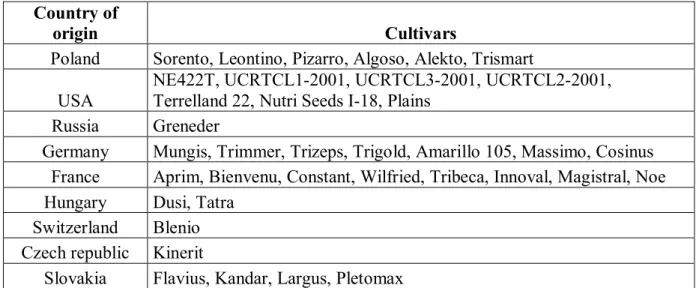
Table 1 List of samples and their origin
PCR conditions
The PCR reaction was performed in 25 μl mixture (PCR premix + DNA). PCR premix (24 μl) comprised of Milli-Q water, 10 x BioTools buffer, 10 mM dNTP, 10 μM primer and 5 U/μl BioTools polymerase. The PCR reaction ran in the Biometra thermocycler under these conditions: 2 min denaturation step at 98°C; 29-32 cycles of 10s at 98°C, 60s at 60°C and 60s at 72°C; 5 min a final extension at 72°C. The number of cycles and an overall time of PCR reaction depended strongly on the used primer (29x – 32x). After PCR, 40 μl of 1 x loading buffer was added to tubes with PCR products and than the mixture was loaded on the prepared gels.
Electrophoresis conditions
There were prepared 1.5 % agarose gel with ethidium bromide and loaded 8 μl of each sample on the gel. Generally, voltage at intervals 50-60 V for 16-19 hours was used. The actual position of DNA in gels was checked with UV transilluminator. Gels were scanned by FUJIFILM FLA-5100 (Fuji Photo Film (Europe) GmbH., Germany) imaging system with a resolution of 50 µm. Dendrogram was constructed by MEGA 5 software.
Country of
origin Cultivars
Poland Sorento, Leontino, Pizarro, Algoso, Alekto, Trismart
USA NE422T, UCRTCL1-2001, UCRTCL3-2001, UCRTCL2-2001, Terrelland 22, Nutri Seeds I-18, Plains
Russia Greneder
Germany Mungis, Trimmer, Trizeps, Trigold, Amarillo 105, Massimo, Cosinus
France Aprim, Bienvenu, Constant, Wilfried, Tribeca, Innoval, Magistral, Noe
Hungary Dusi, Tatra
Switzerland Blenio
Czech republic Kinerit
RESULTS AND DISCUSSION
Retrotransposons are ubiquitous in plants and play a major role in plant gene and genome evolution. In many cases, retrotransposons comprise over 50% of nuclear DNA
content (Kumar and Bennetzen, 1999). These markers have been developed for studing of
bread wheat (Triticum aestivum) genome and its wild relatives (Queen et al., 2004).
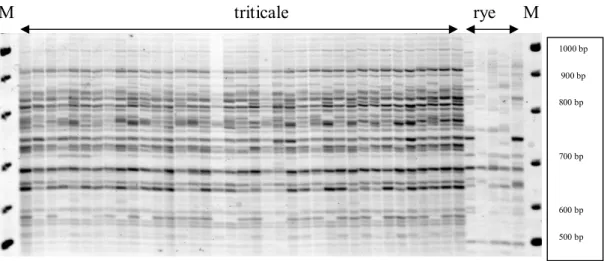
Aim of our work was to use retrotransposon-based markers IRAP and β-amylase (BAMY) genes for purpose of genetic relationships detection between winter triticale and rye. Gels were evaluated on the basis of presence or absence of band in each line. Obtained data
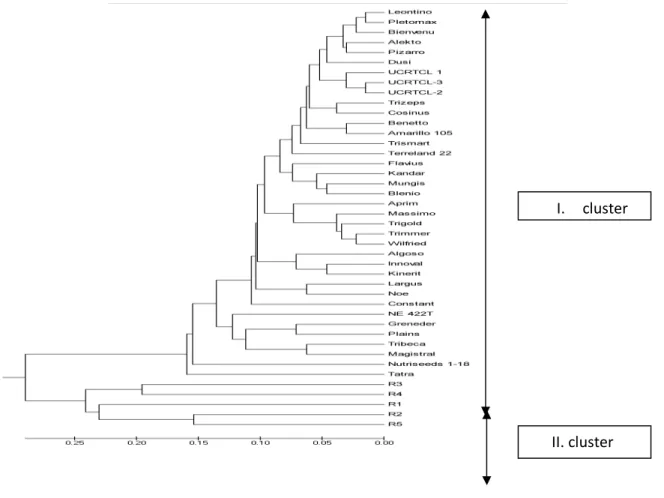
from gels (Fig 1) were used for construction of UPGMA dendrogram (Fig 2), which
differentiated samples in two principal clusters.
IRAP used Bento et al. (2010) to asses genome rearrangements in wheat-rye addition
lines obtained by the controlled backcrossing of octoploid tritcale to hexaploid wheat followed by self-fertilization. The comparative analysis revealed in those lines the presence of wheat-origin bands absent in triticale, and the absence of rye-origin and triticale-specific bands.
M triticale rye M
Figure 1 IRAP banding profiles of triticale and rye (M -size marker).
1000 bp
900 bp
800 bp
700 bp
600 bp
Figure 2 UPGMA dendrogram
The first cluster involved samples of triticale and comprised of several sub-cluster. The first subcluster is divided into two groups, with evident close relationships between Polish cultivar Leontino and Slovak Pletomax, Polish cultivars Alekto and Pizarro and American UCRTCL-1, UCRTCL-2 and UCRTCL-3. In the second subcluster, close genetic relationships between German cultivars Trizeps and Cosinus, Polish cultivar Sorento and German Amarillo 105 and between German cultivar Mungis and Swiss cultivar Blenio were proved. The third subcluster comprised of two French (Aprim, Wilfried) and three German cultivars (Massimo, Trigold and Trimmer).
In the last subclusters genetic proximity between cultivars Innoval (France) and Kinerit (Czech republic), Largus (Slovakia) and Noe (France), Greneder (Russia) and Plains (USA), Tribeca and Magistral (both France) was revealed.
CONCLUSION
The used markers allowed us to differentiate samples of triticale and rye in two groups. Dendrogram arranged samples of triticale in several groups, such that we can better
I. cluster
Acknowledgments: We are very thankful to the MTT/BI Plant Genomics Laboratory (Institute of Biotechnology, University of Helsinki), namely to Anne-Marie Narvanto and Ursula Lönqvist for useful advice and perfect technical support.
This contribution is the result of the project implementation: Centre of excellence for white-green biotechnology, ITMS 26220120054, supported by the research Development Operational Programme funded by the ERDF (50%). VEGA project 1/0471/09 (50%).
REFERENCES
AUSUBEL, F.M. – BRENT, R. – KINGSTON, R.E. 1995. Current protocols in molecular biology. 1995.
BENTO, M. - GUSTAFSON, P. - VIEGAS, W. - SILVA, M. 2010. Genome merger: from sequence rearrangements in triticale to their elimination in wheat-rye addition lines. In Theoretical and Applied Genetics, 121, 2010, 489-497.
FLAVELL, A.J. 1999. Long terminal repeat retrotransposons jump between species.
In PNAS, vol. 96, no. 22, 1999, p. 122111-12212.
KALENDAR, R. - GROB, T. - REGINA, M. - SUONIEMI, A. - SCHULMAN, A.H. 1999. IRAP and REMAP: two new retrotransposon-based DNA fingerprinting techniques. In Theoretical and Applied Genetics, vol. 98, 1999, 704-711.
KALENDAR, R. - SCHULMAN, A.H. 2006. IRAP and REMAP for retrotransposon-based
genotyping and fingerprinting. In Nature Protocols, vol. 1, 2006, p. 2478-2484.
KUMAR, A. - BENNETZEN, J.L. 1999. Plant retrotransposons. In Annual Review of
Genetics, vol. 33, 1999, p. 479-532.
LUKASZEWSKI, A. J. 2006. Cytogenetically engineered rye chromosomes 1R to improve
bread-making quality of hexaploid triticale. In Crop Science, vol. 46, 2006, p. 2183-2194.
McCARTHY, E.M. – McDONALD, J. F. 2004. Long terminal repeat retrotransposons of
Mus musculus. In Genome Biology, vol. 5, 2004.
QUEEN, R.A. - GRIBBON, B.M. - JAMES, C. - JACK, P. - FLAVELL, A.J. 2004. Retrotransposon-based molecular markers for linkage and genetic diversity analysis in
wheat. In Molecular Genetics and Genomics, vol. 271, 2004, p. 91-97.
ZIEGLER, P. 1999. Cereal beta-amylases. In Journal of Cereal Science, vol. 29, 1999, p.