A. Peshenkov, I. Zhukovskiy
99
PARTY SYSTEMS
The article confirms the hypothesis that a multiplicity of parties of the European and national levels forms the party system of the European Union (EU). The authors describe the main characteristics of Eu-roparties and political groups comprised of them as key actors in the European Par-liament’s (EP) political and legislative processes. The authors adopt the institu-tional approach and make use of the tools of the comparative, structural, and func-tional analyses. Special attention is paid to the ‘two-tier’ structure — the connection between national and supranational institu-tions — as a key feature of the European Union’s party system. The study is based on the European Parliament framework laws, election results, Europarties’ political pro-grammes, as well as on the comparison of the composition of the Europarties and the EU bodies. The analysis provides a new perspective on the major processes and contradictions in the functioning of the European Parliament and demonstrates that the transformation of the EU from an intergovernmental association to a (con)federation has not been completed yet.
Key words: European parliament, Eu-roparty, political group, party system, elec-toral system
Amid the development of regional economic and political alliances, it is increasingly important to study political institutions responsible for representa-tion, harmonisation of interests, and decision-making at supranational level within intergovernmental integration. Transboundary economic cooperation provides the impetus for regional poli-tical integration. However, organising optimal decision-making processes at supranational level remains a problem. SUPRANATIONAL
PARTY SYSTEM OF THE EU
A. Peshenkov
*I. Zhukovskiy
**Baltiс region. 2016. Vol. 8, № 2. P. 99—111. *
Russian State University for the Humanities
6 Miusskaya square, Moscow, 125993, Russia.
**
Immanuel Kant Baltic Federal University 14 A. Nevskogo ul., Kaliningrad, 236041, Russia.
Submitted on October 26, 2015.
doi: 10.5922/2079-8555-2016-2-8
Party systems
100
This necessitates studying the development of the European Parliament (EP) and the role of political parties comprising the supranational party system of the European Union, ensuring decision-making, and legitimising these deci-sions based on interest representation.
Structural and functional features of Europarties
Key agents of political process taking place in the European Parliament
are political groups consisting of European-level parties (Europarties)1.
Euro-parties are umbrella organisations bringing together national Euro-parties commit-ted to a common ideology and political programme [14]. Individual mem-bership in Europarties is also possible for members of national parliaments and the EP.
During EP elections, voters elect only national parties — some the of them constitute Europarties, others act without the support of the latter. Na-tional parties compete for votes allocated to each country within the naNa-tional apportionment of MEP seats. Thus, election campaigns focus primarily on national agendas [15].
Europarties are financed by the EU funds and private donations. They
have the right to campaign at European level2. Funds are allocated in line
with the objectives stated in the political programmes of Europarties.
A key characteristic of Europarties is their two-tier structure, which in-cludes national and supranational components. National parties serve as channels for recruiting members of the political elite, who interact with elec-toral groups in EU member states through representing their interests. Fur-ther, national parties set up Europarties, which influence the formation of coalitions and the functioning of the EU governing bodies.
This particularity is a result of the conditions, in which Europarties de-velop in the EU — an intergovernmental association, which has created a system of supranational coordinating and governing institutions. In this sense, the European Parliament — as well as the European-level party-building process — is of a partly artificial nature. Its emergence was not a result of political struggle and its gradual institutionalisation, which shaped modern institutions of parliamentarism and political parties. It is a product of agreements between states and political elites, a result of ‘political enginee-ring’ at the supranational level [6; 10]. Thus, the question of long-term stabi-lity and independence of supranational EU institutions remains relevant.
Increasing international integration requires securing its legitimacy from citizens of European countries, which necessitated the transition to direct EP
1
For the first time, the notion of Europarty was introduced in the Maastricht Treaty of 1992: ‘Political parties at European level are important as a factor for integration within the Union. They contribute to forming a European awareness and to express-ing the political will of the citizens of the Union’ (Article 138a). The Treaty of Am-sterdam (1997) laid down Europarty financing rules. The Treaty of Nice (2001) specified that ‘The Council… shall lay down the regulations governing political par-ties at European level and in particular the rules regarding their funding’.
2
A. Peshenkov, I. Zhukovskiy
101 elections in 1979. This provided the impetus for political struggle and coali-tion formacoali-tion in the framework of European integracoali-tion institucoali-tions. As European level coalitions of national parties, Europarties had been develop-ing long before their formalisation in the 1992 Maastricht Treaty.
In the 1970s, the first three Europarties emerged. These were the Euro-pean People’s Party, Party of EuroEuro-pean Socialists, EuroEuro-pean Liberal Democ-rat and Reform Party. They did not have a strict organisational structure; their coordination was carried out by regular congresses. The weakness of party hierarchy was reflected in Europarty manifestos, often featuring vague or openly populist statements. Gradually, the political party spectrum be-came diverse, as new Europarties emerged (the far-right, the green, regional-ists, etc.). The new Europarties strived to reach a coordinated position for EP elections. At the same time, due to a weak organisational structure and vagueness of their political programmes, Europarties largely depended on the supranational institutions of the EU [26].
Despite the rather low political status of Europarties, they fulfilled a number of important functions, including raising awareness of European processes among voters in the course of EP elections, mitigating differences between national parties at European level, etc. As Europarties developed, they started to coordinate and structure their ideological platforms, thus con-tributing to the formation of the EP based on the political and ideological rather than the national principle3.
In effect, the gradual convergence of national parties brought together by a similar ideology in the framework of European integration processes has been taking place since the establishment of the EP. The transition to direct EP elections in 1979 provided the final impetus for these processes.
In 1990—2000, as European integration was developing and Europarties were being formalised, the objective of coordination was replaced by that of creating a common election platform and political branding. Europarties’ function of forming party groups in the EP crystallised during that period.
Without Europarties, the process of party grouping in the EP would be chaotic, the configuration of groups would change after each election, and parliamentary discussion would be dominated by national agendas. At the same time, Europarties still lack direct interaction with voters, and this fact reduces their role in legitimising of the European Parliament. Special atten-tion should be paid to the transformaatten-tion of naatten-tional parties into Europarties in new EU member states. The political competition space expands with each new wave of European integration and new parties are created [3—5].
The functions of Europarties are not limited to the formation of political groups. Europarties can influence EU governing bodies and decision-making processes in several ways. Firstly, Europarties participate in coordination meetings with heads of state and government (influence on the European Council). Secondly, the positions of Europarties and affiliated European
3
Party systems
102
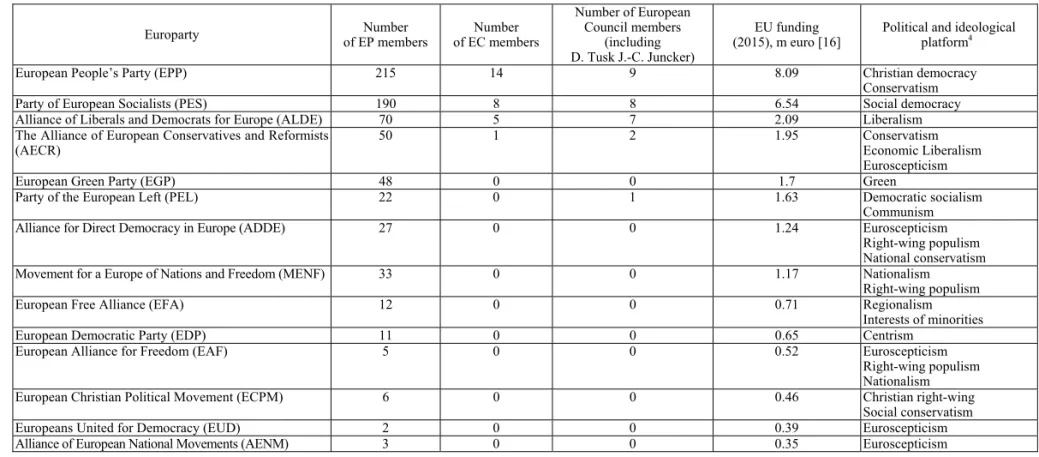
Commission members are coordinated. Europarties also influence the politi-cal process through supporting their EC candidates [27]. The Treaty of Lis-bon governs the right of Europarties holding the majority of votes to put up a candidate for the position of President of European Commission. In 2014, the European People’s Party used this option to nominate Donald Tusk for the position of President of European Council. Thus, Europarties can influ-ence EU governing bodies through delegating their members. A comparative analysis of Europarty representation in EU supranational structures is one of the indicators taken into account when evaluating their influence (table 1).
A comparative analysis shows that there are four leading parties (EPP,
PES, ALDE, AECR) accounting for 70% seats in the European Parliament.
Members of the Big Four hold 29 out of 30 seats in the European Council and all Commissioner Offices in the European Commission. The other 11
Euro-parties account for approximately 20% MEP seats and 1 member of the
Euro-pean Council.
The financing of Europarties out of EU funds is rather limited (the larg-est Europarty — the EPP — receives approximately 8m euros and the small-est — AENM — only 0.35m; these moneys cover three-year salary of a MEP [13]). However, Europarties can accept private donations of 12,000 euro per year [11] and donations from national parties, if the total sum does not exceed 40 % of their annual budget.
From the perspective of internal structure of Europarties is characterised by a weak structure suggesting that PMs can vote in the European Parlia-ment and adoption of legislation depends on compromises both between and within political groups. This reduces the significance of the Europarties, which cannot have a top-down influence on election results. At the same time, this does not reduce the risk of a parliamentary crisis, when strictly disciplined groups would block each other’s initiatives.
Therefore, one of the key functions of Europarties is taking part in the legislative process through forming political groups in the EP. MEPs join such groups in accordance with their party affiliation [7]. Forming a political group requires at least 25 MEPs representing at least one fifth of the EU member states. According to the results of 2014 elections, eight political groups and independent MEPs work in the European Parliament. Party groups are key actors in the EP political process. Thus, the key indicator used when analysing the balance of political forces in the European Parlia-ment is the proportion of seats held by each group rather than by each Eu-roparty separately (table 2).
Table 1
A comparison of Europarties by representation in EU governing bodies, funding, and political and ideological platform
Europarty Number of EP members
Number of EC members
Number of European Council members
(including D. Tusk J.-C. Juncker)
EU funding (2015), m euro [16]
Political and ideological platform41
European People’s Party (EPP) 215 14 9 8.09 Christian democracy Conservatism Party of European Socialists (PES) 190 8 8 6.54 Social democracy Alliance of Liberals and Democrats for Europe (ALDE) 70 5 7 2.09 Liberalism The Alliance of European Conservatives and Reformists
(AECR)
50 1 2 1.95 Conservatism Economic Liberalism Euroscepticism European Green Party (EGP) 48 0 0 1.7 Green
Party of the European Left (PEL) 22 0 1 1.63 Democratic socialism Communism Alliance for Direct Democracy in Europe (ADDE) 27 0 0 1.24 Euroscepticism
Right-wing populism National conservatism Movement for a Europe of Nations and Freedom (MENF) 33 0 0 1.17 Nationalism
Right-wing populism European Free Alliance (EFA) 12 0 0 0.71 Regionalism
Interests of minorities European Democratic Party (EDP) 11 0 0 0.65 Centrism
European Alliance for Freedom (EAF) 5 0 0 0.52 Euroscepticism Right-wing populism
Nationalism
European Christian Political Movement (ECPM) 6 0 0 0.46 Christian right-wing Social conservatism
Europeans United for Democracy (EUD) 2 0 0 0.39 Euroscepticism Alliance of European National Movements (AENM) 3 0 0 0.35 Euroscepticism
4
The ideological comparison of Europarties is based on the approach applied in the ‘Parties and Elections in Europe’ research project using the cleavage model pro-posed by Lipset and Rokkan [15].
10
Table 2
Political groups and Europarties in the European Parliament according to the 2014 election2
Political groups Constituent Europarties3 Political platform4 [15] Number of seats
in the EP
% of seats in the EP
European People’s Party European People’s Party Christian democracy
Conservatism Centrism
216 28.8
Progressive Alliance of Socialists and Democ-rats
Party of European Socialists Centre-left
Social democracy Socialism
190 25.33
Alliance of Liberals and Democrats for Europe
Alliance of Liberals and Democrats for Europe, European Democratic Party
Centrism Liberalism
70 9.33
The Greens — European Free Alliance European Green Party,
European Free Alliance
Centre-left Regionalism Green
50 6.67
European Conservatives and Reformists Alliance of European Conservatives and
Re-formists,
European Christian Political Movement
Centre-right Euroscepticism Conservatism Liberal conservatism Social conservatism Anti-Federalism Economic liberalism
75 10
2
The numbers quoted in the table are based on the official statistics available at the EP official website (http://www.europarl.europa.eu).
3
Some EP political groups include national parties and non-Inscrits alongside Europarties.
4
The classification of ideological platforms of political groups is based on the approach applied in the ‘Parties and Elections in Europe’ research project using the cleavage model proposed by Lipset and Rokkan [15].
10
End of table 2
Political groups Constituent Europarties5 Political platform6 [15] Number of seats
in the EP
% of seats in the EP
European United Left — Nordic Green Left Party of the European Left,
Nordic Green Left Alliance
Left Communism Democratic socialism
51 6.8
Europe of Freedom and Direct Democracy Alliance for Direct Democracy in Europe Right-wing
Euroscepticism National conservatism Right-wing populism
45 6
Europe of Nations and Freedom European Alliance for Freedomd,
Movement for a Europe of Nations and Free-dom
Euroscepticism National conservatism Right-wing populism
38 5.07
Non-Inscrits7 Alliance of European National Movements Euroscepticism 15 2
5
Some EP political groups include national parties and non-Inscrits alongside Europarties.
6
The classification of ideological platforms of political groups is based on the approach applied in the ‘Parties and Elections in Europe’ research project using the cleavage model proposed by Lipset and Rokkan [15].
7
Non-attached MEPs who do not sit in any recognised EP groups. Most of them represent far-right and far-left movements and parties criticising European integration.
10
Party systems
106
European-level (supranational) party system
The ‘two-tier’ structure of European-level party organisations stirred heated debates among researchers focusing on the particularities of the EU
party system1. The problem is that Europarties do not openly compete with
each other during EP elections. Some researchers stress the lack of a cohe-sive system of European-level party representation due to the limits to citi-zens’ participation in EP elections imposed by national borders [17]. Voters elect national rather than European-level parties, although the latter run mas-sive European campaigns. Moreover, Europarties compete with each other through the mediation of national parties for seats in the European Parlia-ment, which affects the balance of forces after the formation of political groups. Creating political groups, Europarties compete in the European Par-liament for the influence on Union-level decision-making [24].
The classical definition of the party system formulated by M. Duverge2
suggests the following criteria for identifying an aggregate of parties as a party system — presence of a party structure, relative stability of connec-tions between party organisaconnec-tions, and dynamic interacconnec-tions between them (competition). A combination of these characteristics grants ‘access’ to rep-resenting interests of voters in the Parliament, which participates in EU gov-ernance.
The European-level party system meets these criteria, although it is not completely identical to a typical national party system. Europarties interact in the European Parliament, where they form political groups, which influ-ence the legislative process in the EU and the operation of the EU governing bodies and compete with the other Europarties and political groups. There-fore, there is a supranational party system, within which Europarties interact and compete at the level of the European Parliament. At the same time, communication with voters is conducted through the constituent national parties, whereas Europarties act as mediators in the course of political group formation (national parties — European parties — political groups).
Thus, the EU party system has both similarities to, and difference from, national party systems. However, using this term in the context of the EU is justified, since Europarties compete with each other and their interaction
produces a ‘system effect’, i.e. legitimises the functioning of the European
Parliament.
The EU party system consisting of 15 Europarties and including perma-nent members — national parties of EU member states — can be considered as a multi-party system. This corresponds to Duverger’s law stating that pro-portional representation tends to favour multipartism, which is observed at the levels of both national party system and the EU [2].
1
This article treats the term ‘European-level party system’ as synonym for the ‘EU party system’.
2
A. Peshenkov, I. Zhukovskiy
107 An important feature is that no political force has an absolute
parliamen-tary majority in the European Parliament (above 50% of votes). Primarily,
this is a result of national party systems translated to European level. As mentioned above, the total number of Europarties (both parliamentary and those without representation in the EP) is fifteen. Such diversity is created by the pluralism of political programmes and agendas of national parties and the erosion of class structure in European societies. As a result, no political plat-form promoted by Europarties can win a majority of European votes.
It is also important to consider another feature of European parties. Some less influential national parties with small representation in national parlia-ments can have large political representation in the European Parliament, which gives them an opportunity to influence European political processes [9]. For instance, in the 2014 EP elections, Marine Le Pen’s National Front won in France, the Danish People’s Party in Denmark, the UK Independence Party in the UK, etc. Of course, the impressive performance of these parties is accounted for by growing Euroscepticism in the EU amid the financial crisis and migration problems. However, winning EP elections does not mean a victory at the national level [23]. A statistical analysis of voters’ be-haviour in EP elections fits in the ‘second-order election’ pattern. This means that voters view elections to the EP as an interim confidence referen-dum and a chance to voice protest against the ruling national parties and the policies of supranational institutions of the EU [16]. In general, the differ-ence between the results of leading national parties in national and EP
elec-tions is approximately 40%.
The impressive results of oppositional parties in European-level elec-tions are accounted for by the particularities of the EU election system, namely, its two-tier structure [12]. Its supranational components include the following common rules. MEPs are directly elected in each EU member state based on the proportionality principle. The election threshold in mem-ber states is 5 % of the total vote. These conditions crate a favourable situa-tion for less influential parties of second and third rank to secure representa-tion in the European Parliament.
The national level is regulated by the laws of EU member states. Each
state determines the number of constituencies. An up to 5% election
thresh-old is set by each member state (in some countries, the threshthresh-old does not apply). In all countries, candidates are nominated by political parties (na-tional parties of member states put up candidates and hold election cam-paigns [14]). However, some countries nominate independent MPs (for in-stance, Poland and Ireland). In different countries, seats are distributed using disparate methods, including the highest averages method, the Hare quota, the Droop quota, the Webster/Sainte-Laguë method, and others. Moreover, voting age also ranges from 18 to 25 years [8].
Party systems
108
Conclusions
A combination of national and European institutions creates a complex multi-tier system of political relations in the European Parliament and the EU in general. Organisational structures and stable competitive interaction between Europarties in the European Parliament support the hypothesis about the development of a supranational party system in the EU.
The EU is an intergovernmental association, which has developed a complex system of supranational political institutions. These institutions are coordinated with and sometimes opposed to the political bodies of EU mem-ber states. These factors explain the key features of the functioning of the EP and the EU party system — the two-tier structure of Europarties and the EU party and election system combining national and supranational components. There are a number of secondary characteristics — the intermediary function of Europarties bringing together national parties and parliamentary political groups, the absence of a parliamentary majority in the EP, the impressive performance of oppositional national parties in European elections ac-counted for by typical models of voters’ behaviour, etc.
A comparative analysis shows that the influence of Europarties is dis-tributed unevenly in the European Parliament. Four centrist parties account for the majority of EP seats and have the largest representation in EU gov-erning bodies. As a result, the leading parties have significant administrative resources and they are closely connected with supranational EU structures. In their turn, small Europarties have little administrative impact on the EU governing bodies and they often represent the extremes of the political spec-trum, sometimes espousing Euroscepticism.
Despite their gradual structuring and ideological grouping, Europarties still depend on political groups in the legislative process and national parties in the election process. Today, Europarties fulfil a number of important po-litical and integration functions. However, they are not major drivers behind European integration and they are unlikely to become ones in the near future due to the lack of institutional tools of direct influence and the absence of direct communication with voters.
One of the ways to strengthen the role of Europarties could be creating a
European constituency distributing a certain proportion of EP seats (10% is
often proposed) among Europarties. Direct participation in elections within the European constituency would bring European institutions closer to EU citizens. Voters would have an opportunity to vote for candidates from other countries, which would strengthen the institution of European citizenship and contribute to the European agenda in the European Parliament, which still serves as a platform to many MEPs to promote national rather than European interests.
par-A. Peshenkov, I. Zhukovskiy
109 ties. Large, well-known Europarties will enjoy significant support within such constituency thus reducing the actual spectrum of voters from EU member states represented in the European Parliament.
These characteristics suggest that the political transformation of the EU from an intergovernmental association to a (con)federation has not com-pleted yet. A complex system of institutions and coordination of interests in the framework of the European Parliament and the EU decelerates and de-centralises the decision-making process. This results in disagreements be-tween the European institutions and the national governments of EU member states. The latter are associated with concentrated authority and clearly for-mulated national interests, which encourages them to influence European-level decision-making so that it meets the national interests. These complica-tions can be overcome through either developing European integration (for instance, establishing a European constituency) or partially ‘liberating’ na-tional governments from supranana-tional EU structures.
References
1. Grechishnikova, E. V. 2011, Pravovoi status Evropeiskogo parlamenta: srav-nitelno-pravovoi analiz [Legal status of the deputy of the European Parliament: comparative legal analysis], Vestnik Omskogo universiteta [Herald of Omsk Univer-sity], no 4, p. 44—63.
2. Dyuverje, M. 2000, Politicheskie partii [Political parties], Moscow.
3. Zhukovskiy, I. I. 2010, Stanovlenie partijnoj sustemy Respubliki Polsha [The formation of the party system Poland], Kaliningrad, 186 p.
4. Zhukovskiy, I. I. 2005, Partijnyje sistemy Vyshegradskih stran i evropejskaja integracija [Party systems of the Visegrad countries and the European integration], Kaliningrad, 117 p.
5. Zhukovskiy, I. I. 2011, Rekrutacja politicheskih elit v sovremennoj Polshe: nekotoryje predvaritelnyje suzhdenia [Rekrutasya political elites in contemporary Poland: some preliminary judgments], Vestnik Moskovskogo gosudartsvennogo universiteta. Ser.12 Politicheskie nauki [Bulletin of Moscow University. Ser.12 Po-litical Science], no. 6, p. 48—55.
6. Kotta, M. 2012, Politicheskie eliti i stanovlenie politicheskoi sistemi na primere Evropeiskogo soyuza [Political elites and the formation of the political sys-tem on the example of the European Union], Sravnitelnaya politika [Comparative Politics], no 3, p. 24—45.
7. Lafitskii,V. I. 2005, Vibori v Evropeiskii parlament [Elections to the Euro-pean parliament], Jurnal rossiiskogo prava [Journal of Russian law], no. 4.
8. Mityaeva,Yu. V. 2014, Evroparlament segodnya. Nekotorie aspekti formiro-vaniya, puti dalneishego razvitiya i vzaimodeistviya [The European Parliament to-day. Some aspects of formation, ways of further development and cooperation]. In:
Vibori: teoriya i praktika [Elections: theory and practice], no. 2, p. 48—57.
9. Pogorelskaya, S. V. 2014, Evropeiskaya integraciya kak faktor transformacii nacionalnih partiino_politicheskih sistem: primer Germanii [European integration as a factor in the transformation of national party-political systems: the example of Germany], Chelovek. Soobschestvo. Upravlenie [Human. Community. Management], no. 3, p. 51—58.
Party systems
110
tion of national political parties in the states — members of the European Union],
Chelovek. Soobschestvo. Upravlenie [Human. Community. Management], no. 3, p. 32—40.
11. Reglament Evroparlamenta i Soveta ES, no. 2004/2003 “O statuse i finansi-rovanii politicheskih partii na evropeiskom urovne" [Regulation №2004/2003 of the European Parliament and of the Council On the regulations governing political par-ties at european level and the rules regarding their funding]2003,Moskovskaya Go-sudarstvennaya Yuridicheskaya Akademiya, Kafedra prava Evropeiskogo Soyuza, Centr prava Evropeiskogo Soyuza [Moscow State Law Academy, Specialized de-partment of the European Union, the Centre of European Union law], available at: http://eulaw.edu. ru/documents/legislation/instit_organs/parties.htm (accessed 28 Sep-tember 2015).
12. Reshenie Soveta Evropeiskogo Soyuza №2002/772/ ES_ Evratom “Ob iz-menenii Akta otnositelno viborov predstavitelei v Evropeiskii parlament na osnove vse_obschego_ pryamogo izbiratelnogo prava_ prilojennogo k Resheniyu 76/787/ EOUS_ EES_ Evratom" [Decision of the Council of the European Union №2002/772 / EU, EAEC "On the change of the Act concerning the election of rep-resentatives to the European Parliament by universal suffrage, applieded to Decision 76/787 / ECSC, EEC, EAEC"], 2002, Moskovskaya Gosudarstvennaya Yuridi-cheskaya Akademiya, Kafedra prava Evropeiskogo Soyuza, Centr prava Evropeis-kogo Soyuza [Moscow State Law Academy, Specialized department of the Euro-pean Union, the Centre of EuroEuro-pean Union law] available at: http://eulaw.edu. ru/documents/review/obz021120.htm (accessed 28 September 2015).
13. Salomatin, A. Yu., Melikov, A. V. 2015, Evropeiskii parlament: politiko-pravovoe issledovanie [European Parliament: political and legal research], Moscow. 14. Strejneva, M. V. 2010, Strukturirovanie politicheskogo prostranstva v Ev-ropeiskom soyuze (demokratizaciya) [The structuring of the political space in the European Union (democratization)], Mirovaya ekonomika i mejdunarodnie otnosh-eniya [World Economy and International Relations], no. 1, p. 61—72.
15. Shveicer, V. Ya. 2014, Itogi viborov v Evropeiskii parlament 2014 g.: ob-schee i osobennoe [Results of elections to the European Parliament in 2014: the general and special], available at: http://www. ieras. ru/pub/analitlka/5.pdf (accessed 29 September 2015).
16. Shveicer, V. Ya. 2014, Vibori v Evropeiskii parlament: sdvigi na partiino-politicheskom prostranstve [Elections to the European Parliament: changes in the party-political space], Sovremennaya Evropa [Modern Europe], no. 4, p. 23—32.
17. Costello, R., Thomassen, J., Rosema, M. 2012, European Parliament Elec-tions and Political Representation: Policy Congruence between Voters and Parties,
West European Politics, T. 35, Vol. 6, p. 1226—1248.
18. Database “Parties and Elections in Europe", 2014, available at: http://www. parties-and-elections.eu/eu.html (accesses 4 October 2015).
19. Grants from the European Parliament to political parties at European level per party and per year, 2015, available at: http://www. europarl. europa. eu/pdf/ grants/Grant_amounts_parties%2003—2015_new%20logo. pdf (accesses 20 De-cember 2015).
20. Hix, S. 2002, A Supranational Party System and the Legitimacy of the Euro-pean Union, The International Spectator, no. 4, p. 49—60.
21. Hix, S., Kreppel, A., Noury, A. 2003, The Part System in the European Par-liament: Collu-sive or Competitive? JCMS, no. 2, p. 309—331.
A. Peshenkov, I. Zhukovskiy
23. Hobolt, S., Spoon, J., Tilley, J. 2008, A Vote Against Europe? Explaining Defection at the 1999 and 2004 European Parliament Elections, British Journal of Political Science, no. 39, p. 93—115.
24. Kreppel, A. 2002, The European Parliament and Supranational Party Sys-tem, Cambridge.
25. Marsh, M., Hix, S. 2007, Punishment or Protest? Understanding European Parliament Elections, The Journal of Politics, T. 69, Vol. 2, p. 495—510.
26. Nugent, N. 2010, The Government and Politics of the European Union: The European Union Series.
27. Sartori, D. 1976, Parties and Party Systems, Cambridge.
28. Sedlakova, M. 2013, The Role of Ideology in Boundary Maintenance of Eu-roparties, available at: www.etd.ceu.hu/2013/sedlakova_maria. pdf (accesses 20 De-cember 2015).
About the authors
Alexander Peshenkov, researcher, Russian State University for the Hu-manities, Russia.
E-mail: [email protected]
Dr Igor Zhukovskiy, Vice-Rector for International and Public Affairs, Im-manuel Kant Baltic Federal University, Kaliningrad, Russia
E-mail: [email protected]
To cite this article: