Efficient Sernipararnetric Estirnation of
Quantile Treatrnent Effects
*
Sergio Firpo
ue
Berkeley - Department of Economics
This Draft: January, 2003
Abstract
This paper presents calculations of semiparametric efficiency bounds for quantile treat-ment effects parameters when se1ection to treattreat-ment is based on observable characteristics. The paper also presents three estimation procedures forthese parameters, alI ofwhich have two steps: a nonparametric estimation and a computation ofthe difference between the so-lutions of two distinct minimization problems. Root-N consistency, asymptotic normality, and the achievement ofthe semiparametric efficiency bound is shown for one ofthe three estimators. In the final part ofthe paper, an empirical application to a job training program reveals the importance of heterogeneous treatment effects, showing that for this program the effects are concentrated in the upper quantiles ofthe earnings distribution.
Keywords: Quantile Treatment Effects, Propensity Score, Semiparametric Efficiency Bounds, Efficient Estimation, Semiparametric Estimation
1
INTRODUCTION
1.1
THE PROBLEMIn program evaluation studies it is often important to learn not only about the average treatment
effects, but about the distributional effects of a treatment. In particular, the policy-maker might
be interested in the effect of the treatment on the dispersion of the outcome, or its effect on the
lower tail of the outcome distribution.
One way of capturing this effect in a setting with binary treatment and scalar outcomes is
by computing the quantiles ofthe distribution ofthe treated and ofthe control outcomes.
Us-ing quantiles, discretized versions of the distribution functions of treated and controls can be
calculated. AIso, quantiles are used in many inequality measurements as, for instance, quantile
ratios, inter-quantile ranges, concentration functions, and the Gini coefficient. Finally,
differ-ences in quantiles are important as the effects of a treatment may be heterogeneous, varying
along the outcome distribution.
The parameter of interest in this paper, labeled the quantile treatment effect, is the
differ-ence between the treated and the control groups in quantiles of the marginal distribution of the
outcome. As is the case for any treatment effect parameter, identification restrictions are
nec-essary for this parameter to be estimable. In this paper the relevant restriction is the assumption
that selection to treatment is based on observable variables.
It is common practice in calculations of average treatment effects to first compute a
condi-tional average treatment effect, and then to integrate over the distribution of covariates to
re-cover the unconditional average treatment effect. However, as the mean of the quantiles is not
equal to the quantile of the mean, integrating a first-stage computation of the conditional
quan-tiles (of the treated and the control outcomes) will not yield the marginal quanquan-tiles. Instead,
this paper demonstrates how to use the identification assumption that selection to treatment is
based on observable variables to calculate the marginal quantiles for the treated and for the
Quantile treatment effects have been indirectly computed for the case in which selection into the treatment group is based on observable characteristics. DiNardo, Fortin and Lemieux (1996) have suggested a way of estimating counterfactual densities of control groups in a binary treatment/scalar outcome setting. Apparently however, no further development, refinement, or derivations of large sample properties of this procedure have been proposed in the literature.
I show in this paper how to estimate the quantile treatment effects in three different ways. All three proposed estimation techniques involve two steps. The first is nonparametric, and the estimators may differ by the number and type of estimated functionals. In the second step all estimators are differences of minimizers of the sums of check functions. This second step is typical of quantile estimation. I then focus on a two-step estimation technique that involves estimation of only one function in the first step: the propensity score. I show that this estimator is root-N consistent and asymptotically normal. I also calculate the semiparametric efficiency bound and show that the quantile treatment effects estimator achieves it. Finally, I provi de an empirical application, to illustrate the techniques and show its practicality. The estimates suggest that for several quantiles the treatment effect is quite different from the mean treatment effect. Thus, the application demonstrates how the techniques developed in this paper can provide evidence ofheterogeneity in the impact ofa treatment.
1.2
QUANTILE TREATMENT EFFECTSIn a binary treatmentlscalar outcome setting, one is often interested in learning the impact of the treatment on the outcome. We define the potential outcome of being treated, Y
(1),
as the outcome that an individual would have experienced (or perhaps did experience) had he been exposed to the treatment. Analogously, we define the potential outcome of not being treated,Y(O),
as the (hypothetical or actual) outcome had the individual not been exposed to the treatment. For any given individual we observe only one potential outcome, the other one, sometimes called the counterfactual outcome, constitutes missing data.The fact that potential outcomes are partially unobservable leads us to the use of some
identification restrictions, a requirement that is common to the identification of any treatment
effects parameter. A typical strategy to deal with this problem is to assume that given a set of
observed covariates, individuaIs are randomly assigned either to the treatment group or to the
control group. That assumption was termed by Rubin (1977) the unconfoundedness assumption
and it characterizes the selection on observables branch of the program evaluation literature.
Barnow, Cain and Goldberger (1980), Heckman, Ichimura, Smith and Todd (1998) and Dehejia
and Wahba (1999) are important examples. Further discussion ofthese identifying assumptions
will be provided in later sections.
Several parameters can be defined in order to capture the effects of a treatment. In most
cases, the focus is on the average treatment effect (ATE) defined as the difference in the means
of the potential outcomes. One reason that many program evaluation studies focus on average
treatment effects is that for the special case in which the treatment has a homogeneous effect,
it is possible to interpret ATE as the effect of the treatment on a single observation. Note,
however, that the average treatment effect does not depend on homogeneity assumptions to be
well-defined.
Indeed, treatment effects may be heterogeneous, varying greatly along the outcome
distri-bution. The presence of heterogeneity in treatment effects is very important when evaluating
programs, as policy-makers are often interested in the distributional consequences ofthe
treat-ment. This is true, for example, for a wide range of social programs such as welfare,
unemploy-ment insurance, subsidized job training, the minimum wage, agrarian reform, and micro-credit
provisiono
A parameter of interest in the presence of heterogeneous treatment effects is the quantile
treatment effect (QTE). As originally defined by Lehmann (1974) and Doksum (1974), the QTE corresponds, for any fixed percentile, to the horizontal distance between two cumulative
Dok-sum (1974) and Lehmann (1974) implicitly argued that an observed individual would maintain
his rank in the distribution regardless of his treatment status. This paper will refer to this type
of assumption as a rank invariance assumption.
Rank invariance assumptions are strong assumptions as they require that the relative value
(rank) of the potential outcome for a given individual would be the same under treatment as
under non-treatment. There are two ways to deal with cases in which rank invariance is an
unreasonable assumption. The first one is due to Heckman, Smith, and Clements (1997), who
suggested computing bounds for the QTE, allowing for several possibilities of re-orderings of
the ranks. According to them, the outcome for the same individual may differ from one
distri-bution to another based on how observable and unobservable attributes impact each one of the
potential outcomes. However, while the effect of observable characteristics can be measured,
unobservable characteristics can interact with treatment status in many unknown ways, leaving
open the possibility of a sharp reordering of ranks. Bounds for the QTE that capture these
altematives were proposed by Heckman, Smith and Clements (1997).
The second approach to dealing with failures of the rank invariance assumption argues that
even without this assumption, one can still have a meaningful parameter for policy purposes.
Consider the case in which all the policy-maker is interested is in learning about the marginal
distributions of the potential outcomes. A good way to summarize interesting aspects of these
distributions is by computing their quantiles. In this case, quantile treatment effects can be
defined as simple differences between quantiles ofthe marginal distributions ofpotential
out-comes. As an example, suppose that one is interested in the difference in medians between two
distributions, and not in the effects of treatment on a typical individual. In such a setting it is
not necessary to have any knowledge about the joint distribution of outcomes for the treated
and control groups, so the rank invariance assumption could be dropped. Note, however, that
if rank invariance holds, then the simple differences in quantiles tum out to be the quantiles of the treatment.1
1 Note that there is no similar problem in estimation ofthe average treatment effect, as differences in means
This definition of quantile treatment effects, together with the selection on observables
approach, allows identification of various QTE parameters that differ by the subpopulation they
refer to. Following the approach ofHeckman and Robb (1986) and Hirano, Imbens and Ridder
(2002), who suggest several parameters of interest for the mean case, two QTE parameters
will be the object of study in this paper. They are labeled the quantile treatment e.ffect and
the quantile treatment e.ffect on the treated, the former being the QTE parameter for the whole
population under consideration and the latter the parameter for those individuaIs subject to
treatment. Defining T as the indicator variable of treatment, these parameters can be expressed
as:
Quantile Treatment Effect: .ó.t = ql,t - qO,t,
where qj,t is such that
Pr[Y(j)
S q]
=
't, j=
0, 1.Quantile Treatment Effect on the Treated: .ó.tIT=1 = ql,tIT=1 - qO,tIT=b
where qj,tIT=1 is such
thatPr[Y(j)
S qJ T
=
1]=
't, j=
0, 1.The role that the observable covariates play in identification ofboth ATE and QTE is made
clearer in the QTE case. This is because, as stated earlier, the computation of quantile
treat-ment effects does not use the conditional quantiles. Computation of conditional quantiles is
unnecessary since the quantiles ofthe marginal distributions ofthe potential outcomes are the
object of interest and the mean of the quantile is not the quantile of the mean. Hence, for QTE,
the covariates serve only to remove the selection bias.
Quantile treatment effects are also useful in describing the center of the distribution of the
treatment. In particular the median treatment e.ffect (MTE), the QTE for the fifty percentile,
is a central measure of the treatment effect, like ATE. However, MTE has an additional and
desirable feature not present in ATE: its corresponding estimator is robust to the presence of
data outliers.
Despite the relevance of QTE, the program evaluation literature on this topic is not as
vast as that of its main competitor, ATE. Traditionally, expectations have received more atten-tion in the literature than quantiles. Pioneer papers on quantile estimaatten-tion, such as those by Koenker and Bassett (1978) and, in an instrumental variables setting, by Amemiya (1982) and Powell (1983) have helped to bridge this gap. In the treatment effects literature, some recent contributions have also been made to the study of the distributional effects of the treatment. Among them, Abadie, Angrist and Imbens (2002), and Chernozhukov and Hansen (2001) have proposed instrumental variables versions of the QTE. Imbens and Rubin (1997) and Abadie (2002) proposed methods to estimate some distributional features for a subset of the treated units, again in an instrumental variables setting. Distributional effects have also been stud-ied empirically, as in the papers of Freeman (1980), Card (1996), and DiNardo, Fortin and Lemieux (1996).
In this paper three different semiparametric ways of estimating each QTE parameter are presented. Each one corresponds to a particular way that the parameter can be identified from the observable data. These three ways will differ by the number and by the sort offunctionals of the observed data involved in estimating the parameter. I focus my attention on the estimation technique that requires estimation of only the propensity score. This estimator is the QTE analogue ofthe ATE estimator proposed by Hirano, Imbens, and Ridder (2002), and involves reweighting observations by the inverse of the propensity score. The estimator will be equal to the difference between two quantiles, which can be expressed as the solution to minimization problems, where the minimand, a sum of check functions, is a convex empirical processo Using the empirical process literature consistency and asymptotic normality results are derived. As the estimator has asymptotic variance equal to the semiparametric efficiency bound (which I compute using the techniques suggested in Newey (1990) and Bickel, Klassen, Ritov, and Wellner (1993», this is an efficient estimator for the QTE parameters.
The remainder of this paper is divided as follows. The next section presents a simple model of quantile treatment effects. In the third section I demonstrate how the identification
assumptions alIow expressing the parameters of interest as functionals of the observed data.
Semiparametric efficiency bounds for QTE parameters are presented in Section 4, while
sec-tion 5 presents the three estimasec-tion techniques (mensec-tioned above) and large sample properties.
Section 6 presents an empirical application for the estimator. Section 7 concludes.
2 A
SIMPLE MODEL OF QUANTILE TREATMENT EFFECTS
I start by assuming that there is an available random sample of N individuaIs (units). For each
unit i, let
Xi
be a random vector of observed covariates with compact support X C ~r. DefineYi( 1) as the potential outcome for individual i under treatment, and Yi(O) the potential outcome
for the same individual without the treatment. Let the treatment assignment be defined as
h
which equals one if individual i is exposed to treatment and equals zero otherwise. As we
only observe each unit at one treatment status, we say that the unobserved outcome is the
counterfactual outcome. Thus, the observed outcome can be expressed as:
Vi (1)
To motivate, consider Yi as the observed earnings of individual i in a model of the impact
of a job training program on worker earnings. In this example,
Ti
is the indicator for the receiptof training.
Potential outcomes depend on both observed and unobserved individual characteristics. For
each individual i, let cI,i and cO,i be functions, under the treatment and the control respectively, of vectors of unobservable attributes. In a job training program model for example, earnings
of each individual are a function of their pre-program observable characteristics, such as past
earnings, employment status, education, age, job experience, gender, and union status; they
are also a function of unobservable attributes, such as ability, motivation and some possible
Specifying the impact of X and (t], to) on the potential outcomes:
Yi(
1)=
G](Xi,
El,i)Yi(O)
=
Go(Xi,Eo,i)
(2)
(3)
I assume se1f-selection into treatment: individuaIs can decide whether or not to be treated.
When an individual i faces the decision whether or not to join the job training program, he
will weigh the gains and costs to him of both situations. Assume that an individual i predicts
his expected eamings (given his vector Xi) and his costs for each of the altematives. In other
words, the individual i chooses the state that yields the largest expected utility:
where u(·) is utility function, C] (., .) and
Co(·, .)
are some costs associated respective1y withjoining the training program and not joining it, and
lli
is a vector of variables that is unobservedto the econometrician but not to the individual. AIso,
lli
is assumed to be independent of(EI,i,tO,a. The effect of
lli
on the individual 's utility will depend on whether or not he enters the job programo For example,lli
might be a reservation wage that enters as an argumentto a foregone eamings function. Individual i will then choose to take part in the program if
E[u(Y(
1))IXi, lli]-
C](Xi,
lli)
~E[u(Y(O))
IXi, lld -
Co(Xi,
lli).
That is:2T
=n{E[u(Y(l)) -u(Y(O))
IXi,lld -:-
(Cl(Xi,
lli)
-Co(Xi,lli))
~ O} (5)Note how this model fits into the Roy model (1951) of income distribution.3 In the Roy model, an individual chooses the greater of the potential eamings given by two different
occu-pations. Here, the choice is based on the individual's expected eamings and on some individual
2The indicator function n{A} is equal to one if Ais true and zero otherwise.
3 See also Heckman and Honore (1990).
cost. Thus, after controlling for Xi, the choice of getting treatment will be independent ofthe
individual potential earnings, whiCh depends only on Xi and (f!,i,fO,i). That will hold as long
as lli and (fl,i,fO,i) are independent and the functional form of potential earnings is the one
described in Equations (2) and (3). The independence result can be written as:
(Yi(
1),
Y;(O))
is jointly independent of1i
givenXj Vi (6)Equation (6) is the the unconfoundedness asswnption labeled by Rubin (1977) . This
as-sumption was derived here as a result, but we needed to put some structure on the form of
the potential outcomes and on the form of the decision rule. We also needed to put stochastic
restrictions on the unobserved variables. Note however, that unless there is a gain in insight to
writing the model with the structure presented in Equations (2)-(5), Equation (6) could actually
have been our starting point.
I will maintain the structure of the above model for now. In this model, a rank invariance
asswnption can be obtained by imposing two additional requirements:
(i) Vx E X, GI (x, .) and Go(x,·) are either (a) strictly increasing functions or (b) strictly
de-creasing functions;
(ii)
Vi,
fl,i and fO,i are perfectly positively correlated.These two asswnptions ensure that people do not change their position in the earnings ranks
in each one ofthe possible two states. These are strong asswnptions, in particularpart (ii). This
is the case when skills that are useful in one regime may not be as useful in another regime. 4
However, note that if these two extra requirements hold, then for every individual i such
that
Pr[Y;(I)
~ ql,'t], it must be the case thatPr[Yi(O)
~ qO,'t].5 Therefore, calculations ofthedifference ql,'t - qO,'t for all 't in the interval [0,1] yield the distribution ofthe treatment effects.
4In terms ofthe Roy model (1951), in a world with only two occupations, hunting and fishing, that assumption implies that the most able hunters are also the most able fishermen.
5The same would be true for the quantiles of the distribution of potential outcomes given T
=
1, that is, ifAs rank invariance is in many cases a too strong assumption, I also motivate the interest in the differences in quantiles in a different way. Assume that there is a social welfare function, V, such that V depends on the individual utility functions. For simplicity, assume that each individual utility depends on his earnings only. Therefore, we can write V as a function of the eamings distribution of the whole population. In order to simplify the argument, imagine that there are two possible scenarios: we either treat everyone or treat no one.6 Under the first scenario, the distribution of earnings is then equal to distribution of Y( 1), which has the cu-mulative distribution function FI; while in the second scenario, the earnings distribution equals that of Y( O), whose cumulative distribution function is Fo. Ignoring social choice problems, as-sume that the policy-maker has to choose between these two distributions in order to maximize the social welfare function:
V*
=
maxV(F)Fl,Fo (7)
In order to compare V(FI) with V(Fo) the policy-maker will need to calculate approximate distributions ofthe potential earnings, FI and Fo, and a good way to summarize a distribution is to compute its quantiles. If we compute a sufficient number of quantiles, we will end up having a discretized approximation of the distribution.
Consider then that each distribution is approximated by the calculation of a number P of quantiles. When P is equal to 100, we say that each quantile corresponds to a percentile. Doing that for both distributions, we have:
(8)
(9)
6 Altematives, as discussed in Manski (1997), include allowing individuais to choose their treatrnent status or assigning them to treatment based on observed characteristics.
The policy maker chooses between treatment and no treatment according to whether VI is
greater than Vo.
Say that both VI and Vo are linear in the quantiles, that is, say that:
VI = V(ql l,qI2, ... ,qll)
'P']5 ,
P
=
~al,fql,f
J=I(10)
(11)
where aj,f and ao,f'
U
=
1, ... ,P) are parameters ofthe social welfare function.Consider the case where for each 't E {~,~, ... ,1}, al,'t
=
ao,'t = a't. This is a fairly intuitivecase: The weights on the social welfare function are the same whether or not the treatment is
implemented. In this case, the decision to run a job training program would be consistent with
the following inequality:
(12)
Equation (12) motivates the difference in quantiles as the main object of interest for the
policy-maker. The decision to continue running the program depends crucially on the quantile
treatment effects for all the quantiles of interest, that is, for alI 't such that a't
::f.
0.1A particular case ofEquation (12) would be when a't
=
O for all 't but for one 't'. This is the case, for example, when all the policy-maker is interested in is whether the training increasesthe earnings of those at the lower tail of the distribution.
Other types of social welfare functions would lead to the calculation of other treatment
effect parameters. For example, say that V1
=
ql,O.25 and that Vo=
QQO,O.25. This is the case inQI,O.75 0,0.75
which the policy-maker aims to run ajob training program that decreases eamings inequality
measured in a particular way. In this example, if V1 - Vo ~ 0, then the program reduces the gap
between quartiles (.75 and .25), that is, reduces earnings inequality.
3
IDENTIFICATION OF QUANTILE TREATMENT EFFECTS
PA-RAMETERS
As potential outcomes are only partially observed, in order to identify from the observed data
both L1, and ~ I T = 1, the quantile treatment effects and the quantile treatment effects on the treated, we need an identification restriction. Instead of writing that restriction in terms of
unobserved components (as in the previous section), I will start from a more general setting, in
which we do not need to know the functional form ofthe potential outcomes. Let the propensity
score, Pr[T = llX
=
x], be written as p(x), and its expectation, E [P(X)], be written as p. Thus, the identification assumption used here, following Rosenbaum and Rubin (1983), is:ASSUMPTION 1 (Strong Ignorability - Rosenbaum and Rubin (1983)): For almost all values ofX:
(i) Unconfoundedness: (Y(I),Y(O)) isjointlyindependentfrom T givenX;
(ü) Common Support: c
<
p(x)<
1 - c, for some c>
°
Although it is a strong assumption, many studies of the effect of treatments or programs
make an assumption similar to that of part
(i)
of Assumption 1 as, for example, Heckman,Ichimura, Smith, and Todd (1998) and Dehejia and Wahba (1999). Altematives to this
as-sumption are the using instrumental variables (the selection on unobservables approach), and
calculating bounds for the parameter of interest, as proposed by Manski (1997).8 Part (ü) states 8For review and comparison of approaches see, for instance, Angrist and Krueger (1999) and Heckman, LaLonde and Smith (2000).
that for almost alI values of X both treatment assignment leveIs have a positive probability of
occurring.
Now consider that each one of the four types of quantiles defined previously, ql;r, qO;r,
ql,'tl T=], and qO,'t1 T=l do exist and are uniquely deterrnined or, in other words, the distribu-tion funcdistribu-tions of the potential outcomes are continuous and not fiat at the t-percentile. These
conditions appear in the folIowing asumption:
ASSUMPTION 2 (Existence and Uniqueness ofQuantiles): For j
=
0, 1, YO) is a continuous random variable with support in ]R. such that for t E [0,1]:(i) Existence: ~,j = {q E]R.I t = Pr[Y(j) ~ q]} and Q..,jIT=l = {q E]R.I t=Pr[Y(j) ~
ql T
=
1]} are non-empty.(ii)Uniqueness: Let Fj(q)
=
Pr[Y(j) ~ q] and FjlT=l (q)=
Pr[Y(j) ~ql T
=
1].
'h
a~(q)1
+ ( )°
daFm=l(q)1f
(
)
°
r.
en q _ . =Jj qj,'t>
an dq _=
jlT=l qj,'tIT=l>
q-q},t q-qj,tIT=l
Under Assumptions 1 and 2 both the overalI quantile treatment effect and the quantile
treatment effect on the treated become estimable from the data on (Y, T,X). To show this, I
first prove that the quantiles of the potential outcome distributions can be written as implicit
functions ofthe observed data:
LEMMA 1 (Identification ofQuantiles): Under Assumptions 1 and 2, thefollowingequalities hold:
ql,'t :
(Q1c)
= E[Pr[Y ~
ql,'tIX,
T=
1]]
= [E[T n{Y
~
ql,dIXJ]
E p(X)
=
E[Tn{y~ql,'t}]
Proof: See Appendix I
Lemma 1 shows that there are multiple ways of expressing each quantile of the potential outcome distributions in terms ofthe observed data (Y, T,X).9 In fact, the lemma shows that there are at least three ways of identifying the quantiles using the observed data (Y, T,X). These are divided into three groups denoted by A, B and C (which are the indices for each expres-sion in Lemma 1). Each group will differ according to the number and type of conditional expectations to be taken inside the expectation symbol.
In the first identification group, indexed by A, the computation of a conditional probability function in the first step is required. This function is the probability of Y being less than or equal to q given that X
=
x and T=
1. Taking the expectation over alI x E X for the treatedsubset (T
=
1) yields the desired result: ql,t will be the quantity that sets the expected value equal to 'toThe equation indexed by B also requires computation of a conditional expectation in the first step. However, as this conditional expectation function is not restricted to the subset oftreated units, one needs to divide by the probability of being treated given X
=
x (the "propensity score"). Notice then, that the first step involves two conditional expectations computations. This is the price paid for not restricting computation to the subset of treated units. Also, as in expression A, in expression B ql,t wilI be the quantity that sets the expected value ofthe ratio of conditional functions equal to 'toFinally, expression C is the simplest of the three. The first step requires computation of just one conditional expectation function, namely, the propensity score. Notice, that ex-pression A also requires just one conditional expectation computation in the first step. The main difference lies in the role that the quantile q plays. In A one first has to compute
KI (x;
q)
=
E[n{Y::; q}IX
= x,T
= 1]. This function does not simply depend on (y,t,x), be-9 An analogous result for qO,t would follow from the same lines ofLemma 1. For example, for the group C we would have t - E [(I-T)I{y<QO,t}]- l-p(X) .
cause the quantile q enters as an argument, complicating computation.10 This is different for expression C. In C, the p-score computation does not involve q; in fact, it does not involve
the random variable Y nor any functional of its distribution. Finally, to get
ql,'t,
one needs toproceed as in the other steps and compute an unconditional expectation.
As Lemma 1 does not directly yield a way to identify the quantiles ofthe potential outcomes
for the actual treated units, it is necessary to postulate another set ofresults for that special case:
LEMMA 2 (Identification of Quantiles for the Treated): Under Assumptions 1 and 2, the
following two sets of equalities hold:
(QT1B)
(QT1c)
(QTOB)
(QTOc)
Proof: See Appendix I
= E[p(x)pr[y:::;ql;IT=lIX,T=
ll]
= E [E[T n{Y:::;
!l,'tIT=l}IXl]
E [T n{Y:::;
;l,'tIT=d]
E [p(x)pr[Y:::; qO;IT=lIX, T
=Ol]
E
[(1
!;~l))pE[(l-
T)n{Y:::; qO,'tIT=dIXl]
= E
[(1
!;~l))p
(1-
T)n{Y:::; qO,'tIT=l}]
In the proof in the Appendix I, one can see that Assumption 1 plays no role in the
iden-tification of ql;tl T=l· Heckman, Ichimura, and Todd (1997) have stressed such result when
looking for identification conditions for the average treatment effects on the treated.
Identification of the quantile treatment effect parameters parameters is a straightforward
consequence of Lemmas 1 and 2, as stated in the next corolIary.
COROLLARY 1 (Identification of quantile treatment effect parameters): Under Assumptions 1 and 2, the quantile treatment effect, ~'t, and the quantile treatment effect on the treated,
~IT=l' are identifiedfrom data on (1', T,X).
Proof: Note that from Lemmas 1 and 2 the four parameters ql,'t, qo,'t, ql,'tIT=l> and qO,'tIT=l
are functionals of the joint distribution of (Y, T,X). As ~'t equals the difference between ql,'t
and qO,'t; and ~IT=l equals the difference between ql,'tIT=l and qO,'tIT=l, ~'t and ~IT=lare
also functionals ofthe joint distribution of (Y, T,X). Therefore, ~'t and ~IT=b are identified
from data on (Y, T,X). O
For ~IT=b the method given by group A requires the computation ofthe p-score in
ad-dition to the computation of one conad-ditional expectation given T
=
1 and X for (QT1A), and another conditional expectation given T = O andX for (QTOA). The method in group B requires computing one conditional expectation givenX for (QT1B) and computing another conditionalexpectation as welI as the p-score for (QTOB). FinalIy, for group C alI that it is required is the
p-score computation for (QTOc). Notice that the expectation ofthe p-score, p, is required for
alI three groups.
A comparison between Lemmas 1 and 2 reveals the presence of an interesting asymmetry
in the former but not in the latter. Using procedures B and C, the computation of ql,'tIT=l
requires fewer first step calculations of conditional functions than the computation of q O,'t I T= 1.
This difference does not hold for ql,'t versus qO,'t, since the computation ofthese are symmetric
and both computations involve the same number and sort offunctionals.
From an estimation point of view the classification of these three groups of methods is
relevant not only for the QTE, but for mean-based measures, such as the ATE, as well. Using
sample analogues, Hahn (1998) has suggested estimation of the ATE based on an identifying
approach similar to that described by B. Dehejia and Wahba (1999) proposed (among other
techniques) estimating the average treatment effect on the treated by reweighing the control
sample using the estimated p-score; this is analogous to the identification set C. Hirano,lmbens
and Ridder (2002), going into more detail, have also focused on the estimation of ATE using
the analogue of the set C for identification.
Estimation of the quantile treatment effect on the treatment based on the set C of identifying
assumptions has been implicit in the applied literature. DiNardo, Fortin, and Lemieux (1996)
proposed estimation of the counterfactual density of outcomes for the control group using a
method similar to (QTOc). They argue in a footnote that, once the counterfactual density
is estimated, it is possible to recover the counterfactual quantiles and therefore the difference
between the quantiles ofthe treated group and the counterfactual quantiles ofthe control group.
However, as is made clear by expression (QTOc), there is no need to first compute densities if
the ultimate goal is the estimation of quantiles.
In Section 5 of this paper I present the estimation counterparts of alI three sets of equations
for both the overalI quantile treatment effect and the quantile treatment effect on the treated.
4
SEMIPARAMETRIC EFFICIENCY BOUNDS
As Lemmas 1 and 2 suggest, estimation of quantile treatment effects can be attempted using
a two-step procedure, where the first step is a non-parametric estimation of a conditional
ex-pectation function. The preliminary step must be non-parametric since the joint distribution
of (Y(O), Y(I)) is not parametricalIy specified. Semiparametric estimation for the ATE can be
found in Hahn (1998), Heckman, Ichimura, Smith, and Todd (1998) and Hirano, Imbens and
A semiparametric analog of the Cramer-Rao lower bound was first introduced by Stein
(1956) and further developed by Bickel, KIassen, Ritov, and Wellner (1993). The
semipara-metric efficiency bound concept was popularized in the econosemipara-metric literature by a review
article by Newey (1990). In general terms, the bound corresponds to the largest variance over
all possible regular parametric specifications of the nonparametric component of the mode!.
Such bound is indeed a (not necessarily achievable) lower bound for the asymptotic variance
of distribution-free, root-N consistent estimators.
More formally, consider a finite-dimensional parameter
ç
from some general statisticalmode!. Say that this model contains a submodel that can be parameterized by a finite-dimensional
parameter
8.
Thus, for this submodel we writeÇ(8).
Ifthis parameter is differentiable in thesense described by Bickel, KJassen, Ritov, and Wellner (1993), then its derivative with respect
to 8 can be written as E['Vs~], where 'V is the influence function of
ç
and se is the score of that submode!. The semiparametric efficiency boundVç
will be equa1 to E [%'Ve] , where 'Ve isequal to E['Vs'e](E[ses~])-l Se, the "projection" onto the space spanned by all scores.
Hahn (1998) uses the setup described above to compute the semiparametric efficiency
bounds for both the average treatment effect, ~, and the average treatment effect on the treated,
y. For the quantile treatment effects setting, I also compute bounds for two parameters, namely,
~t and ~IT=l. With Assumptions 1 and 2, the semiparametric efficiency bounds for ~t and
~IT=l can be calculated:
THEOREM 1 : (Boundsfor ~t and ~I T=l): Under Assumptions 1 and 2, the semiparametric efficiency boundsfor ~t and ~IT=l are respectively equal to:
_ [V[gl,Llt(Y)IX, T =
1]
V[gO,Llt(Y)IX, T =O]
VLlt -E p(X)
+
1 _ p(X)+
(E[gl,Llt(Y) IX, T = 1]-E[gO,Llt(Y)IX, T=
0])2]
(13)
and
wherefor j
=
0,1:(15)
and
(16)
Proof: See Appendix I
Note that the bounds VÓt and V ~IT=I are similar to the bounds computed by Hahn (1998)
for the mean case. For
B
andr
the bounds, as computed by Hahn (1998), are respectively: 11[
V[YIX,T=
1]
V[YIX,T=O]
2]
V~=E
p(X)
+
l-p(X)
+((E[YIX,T=I]-BI)-(E[YIX,T=O]-Bo))
and
v;
=E [P(X)V[Y IX, T
=
1]
+
",-p(,-X"-7?...,.-'V[,--Y-,-IX..,.-'
T--:-:=~O]
Y
p2
p2(I-p(X))
p(X)((E[Y IX, T
=
1] -
rI) -
(E[Y IX, T
=
0]-ro))2]
+
2 .P
There are two reasons for the similarity between the semiparametric efficiency bounds of
the QTE and the ATE parameters. First, both the QTE and the ATE are parameters from the
same statistical model and, therefore, can be expressed as functionals of the same distribution of the data. But this is not enough for the similarity. In fact, the second reason is the im-portant one: both the QTE and the ATE are written as differences in expectations of random variables (implicitly for the QTE case) over the same density. This can be seen in the following equations: 12
d"C = arg zeroqE[ll{Y( I) ::; q} -
1]-
arg zeroqE[ll{Y(O) ::; q} -1]
(17)and
~
=
E[Y(I)]-E[Y(O)] (18)Note that what ultimately determines the difference in the bounds is the distinction between the random variables gj,D., (Y(j)) and Y(j), respectively the influence functions of qj,"C and of
~ j when Y is independent of X.
The role of the propensity score in efficient estimation of ATE has received a great deal of attention in the recent literature. Examples include Heckman, Ichimura, Smith and Todd (1998), Hahn (1998) and Hirano, Imbens, and Ridder (2002). The latter provide intuition for Hahn's result that knowing the true propensity score does not lead to efficient estimation ofthe ATE. For the QTE parameters the same results apply since both cases share the same statistical model, and thus the propensity score plays the same role. Because ofthis similarity, this result will not be further explored in this paper.
5
EFFICIENT ESTIMATION
Once we know which parameters we want to estimate and we know the minimum attainable asymptotic variance of any semiparametric estimator, we can propose candidates for
estima-12Note that this argument could be very well be applied to the comparison between the "on the treated" param-eters, ~I T= I and y.
[20]
BIBLIOTECA
MARIO HENRIQUE. SIMOrtSEfttion. In this section I use the sample analogy principIe 13 to motivate the appropriateness of the usage of estimators of ~'t and ~I T=1 that are in fact solutions to minimization problems.
Restricting then attention to one of the estimators, I present its large sample properties and
also show that the asymptotic variance of the proposed estimator achieves the semiparametric
efficiency bound.
5.1
MINIMIZATION ApPROACHAccording to Lemmas 1 and 2 there are at least three ways of identifying the quantiles of the
potential outcome distribution. From the sets A, B and C of identification expressions, it is
pos-sible to derive three different estimators for both the ~'t and ~
I
T=1 parameters. The estimatorswill differ among themselves by the number and type of conditional expectations functions to
be non-parametrically estimated in a first step. As a piece of notation, let the first step
esti-mators of functionals of (Y, T, X) be denoted by a "hat" on it. For example, the nonparametric
estimator of the p-score will be p(
x).
In order to simplify the following argument, let me focusonly on the three estimators of ~'t, which will be, for E E {A,B,C}:
ÁE ~ ~
"'4 =
'11,'t - '10,'t
(19)where for j = 0, 1:
N
tJ7,'t
=
argminL
Ôl7,iP't(Ji -
q)
qi=1
(20)
and where the check function
P't(')
evaluated at}f -
q is:P't(}f -
q) =(}f -
q)('t -n{}f -
q S;O})
The previous definitions of the estimators rely on the fact that sample quantiles can be found by minimizing a sum of check functions.14 In our particular case, we have a weighted
sum of check functions, which reflects the fact that as we do not observe the two potential outcomes for the same unit, a rescaling over the observed units is necessary. AIso note that for the definition to be complete, I need to determine what the weights
roJ,i
are.Once again for simplification, let us focus on the estimation technique C and concentrate on the sample quantile ofthe Y(I)'s distribution,
qf't.
This sample quantile is defined as the minimizer of a weighted sum, where the weight of each unit is given by:(21)
To get some intuition on why
qf't
is actually consistent for ql,'t, notice that an approximate first derivative ofEquation (20) using the weight defined in Equation (21) and evaluated atqf't
is equal to:~
f
L(n{}f
~
qf,'t}
--r)
N i=1 p(~)
(22)
As
qf't
, is the minimizer ofthe convex function expressed in Equation (20) using the weight defined in Equation (21), Equation (22) will converge in probability to zero as N increases. Therefore, Equation (22) is the sample analog ofthe identifying expression (Qf) in Lemma l. Note that this intuition works also for the other two estimators of ql,'t:tl1,'t
andqf,'t"
For a more detailed discussion on how to find weights for the cases A and B, see the Appendix 11.The same line of reasoning could have been applied to estimation of Li'tl T=I. Each esti-mator will be defined as the difference between the solutions of two minimizations of sums of weighted check functions. For E E {A,B, C}:
14See, for instance, Koenker and Bassett (1978).
In particular, for the estimation procedure indexed by C, the weights are equal to:
and (24)
This result will be used later in the paper. Before that, however, let us turn our attention on the computation of the weights used in this subsection. In particular, let us concentrate on the
calculation of
rof,i.
5.2
FEASIBLE ESTIMATIONFor the remainder of the paper, I shall restrict the discussion to estimators that use the set C of
identifying equations. As argued before, these are the simplest estimators. I will also focus on
qf.
t only since extensions forq~
t and for~~I
T = 1 follow immediately.The estimator qf,t is a two-step .estimator. In the fust step, we estimate the p-score
non-parametrically. In the second stage, we minimize:
(25)
Equation (25) is a weighted sum of check functions. Following Koenker and Bassett (1978),
I find sample quantiles as minirnizers of sums of check functions. However, I have a weighted
sum of check function, as the weights are the way used here to correct for the selection.
My specific methods were as follows: To estimate the p-score, I used a logistic power
series approximation, i.e., the log odds ratio of the p-score was approximated by a series of
functions.15 These functions were chosen to be polynomials of x and the coefficients corre-sponding to those functions were estimated by maximum likelihood.
Start by defining
HK(X)
=[HK,j(X)]
(j
= 1, ...,K),
a vector of lengthK
of polynomialfunctions of x E X satisfying the following properties:
(i) HK: X
--+
~K;(ii)(Constant included)
HK,I (x)
= 1Ifwe wantHK(x) to include polynomials ofx up to the order n, then it is sufficient to choose
K such that K ~
(n
+
1y.
In what follows, I will assume that K is a function of the sample sizeN and grows without bounds as N grows without bounds, that is, K
=
K(N)--+
00 as N--+
00.Next, the propensity score is estimated. Let
jJ(x)
be:jJ(x)
=L(HK(X)'it)
(26)where
L:
IR--+
~,L(z)
= (1+
exp( -z))-
1 andit
=
argm:x~ ~ {1iln(L(HK(~)'1t))
+
(l-1i)ln(l-L(HK(~)'1t))}
(27)Thus, after estimating the p-score, I minimize GN(
q, jJ)
with respect toq,
obtainingtiL.
,5.3
LARGE SAMPLE PROPERTIESIn this subsection I will prove that
qY,'t
is (i) root-N consistent for ql,'t; (U) asyrnptoticallynormal; and (Ui) has asymptotic variance equal to the expected square of the efficient infiuence
function of ql,'t. 16
This subsection is divided into several parts, each one corresponds to a step in the proof:
16Thus, as ÓT
=
ql,T - qO,T and as it can be shown by analogy that qÕ,T equally satisfies the properties (i), (ii) and a properIy modified version of (iii), the effi.cient infiuence function of óT will be equal to the difference between the effi.cient infiuence function of ql,T and qO,T.1. I state the assumptions and the results derived in Hirano, 1mbens and Ridder (2002) for
the asymptotics properties ofthe non-parametric estimation ofthe p-score in the first step
by means of a power series approximation.
2. I use a tranformation from q to
t
= q - qI,"t and defineQN(t,p),
which is minimized by~ ~C
t = qI,"t - qI,"t·
3. I use another transformation,
u
=VNt,
and show thatN(QN(U/VN,p) - QN(u/VN))
is op(l) for fixed
u,
whereQN(u/VN),
which does not depend onp(x),
is a quadraticrandom function.
4. I show that ü, the argument that minimizes the random quadratic
NQN(U/VN),
is: (i)Op(l); and (U) ü
~
N(O, VI), where VI is the semiparametric efficiency bound of ql,"t.5. I show that the term ú
=
VNr
is just op(l) from ü, or written in terms of q, that ti?,"t is asymptotically equiva1ent to ilI,"t =ü/
VN
+
qI,"t, which establishes the desired result.5.3.1 ASYMPTOTIC PROPERTIES OF THE FIRST STEP
The suggested approach to estimating the p-score guarantees, under certain regularity
condi-tions, that
p(x),
the estimator ofthe p-score, is uniform1y consistent for the truep(x).
To assurethat this holds, I make the following assumptions:
ASSUMPTION 3 (First Step):
(i) X is a compact subset of~ r;
(ii) the density ofX, f(x), satisfies
0<
infxEXf(x) :::; sUPxEXf(x)<
00(iii) p( x) is s-times continuously difJerentiable, where s
2':
7 r and r is the dimension of X; (iv) the order ofHK(X), K, is oftheform K=
CN(J. where C is a constant anda
E (4(~~I)'~)Newey (1995, 1997) has established that for orthogonal polynomials HK(X) and compact
Ç(K) = sup IIHK(X)II ~ CK (28)
xEX
where C is a generic constant. Note then that because ofpart (iv) of Assumption 3
ç
will be afunction of N since K is assumed to be a function of N.
With part (ii) of Assumption 1 (Common Support) and Assumption 3 in hand we can invoke
some of the results derived by Hirano, 1mbens and Ridder (2002) in a format of a lemma:
LEMMA 3 (First Step): Under Assumptions 1 and 3 the following results hold:
(1)
sUPXEX
Ip(x) -
PK(X)
I
~ CÇ(K)K-sjr ~ cçl-sjr ~ CN(1-sjr)a. = 0(1); where:and:
nK
=
argm;xE{P(X) In(L(HK(X)'n))
+
(1- p(X)) In(l -L(HK(X)'n))};
(II)Ellit-nKI12
~
Cçr:;)
~
CNa.-l = 0(1);(III) There is 8
>
O: limN-+ooPr[8<
infxExp(X)
~sUPXEXP(X)
<
1- 8] = l.Proof: See Hirano, 1mbens and Ridder (2002).
(29)
(30)
Note the importance of result (III) in simplifying the whole process of estimating ql,'t by
qf,'t.
Asp(x)
is bounded inprobability from O and 1, there is no need to use a trimming functionin order to avoid dividing a number by zero.
5.3.2 CHANGE OF VARIABLES: t AND
QN
First notice that:
ti?,'t
= argmin~
f
~(~.)
(Ji -q)(t - ll{Yi
~
q})
q i==1 P 1
1 N Ti [ ]
=
argminN
~ ~(~.)(fi - q)(t - ll{Yi
~q}) -
(Yi - ql,'t)(t -
ll{Ji
~ql,'t})
q 1==1 P 1
1 N Ti [ ]
= argmin N ~ ~(~.)
(ll{Ji
~ql,'t} - t)(q -
ql,'t)
+
(fi -
q)(ll{Ji ::; ql,'t} - ll{Ji ::; q})
q 1==1 P 1
Now, define:
t =
q-ql,'t
~ ~C
t
=
ql,'t - ql,'t
D(Ji)
=ll{Ji ::; ql,'t} -
tR(Ji, t)
=(Ji - (ql,'t
+
t))(
ll{Ji ::; ql,'t} - ll{Ji ::; ql,'t
+
t})
A(Ji,t)
=
D(Yi)t+R(Ji,t)
(
~)
1~
Ti
(
)
QN
t,p
=
N ~ ~(X)AJi,t
1==1 P 1
(31)
(32)
(33)
(34)
(35)
(36)
(37)
A comment about some ofthe quantities above: The variable
D(Yi)
is the approximate firstderivative ofthe check function
P(Yi - q)
with respect toq.
It is approximate in the sense thatp(
Ji - q)
is not differentiable for allq,
as it involves indicator functions of whetherq
is lessthan or equal to some values in the data.
R(Yi, q - ql,'t)
can be interpreted as the remaindertermfrom a linear expansion about
ql,'t
that usesD(Yi)
as an approximated derivative.i
=
arg~in~
f
~(~o)
[(1I{Y;:::; ql;r}-'t)t+
(Y;- (ql;r+ t ))(lI{Yi :::; ql,,:} -lI{Yi :::; ql;r+ t})]
1=IP I
=
argmin~
f
~(I;)
[D(Y;)t+R(Yi,t)]
t Ni=IP
Xi
1 N r; = argmin
N
L
~(Xl
o)A(y;,t)
t i=IP I
=
argminQN(t,p)
t
5.3.3 A QUADRATIC ApPROXIMATlON TO THE OBJECTlVE FUNCTION
(38)
(39)
(40)
(41)
I begin by defining some useful expressions: First, consider the function
QN(t),
which will beshown to be a quadratic approximation to
QN(t,p),
which, however, does not depend on thefirst step p(X):
Now, define:
(43)
and
u=
VNt
(44)The next lemma shows that NêN(U/VN) goes to zero in probability for each
u,
whichmeans that the objective function is asymptotically equivalent to a quadratic random function.
Before stating the lemma, let me first assume that the next regularity condition holds:
ASSUMPTION 4 (Lipschitz condition): For j = O, 1 and every t, the conditional density of
Y(j) given X = x, Jj(·Jx), satisfies thefollowing inequality, where E[M(X)]
<
00, and À> O:(45)
LEMMA 4 (Bounding the difJerences in the Objective Functions): Under Assumptions }, 2,
3 and 4,for each u:
(46)
Proof: See Appendix I
5.3.4 ASYMPTOTIC PROPERTIES OF ii
We have used Assumption 2 previously both for identification of quantiles of the potential
outcomes and for an appropriate definition of the efficiency bounds. The same assumption is
plays another role in this subsection; it guarantees that
a,
the argument that minimizes NQN(
u)
is unique. From Equation (42) we have:
(47)
= _
1f
(TiD(Y;) -E[D(Y)IXz',T= 1JTi-p(Xz-))
(48)v'N
fI
(ql;r) i=1p(J4)
p(Xi)
1 N
=
hrNL
'V1,i (50)VIV 1=1
where the function gl ,t1
t was defined by Equation (15) and:
Let me now write the main result of this subsection as a lemma:
LEMMA 5 (Asymptotic Properties oJíl): Let íl
=
argminuNQN(u/v'N). Then, underAs-sumptions 1, 2 and 3:
(i) íl
=
Op(l);(ii) íl
Et
N(O,E['VL));(iii) E['VI,J
=
VI, the semiparametric efficiency boundfor ql;r·Proof: See Appendix I
5.3.5 NEARNESS OF ARGMINS
Defining
u
=
v'Nt, I show the desiredresult thatu-
íl=
op( 1), which will implythat..;N(qf
, 1:-ql,1:) is (i) Op(l), (U) and asymptotical1y normal (Ui) and has an asymptotic variance that isequal to the semiparametric efficiency bound for ql,'t. Before I do that, let me state and prove
an intermediate lemma.
We have already seen that Lemma 5 holds. To get results about íi and consequently about
qÍ,'t
I will use a result in Hjort and Pollard (1993) on the nearness of minimizers of convexrandom functions.
I apply Hjort and Pollard's Lemma 2 directly to my case:
LEMMA 6 : (Nearness of Argmins (Hjort and Pollard (1993)) Under Assumptions 1, 2, 3
and 4 we have the following probabilistic bound on how far íi can be from
u:
For each Õ>
O:Moreover:
Proof: See Appendix I
Stating the final results:
(52)
(53)
T HEOREM 2 : lf:1symptotlc ropertles oJ /" . P . ,./.'C Iql,v I L et ql,'t -'c - argInln. I .... N JL(i'i )( q N ":"i=1 p(Xi) i - q ' t
-ll{Yj::; q}) where
p(x)
is computed as described in subsection 5.2. Under Assumptions 1, 2, 3and 4:
(i)
VN(qÍ,'t -
ql,'t)=
Op(l)
(ii)
VN(qÍ,'t
-ql,'t)=
JNL~I
\jfl,i+op(l)
I N D ( )
where
JN
Li=1
\jfl,i -+ N O, VI ;Proof: Defining iÍl,"C =
u/ VN
+
ql,"C, by Lemma 6 we have:vNlqf,t - 'lI,tl =lvN(qf,t -
ql,t) - VN(qf,t -
ql,t)1
:Slu-ul
=op( 1)
(54)
That is,
qf,t
is asymptotically equivalent to (JI,t and Theorem 2 follows immediately by Lemma 5. OThe same result obtained for ql,t could have been obtained analogously for qO,t. In
partic-ular, with the same set of assumptions used in Theorem 2, it is possible to derive an asymptotic
linear influence function for q5,t' "'0, which is analogous to "'I· In fact, "'O,i
=
12
;[k)
(gO,llt(lí)
-E[gO,llt(Y) IXi , T
=
O])
+E[gO,llt(Y) IXi , T=
O].
A consequence of Theorem 2 is that ~, which is equal to the difference between qf, t and
q5,t:
(i) will also be consistent, (ii) will have an asymptotically linear influence function and, (iii) will be asymptotically normal:THEOREM 3 : (Asymptotic Properties 01 ~): Under Assumptions 1,2,3 and 4:
'c p
(i) 11'i - Ôt -+ O
(ii)
VN(~
- Ôt )=
J;vIf:1
"'i+
Op(1)
(iii)
VN(~
-
Ôt )~
N(O, Vt )where "'i
=
"'I,i - "'O,i andV
=
E [V[gI,ót(Y)IX,T=I]+
v[go,L'>t(Y)IX,T=O]+
(E[g (Y)IX T=
l]-E[go (Y)IX T=
0])2]
llt p(X) l-p(X) I , l l t ' , l l t '
Proof: Omitted.
Theorem 3 shows that besides ~ being
root-N
consistent and asymptotically linear, it isefficient, as it achieves the semiparametric lower bound for ôt .
Estimation ofthe quantile treatment effect on the treated, Ôtl T=I, will yield a similar result,
which could have been obtained using analogous steps to those used for the overall quantile treatment effect, .ó."C, to get results similar to Theorem 3.
6
EMPIRICAL ApPLICATION
In this section I consider one empirical application for the QTE estimators proposed in the previous sections. This application uses the job training program data set first analyzed by LaLonde (1986) and later by many others, including Heckman and Hotz (1989), Dehejia and Wahba (1999), Smith and Todd (2001) and Abadie and Imbens (2002).
The original data set from the "National Supported Work Program" (NSW) is well de-scribed in LaLonde (1986). The program was designed as an experiment as applicants were randomly assigned into treatment. The treatment was work experience in a wide range of pos-sible activities, like leaming to operating a restaurant or a child care center, for a period not exceeding twelve months. Eligible participants were targeted from recipients of AFDC, former addicts, former offenders and young school dropouts. The NSW data set consists of informa-tion on eamings and employment (outcome variables); whether treated or not; and background characteristics, such as education, ethnicity, age, and employment variables before treatment. LaLonde uses this experimental data set as a benchmark for comparisons with the case in which control samples come from non-experimental data sets, as for example, control samples based on Panel Study of Income Dynamics (PSID) and on Westat's Matched Current Popu-lation Survey-Social Security Administration File (CPS-SSA). I use on1y a subsample from the PSID, which corresponds the subsample termed "PSID-1"by Dehejia and Wahba (1999). Summary statistics for the two data sets are presented in Table 1. As this table reveals, the non-experimental control group is essentially different from the treated group, which leads us to tum the attention to the parameters of the treatment effect on the treated. In what follows here, the outcome variable is eamings in 1978.17 As in Dehejia and Wahba (1999) I consider
male workers only.
LaLonde finds that non-experimental control samples are poor substitutes for experimental data. Some reasons for those findings are described in the survey paper by Heckman, LaLonde and Smith (2000) and explored subsequently by Smith and Todd (2001). Three reasons that do not depend on the estimating procedures but on the data quality of the non-experimental data set are the following. A first reason relies on the fact that the non-experimental data set is not ofthe same type ofthe NSW, which implies that same variables are obtained from distinct questions and questionnaires. A second reason is the fact that comparisons groups obtained from surveys that do not cover only the original local labor market where the program took place should not be used to assess the impact of the program on that specific labor market. A third reason is that both data sets must have a sufficient number of relevant variables that explain the participation decision, which might not necessarily be the case for the NSW data set.
The choice ofthe estimation procedure also contributed for LaLonde's findings on the per-formance of comparisons using non-experimental samples. Dehejia and Wahba (1999) used the same data set as LaLonde (1986) and reached a different conclusion than LaLonde did. A first reason for the difference in conclusions come from the choice ofwhich pre-program vari-ables to include.18 Another important difference relies on the parametric nature ofLaLonde's
analysis using non-experimental control groups. While LaLonde estimates parametric wage regressions for treatment and control groups which are intrinsically different from each other, Dehejia and Wahba use a more fiexible methodology. Their methods involve considering dif-ferentiallythe control units based on some closeness measure oftheir observable characteristics to characteristics ofthe treatment group.
In Dehejia and Wahba's estimation ofthe ATE on the treated, they estimate the propensity score in a first step using logistic regressions and propose several ways of using it to control 18Dehejia and Wahba included information on previous two years eamings, what reduced the treated sample in about 40%. See Dehejia and Wahba (1999) and Smith and Todd (2001).
for the selection problem. One of these methods, reweighing using the estimated p-score, uses
exactly the weights described by Equation (24),
CÔf,I"IT=1
and cô~iIT=I'One data set Dehejia and Wahba use is a subset of 185 treated units and 2490 control
ob-servations from the PSID.19 Dehejia and Wahba estimate the p-score using logistic regression. The specification ofthe logit model is an issue in theirpaper, and it varies for each control
sam-pIe, because they are trying to find a specification that best "balances" each covariate between
treated and control groups. Next, they compute the average treatrnent effect on the treated,
which is equal to
2:7=1 (côf,il T=1 -
cô~iIT=I)r;·· For these specific treatrnent and control groupsthey find an average treatment effect on the treated ofUS$ 1129.20 This is lower than the un-adjusted experimental treatment effect of $1749, but larger than the initial nurnbers LaLonde
cbmputed using the non-experimental data.21
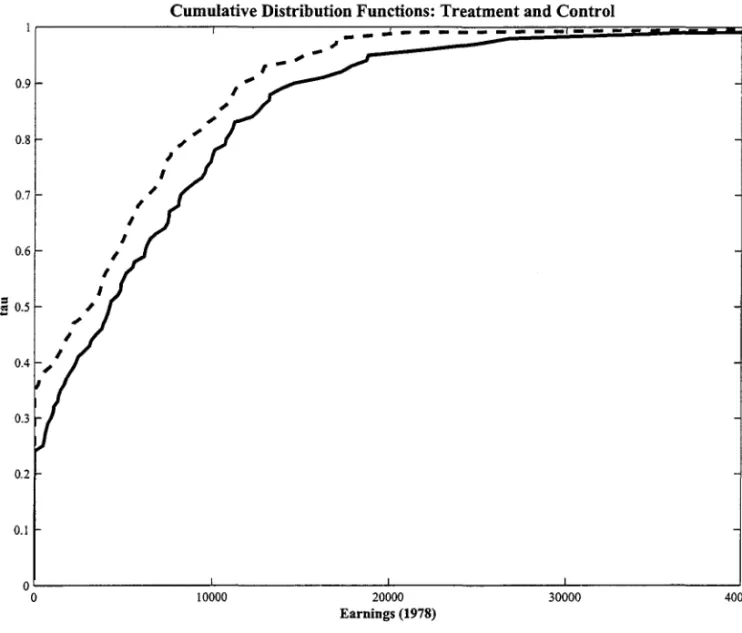
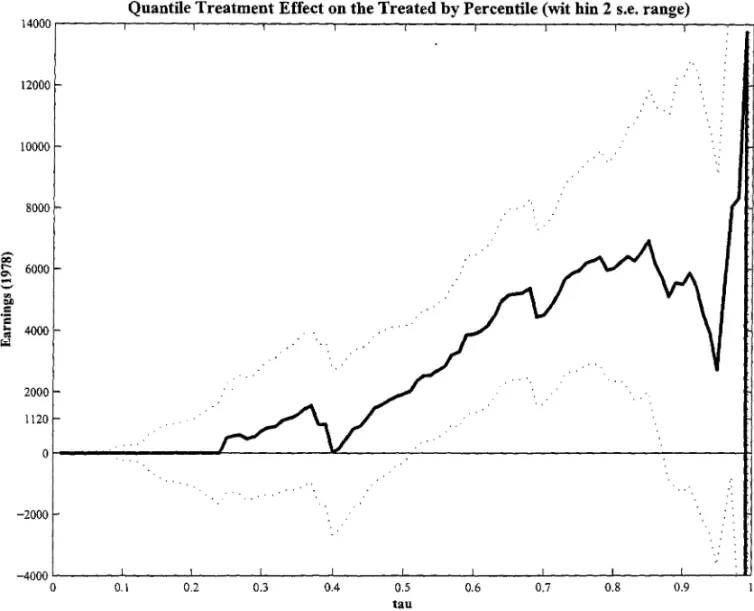
Using the same data, I analyze the treatrnent and control subsets to generate estimates ofthe
quantile treatrnent effect on the treated for each percentile. I also perforrn an "experimental"
QTE estimation, which is just the difference between the quantiles of the treated and the
ex-perimental controls, without any weighting. My results are presented in Table 2 and in Figures
I to 5.22 I find that using experimental controls, treatment effects tend to be more homogenous
than in the observational setting. With a non-experimental control sample, treatrnent effects
seem to be above the median until almost the upper end of the distribution. At the extreme
upper quantiles, the very high earnings of the control sample induce a negative effect. Despite
the fact that the counterfactual c.d.f. ofthe control group introduces a heterogeneity in effects
not seen by using the experimental control, the difference between the two lies around zero, as
it is shown by Figure 5.
An important feature of the estimated counterfactual distribution is that there are some
19 As mentioned earlier this corresponds to the control sample labeIled by LaLonde (1986) and Dehejia and Wahba (1999) as PSID-I, as they constructed more than one control group based on PSID.
2°1 replicated their calculations using the same p-score specification and got a slightIy different number, $1120. 21 The unadjusted for covariates treatment effect was computed using the experimental control sample of size 260. It is a simple difference in means between treated and control groups.