
Keywords:
• smart antenna
• Montecarlo simulation and • Digital Cellular System Information on the article: received: October 2013, reevaluated: January 2014, accepted: May 2014
Montecarlo Simulation Applied to Measurement of the Impact of the
Smart Antenna Technology in Digital Cellular Systems
Simulación montecarlo aplicada a la medición del impacto de la tecnología de
antenas inteligentes en sistemas celulares digitales
Castañeda-Camacho Josefina
Electronic DepartmentBenemérita Universidad Autónoma de Puebla E-mail: [email protected]
Mino-Aguilar Gerardo
Electronic DepartmentBenemérita Universidad Autónoma de Puebla E-mail: [email protected]
Cortez Liliana
Electronic DepartmentBenemérita Universidad Autónoma de Puebla E-mail: [email protected]
Gutiérrez-Arias José Eligio Moisés
Electronic DepartmentBenemérita Universidad Autónoma de Puebla E-mail: [email protected]
Guerrero-Castellanos José Fermi
Electronic DepartmentBenemérita Universidad Autónoma de Puebla E-mail: [email protected]
Muñóz-Hernández Germán Ardul
Electronic DepartmentBenemérita Universidad Autónoma de Puebla E-mail: [email protected]
Abstract
Introduction
The adoption of smart antenna techniques in future wi-reless systems is expected to have a signiicant impact on the eicient use of the spectrum, the minimization of the cost of establishing new wireless networks, the op-timization of service quality, and realization of transpa-rent operation across wireless networks. Adaptive antennas have been used for decades in areas such as radars, satellite communications, remote sensing, and direction inding, to name a few. Each of these applica-tions is associated with its own unique set of challen-ges, such as the channel in which the system operates, the propagation environment, sources of interference, and noise or jamming. In addition, the end goal for which the adaptive antenna is used afects the selection of the type of array, size, adaptive algorithms, and inte-gration with other system components (Alexiou and Haardt, 2004; Liberti and Rapaport, 1999).
Current mobile communications systems employ sectorization to reduce interference and increase capa-city. Cells are broken into three or six sectors, with de-dicated antennas and RF paths. Increasing the amount of sectorization reduces the interference seen by the desired signal. One drawback of current sectorization techniques is that its eiciency decreases as the num-ber of sectors increase, due to the antenna patern overlap. Furthermore, increasing the number of sec-tors increases the handofs in the mobile experiences while moving across the cell. Smart antennas ofer a more eicient way to reduce interference in mobile communications systems, through the use of narrow beams directed toward clusters of users, while at the same time steering nulls toward interfering users. With a narrow-beam directed toward a desired user, some interferers that would have seen in the 120° sec-tor antenna, will be outside of the beam-width of the array (Herscovici, 2001).
Achieving peak data rates speciied in each stan-dard in a real system remains very unlikely because it would require an unloaded system serving a single user to be extremely close to the base station. This leads to two questions: Why the increased interest in the smart antennas?, and how are they being considered as a viable technology for applications such as mobile tele-communications? As we know, operators are faced with increasing capacity demands for both voice and data services. Although various 3G technologies ofer higher data rates and double voice capacity compared with their 2G counterparts, their actual performance is still susceptible to interference, and adverse channel conditions created by multipath propagation and sys-tem loading. As such, smart antennas techniques can complement 3G system and improve their performance by alleviating and reducing the degradation caused by the aforementioned factors. In fact, because of their na-ture, technologies such as HSDPA and 1xEV-DO can greatly beneit from smart antennas since any improve-ment in the SIR experienced by the users would directly translate to beter throughput for individual users as well as increased sector throughput that can support higher capacities (Liberti and Rapaport, 1999; Herscovi-ci, 2001; Bender et al., 2000) A new generation of mobile technology is marked by a signiicant advance in functionality (Etoh, 2005; Yavuz et al., 2006). Smart ante-nnas techniques can complement the new generation systems by improving their performance.
In this work we analyze the beneit of the smart antennas in CDMA2000 1xEV-DO systems in terms of the throughput of the data network or the maximum achievable data transmission rate; in a sense that any improvement in the SIR experienced by the users would directly translate to beter throughput for indi-vidual users as well as increased sector throughput that can support higher capacities (Herscovici, 2001; Bender et al., 2000).
Resumen
La tecnología de antenas inteligentes ha sido de gran interés debido a su capacidad para mejorar el desempeño de los sistemas inalámbricos. En este trabajo, estudiamos la mejora del desempeño en el sistema digital celular cuando se utiliza un arreglo de antenas inteligentes. Nos enfocamos además, en el estudio del enlace de bajada de un sistema celular 3G y consideramos un esquema de acceso múltiple de paquetes de datos de secuencia directa (DS-CDMA). Nuestra metodología está basada en la téc-nica de simulación Montecarlo y se usa para mostrar que es posible obtener un in-cremento signiicativo en el desempeño del sistema debido al arreglo de antenas inteligentes. De nuestros resultados concluimos que es posible considerar la apli-cación de esta tecnología en ambientes 4G.
Descriptores:
• antenas Inteligentes
• simulación Montecarlo
We evaluate the throughput in the forward link of a system coniguration which consists of 37 macrocells. The base stations are located in the center position and the use of three sectored antennas is assumed. The mo-bile users are uniformly distributed within the cells. The performance of the system has been measured in terms of a Monte Carlo simulation implemented in MATLAB. The Monte Carlo simulation methodology is a type of simulation that relies on repeated random sampling and statistical analysis to compute the results (Raychaudhuri, 2008; Zhuang and Lin, 2007). This method of simulation is very closely related to random experiments, experiments for which the speciic result is not known in advance. In this context, Monte Carlo simulation can be considered as a methodical way of doing so-called what-if analysis where we use mathe-matical models to describe the interactions in a system using mathematical expressions. These models typica-lly depend on a number of input parameters, which when processed through the mathematical formulas in the model, results in one or more outputs.
This work is organized as follows. In the next sec-tion, we present the operation of the CDMA2000
1xEV-DO system. In the third section we evaluate
the performance of the CDMA2000 1xEV-DO sys
-tem. The numerical results are presented in the four-th section. The last section provides our conclusions and remarks.
CDMA2000 1xEV-DO System
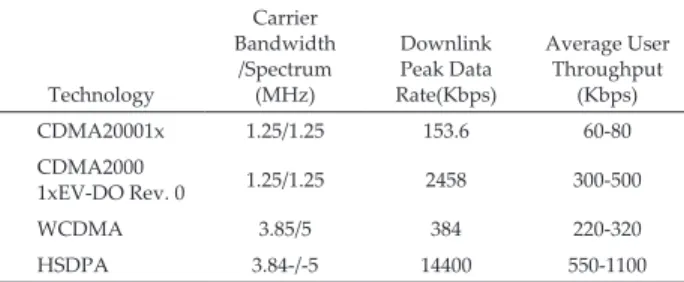
As we can see in Table 1, diferent technologies support diferent peak data rates. The peak rate is the maximum transmission speed which an individual user may ex-perience under ideal conditions (i.e., it only afects the user experience). Data throughput on the other hand, is a far more important metric for performance. Thus, the user throughput is the average data rate a user may ex-perience. Table I compares diferent peak data rates and throughput for diferent 3G technologies (Liberti and Rapaport, 1999).
The CDMA2000 family of standards is a wideband spread spectrum radio interface that uses CDMA tech-nology to meet the objectives of 3G systems while maintaining backward compatibility with IS-95 based systems. This means that mobile handsets designed ac-cording to the IS-95 standard are capable to operate in a CDMA2000 system and vice versa. The irst component of the CDMA2000 standard is called 1x radio transmis-sion technology (1xRTT) because it uses an RF carrier of 1.25 MHz just like IS-95 based systems, hence the 1x, is also referred to as spreading rate (SR) 1. The key
bene-its of the 1xRTT technology standardized under the name of IS-2000 compared with IS-95A/B standards can be summarized as follows: Beter forward error correc-tion (FEC), fast forward link power control mechanism and multimedia services and improved data services support (Liberti and Rapaport, 1999).
The current 3G operators in Japan and Korea as well as in the United States are already experiencing great success with their data services. The 1xEV-DO standard is optimized for wireless high speed packet data servi-ces (Liberti and Rapaport, 1999; Esteves et al., 2003; Wonsuk et al., 2001);. Because of the typical asymmetric characteristics of the IP traic, the downlink is the most critical of the two links (Bender et al., 2000; Esteves et al., 2003). Thus several techniques were introduced in 1xEV-DO to optimize the downlink throughput. Time-division-multiplexed (TDM) waveform, power control and a variety of modulation schemes, including QPSK, 8 PSK and 16 QAM as well as coding rates that best match the fading channel, are deined in what is com-monly called adaptive modulation and coding techni-ques (Yavuz and Paranchych, 2003; Yonghoon and Youngnam, 2002)
Forward Link Performance.
In the CDMA2000 1xEV-DO system when the transmis-sion rate of user i is Ri and the bandwidth is given by
WC, the energy to interference ratio requirement is
gi-ven by
i i C
i
b SIR
R W I
E
= =
0
g (1)
where SIRi is the signal to interference ratio
require-ment. If we consider QPSK modulation and the trans-mission rate as a function of the processing gain, the maximum achievable transmission rate for the user i, which we deine as throughput, can be writen as (Yonghoon and Youngnam, 2002; Ulukus and Greens-tain, 2000).
Table 1. 3G Technologies Comparisons
Technology
Carrier Bandwidth
/Spectrum
(MHz)
Downlink Peak Data Rate(Kbps)
Average User Throughput
(Kbps)
CDMA20001x 1.25/1.25 153.6 60-80
CDMA2000
1xEV-DO Rev. 0 1.25/1.25 2458 300-500
WCDMA 3.85/5 384 220-320
(2) ≥ < = g g g 2 2 2 i C i i C i SIR W SIR SIR W R
For the CDMA2000 1xEV-DO system, the signal to in-terference ratio is given by
(3)
where G(ϕ0, i) is the antenna gain relative to the i-th
user respect to the 0-th base station, G(ϕk, i) is the
ante-nna gain relative to the i-th user with respect to the k-th base station models the propagation losses given by the product of the m-th power of the rk,i
distan-ce between the CDMA2000 1xEV-DO interest user in the 0-th base station and the k-th base station, and a log-normal component which represents the shadowing losses and whose characteristic Gaussian random va-riable, ζk,i, has zero mean and standard deviation D. The
models the propagation losses given by the product of the m-th power of the rk , j distance between the
j-th user and its k-th power control base station and a log-normal component which represents the shadowing los-ses. NBS is the number of interfering base stations.
In the previous equation the antenna gain is ap-proximated by a parabolic function in the main beam and by a constant average for the side-lobe. Therefore, the antenna gain can be expressed as (Ramakrishna and Holzman, 1998; Castañeda y Lara, 2008).
( )
− − > − − ≤ − − = θ f θ f f θ f q p p q p q G j k j k j k j k 1 1 1 1 1 1 , , 2 , 2, (4)
where fis the angle between the desired user and the direction of the maximum gain of the antenna, q repre-sents the antenna gain level (normalized to the maxi-mum gain) at diferent θ sector crossover from the maximum gain direction and p represents the average normalized gain level for the side-lobe. The nominal values chosen in our evaluations for q and p were –4 and –15 dB respectively. This corresponds to a typical cellular sector antenna with 3-dB horizontal beam width around 100-110°.
Numerical results
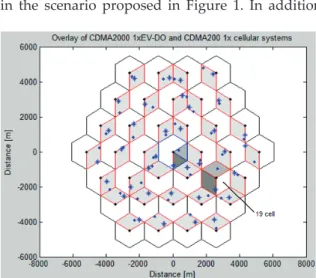
A Monte Carlo simulation of discrete events was ca-rried out in a cellular CDMA2000 1xEV-DO system. We evaluated the performance in terms of the throughput given by the equation (2), where the SIR is calculated in the scenario proposed in Figure 1. In addition we
( )
( )
0 ,
,
10
0 , 0 ,
10 , , 1 10 10 i BS k i i i i N
k i k i
k G r SIR G r ς m ς m ϕ ϕ = =
∑
, 10 ,10k i
k i
r
ς m
, 10
, 10k j
k j r
ς m
Figure 1. Macrocell CDMA1xEV-DO system scenario
Figure 2. Dataflow of the Monte Carlo simulation
Design of cellular network with sectorized cells
Random generation of the uniformly distributed users
Propagation losses estimation, considering the μ-th power
of the distance and the shadowing efect,
with parameters μ = 4 and D = 8dB Start
Estimation of the angle f, between the direction of maximum radiation of each antenna and the desired user in the 0-th cell
Antenna gain estimation,
( )
− − > − − ≤ − − = θ f θ f f θ fG k,j
( )
− − > − − ≤ − − = θ f θ f f θ f q p p q p q G j k j k j k j k 1 1 1 1 1 1 , , 2 , 2 ,Where p = –15dB, q = –4dB
End
SIR evaluation
Transmission rate evaluation
≥ < = g g gCSIRi SIRi 2
W ≥ < = g g g 2 2WC SIRi
assumed that D = 8dB, m = 4, WC = 1.2288 MHz and the
cell size of 1 Km. In equation (3) we are considering that
NBS = 36 in a 37-cell system with one center cell and 36
interfering cells as we can see in Figure 1.
The development of the Monte Carlo simulation can be summarized by the datalow in Figure 2.
Finally, Figure 3 shows the average data rate or maximum achievable data transmission rate of the CDMA2000 1xEV-DO system for diferent g values and for diferent, θ, beam-width values.
Compared with the normal operation, in which the CDMA2000 1xEV-DO system does not implement smart antennas, we can observe that the throughput in-creases as the beam width of the antenna array decrea-ses. From the results, when we consider for example a
θ=15° we obtain a signiicantly improved data rate, ap-proximately equal to 100% in comparison with the nor-mal operation.
Conclusion
In this paper we developed a Monte Carlo simulation of discrete events to prove that it is possible to obtain a signiicant increment in the throughput of the 3G sys-tem due to the smart antenna array. Also, we can apply this technology to 4G generation systems to improve its performance. Smart antenna arrays provide an eicient mechanism to maximize the throughput of a CDMA2000 1xEV-DO system. In fact, results prove that the use of smart antennas in a CDMA cellular system can provide a 100% of data rate increment compared with the nor-mal operation of the system. We arealsoleavingthe basisfor the analysisof this smart antenna technolo-gyin future wireless generations.
References
Alexiou A. and Haardt M. Smart antenna technologies for future wireless systems: Trends and Challenges. IEEE
Communica-tions Magazine, volume 42 (issue 9), 2004: 90-97.
Bender P., Black P., Grob M., Padovani R., Sindhushyana N., Vi
-terbi A. CDMA/HDR: A bandwidth-eicient high-speed wire
-less data service for nomadic users. IEEE Communications
Magazine, volume 38 (issue 7), July 2000: 70-77.
Castañeda-Camacho J., Uc-Rios C.E., Lara-Rodríguez D. Reverse
link erlang capacity of multiclass cdma cellular system conside-ring nonideal antenna sectorization. IEEE Transactions on
Vehi-cular Technology, volume 52 (issue 6), November 2003: 1476-1488.
Castañeda-Camacho J. and Lara-Rodríguez D. Teletraic analysis
of an overlaid cdma and tdma systems with cell coverage area restriction. IEEE Transactions on Vehicular Technology, volume
57, (issue 2), March 2008: 828-845.
Esteves E., Gurelli M., Fan M. Performance of ixed wireless access
with CDMA2000 1xEV-DO, in: IEEE 58th Vehicular Technolo
-gy Conference (VTC 2003-Fall), 2003, pp. 836-840.
Etoh M. Next generation mobile systems 3G and beyond, John Wiley and Sons, Wiley Online Library, 2005.
Herscovici N. and Christodoulou C. Potentials of smart antennas in CDMA systems and uplink improvements. IEEE Antennas and
Propagation Magazine, volume 43 (issue 5), October 2001: 172-177.
Liberti J.C. and Rapaport T.S. Smart antennas for wireless com-munications, Prentice Hall, 1999.
Zhuang M. and Lin B. Performance analysis of receive antennas
array egc diversity with monte-carlo simulation method, IEEE
International Workshop on Anti-counterfeiting, Security and
Identiication, IEEEXplore Digital Library, 2007, pp. 344-349. Ramakrishna S. and Holzman J.M. A scheme for throughput
maximization in a dual class CDMA system. IEEE Journal on
Selected Areas in Communication, volume 16 (issue 6), August
1998: 830-844.
Raychaudhuri S. Introduction to monte carlo simulation, in: IEEE
Proceedings of the 2008 Winter Simulation Conference, 2008, pp. 91-100.
Sennor U. and Greenstain L.J. Throughput maximization in CDMA uplinks using adaptive spreading and power control,
in: IEEE sixth International Symp on Spread Spectrum Techi
-ques and Applications, volume 2, September 2000, pp. 565-569.
Sindhushayana N.T. and Black P.J. Forward link coding and
mo-dulation for CDMA2000 1xEV-DO (IS-856), in: IEEE Intl.
Symp. On Personal Indoor and Mobile Radio Communica-tions, volume 4, pp. 1839-1846, September 2002.
Wonsuk C., Hong-Woo L., Moon J. Downlink capacity of CDMA/ HDR, in: IEEE Vehicular Technology Conference (VTC 2003),
Spring 2001, pp. 836-840.
Yavuz M., Díaz S., Kapoor R., Grob M., Black P., Tokgoz Y., Lot C.
VoIP over cdma2000 1xEV-DO revision A. IEEE
Communica-tions Magazine, volume 44 (issue 2), February 2006, pp. 88-95.
Yavuz M. and Paranchych D.W. Adaptive rate control in high data
rate wireless networks. IEEE Wireless Communications and
Net-working, volume 2, March 2003: 866-871.
Yonghoon C. and Youngnam H. A channel based scheeduling al
-gorithm for CDMA2000 1xEV-DO system, in: IEEE Symp., in:
Wireless Personal Multimedia Communications, volume 2,
October 2002, pp. 621-625.
0.00E+00 5.00E+05 1.00E+06 1.50E+06 2.00E+06 2.50E+06 3.00E+06
1 2 3 4 5 6
A v e ra g e d a ta r a te [ b p s]
Quality of service[dB]
120° 60° 30° 15° Normal Operation
Citation for this article:
Chicago citation
Castañeda-Camacho, Josefina, Gerardo Mino-Aguilar, Liliana Cor-tez, José Eligio Moisés Gutiérrez-Arias, José Fermi Guerrero-Caste-llanos, Germán Ardul Muñóz-Hernández. Monte Carlo Simulation Applied to the Measurement of the Impact of the Smart Antenna
Technology in Digital Cellular Systems. Ingeniería Investigación y
Tecnología, XVI, 02 (2015): 207-212.
ISO 690 citation style
Castañeda-Camacho J., Mino-Aguilar G., Cortez- L., Gutiérrez-Arias J.E.M, Guerrero-Castellanos J.F., Muñóz-Hernández G.A. Monte Carlo Simulation Applied to the Measurement of the Im-pact of the Smart Antenna Technology in Digital Cellular
Sys-tems. Ingeniería Investigación y Tecnología, volume XVI (issue 2),
April-June 2015: 207-212.
About the authors
Joseina Castañeda-Camacho (S’99). Born in Puebla, México, 1973. B.Sc. degree in electrical engineering from the Benemérita
Universidad Autónoma de Puebla (BUAP) 1999, and M.Sc. and Ph.D. degrees in electrical engineering from Centro de
Investigación y de Estudios Avanzados (CINVESTAV) of Instituto Politécnico Nacional, Mexico, 2000 and 2007, res
-pectively. Currently works in BUAP as professor and researcher. Research interests: teletraic analysis, cellular sys
-tem dimensioning, performance modeling and evaluation of overlaid sys-tems, packet networks and digital sys-tems.
Gerardo Mino-Aguilar. Born in Mexico, 1971. Bachelor in Electronics Engineering at BUAP in 1995, master degree in
power electronics at the Universidad de las Américas Puebla in 1999, and Ph.D. in electrical machines control at the Universitat Politècnica de Catalunya, Spain, 2006. Currently head of the graduate department on electronics engi-neering master´s program, and electronics instrumentation at BUAP. Focused in digital systems, power electronics, power quality, power generation, electric drives and drivetrain electric vehicles.
Cortez Liliana. Born in Kiev, Ukraine in 1962. BS in Electrical Engineering and a Master of Sciences in power stations at
the Polytechnical Institute of Kiev, Ukraine and a Ph.D in technical sciences at the Polytechnical State University of
Saint Petersburg, Russia. Currently works as titular professor in the Faculty of Sciences in Electronics at BUAP,
Mexico. Focused in digital systems, power electronics and power generation.
José Eligio Moisés Gutiérrez-Arias. Born in Puebla, Mexico, 1967. Bachelor of Mathematics and Master of Sciences in
Mathematics in 1997 from the BUAP and PhD in Mathematical Sciences, same institution in 2003. Research: mathe
-matical modeling and analysis of dynamic and digital systems. Currently he is researcher and professor at the
Fa-culty of Electronic Sciences, BUAP.
José Fermi Guerrero-Castellanos. Born in Poza Rica, México. Bachelor degree in electronic science from BUAP, México in
2002, and M.Sc and Ph.D in automatic control from Grenoble Institute of Technology and Joseph Fourier University, Grenoble, France, in 2004 and 2008, respectively. Between January and June 2008, he was a Postdoctoral Researcher at GIPSALab Laboratory, Grenoble, France. Spent one year at the University Polytechnic of Puebla, Mexico as an
assis-tant Professor, in June 2009 joined the Faculty of Electronics, at BUAP, Mexico, head of the Control and Power Systems
Laboratory. Research interests: modeling, estimation and nonlinear control of cyber-physical systems. Applied
con-cerns: Micro Unmanned Aerial Vehicles (MAVs ), wearable robots and digital systems.
Germán Ardul Muñóz-Hernández. BSc degree in electronic engineering from Veracruz Institute of Technology in 1988. In
1990, MSc degree in electronic systems from National Institute of Astrophysics Optic and Electronic (INAOE, Mexi
-co). PhD degree from the University of Wales, Bangor in 2005. Worked at FAPATUX, a Pulp and Paper factory in Tuxtepec, Mexico, from 1986-1987 as programmer and from 1990-1993 in the area of Engineering and new projects. In 1993-1996, he was in the Electronics department at University of Puebla. He has been Visiting Engineer at South Carolina (Columbia, USA 1995), Michigan (Ann Arbor, USA 1996) and the CERN (Geneva, Swizerland 2007, 2009).
![Figure 3. Throughput [bps] of the CDMA1xEV-DO system](https://thumb-eu.123doks.com/thumbv2/123dok_br/17227653.244302/5.918.109.447.132.287/figure-throughput-bps-the-cdma-xev-do-system.webp)
