UDC 575.22; 633.15 Original scientific paper
GENETIC CHARACTERIZATION OF EARLY MATURING MAIZE HYBRIDS (ZEA MAYS L.) OBTAINED BY PROTEIN AND RAPD
MARKERS
Iva BAUER, Snežana MLADENOVIĆ DRINIĆ, Milomir FILIPOVIĆ, and Kosana KONSTANTINOV
Maize Research Institute „Zemun Polje“, S. Bajića 1a, 11185 Zemun Polje, Belgrade, Serbia and Montenegro
Bauer I., S. Mladenović Drinić, M. Filipović, and K. Konstanti-nov (2005): Genetic characterization of early maturing maize hybrids (Zea mays L.) obtained by protein and RAPD markers. – Genetika, Vol. 37, No. 3, 235-243.
Knowledge of maize germplasm genetic diversity is important for planning breeding programmes, germplasm conservation per se etc. Genetic variability of maize hybrids grown in the fields is also very im-portant because genetic uniformity implies risks of genetic vulnerability to stress factors and can cause great losts in yield. Early maturing maize hybrids are characterized by shorter vegetation period and they are grown in areas with shorter vegetation season. Because of different climatic con-ditions in these areas lines and hybrids are developed with different fea-tures in respect to drought resistance and disease resistance. The objective of our study was to characterize set of early maturing maize hybrids with protein and RAPD markers and to compare this clasification with their pedigree information. RAPD markers gave significantly higher rate of polymorphism than protein markers. Better corelation was found among pedigree information and protein markers.
Key words: maize, protein markers, RAPD
_______________________________
Corresponding author: Iva Bauer, Maize Research Institute „Zemun Polje“, S.Bajića 1a, 11185 Zemun Polje, Belgrade, Serbia and Montenegro
INTRODUCTION
Knowledge of maize germplasm genetic diversity is important for plan-ning breeding programmes, germplasm conservation per se etc. Genetic variability of maize hybrids grown in the fields is also very important because genetic uni-formity implies risks of genetic vulnerability to stress factors and can cause great losts in yield. In spite of this, consumers are demanding greater product uniformity and the maize farmers also prefer uniform crop fields. Risks of environmental damage may be reduced by use of best performing unrelated hybrids for which are estimation of genetic diversity needed.
Three methods have been mostly used in assesing genetic diversity among maize germplasm: pedigree records, field trials and molecular markers. Molecular markers have several advantages over two other methods: results are obtained faster than in time and space consuming field trials and are more reliable than pedigree records. High discrimination power among similar genotypes is the main reason for use of molecular markers in studies of genetic diversity.
The advent of marker technology designed to detect naturally occuring polymorphisms at the DNA level has become an invaluable tool for both applied and basic diagnostic studies in plant, animal and humane genomes as well as for microorganisms. In past decade there has been an explosion of new DNA-based marker methods utilizing the PCR reaction such as RAPD, VNTR, SSR, AFLP, SNP etc. Other, more specific approaches exploit mitochondrial, chloroplast or ribosomal DNAs. Strategies based on the PCR have the highest potential for rou-tine diagnosis.
Early maturing maize hybrids are characterized by shorter vegetation pe-riod and they are suitable for growth in areas with shorter vegetation season. Be-cause of different climatic conditions in these areas lines and hybrids are developed with different features in respect to drought resistance and disease resistance. In colder regions with more rain, lines with flint kernel type are developed, while in wormer regions with arid climate lines with dent kernel type are developed. Maize germplasm of diverse sourses is used in breeding programs of hybrid maize in the Maize Research Institute „Zemun Polje“.
The objective of our study was to: (1) characterize maize hybrids by pro-tein and RAPD markers; (2) compare their clasification with their pedigre infor-mation.
MATERIALS AND METHODS
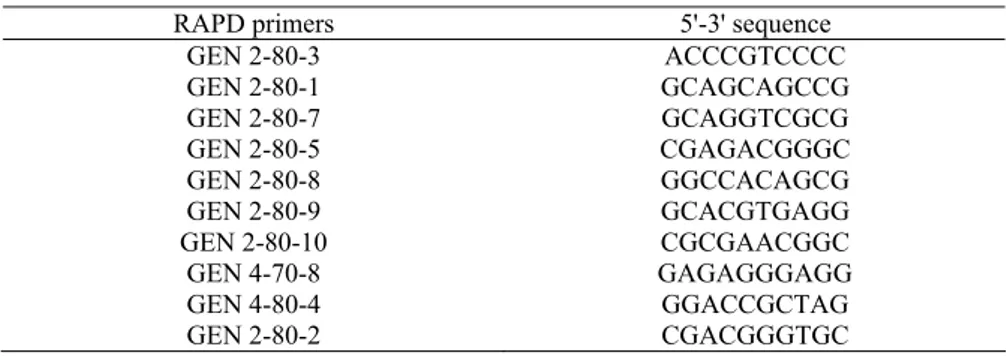
(LEAMMLI, 1970). The genomic DNA was isolated from embryo tissue following the CTAB procedure (ROGERS and BENDICH, 1988). RAPD-PCR amplification was performed with 15 RAPD primers (Genosys Biotechnologies) (WILLIAMS, 1990). Primers which gave clear and reproducible patterns of amplification are shown in table 1.
RAPD fragments were separated on 1.4. % agarose gels in 0.5x TBE buffer. Presense/absense of protein fractions or DNA fragments was transformed to binary data (0,1). The computing of binary data including coefficients of similari-ties and UPGMA clustering was performed using NTSYS-pc software (ROHLF, 2000).
Table 1. RAPD primers used in this study which gave clear and reproducible bending patterns
RAPD primers 5'-3' sequence
GEN 2-80-3 ACCCGTCCCC
GEN 2-80-1 GCAGCAGCCG
GEN 2-80-7 GCAGGTCGCG
GEN 2-80-5 CGAGACGGGC
GEN 2-80-8 GGCCACAGCG
GEN 2-80-9 GCACGTGAGG
GEN 2-80-10 CGCGAACGGC
GEN 4-70-8 GAGAGGGAGG
GEN 4-80-4 GGACCGCTAG
GEN 2-80-2 CGACGGGTGC
RESULTS
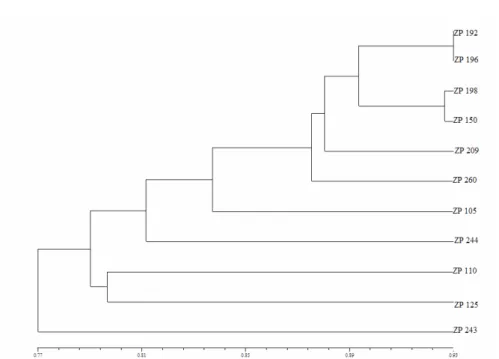
Fig. 1. Protein based dendogram of investigated early maturing hybrids obtained by UPGMA clustering
PCR amplification of genomic DNA was tested on 15 RAPD primers in two rounds of amplification which of 10 primers gave clear and reproducibile banding paterns. PCR amplification with 10 RAPD primers gave totally 69 RAPD fragments of different molecular weight, which of 78.2 % were polymorphic (in presence/absence of bands, while there were not significant diferences in intensity of bands). Number of fragments obtained with different primers was in range of 5-9, average number was 6.9.
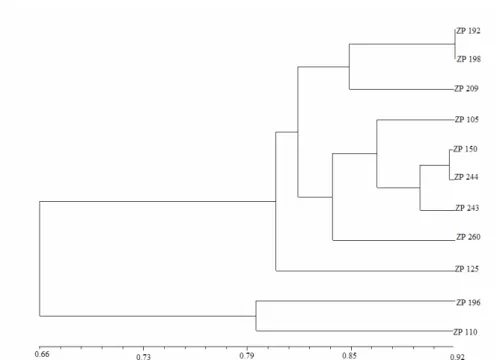
Based on presense/absense of RAPD fragments coefficient of similarity was calculated (DICE, 1945). The genetic similarities based on Dice’s coefficient were in range from 0.61 for ZP 192 and ZP 110 to 0.91 for two pairs of hybrids ZP 192 and ZP 198. The RAPD based dendogram obtained from similarity matrix is presented on Fig. 2. Cluster consists of three distinct subclusters which show good separation of hybrids. RAPD grouping shows moderate agrement with their pe-digre data.
DISCUSSION
Fig. 2. RAPD based dendogram of investigated early maturing hybrids obtained by UPGMA clustering
In our study we used protein and RAPD markers for characterization of maize hybrids and evaluation of their genetic diversity. Maize embryo salt-solubile proteins are suitable for characterization of maize hybrids as shown previously (ERIĆet al., 2003). All studied genotypes were differentiated from each other on the basis of protein fractions polymorphism. This is in agreement with results of several authors who used seed proteins for characterization of maize hybrids and inbred lines from different geografical regions as well as different cotton cultivars (WANG et al., 1994; ZHANG et al., 1998; GONZALESet al., 2001). Clustering of hybrids based on embryo salt-solubile protein markers showed good agreement with their pedigre data, because hybrids with similar parental components were joined together in smaller groups. In our study dendogram of hybrids based on embryo salt-solubile protein markers showed better agreement with their pedigre data than on RAPD data. One possible reason for this is a small number of RAPD markers used which doesnt neccesarily represent variability of the entire genome.
for minimal substrat DNA. RAPD can efficiently generate both randomly dis-persed markers as well as markers linked to specific genes. Constrain of the tehnique is its reproducibity, which difficults possibility of interchanging results in and between laboratories (JONES et al., 1998). It is important to confirm reproduci-bility of results for every change of reaction conditions and primers. Problems re-lated with reproducibility of RAPD can be resolved by rigorous attention to detail.
RAPD markers were suitable for genetic characterization of hybrids and for assessing relatedness among them, as documented previously (ERIC, 2004). RAPD analysis with 10 random primers gave totally 69 fragments which of 78.2 % were polymorphic. These results concerning rate of polymorphism are in agree-ment with results of several other authors. (STOJŠIN et al., 1996) compared 28 commercial corn hybrids grown in Canada and found that 80 % of RAPD frag-ments from embryo DNA were polymorphic. Also, study of 57 elite corn inbred lines which were used in production of hybrid corn in Central and Northwestern Europe with 54 RAPD primers (HAHN et al., 1995)showed that 84% RAPD frag-ments were polymorphic. Slight differencies in level of RAPD marker polymor-phism in different studies can be atributed to different hybrids and lines chosen for the analysis and differnt regions of genome that were amplified by selected prim-ers.
Embryo salt-solubile protein markers are not a marker sistem of choise for assesing genetic relatedness of maize hybrids (they have been used for their char-acterization and genetic purity assessment), because of a relatively low number of protein fractions obtained, low polymorphism and unknown mode of inheritance. For percise assessment of genetic relatedness among maize hybrids and lines it is well documented usage of DNA based markers (AJMONE–MARSAN et al., 1998;
BERNARDO et al., 2000). RAPD markers have been used extensively for maize fingerprinting. Due to their reproducibility problem they have been replaced with SSR markers which are currently the system of choise for maize genetic diversity studies due to their high rate of polymorphism, reliability, cost and time effectiv-ness (GETHI et al., 2002;LEE et al., 2002; REIF et al., 2003).
Received March 23rd, 2005
Accepted June 1st, 2005
REFERENCES
AJMONE-MARSAN P., G. EGIDY, G. MONFREDINI, S. DI SILVESTRO, and M. MOTTO (1993): RAPD markers in maize genetic analysis. Maydica, 38, 259-264.
BERNANDO R., J. ROMERO-SEVERSSON, J. ZIEGLE, J. HAUSER, L. JOE, G. HOOKSTRA, and R. W. DOERGE (2000): Parental contribution and coefficient of coancestry among maize inbreds: pedigree, RFLP, and SSR data. Theor. Appl. Genet., 100, 552-556.
BEEBE S., P.W. SKROCH, J. TOHME, M.C. DUQUE, F. PEDRAZA, and J. NIENNHUIS (2000): Structure of genetic diversity among common bean landrases of midlle american origin based on correspondence analysis of RAPD.Crop Sci., 40, 264-273.
BRUMMER E.C., J.H. BOUTON, and G. KOCHET (1995): Analysis of annual Medicago species using RAPD markers. Genome, 38, 362-367.
CASLER M.D., Y. RANGEL, J.C. STIER, and G. JUNG (2003): RAPD marker diversity among creeping bentgrass clones. Crop Sci., 43, 688-693.
DIABY M. and M.D. CASLER (2003): RAPD marker variation among smooth bromegrass cultivars. Crop Sci., 43, 1538-1547.
DICE L.R. (1945): Measures of the amount of ecologic association between species. Ecology, 26, 297-302.
ERIĆ I., S. MLADENOVIĆ DRINIĆ i G. STANKOVIĆ (2003): Utvrdjivanje genetičke divergentnosti ZP hibrida kukuruza iz različitih ciklusa selekcije pomoću proteinskih markera. Arhiv za poljoprivredne nauke, 64 (227-228), 21-27.
ERIĆ I. (2004): Genetička karakterizacija ZP hibrida kukuruza (Zea mays L.) iz različitih ciklusa selek-cije primenom molekularnih markera. Magistarski rad. Biblioteka Instituta za kukuruz i Bib-lioteka Instituta za Zoologiju Biološkog fakulteta u Beogradu. Univerzitet u Beogradu. GETHI J.G., J.A. LABATE, K.R. LAMKEY, M.E. SMITH, and S. KRESHOVICH (2002): SSR
varia-tion in important U. S. maize inbred lines. Crop Sci., 42, 951-957.
GONZALES P., M.M. GUTIERREZ, and M. FUCHS (2001): Standardization of methodology for characterization of cotton genotipes (Gossypium sp.) by protein electrophoresis. Rev. Fac. Agron., (Maracay), 27, 95-103.
HAHN V., K. BLANKERRHORN, M. SCHWALL, and A.E. MELCHINGER (1995): Relationships among early european maize inbreds. III. Genetic diversity revealed with RAPD markers and comparison with RFLP and pedigree data. Maydica, 40, 299-310.
JACCARD P. (1908): Nouvelles rescherches sur la distribution floral. Bull. Soc. Vand.Sci. Nat., 44, 223-270.
JONES C.J., K.J. EDWARDS, S. CASTIGLIONE, M.O. WINFIELD, F. SALA, C. VAN DER WIEL, B.L. VOSMAN, M. MATTHES, A. DALY, R. BRETTSCHNEIDER, P. BETTINI, M. BUIATTI, E. MAESTRI, N. MARMIROLI, R.L. AERT, G. VOLCKAERT, J. RUEDA, A. VASQUEZ, and A. KARP (1998): Reproducubulity testing of RAPDs by a network of European laboratories. In: Molecular Tools for Screening Biodiversity. A. Karp, P.G.Isaac and D.S. Ingram eds.,Chapman and Hall, London.
LAEMLLI V.K. (1970): Cleavage of structural proteins during the assembly of the head of bacterio-phage T4. Nature, 227, 680-685.
LI Y., J. DU, T. WANG, Y. SHI, Y. SONG, and J. JIA (2002): Genetic diversity and relationships among chinese maize inbred lines revealed by SSR markers. Maydica, 47, 93-101.
REIF J.C., A.E. MELCHINGER, X.C. XIA, L. WARBURTON, D.A. MHOISTINGTON, S.K. VA-SAL, G. SRINIVASAN, M. BOHN, and M. FRISCH (2003): Genetic distance based on simple sequence repeats and heterosis in tropical maize populations. Crop Sci., 43, 1275-1282.
ROGER S.O. and A.J. BENDICH (1988): Extraction of DNA from plant tissues. Plant Molecular biol-ogy manual a6: 1-10. Kluwer Academic Publishers, Dordrecht-printed in Belgium.
ROHLF F.J. (2000): NTSYS-pc. Numerical taxonomy and multivaiate analysis system. Version 2.0 Exeter Software, Setaket, N.Y.
STOJŠIN D., L.W. KANNENBERG, J. RAJNPREHT, P.K. PAULS, and R. STOJŠIN (1996): Genetic relationships among commercial corn hybrids and parents based on RAPD analyses of peri-carp and emryo DNA. Genetika, 28 (3), 137-150.
WANG C., K. BIAN, H. ZHANG, Z. ZHOU, and J. WANG (1994): Polyacrylamide gel electrophoresis of salt soluble proteins for maize variety identification and genetic purity assessment. Seed Sci. Tech.21, 51.
WILLIAMS J.G.K., A.R. KUBELIK, K.J. LIVAK, J.A. RAFALSKI, and S.V. TINGEY (1990): DNA polymorphisms amplified by arbitrary primers are useful as genetic markers. Nucleic Acids Res. 18, 6531-6535.
GENETIČKA KARAKTERIZACIJA RANIH HIBRIDA KUKURUZA (ZEA MAYS L.) PRIMENOM PROTEINSKIH I RAPD MARKERA
Iva BAUER, Snežana MLADENOVI DRINIĆ, Milomir FILIPOVIĆ i Kosana KONSTANTINOV
Institut za kukuruz „Zemun Polje“, S. Bajića 1a, 11185 Zemun Polje, Srbija i Crna Gora
I z v o d
Poznavanje genetičke varijabilnosti germplazme kukuruza je važno zbog planiranja programa selekcije, konzervacije germplazme per se. Genetička uni-formnost uključuje rizik od velikih gubitaka u prinosima zbog izuzetne osetljivosti ovakvih useva na stresne faktore sredine. Rani hibridi se odlikuju kraćim vege-tacionim periodom i namenjeni su za gajenje u područjima sa kraćom vege-tacionom sezonom. Zbog različitih klimatskih uslova u ovim područjima stvorene su linije i hibridi sa različitim osobinama u pogledu otpornosti na sušu i bolesti lista, stabla i klipa. Cilj rada je bila karakterizacija ranih hibrida različitog porekla primenom proteinskih i RAPD markera. U ovom radu RAPD markeri su pokazali znatno viši nivo polimorfizma, dok su proteinski markeri pokazali bolje slaganje sa pedigre podacima ispitivanih hibrida.