JOURNAL OF NANO- AND ELECTRONIC PHYSICS Р А А - А Р
Vol. 5 No 2, 02032(3pp) (2013) Том 5 № 2, 02032(3cc) (2013)
2077-6772/2013/5(2)02032(3) 02032-1 2013 Sumy State University Synthesis of Reduced Graphene Oxide Using Novel Exfoliation Technique
and its Characterizations
Asha R. Pai*, Bipin Nair†
Amrita School of Biotechnology, Amrita Vishwa Vidyapeetham, Amritapuri, Kollam – 690 525, Kerala, India
(Received 15 February 2013; published online 04 May 2013)
For processing of graphene based composite materials Graphene oxide is considered to be the main precursor. Though epitaxial growth and chemical vapor deposition techniques have been utilized to get monolayers of graphene, wet chemical process have been used for its large scale synthesis. For the extrac-tion of graphene monolayer the chemical route relies on the weakening of the Van der Waals cohesive force upon the insertion of reactants in the inter layer space as a consequence sp2 lattice is partially degraded into a sp2-sp3 sheet that possesses a less π-π stacking stability. The method described here uses a novel chemical exfoliation technique. The graphite from the pencil lead is used as the precursor and it is treated with alcohol-ketone-surfactant mixture and mechanically and thermally agitated so as to get the golden brown colored suspension. The material was characterized by Fourier Transform Infra Red spectroscopy. The absence of 1570 cm– 1 peak clearly indicates the oxidation of C = C bonds. The SEM images confirmed the presence of the nanoplatelets of graphene oxide. The AFM analysis confirmed the sheet thickness of the graphene oxide sheets to be < 5 nm. The sheet resistance of the sheets of thermally treated graphene oxide or reduced graphene oxide on Si wafer (p-type, 4-6 Ω/cm) was measured as 200-300 Ω/□. The Ellip-sometric characterisations also matches with that of the thermally reduced graphene oxide films formed.
Keywords: Graphite, Graphene, Reduced Graphene oxide, Nano-sheets, Oxidation, Exfoliation.
PACS numbers: 62.23.Kn, 68.37.Ps, 68.37.Hk, 78.30. – j, 78.67. – n, 81.05.U –, 81.05.uf, 81.16.Be, 81.20. Ka, 82.70.Uv, 82.80.Dx, 83.80.Hj
* [email protected] † [email protected] 1. INTRODUCTION
Graphene is a special class of two-dimensional car-bon nanostructure which is so unique that it holds to be a promising material for potential applications in many technological fields such as Nanoelectronics, sensors, nanocomposites, batteries, super capacitors and hydro-gen storage [1, 2, 7, 8, 13 and 14]. Inspite of such poten-tial applications the major challenge is in the synthesis and processing of bulk-quantity of Graphene sheets. Graphite consists of a stalk of flat Graphene sheets. It is much cheap and is available in large quantities. Though mechanical cleavage of graphite had originally led to the discovery of Graphene sheets, its low productivity makes it unsuitable for large-scale use. In such a case chemical conversion appears to be a much more efficient approach to bulk production of Graphene sheets at low cost. In such method the exfoliation of graphite in liquid phase to Graphene like materials include the oxidation and subsequent exfoliation of graphite to give Graphene ox-ide.
Ruoff and co-workers [11, 12, 18] demonstrated a so-lution based route involving chemical oxidation of graph-ite to hydrophilic graphgraph-ite oxide (GO), which can be readily exfoliated as individual Graphene oxide sheets by ultrasonification. Graphene oxide can be converted back to conducting Graphene by chemical reduction us-ing hydrazine or by thermal methods. But the Graphene sheets so produced by this method had a tendency to form irreversible agglomerates owing to their hydropho-bic nature. To overcome this defect stabilization using selected polymers or surfactants has to be done [3, 9, 10, 15]. The study is particularly based on pencil lead which is a low cost, easily available graphite precursor. Here a
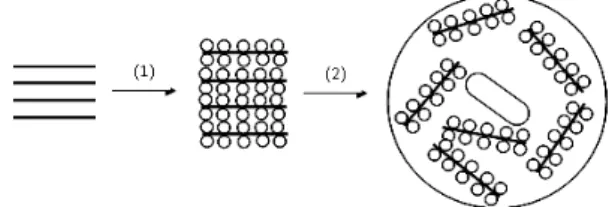
chemical and mechanical exfoliation has been done. The polar solvent-surfactant and mechanical stirring has been combined with heating resulting in fast exfoliation of the graphite sheets Fig. 1 and 2. As the method does not use any salt and acid there is no criticality to stabil-ity of the sheets developed. On the other hand hydrazine being highly toxic and its use has to be minimized the reduction process by thermal heating has been used. In addition the presence of the polymeric nature of the non-ionic surfactant used reduces the tendency of agglomera-tion upon the evaporaagglomera-tion of solvent. On study of the FTIR spectra of the specimen so developed by the meth-od indicates the absence of peaks associated with, C = C, C-OH and –COOH groups showing that the material is completely oxidized and is a defect free material.
Fig. 1 –Possible mechanism of reduced graphene oxide for-mation (1) Oxidation of graphite to graphite oxide and (2) Exfoliation of graphene oxide under stirring. Under thermal treatment the material reduces to reduced graphene oxide
2. EXPERIMENTAL DETAILS
ASHA R. PAI, BIPIN NAIR J.NANO-ELECTRON.PHYS. 5, 02032 (2013)
02032-2 Fig. 2 –From pencil to reduced graphene oxide
removed under vacuum from the dispersion and again heated in a hot air oven at 200 C and is then centri-fuged above 6000 rpm. The supernatant is a yellow-brown colored suspension which is separated and stud-ied. This suspension turned black when heated to high temperature above 400 C indicating the reduction of the graphene oxide under vacuum. Solid samples and film prepared by drop casting the material so obtained were dried and were characterized.
FTIR spectra were studied using Thermo Nicolet, Ava-tar 370. SEM micrographs were taken using Energy dis-persive spectrometers JEOL Model JSM-6390LV. The sheet resistance was measured by coating the suspension on Si wafer (ptype, 4-6 ohms/sq) and then using automat-ed Kaithley 4 point probe system. The film thickness and optical property were measured using Spectrometric ellip-someter SE 800. The sheet thickness was measured using PARK systems Atomic force microscope.
3. RESULTS AND DISCUSSIONS
3.1 Structural characterisations
3.1.1Fourier Transform Infra red spectroscopy
Total transmittance FTIR spectra as shown in Fig. 3 of the final sample were measured. The spectra shows the deformation of water molecules at 1630 cm– 1 and alkoxy C-O stretching vibrational modes at ~ 1043 cm – 1. Further the bands at 1448 cm – 1 corre-sponds to = CH in-plane vibrations and 780 cm– 1 cor-responding to - CH out-of-plane vibrations. A broad peak at 3400 cm – 1 which can be assigned to the vibra-tions of the adsorbed water molecules or may also con-tain skeletal vibrations corresponding to unoxidised graphitic domains [4, 5, 6, 18]. The spectra does not
Fig. 3 –FTIR spectra of reduced Graphene oxide
contain any peaks associated with C-OH (~ 1340 cm– 1), C = C (~ 1570 cm – 1) and –COOH (~ 1710-1720 cm – 1) groups. The C = C bonds missing indicates a strong oxidation to have taken place [19]. This spectrum is in contrast with the spectra for reduced grapheme oxide or chemically derived Graphene.
3.1.2Atomic force Microscopy
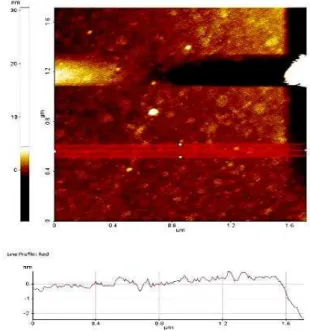
The GO dispersion were deposited on hydrophobic substrates such as Si wafer (p-type, 4-6 ohms/sq) by drop casting the suspension and then annealing at 480 C. The average height of 2.5 nm were observed with atomic force microscopy (AFM) given by the Fig. 4. Color change from golden brown to deep brown and then to black is also noted.
Fig. 4 –Reduced graphene oxide film and its height profile
3.1.3Scanning electron Microscopy
Fig. 5 shows the SEM images of the material after thermally treating it after drop casting it on glass cover slips. It can be seen from the SEM images that many of the flakes are smaller in diameter (< 1 m). Some flakes are found to be larger in size [16, 17].
SYNTHESIS OF REDUCED GRAPHENE … J.NANO-ELECTRON.PHYS. 5, 02032 (2013)
02032-3 3.2 Optical characterizations
3.2.1Spectroscopic Ellipsometry
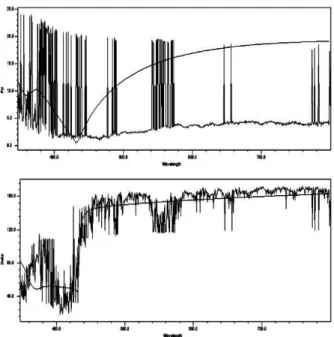
The reduced graphene oxide film was studied using a spectroscopic ellispometer. The Ellipsometric data was recorded (Fig. 6) and the optical properties and thickness of the multilayer stack were fitted by model-ing with a Cauchy function [20].
Fig. 6 –Spectroscopic Ellipsometric data of reduced graphene oxide after thermal treatment
3.3 Electrical characterisations
The sheet resistance (Rs) of a 50 nm thick graphene film prepared was measured using a four point probe
method and the average sheet resistance was calculat-ed to be about 230 Ω/□. Such low sheet resistance is subsequently due to the annealing and removal of oxy-genated groups in Graphene Oxide films.
4. CONCLUSIONS
A method has been developed to disperse graphite from pencil lead in surfactant-polar solvent solutions. The results show that exfoliation and oxidation of graphite to graphene oxide can be done in a much sim-pler way and also with a much common precursor easi-ly available to everyone. The films of reduced graphene oxide of good conductivity can be prepared by simple drop casting the suspension on a surface and further by thermal treatment. This film made from the material has been utilized as the counter electrode in dye sensi-tized solar cell using natural dyes and also for develop-ing immunosensor. Further studies are intended in the defects study of the material.
AKNOWLEDGEMENTS
Authors are very grateful for the help and service rendered by Sophisticated Test & Instrumentation Centre, Cochin University of Science and Technology, Cochin – 682022, Kerala, India, and Amrita Center for Biomedical Engineering, Amrita Vishwa Vidyapeeth-am, Ettimadai, Tamilnadu for providing the instru-mentation facilities in analyzing the samples. The au-thors also like to thank the staff and operators of Cen-ter for Excellence in Nanoelectronics, IIT Bombay and would also like to refer the short term project(S 0088) under Indian Nanoelectronics Users programme sup-ported by Ministry of Communications & Information Technology (MCIT), Government of India under which the analysis has been done.
REFERENCES
1. J. Chattopadhyay, A. Mukherjee, S. Chakraborty, J. Kang, P.J. Loos, K.F. Kelly, H.K. Schmidt, W.E. Billups, Carbon
47, 2945 (2009).
2. C. Soldano, A. Mahmood, E. Dujardin, Carbon 48, 2127 (2010).
3. F. Liu, Y. Zhang, Carbon 48, 2394 (2010).
4. S. Stankovich, R.D. Piner, S.T. Nguyen, R.S. Ruoff, Car-bon 44, 3342 (2006).
5. H.K. Jeong, M.H. Jin, K.P. So, S.C. Lim, Y.H. Lee, J. Phys. D. Appl.Phys. 42, 065418 (2009).
6. L. Tian, X. Wang, L. Cao, M.J. Meziani, C.Y. Kong, F. Lu, Y. Sun, J. Nanomater. 2010, 742167 (2010).
7. M. Lotya, Y. Hernandez, P.J. King, R.J. Smith, V. Nicolosi, L.S. Karlsson, F.M. Blighe, S. De, Z. Wang, I.T. McGovern, G.S. Duesberg, J.N. Coleman, J. Am. Chem. Soc. 131, 3611 (2009).
8. D.A. Dikin, S. Stankovich, E.J. Zimney, R.D. Piner, G.H.B Dommett, G. Evmeneko, S.T. Nguyen, R.S. Ruoff,
Nature 448, 457 (2007).
9. X. Fan, W. Peng, Y. Li, X. Li, S. Wang, G. Zhang, F. Zhang, Adv. Mater. 20, 4490 (2008).
10.D. Li, M.B. Muller, S. Gilje, R.B. Kaner, G.G. Wallace,
Nat. Nanotechnol. 3, 101 (2008).
11.M.J. McAllister, J. Li, D.H. Adamson, H.C. Schniepp, A.A. Abdala, J. Liu, M. Herrera-Alonso, D.L. Millus, R. Car, R.K. Prud’homme, I.A. Aksay, Chem. Mater. 19, 4396 (2007).
12.S. Stankovich, R.D. Piner, D. Chen, N. Wu, S.T. Nguyen, R.S. Ruoff, J. Mater. Chem. 16, 155 (2006).
13.X. Li, X. Wang, L. Zhang, S. Lee, H. Dai, Science 319, 1229 (2008)
14.C. Peng, W. Hu, Y. Zhou, C. Fan, Q. Huang, Small 6, 1686 (2010).
15.K. Haubner, J. Murawski, P. Olk, L.M. Eng, C. Ziegler, B. Adolphi, E. Jaehne, Chem. Phy. Chem. 11, 2131 (2010). 16.W. Zhao, F. Wu, H. Wu, G. Chen, J. Nanomater. 2010,
528235 (2010)
17.S.M. Kang, S. Park, D. Kim, S.Y. Park, R,S. Ruoff, H. Lee,
Adv. Funct. Mater. 21, 108 (2011)
18.D.R. Dreyer, S. Murali, Y. Zhu, R.S. Ruoff, C.W. Bielawski, J. Mater. Chem. 21, 3443 (2011)
19.G.I. Titelman, V. Gelman, S. Bron, R.L. Khalfin, Y. Cohen, H. Bianco-Peled, Carbon 43, 641 (2005)