Submitted27 January 2016 Accepted 2 March 2016 Published29 March 2016
Corresponding author A. Murat Eren,
[email protected], [email protected]
Academic editor Christophe Dessimoz
Additional Information and Declarations can be found on page 10
DOI10.7717/peerj.1839
Copyright 2016 Delmont and Eren
Distributed under
Creative Commons CC-BY 4.0
OPEN ACCESS
Identifying contamination with advanced
visualization and analysis practices:
metagenomic approaches for eukaryotic
genome assemblies
Tom O. Delmont1and A. Murat Eren1,2
1Department of Medicine, University of Chicago, Chicago, IL, United States
2Josephine Bay Paul Center, Marine Biological Laboratory, Woods Hole, MA, United States
ABSTRACT
High-throughput sequencing provides a fast and cost-effective mean to recover genomes of organisms from all domains of life. However, adequate curation of the assembly results against potential contamination of non-target organisms requires ad-vanced bioinformatics approaches and practices. Here, we re-analyzed the sequencing data generated for the tardigradeHypsibius dujardini,and created a holistic display of the eukaryotic genome assembly using DNA data originating from two groups and eleven sequencing libraries. By using bacterial single-copy genes, k-mer frequencies, and coverage values of scaffolds we could identify and characterize multiple near-complete bacterial genomes from the raw assembly, and curate a 182 Mbp draft genome forH. dujardinisupported by RNA-Seq data. Our results indicate that most contaminant scaffolds were assembled from Moleculo long-read libraries, and most of these contaminants have differed between library preparations. Our re-analysis shows that visualization and curation of eukaryotic genome assemblies can benefit from tools designed to address the needs of today’s microbiologists, who are constantly challenged by the difficulties associated with the identification of distinct microbial genomes in complex environmental metagenomes.
SubjectsBioinformatics, Genomics, Microbiology
Keywords Genomics, Assembly, Curation, Visualization, Contamination, HGT
INTRODUCTION
Advances in high-throughput sequencing technologies are revolutionizing the field of genomics by allowing researchers to generate large amount of data in a short period of time (Loman & Pallen, 2015). These technologies, combined with advances in computational approaches, help us understand the diversity and functioning of life at different scales by facilitating the rapid recovery of bacterial, archaeal, and eukaryotic genomes (Venter et al., 2001;Schleper, Jurgens & Jonuscheit, 2005;Brown et al., 2015). Yet, the recovery of genomes is not straightforward, and reconstructing bacterial and archaeal versus eukaryotic genomes present researchers with distinct pitfalls and challenges that result in different molecular and computational workflows.
genomes directly from the environment through assembly-based metagenomics workflows and genome binning. This workflow commonly entails (1) whole sequencing of environmental genetic material, (2) assembly of short reads into contiguous DNA segments (contigs), and (3) identification of draft genomes by binning contigs that originate from the same organism. Due to the extensive diversity of bacteria and archaea in most environmental samples (Gans, Wolinsky & Dunbar, 2005;Rusch et al., 2007), the field of metagenomics has rapidly evolved to accurately delineate genomes in assembly results. Today, microbiologists often exploit two essential properties of bacterial and archaeal genomes to improve the ‘‘binning’’ step: (1) k-mer frequencies that are somewhat preserved throughout a single microbial genome (Pride et al., 2003) to identify contigs that likely originate from the same genome (Teeling et al., 2004), and (2) a set of genes that occur in the vast majority of bacterial genomes as a single copy to estimate the level of completion and contamination of genome bins (Wu & Eisen, 2008;Campbell et al., 2013;Parks et al., 2015). These properties, along with differential coverage of contigs across multiple samples when such data exist, are routinely used to identify coherent microbial draft genomes in metagenomic assemblies (Dick et al., 2009;Albertsen et al., 2013;Wu et al., 2014;Alneberg et al., 2014;Kang et al., 2015;Eren et al., 2015).
On the other hand, researchers who study eukaryotic genomes generally focus on the recovery of a single organism, which, in most cases, simplifies the identification of the target genome in assembly results. However, sequences of bacterial origin can contaminate eukaryotic genome assemblies due to their occurrence in samples (Chapman et al., 2010;Artamonova & Mushegian, 2013), DNA extraction kits (Salter et al., 2014), or laboratory environments (Laurence, Hatzis & Brash, 2014;Strong et al., 2014). One of the major challenges of working with eukaryotic genomes is the extent of repeat regions that complicate the assembly process (Richard, Kerrest & Dujon, 2008). To optimize the assembly, researchers often employ multiple library preparations for sequencing (Gnerre et al., 2010;Ekblom & Wolf, 2014), which may increase the potential sources of post-DNA extraction contamination. Contaminants in assembly results can eventually contaminate public databases (Merchant, Wood & Salzberg, 2014), and impair scientific findings (Artamonova et al., 2015). The detection and removal of contaminants poses a major bioinformatics challenge. To identify undesired contigs in a genomic assembly, scientists can simply compare their assembly results to public sequence databases for positive hits to unexpected taxa (Ekblom & Wolf, 2014), use k-mer coverage plots to identify distinct genomes (Percudani, 2013), or employ scatter plots to partition contigs based on their GC-content and coverage (Kumar et al., 2013). However, advanced solutions developed for accurate identification of microbial genomes in complex metagenomic assemblies can leverage these approaches further, and offer enhanced curation options for eukaryotic assemblies.
Jönsson et al., 2008; Horikawa et al., 2013). Boothby and his colleagues generated a composite DNA sequencing dataset from a culture of the tardigradeHypsibius dujardini
by exploiting some of the best practices of high-throughput sequencing available today (Boothby et al., 2015). In their assembled tardigrade genome, the authors detected a large number of genes originating from bacteria, making up approximately one-sixth of the gene pool, and suggested that horizontal gene transfers (HGTs) could explain the unique ability of tardigrades to withstand extreme ranges of temperature, pressure, and radiation. However, Koutsovoulos et al.’s (2016) subsequent analysis of Boothby et al.’s assembly suggested that it contained extensive bacterial contamination, casting doubt on the extended HGT hypothesis. By applying two-dimensional scatterplots on their own raw assembly results, Koutsovoulos et al. also reported a curated draft genome ofH. dujardini.
Here we re-analyzed the raw sequencing data generated byBoothby et al. (2015)and Koutsovoulos et al. (2016), in combination with an independent RNA-Seq dataset generated byLevin et al. (2016)forH. dujardini. Using anvi’o, an analysis and visualization platform originally designed for the identification of bacterial genomes in metagenomic assemblies (Eren et al., 2015), we employed bacterial single-copy genes to assess the occurrence of bacterial genomes in the raw and curated assembly results, utilized k-mer frequencies and coverage values across multiple sequencing libraries to organize scaffolds, and visualized our findings in a single display.
MATERIAL AND METHODS
Genome assemblies, and raw sequencing data for DNA and RNA
Boothby et al. (2015)constructed three paired-end Illumina libraries (insert sizes of 0.3, 0.5 and 0.8 kbp) for 2×100 paired-end sequencing on a HiSeq2000, and six single-end long-read libraries (five Illumina Moleculo libraries sequenced by the Illumina ‘‘long long-read’’ DNA sequencing service, and one PacBio SMRT library sequenced using the P6-C4 chemistry and a 1 X 240 movie), which altogether provided a co-assembly of 252.5 Mbp. The tardigrade genome released byBoothby et al. (2015), along with the nine sequencing data used for its assembly, are available athttp://weatherby.genetics.utah.edu/seq_transf. Independently, Koutsovoulos et al. (2016)generated a 0.3 kbp insert library and a 1.1 kbp insert mate-pair library for 2×100 paired end sequencing on a HiSeq2000 that provided a co-assembly of 185.8 Mbp (nHd.1.0). These authors subsequently curated a 135 Mbp draft genome (nHd.2.3) by removing potential contamination and re-assembling filtered short reads (Koutsovoulos et al., 2016). The tardigrade raw assembly and curated draft genome released by Koutsovoulos et al. (2016) are available athttp://badger.bio.ed.ac.uk/H_dujardini, and their two sequencing datasets are available from the ENA, under study accession PRJEB11910.
RNA-seq data
Quality filtering and read mapping
We used illumina-utils (Eren et al., 2013) (available from http://github.com/meren/ illumina-utils) for quality filtering of short Illumina reads using ‘iu-filter-quality-minoche’ script with default parameters, which implements the quality filtering described byMinoche, Dohm & Himmelbauer (2011). Bowtie2 v2.2.4 (Langmead & Salzberg, 2012) with default parameters mapped all reads to the scaffolds, and we used samtools v1.2 (Li et al., 2009) to convert reported SAM files to BAM files.
Overview of the anvi’o workflow
Our workflow with anvi’o to identify and remove contamination from a given collection of scaffolds consists of four main steps. The first step is the processing of the FASTA file of scaffolds to create an anvi’o contigs database (CDB). The resulting database holds basic information about each scaffold in the assembly (such as the k-mer frequency, or GC-content). The second step is the profiling of each BAM file with respect to the CDB we generated in the previous step. Each anvi’o profile describes essential statistics for each scaffold in a given BAM file, including their average coverage, and the portion of each scaffold covered by at least one read. The third step is the merging of all anvi’o profiles. The merging step combines all statistics from individual profiles, and uses them to compute hierarchical clusterings of scaffolds. The default organization of scaffolds is determined by the average coverage information from individual profiles, and the sequence composition information from the CDB. This organization makes it possible to identify scaffolds that distribute similarly across different library preparations. The final step is the visualization of the merged data on the anvi’o interactive interface. The anvi’o interactive interface provides a holistic perspective of the combined data, which allows the identification of draft genome bins, and removal of contaminants.
Processing of scaffolds, and mapping results
the program ‘anvi-interactive’ to visualize the merged data, and identify genome bins. We included RNA-Seq results and scaffolds with HGTs into our visualization using the ‘--additional-layers’ flag. To finalize the anvi’o generated SVG files for publication, we used Inkscape v0.91 (available fromhttps://inkscape.org/).
Predicting the number of bacterial genomes in an assembly
We used the occurrence of bacterial single-copy genes as a proxy to the expected number of bacterial genomes in a raw assembly or in a curated genome bin. First, we ran on each CDB generated in this study the anvi’o program ‘anvi-populate-search-tables’ to search using HMMer v3.1b2 (Eddy, 2011) for bacterial single-copy genesCampbell et al. (2013) published. Then, we used the anvi’o script ‘gen-stats-for-single-copy-genes’ to report the number of hits per single-copy gene as an array of integers from each CDB. We finally used mode (i.e., the most frequently occurring number) of this array as the expected number of complete bacterial genomes in a given collection of scaffolds. For additional discussion regarding the relevance of this metric to predict the number of bacterial genomes in an assembly, see theSupplemental Information 1. The script ‘gen-stats-for-single-copy-genes’ also used the R library ‘ggplot’ v1.0.0 (R Development Core Team R, 2011;Ginestet, 2011) to plot the occurrence of single-copy genes.
Taxonomical and functional annotation of bacterial genomes
We uploaded bacterial draft genomes identified from the raw tardigrade genomic assembly results into the RAST server (Aziz et al., 2008), and used the RAST best taxonomic hits and FigFams to infer the taxonomy of genome bins and functions they harbor.
Data availability
The URL http://merenlab.org/data/reports (1) anvi’o files to regenerateFigs. 1and2, (2) our curation of the tardigrade genome from Boothby et al.’s assembly (which is also available through the NCBI under the bioproject IDPRJNA309530), and (3) the FASTA files for bacterial genomes we identified in the raw assemblies from Boothby et al. and Koutsovoulos et al.
RESULTS AND DISCUSSION
Boothby et al. (2015) generated sequencing data from a tardigrade culture using three short read (Illumina) and six long read (Moleculo and PacBio) libraries, which altogether provided a co-assembly of 252.5 Mbp. Using this assembly, the authors suggested that 6,663 genes were entered into the tardigrade genome through HGTs. Independently, Koutsovoulos et al. generated sequencing data from another tardigrade culture using two short read Illumina libraries that provided a co-assembly of 185.8 Mbp, from which they could curate a 135 Mbp tardigrade draft genome by removing potential bacterial contamination using two-dimensional scatterplots of scaffolds with respect to their GC-content and coverage (Koutsovoulos et al., 2016).
A holistic view of the data
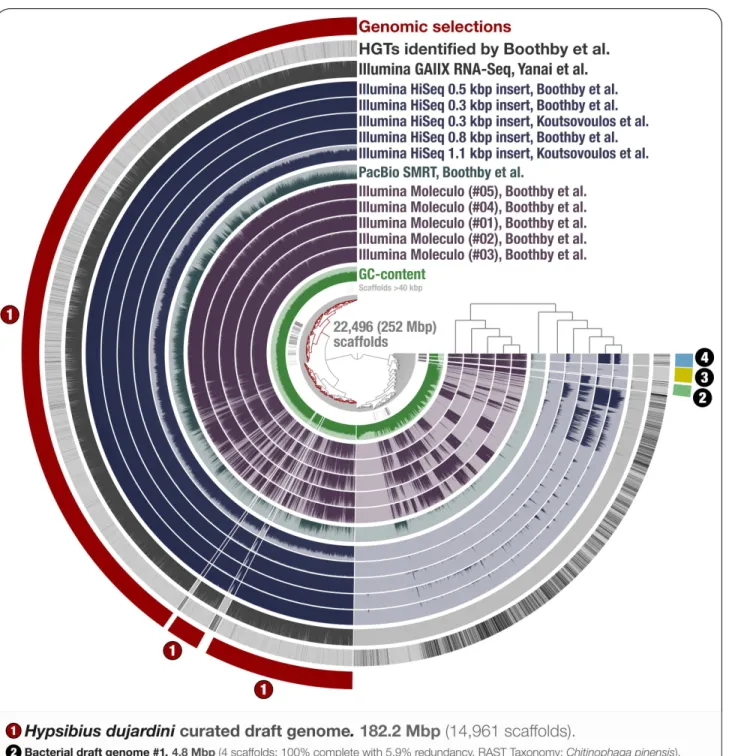
byBoothby et al. (2015)as a foundation to maximize the recovery of the tardigrade genome. To provide a holistic understanding of the composite sequencing data generated by the two teams, we mapped the raw data from the nine DNA sequencing libraries from Boothby et al., and the two Illumina libraries from Koutsovoulos et al. (2016)on this assembly. Anvi’o generated a hierarchical clustering of scaffolds by combining the tetra-nucleotide frequency and coverage of each scaffold across the 11 DNA sequencing libraries (Eren et al., 2015). Besides visualizing the coverage of each scaffold in each sample, we highlighted scaffolds with HGTs identified by Boothby et al. on the resulting organization of scaffolds, and visualized RNA-seq mapping results.Figure 1displays the anvi’o merged profile that represents all this information in a single display.
A draft genome forH. dujardini
Through the anvi’o interactive interface we selected 14,961 scaffolds from the Boothby et al. assembly that recruited large number of short-reads in a consistent manner (Fig. 1). This 182.2 Mbp selection with consistent coverage (#1 inFig. 1) represents our curation of the tardigrade draft genome from Boothby et al.’s assembly. The remaining 7,535 scaffolds, which total about 70 Mbp of the assembly, harbored 96.1% of HGTs identified by Boothby et al. These scaffolds recruited only 0.05% of the reads from the RNA-Seq data, highlighting the extent of contamination in the original assembly. This finding is in agreement with Koutsovoulos et al.’s findings; however, our curated draft genome from the Boothby et al.’s assembly is 47 Mbp larger than the draft genome released byKoutsovoulos et al. (2016), most probably due to Boothby et al.’s inclusion of longer reads from Moleculo libraries. While the portion of scaffolds covered by RNA-Seq data suggests that this additional 47 Mbp still originate from the tardigrade genome, the biological relevance of this information (or lack thereof) for the characterization of the tardigrade genome falls outside of the scope of our study.
The origin of bacterial contamination
We identified three near-complete bacterial genomes affiliated toChitinophagaand
Thermosinusin Boothby et al.’s assembly (Fig. 1). Surprisingly, Boothby et al. identified only a small portion of these complete bacterial genomes as sources of HGTs while applying a metric specifically designed to detect foreign DNA in eukaryotic genomes. For instance, none of the 4,459 genes in bacterial draft genome #2 (selection #3 inFig. 1) were reported in Boothby et al.’s findings as HGTs. We also processed and visualized the raw assembly (nHd.1.0) from Koutsovoulos et al. (2016)using anvi’o (Fig. S1), and recovered eight bacterial genomes. However, we found no taxonomical overlap between high-completion bacterial genomes from the two sequencing projects (Table S1).
Interestingly, one bacterial genome (selection #2 inFig. 1) was detected in DNA libraries from both groups, as well as in the RNA-seq data, suggesting that the related bacterial population was in all samples prior to the DNA/RNA extraction step. This genome is affiliated toChitinophaga, and harbors genes coding for chitin degradation and utilization (Table S2). Chitin occurs naturally in the feeding apparatus of tardigrades (Guidetti et al., 2015), and might be a source of carbon for its microbial inhabitants. The genome also harbors genes coding for the biosynthesis of proteorhodopsin, host invasion and intracellular resistance, dormancy and sporulation, oxidative stress, and tryptophan, which is an essential amino acid for animals (Crawford, 1989;Zelante et al., 2013). Although this genome may belong to a tardigrade symbiont, the generation of the data does not allow us to rule out the possibility that it may be associated with the food source. Nevertheless, this finding suggests that there may be cases where non-target genomes in an assembly can provide clues about the lifestyle of a given host.
Best practices to assess bacterial contamination
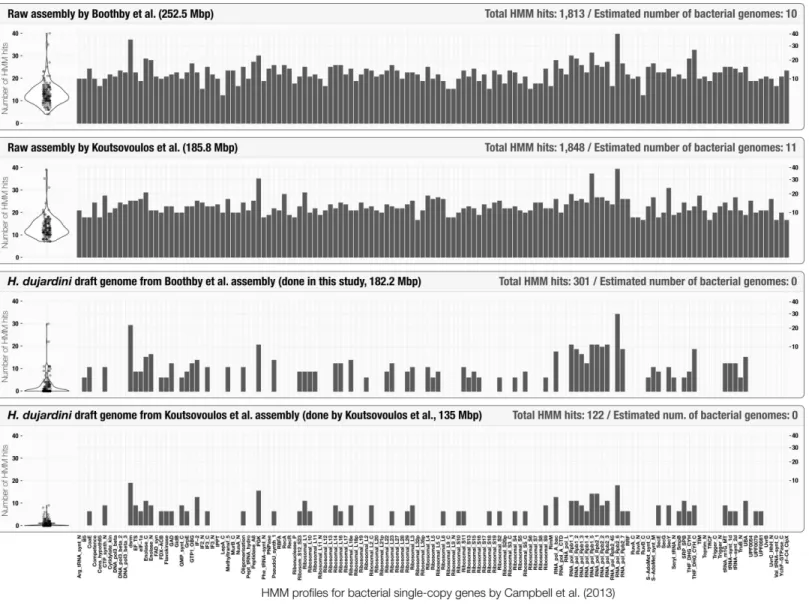
Initial assessment of the occurrence of bacterial single-copy genes can provide a quick estimation of the number of bacterial genomes that occur in assembly results (Supplemental Information 1). The use of bacterial single-copy genes can give much more accurate representation of potential bacterial contamination than screening for 16S rRNA genes alone, as they are less likely to be found in co-assembly results (Miller et al., 2011;Delmont et al., 2015). AlthoughBoothby et al. (2015)reported the lack of 16S rRNA genes in their assembly, anvi’o estimated that it contained at least 10 complete bacterial genomes (Fig. 2) using a bacterial single-copy gene collection (Campbell et al., 2013). This simple yet powerful step could identify cases of extensive contamination, and alert researchers to be diligent in identifying scaffolds originating from bacterial organisms.Figure 2also summarizes the HMM hits in scaffolds found in curated tardigrade genomes from our analysis and Koutsovoulos et al.’s study. We observed that the average significance score for the remaining HMM hits for bacterial single-copy genes in curated genomes was 4.2 times lower in average compared to the HMM hits in assembly results (Table S3). The decrease in the significance scores, and the very similar patterns of occurrence of HMM hits between the two curation efforts suggest that some of the HMM profiles may not be specific enough to be identified only in bacteria.
Figure 2 Occurrence of the 139 bacterial single-copy genes reported byCampbell et al. (2013)across scaffold collections.The top two plots dis-play the frequency and distribution of single-copy genes in the raw tardigrade genomic assembly generated byBoothby et al. (2015), and Koutsovou-los et al. (2016), respectively. The bottom two plots display the same information for each of the curated tardigrade genomes. Each bar represents the squared-root normalized number of significant hits per single-copy gene. The same information is visualized as box-plots on the left side of each plot.
layers of independent information produce more comprehensive visualizations that display multiple aspects of the data.
CONCLUSIONS
The field of genomics requires advanced computational approaches to take best advantage of constantly evolving ways to generate sequencing data, and to identify and remove contamination from genome assemblies. Our study indicates that some of these advanced approaches may emerge from the field of metagenomics, where the need forde novo
reconstruction of microbial genomes from environmental samples has given raise to techniques and software platforms that can make sense of complex assemblies. Here we used k-mer frequencies to organize scaffolds, the occurrence of bacterial single-copy genes to estimate the extent of contamination, and an advanced visualization strategy to detect and remove contamination in a eukaryotic assembly project while simultaneously characterizing the sources of contamination. Our results also suggest that metagenomic binning strategies can be used to recover near-complete bacterial genomes from raw eukaryotic assemblies, which can provide insights into the potential host-microbe interactions during the curation step.
ACKNOWLEDGEMENTS
We are grateful to Thomas C. Boothby, Georgios Koutsovoulos, Sujai Kumar, and their colleagues for making their data available and answering our questions. We thank Itai Yanai for providing us with the RNA-Seq data ahead of publication. We also thank Hilary G. Morrison for her invaluable suggestions. We finally thank our editor and reviewers for their valuable comments and suggestions.
ADDITIONAL INFORMATION AND DECLARATIONS
Funding
This work was supported by the Frank R. Lillie Research Innovation Award, and startup funds from the University of Chicago. The funders had no role in study design, data collection and analysis, decision to publish, or preparation of the manuscript.
Grant Disclosures
The following grant information was disclosed by the authors: Frank R. Lillie Research Innovation Award.
University of Chicago.
Competing Interests
A. Murat Eren is an Academic Editor for PeerJ.
Author Contributions
Data Availability
The following information was supplied regarding data availability: http://merenlab.org/data/.
Supplemental Information
Supplemental information for this article can be found online athttp://dx.doi.org/10.7717/ peerj.1839#supplemental-information.
REFERENCES
Albertsen M, Hugenholtz P, Skarshewski A, Nielsen KL, Tyson GW, Nielsen PH.
2013.Genome sequences of rare, uncultured bacteria obtained by differential
coverage binning of multiple metagenomes.Nature Biotechnology31:533–538 DOI 10.1038/nbt.2579.
Alneberg J, Bjarnason BS, De Bruijn I, Schirmer M, Quick J, Ijaz UZ, Lahti L, Loman
NJ, Andersson AF, Quince C. 2014.Binning metagenomic contigs by coverage and
composition.Nature Methods11:1144–1146DOI 10.1038/nmeth.3103.
Artamonova II, Lappi T, Zudina L, Mushegian AR. 2015.Prokaryotic genes in
eukaryotic genome sequences: when to infer horizontal gene transfer and when to suspect an actual microbe.Environmental Microbiology17:2203–2208 DOI 10.1111/1462-2920.12854.
Artamonova II, Mushegian AR. 2013.Genome sequence analysis indicates that the
model eukaryote Nematostella vectensis harbors bacterial consorts.Applied and Environmental Microbiology79:6868–6873DOI 10.1128/AEM.01635-13. Aziz RK, Bartels D, Best AA, DeJongh M, Disz T, Edwards RA, Formsma K, Gerdes
S, Glass EM, Kubal M, Meyer F, Olsen GJ, Olson R, Osterman AL, Overbeek RA, McNeil LK, Paarmann D, Paczian T, Parrello B, Pusch GD, Reich C,
Stevens R, Vassieva O, Vonstein V, Wilke A, Zagnitko O. 2008.The RAST
Server: rapid annotations using subsystems technology.BMC Genomics9:75 DOI 10.1186/1471-2164-9-75.
Boothby TC, Tenlen JR, Smith FW, Wang JR, Patanella KA, Osborne Nishimura E, Tintori SC, Li Q, Jones CD, Yandell M, Messina DN, Glasscock J, Goldstein B.
2015.Evidence for extensive horizontal gene transfer from the draft genome of a
tardigrade.Proceedings of the National Academy of Sciences of the United States of America112:15976–15981DOI 10.1073/pnas.1510461112.
Brown CT, Hug LA, Thomas BC, Sharon I, Castelle CJ, Singh A, Wilkins MJ, Wrighton
KC, Williams KH, Banfield JF. 2015.Unusual biology across a group comprising
more than 15% of domain Bacteria.Nature523:208–211DOI 10.1038/nature14486. Campbell JH, O’Donoghue P, Campbell AG, Schwientek P, Sczyrba A, Woyke T, Söll D,
Podar M. 2013.UGA is an additional glycine codon in uncultured SR1 bacteria from
Cantor M, Nordberg H, Smirnova T, Hess M, Tringe S, Dubchak I. 2015.Elviz— exploration of metagenome assemblies with an interactive visualization tool.BMC Bioinformatics16:130DOI 10.1186/s12859-015-0566-4.
Chapman JA, Kirkness EF, Simakov O, Hampson SE, Mitros T, Weinmaier T, Rattei T, Balasubramanian PG, Borman J, Busam D, Disbennett K, Pfannkoch C, Sumin N, Sutton GG, Viswanathan LD, Walenz B, Goodstein DM, Hellsten U, Kawashima T, Prochnik SE, Putnam NH, Shu S, Blumberg B, Dana CE, Gee L, Kibler DF, Law L, Lindgens D, Martinez DE, Peng J, Wigge PA, Bertulat B, Guder C, Nakamura Y, Ozbek S, Watanabe H, Khalturin K, Hemmrich G, Franke A, Augustin R, Fraune S, Hayakawa E, Hayakawa S, Hirose M, Hwang JS, Ikeo K, Nishimiya-Fujisawa C, Ogura A, Takahashi T, Steinmetz PRH, Zhang X, Aufschnaiter R, Eder M-K, Gorny A-K, Salvenmoser W, Heimberg AM, Wheeler BM, Peterson KJ, Böttger A, Tischler P, Wolf A, Gojobori T, Remington KA, Strausberg RL, Venter JC, Technau U, Hobmayer B, Bosch TCG, Holstein TW, Fujisawa T, Bode HR, David CN,
Rokhsar DS, Steele RE. 2010.The dynamic genome of Hydra.Nature464:592–596
DOI 10.1038/nature08830.
Crawford IP. 1989.Evolution of a biosynthetic pathway: the tryptophan paradigm.
Annual Review of Microbiology 43:567–600 DOI 10.1146/annurev.mi.43.100189.003031.
Delmont TO, Eren AM, Maccario L, Prestat E, Esen ÖC, Pelletier E, Le Paslier
D, Simonet P, Vogel TM. 2015.Reconstructing rare soil microbial genomes
usingin situenrichments and metagenomics.Frontiers in Microbiology6:358 DOI 10.3389/fmicb.2015.00358.
Dick GJ, Andersson AF, Baker BJ, Simmons SL, Thomas BC, Yelton AP, Banfield JF.
2009.Community-wide analysis of microbial genome sequence signatures.Genome
Biology10:R85DOI 10.1186/gb-2009-10-8-r85.
Eddy SR. 2011.Accelerated Profile HMM Searches.PLoS Computational Biology
7:e1002195DOI 10.1371/journal.pcbi.1002195.
Ekblom R, Wolf JBW. 2014.A field guide to whole-genome sequencing, assembly and
annotation.Evolutionary Applications7: n/a–n/a DOI 10.1111/eva.12178. Eren AM, Esen ÖC, Quince C, Vineis JH, Morrison HG, Sogin ML, Delmont TO.
2015.Anvi’o: an advanced analysis and visualization platform for ‘omics data.PeerJ
3:e1319DOI 10.7717/peerj.1319.
Eren AM, Vineis JH, Morrison HG, Sogin ML. 2013.A filtering method to generate
high quality short reads using illumina paired-end technology.PLoS ONE8:e66643 DOI 10.1371/journal.pone.0066643.
Gans J, Wolinsky M, Dunbar J. 2005.Computational improvements reveal great
bacterial diversity and high metal toxicity in soil.Science309:1387–1390 DOI 10.1126/science.1112665.
Ginestet C. 2011.ggplot2: elegant graphics for data analysis.Journal of the Royal
Gnerre S, MacCallum I, Przybylski D, Ribeiro FJ, Burton JN, Walker BJ, Sharpe T, Hall G, Shea TP, Sykes S, Berlin AM, Aird D, Costello M, Daza R, Williams L, Nicol R,
Gnirke A, Nusbaum C, Lander ES, Jaffe DB. 2010.High-quality draft assemblies
of mammalian genomes from massively parallel sequence data.Proceedings of the National Academy of Sciences108:1513–1518DOI 10.1073/pnas.1017351108.
Guidetti R, Bonifacio A, Altiero T, Bertolani R, Rebecchi L. 2015.Distribution
of calcium and chitin in the tardigrade feeding apparatus in relation to its function and morphology.Integrative and Comparative Biology55:241–252 DOI 10.1093/icb/icv008.
Horikawa DD, Cumbers J, Sakakibara I, Rogoff D, Leuko S, Harnoto R, Arakawa K,
Katayama T, Kunieda T, Toyoda A, Fujiyama A, Rothschild LJ. 2013.Analysis
of DNA repair and protection in the Tardigrade Ramazzottius varieornatus andHypsibius dujardiniafter exposure to UVC radiation.PLoS ONE8:e64793 DOI 10.1371/journal.pone.0064793.
Jönsson KI, Harms-Ringdahl M, Torudd J. 2005.Radiation tolerance in the eutardigrade
Richtersius coronifer.International Journal of Radiation Biology 81:649–656 DOI 10.1080/09553000500368453.
Jönsson KI, Rabbow E, Schill RO, Harms-Ringdahl M, Rettberg P. 2008.Tardigrades
survive exposure to space in low Earth orbit.Current Biology: CB18:R729–R731 DOI 10.1016/j.cub.2008.06.048.
Kang DD, Froula J, Egan R, Wang Z. 2015.MetaBAT, an efficient tool for accurately
reconstructing single genomes from complex microbial communities.PeerJ3:e1165 DOI 10.7717/peerj.1165.
Koutsovoulos G, Kumar S, Laetsch DR, Stevens L, Daub J, Conlon C, Maroon H,
Thomas F, Aboobaker A, Blaxter M. 2016.No evidence for extensive horizontal
gene transfer in the genome of the tardigradeHypsibius dujardini.Proceedings of the National Academy of Sciences of the United States of AmericaEpub ahead of print Mar 24 2016DOI 10.1073/pnas.1600338113.
Kuleshov V, Jiang C, Zhou W, Jahanbani F, Batzoglou S, Snyder M. 2015.Synthetic
long-read sequencing reveals intraspecies diversity in the human microbiome.
Nature Biotechnology34:64–69DOI 10.1038/nbt.3416.
Kumar S, Jones M, Koutsovoulos G, Clarke M, Blaxter M. 2013.Blobology: exploring
raw genome data for contaminants, symbionts and parasites using taxon-annotated GC-coverage plots.Frontiers in Genetics4:237DOI 10.3389/fgene.2013.00237.
Langmead B, Salzberg SL. 2012.Fast gapped-read alignment with Bowtie 2.Nature
Methods9:357–359DOI 10.1038/nmeth.1923.
Laurence M, Hatzis C, Brash DE. 2014.Common contaminants in next-generation
sequencing that hinder discovery of low-abundance microbes.PLoS ONE9:e97876 DOI 10.1371/journal.pone.0097876.
Levin M, Anavy L, Cole AG, Winter E, Mostov N, Khair S, Senderovich N, Kovalev E, Silver DH, Feder M, Fernandez-Valverde SL, Nakanishi N, Simmons D,
The mid-developmental transition and the evolution of animal body plans.Nature
advance onDOI 10.1038/nature16994.
Li H, Handsaker B, Wysoker A, Fennell T, Ruan J, Homer N, Marth G, Abecasis G,
Durbin R. 2009.The Sequence Alignment/Map format and SAMtools.
Bioinformat-ics25:2078–2079DOI 10.1093/bioinformatics/btp352.
Loman NJ, Pallen MJ. 2015.Twenty years of bacterial genome sequencing.Nature
Reviews Microbiology 13:787–794DOI 10.1038/nrmicro3565.
Merchant S, Wood DE, Salzberg SL. 2014.Unexpected cross-species contamination in
genome sequencing projects.PeerJ2:e675DOI 10.7717/peerj.675.
Miller CS, Baker BJ, Thomas BC, Singer SW, Banfield JF. 2011.EMIRGE:
reconstruc-tion of full-length ribosomal genes from microbial community short read sequencing data.Genome Biology12:R44DOI 10.1186/gb-2011-12-5-r44.
Minoche AE, Dohm JC, Himmelbauer H. 2011.Evaluation of genomic high-throughput
sequencing data generated on Illumina HiSeq and genome analyzer systems.Genome Biology12:R112DOI 10.1186/gb-2011-12-11-r112.
Parks DH, Imelfort M, Skennerton CT, Hugenholtz P, Tyson GW. 2015.CheckM:
assessing the quality of microbial genomes recovered from isolates, single cells, and metagenomes.Genome Research25:1043–1055DOI 10.1101/gr.186072.114.
Percudani R. 2013.A microbial metagenome (Leucobacter sp.) in
Caenorhab-ditiswhole genome sequences.Bioinformatics and Biology Insights7:55–72 DOI 10.4137/BBI.S11064.
Pride DT, Meinersmann RJ, Wassenaar TM, Blaser MJ. 2003.Evolutionary implications
of microbial genome tetranucleotide frequency biases.Genome Research13:145–158 DOI 10.1101/gr.335003.
R Development Core Team R. 2011.R: a language and environment for statistical
computing. Vol. 1. Vienna: the R Foundation for Statistical Computing, 409.
Ramløv H, Westh P. 2001.Cryptobiosis in the Eutardigrade Adorybiotus (Richtersius)
coronifer: tolerance to Alcohols, Temperature and de novo Protein Synthesis.
Zoologischer Anzeiger—A Journal of Comparative Zoology 240:517–523 DOI 10.1078/0044-5231-00062.
Richard G-F, Kerrest A, Dujon B. 2008.Comparative genomics and molecular dynamics
of DNA repeats in eukaryotes.Microbiology and Molecular Biology Reviews: MMBR
72:686–727DOI 10.1128/MMBR.00011-08.
Rusch DB, Halpern AL, Sutton G, Heidelberg KB, Williamson S, Yooseph S, Wu D, Eisen JA, Hoffman JM, Remington K, Beeson K, Tran B, Smith H, Baden-Tillson H, Stewart C, Thorpe J, Freeman J, Andrews-Pfannkoch C, Venter JE, Li K, Kravitz S, Heidelberg JF, Utterback T, Rogers Y-H, Falcón LI, Souza V, Bonilla-Rosso G, Eguiarte LE, Karl DM, Sathyendranath S, Platt T, Bermingham E, Gallardo V, Tamayo-Castillo G, Ferrari MR, Strausberg RL, Nealson K,
Friedman R, Frazier M, Venter JC. 2007.The Sorcerer II Global Ocean Sampling
Salter SJ, Cox MJ, Turek EM, Calus ST, Cookson WO, Moffatt MF, Turner P, Parkhill
J, Loman NJ, Walker AW. 2014.Reagent and laboratory contamination can
critically impact sequence-based microbiome analyses.BMC Biology12:87 DOI 10.1186/s12915-014-0087-z.
Schleper C, Jurgens G, Jonuscheit M. 2005.Genomic studies of uncultivated archaea.
Nature Reviews. Microbiology 3:479–488DOI 10.1038/nrmicro1159.
Schloss PD, Handelsman J. 2003.Biotechnological prospects from metagenomics.
Current Opinion in Biotechnology14:303–310DOI 10.1016/S0958-1669(03)00067-3. Sharon I, Kertesz M, Hug LA, Pushkarev D, Blauwkamp TA, Castelle CJ, Amirebrahimi
M, Thomas BC, Burstein D, Tringe SG, Williams KH, Banfield J. 2015.Accurate,
multi-kb reads resolve complex populations and detect rare microorganisms.
Genome Research25:534–543DOI 10.1101/gr.183012.114.
Strong MJ, Xu G, Morici L, Splinter Bon-Durant S, Baddoo M, Lin Z, Fewell C, Taylor
CM, Flemington EK. 2014.Microbial contamination in next generation sequencing:
implications for sequence-based analysis of clinical samples.PLoS Pathogens
10:e1004437DOI 10.1371/journal.ppat.1004437.
Teeling H, Meyerdierks A, Bauer M, Amann R, Glöckner FO. 2004.Application of
tetranucleotide frequencies for the assignment of genomic fragments.Environmental Microbiology6:938–947DOI 10.1111/j.1462-2920.2004.00624.x.
Tyson GW, Chapman J, Hugenholtz P, Allen EE, Ram RJ, Richardson PM, Solovyev
V V, Rubin EM, Rokhsar DS, Banfield JF. 2004.Community structure and
metabolism through reconstruction of microbial genomes from the environment.
Nature428:37–43DOI 10.1038/nature02340.
Venter JC, Adams MD, Myers EW, Li PW, Mural RJ, Sutton GG, Smith HO, Yandell M, Evans CA, Holt RA, Gocayne JD, Amanatides P, Ballew RM, Huson DH, Wortman JR, Zhang Q, Kodira CD, Zheng XH, Chen L, Skupski M, Subramanian G, Thomas PD, Zhang J, Gabor Miklos GL, Nelson C, Broder S, Clark AG, Nadeau J, McKusick VA, Zinder N, Levine AJ, Roberts RJ, Simon M, Slayman C, Hunkapiller M,
Mann F, May D, McCawley S, McIntosh T, McMullen I, Moy M, Moy L, Murphy B, Nelson K, Pfannkoch C, Pratts E, Puri V, Qureshi H, Reardon M, Rodriguez R, Rogers YH, Romblad D, Ruhfel B, Scott R, Sitter C, Smallwood M, Stewart E, Strong R, Suh E, Thomas R, Tint NN, Tse S, Vech C, Wang G, Wetter J, Williams S, Williams M, Windsor S, Winn-Deen E, Wolfe K, Zaveri J, Zaveri K, Abril JF, Guigó R, Campbell MJ, Sjolander KV, Karlak B, Kejariwal A, Mi H, Lazareva B,
Hatton T, Narechania A, et al. 2001.The sequence of the human genome.Science
291(5507):1304–1351DOI 10.1126/science.1058040.
Wu M, Eisen JA. 2008.A simple, fast, and accurate method of phylogenomic inference.
Genome Biology9:R151DOI 10.1186/gb-2008-9-10-r151.
Wu Y-W, Tang Y-H, Tringe SG, Simmons BA, Singer SW. 2014.MaxBin: an automated
binning method to recover individual genomes from metagenomes using an expectation–maximization algorithm.Microbiome2:26
DOI 10.1186/2049-2618-2-26.
Zelante T, Iannitti RG, Cunha C, De Luca A, Giovannini G, Pieraccini G, Zecchi R, D’Angelo C, Massi-Benedetti C, Fallarino F, Carvalho A, Puccetti P, Romani L.
2013.Tryptophan catabolites from microbiota engage aryl hydrocarbon receptor and