Spawning Coral Species
Koty H. Sharp1*¤, Kim B. Ritchie2, Peter J. Schupp3, Raphael Ritson-Williams1, Valerie J. Paul1
1Smithsonian Marine Station at Fort Pierce, Fort Pierce, Florida, United States of America,2Mote Marine Laboratory, Sarasota, Florida, United States of America, 3University of Guam Station, University of Guam, Mangilao, Guam
Abstract
Coral animals harbor diverse microorganisms in their tissues, including archaea, bacteria, viruses, and zooxanthellae. The extent to which coral-bacterial associations are specific and the mechanisms for their maintenance across generations in the environment are unknown. The high diversity of bacteria in adult coral colonies has made it challenging to identify species-specific patterns. Localization of bacteria in gametes and larvae of corals presents an opportunity for determining when bacterial-coral associations are initiated and whether they are dynamic throughout early development. This study focuses on the early onset of bacterial associations in the mass spawning coralsMontastraea annularis, M. franksi, M. faveolata, Acropora palmata, A. cervicornis, Diploria strigosa, and A. humilis. The presence of bacteria and timing of bacterial colonization was evaluated in gametes, swimming planulae, and newly settled polyps by fluorescencein situhybridization (FISH) using general eubacterial probes and laser-scanning confocal microscopy. The coral species investigated in this study do not appear to transmit bacteria via their gametes, and bacteria are not detectable in or on the corals until after settlement and metamorphosis. This study suggests that mass-spawning corals do not acquire, or are not colonized by, detectable numbers of bacteria until after larval settlement and development of the juvenile polyp. This timing lays the groundwork for developing and testing new hypotheses regarding general regulatory mechanisms that control bacterial colonization and infection of corals, and how interactions among bacteria and juvenile polyps influence the structure of bacterial assemblages in corals.
Citation:Sharp KH, Ritchie KB, Schupp PJ, Ritson-Williams R, Paul VJ (2010) Bacterial Acquisition in Juveniles of Several Broadcast Spawning Coral Species. PLoS ONE 5(5): e10898. doi:10.1371/journal.pone.0010898
Editor:Steve Vollmer, Northeastern University, United States of America
ReceivedJanuary 11, 2010;AcceptedMay 4, 2010;PublishedMay 28, 2010
Copyright:ß2010 Sharp et al. This is an open-access article distributed under the terms of the Creative Commons Attribution License, which permits unrestricted use, distribution, and reproduction in any medium, provided the original author and source are credited.
Funding:This work was funded primarily by the Mote Marine Laboratory ‘‘Protect Our Reefs’’ License Plate Research Grant. K.S. was supported by the Smithsonian Marine Science Network Postdoctoral Fellowship. P.J.S. acknowledges partial support by NIH MBRS SCORE grant S06-GM-44796. The funders had no role in study design, data collection and analysis, decision to publish, or preparation of the manuscript.
Competing Interests:The authors have declared that no competing interests exist.
* E-mail: [email protected]
¤ Current address: Ocean Genome Legacy, Ipswich, Massachusetts, United States of America
Introduction
Coral holobionts are dynamic assemblages consisting of the animal host, symbiotic dinoflagellates (zooxanthellae), bacteria, archaea, fungi, and viruses [1]. Recent research on coral-zooxanthellae associations has focused on how changing environmental conditions, especially increased temperatures, affect dinoflagellate and coral physiology [2,3], and studies have revealed elegant biochemical mechanisms that regulate species-specific zooxanthellae acquisition by the coral host [4]. In contrast, there is still little known about what controls coral-bacterial interactions and whether true symbioses, or long-term species-specific associations between corals and bacteria, exist. Pandemic outbreaks of diverse bacterial diseases in corals across the globe, among other factors including the demise of herbivorous fish and sea urchins, have facilitated the overgrowth and dominance of macroalgae on reefs and dramatically shifted the ecology of reef habitats [5,6]. Though identification of pathogens is critical for management and prevention of coral diseases, it is equally important to define and establish a baseline for bacterial diversity associated with healthy corals. A thorough understanding of the dynamic coral-associated bacterial communities, how they establish interactions with coral animals, and the roles they play in coral health is critical for effective reef management.
Recent research has identified diverse, complex bacterial assemblages in and on corals, including the carbonate skeleton, the internal tissue, and the surface mucopolysaccharide layer [7]. Data suggest that bacteria maintain long-term associations with some coral hosts and in some cases may contribute to coral metabolism or provide defense. In some corals, diverse bacterial communities appear to be spatially structured within chemical micro-environments in tissue of branching corals [8,9]. Cyano-bacteria have been shown to fix nitrogen and translocate it to the Caribbean star coral Montastraea cavernosa [10], and diverse communities of bacteria with nitrogen fixation genes have been identified in two Hawaiian Montipora coral species [11]. Ritchie [12] demonstrated thatAcropora palmata mucus contains bacteria that can inhibit the growth of known coral pathogens, and some bacteria can induce coral larval settlement [13].
bacterial communities in coral health appears to be variable; the extent to which species-specific bacterial associations with corals persist across geographical and temporal gradients is unknown; and the physiological and genetic basis for the maintenance of specific associations among host populations from one generation to the next remains undetermined.
The Caribbean corals in this study, Montastraea faveolata,
Montastraea annularis, Montastraea franksi, Acropora palmata, Acropora cervicornis, and Diploria strigosa, release gametes in seasonal mass spawning events, and species-specific external fertilization occurs in the water column. Recent research shows that three cryptic
Montastraeaspecies,Montastraea annularis,M. faveolata, andM. franksi, live sympatrically in both Panama and the Bahamas, but temporal and spatial mechanisms can prevent cross-specific hybrid fertil-ization among these species [20,21]. All six species in this study are hermaphroditic, and eggs and sperm from multiple individuals are simultaneously broadcast on the same lunar phases for external fertilization [22,23]. Once fertilization occurs in the water column, embryos develop into ciliated non-feeding planula larvae with two cell layers. The planulae swim in the water column for a variable time period, ranging from approximately 96–144 hours [23,24]. Upon selection and attachment to suitable substrata, the larvae undergo metamorphosis into a juvenile polyp [25]. Bacterial communities associated with corals during early developmental stages remain largely uncharacterized in most coral species, with the exception of the speciesPocillopora meandrina, a spawning coral that transmits zooxanthellae via its eggs and appears to acquire bacteria during planula larval stages [26].
The larvae and subsequent early developmental stages of stony corals present a unique opportunity for microbiology research. In contrast to their adult counterparts, the early life stages have not accumulated a high bacterial load from the surrounding environment or by feeding. Research on these early life-history stages offers the ability to ‘‘weed out’’ microbes that are incidentally in or on the adult tissue and mucus layer and to determine the timing of onset of bacterial associations. Identifica-tion of inherited bacteria could reveal bacteria that are potentially significant to the survival and fitness of the larvae or host. Vertical symbiont transmission (trans-ovarian inheritance) has been documented in numerous marine invertebrate-bacterial associa-tions, including but not limited to bryozoans [27], sponges [28,29,30], ascidians [31], and bivalves [32,33,34,35]. Species-specific transmission suggests a history of selection for the maintenance of certain bacteria over evolutionary time, and vertical transmission of specific symbionts is often reflected by highly co-evolved host-symbiont phylogenies [36]. However, horizontal bacterial acquisition is also significant to highly specific symbioses and can be regulated by elegant, specific biochemical mechanisms, as is the case in the well-described association between the Hawaiian bobtail squid Euprymna scolopes and the bioluminescent Vibrio fischeri [37]. Characterizing the onset of bacterial-coral associations may reveal mechanisms by which bacterial colonization and proliferation within coral tissue are regulated. The aim of this study is to determine whether mass spawning corals initiate associations with bacteria via inheritance from parent colonies or through horizontal acquisition of bacteria from the surrounding seawater.
Materials and Methods
Belize Fisheries Department provided permits and facilitated the research on coral larvae at Carrie Bow Cay, Belize. Coral gametes in the Florida Keys were collected under permit FKNMS-2006-025.
Gamete collection
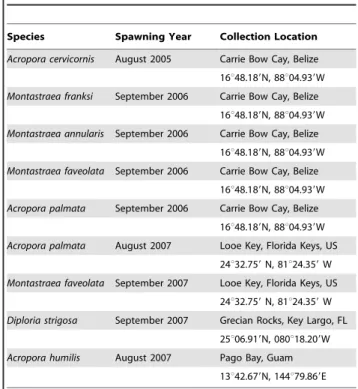
A summary of the dates and locations of spawning events from which gametes were collected for this study is presented in Table 1. Gametes were collected from Looe Key Buoy#21 during anA. palmataspawning event in August 2007 and aM. faveolataspawning event in September 2007.Diploria strigosagametes were collected from colonies at Grecian Rocks reef in Key Largo during a spawning event in September 2007. Gametes were obtained from spawning colonies with non-invasive nylon mesh collection tents attached to polypropylene collection jars, such as the apparatus shown in Figure 1.
In the Belize 2005 and 2006 collections, gametes were collected fromA. palmatacolonies with non-invasive nylon mesh collection tents and polypropylene collection jars, similar to the design used for gamete collection in the Florida Keys. Small colonies ofA. cervicornis, M. franksi, M. faveolata, andM. annularis
were collected from the reefs surrounding Carrie Bow Cay, Belize and were placed on submerged racks where they were maintained for several days. Each night, the colonies were placed in 5-gallon buckets full of freshly collected reef water for several hours, and upon gamete release, gametes were collected from the buckets via glass Pasteur pipets. Every night after gamete collection was complete, the colonies were returned to the submerged racks. After gamete collection, coral colonies were reattached on their reef using Splash Zone underwater epoxy (Z-Spar).
Fertilization was achieved by mixing gametes from separate colonies in buckets of reef water, and the resulting embryos developed into swimming larvae in flow-through reef water (Belize), or fresh, filtered reef water (0.45mm filtered Looe Key reef water) that was changed twice per day (Florida Keys). Samples were fixed for microscopy (see below) at sequential time points including gametes (t = 0 h) and larvae at subsequent 24 h intervals until settlement. In the 2007M. faveolatacollection from
Table 1.A list of the locations and timing of all gamete collections described in this study.
Species Spawning Year Collection Location
Acropora cervicornis August 2005 Carrie Bow Cay, Belize
16u48.189N, 88u04.939W
Montastraea franksi September 2006 Carrie Bow Cay, Belize
16u48.189N, 88u04.939W
Montastraea annularis September 2006 Carrie Bow Cay, Belize
16u48.189N, 88u04.939W
Montastraea faveolata September 2006 Carrie Bow Cay, Belize
16u48.189N, 88u04.939W
Acropora palmata September 2006 Carrie Bow Cay, Belize
16u48.189N, 88u04.939W
Acropora palmata August 2007 Looe Key, Florida Keys, US
24u32.759N, 81u24.359W
Montastraea faveolata September 2007 Looe Key, Florida Keys, US
24u32.759N, 81u24.359W
Diploria strigosa September 2007 Grecian Rocks, Key Largo, FL
25u06.919N, 080u18.209W
Acropora humilis August 2007 Pago Bay, Guam
13u42.679N, 144u79.869E
Florida, some larvae were reared in the above conditions until 96 h post-gamete release. At 96 h, swimming larvae were moved to 500 ml beakers containing 0.45mm filtered reef water and untreated glass microscopy slides. A small percentage of the larvae settled and metamorphosed on the microscopy slides, and those settled individuals were fixed for microscopy (as described below) after attachment. Larvae were classified as metamor-phosed if they had transformed into a juvenile polyp. A few days after metamorphosis, carbonate skeleton deposition was observed.
In the 2007 Guam collection, Acropora humilis gametes were collected from laboratory colonies. Colonies (15–20 cm diameter in size) were collected one week before the spawning event from the fore reef slope (2–5 m depth) in Pago Bay, Guam. Colonies were maintained in 72 L tanks (1 per tank) with unfiltered flow-through seawater. For gamete collection colonies were kept without running seawater and aeration only. Egg and sperm bundles from different colonies were mixed upon release, and developing larvae were maintained in 13 L of filtered seawater (200mm), which was changed twice daily. After 8 days, larvae were pipetted into wax-coated 15 ml petri dishes, each of which contained a glass microscopy slide. One to three small pieces of the crustose coralline alga (CCA) Hydrolithon sp. were placed on the glass slides to facilitate larval settlement because only occasional settlement was observed in preliminary experiments without CCA added to the petri dishes. Typically, 3–5 larvae settled on the glass slide, which produced a sufficient number of settled polyps on the glass slides for FISH experiments at distinct time intervals.
Fixation of Larvae for FISH
Gametes and swimming larvae were rinsed three times in sterile filtered seawater (0.22mm), fixed in paraformaldehyde (4% in buffer: 20 mM K2HPO4, 0.5 M NaCl, pH 7.4) overnight at 4uC, and
transferred to 70% ethanol for long-term storage at220uC. To fix polyps that settled on glass slides, the slides were dipped three times in separate 50 ml polypropylene tubes of sterile filtered seawater (0.22mm). The slides were then submerged in 4% paraformaldehyde in 50 ml polypropylene tubes and fixed overnight at 4uC. The 4% paraformaldehyde was discarded, and the tube was filled with 70% ethanol for long-term storage at220uC.
FISH and Microscopy Analysis
FISH was performed on fixed whole gametes or larvae in microfuge tubes, or settled polyps on microscopy slides with hybridization buffer (0.9 M NaCl, 20 mM Tris-HCl [pH 7.4], 0.01% sodium dodecyl sulfate) containing 35% percent formam-ide. Samples were probed with a suite of general eubacterial probes, added in equimolar amounts: EUB338I (59 -GCTGCCTCCCGTAGGAGT-39); EUB338II (59-GCA GCC ACC CGT AGG TGT-39), and EUB338III (59-GCT GCC ACC CGT AGG TGT-39) [38]. Negative control samples were probed with the negative control probe, NONEUB (59-ACT CCT ACG GGA GGC AGC-39) [38]. Probes were ordered as CY3-end labeled oligonucleotides (Integrated DNA Technologies, Coral-ville, IA). For each set of FISH reactions, a sample in which the bacterial content and location was known was probed with the EUB338 probe suite as a positive control for probe and reagent quality. All probes were added to hybridization buffer at a final concentration of 5 ng/ml. After 2 h hybridization at 46uC, the hybridization buffer was removed from the samples. Samples were incubated in wash buffer (0.7 M NaCl, 20 mM Tris-HCl [pH 7.4], 50 mM EDTA, 0.01% sodium dodecyl sulfate) for 20 minutes at 48uC. The samples were rinsed with Milli-Q water and mounted in VectaShield (Vector Labs, Burlingame, CA). Slides were visualized on an LSM510 laser scanning confocal microscope (Zeiss, Jena, Germany). Approximately 50–100 individuals of each stage were imaged, depending on sample availability.
Results
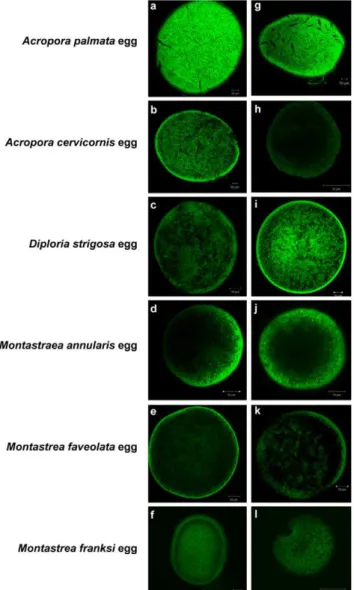
Eggs and sperm were both examined for the presence of bacterial cells, indicated by fluorescent signal from the eubacterial FISH probe suite (EUB338) (Figure 2a–f). No bacteria were detected in the sperm (not shown) or eggs of six different coral species. Though the background autofluorescence in the eggs is high, there is little difference between signal from the probed samples and the controls for non-specific probe binding (NONEUB probe) (Figure 2g–l).
EUB338 FISH results from M. faveolata early development, a time series of stages spanning from newly released eggs to 24 h post-settlement (Figure 3a–f), show that bacteria were not detectable in the eggs or inM. faveolataplanulae through 120 h post-release. The nematocysts are apparent on the surface of the polyps in both the EUB338 probe- and NONEUB probe-treated samples (Figure 3e,k), indicating non-specific probe binding to nematocysts. Bacteria were observed on the surface of the M. faveolatarecruits, which had attached and then developed for 24 h into juvenile polyps (Figure 3f). Negative controls probed with the NONEUB probe are shown in Figure 3g–l, corresponding to the stages probed with the EUB338 suite.
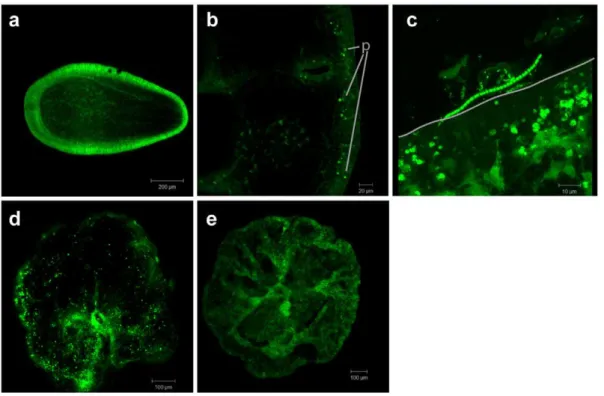
No bacteria were detected inA. humilisstages up through 129 h after release, immediately prior to settlement (Figure 4a). Figure 4b shows a cross-section of a 12 h post-settlement juvenile polyp Figure 1. Spawning tent used to collect gametes from coral
probed with EUB338. In this stage, there are no bacterial cells visible within the epidermis or gastrodermis. The interface between the same 12 h polyp and the settlement substratum (glass microscopy slide), shown in a three-dimensional projection (Figure 4c), shows abundant bacterial cells and diverse cell morphologies outside of the polyp, but bacteria are neither present on the coral polyp surface nor in the polyp interior. Figure 4d shows an A. humilis juvenile polyp, 24 hours post-settlement, and EUB probe signal is visible across the polyp surface. In the negative probe control (Figure 4e), no signal is seen on the polyp surface.
Discussion
The corals in this study represent several different spawning species and include corals collected from locations spanning
thousands of miles and four years of collection. None of these corals transmitted bacteria to their offspring via gametes. In the spawning corals examined in this study, throughout the 5-day swimming larval period, bacteria did not appear to be taken up by planulae, nor were they detectable on the planula surface. Only after the larvae settled and metamorphosed were there detectable numbers of bacteria in the corals, even though the coral larvae Figure 2. General eubacterial FISH in gametes of six Caribbean
coral species.FISH visualization of the CY3-labeled general eubacterial probe suite (EUB338I/EUB338II/EUB338III) on eggs from the six species of Caribbean scleractinian corals,Montastraea annularis, M. franksi, M. faveolata, Acropora palmata, A. cervicornis,andDiploria strigosa. Panels a–f, EUB338; g–l, NONEUB (negative control). No bacterial signal is visible in or on the eggs of any of the species.
doi:10.1371/journal.pone.0010898.g002
were exposed to seawater containing bacteria during their development. This suggests that either bacteria were unable to colonize the larvae in high numbers during swimming stages, or that some change occurred in the coral after settlement that either allowed or decreased the inhibition of bacterial colonization.
One possible explanation for the observed timing of bacterial colonization in the juvenile coral polyps is that eggs and newly developed larvae contain chemical defenses that are lethal to bacteria. While the presence of antimicrobial compounds for protection of egg masses in mollusks is well documented [39,40], Marquis and colleagues [41] showed that out of eleven Pacific coral species screened, eggs of only one species,Montipora digitata, contained antimicrobial compounds. Because a crude extract of
M. digitata eggs inhibited the growth of only three out of ninety-three tested bacterial strains, it seems unlikely that antibacterial compounds in the eggs and larvae of the corals in our study explain the delayed bacterial colonization.
To date, a mechanistic link between developmental changes in corals and recruitment of bacteria has not been identified. Whether compound production by the host plays a role in attracting bacteria is unclear. Morphogenesis in the bobtail squid
Euprymna scolopesresults in tissue-localized shifts in gene expression and production of specific receptors that induce symbiotic attachment and infection [37]. It is possible that corals may exhibit stage-specific gene expression, attracting bacteria during post-settlement stages. It has been demonstrated that the adhesion of the pathogenic bacterium Vibrio shiloi to a b –D-galactoside-containing receptor in the mucus of the coralOculina patagonicais dependent on the presence of actively photosynthesizing
zooxan-thellae [42], suggesting that the zooxanzooxan-thellae play a role in bacterial adhesion. Another study suggested that coral and zooxanthellae metabolic contributions to coral mucus may select for specific functional groups of bacteria [43]. Further research exploring the timing of Symbiodinium acquisition relative to the timing of bacterial acquisition may provide insight into whether zooxanthellae are involved in bacterial colonization of juvenile corals. In addition, further histological investigation of bacterial presence in coral recruits is required to determine when and how bacteria enter coral tissues.
These results describe the initial onset of bacterial-coral associations in a wide range of coral hosts. It has not been determined whether acquisition of bacteria by corals from the water column is a selective process or whether bacterial colonization of juvenile corals is simply opportunistic in nature. Apprillet al.(2009) suggested that the spawning coral Pocillopora meandrinaacquired a specific bacterial associate, belonging to the alpha-proteobacterial subdivision, but to date, that is the only documented specific association between bacteria and early life stages of a coral. It is currently unknown whether corals select certain bacteria from the surrounding seawater during these vulnerable early life stages, or how juvenile corals will respond to alterations in seawater quality and subsequent changes in seawater bacterial communities. Understanding the factors that control the timing and specificity of bacterial colonization will provide insight into communication among the multiple partners in the coral holobiont and identify significant determinants in host vulnerability to bacterial disease and changing marine environments.
Figure 4. Bacteria in juvenileAcropora humilis polyps.FISH visualization of signal from the CY3-labeled general eubacterial probe suite (EUB338I/EUB338II/EUB338III) on early stages ofAcropora humilis. Panel a, a cross-section of a 129 h planula larva probed with the CY3-EUB338 suite, showing no probe signal. Panel b, a cross-section of a settled polyp, showing autofluorescent pigment granules (p) in the epidermis of a juvenile polyp but no bacterial cells hybridizing to the suite of general eubacterial probes. Panel c, a three-dimensional projection showing the sameA. humilispolyp from the settlement substrate to the top of the polyp surface. The line delineates the edge of the polyp on the settlement slide. Several different morphotypes of CY3-EUB338-hybridized bacterial cells (b) are visible on the glass settlement slide, but the interior and the surface of the polyp do not contain any bacterial signal. Panel d, the surface of a juvenileA. humilispolyp with bacterial cells hybridizing with the CY3-EUB338 probe suite across the polyp surface. Panel e, the negative control (CY3-NONEUB) shows no signal on anA. humilisjuvenile.
Acknowledgments
The authors wish to thank E. Bartels and C. Walter at Mote Marine Laboratory for assistance withM. faveolataandA. palmatagamete collection in the Florida Keys. In addition, we thank M. Teplitski, M. Matz, D. Poland, D. Levitan, and B. Mason for assisting in gamete collection. We thank Margo Haygood at the Oregon Health and Sciences University for providing access to a Zeiss LSM510 confocal microscope system, on which some of the images were taken. The remaining micrographs were taken on a Zeiss LSM510 at the Smithsonian Marine Station in Fort Pierce. This is
contribution#824 from the Smithsonian Marine Station at Fort Pierce, contribution#881 from the CCRE program, and contribution#650 from the University of Guam Marine Laboratory.
Author Contributions
Conceived and designed the experiments: KS KBR PJS RRW VP. Performed the experiments: KS KBR PJS VP. Analyzed the data: KS KBR PJS RRW VP. Contributed reagents/materials/analysis tools: KS KBR PJS RRW VP. Wrote the paper: KS KBR PJS RRW VP.
References
1. Knowlton N, Rohwer F (2003) Multispecies microbial mutualisms on coral reefs: The host as a habitat. American Naturalist 162: S51–S62.
2. Hoegh-Guldberg O (1999) Climate change, coral bleaching and the future of the world’s coral reefs. Marine and Freshwater Research 50: 839–866.
3. Lesser MP, Farrell JH (2004) Exposure to solar radiation increases damage to both host tissues and algal symbionts of corals during thermal stress. Coral Reefs 23: 367–377.
4. Wood-Charlson EM, Hollingsworth LL, Krupp DA, Weis VM (2006) Lectin/ glycan interactions play a role in recognition in a coral/dinoflagellate symbiosis. Cellular Microbiology 8: 1985–1993.
5. Aronson RB, Precht WF (2001) White-band disease and the changing face of Caribbean coral reefs. Hydrobiologia 460: 25–38.
6. Hughes TP (1994) Catastrophes, phase-shifts, and large-scale degradation of a Caribbean coral reef. Science 265: 1547–1551.
7. Rosenberg E, Koren O, Reshef L, Efrony R, Zilber-Rosenberg I (2007) The role of microorganisms in coral health, disease and evolution. Nature Reviews Microbiology 5: 355–362.
8. Rohwer F, Breitbart M, Jara J, Azam F, Knowlton N (2001) Diversity of bacteria associated with the Caribbean coralMontastraea franksi. Coral Reefs 20: 85–91. 9. Rohwer F, Seguritan V, Azam F, Knowlton N (2002) Diversity and distribution
of coral-associated bacteria. Marine Ecology-Progress Series 243: 1–10. 10. Lesser MP, Mazel CH, Gorbunov MY, Falkowski PG (2004) Discovery of
symbiotic nitrogen-fixing cyanobacteria in corals. Science 305: 997–1000. 11. Olson ND, Ainsworth TD, Gates RD, Takabayashi M (2009) Diazotrophic
bacteria associated with HawaiianMontiporacorals: diversity and abundance in correlation with symbiotic dinoflagellates. Journal of Experimental Marine Biology and Ecology 371: 140–146.
12. Ritchie KB (2006) Regulation of microbial populations by coral surface mucus and mucus-associated bacteria. Marine Ecology-Progress Series 322: 1–14. 13. Negri AP, Webster NS, Hill RT, Heyward AJ (2001) Metamorphosis of
broadcast spawning corals in response to bacteria isolated from crustose algae. Marine Ecology-Progress Series 223: 121–131.
14. Frias-Lopez J, Bonheyo GT, Jin QS, Fouke BW (2003) Cyanobacteria associated with coral black band disease in Caribbean and Indo-Pacific Reefs. Applied and Environmental Microbiology 69: 2409–2413.
15. Frias-Lopez J, Klaus JS, Bonheyo GT, Fouke BW (2004) Bacterial community associated with black band disease in corals. Applied and Environmental Microbiology 70: 5955–5962.
16. Patterson KL, Porter JW, Ritchie KE, Polson SW, Mueller E, et al. (2002) The etiology of white pox, a lethal disease of the Caribbean elkhorn coralAcropora palmata. Proceedings of the National Academy of Sciences of the United States of America 99: 8725–8730.
17. Ben-Haim Y, Rosenberg E (2002) A novelVibriosp. pathogen of the coral
Pocillopora damicornis. Marine Biology (Berlin) 141: 47–55.
18. Kushmaro A, Rosenberg E, Fine M, Loya Y (1997) Bleaching of the coral
Oculina patagonicabyVibrioAK-1. Marine Ecology-Progress Series 147: 159–165. 19. Kline DI, Kuntz NM, Breitbart M, Knowlton N, Rohwer F (2006) Role of elevated organic carbon levels and microbial activity in coral mortality. Marine Ecology-Progress Series 314: 119–125.
20. Knowlton N, Mate JL, Guzman HM, Rowan R, Jara J (1997) Direct evidence for reproductive isolation among the three species of theMontastraea annularis
complex in Central America (Panama and Honduras). Mar Bio 127: 705–711. 21. Levitan DR, Fukami H, Jara J, Kline D, McGovern TM, et al. (2004) Mechanisms of reproductive isolation among sympatric broadcast-spawning corals of theMontastraea annularisspecies complex. Evolution 58: 308–323. 22. Szmant AM (1991) Sexual reproduction by the Caribbean reef coralsMontastrea
annularisandM. cavernosa. Marine Ecology-Progress Series 74: 13–25. 23. Vanveghel MLJ (1994) Reproductive characteristics of the polymorphic
Caribbean reef building coral Montastrea annularis. 1. Gametogenesis and spawning behavior. Marine Ecology-Progress Series 109: 209–219.
24. Babcock RC, Heyward AJ (1986) Larval development of certain gamete-spawning scleractinian corals. Coral Reefs 5: 111–116.
25. Ritson-Williams R, Arnold S, Fogarty N, Steneck RS, Vermeij MJA, et al. (2009) New perspectives on ecological mechanisms affecting coral recruitment on reefs. Smithsonian Contributions to Marine Science 38: 437–457. 26. Apprill A, Marlow HQ, Martindale MQ, Rappe MS (2009) The onset of
microbial associations in the coralPocillopora meandrina. Isme Journal 3: 685–699. 27. Haygood MG, Davidson SK (1997) Small-subunit rRNA genes and in situ hybridization with oligonucleotides specific for the bacterial symbionts in the larvae of the bryozoanBugula neritinaand proposal of ‘‘CandidatusEndobugula sertula’’. Applied & Environmental Microbiology 63: 4612–4616.
28. Enticknap JJ, Kelly M, Peraud O, Hill RT (2006) Characterization of a culturable alphaproteobacterial symbiont common to many marine sponges and evidence for vertical transmission via sponge larvae. Applied & Environmental Microbiology 72: 3724–3732.
29. Schmitt S, Weisz JB, Lindquist N, Hentschel U (2007) Vertical transmission of a phylogenetically complex microbial consortium in the viviparous spongeIrcinia felix. Applied and Environmental Microbiology 73: 2067–2078.
30. Sharp KH, Eam BE, Faulkner DJ, Haygood MG (2007) Vertical transmission of diverse microbes in the tropical spongeCorticiumsp. Applied and Environmental Microbiology 73: 622–629.
31. Hirose E (2000) Plant rake and algal pouch of the larvae in the tropical ascidian
Diplosoma similis: an adaptation for vertical transmission of photosynthetic symbiontsProchloronsp. Zoological Science 17: 233–240.
32. Cary SC (1994) Transovarial inheritance of endosymbiotic bacteria in the protobranch bivalve,Solemya reidi. EOS 75: 60.
33. Fiala-Medioni A, McKiness ZP, Dando P, Boulegue J, Mariotti A, et al. (2002) Ultrastructural, biochemical, and immunological characterization of two populations of the mytilid musselBathymodiolus azoricusfrom the Mid-Atlantic Ridge: Evidence for a dual symbiosis. Marine Biology (Berlin) 141: 1035–1043. 34. Gros O, Duplessis MR, Felbeck H (1999) Embryonic development and endosymbiont transmission mode in the symbiotic clam Lucinoma aequizonata
(Bivalvia: Lucinidae). Invertebrate Reproduction & Development 36: 93–103. 35. Krueger DM, Gustafson RG, Cavanaugh CM (1996) Vertical transmission of
chemoautotrophic symbionts in the bivalveSolemya velum(Bivalvia: Protobran-chia). Biological Bulletin 190: 195–202.
36. Peek AS, Feldman RA, Lutz RA, Vrijenhoek RC (1998) Cospeciation of chemoautotrophic bacteria and deep sea clams. Proceedings of the National Academy of Sciences of the United States of America 95: 9962–9966. 37. Nyholm SV, McFall-Ngai MJ (2004) The winnowing: establishing the
squid-Vibriosymbiosis. Nature Reviews Microbiology 2: 632–642.
38. Loy A, Horn M, Wagner M (2003) probeBase - an online resource for rRNA-targeted oligonucleotide probes. Nucleic Acids Research 31: 514–516. 39. Benkendorff K, Davis AR, Bremner J (2001) Chemical defense in the egg masses
of benthic invertebrates: An assessment of antibacterial activity in 39 mollusks and 4 polychaetes. Journal of Invertebrate Pathology 78: 109–118.
40. Pawlik JR, Kernan MR, Molinski TF, Harper MK, Faulkner DJ (1988) Defensive chemicals of the Spanish Dancer nudibranchHexabranchus sanguineus
and its egg ribbons - macrolides derived from a sponge diet. Journal of Experimental Marine Biology and Ecology 119: 99–109.
41. Marquis CP, Baird AH, de Nys R, Holmstrom C, Koziumi N (2005) An evaluation of the antimicrobial properties of the eggs of 11 species of scleractinian corals. Coral Reefs 24: 248–253.
42. Banin E, Israely T, Fine M, Loya Y, Rosenberg E (2001) Role of endosymbiotic zooxanthellae and coral mucus in the adhesion of the coral-bleaching pathogen
Vibrio shiloito its host. FEMS Microbiology Letters 199: 33–37.